SOA: What it means to the Enterprise


              Paul Fremantle
             paul@wso2.com
        CTO and Co-Founder, WSO2
           VP, Apache Synapse
Service Oriented Architecture

• SOA is the best practice for building distributed
  interconnected systems
   – Using well-defined interactions between systems

   – Moving from proprietary formats to open formats:
      • XML, HTTP, SOAP

   – Integration is dependent on external interfaces not on
     internal code

• SOA is the basis of all modern Enterprise Architecture
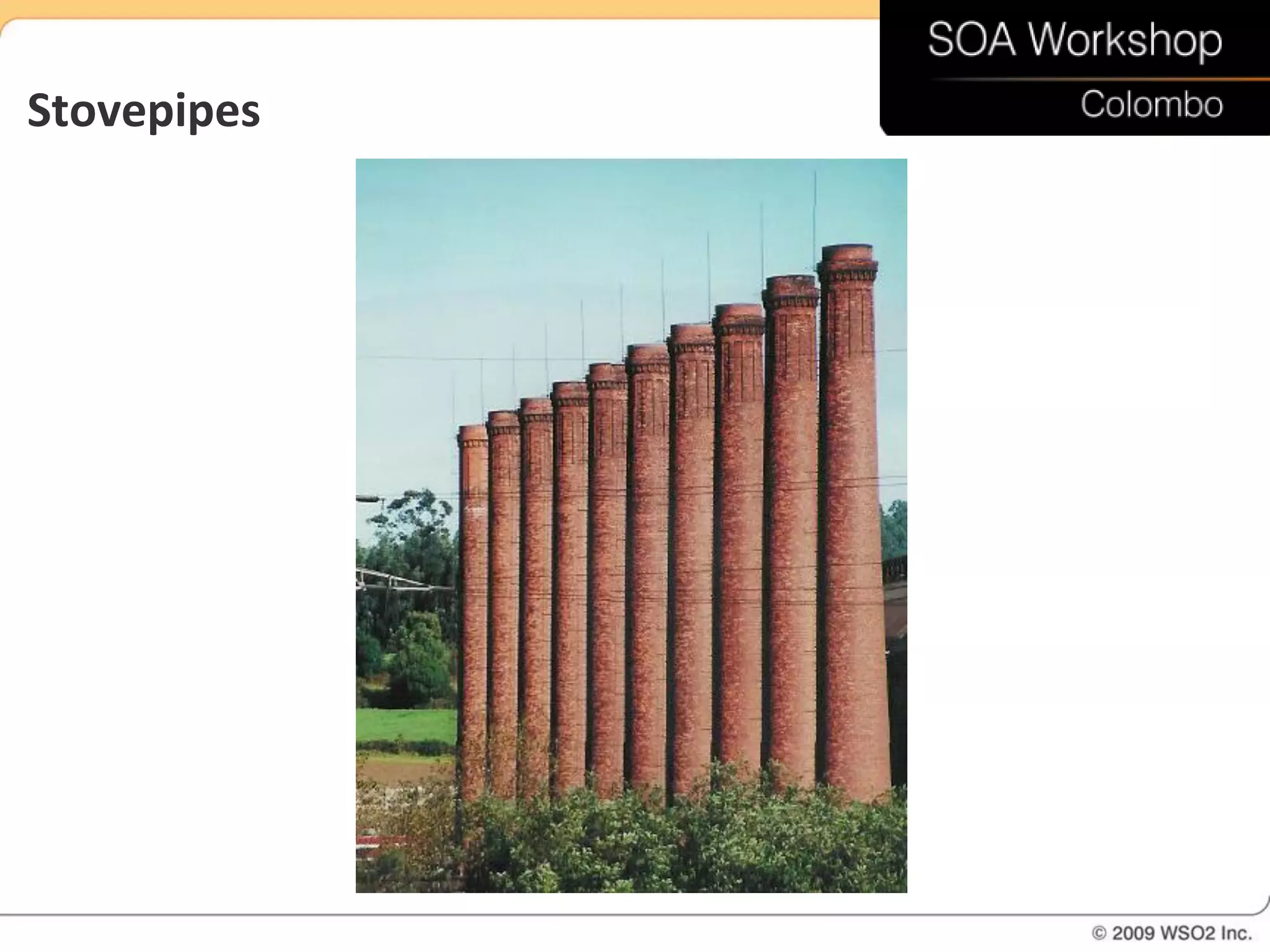
Stovepipes
The Enterprise Architecture landscape
has changed
• Development cycles:
   – From 18 to 6 months to 3 months
• Real standards
   – HTTP, HTML, XML, Java
• Supply chain management and integration are key
   – Companies without integration are falling behind
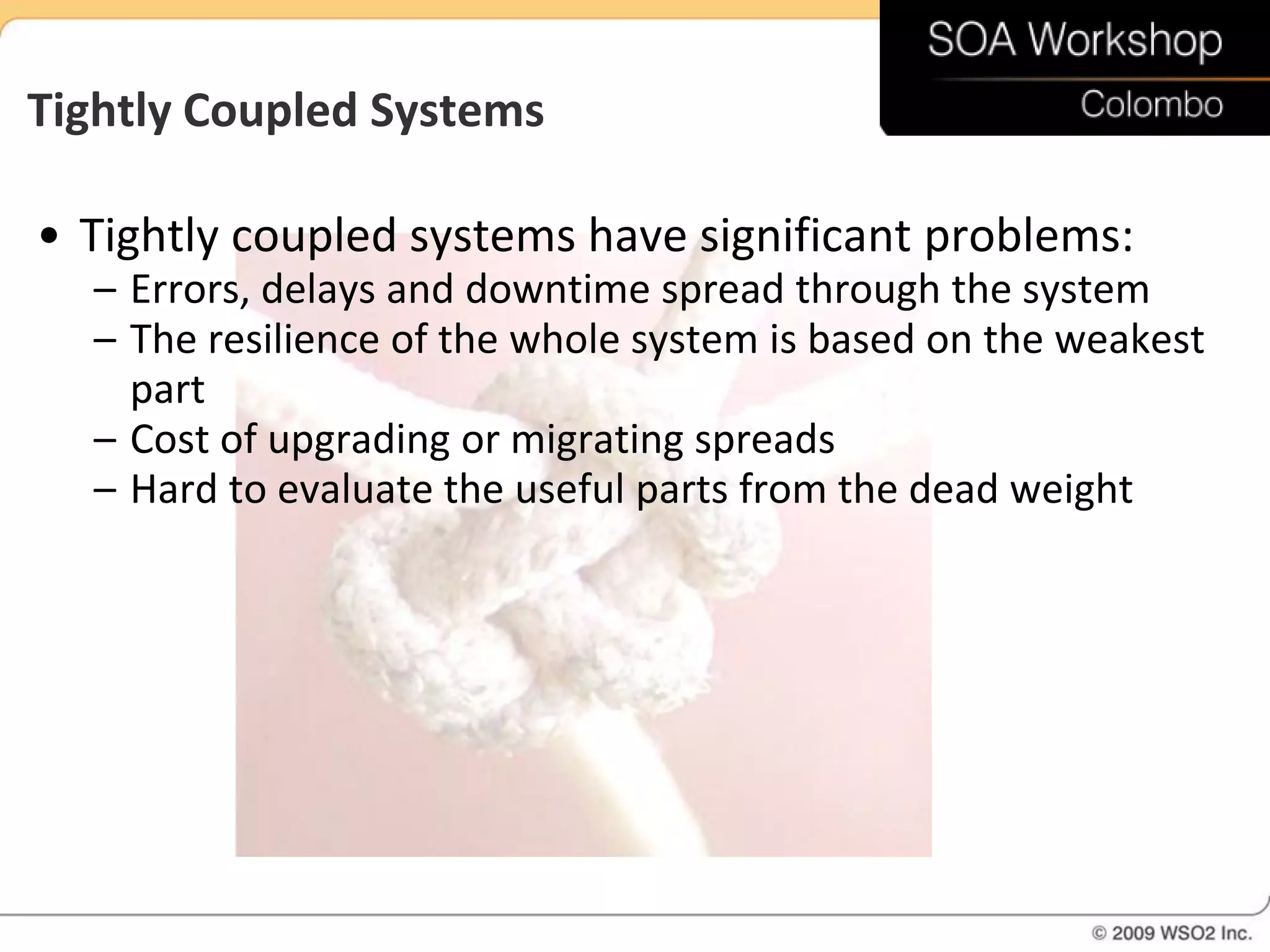
Tightly Coupled Systems

• Tightly coupled systems have significant problems:
  – Errors, delays and downtime spread through the system
  – The resilience of the whole system is based on the weakest
    part
  – Cost of upgrading or migrating spreads
  – Hard to evaluate the useful parts from the dead weight
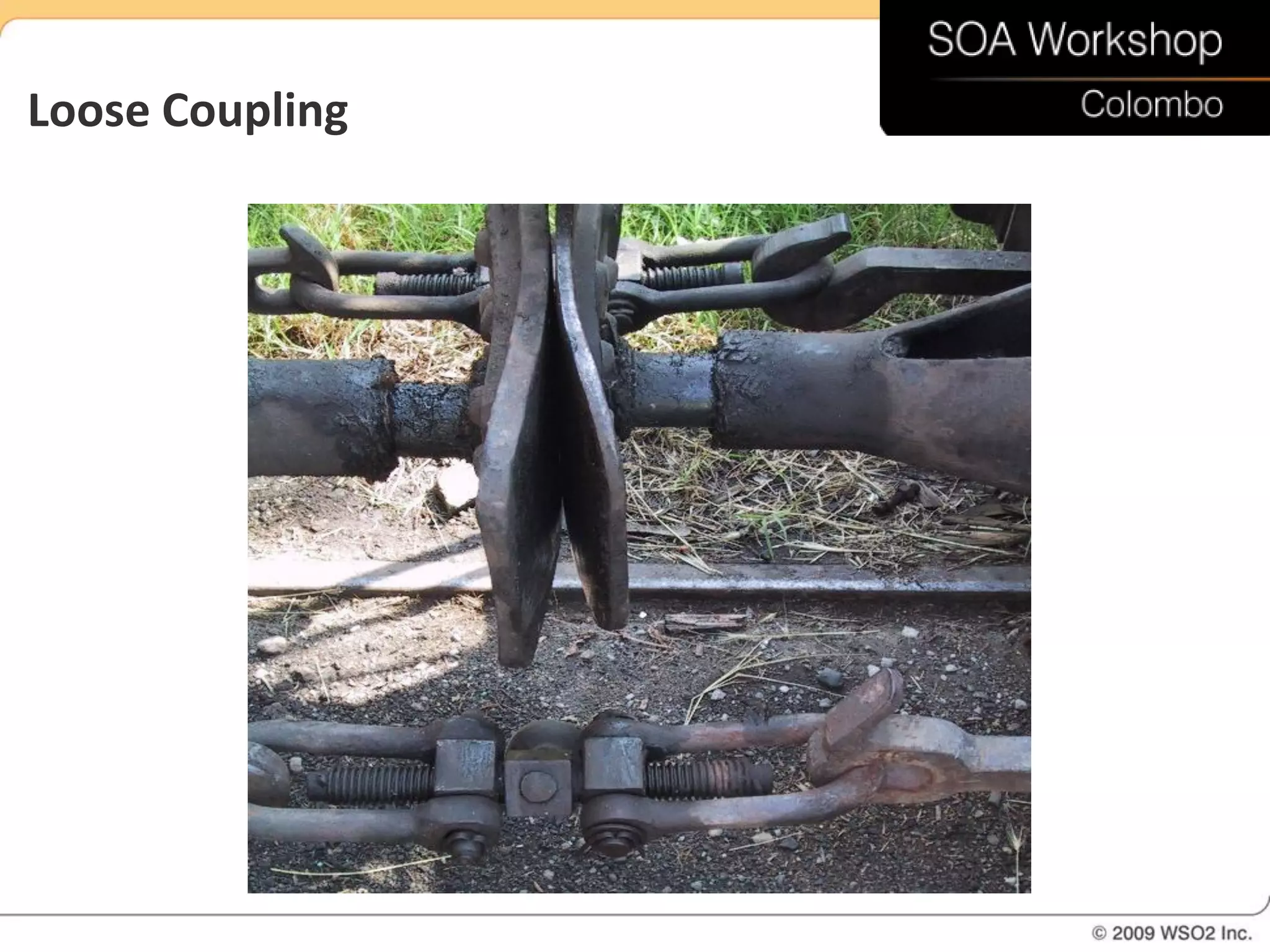
Loose Coupling
Loose Coupling

  • Location and Access
     – Scale up, failover, contingency
  • Programming Language
     – Work with available skills
     – Integrate old and new
  • Stack/Vendor
     – No tie in to a particular proprietary solution
  • Time
     – Asynchronous interactions avoid gridlock
Services

• Services are application assets that provide useful
  function
• The service is not just the software… it is the running
  system
• Services are accessible in a common way across the
  network and organisation
• Services are re-usable building blocks that can be re-
  used to build other applications
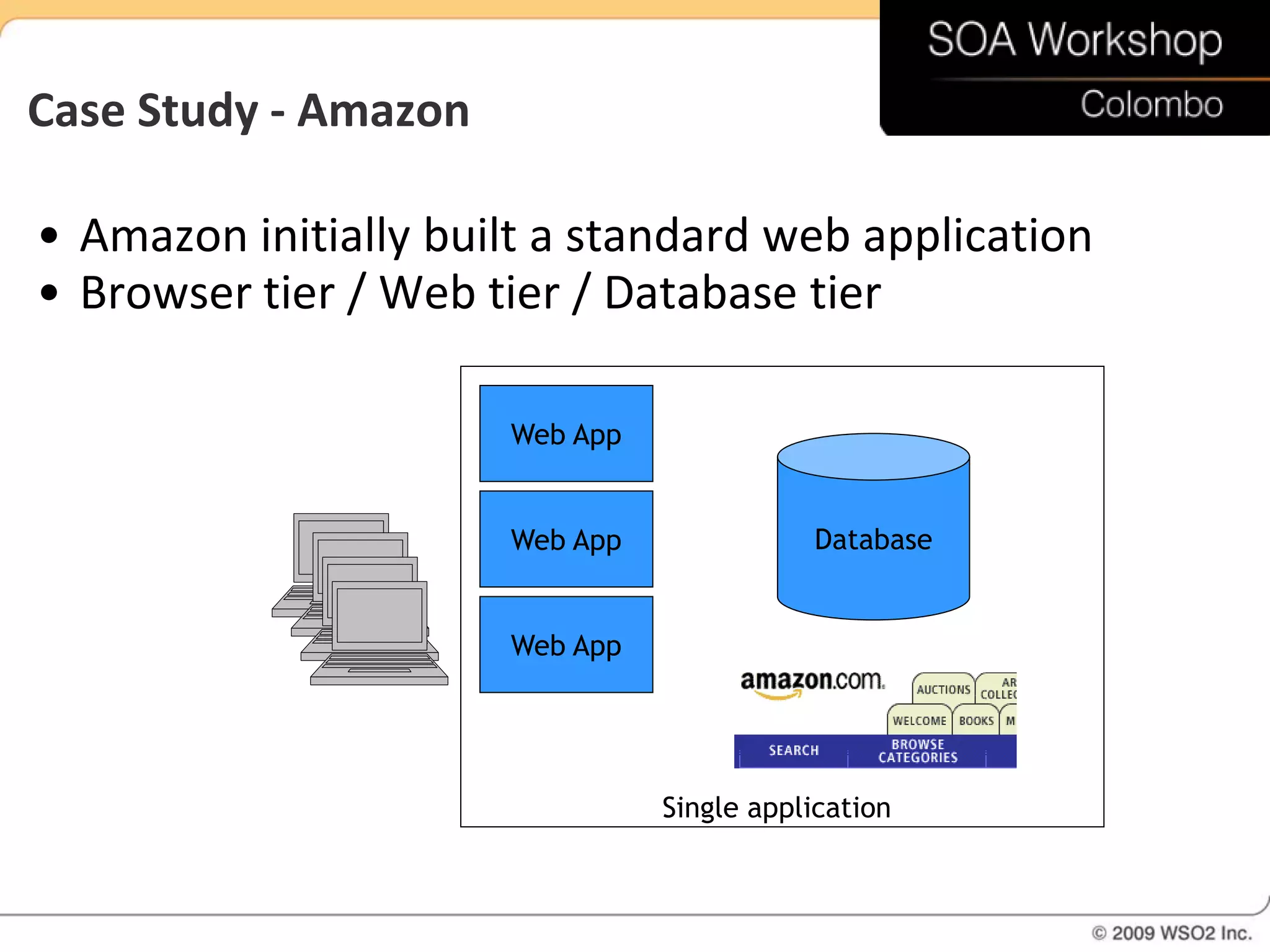
Case Study - Amazon

• Amazon initially built a standard web application
• Browser tier / Web tier / Database tier

                      Web App


                      Web App              Database


                      Web App


                                Single application
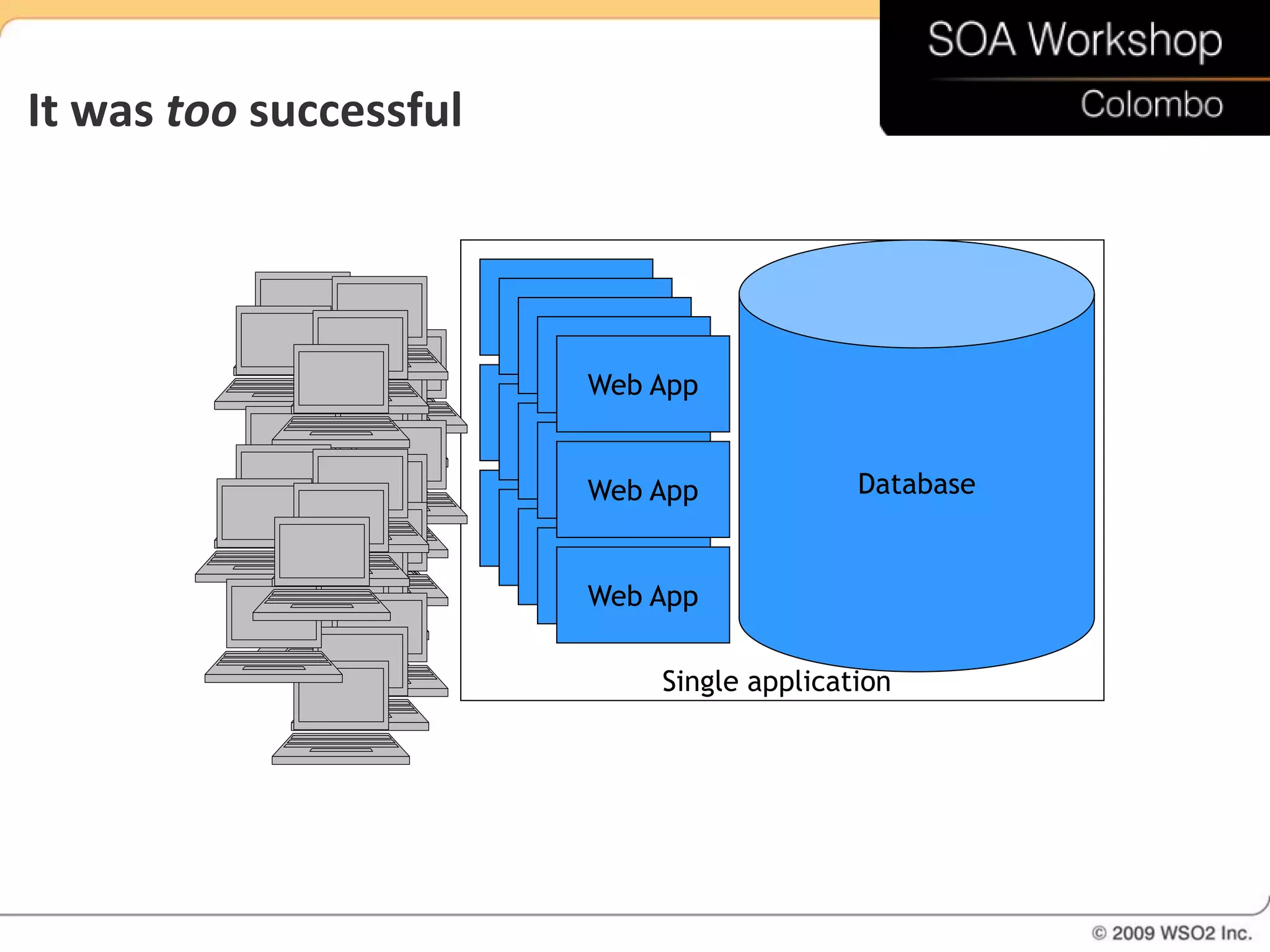
It was too successful


                        Web App
                         Web App
                          Web App
                           Web App
                             Web App
                        Web App
                         Web App
                          Web App
                           Web App              Database
                             Web App
                        Web App
                         Web App
                          Web App
                           Web App
                             Web App

                                 Single application
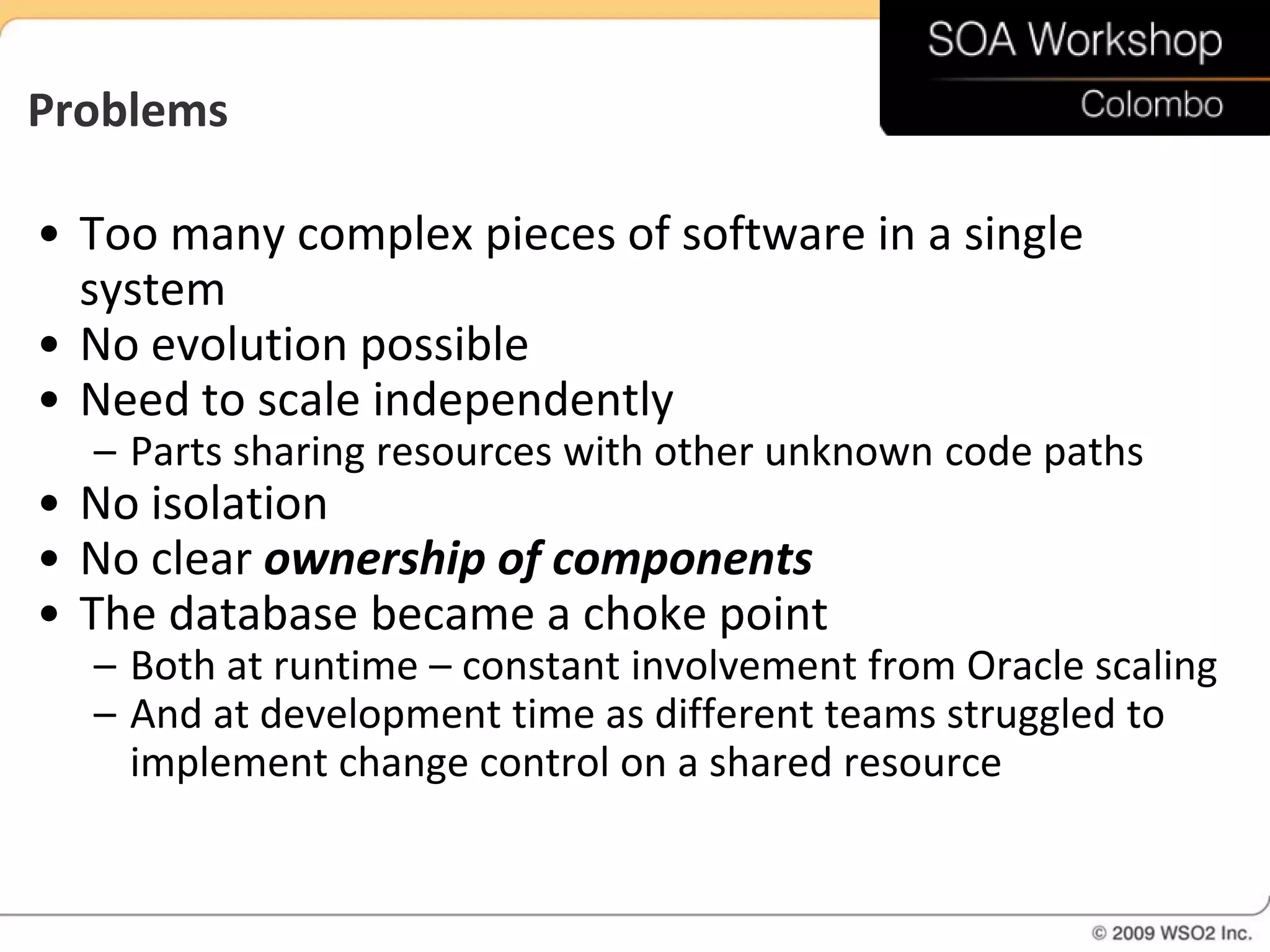
Problems

• Too many complex pieces of software in a single
  system
• No evolution possible
• Need to scale independently
  – Parts sharing resources with other unknown code paths
• No isolation
• No clear ownership of components
• The database became a choke point
  – Both at runtime – constant involvement from Oracle scaling
  – And at development time as different teams struggled to
    implement change control on a shared resource
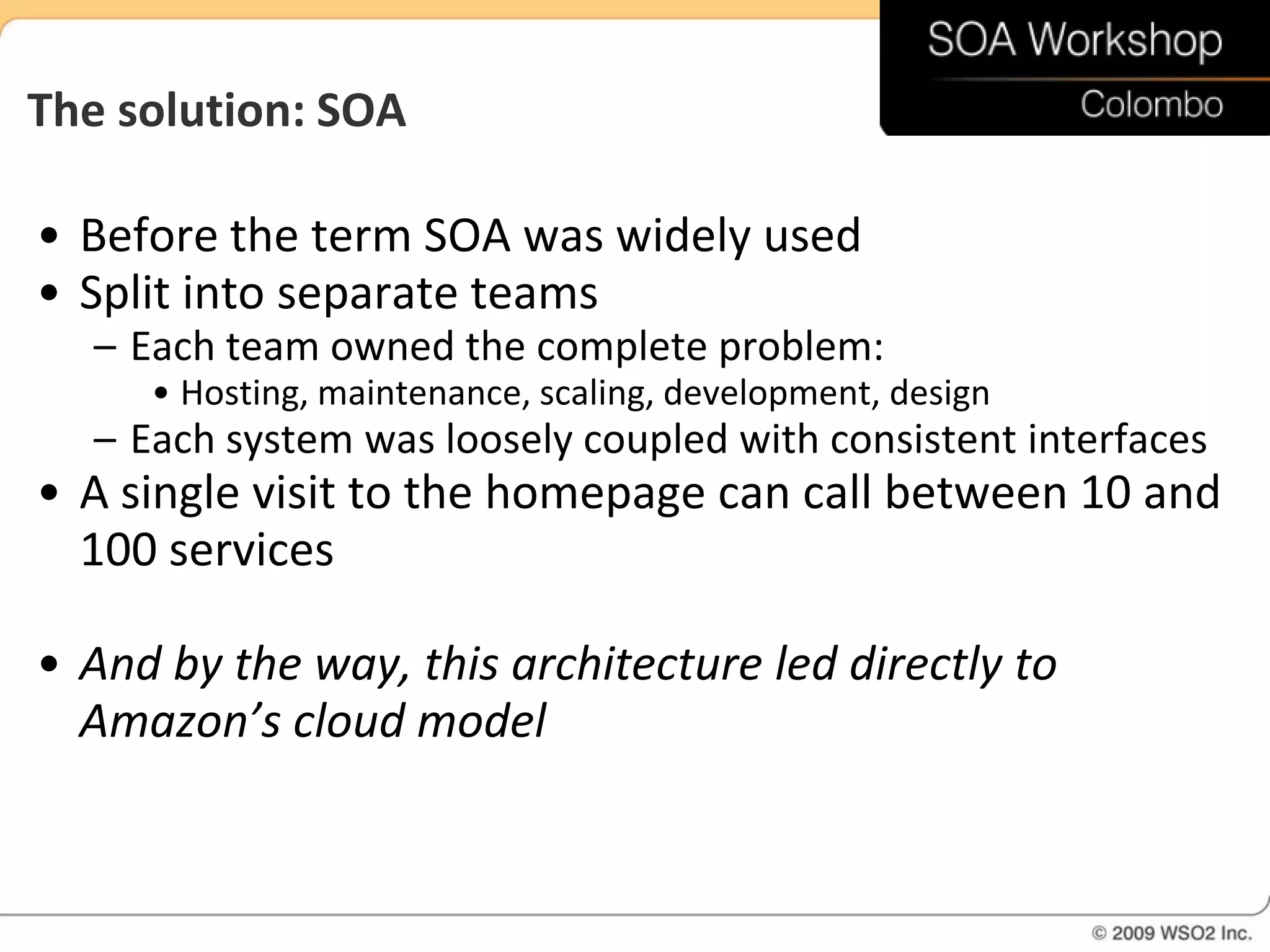
The solution: SOA

• Before the term SOA was widely used
• Split into separate teams
  – Each team owned the complete problem:
     • Hosting, maintenance, scaling, development, design
  – Each system was loosely coupled with consistent interfaces
• A single visit to the homepage can call between 10 and
  100 services

• And by the way, this architecture led directly to
  Amazon’s cloud model
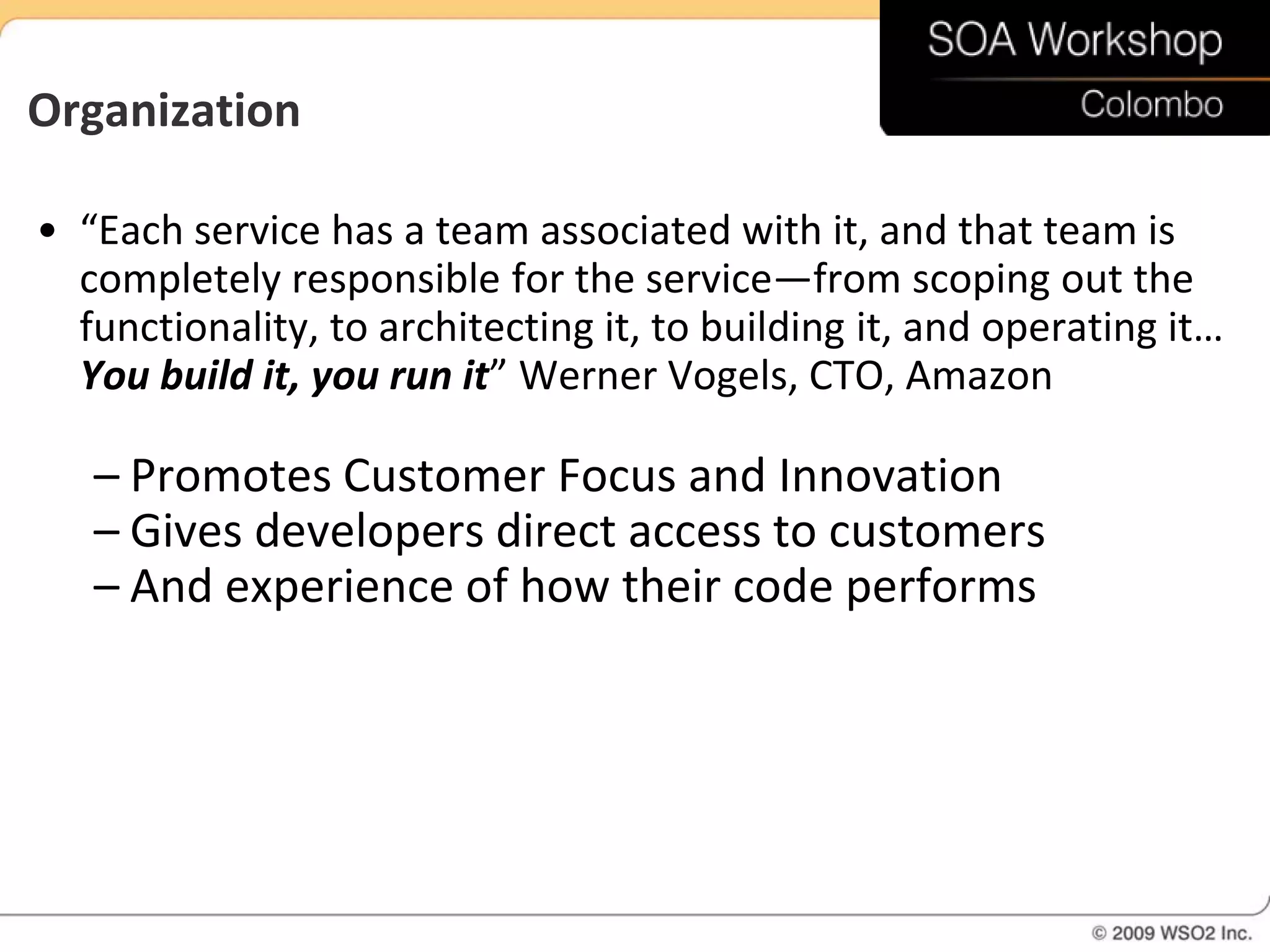
Organization

• “Each service has a team associated with it, and that team is
  completely responsible for the service—from scoping out the
  functionality, to architecting it, to building it, and operating it…
  You build it, you run it” Werner Vogels, CTO, Amazon

   – Promotes Customer Focus and Innovation
   – Gives developers direct access to customers
   – And experience of how their code performs
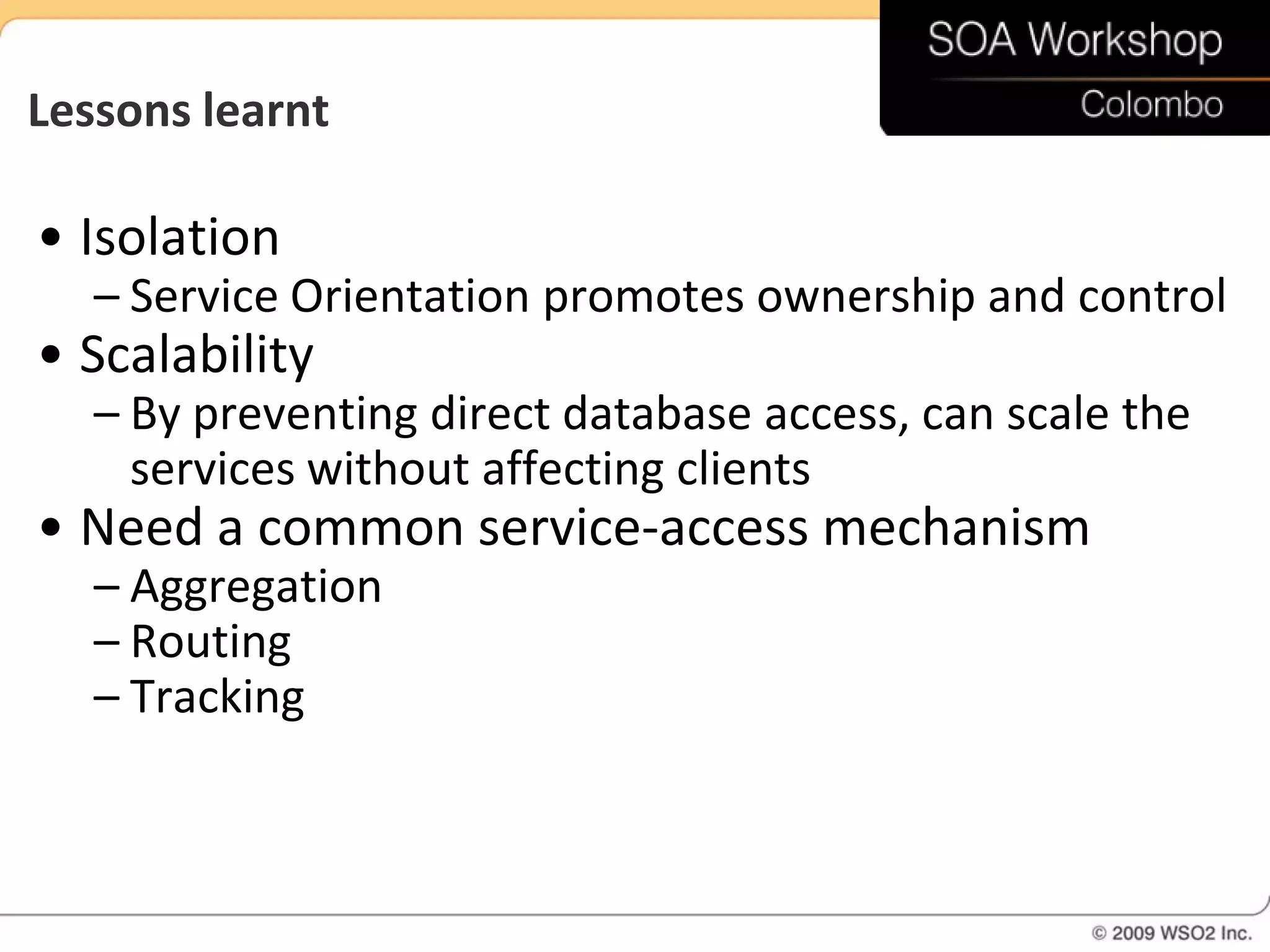
Lessons learnt

• Isolation
   – Service Orientation promotes ownership and control
• Scalability
   – By preventing direct database access, can scale the
     services without affecting clients
• Need a common service-access mechanism
   – Aggregation
   – Routing
   – Tracking
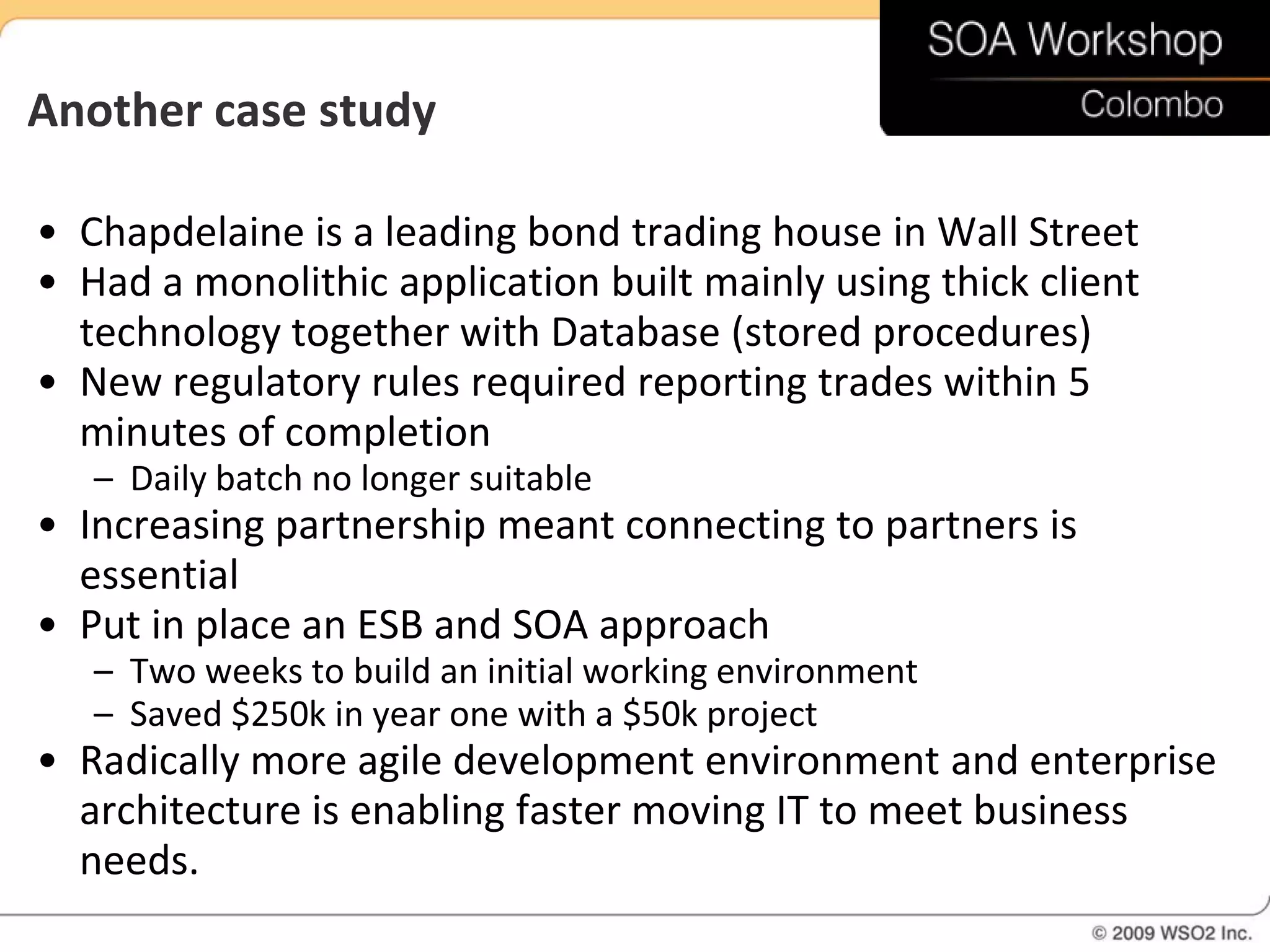
Another case study

• Chapdelaine is a leading bond trading house in Wall Street
• Had a monolithic application built mainly using thick client
  technology together with Database (stored procedures)
• New regulatory rules required reporting trades within 5
  minutes of completion
   – Daily batch no longer suitable
• Increasing partnership meant connecting to partners is
  essential
• Put in place an ESB and SOA approach
   – Two weeks to build an initial working environment
   – Saved $250k in year one with a $50k project
• Radically more agile development environment and enterprise
  architecture is enabling faster moving IT to meet business
  needs.
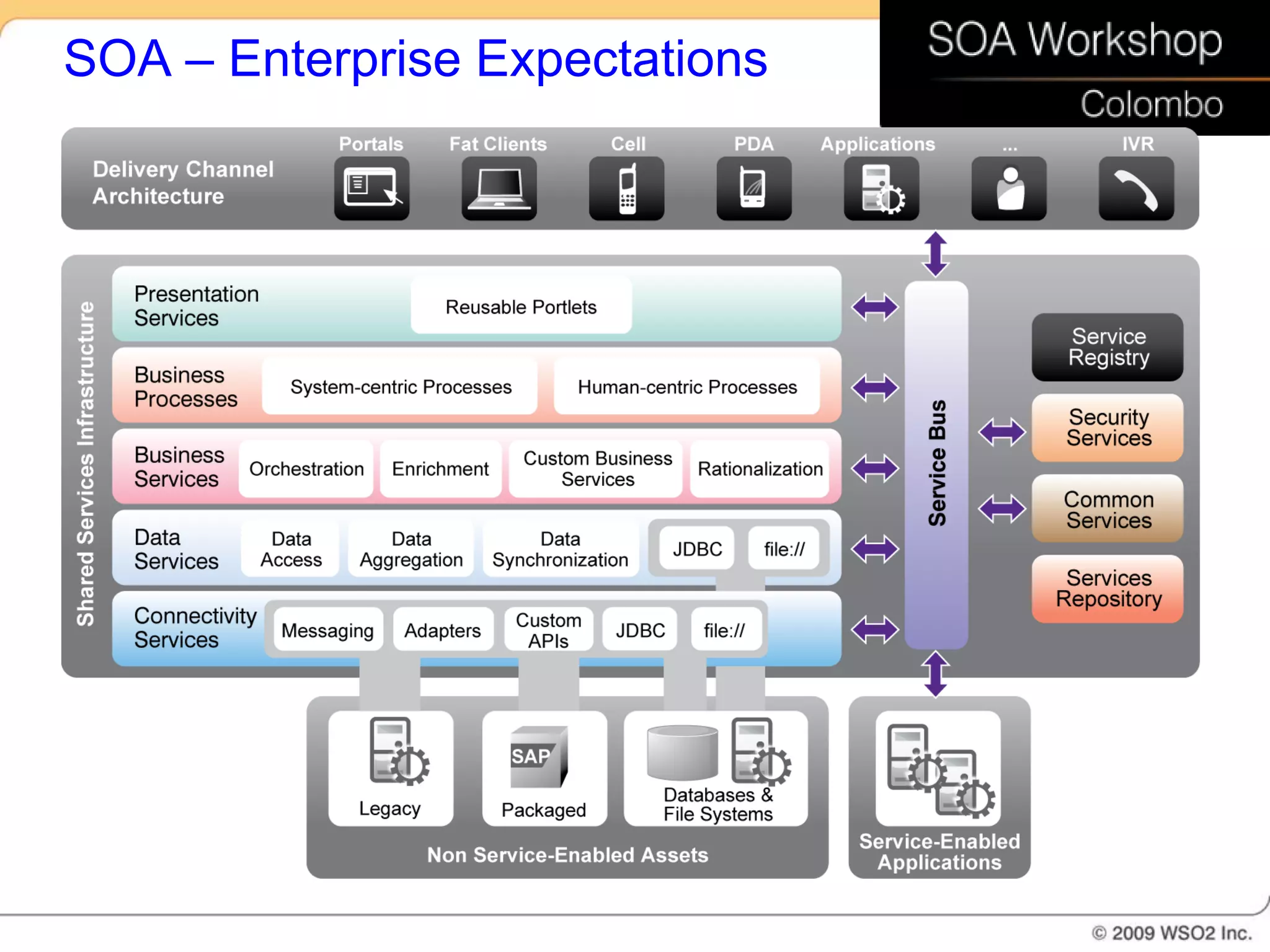
SOA – Enterprise Expectations
Challenges and Opportunities
for SOA
Challenges
• Complexity
• Performance of distributed applications
• Security
• Management, problem determination
• Free-for-all vs Governance
• Standards and best practises
Opportunities
• Process management
• Faster time to market, Agility, time to value
• Business intelligence and activity monitoring
• Rules and Event Processing
• Cloud readiness
Questions

SOA: What It Means To The Enterprise

  • 1.
    SOA: What itmeans to the Enterprise Paul Fremantle paul@wso2.com CTO and Co-Founder, WSO2 VP, Apache Synapse
  • 2.
    Service Oriented Architecture •SOA is the best practice for building distributed interconnected systems – Using well-defined interactions between systems – Moving from proprietary formats to open formats: • XML, HTTP, SOAP – Integration is dependent on external interfaces not on internal code • SOA is the basis of all modern Enterprise Architecture
  • 3.
  • 4.
    The Enterprise Architecturelandscape has changed • Development cycles: – From 18 to 6 months to 3 months • Real standards – HTTP, HTML, XML, Java • Supply chain management and integration are key – Companies without integration are falling behind
  • 5.
    Tightly Coupled Systems •Tightly coupled systems have significant problems: – Errors, delays and downtime spread through the system – The resilience of the whole system is based on the weakest part – Cost of upgrading or migrating spreads – Hard to evaluate the useful parts from the dead weight
  • 6.
  • 7.
    Loose Coupling • Location and Access – Scale up, failover, contingency • Programming Language – Work with available skills – Integrate old and new • Stack/Vendor – No tie in to a particular proprietary solution • Time – Asynchronous interactions avoid gridlock
  • 8.
    Services • Services areapplication assets that provide useful function • The service is not just the software… it is the running system • Services are accessible in a common way across the network and organisation • Services are re-usable building blocks that can be re- used to build other applications
  • 9.
    Case Study -Amazon • Amazon initially built a standard web application • Browser tier / Web tier / Database tier Web App Web App Database Web App Single application
  • 10.
    It was toosuccessful Web App Web App Web App Web App Web App Web App Web App Web App Web App Database Web App Web App Web App Web App Web App Web App Single application
  • 11.
    Problems • Too manycomplex pieces of software in a single system • No evolution possible • Need to scale independently – Parts sharing resources with other unknown code paths • No isolation • No clear ownership of components • The database became a choke point – Both at runtime – constant involvement from Oracle scaling – And at development time as different teams struggled to implement change control on a shared resource
  • 12.
    The solution: SOA •Before the term SOA was widely used • Split into separate teams – Each team owned the complete problem: • Hosting, maintenance, scaling, development, design – Each system was loosely coupled with consistent interfaces • A single visit to the homepage can call between 10 and 100 services • And by the way, this architecture led directly to Amazon’s cloud model
  • 13.
    Organization • “Each servicehas a team associated with it, and that team is completely responsible for the service—from scoping out the functionality, to architecting it, to building it, and operating it… You build it, you run it” Werner Vogels, CTO, Amazon – Promotes Customer Focus and Innovation – Gives developers direct access to customers – And experience of how their code performs
  • 14.
    Lessons learnt • Isolation – Service Orientation promotes ownership and control • Scalability – By preventing direct database access, can scale the services without affecting clients • Need a common service-access mechanism – Aggregation – Routing – Tracking
  • 15.
    Another case study •Chapdelaine is a leading bond trading house in Wall Street • Had a monolithic application built mainly using thick client technology together with Database (stored procedures) • New regulatory rules required reporting trades within 5 minutes of completion – Daily batch no longer suitable • Increasing partnership meant connecting to partners is essential • Put in place an ESB and SOA approach – Two weeks to build an initial working environment – Saved $250k in year one with a $50k project • Radically more agile development environment and enterprise architecture is enabling faster moving IT to meet business needs.
  • 16.
    SOA – EnterpriseExpectations
  • 17.
    Challenges and Opportunities forSOA Challenges • Complexity • Performance of distributed applications • Security • Management, problem determination • Free-for-all vs Governance • Standards and best practises Opportunities • Process management • Faster time to market, Agility, time to value • Business intelligence and activity monitoring • Rules and Event Processing • Cloud readiness
  • 18.