Boundaryless Information Flow
The Role of Architecture
Allen Brown
President & CEO
a.brown@opengroup.org
44 Montgomery Street
Suite 960
San Francisco, CA
94104 USA
Tel +1 415 374 8280
www.opengroup.org
20 October 2022 (C) The Open Group 2003
2
Who we are
 You are architects and managers of architects
 Technology architects
 Information architects
 Application architects
 Business architects
 Enterprise architects
 I am a decision making CEO who sees the
value of using architecture to make decisions
20 October 2022 (C) The Open Group 2003
3
Customer problem statement
 “I could run my business better if I could gain operational efficiencies
improving
 the many different business processes of the enterprise
 both internal, and
 spanning the key interactions with suppliers, customers, and
partners using
 integrated information, and access to that information.”
Source: “The Interoperable Enterprise”
http://www.opengroup.org/cio/iop/index.htm
20 October 2022 (C) The Open Group 2003
4
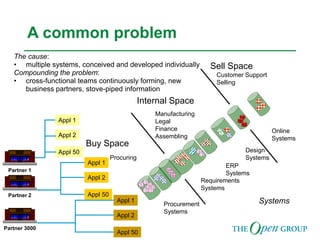
Buy Space
Internal Space
Sell Space
Procuring
Manufacturing
Legal
Finance
Assembling
Customer Support
Selling
Procurement
Systems
Design
Systems
Online
Systems
ERP
Systems
Requirements
Systems
Systems
A common problem
The cause:
• multiple systems, conceived and developed individually
Compounding the problem:
• cross-functional teams continuously forming, new
business partners, stove-piped information
Partner 1
Partner 2
Partner 3000
Appl 1
Appl 2
Appl 50
Appl 1
Appl 2
Appl 50
Appl 1
Appl 2
Appl 50
20 October 2022 (C) The Open Group 2003
5
Vision
Vision
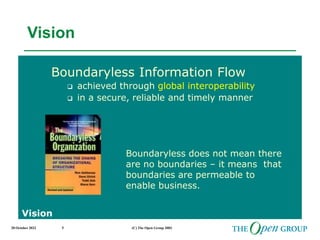
Boundaryless Information Flow
 achieved through global interoperability
 in a secure, reliable and timely manner
Boundaryless does not mean there
are no boundaries – it means that
boundaries are permeable to
enable business.
20 October 2022 (C) The Open Group 2003
6
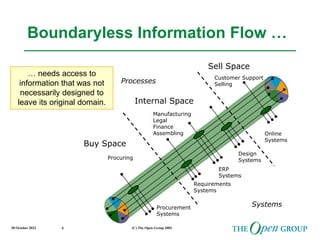
Buy Space
Internal Space
Sell Space
Procuring
Manufacturing
Legal
Finance
Assembling
Customer Support
Selling
Procurement
Systems
Design
Systems
Online
Systems
ERP
Systems
Requirements
Systems
Systems
Boundaryless Information Flow …
Processes
… needs access to
information that was not
necessarily designed to
leave its original domain.
20 October 2022 (C) The Open Group 2003
7
Technologies create boundaries…
 Infrastructural
 Organization of the interconnecting and underlying
facilities
 Structural
 System growth is limited by the “strength” or scalability
of its structure
 Architectural
 Differently architected technologies often don’t
“fit” with each other
 Semantic
 Different ways of representing the same thing
20 October 2022 (C) The Open Group 2003
8
The role of architecture
 “Architecture is fast becoming one of the main instruments for
improving Business IT Alignment.”
 “It is time to broaden our view and build systems that last and
that keep delivering value to the business. Business and IT
Architecture play a pivotal role in achieving this goal..“
Raymond Slot M.Sc, MBA, Principal Consultant and Enterprise Architect
for Cap Gemini Ernst & Young
20 October 2022 (C) The Open Group 2003
9
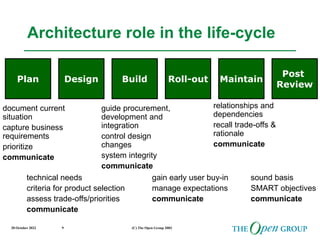
Architecture role in the life-cycle
document current
situation
capture business
requirements
prioritize
communicate
Plan Design Build Roll-out Maintain
Post
Review
technical needs
criteria for product selection
assess trade-offs/priorities
communicate
gain early user buy-in
manage expectations
communicate
guide procurement,
development and
integration
control design
changes
system integrity
communicate
relationships and
dependencies
recall trade-offs &
rationale
communicate
sound basis
SMART objectives
communicate
20 October 2022 (C) The Open Group 2003
10
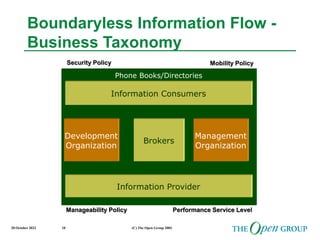
Phone Books/Directories
Boundaryless Information Flow -
Business Taxonomy
Mobility Policy
Information Provider
Management
Organization
Brokers
Development
Organization
Information Consumers
Performance Service Level
Manageability Policy
Security Policy
20 October 2022 (C) The Open Group 2003
11
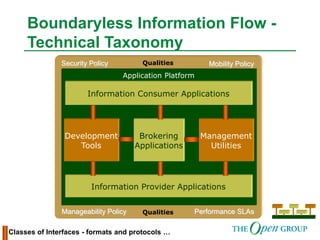
Qualities
Qualities
Application Platform
Boundaryless Information Flow -
Technical Taxonomy
Mobility Policy
Classes of Interfaces - formats and protocols …
Information Provider Applications
Management
Utilities
Brokering
Applications
Development
Tools
Information Consumer Applications
Performance SLAs
Manageability Policy
Security Policy
20 October 2022 (C) The Open Group 2003
12
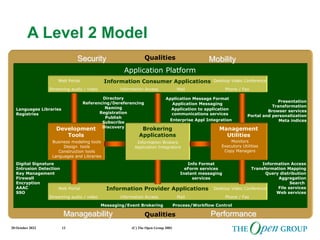
Qualities
Qualities
Application Platform
A Level 2 Model
Information Provider Applications
Management
Utilities
Brokering
Applications
Development
Tools
Information Consumer Applications Desktop Video Conference
information Access
Streaming audio / video Mail Phone / Fax
Web Portal
Business modeling tools
Design tools
Construction tools
Languages and Libraries
Monitors
Executory Utilities
Copy Managers
Mobility
Performance
Manageability
Security
Information Brokers
Application Integrators
Desktop Video Conference
information Access
Streaming audio / video Mail Phone / Fax
Web Portal
Application to application
communications services
Directory
Referencing/Dereferencing
Naming
Registration
Publish
Subscribe
Discovery
Digital Signature
Intrusion Detection
Key Management
Firewall
Encryption
AAAC
SSO
Presentation
Transformation
Browser services
Portal and personalization
Meta indices
Information Access
Transformation Mapping
Query distribution
Aggregation
Search
File services
Web services
Application Messaging
Languages Libraries
Registries
Application Message Format
Info Format
eForm services
Instant messaging
services
Messaging/Event Brokering Process/Workflow Control
Enterprise Appl Integration
20 October 2022 (C) The Open Group 2003
13
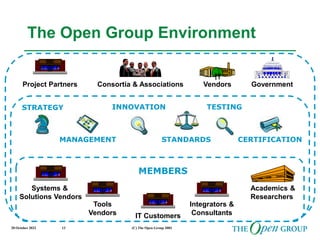
The Open Group Environment
Tools
Vendors
Academics &
Researchers
Integrators &
Consultants
Systems &
Solutions Vendors
IT Customers
MEMBERS
Project Partners Vendors Government
Consortia & Associations
STRATEGY
MANAGEMENT
INNOVATION
STANDARDS
TESTING
CERTIFICATION
20 October 2022 (C) The Open Group 2003
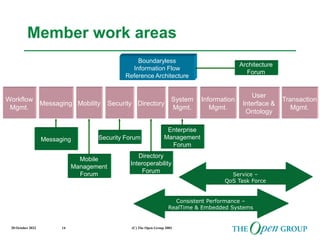
14
Boundaryless
Information Flow
Reference Architecture
Member work areas
Security Forum
Mobile
Management
Forum
Enterprise
Management
Forum
Messaging
Directory
Interoperability
Forum
Architecture
Forum
Directory
Security
System
Mgmt.
Information
Mgmt.
Messaging
Workflow
Mgmt.
Mobility
User
Interface &
Ontology
Transaction
Mgmt.
Consistent Performance –
RealTime & Embedded Systems
Service –
QoS Task Force
20 October 2022 (C) The Open Group 2003
15
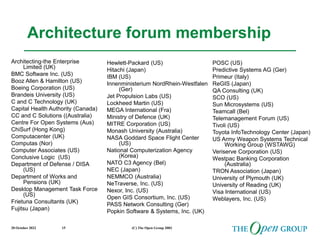
Architecture forum membership
Hewlett-Packard (US)
Hitachi (Japan)
IBM (US)
Innenministerium NordRhein-Westfalen
(Ger)
Jet Propulsion Labs (US)
Lockheed Martin (US)
MEGA International (Fra)
Ministry of Defence (UK)
MITRE Corporation (US)
Monash University (Australia)
NASA Goddard Space Flight Center
(US)
National Computerization Agency
(Korea)
NATO C3 Agency (Bel)
NEC (Japan)
NEMMCO (Australia)
NeTraverse, Inc. (US)
Nexor, Inc. (US)
Open GIS Consortium, Inc. (US)
PASS Network Consulting (Ger)
Popkin Software & Systems, Inc. (UK)
Architecting-the Enterprise
Limited (UK)
BMC Software Inc. (US)
Booz Allen & Hamilton (US)
Boeing Corporation (US)
Brandeis University (US)
C and C Technology (UK)
Capital Health Authority (Canada)
CC and C Solutions ((Australia)
Centre For Open Systems (Aus)
ChiSurf (Hong Kong)
Computacenter (UK)
Computas (Nor)
Computer Associates (US)
Conclusive Logic (US)
Department of Defense / DISA
(US)
Department of Works and
Pensions (UK)
Desktop Management Task Force
(US)
Frietuna Consultants (UK)
Fujitsu (Japan)
POSC (US)
Predictive Systems AG (Ger)
Primeur (Italy)
ReGIS (Japan)
QA Consulting (UK)
SCO (US)
Sun Microsystems (US)
Teamcall (Bel)
Telemanagement Forum (US)
Tivoli (US)
Toyota InfoTechnology Center (Japan)
US Army Weapon Systems Technical
Working Group (WSTAWG)
Veriserve Corporation (US)
Westpac Banking Corporation
(Australia)
TRON Association (Japan)
University of Plymouth (UK)
University of Reading (UK)
Visa International (US)
Weblayers, Inc. (US)
20 October 2022 (C) The Open Group 2003
16
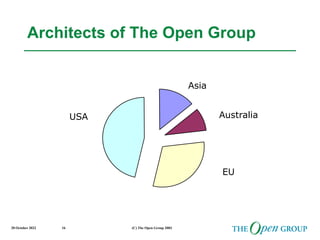
Architects of The Open Group
Asia
Australia
EU
USA
20 October 2022 (C) The Open Group 2003
17
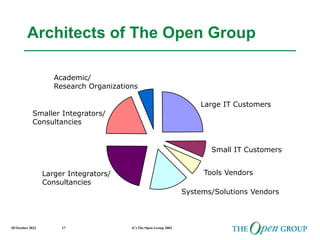
Architects of The Open Group
Large IT Customers
Small IT Customers
Tools Vendors
Systems/Solutions Vendors
Larger Integrators/
Consultancies
Smaller Integrators/
Consultancies
Academic/
Research Organizations
20 October 2022 (C) The Open Group 2003
18
Architecture Forum
 The mission of the Forum’s members is to:
 Advance the cause of IT Architecture - in order to
 Improve the quality of information systems
 To move IT Architecture from a cottage industry to a
profession
 Original (and continuing) focus: (TOGAF)
 Industry consensus framework and method for IT
architecture
 Tool- and technology-neutral
 Extended focus
 Architecture Tools
 IT Architect Certification
20 October 2022 (C) The Open Group 2003
19
What is an Architectural
Framework?
 Architecture design is a complex process
 An architectural framework is a tool for:
 Designing a broad range of a architectures
 Assisting the evaluation of different architectures
 Selecting and building the right architecture for an
organization
 It embodies best practice and acknowledged wisdom
 It presents a set of services, standards, design
concepts, components and configurations
 It guides the development of specific architectures
20 October 2022 (C) The Open Group 2003
20
Developing an IT Architecture
 It is not possible for you to specify a single, universal
architecture suitable for:
 All purposes
 At all times
 An architecture must be suited to its specific business
purpose
 That purpose may change with time
20 October 2022 (C) The Open Group 2003
21
What is an Architectural
Framework?
 Use of a framework leads to:
 The use of common principles, assumptions and
terminology
 The development of information systems with better
integration and interoperability, especially with respect to
issues that affect the whole enterprise
 WARNING!
 A framework does not make architectural design an
automatic process
 It is a valuable aid to experienced and knowledgeable IT
Architects
20 October 2022 (C) The Open Group 2003
22
Examples of Architectural
Frameworks
 Zachman Framework
 DoD Architecture Framework – DoDAF
 Command, Control, Communications, Computers,
Intelligence, Surveillance, and Reconnaissance – C4ISR
 Federal Enterprise Architecture Framework - FEAF
 Treasury Enterprise Architecture Framework - TEAF
These frameworks are all complementary to The Open
Group Architecture Framework - TOGAF
TOGAF can be used in conjunction with these
frameworks
20 October 2022 (C) The Open Group 2003
23
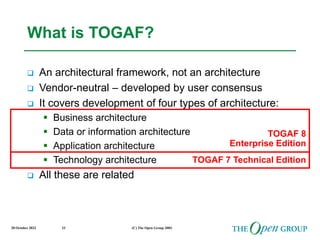
What is TOGAF?
 An architectural framework, not an architecture
 Vendor-neutral – developed by user consensus
 It covers development of four types of architecture:
 Business architecture
 Data or information architecture
 Application architecture
 Technology architecture
 All these are related
TOGAF 7 Technical Edition
TOGAF 8
Enterprise Edition
20 October 2022 (C) The Open Group 2003
24
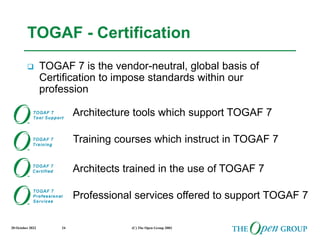
TOGAF - Certification
 TOGAF 7 is the vendor-neutral, global basis of
Certification to impose standards within our
profession
Architecture tools which support TOGAF 7
Training courses which instruct in TOGAF 7
Architects trained in the use of TOGAF 7
Professional services offered to support TOGAF 7
20 October 2022 (C) The Open Group 2003
25
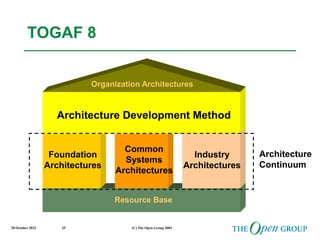
TOGAF 8
Industry
Architectures
Common
Systems
Architectures
Foundation
Architectures
Architecture Development Method
Resource Base
Organization Architectures
Architecture
Continuum
20 October 2022 (C) The Open Group 2003
26
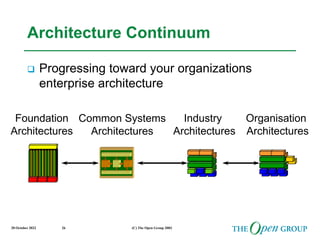
Foundation
Architectures
Common Systems
Architectures
Industry
Architectures
Organisation
Architectures
Architecture Continuum
 Progressing toward your organizations
enterprise architecture
20 October 2022 (C) The Open Group 2003
27
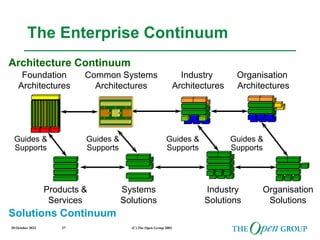
The Enterprise Continuum
Foundation
Architectures
Common Systems
Architectures
Industry
Architectures
Organisation
Architectures
Systems
Solutions
Industry
Solutions
Organisation
Solutions
Products &
Services
Solutions Continuum
Architecture Continuum
Guides &
Supports
Guides &
Supports
Guides &
Supports
Guides &
Supports
20 October 2022 (C) The Open Group 2003
28
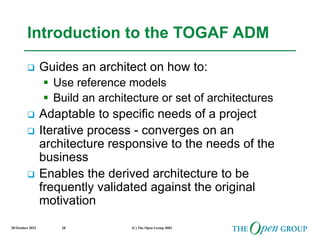
Introduction to the TOGAF ADM
 Guides an architect on how to:
 Use reference models
 Build an architecture or set of architectures
 Adaptable to specific needs of a project
 Iterative process - converges on an
architecture responsive to the needs of the
business
 Enables the derived architecture to be
frequently validated against the original
motivation
20 October 2022 (C) The Open Group 2003
29
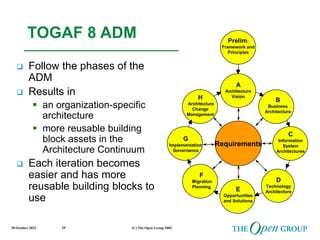
TOGAF 8 ADM
 Follow the phases of the
ADM
 Results in
 an organization-specific
architecture
 more reusable building
block assets in the
Architecture Continuum
 Each iteration becomes
easier and has more
reusable building blocks to
use
A
Architecture
Vision
H
Architecture
Change
Management
G
Implementation
Governance
C
Information
System
Architectures
Requirements
B
Business
Architecture
E
Opportunities
and Solutions
F
Migration
Planning
Prelim:
Framework and
Principles
D
Technology
Architecture
20 October 2022 (C) The Open Group 2003
30
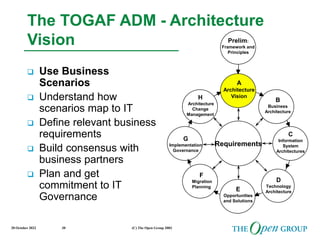
The TOGAF ADM - Architecture
Vision
 Use Business
Scenarios
 Understand how
scenarios map to IT
 Define relevant business
requirements
 Build consensus with
business partners
 Plan and get
commitment to IT
Governance
A
Architecture
Vision
H
Architecture
Change
Management
G
Implementation
Governance
C
Information
System
Architectures
Requirements
B
Business
Architecture
E
Opportunities
and Solutions
F
Migration
Planning
Prelim:
Framework and
Principles
D
Technology
Architecture
20 October 2022 (C) The Open Group 2003
31
Business Scenarios
 A complete description of the business problem in
business and architectural terms
 It ensures:
 The architecture is based on a complete set of
requirements
 The business value of solving the problem is clear
 The relevance of potential solutions is clear
 Aids the buy-in by business stakeholders
 Clarifies communication with vendors
 Needs to be SMART
20 October 2022 (C) The Open Group 2003
32
A SMART Business Scenario
 Specific - defines what needs to be done in the business
 Measurable - clear metrics for success
 Actionable - it clearly segments the problem and provides
the basis for determining elements and plans for the
solution
 Realistic - the problem can be solved within the bounds of
physical reality, time and cost constraints
 Time-bound - there is a clear understanding of when the
solution opportunity expires
20 October 2022 (C) The Open Group 2003
33
Contents of a Business Scenario
 Business Scenario problem description
 Purpose of the Business Scenario
 Detailed objectives
 Environment and process models
 Process description
 Process steps mapped to environment
 Process steps mapped to people
 Information flow
20 October 2022 (C) The Open Group 2003
34
Contents of a Business Scenario
 Actors and their roles and responsibilities
 Human actors and roles
 Computer actors and roles
 Requirements
 Resulting technology architecture model
 Constraints
 IT principles
 Technology architecture supporting the process
 Requirements mapped to technology architecture
20 October 2022 (C) The Open Group 2003
35
Phases used in a Business
Scenario development
 Gather information
 Workshops are a great way to gather information through questions
 Additional information such as strategies, plans, facts are solicited
 Analyze and process information
 Information is usually processed offline
 Use a small team, your architects
 Document information
 Create models of your findings, both business and technical views
 Augment models with detailed documentation
 Review
 Vet the models and documentation back to suppliers
 Have a controlled review, allocate specific review sections to
specific reviewers
 Only a few reviewers needed to review the complete Business
Scenario
20 October 2022 (C) The Open Group 2003
36
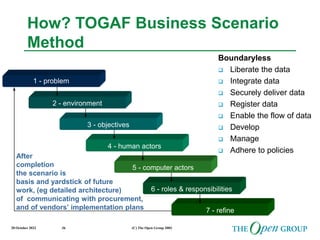
How? TOGAF Business Scenario
Method
1 - problem
2 - environment
3 - objectives
4 - human actors
5 - computer actors
6 - roles & responsibilities
7 - refine
After
completion
the scenario is
basis and yardstick of future
work, (eg detailed architecture)
of communicating with procurement,
and of vendors’ implementation plans
Boundaryless
 Liberate the data
 Integrate data
 Securely deliver data
 Register data
 Enable the flow of data
 Develop
 Manage
 Adhere to policies
20 October 2022 (C) The Open Group 2003
37
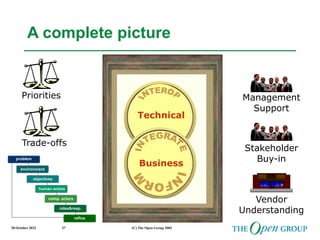
A complete picture
problem
environment
objectives
human actors
comp. actors
roles&resp.
refine
Management
Support
Stakeholder
Buy-in
Vendor
Understanding
Business
Technical
Priorities
Trade-offs
20 October 2022 (C) The Open Group 2003
38
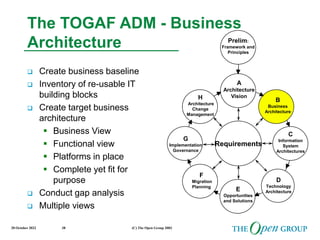
The TOGAF ADM - Business
Architecture
 Create business baseline
 Inventory of re-usable IT
building blocks
 Create target business
architecture
 Business View
 Functional view
 Platforms in place
 Complete yet fit for
purpose
 Conduct gap analysis
 Multiple views
A
Architecture
Vision
H
Architecture
Change
Management
G
Implementation
Governance
C
Information
System
Architectures
Requirements
B
Business
Architecture
E
Opportunities
and Solutions
F
Migration
Planning
Prelim:
Framework and
Principles
D
Technology
Architecture
20 October 2022 (C) The Open Group 2003
39
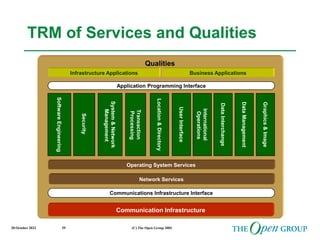
Qualities
Infrastructure Applications Business Applications
Communication Infrastructure
Communications Infrastructure Interface
Network Services
Operating System Services
System
&
Network
Management
Software
Engineering
Application Programming Interface
Data
Management
Location
&
Directory
Data
Interchange
International
Operations
Transaction
Processing
Security
Graphics
&
Image
User
Interface
TRM of Services and Qualities
20 October 2022 (C) The Open Group 2003
40
Qualities
Infrastructure Applications Business Applications
Communication Infrastructure
Communications Infrastructure Interface
Network Services
System
&
Network
Management
Software
Engineering
Application Programming Interface
Data
Management
Location
&
Directory
Data
Interchange
International
Operations
Transaction
Processing
Security
Graphics
&
Image
User
Interface
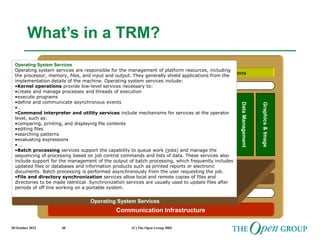
What’s in a TRM?
Operating System Services
Operating system services are responsible for the management of platform resources, including
the processor, memory, files, and input and output. They generally shield applications from the
implementation details of the machine. Operating system services include:
•Kernel operations provide low-level services necessary to:
•create and manage processes and threads of execution
•execute programs
•define and communicate asynchronous events
•…
•Command interpreter and utility services include mechanisms for services at the operator
level, such as:
•comparing, printing, and displaying file contents
•editing files
•searching patterns
•evaluating expressions
•….
•Batch processing services support the capability to queue work (jobs) and manage the
sequencing of processing based on job control commands and lists of data. These services also
include support for the management of the output of batch processing, which frequently includes
updated files or databases and information products such as printed reports or electronic
documents. Batch processing is performed asynchronously from the user requesting the job.
•File and directory synchronization services allow local and remote copies of files and
directories to be made identical. Synchronization services are usually used to update files after
periods of off line working on a portable system.
20 October 2022 (C) The Open Group 2003
41
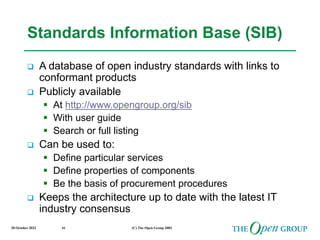
Standards Information Base (SIB)
 A database of open industry standards with links to
conformant products
 Publicly available
 At http://www.opengroup.org/sib
 With user guide
 Search or full listing
 Can be used to:
 Define particular services
 Define properties of components
 Be the basis of procurement procedures
 Keeps the architecture up to date with the latest IT
industry consensus
20 October 2022 (C) The Open Group 2003
42
What architects have said about
TOGAF
 Shared best practice
 Cuts up-front costs - eliminates re-invention of wheel
 Corporate memory of previous successes and failures
 Access to accumulated best practice wisdom
 Comprehensive
 Business requirements to solutions
 Facilitates team communication
 Refined and honed checklists at all levels
 An open professional approach developed by professionals
 The result of 8 years of global development
 Vendor and technology neutral
20 October 2022 (C) The Open Group 2003
43
Next steps
 Download the TOGAF documentation
 http://www.opengroup.org/architecture/togaf7/index7.htm
 http://www.opengroup.org/architecture/togaf8/index8.htm
 Use Business Scenarios
 The Interoperable Enterprise
 The Executive on the Move
 Identity Management
 Run your own a 1 day Business Scenario
workshop with your stakeholders
20 October 2022 (C) The Open Group 2003
44
Summary
 Boundaryless Information Flow is critical in today’s
business environment
 Good professional architecture is a key enabler of
Boundaryless Information Flow
 TOGAF is an enabler of good professional
architecture and is free for own use
 Business Scenarios give a complete picture of the
requirements
 The Architecture Development Method provides a
rigorous process and can be used with other
frameworks
20 October 2022 (C) The Open Group 2003
45
Final thoughts
 Senior management buy-in is critical
 TOGAF can be used to communicate with
senior management about solving their
Boundaryless Information Flow problem
 Try it!
20 October 2022 (C) The Open Group 2003
46
Contact Information
 Thank you very much
Allen Brown
President & CEO
a.brown@opengroup.org
44 Montgomery Street
Suite 960
San Francisco, CA
94104 USA
Tel +1 415 374 8280
www.opengroup.org

brown_eac.ppt

  • 1.
    Boundaryless Information Flow TheRole of Architecture Allen Brown President & CEO a.brown@opengroup.org 44 Montgomery Street Suite 960 San Francisco, CA 94104 USA Tel +1 415 374 8280 www.opengroup.org
  • 2.
    20 October 2022(C) The Open Group 2003 2 Who we are  You are architects and managers of architects  Technology architects  Information architects  Application architects  Business architects  Enterprise architects  I am a decision making CEO who sees the value of using architecture to make decisions
  • 3.
    20 October 2022(C) The Open Group 2003 3 Customer problem statement  “I could run my business better if I could gain operational efficiencies improving  the many different business processes of the enterprise  both internal, and  spanning the key interactions with suppliers, customers, and partners using  integrated information, and access to that information.” Source: “The Interoperable Enterprise” http://www.opengroup.org/cio/iop/index.htm
  • 4.
    20 October 2022(C) The Open Group 2003 4 Buy Space Internal Space Sell Space Procuring Manufacturing Legal Finance Assembling Customer Support Selling Procurement Systems Design Systems Online Systems ERP Systems Requirements Systems Systems A common problem The cause: • multiple systems, conceived and developed individually Compounding the problem: • cross-functional teams continuously forming, new business partners, stove-piped information Partner 1 Partner 2 Partner 3000 Appl 1 Appl 2 Appl 50 Appl 1 Appl 2 Appl 50 Appl 1 Appl 2 Appl 50
  • 5.
    20 October 2022(C) The Open Group 2003 5 Vision Vision Boundaryless Information Flow  achieved through global interoperability  in a secure, reliable and timely manner Boundaryless does not mean there are no boundaries – it means that boundaries are permeable to enable business.
  • 6.
    20 October 2022(C) The Open Group 2003 6 Buy Space Internal Space Sell Space Procuring Manufacturing Legal Finance Assembling Customer Support Selling Procurement Systems Design Systems Online Systems ERP Systems Requirements Systems Systems Boundaryless Information Flow … Processes … needs access to information that was not necessarily designed to leave its original domain.
  • 7.
    20 October 2022(C) The Open Group 2003 7 Technologies create boundaries…  Infrastructural  Organization of the interconnecting and underlying facilities  Structural  System growth is limited by the “strength” or scalability of its structure  Architectural  Differently architected technologies often don’t “fit” with each other  Semantic  Different ways of representing the same thing
  • 8.
    20 October 2022(C) The Open Group 2003 8 The role of architecture  “Architecture is fast becoming one of the main instruments for improving Business IT Alignment.”  “It is time to broaden our view and build systems that last and that keep delivering value to the business. Business and IT Architecture play a pivotal role in achieving this goal..“ Raymond Slot M.Sc, MBA, Principal Consultant and Enterprise Architect for Cap Gemini Ernst & Young
  • 9.
    20 October 2022(C) The Open Group 2003 9 Architecture role in the life-cycle document current situation capture business requirements prioritize communicate Plan Design Build Roll-out Maintain Post Review technical needs criteria for product selection assess trade-offs/priorities communicate gain early user buy-in manage expectations communicate guide procurement, development and integration control design changes system integrity communicate relationships and dependencies recall trade-offs & rationale communicate sound basis SMART objectives communicate
  • 10.
    20 October 2022(C) The Open Group 2003 10 Phone Books/Directories Boundaryless Information Flow - Business Taxonomy Mobility Policy Information Provider Management Organization Brokers Development Organization Information Consumers Performance Service Level Manageability Policy Security Policy
  • 11.
    20 October 2022(C) The Open Group 2003 11 Qualities Qualities Application Platform Boundaryless Information Flow - Technical Taxonomy Mobility Policy Classes of Interfaces - formats and protocols … Information Provider Applications Management Utilities Brokering Applications Development Tools Information Consumer Applications Performance SLAs Manageability Policy Security Policy
  • 12.
    20 October 2022(C) The Open Group 2003 12 Qualities Qualities Application Platform A Level 2 Model Information Provider Applications Management Utilities Brokering Applications Development Tools Information Consumer Applications Desktop Video Conference information Access Streaming audio / video Mail Phone / Fax Web Portal Business modeling tools Design tools Construction tools Languages and Libraries Monitors Executory Utilities Copy Managers Mobility Performance Manageability Security Information Brokers Application Integrators Desktop Video Conference information Access Streaming audio / video Mail Phone / Fax Web Portal Application to application communications services Directory Referencing/Dereferencing Naming Registration Publish Subscribe Discovery Digital Signature Intrusion Detection Key Management Firewall Encryption AAAC SSO Presentation Transformation Browser services Portal and personalization Meta indices Information Access Transformation Mapping Query distribution Aggregation Search File services Web services Application Messaging Languages Libraries Registries Application Message Format Info Format eForm services Instant messaging services Messaging/Event Brokering Process/Workflow Control Enterprise Appl Integration
  • 13.
    20 October 2022(C) The Open Group 2003 13 The Open Group Environment Tools Vendors Academics & Researchers Integrators & Consultants Systems & Solutions Vendors IT Customers MEMBERS Project Partners Vendors Government Consortia & Associations STRATEGY MANAGEMENT INNOVATION STANDARDS TESTING CERTIFICATION
  • 14.
    20 October 2022(C) The Open Group 2003 14 Boundaryless Information Flow Reference Architecture Member work areas Security Forum Mobile Management Forum Enterprise Management Forum Messaging Directory Interoperability Forum Architecture Forum Directory Security System Mgmt. Information Mgmt. Messaging Workflow Mgmt. Mobility User Interface & Ontology Transaction Mgmt. Consistent Performance – RealTime & Embedded Systems Service – QoS Task Force
  • 15.
    20 October 2022(C) The Open Group 2003 15 Architecture forum membership Hewlett-Packard (US) Hitachi (Japan) IBM (US) Innenministerium NordRhein-Westfalen (Ger) Jet Propulsion Labs (US) Lockheed Martin (US) MEGA International (Fra) Ministry of Defence (UK) MITRE Corporation (US) Monash University (Australia) NASA Goddard Space Flight Center (US) National Computerization Agency (Korea) NATO C3 Agency (Bel) NEC (Japan) NEMMCO (Australia) NeTraverse, Inc. (US) Nexor, Inc. (US) Open GIS Consortium, Inc. (US) PASS Network Consulting (Ger) Popkin Software & Systems, Inc. (UK) Architecting-the Enterprise Limited (UK) BMC Software Inc. (US) Booz Allen & Hamilton (US) Boeing Corporation (US) Brandeis University (US) C and C Technology (UK) Capital Health Authority (Canada) CC and C Solutions ((Australia) Centre For Open Systems (Aus) ChiSurf (Hong Kong) Computacenter (UK) Computas (Nor) Computer Associates (US) Conclusive Logic (US) Department of Defense / DISA (US) Department of Works and Pensions (UK) Desktop Management Task Force (US) Frietuna Consultants (UK) Fujitsu (Japan) POSC (US) Predictive Systems AG (Ger) Primeur (Italy) ReGIS (Japan) QA Consulting (UK) SCO (US) Sun Microsystems (US) Teamcall (Bel) Telemanagement Forum (US) Tivoli (US) Toyota InfoTechnology Center (Japan) US Army Weapon Systems Technical Working Group (WSTAWG) Veriserve Corporation (US) Westpac Banking Corporation (Australia) TRON Association (Japan) University of Plymouth (UK) University of Reading (UK) Visa International (US) Weblayers, Inc. (US)
  • 16.
    20 October 2022(C) The Open Group 2003 16 Architects of The Open Group Asia Australia EU USA
  • 17.
    20 October 2022(C) The Open Group 2003 17 Architects of The Open Group Large IT Customers Small IT Customers Tools Vendors Systems/Solutions Vendors Larger Integrators/ Consultancies Smaller Integrators/ Consultancies Academic/ Research Organizations
  • 18.
    20 October 2022(C) The Open Group 2003 18 Architecture Forum  The mission of the Forum’s members is to:  Advance the cause of IT Architecture - in order to  Improve the quality of information systems  To move IT Architecture from a cottage industry to a profession  Original (and continuing) focus: (TOGAF)  Industry consensus framework and method for IT architecture  Tool- and technology-neutral  Extended focus  Architecture Tools  IT Architect Certification
  • 19.
    20 October 2022(C) The Open Group 2003 19 What is an Architectural Framework?  Architecture design is a complex process  An architectural framework is a tool for:  Designing a broad range of a architectures  Assisting the evaluation of different architectures  Selecting and building the right architecture for an organization  It embodies best practice and acknowledged wisdom  It presents a set of services, standards, design concepts, components and configurations  It guides the development of specific architectures
  • 20.
    20 October 2022(C) The Open Group 2003 20 Developing an IT Architecture  It is not possible for you to specify a single, universal architecture suitable for:  All purposes  At all times  An architecture must be suited to its specific business purpose  That purpose may change with time
  • 21.
    20 October 2022(C) The Open Group 2003 21 What is an Architectural Framework?  Use of a framework leads to:  The use of common principles, assumptions and terminology  The development of information systems with better integration and interoperability, especially with respect to issues that affect the whole enterprise  WARNING!  A framework does not make architectural design an automatic process  It is a valuable aid to experienced and knowledgeable IT Architects
  • 22.
    20 October 2022(C) The Open Group 2003 22 Examples of Architectural Frameworks  Zachman Framework  DoD Architecture Framework – DoDAF  Command, Control, Communications, Computers, Intelligence, Surveillance, and Reconnaissance – C4ISR  Federal Enterprise Architecture Framework - FEAF  Treasury Enterprise Architecture Framework - TEAF These frameworks are all complementary to The Open Group Architecture Framework - TOGAF TOGAF can be used in conjunction with these frameworks
  • 23.
    20 October 2022(C) The Open Group 2003 23 What is TOGAF?  An architectural framework, not an architecture  Vendor-neutral – developed by user consensus  It covers development of four types of architecture:  Business architecture  Data or information architecture  Application architecture  Technology architecture  All these are related TOGAF 7 Technical Edition TOGAF 8 Enterprise Edition
  • 24.
    20 October 2022(C) The Open Group 2003 24 TOGAF - Certification  TOGAF 7 is the vendor-neutral, global basis of Certification to impose standards within our profession Architecture tools which support TOGAF 7 Training courses which instruct in TOGAF 7 Architects trained in the use of TOGAF 7 Professional services offered to support TOGAF 7
  • 25.
    20 October 2022(C) The Open Group 2003 25 TOGAF 8 Industry Architectures Common Systems Architectures Foundation Architectures Architecture Development Method Resource Base Organization Architectures Architecture Continuum
  • 26.
    20 October 2022(C) The Open Group 2003 26 Foundation Architectures Common Systems Architectures Industry Architectures Organisation Architectures Architecture Continuum  Progressing toward your organizations enterprise architecture
  • 27.
    20 October 2022(C) The Open Group 2003 27 The Enterprise Continuum Foundation Architectures Common Systems Architectures Industry Architectures Organisation Architectures Systems Solutions Industry Solutions Organisation Solutions Products & Services Solutions Continuum Architecture Continuum Guides & Supports Guides & Supports Guides & Supports Guides & Supports
  • 28.
    20 October 2022(C) The Open Group 2003 28 Introduction to the TOGAF ADM  Guides an architect on how to:  Use reference models  Build an architecture or set of architectures  Adaptable to specific needs of a project  Iterative process - converges on an architecture responsive to the needs of the business  Enables the derived architecture to be frequently validated against the original motivation
  • 29.
    20 October 2022(C) The Open Group 2003 29 TOGAF 8 ADM  Follow the phases of the ADM  Results in  an organization-specific architecture  more reusable building block assets in the Architecture Continuum  Each iteration becomes easier and has more reusable building blocks to use A Architecture Vision H Architecture Change Management G Implementation Governance C Information System Architectures Requirements B Business Architecture E Opportunities and Solutions F Migration Planning Prelim: Framework and Principles D Technology Architecture
  • 30.
    20 October 2022(C) The Open Group 2003 30 The TOGAF ADM - Architecture Vision  Use Business Scenarios  Understand how scenarios map to IT  Define relevant business requirements  Build consensus with business partners  Plan and get commitment to IT Governance A Architecture Vision H Architecture Change Management G Implementation Governance C Information System Architectures Requirements B Business Architecture E Opportunities and Solutions F Migration Planning Prelim: Framework and Principles D Technology Architecture
  • 31.
    20 October 2022(C) The Open Group 2003 31 Business Scenarios  A complete description of the business problem in business and architectural terms  It ensures:  The architecture is based on a complete set of requirements  The business value of solving the problem is clear  The relevance of potential solutions is clear  Aids the buy-in by business stakeholders  Clarifies communication with vendors  Needs to be SMART
  • 32.
    20 October 2022(C) The Open Group 2003 32 A SMART Business Scenario  Specific - defines what needs to be done in the business  Measurable - clear metrics for success  Actionable - it clearly segments the problem and provides the basis for determining elements and plans for the solution  Realistic - the problem can be solved within the bounds of physical reality, time and cost constraints  Time-bound - there is a clear understanding of when the solution opportunity expires
  • 33.
    20 October 2022(C) The Open Group 2003 33 Contents of a Business Scenario  Business Scenario problem description  Purpose of the Business Scenario  Detailed objectives  Environment and process models  Process description  Process steps mapped to environment  Process steps mapped to people  Information flow
  • 34.
    20 October 2022(C) The Open Group 2003 34 Contents of a Business Scenario  Actors and their roles and responsibilities  Human actors and roles  Computer actors and roles  Requirements  Resulting technology architecture model  Constraints  IT principles  Technology architecture supporting the process  Requirements mapped to technology architecture
  • 35.
    20 October 2022(C) The Open Group 2003 35 Phases used in a Business Scenario development  Gather information  Workshops are a great way to gather information through questions  Additional information such as strategies, plans, facts are solicited  Analyze and process information  Information is usually processed offline  Use a small team, your architects  Document information  Create models of your findings, both business and technical views  Augment models with detailed documentation  Review  Vet the models and documentation back to suppliers  Have a controlled review, allocate specific review sections to specific reviewers  Only a few reviewers needed to review the complete Business Scenario
  • 36.
    20 October 2022(C) The Open Group 2003 36 How? TOGAF Business Scenario Method 1 - problem 2 - environment 3 - objectives 4 - human actors 5 - computer actors 6 - roles & responsibilities 7 - refine After completion the scenario is basis and yardstick of future work, (eg detailed architecture) of communicating with procurement, and of vendors’ implementation plans Boundaryless  Liberate the data  Integrate data  Securely deliver data  Register data  Enable the flow of data  Develop  Manage  Adhere to policies
  • 37.
    20 October 2022(C) The Open Group 2003 37 A complete picture problem environment objectives human actors comp. actors roles&resp. refine Management Support Stakeholder Buy-in Vendor Understanding Business Technical Priorities Trade-offs
  • 38.
    20 October 2022(C) The Open Group 2003 38 The TOGAF ADM - Business Architecture  Create business baseline  Inventory of re-usable IT building blocks  Create target business architecture  Business View  Functional view  Platforms in place  Complete yet fit for purpose  Conduct gap analysis  Multiple views A Architecture Vision H Architecture Change Management G Implementation Governance C Information System Architectures Requirements B Business Architecture E Opportunities and Solutions F Migration Planning Prelim: Framework and Principles D Technology Architecture
  • 39.
    20 October 2022(C) The Open Group 2003 39 Qualities Infrastructure Applications Business Applications Communication Infrastructure Communications Infrastructure Interface Network Services Operating System Services System & Network Management Software Engineering Application Programming Interface Data Management Location & Directory Data Interchange International Operations Transaction Processing Security Graphics & Image User Interface TRM of Services and Qualities
  • 40.
    20 October 2022(C) The Open Group 2003 40 Qualities Infrastructure Applications Business Applications Communication Infrastructure Communications Infrastructure Interface Network Services System & Network Management Software Engineering Application Programming Interface Data Management Location & Directory Data Interchange International Operations Transaction Processing Security Graphics & Image User Interface What’s in a TRM? Operating System Services Operating System Services Operating System Services Operating system services are responsible for the management of platform resources, including the processor, memory, files, and input and output. They generally shield applications from the implementation details of the machine. Operating system services include: •Kernel operations provide low-level services necessary to: •create and manage processes and threads of execution •execute programs •define and communicate asynchronous events •… •Command interpreter and utility services include mechanisms for services at the operator level, such as: •comparing, printing, and displaying file contents •editing files •searching patterns •evaluating expressions •…. •Batch processing services support the capability to queue work (jobs) and manage the sequencing of processing based on job control commands and lists of data. These services also include support for the management of the output of batch processing, which frequently includes updated files or databases and information products such as printed reports or electronic documents. Batch processing is performed asynchronously from the user requesting the job. •File and directory synchronization services allow local and remote copies of files and directories to be made identical. Synchronization services are usually used to update files after periods of off line working on a portable system.
  • 41.
    20 October 2022(C) The Open Group 2003 41 Standards Information Base (SIB)  A database of open industry standards with links to conformant products  Publicly available  At http://www.opengroup.org/sib  With user guide  Search or full listing  Can be used to:  Define particular services  Define properties of components  Be the basis of procurement procedures  Keeps the architecture up to date with the latest IT industry consensus
  • 42.
    20 October 2022(C) The Open Group 2003 42 What architects have said about TOGAF  Shared best practice  Cuts up-front costs - eliminates re-invention of wheel  Corporate memory of previous successes and failures  Access to accumulated best practice wisdom  Comprehensive  Business requirements to solutions  Facilitates team communication  Refined and honed checklists at all levels  An open professional approach developed by professionals  The result of 8 years of global development  Vendor and technology neutral
  • 43.
    20 October 2022(C) The Open Group 2003 43 Next steps  Download the TOGAF documentation  http://www.opengroup.org/architecture/togaf7/index7.htm  http://www.opengroup.org/architecture/togaf8/index8.htm  Use Business Scenarios  The Interoperable Enterprise  The Executive on the Move  Identity Management  Run your own a 1 day Business Scenario workshop with your stakeholders
  • 44.
    20 October 2022(C) The Open Group 2003 44 Summary  Boundaryless Information Flow is critical in today’s business environment  Good professional architecture is a key enabler of Boundaryless Information Flow  TOGAF is an enabler of good professional architecture and is free for own use  Business Scenarios give a complete picture of the requirements  The Architecture Development Method provides a rigorous process and can be used with other frameworks
  • 45.
    20 October 2022(C) The Open Group 2003 45 Final thoughts  Senior management buy-in is critical  TOGAF can be used to communicate with senior management about solving their Boundaryless Information Flow problem  Try it!
  • 46.
    20 October 2022(C) The Open Group 2003 46 Contact Information  Thank you very much Allen Brown President & CEO a.brown@opengroup.org 44 Montgomery Street Suite 960 San Francisco, CA 94104 USA Tel +1 415 374 8280 www.opengroup.org

Editor's Notes

  • #2 (C) The Open Group 2002
  • #4 (C) The Open Group 2002
  • #5 (C) The Open Group 2002
  • #7 (C) The Open Group 2002
  • #8 (C) The Open Group 2002
  • #11 (C) The Open Group 2002
  • #12 (C) The Open Group 2002
  • #13 (C) The Open Group 2002
  • #17 (C) The Open Group 2002
  • #18 (C) The Open Group 2002
  • #19 (C) The Open Group 2002
  • #20 (C) The Open Group 2002
  • #21 (C) The Open Group 2002
  • #22 (C) The Open Group 2002
  • #24 (C) The Open Group 2002
  • #25 (C) The Open Group 2002
  • #29 (C) The Open Group 2002
  • #30 (C) The Open Group 2002
  • #31 (C) The Open Group 2002
  • #32 (C) The Open Group 2002
  • #33 (C) The Open Group 2002
  • #34 (C) The Open Group 2002
  • #35 (C) The Open Group 2002
  • #37 (C) The Open Group 2002
  • #38 (C) The Open Group 2002
  • #39 (C) The Open Group 2002
  • #40 (C) The Open Group 2002
  • #41 (C) The Open Group 2002
  • #42 (C) The Open Group 2002
  • #43 (C) The Open Group 2002