“ You cannot successfully treat dysfunction unless you understand function”
TMJ and its Prosthodontic
Implication
Contents
 Introduction
 Classification of TMJ
 Development and evolution
 TMJ embryology
 Functional anatomy
 Muscles and ligaments
 Biomechanics of the TMJ
 Temperomandibular disorders
 Intra oral appliances
 Management of TMD symptoms
 Summary
 References
Introduction
prosthodntists are constantly being challenged with the task of
providing their patients with acceptable esthetics and masticatory
function. Developing a sound, functional masticatory system is the
primary goal of all Prosthodontics therapy.
The prosthodontist a unique person to either improve or worsen
the occlusal condition while carrying out the esthetic goals therapy.
Therefore prosthodontist should know the normal masticatory
function and the goals that need to be achieved to maintain normal
function.
The Temporomandibular joint (TMJ) is the jaw joint.
As the term temporomandibular indicates, this joint includes
the temporal bone and mandible. The glenoid fossa and
articular eminence of the temporal bone, the condyle of
mandible, and the articular disk between bones make up TMJ
area.
Classification of TMJ
1. BICONDYLAR- the joint consist of bilateral articulation.
2. GINGLYMOARTHROIDAL- TMJ offers hinging movements
i.e ginglymoid, also provide gliding movement ,hence
arthroidal.
3. DIARTHROIDAL- capability of free movements.
4. COMPOUND joint - A compound joint requires the presence
of three bones, yet the TMJ is made up of only two bones.
Functionally, the articular disc serves as a non-ossified bone
that permits complex movement of the joint.
5. SYNOVIAL joint- joint filled with synovial fluid.
Management of TMJ disorders and occlusion by Jeffrey Okeson ,6th ed
TMJ evolution
In primitive vertebrates - cephalisation led to the development
of jaws, became specialized for the purpose of collecting food.
Later stages of evolution amphibians and reptiles came to the
dry land for food. Survival in the habitat meant greater demands
upon the jaw.
malleus
Primitive jaw joint between the incus and
the malleus
incus
The early TMJ structures emerged progressively from a block of
embryonic mesenchymal cells interposed between the developing
temporal bone and mandible.
The critical period in the early prenatal morphogenesis of human
TMJ is approx. during the time of early 7-11 weeks of
fertilization age.
There appears to be a definite pattern or sequence in the early
shaping of each component of TMJ relative to structure and
cronology.
TMJ embryology
Embryonic Development of the Temporomandibular Joint
4TH week of embryonic development.
Upper and lower jaw bones as well as temporal
bones develops
After 4-5 weeks of development
stomodeum is surrounded by mandibular process (ventral part of
the first pharyngeal arch), maxillary process (dorsal part of the
first pharyngeal arch), and by a frontal process from above
In the mandibular process, Meckel’s cartilage is formed.
(The tympanic and mandibular process of Meckel’s cartilage is
completely developed in the 16th week of embryonic
development.)
The thickened posterior ending of the tympanic cartilage is
the primordial cartilage called the malleus.
Malleus is in direct contact with the primordial cartilage called
the incus by means of a flat articulation plane
From the 8th until the 16th week of development
the primordial cartilages function as the primary
temporomandibular or malleoincudal joint; auditory ossicles
develop from the latter.
This joint can perform only simple rotation or buccal
movements, which appear in the 8th week of development.
Later, the malleus is separated from Meckel’s cartilage and
ossified to become the middle ear ossicle
TMJ development takes place mostly between the 7th and
20th week of intrauterine life and a particularly sensitive
period is morphogenesis between the 7th and 11th week
Temporomandibular joint development and funct ional disorders relat ed to
clinica ln otologic symptomatology, T. Badel et al. Acta Clin Croat, Vol. 50, No.
1, 2011
There are three stages in TMJ development
1) Blastemic stage (7th-8th week)
- development of the condyles, articular fossa, articular
disk and capsule
2)Cavitation (9th-11th week)
- beginning of lower joint space development and condylar
chondrogenesis, and
3) Maturation stage (after the 12th week)
Temporomandibular joint development and funct ional disorders relat ed to
clinica ln otologic symptomatology, T. Badel et al. Acta Clin Croat, Vol. 50, No.
1, 2011
Temporomandibular joint development and funct ional disorders relat ed to
clinica ln otologic symptomatology, T. Badel et al. Acta Clin Croat, Vol. 50, No.
1, 2011
After the 7th week
mesenchymal thickening is visible, positioned craniolaterally from
the future condyle, out of which the articular disk develops. Due
to the forming of articular spaces, the articular disk is thinner in the
middle section, which later creates a characteristic biconcave shape
In the 8th week
The mesenchymal development of the articular capsule starts
and stretches from the squamous part of the temporal bone
towards the articular disk and the condyle
In the 9th week,
chondrogenesis begins from the mesenchyme cells, laterally
from Meckel’s cartilage, in the middle of the condylar blastema.
In the 10th week
the condylar head and the entire conical condyle are apically
surrounded by the lower jaw body, which is ossified
intramembraneously
In the period of the 11th and 12th week
the articular fossa can be concave, convex or completely flat.
The articular fossa spreads cranially from the condyle in
anterior direction and from the 12th week it has a
concave shape
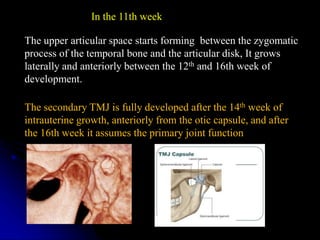
In the 11th week
The upper articular space starts forming between the zygomatic
process of the temporal bone and the articular disk, It grows
laterally and anteriorly between the 12th and 16th week of
development.
The secondary TMJ is fully developed after the 14th week of
intrauterine growth, anteriorly from the otic capsule, and after
the 16th week it assumes the primary joint function
Primitive jaw joint between the incus
and the malleus
Lateral
pterygoid
malleus
incus
Anatomy of TMJ
Joint architecture
Functional anatomy
Classified as a ginglymodiarthrodial joint, a joint that is capable
of hinge-type movements (ginglymos) and gliding movements,
with the bony components enclosed and connected by a fibrous
capsule.
The articulation is formed by the mandibular condyle occupying
a hollow in the temporal bone (the mandibular or glenoid fossa).
During wide mouth opening, the condyle rotates around a hinge
axis and glides, causing it to move beyond the anterior border of
the fossa, the articular eminence. The TMJ has a rigid end point
when the teeth contact .
 The TMJ is classified as a compound joint.
 By definition, a compound joint requires the presence of at
least 3 bones, but the TMJ is made of only 2 bones i.e
mandibular bone and the temporal bone. Functionally the
articular disc serves as the non-ossified bone that permit the
complex movements of the joint.
 This articular disc functions as 3 rd bone and the TMJ is
considered a compound joint.
Occurs by two mechanisms:-
a) weeping lubrication
b) boundary lubrication.
Weeping lubrication : During movement under conditions of
loading, the hydrostatic pressure exceeds the pressure within the
cartilage itself, causing a squeezing out of synovial fluid.
Joint lubrication
Boundary lubrication : During movement under conditions
of little or no loading, there is thought to exist a glycoprotein
that binds to the surface of the cartilage called the “lubricating
protein”, to keep the cartilage surfaces of a joint from actually
making contact this is called boundary lubrication.
Synovial Fluid forced from one area of cavity to another .
 The forces created between the articular Surfaces drive a small
amount of synovial fluid in and out of the articular tissues, thus
produce exchange of metabolites.
 Under compressive forces, therefore a small amount of synovial
fluid is released. This synovial fluid acts as a lubricant between
articular tissues to prevent sticking.
Weeping lubrication helps eliminate friction in the compressed
joint but in moving joint only a small amount of friction is
eliminated as a result of weeping lubrication;
therefore, prolonged compressive forces to the articular
surfaces will exhaust this supply.
•The distinguishing features of this joint include a covering of
fibro cartilage over the articulating surfaces, rather than hyaline
cartilage and its bilaterality.
•Fibro cartilage is less distensible than hyaline cartilage due to a
greater number of collagen fibers.
Fibro cartilage
The matrix and chondrocytes are decreased because of the
larger irregular bundles of collagen fibers.
Fibro cartilage derives its nutrition from the diffusion of
nutrients into the synovial fluid; these then diffuse through the
dense matrix to the chondrocytes.
Articular disc
•The space between the condyle and mandibular fossa is occupied
by collagenous fibrous tissue of variable thickness, called the
articular disk.
•The disk consists of collagen fibers, cartilage-like proteoglycans
and elastic fibers. The disk contains variable numbers of cartilage
cells and is referred to as a fibro cartilage.
The collagen fibers in the center of the disk are oriented
perpendicular to its transverse axis. The collagen fibers
become interlaced as they approach the anterior and posterior
bands, and many fibers are oriented parallel to the mediolateral
aspect of the disk.
The cartilage-like proteoglycans contribute to the compressive
stiffness of articular cartilage.
The articular disc
•The disk is attached to the lateral and medial poles of the
condyle by ligaments consisting of collagen and elastic fibers.
• These ligaments permit rotational movement of the disk on the
condyle during the opening and closing of the jaw. The disk is
thinnest in its center and thickens to form anterior and posterior
bands.
This arrangement is considered to help stabilize the condyle in
the glenoid fossa. The disk is primarily avascular and has little
sensory nerve penetration.
 The articular disc is not only attached to the capsular ligament
anteriorly and posteriorly but also medially and laterally.
 It divides the joint cavity into two distinct cavities.
 The upper and superior cavity is bordered by mandibular fossa
and the superior surface of the disc.
 The lower and the inferior cavity is bordered by the mandibular
condyle and the inferior surface of the disc.
Upper
joint
cavity
Lower
joint
cavity
The passive volume :-
upper compartment is 1.2 mL,
lower compartment is 0.9 mL.
The roof of the superior compartment is the mandibular fossa
whereas the floor is the superior surface of the disk. The roof of
the inferior compartment is the inferior surface of the disk, and
the floor is the articulating surface of the mandibular condyle.
Fibers of the posterior one-third of the temporalis muscle and
deep masseter muscle may attach on the anterolateral aspect..
Fibers of the superior head of the lateral pterygoid have been
observed to insert into the anteromedial two-thirds of the disk
Hinge movement- closed
Hinge movements- open
Ligaments
1. Capsular ligament
2. Temperomandibular ligament
3. Collateral ligament
Functional ligament of the TMJ
There are also 2 accessory ligaments attached
1. sphenomandibular ligament
2. stylomandibular ligament
CAPSULAR LIGAMENT
• The capsular ligament is a thin inelastic fibrous
connective-tissue envelope that encompasses the TMJ. It
attaches superiorly to the margins of the articular surfaces
and inferiorly to the neck of the condyle..
• A significant function of the capsular ligament is to
encompass the joint thus retaining the synovial fluid.
Capsular
ligament
Attaches to the medial and lateral borders of disc at the poles of
the condyles. They are commonly called the discal ligaments
and they are two.
COLLATERAL LIGAMENT
 The medial discal ligament attaches the medial edge of the disc
to the medial pole of the condyle.
 The lateral discal ligament attaches the lateral edge of the disc
to the lateral pole of the condyle.
 These ligaments are responsible for dividing the joint
mediolaterally into superior and inferior joint cavity. They are
true ligaments composed of connective tissue fiber, hence they
do not stretch.
They function to restrict movement of the disc away from the
condyle. In other words they allow the disc to move passively so
as to glide anteriorly and posteriorly on the articular surface of
the condyle.
They are responsible for hinging movements between condyle
and articular disc. The discal ligaments have a vascular supply
and are innervated. Their innervations provide information
regarding joint position and movement. Strain on this ligament
produces pain.
It is the main ligament of the joint,
 lateral to the capsule but not easily separated from
it by dissection.
 Its fibers pass obliquely from bone lateral to the articular
tubercle in a posterior and inferior direction and insert in a
narrower area below and behind the lateral pole of the condyle
TEMPEROMANDIBULAR LIGAMENT
 In earlier literature, this ligament was identified as an
oblique band from the condylar neck to the
anterosuperior region on the eminence and as a
horizontal band from the lateral condylar pole to an
anterior attachment of the eminence.
Temperomandibular ligaments
ACCESSORY LIGAMENTS OF TMJ
Vascular supply of joint
The external carotid artery is the main blood supply for the
tempero-mandibular structures.
The artery sends two important branches, the lingual and facial
arteries, to supply parotid gland and the region around it.
At the level of the condylar neck, the external carotid bifurcates
into the superficial temporal artery and the internal maxillary
artery.
 These two arteries supply the muscles of mastication and the
TMJ.
Arteries within the temporal bone or mandible may also send
branches to the capsule.
The deep temporal and masseteric nerves -anterior portion of
the joint. (motor nerves), but they contain sensory fibers
distributed to the anterior part of the TMJ capsule.
The autonomic nerve supply is carried to the joint by the
auriculotemporal nerve and by nerves traveling along the
superficial temporal artery.
TMJ
DISORDERS
Etiology of TMJ disorders
• The etiology of the most common TMD is unknown. Two
hypotheses,
 occlusal disharmony
 psychological distress,
• Para functional habits (e.g., nocturnal bruxing, tooth
Clenching, lip or cheek biting)
• Emotional distress
• Acute trauma from blows or impacts
• Trauma from hyperextension (e.g., dental procedures,
oral intubations, yawning, hyperextension associated with
cervical trauma)
• Instability of maxillomandibular relationships
• Rheumatic or musculoskeletal disorders
• Poor general health and an unhealthy lifestyle
 The frequency and the importance of these factors as causes are
unknown.
 The psychological hypothesis proposes that the disorder evolves as
a consequence of psychological distress that is usually due to the
individual’s stressful environment; the psychological distress leads
to Para functional habits (tooth clenching and grinding) that result
in muscle pain.
Muscle and facial disorders Myalgia; muscle contracture; hypertrophy; spasm;
dyskinesia; forceful jaw closure habit; myositis
(bruxism)
TMJ disorders Disk condyle incoordination; osteoarthritis; disk
condyle restriction; inflammatory polyarthritis; open
dislocation; trauma
Disorder of mandibular
mobility
Ankylosis; adhesions (intracapsular); fibrosis of
muscular tissue; coronoid elongation;hypermobility
of TMJ
Disorders of
maxillomandibular growth
Masticatory-muscle hypertrophy; neoplasia (muscle,
maxillomandibular or condylar); maxillomandibular
or condylar Hypoplasia / hyperplasia
Classification for diagnosing TMJ disorders
Assessment of Para functional Habits
It is difficult to determine the presence of active severe oral
habits. The patient is often unaware of tooth clenching or other
behaviors contributing to jaw hyperactivity while awake.
 Self-reports, instructions for checking jaw activity during the
day, and reports by sleeping partners of tooth-grinding noises are
helpful.
 Examination for tooth wear, soft-tissue changes (lip or cheek
chewing, a hyperplastic occlusal line, and scalloped tongue
borders), and hypertrophic jaw-closing muscles may suggest
hyperactivity.
CONCLUSION
Dentists must learn to correctly diagnosis and
properly treat acute orofacial pain conditions
with practical, cost-effective, and evidence
based approaches. Acute pain management is
necessary to prevent an acute condition from
becoming a chronic pain disorder in the future.
Prosthodontic Management of Temporomandibular Disorders. J
Indian Prosthodont society2013 Dec; 13(4): 400–405.
Temporomandibular Joint Disorders: A Review of Etiology,
Clinical Management, and Tissue Engineering Strategies.
Int J Oral Maxillofac Implants. 2013 Nov-Dec; 28(6): e393–
e414
Temporomandibular Joint Disorders (TMD).
2021:79(10); 2171-2
Reported concepts for the treatment modalities and
pain management of temporomandibular disorders.
Thank You

TMJ and it’s Prosthodontic Implication

  • 1.
    “ You cannotsuccessfully treat dysfunction unless you understand function” TMJ and its Prosthodontic Implication
  • 2.
    Contents  Introduction  Classificationof TMJ  Development and evolution  TMJ embryology  Functional anatomy  Muscles and ligaments
  • 3.
     Biomechanics ofthe TMJ  Temperomandibular disorders  Intra oral appliances  Management of TMD symptoms  Summary  References
  • 4.
    Introduction prosthodntists are constantlybeing challenged with the task of providing their patients with acceptable esthetics and masticatory function. Developing a sound, functional masticatory system is the primary goal of all Prosthodontics therapy. The prosthodontist a unique person to either improve or worsen the occlusal condition while carrying out the esthetic goals therapy. Therefore prosthodontist should know the normal masticatory function and the goals that need to be achieved to maintain normal function.
  • 5.
    The Temporomandibular joint(TMJ) is the jaw joint. As the term temporomandibular indicates, this joint includes the temporal bone and mandible. The glenoid fossa and articular eminence of the temporal bone, the condyle of mandible, and the articular disk between bones make up TMJ area.
  • 6.
    Classification of TMJ 1.BICONDYLAR- the joint consist of bilateral articulation. 2. GINGLYMOARTHROIDAL- TMJ offers hinging movements i.e ginglymoid, also provide gliding movement ,hence arthroidal. 3. DIARTHROIDAL- capability of free movements. 4. COMPOUND joint - A compound joint requires the presence of three bones, yet the TMJ is made up of only two bones. Functionally, the articular disc serves as a non-ossified bone that permits complex movement of the joint. 5. SYNOVIAL joint- joint filled with synovial fluid. Management of TMJ disorders and occlusion by Jeffrey Okeson ,6th ed
  • 7.
    TMJ evolution In primitivevertebrates - cephalisation led to the development of jaws, became specialized for the purpose of collecting food. Later stages of evolution amphibians and reptiles came to the dry land for food. Survival in the habitat meant greater demands upon the jaw.
  • 8.
    malleus Primitive jaw jointbetween the incus and the malleus incus
  • 9.
    The early TMJstructures emerged progressively from a block of embryonic mesenchymal cells interposed between the developing temporal bone and mandible. The critical period in the early prenatal morphogenesis of human TMJ is approx. during the time of early 7-11 weeks of fertilization age. There appears to be a definite pattern or sequence in the early shaping of each component of TMJ relative to structure and cronology. TMJ embryology
  • 11.
    Embryonic Development ofthe Temporomandibular Joint 4TH week of embryonic development. Upper and lower jaw bones as well as temporal bones develops After 4-5 weeks of development stomodeum is surrounded by mandibular process (ventral part of the first pharyngeal arch), maxillary process (dorsal part of the first pharyngeal arch), and by a frontal process from above In the mandibular process, Meckel’s cartilage is formed. (The tympanic and mandibular process of Meckel’s cartilage is completely developed in the 16th week of embryonic development.)
  • 12.
    The thickened posteriorending of the tympanic cartilage is the primordial cartilage called the malleus. Malleus is in direct contact with the primordial cartilage called the incus by means of a flat articulation plane From the 8th until the 16th week of development the primordial cartilages function as the primary temporomandibular or malleoincudal joint; auditory ossicles develop from the latter. This joint can perform only simple rotation or buccal movements, which appear in the 8th week of development.
  • 13.
    Later, the malleusis separated from Meckel’s cartilage and ossified to become the middle ear ossicle TMJ development takes place mostly between the 7th and 20th week of intrauterine life and a particularly sensitive period is morphogenesis between the 7th and 11th week Temporomandibular joint development and funct ional disorders relat ed to clinica ln otologic symptomatology, T. Badel et al. Acta Clin Croat, Vol. 50, No. 1, 2011
  • 14.
    There are threestages in TMJ development 1) Blastemic stage (7th-8th week) - development of the condyles, articular fossa, articular disk and capsule 2)Cavitation (9th-11th week) - beginning of lower joint space development and condylar chondrogenesis, and 3) Maturation stage (after the 12th week) Temporomandibular joint development and funct ional disorders relat ed to clinica ln otologic symptomatology, T. Badel et al. Acta Clin Croat, Vol. 50, No. 1, 2011
  • 16.
    Temporomandibular joint developmentand funct ional disorders relat ed to clinica ln otologic symptomatology, T. Badel et al. Acta Clin Croat, Vol. 50, No. 1, 2011
  • 17.
    After the 7thweek mesenchymal thickening is visible, positioned craniolaterally from the future condyle, out of which the articular disk develops. Due to the forming of articular spaces, the articular disk is thinner in the middle section, which later creates a characteristic biconcave shape In the 8th week The mesenchymal development of the articular capsule starts and stretches from the squamous part of the temporal bone towards the articular disk and the condyle
  • 18.
    In the 9thweek, chondrogenesis begins from the mesenchyme cells, laterally from Meckel’s cartilage, in the middle of the condylar blastema. In the 10th week the condylar head and the entire conical condyle are apically surrounded by the lower jaw body, which is ossified intramembraneously In the period of the 11th and 12th week the articular fossa can be concave, convex or completely flat. The articular fossa spreads cranially from the condyle in anterior direction and from the 12th week it has a concave shape
  • 19.
    In the 11thweek The upper articular space starts forming between the zygomatic process of the temporal bone and the articular disk, It grows laterally and anteriorly between the 12th and 16th week of development. The secondary TMJ is fully developed after the 14th week of intrauterine growth, anteriorly from the otic capsule, and after the 16th week it assumes the primary joint function
  • 20.
    Primitive jaw jointbetween the incus and the malleus Lateral pterygoid malleus incus
  • 21.
  • 22.
  • 23.
    Functional anatomy Classified asa ginglymodiarthrodial joint, a joint that is capable of hinge-type movements (ginglymos) and gliding movements, with the bony components enclosed and connected by a fibrous capsule. The articulation is formed by the mandibular condyle occupying a hollow in the temporal bone (the mandibular or glenoid fossa). During wide mouth opening, the condyle rotates around a hinge axis and glides, causing it to move beyond the anterior border of the fossa, the articular eminence. The TMJ has a rigid end point when the teeth contact .
  • 24.
     The TMJis classified as a compound joint.  By definition, a compound joint requires the presence of at least 3 bones, but the TMJ is made of only 2 bones i.e mandibular bone and the temporal bone. Functionally the articular disc serves as the non-ossified bone that permit the complex movements of the joint.  This articular disc functions as 3 rd bone and the TMJ is considered a compound joint.
  • 25.
    Occurs by twomechanisms:- a) weeping lubrication b) boundary lubrication. Weeping lubrication : During movement under conditions of loading, the hydrostatic pressure exceeds the pressure within the cartilage itself, causing a squeezing out of synovial fluid. Joint lubrication
  • 26.
    Boundary lubrication :During movement under conditions of little or no loading, there is thought to exist a glycoprotein that binds to the surface of the cartilage called the “lubricating protein”, to keep the cartilage surfaces of a joint from actually making contact this is called boundary lubrication. Synovial Fluid forced from one area of cavity to another .
  • 27.
     The forcescreated between the articular Surfaces drive a small amount of synovial fluid in and out of the articular tissues, thus produce exchange of metabolites.  Under compressive forces, therefore a small amount of synovial fluid is released. This synovial fluid acts as a lubricant between articular tissues to prevent sticking.
  • 28.
    Weeping lubrication helpseliminate friction in the compressed joint but in moving joint only a small amount of friction is eliminated as a result of weeping lubrication; therefore, prolonged compressive forces to the articular surfaces will exhaust this supply.
  • 29.
    •The distinguishing featuresof this joint include a covering of fibro cartilage over the articulating surfaces, rather than hyaline cartilage and its bilaterality. •Fibro cartilage is less distensible than hyaline cartilage due to a greater number of collagen fibers. Fibro cartilage
  • 30.
    The matrix andchondrocytes are decreased because of the larger irregular bundles of collagen fibers. Fibro cartilage derives its nutrition from the diffusion of nutrients into the synovial fluid; these then diffuse through the dense matrix to the chondrocytes.
  • 31.
    Articular disc •The spacebetween the condyle and mandibular fossa is occupied by collagenous fibrous tissue of variable thickness, called the articular disk. •The disk consists of collagen fibers, cartilage-like proteoglycans and elastic fibers. The disk contains variable numbers of cartilage cells and is referred to as a fibro cartilage.
  • 32.
    The collagen fibersin the center of the disk are oriented perpendicular to its transverse axis. The collagen fibers become interlaced as they approach the anterior and posterior bands, and many fibers are oriented parallel to the mediolateral aspect of the disk. The cartilage-like proteoglycans contribute to the compressive stiffness of articular cartilage.
  • 33.
  • 34.
    •The disk isattached to the lateral and medial poles of the condyle by ligaments consisting of collagen and elastic fibers. • These ligaments permit rotational movement of the disk on the condyle during the opening and closing of the jaw. The disk is thinnest in its center and thickens to form anterior and posterior bands.
  • 35.
    This arrangement isconsidered to help stabilize the condyle in the glenoid fossa. The disk is primarily avascular and has little sensory nerve penetration.
  • 36.
     The articulardisc is not only attached to the capsular ligament anteriorly and posteriorly but also medially and laterally.  It divides the joint cavity into two distinct cavities.  The upper and superior cavity is bordered by mandibular fossa and the superior surface of the disc.  The lower and the inferior cavity is bordered by the mandibular condyle and the inferior surface of the disc. Upper joint cavity Lower joint cavity
  • 37.
    The passive volume:- upper compartment is 1.2 mL, lower compartment is 0.9 mL. The roof of the superior compartment is the mandibular fossa whereas the floor is the superior surface of the disk. The roof of the inferior compartment is the inferior surface of the disk, and the floor is the articulating surface of the mandibular condyle.
  • 38.
    Fibers of theposterior one-third of the temporalis muscle and deep masseter muscle may attach on the anterolateral aspect.. Fibers of the superior head of the lateral pterygoid have been observed to insert into the anteromedial two-thirds of the disk
  • 39.
  • 40.
  • 41.
    Ligaments 1. Capsular ligament 2.Temperomandibular ligament 3. Collateral ligament Functional ligament of the TMJ There are also 2 accessory ligaments attached 1. sphenomandibular ligament 2. stylomandibular ligament
  • 42.
    CAPSULAR LIGAMENT • Thecapsular ligament is a thin inelastic fibrous connective-tissue envelope that encompasses the TMJ. It attaches superiorly to the margins of the articular surfaces and inferiorly to the neck of the condyle.. • A significant function of the capsular ligament is to encompass the joint thus retaining the synovial fluid. Capsular ligament
  • 43.
    Attaches to themedial and lateral borders of disc at the poles of the condyles. They are commonly called the discal ligaments and they are two. COLLATERAL LIGAMENT  The medial discal ligament attaches the medial edge of the disc to the medial pole of the condyle.
  • 44.
     The lateraldiscal ligament attaches the lateral edge of the disc to the lateral pole of the condyle.  These ligaments are responsible for dividing the joint mediolaterally into superior and inferior joint cavity. They are true ligaments composed of connective tissue fiber, hence they do not stretch.
  • 45.
    They function torestrict movement of the disc away from the condyle. In other words they allow the disc to move passively so as to glide anteriorly and posteriorly on the articular surface of the condyle. They are responsible for hinging movements between condyle and articular disc. The discal ligaments have a vascular supply and are innervated. Their innervations provide information regarding joint position and movement. Strain on this ligament produces pain.
  • 46.
    It is themain ligament of the joint,  lateral to the capsule but not easily separated from it by dissection.  Its fibers pass obliquely from bone lateral to the articular tubercle in a posterior and inferior direction and insert in a narrower area below and behind the lateral pole of the condyle TEMPEROMANDIBULAR LIGAMENT
  • 47.
     In earlierliterature, this ligament was identified as an oblique band from the condylar neck to the anterosuperior region on the eminence and as a horizontal band from the lateral condylar pole to an anterior attachment of the eminence.
  • 48.
  • 49.
  • 51.
    Vascular supply ofjoint The external carotid artery is the main blood supply for the tempero-mandibular structures. The artery sends two important branches, the lingual and facial arteries, to supply parotid gland and the region around it. At the level of the condylar neck, the external carotid bifurcates into the superficial temporal artery and the internal maxillary artery.  These two arteries supply the muscles of mastication and the TMJ. Arteries within the temporal bone or mandible may also send branches to the capsule.
  • 52.
    The deep temporaland masseteric nerves -anterior portion of the joint. (motor nerves), but they contain sensory fibers distributed to the anterior part of the TMJ capsule. The autonomic nerve supply is carried to the joint by the auriculotemporal nerve and by nerves traveling along the superficial temporal artery.
  • 54.
  • 55.
    Etiology of TMJdisorders • The etiology of the most common TMD is unknown. Two hypotheses,  occlusal disharmony  psychological distress, • Para functional habits (e.g., nocturnal bruxing, tooth Clenching, lip or cheek biting) • Emotional distress • Acute trauma from blows or impacts • Trauma from hyperextension (e.g., dental procedures, oral intubations, yawning, hyperextension associated with cervical trauma)
  • 56.
    • Instability ofmaxillomandibular relationships • Rheumatic or musculoskeletal disorders • Poor general health and an unhealthy lifestyle  The frequency and the importance of these factors as causes are unknown.  The psychological hypothesis proposes that the disorder evolves as a consequence of psychological distress that is usually due to the individual’s stressful environment; the psychological distress leads to Para functional habits (tooth clenching and grinding) that result in muscle pain.
  • 57.
    Muscle and facialdisorders Myalgia; muscle contracture; hypertrophy; spasm; dyskinesia; forceful jaw closure habit; myositis (bruxism) TMJ disorders Disk condyle incoordination; osteoarthritis; disk condyle restriction; inflammatory polyarthritis; open dislocation; trauma Disorder of mandibular mobility Ankylosis; adhesions (intracapsular); fibrosis of muscular tissue; coronoid elongation;hypermobility of TMJ Disorders of maxillomandibular growth Masticatory-muscle hypertrophy; neoplasia (muscle, maxillomandibular or condylar); maxillomandibular or condylar Hypoplasia / hyperplasia Classification for diagnosing TMJ disorders
  • 58.
    Assessment of Parafunctional Habits It is difficult to determine the presence of active severe oral habits. The patient is often unaware of tooth clenching or other behaviors contributing to jaw hyperactivity while awake.  Self-reports, instructions for checking jaw activity during the day, and reports by sleeping partners of tooth-grinding noises are helpful.  Examination for tooth wear, soft-tissue changes (lip or cheek chewing, a hyperplastic occlusal line, and scalloped tongue borders), and hypertrophic jaw-closing muscles may suggest hyperactivity.
  • 59.
    CONCLUSION Dentists must learnto correctly diagnosis and properly treat acute orofacial pain conditions with practical, cost-effective, and evidence based approaches. Acute pain management is necessary to prevent an acute condition from becoming a chronic pain disorder in the future.
  • 60.
    Prosthodontic Management ofTemporomandibular Disorders. J Indian Prosthodont society2013 Dec; 13(4): 400–405. Temporomandibular Joint Disorders: A Review of Etiology, Clinical Management, and Tissue Engineering Strategies. Int J Oral Maxillofac Implants. 2013 Nov-Dec; 28(6): e393– e414 Temporomandibular Joint Disorders (TMD). 2021:79(10); 2171-2
  • 61.
    Reported concepts forthe treatment modalities and pain management of temporomandibular disorders.
  • 62.

Editor's Notes

  • #8 The agnatha, the earliest type of vertebrate, had its mouth opening on the ventral side anteriorly along the vertebral axis. This opening led through an oropharyngeal channel to the gut proper. synarthrosis, which was considered to be the earliest form of a jaw joint. This structure remains as an epiceratobranchial joint in the present-day shark.
  • #32 According to Rees (1954), the disc is divided into the following four parts: (1) the anterior band, a thickened portion in the anterior part of the disc; (2) the intermediate band, a narrow and quite thin portion posterior to the anterior band; (3) the posterior band, a thickened portion in the posterior part of the disc; (4) the bilaminar zone, which is divided into two parts: an upper layer containing elastic fibers and attaching to the posterior margin of the glenoid fossa and the tympanosquamous fissure, and a lower layer composed mainly of collagen fibers and attached to the posterior aspect of the condylar head.