Assalamu Alaikum Wa Rahmatullah
Presentation On Structural
Linguistics
Course Code: LING 304
Evolution to Language Communication
Course Teacher: Tanjima Tahrin Konok
Topics will be discussed:
1. Prague School & Linguistics
2. Roman Jakobson
3. Nikolay Trubetzkoy
4. Ferdinand De Saussure
5. Copenhagen School & Linguistics
Prague School & Linguistics
Introduction :
• The capital and the largest city in the Czech Republic.
• The 13th largest city in the European Union
• The historical capital of Bohemia.
Prague Linguistic Circle:
• A language and literature society.
• Started in 1926 as a group of linguists. philologists and literary
critics in Prague.
• Developed methods of structuralist literary analysis and a theory
of the standard language
founded in the Cafe Derby in Prague where meetings took place
during its first years
Prague School & Linguistics
• Prague School and Linguistics
• Language study synchronic or diachronic
• Study of language through relationship with existing elements
• Language is a tool for performing various functions in a
society.
• Three Functions of a Language .
• Karl Buhler
• i. Cognitive function (transfer factual info)
• ii. Expressive function (mood. attitude)
• iii. Conative function (influences the addresser) (the mental
faculty of purpose, desire. or will to perform an action)
Prague School & Linguistics
• Contributions of Prague School:
• It saw language in terms of function.
• They analyzed language with a view of showing
the functions played by the different
components.
• They looked at languages and explained why
languages were the way they were.
• Use of terms theme and rheme.
• It was interested in standardizing linguistic usage
Prague School & Linguistics
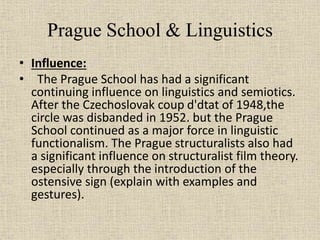
• Influence:
• The Prague School has had a significant
continuing influence on linguistics and semiotics.
After the Czechoslovak coup d'dtat of 1948,the
circle was disbanded in 1952. but the Prague
School continued as a major force in linguistic
functionalism. The Prague structuralists also had
a significant influence on structuralist film theory.
especially through the introduction of the
ostensive sign (explain with examples and
gestures).
Roman Jakobson
• A pioneer of structural linguistics
Jakobson was one of the most
celebrated and influential
linguistics of twentyth century, a
principal founder of the
european movement in structural
linguistics is known as prague
school.
Roman Jakobson
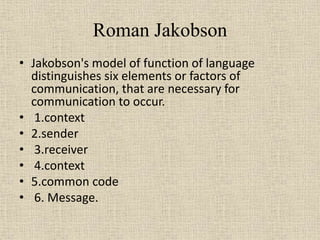
• Jakobson's model of function of language
distinguishes six elements or factors of
communication, that are necessary for
communication to occur.
• 1.context
• 2.sender
• 3.receiver
• 4.context
• 5.common code
• 6. Message.
Established in 1926 by Vilem Mathesius.
It is an influential group of linguist, philosophers and literary
critics.
It was influenced by Saussurian school.
Proponents: Nikolai Trubetzkoy, Roman Jakobson, Sergei
Karcevskiy
Nikolai Trubezkoi was leading representitive of prague school.
Contribution: Phonology and the distinction between
phonetics and phonology.
Focus:
1. Language in terms of function.
2. Sound system analysis i.g. Phonology.
Nikolai Trubetzkoy
Born: 16 April 1890, Moscow, Russia.
Graduated from Moscow University
Worked at University of Vienna as Professor of Slavic
Philology.
Books:
• Principles of Phonology,
• Writings on Literature( Theory of Literature)
Died: 25 June 1938, Vienna, Germany.
Nikolai Trubetzkoy
Further information about N. Trubetzkoy
• He is a Russian linguist whose teachings formed a
nucleus of the Prague School of structural linguistics.
• He was widely considered to be the founder of
morphophonology.
• His principles of phonological theory have been
also applied to the analysis of sign languages.
Nikolai Trubetzkoy
• N. Trubetzkoy: Principle of Phonology
• Phonetics and phonology : different for parole and langue
• Phoneme: an abstract unite of the sound system.
• Distinctive feature: phonological oppositions.
Nikolai Trubetzkoy
Contribution to Prague School:
1. Showed distinctive functions of speech sounds and gave an
accurate definition of the phoneme.
2. Reveled the interdependent syntagmatic and paradigmatic
relations between phonemes.
3. Making distinction between phonetics and phonology, he
defined the sphere of phonological studies.
4. He put a set of methodologies for phonological studies such
as method of extracting phonemes.
5. Analysis of utterances in terms of the information they
contain.
6. The role of each utterance part is evaluated for its semantic
contribution to the whole.
শ্বশুর
Ferdinand De Saussure
The Father of “Modern Linguistics”
Contributions:
1. Synchronic-Diachronic
View
2. Sign-Signifier-Signified
3. Langue & Parole
4. Syntagmatic &
Paradigmatic Relation
Synchronic-Diachronic View
• Synchronic View: Synchronic linguistics sees
language as a living whole, existing as a state
at particular point in time.
Synchronic View
Diachronic View: It Studies how language develops
by time to time or the history of language and
change
Synchronic-Diachronic View
Diachronic View
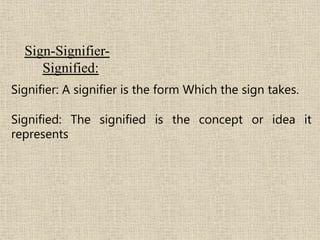
Signifier: A signifier is the form Which the sign takes.
Signified: The signified is the concept or idea it
represents
Sign-Signifier-
Signified:
Sign-Signifier-
Signified:
Sign
Cat (Munni)
Signifier
Signified
/kæt/
Cat? So what?
AWWWW….
AWWWW
….
Aqsa is ours
What does this picture
Thank You Everyone for being
with us
Group members:
Syeda Nujhat Jabin- 19114001
Ashfia Rahman - 18114040
Sabil Ahamed Khan- 18114041
Md. Jamil Ahmed- 19114002
Md Shafayet Ahmed- 19114020
Kofil Uddin Joy-19114022

Presentation On Structural Linguistics.pptx

  • 1.
  • 2.
    Presentation On Structural Linguistics CourseCode: LING 304 Evolution to Language Communication Course Teacher: Tanjima Tahrin Konok
  • 3.
    Topics will bediscussed: 1. Prague School & Linguistics 2. Roman Jakobson 3. Nikolay Trubetzkoy 4. Ferdinand De Saussure 5. Copenhagen School & Linguistics
  • 4.
    Prague School &Linguistics Introduction : • The capital and the largest city in the Czech Republic. • The 13th largest city in the European Union • The historical capital of Bohemia. Prague Linguistic Circle: • A language and literature society. • Started in 1926 as a group of linguists. philologists and literary critics in Prague. • Developed methods of structuralist literary analysis and a theory of the standard language founded in the Cafe Derby in Prague where meetings took place during its first years
  • 5.
    Prague School &Linguistics • Prague School and Linguistics • Language study synchronic or diachronic • Study of language through relationship with existing elements • Language is a tool for performing various functions in a society. • Three Functions of a Language . • Karl Buhler • i. Cognitive function (transfer factual info) • ii. Expressive function (mood. attitude) • iii. Conative function (influences the addresser) (the mental faculty of purpose, desire. or will to perform an action)
  • 6.
    Prague School &Linguistics • Contributions of Prague School: • It saw language in terms of function. • They analyzed language with a view of showing the functions played by the different components. • They looked at languages and explained why languages were the way they were. • Use of terms theme and rheme. • It was interested in standardizing linguistic usage
  • 7.
    Prague School &Linguistics • Influence: • The Prague School has had a significant continuing influence on linguistics and semiotics. After the Czechoslovak coup d'dtat of 1948,the circle was disbanded in 1952. but the Prague School continued as a major force in linguistic functionalism. The Prague structuralists also had a significant influence on structuralist film theory. especially through the introduction of the ostensive sign (explain with examples and gestures).
  • 8.
    Roman Jakobson • Apioneer of structural linguistics Jakobson was one of the most celebrated and influential linguistics of twentyth century, a principal founder of the european movement in structural linguistics is known as prague school.
  • 9.
    Roman Jakobson • Jakobson'smodel of function of language distinguishes six elements or factors of communication, that are necessary for communication to occur. • 1.context • 2.sender • 3.receiver • 4.context • 5.common code • 6. Message.
  • 11.
    Established in 1926by Vilem Mathesius. It is an influential group of linguist, philosophers and literary critics. It was influenced by Saussurian school. Proponents: Nikolai Trubetzkoy, Roman Jakobson, Sergei Karcevskiy Nikolai Trubezkoi was leading representitive of prague school. Contribution: Phonology and the distinction between phonetics and phonology. Focus: 1. Language in terms of function. 2. Sound system analysis i.g. Phonology.
  • 12.
    Nikolai Trubetzkoy Born: 16April 1890, Moscow, Russia. Graduated from Moscow University Worked at University of Vienna as Professor of Slavic Philology. Books: • Principles of Phonology, • Writings on Literature( Theory of Literature) Died: 25 June 1938, Vienna, Germany.
  • 13.
    Nikolai Trubetzkoy Further informationabout N. Trubetzkoy • He is a Russian linguist whose teachings formed a nucleus of the Prague School of structural linguistics. • He was widely considered to be the founder of morphophonology. • His principles of phonological theory have been also applied to the analysis of sign languages.
  • 14.
    Nikolai Trubetzkoy • N.Trubetzkoy: Principle of Phonology • Phonetics and phonology : different for parole and langue • Phoneme: an abstract unite of the sound system. • Distinctive feature: phonological oppositions.
  • 15.
    Nikolai Trubetzkoy Contribution toPrague School: 1. Showed distinctive functions of speech sounds and gave an accurate definition of the phoneme. 2. Reveled the interdependent syntagmatic and paradigmatic relations between phonemes. 3. Making distinction between phonetics and phonology, he defined the sphere of phonological studies. 4. He put a set of methodologies for phonological studies such as method of extracting phonemes. 5. Analysis of utterances in terms of the information they contain. 6. The role of each utterance part is evaluated for its semantic contribution to the whole.
  • 17.
  • 19.
    Ferdinand De Saussure TheFather of “Modern Linguistics” Contributions: 1. Synchronic-Diachronic View 2. Sign-Signifier-Signified 3. Langue & Parole 4. Syntagmatic & Paradigmatic Relation
  • 20.
    Synchronic-Diachronic View • SynchronicView: Synchronic linguistics sees language as a living whole, existing as a state at particular point in time. Synchronic View
  • 21.
    Diachronic View: ItStudies how language develops by time to time or the history of language and change Synchronic-Diachronic View Diachronic View
  • 22.
    Signifier: A signifieris the form Which the sign takes. Signified: The signified is the concept or idea it represents Sign-Signifier- Signified:
  • 24.
  • 26.
  • 28.
  • 30.
  • 32.
  • 42.
    Thank You Everyonefor being with us Group members: Syeda Nujhat Jabin- 19114001 Ashfia Rahman - 18114040 Sabil Ahamed Khan- 18114041 Md. Jamil Ahmed- 19114002 Md Shafayet Ahmed- 19114020 Kofil Uddin Joy-19114022