Zika Virus: The Dreaded Infection of The
Century (Invited article by Dove Medical
Press)
Professor Dr. Omprakash H Nautiyal
Professor & Consulting scientist
102, Shubh Building, Shivalik II, Canal Road, TP13,
Vadodara 390024
Gujarat
Website www.opnautiyal.com
Published: 20 national, 20 international, 2
books, 9 international chapters, 4 patents, 20
reviewed, IBC Honor, Marquis Who’s who USA.
INTRODUCTION
Liquid surrounding the embryo of two pregnant
women (amniotic fluid) was detected with Zika
virus RNA in 2015 whose fetuses had microcephaly,
Brain tissue from two newborns with microcephaly
reported to die 20 hours of post birth and placenta
and other tissue of two miscarriages (11 and 13
weeks)
Rio Grande do Norte in Brazil tested virus by RT-PCR
positive for Zika at the CDC.
According to the WHO on 5 February 2016, a causal link
between the Zika virus and microcephaly was "strongly
suspected but not yet scientifically proven" and in Brazil "
Research in 1952 conducted in India had shown a "significant
number" of Indians tested for Zika had exhibited an immune
response to the virus with suggestion of long been widespread
within human populations.
A Rhesus monkey living in the Forest of Zika (hence the name)
in Uganda and so the Zika Virus first came to the attention of the
world in 1947,
World Health Officials and the CDC have taken the unusual
step of advising pregnant women and those thinking of
becoming pregnant to avoid visiting areas which have Zika Virus
outbreaks
Health authorities of Brazil reported more than 3,500
microcephaly cases between October 2015 and January 2016 few
of them of severe type and few were having died.
Virus isolation in monkeys and mosquitoes (1947)
First isolation of virus was carried out from a rhesus
macaque monkey in 1947 which was placed in a cage in the Zika
Forest of Uganda near Lake Victoria by the scientists of
the yellow fever Research Institute.
On developing a fever in monkey researchers isolated
“filterable transmissible agent” from its serum and was named
Zika virus in 1948.
First evidence of human infection, 1952
Zika virus had been known to infect humans from
the results of serological surveys in Uganda and
Nigeria.
A survey of 84 people of all ages showed 50
contained antibodies, with all above 40 years of age
being immune.
It was not until 1954 that the successful isolation of
Zika virus from a human was published.
 Vaccine Development
Effective vaccines exist for several flaviviruses, viz for yellow fever virus,
Japanese yellow fever virus, Japanese encephalitis, and tick borne
encephalitis were introduced in the 1930s, while the vaccine for dengue
fever only became available for use in the mid of 2010.
Nikos Vasilakis of the Center for Bio defense and Emerging Infectious
Diseases predicted that it may take two years to develop a vaccine, but 10
to 12 years may be needed before an effective Zika virus vaccine is
approved by regulators for public use.
Bharat Biotech International an Indian company reported in early
February 2016 that it was working on vaccines for the Zika virus.
The company is working on two approaches to a vaccine; “recombinant”
involving genetic engineering, and “inactivated” where the virus is
incapable of reproducing itself but may still trigger an immune response.
 Virology
The Zika virus having belonging to Flaviviridae and the
genus Flavivirus, and relates to the dengue, Yellow fever, Japanese
encephalitis and West Nile viruses. Zika virus like other flaviviruses,
is enveloped and icosahedral and contains non segmented, single-
stranded.
Zika virus like other flaviviruses, is enveloped and icosahedral and
contains non segmented, single-stranded. It was found with positive
sense RNA genome.
A positive sense RNA genome can be directly translated into viral
proteins. In other flaviviruses, such as the similarly sized West Nile virus,
seven nonstructural proteins and three structural proteins were found to
encode the RNA genome genes.
Dr. Michael Hager, Emory University senior development scientist is a
member of the chemistry staff at EIDD (Emory Institute of Drug
Development), one of the two drug development teams at Emory
working to find a treatment for those infected by the Zika virus.
Symptoms of Zika Virus
The main vector being Aedes aegypti mosquito that transmits the Zika Virus and fever
to humans when biting, their saliva contains the virus that passes into humans when
they feed on blood.
Zika virus symptomatically passing the infection usually exhibited influenza like
syndrome often mistaken for other arboviral infections like dengue and chikun gunya.
Fever between 37.8 o
C and 38.5 o
C
Pain most notably in small joints (Anthralgia)
Pain in the muscles of the body (Myalgia)
Headache
Non-purulent conjunctivitis (pink eye without the sticky substance)
retroocular headaches or headaches originating from behind the eyes.
Cutaneous maculopapular rash, flat red areas on the skin
Digestive troubles (abdominal pain, diarrhea, constipation,)
Small ulcer occurring in groups in the mouth or on the tongue (Aphthaea)
Severe itching of the skin (Pruritus)
Swelling in lower limbs (Oedema)
Weakness and loss of appetite
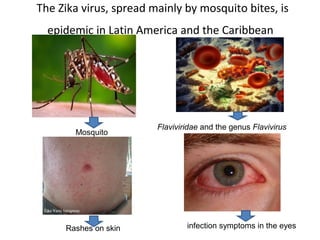
The Zika virus, spread mainly by mosquito bites, is
epidemic in Latin America and the Caribbean
Flaviviridae and the genus Flavivirus
                        Mosquito
infection symptoms in the eyes     Rashes on skin
Conclusions
An alliance of scientists is presently working to develop a Zika vaccine which
will protect against the virus.
By the time this happen public health measures are being placed
internationally to swiftly recognize the Zika cases and prevent the spreading of
the disease by controlling mosquitoes with pesticide and eliminating habitats
where insects breed.
Infected individuals infected with the Zika virus should have plenty of rest,
intake of fluids, and medications preferably acetaminophen for pain.
Aspirin and anti-inflammatory medications (NSAIDS) should be avoided
until dengue has been ruled out.
One must take steps to prevent mosquito bites is the best effective way to
protect oneself.
Countries declared of Zika virus outbreak and people traveling these
countries are encouraged to use insect repellent, wear long sleeves and long
pants, and window and door screens when inside must be in use.
Thank you very much

TITTR Zika Virus

  • 1.
    Zika Virus: TheDreaded Infection of The Century (Invited article by Dove Medical Press) Professor Dr. Omprakash H Nautiyal Professor & Consulting scientist 102, Shubh Building, Shivalik II, Canal Road, TP13, Vadodara 390024 Gujarat Website www.opnautiyal.com Published: 20 national, 20 international, 2 books, 9 international chapters, 4 patents, 20 reviewed, IBC Honor, Marquis Who’s who USA.
  • 2.
    INTRODUCTION Liquid surrounding theembryo of two pregnant women (amniotic fluid) was detected with Zika virus RNA in 2015 whose fetuses had microcephaly, Brain tissue from two newborns with microcephaly reported to die 20 hours of post birth and placenta and other tissue of two miscarriages (11 and 13 weeks) Rio Grande do Norte in Brazil tested virus by RT-PCR positive for Zika at the CDC.
  • 3.
    According to theWHO on 5 February 2016, a causal link between the Zika virus and microcephaly was "strongly suspected but not yet scientifically proven" and in Brazil " Research in 1952 conducted in India had shown a "significant number" of Indians tested for Zika had exhibited an immune response to the virus with suggestion of long been widespread within human populations. A Rhesus monkey living in the Forest of Zika (hence the name) in Uganda and so the Zika Virus first came to the attention of the world in 1947, World Health Officials and the CDC have taken the unusual step of advising pregnant women and those thinking of becoming pregnant to avoid visiting areas which have Zika Virus outbreaks
  • 4.
    Health authorities ofBrazil reported more than 3,500 microcephaly cases between October 2015 and January 2016 few of them of severe type and few were having died. Virus isolation in monkeys and mosquitoes (1947) First isolation of virus was carried out from a rhesus macaque monkey in 1947 which was placed in a cage in the Zika Forest of Uganda near Lake Victoria by the scientists of the yellow fever Research Institute. On developing a fever in monkey researchers isolated “filterable transmissible agent” from its serum and was named Zika virus in 1948.
  • 5.
    First evidence ofhuman infection, 1952 Zika virus had been known to infect humans from the results of serological surveys in Uganda and Nigeria. A survey of 84 people of all ages showed 50 contained antibodies, with all above 40 years of age being immune. It was not until 1954 that the successful isolation of Zika virus from a human was published.
  • 6.
     Vaccine Development Effectivevaccines exist for several flaviviruses, viz for yellow fever virus, Japanese yellow fever virus, Japanese encephalitis, and tick borne encephalitis were introduced in the 1930s, while the vaccine for dengue fever only became available for use in the mid of 2010. Nikos Vasilakis of the Center for Bio defense and Emerging Infectious Diseases predicted that it may take two years to develop a vaccine, but 10 to 12 years may be needed before an effective Zika virus vaccine is approved by regulators for public use. Bharat Biotech International an Indian company reported in early February 2016 that it was working on vaccines for the Zika virus. The company is working on two approaches to a vaccine; “recombinant” involving genetic engineering, and “inactivated” where the virus is incapable of reproducing itself but may still trigger an immune response.
  • 7.
     Virology The Zikavirus having belonging to Flaviviridae and the genus Flavivirus, and relates to the dengue, Yellow fever, Japanese encephalitis and West Nile viruses. Zika virus like other flaviviruses, is enveloped and icosahedral and contains non segmented, single- stranded. Zika virus like other flaviviruses, is enveloped and icosahedral and contains non segmented, single-stranded. It was found with positive sense RNA genome. A positive sense RNA genome can be directly translated into viral proteins. In other flaviviruses, such as the similarly sized West Nile virus, seven nonstructural proteins and three structural proteins were found to encode the RNA genome genes. Dr. Michael Hager, Emory University senior development scientist is a member of the chemistry staff at EIDD (Emory Institute of Drug Development), one of the two drug development teams at Emory working to find a treatment for those infected by the Zika virus.
  • 8.
    Symptoms of ZikaVirus The main vector being Aedes aegypti mosquito that transmits the Zika Virus and fever to humans when biting, their saliva contains the virus that passes into humans when they feed on blood. Zika virus symptomatically passing the infection usually exhibited influenza like syndrome often mistaken for other arboviral infections like dengue and chikun gunya. Fever between 37.8 o C and 38.5 o C Pain most notably in small joints (Anthralgia) Pain in the muscles of the body (Myalgia) Headache Non-purulent conjunctivitis (pink eye without the sticky substance) retroocular headaches or headaches originating from behind the eyes. Cutaneous maculopapular rash, flat red areas on the skin Digestive troubles (abdominal pain, diarrhea, constipation,) Small ulcer occurring in groups in the mouth or on the tongue (Aphthaea) Severe itching of the skin (Pruritus) Swelling in lower limbs (Oedema) Weakness and loss of appetite
  • 9.
    The Zika virus,spread mainly by mosquito bites, is epidemic in Latin America and the Caribbean Flaviviridae and the genus Flavivirus                         Mosquito infection symptoms in the eyes     Rashes on skin
  • 10.
    Conclusions An alliance ofscientists is presently working to develop a Zika vaccine which will protect against the virus. By the time this happen public health measures are being placed internationally to swiftly recognize the Zika cases and prevent the spreading of the disease by controlling mosquitoes with pesticide and eliminating habitats where insects breed. Infected individuals infected with the Zika virus should have plenty of rest, intake of fluids, and medications preferably acetaminophen for pain. Aspirin and anti-inflammatory medications (NSAIDS) should be avoided until dengue has been ruled out. One must take steps to prevent mosquito bites is the best effective way to protect oneself. Countries declared of Zika virus outbreak and people traveling these countries are encouraged to use insect repellent, wear long sleeves and long pants, and window and door screens when inside must be in use. Thank you very much