1.DISCOVERY AND ISSUES
ZIKV first isolated from Rhesus monkeys in
Uganda in 1947 which causes ZIKA fever.
 Propagated to Pacific in 2007 and 2013.
 Then to the Americas and Africa in 2015.
 Now more than 13 countries in the America
have reported sporadic Zika virus infections
indicating rapid geographic expansion of Zika
virus.
2.TAXANOMY AND NOMENCLATURE
Family :Flaviviridae
Order :Unassingned
Genus :Flavivirus
Species :Zika virus
It is so called “ZIKA” where it is found.
Zika virus bears a striking resemblance to
chikungunya.
Same clade of ZIKA are Spondweni virus ,St. Louis
encephalitis virus, Ilheus virus and Rocio virus.
3.STRUCTURE AND COMPOSITION
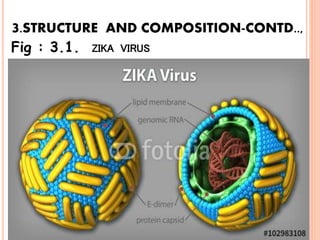
It is an enveloped virus with icosahedral structure.
Contains non segmented Single-stranded, positive
sense RNA .
Complete genome sequence of ZIKA has been
published.
The open reading frame of the Zika virus reads as
follows:
5′-C-prM-E-NS1-NS2A-NS2B-NS3-NS4A-NS4B-N​S5-
3′.
3.STRUCTURE AND COMPOSITION-CONTD..,
Fig : 3.1. ZIKA VIRUS
4.TRANSMISSION
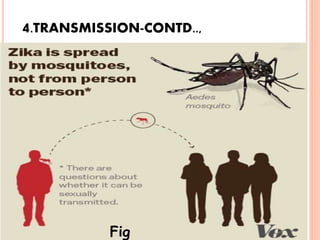
Transmitted by Aedes species mosquitoes.
Major contribution by A. aegypti.
This is the same mosquito that transmits dengue,
chikungunya and yellow fever.
This usually bite during the morning and late
afternoon/evening hours.
Incubation period is about three to 12 days after the
bite of an infected mosquito.
4.TRANSMISSION-CONTD..,
Fig
5.MECHANISM OF INFECTION
This ZIKA has enzootic mosquito-monkey-mosquito
cycle, with only occasional transmission to humans.
Dermal fibroblasts, epidermal keratinocytes are
permissible to ZIKV.
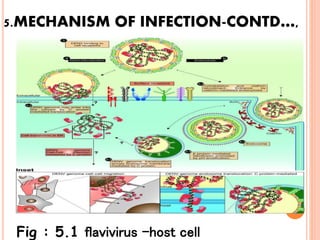
The virion attaches to host cell membrane receptors
via envelope protein E which induces virion
endocytosis.
 The virus membrane fuses with the endosomal
membrane .
5.MECHANISM OF INFECTION-CONTD…,
 The ssRNA genome of the virus is released into the
cytoplasm.
It is then translated into a polyprotein. Translation
takes place by viral initiation.
 Replication follows the positive stranded RNA virus
replication model and takes place as a cytoplasmic
viral factory in the endoplasmic reticulum resulting in
a dsRNA genome.
5.MECHANISM OF INFECTION-CONTD…,
The dsRNA genome is then transcribed to ssRNA
New virions are transported to the Golgi apparatus
and then excreted by budding into the intracellular
space where the new virions cause infection.
ZIKV activates an antiviral innate immune
response with type 1 interferon in infected cells.
5.MECHANISM OF INFECTION-CONTD…,
Fig : 5.1 flavivirus –host cell
5.HUMAN IMMUNE RESPONSE
 Flavivirus cause acute sporadic disease and are
not persistent.
The outcome of flavivirus infection in an animal is
determined by a balance between the speed of viral
replication and spread, and the immune system
response.
 Flaviviruses have evolved specific tactics to evade
the innate and adaptive immune response.
5.HUMAN IMMUNE RESPONSE-CONTD..,
Flaviviruses, have genomic size constraints, and are
unable to acquire exogenous genes.
Smaller viruses evolve multifunctional genes that
regulate viral life cycle, yet also modulate the host
response.
The infected cells migrate to draining lymph nodes
where arise early immune response.
Then reach secondary lymphoid tissues, leading to
entry into the circulation via the efferent lymphatic
system and thoracic duct.
5.HUMAN IMMUNE RESPONSE-CONTD..,
Now spread to visceral organs , then to neurotropic
flaviviruses disseminate to the central nervous system
The mechanism by which flaviviruses avoid being
targeted by its entry into brain and spinal cord remains
unclear
There is an assumption that the virus enters via a
haematogenous route.
5.HUMAN IMMUNE RESPONSE-CONTD..,
Flaviviruses may cross the blood–brain barrier by
passive transport across the endothelium, by active
replication in endothelial cells.
'Trojan horse' mechanism in which the virus is
carried into the brain by infected inflammatory cells
The IFN-dependent innate immune response is
essential for protection against flavivirus infections.
 Type I and II IFN inhibit flavivirus infection in cell
culture and in animals.
5.HUMAN IMMUNE RESPONSE-CONTD..,
Type I IFN block flavivirus infection by
preventing translation and replication of
infectious viral RNA.
Type II IFN inhibit flavivirus replication via the
generation of proinflammatory and antiviral
molecules including nitric oxide .
6.SYMPTOMS AND DISEASE
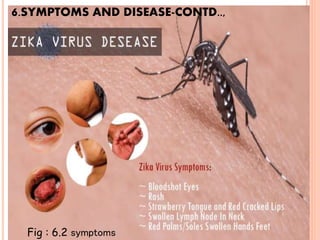
Fever.
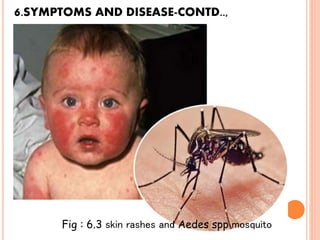
Skin rashes.
Conjunctivitis.
Muscle and joint pain.
Malaise or headache.
These symptoms normally last for 2-7 days.
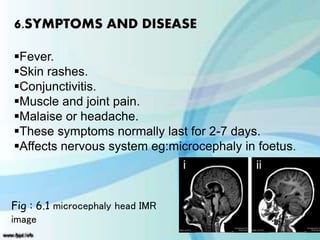
Affects nervous system eg:microcephaly in foetus.
Fig : 6.1 microcephaly head IMR
image
6.SYMPTOMS AND DISEASE-CONTD..,
Fig : 6.2 symptoms
6.SYMPTOMS AND DISEASE-CONTD..,
Fig : 6.3 skin rashes and Aedes spp mosquito
6.SYMPTOMS AND DISEASE-CONTD..,
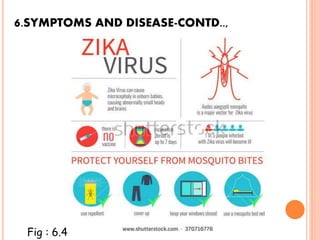
Fig : 6.4
7.DIAGNOSIS
 Can be confirmed by presence Zika virus RNA in
the blood or other body fluids, such as urine or saliva
 Zika virus RNA has been detected in urine up to 10
days after onset of the disease.
From day five post onset of disease, serological
investigations can be conducted by detection of
Zika-specific IgM antibodies and confirmation by
neutralisation, seroconversion or four-fold antibody
titer increase of Zika specific antibodies in paired
serum samples.
8.AVAILABLE TREATMENT
 There is no vaccine or specific prophylactic
treatment.
Bharat biotech international company of India
declared that they patented for medicine for ZIKV.
The treatment is symptomatic and mainly based
on pain relief, fever reduction and anti-histamines
for pruritic rash.
9.PREVENTION
The best form of prevention is protection against
mosquito bites.
Repellents should contain DEET (N, N-diethyl-3-
methylbenzamide), IR3535 (3-[N-acetyl-N-butyl]-
aminopropionic acid ethyl ester) or icaridin (1-
piperidinecarboxylic acid, 2-(2-hydroxyethyl)-1-
methylpropylester).
10.EXPERMENTAL TREATMENT
 The Bharath biotech produced one inactivated and
one recombinant vaccines which are seeking for
patent.
People sick with Zika virus get plenty of rest, drink
enough fluids, and treat pain and fever with common
medicines.
Hypochlorite is a natural product for human
organism, and elaborated by immune cells for
protection against infection.
REFERENCES
1.R. M. Kofler, J. H. Aberle, S. W. Aberle, S. L. Allison, F. X. Heinz, and C. W. Mandl,
Proc. Natl. Acad. Sci. USA 7:1951-1956, 2004
2.Evasion of innate and adaptive immunity by flaviviruses,Michael
S Diamond1,1Departments of Medicine, Molecular Microbiology and Pathology &
Immunology, Washington University School of Medicine, Saint Louis, Missouri, USA
3. Oliveira Melo, A. S.; Malinger, G.; Ximenes, R.; Szejnfeld, P. O.; Alves Sampaio,
S.; Bispo de Filippis, A. M. (2016-01-01). "Zika virus intrauterine infection causes
fetal brain abnormality and microcephaly: tip of the iceberg?". Ultrasound in
Obstetrics & Gynecology 47 (1): 6–7. doi:10.1002/uog.15831. ISSN 1469-
0705. PMID 26731034.
4. Tick-borne flaviviruses: dissecting host immune responses and virus
countermeasures.
Robertson SJ1, Mitzel DN, Taylor RT, Best SM, Bloom ME
REFERENCES
5. Immune evasion strategies of flaviviruses.
Ye J1, Zhu B, Fu ZF, Chen H, Cao S.
6. Evasion of innate and adaptive immunity by
S Diamond1,Departments of Medicine, Molecular
Microbiology and Pathology & Immunology, Washington
University School of Medicine, Saint Louis, Missouri, USA
Human immunal response against zika

Human immunal response against zika

  • 2.
    1.DISCOVERY AND ISSUES ZIKVfirst isolated from Rhesus monkeys in Uganda in 1947 which causes ZIKA fever.  Propagated to Pacific in 2007 and 2013.  Then to the Americas and Africa in 2015.  Now more than 13 countries in the America have reported sporadic Zika virus infections indicating rapid geographic expansion of Zika virus.
  • 3.
    2.TAXANOMY AND NOMENCLATURE Family:Flaviviridae Order :Unassingned Genus :Flavivirus Species :Zika virus It is so called “ZIKA” where it is found. Zika virus bears a striking resemblance to chikungunya. Same clade of ZIKA are Spondweni virus ,St. Louis encephalitis virus, Ilheus virus and Rocio virus.
  • 4.
    3.STRUCTURE AND COMPOSITION Itis an enveloped virus with icosahedral structure. Contains non segmented Single-stranded, positive sense RNA . Complete genome sequence of ZIKA has been published. The open reading frame of the Zika virus reads as follows: 5′-C-prM-E-NS1-NS2A-NS2B-NS3-NS4A-NS4B-N​S5- 3′.
  • 5.
  • 6.
    4.TRANSMISSION Transmitted by Aedesspecies mosquitoes. Major contribution by A. aegypti. This is the same mosquito that transmits dengue, chikungunya and yellow fever. This usually bite during the morning and late afternoon/evening hours. Incubation period is about three to 12 days after the bite of an infected mosquito.
  • 7.
  • 8.
    5.MECHANISM OF INFECTION ThisZIKA has enzootic mosquito-monkey-mosquito cycle, with only occasional transmission to humans. Dermal fibroblasts, epidermal keratinocytes are permissible to ZIKV. The virion attaches to host cell membrane receptors via envelope protein E which induces virion endocytosis.  The virus membrane fuses with the endosomal membrane .
  • 9.
    5.MECHANISM OF INFECTION-CONTD…, The ssRNA genome of the virus is released into the cytoplasm. It is then translated into a polyprotein. Translation takes place by viral initiation.  Replication follows the positive stranded RNA virus replication model and takes place as a cytoplasmic viral factory in the endoplasmic reticulum resulting in a dsRNA genome.
  • 10.
    5.MECHANISM OF INFECTION-CONTD…, ThedsRNA genome is then transcribed to ssRNA New virions are transported to the Golgi apparatus and then excreted by budding into the intracellular space where the new virions cause infection. ZIKV activates an antiviral innate immune response with type 1 interferon in infected cells.
  • 11.
    5.MECHANISM OF INFECTION-CONTD…, Fig: 5.1 flavivirus –host cell
  • 12.
    5.HUMAN IMMUNE RESPONSE Flavivirus cause acute sporadic disease and are not persistent. The outcome of flavivirus infection in an animal is determined by a balance between the speed of viral replication and spread, and the immune system response.  Flaviviruses have evolved specific tactics to evade the innate and adaptive immune response.
  • 13.
    5.HUMAN IMMUNE RESPONSE-CONTD.., Flaviviruses,have genomic size constraints, and are unable to acquire exogenous genes. Smaller viruses evolve multifunctional genes that regulate viral life cycle, yet also modulate the host response. The infected cells migrate to draining lymph nodes where arise early immune response. Then reach secondary lymphoid tissues, leading to entry into the circulation via the efferent lymphatic system and thoracic duct.
  • 14.
    5.HUMAN IMMUNE RESPONSE-CONTD.., Nowspread to visceral organs , then to neurotropic flaviviruses disseminate to the central nervous system The mechanism by which flaviviruses avoid being targeted by its entry into brain and spinal cord remains unclear There is an assumption that the virus enters via a haematogenous route.
  • 15.
    5.HUMAN IMMUNE RESPONSE-CONTD.., Flavivirusesmay cross the blood–brain barrier by passive transport across the endothelium, by active replication in endothelial cells. 'Trojan horse' mechanism in which the virus is carried into the brain by infected inflammatory cells The IFN-dependent innate immune response is essential for protection against flavivirus infections.  Type I and II IFN inhibit flavivirus infection in cell culture and in animals.
  • 16.
    5.HUMAN IMMUNE RESPONSE-CONTD.., TypeI IFN block flavivirus infection by preventing translation and replication of infectious viral RNA. Type II IFN inhibit flavivirus replication via the generation of proinflammatory and antiviral molecules including nitric oxide .
  • 17.
    6.SYMPTOMS AND DISEASE Fever. Skinrashes. Conjunctivitis. Muscle and joint pain. Malaise or headache. These symptoms normally last for 2-7 days. Affects nervous system eg:microcephaly in foetus. Fig : 6.1 microcephaly head IMR image
  • 18.
  • 19.
    6.SYMPTOMS AND DISEASE-CONTD.., Fig: 6.3 skin rashes and Aedes spp mosquito
  • 20.
  • 21.
    7.DIAGNOSIS  Can beconfirmed by presence Zika virus RNA in the blood or other body fluids, such as urine or saliva  Zika virus RNA has been detected in urine up to 10 days after onset of the disease. From day five post onset of disease, serological investigations can be conducted by detection of Zika-specific IgM antibodies and confirmation by neutralisation, seroconversion or four-fold antibody titer increase of Zika specific antibodies in paired serum samples.
  • 22.
    8.AVAILABLE TREATMENT  Thereis no vaccine or specific prophylactic treatment. Bharat biotech international company of India declared that they patented for medicine for ZIKV. The treatment is symptomatic and mainly based on pain relief, fever reduction and anti-histamines for pruritic rash.
  • 23.
    9.PREVENTION The best formof prevention is protection against mosquito bites. Repellents should contain DEET (N, N-diethyl-3- methylbenzamide), IR3535 (3-[N-acetyl-N-butyl]- aminopropionic acid ethyl ester) or icaridin (1- piperidinecarboxylic acid, 2-(2-hydroxyethyl)-1- methylpropylester).
  • 24.
    10.EXPERMENTAL TREATMENT  TheBharath biotech produced one inactivated and one recombinant vaccines which are seeking for patent. People sick with Zika virus get plenty of rest, drink enough fluids, and treat pain and fever with common medicines. Hypochlorite is a natural product for human organism, and elaborated by immune cells for protection against infection.
  • 25.
    REFERENCES 1.R. M. Kofler,J. H. Aberle, S. W. Aberle, S. L. Allison, F. X. Heinz, and C. W. Mandl, Proc. Natl. Acad. Sci. USA 7:1951-1956, 2004 2.Evasion of innate and adaptive immunity by flaviviruses,Michael S Diamond1,1Departments of Medicine, Molecular Microbiology and Pathology & Immunology, Washington University School of Medicine, Saint Louis, Missouri, USA 3. Oliveira Melo, A. S.; Malinger, G.; Ximenes, R.; Szejnfeld, P. O.; Alves Sampaio, S.; Bispo de Filippis, A. M. (2016-01-01). "Zika virus intrauterine infection causes fetal brain abnormality and microcephaly: tip of the iceberg?". Ultrasound in Obstetrics & Gynecology 47 (1): 6–7. doi:10.1002/uog.15831. ISSN 1469- 0705. PMID 26731034. 4. Tick-borne flaviviruses: dissecting host immune responses and virus countermeasures. Robertson SJ1, Mitzel DN, Taylor RT, Best SM, Bloom ME
  • 26.
    REFERENCES 5. Immune evasionstrategies of flaviviruses. Ye J1, Zhu B, Fu ZF, Chen H, Cao S. 6. Evasion of innate and adaptive immunity by S Diamond1,Departments of Medicine, Molecular Microbiology and Pathology & Immunology, Washington University School of Medicine, Saint Louis, Missouri, USA