

GROWTH FACTORS
Dr.R.Dhivya.,MDS
CONTENTS
• INTRODUCTION
• DEFINITION AND MODE OF ACTION
• CLASSIFICATION
• GROWTH FACTORS
Platelet-Derived Growth Factor (PDGF)
Fibroblast Growth Factors (a-FGF and b-FGF)
Transforming Growth Factors (TGF a and b and Bone morphogenic protein (BMP)
Connective Tissue Growth Factor (CTGF)
Vascular Endothelial Growth Factor (VEGF)
Insulin-like Growth Factors (IGF-I, IGF-II)
Epidermal Growth Factor (EGF)
Hepatocyte Growth Factor (HGF)
• GROWTH FACTORS AS THERAPEUTICS TOOLS AND DELIVERY IN PERIODONTICS
• CONCLUSION
INTRODUCTION
• Growth factors - signaling agents for cells.
• cell division, matrix synthesis, and tissue differentiation.
• Important role in bone and cartilage formation, fracture- healing, and the repair of other
musculoskeletal tissues.
• Recombinant proteins, there has been considerable interest in the use of growth factors
as therapeutic agents in the treatment of PERIODONTITIS.
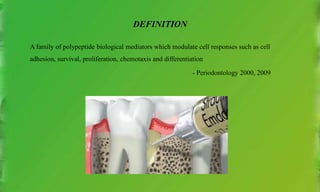
DEFINITION
A family of polypeptide biological mediators which modulate cell responses such as cell
adhesion, survival, proliferation, chemotaxis and differentiation
- Periodontology 2000, 2009
MODE OF ACTION
Autocrine mode
Paracrine mode
Intracrine mode
Juxtacrine mode
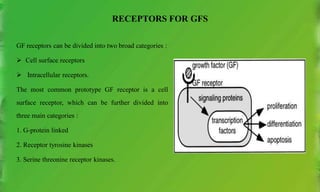
RECEPTORS FOR GFS
GF receptors can be divided into two broad categories :
 Cell surface receptors
 Intracellular receptors.
The most common prototype GF receptor is a cell
surface receptor, which can be further divided into
three main categories :
1. G-protein linked
2. Receptor tyrosine kinases
3. Serine threonine receptor kinases.
CLASSIFICATION
The most important growth factors exerting functions in healthy & diseased periodontium are :
• Platelet-Derived Growth Factor (PDGF)
• Fibroblast Growth Factors (a-FGF and b-FGF)
• Transforming Growth Factors (TGF a and b)
• Bone morphogenic protein (BMP)
• Connective Tissue Growth Factor (CTGF)
• Vascular Endothelial Growth Factor (VEGF)
• Insulin-like Growth Factors (IGF-I, IGF-II)
• Epidermal Growth Factor (EGF)
• Hepatocyte Growth Factor (HGF)
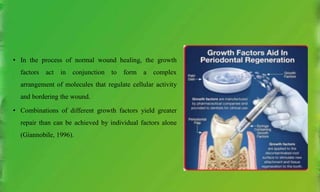
• In the process of normal wound healing, the growth
factors act in conjunction to form a complex
arrangement of molecules that regulate cellular activity
and bordering the wound.
• Combinations of different growth factors yield greater
repair than can be achieved by individual factors alone
(Giannobile, 1996).
PLATELET-DERIVED GROWTH FACTOR
• Platelet-derived growth factor (PDGF) is the natural wound healing “hormone”.
• It was discovered by Lynch and coworkers in the late 1980s.
• There are different isoforms of PDGF (PDGF-AA, -AB, -BB),fibroblast proliferative activity in vitro
(Giannobile, 1996).
• PDGF BB is the most effective isoform and its effect on PDL cells have been well studied Boyan LA 1994
• Moon et al applied PDGF-BB to promote migration and proliferation of periodontal ligament fibroblasts.
• PDGF is present in increased levels in the human inflamed gingiva and is mainly localized to the pocket
epithelium (Pinheiro et al., 2003).
• PDGF, In vitro studies had shown that exogenous application of PDGF at different concentrations
(between 0,01 and 10 ng/ml) resulted in proliferation, migration and matrix synthesis in cultures
of periodontal cells, including gingival and periodontal ligament fibroblasts, cementoblasts,
preosteoblasts and osteoblasts in a time and dose dependence (Kaigler et al., 2006).
• Even periodontal ligament fibroblasts and gingival fibroblasts have been shown to proliferate
rapidly, gingival fibroblasts have been shown to fill a wound space significantly faster than
periodontal ligament cells and this is an unwanted effect (Mumford et al., 2001).
PLATELET RICH PLASMA
 Platelet-rich plasma is blood plasma that has been enriched with platelets.
 As a concentrated source of autologous platelets, PRP contains several different growth factors and
other cytokines that can stimulate healing of soft tissue.
CLASSIFICATION - Ehrenfest et al(2009)
• Pure Platelet-Rich Plasma (P-PRP) or leucocyte-poor PRP
• Leucocyte- and PRP (L-PRP)
• Pure platelet-rich fibrin (P-PRF) or leucocyte-poor platelet-rich fibrin
• Leucocyte- and platelet-rich fibrin (L-PRF) or second-generation
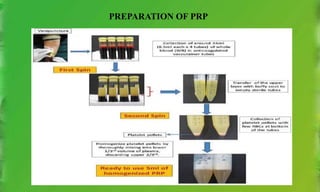
PREPARATION OF PRP
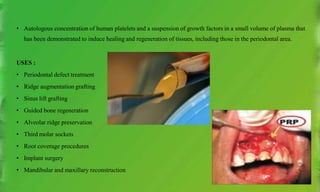
• Autologous concentration of human platelets and a suspension of growth factors in a small volume of plasma that
has been demonstrated to induce healing and regeneration of tissues, including those in the periodontal area.
USES :
• Periodontal defect treatment
• Ridge augmentation grafting
• Sinus lift grafting
• Guided bone regeneration
• Alveolar ridge preservation
• Third molar sockets
• Root coverage procedures
• Implant surgery
• Mandibular and maxillary reconstruction
PLATELET RICH FIBRIN
Platelet-rich fibrin (PRF) described by Choukroun et al is a second-generation platelet concentrate
which contains platelets and growth factors in the form of fibrin membranes prepared from the patient’s
own blood free of any anticoagulant.
Effects Of PRF
(a) the fibrin clot - mechanical properties -protection of graftmaterials - biological connector between
the bone particles.
(b) fibrin network - cellular migration - endothelial cells - neoangiogenesis, vascularization, and
survival of the graft.
(c) the process of healing - persistent release of various growth factor
(d) the presence of leukocytes and cytokines- self-regulation of the infectious and inflammatory
processes.
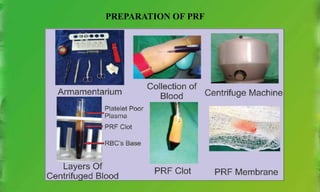
PREPARATION OF PRF
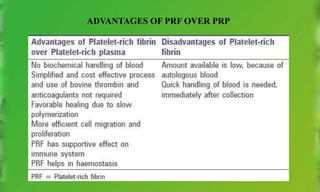
ADVANTAGES OF PRF OVER PRP
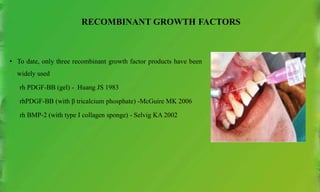
RECOMBINANT GROWTH FACTORS
• To date, only three recombinant growth factor products have been
widely used
rh PDGF-BB (gel) - Huang JS 1983
rhPDGF-BB (with β tricalcium phosphate) -McGuire MK 2006
rh BMP-2 (with type I collagen sponge) - Selvig KA 2002
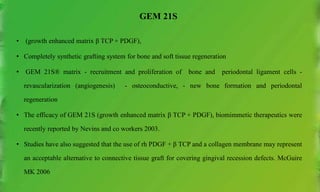
GEM 21S
• (growth enhanced matrix β TCP + PDGF),
• Completely synthetic grafting system for bone and soft tissue regeneration
• GEM 21S® matrix - recruitment and proliferation of bone and periodontal ligament cells -
revascularization (angiogenesis) - osteoconductive, - new bone formation and periodontal
regeneration
• The efficacy of GEM 21S (growth enhanced matrix β TCP + PDGF), biomimmetic therapeutics were
recently reported by Nevins and co workers 2003.
• Studies have also suggested that the use of rh PDGF + β TCP and a collagen membrane may represent
an acceptable alternative to connective tissue graft for covering gingival recession defects. McGuire
MK 2006
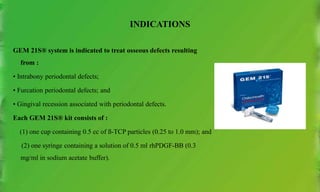
INDICATIONS
GEM 21S® system is indicated to treat osseous defects resulting
from :
• Intrabony periodontal defects;
• Furcation periodontal defects; and
• Gingival recession associated with periodontal defects.
Each GEM 21S® kit consists of :
(1) one cup containing 0.5 cc of ß-TCP particles (0.25 to 1.0 mm); and
(2) one syringe containing a solution of 0.5 ml rhPDGF-BB (0.3
mg/ml in sodium acetate buffer).
TRANSFORMING GROWTH FACTOR
• TGF-superfamily - growth and differentiation factors associated to the inflammatory response,
known also to be involved in apoptosis, angiogenesis, wound healing and fibrosis (Frank et al., 1996;
Lawrence, 1995).
• There are three TGF- isoforms important for humans, TGF- 1, 2 and 3; their amino acid sequences
are 70-80% homologous but they can be distinguished by the effects on cell growth, biological
interactions and receptor binding abilities (Frank et al., 1996).
• TGF- 1 is expressed in epithelial, hematopoietic, and connective tissue cells (Massague, 1998).
• It has been intensively evaluated in relation to all types of gingival overgrowth.
• Regarding TGF- 1 expression in chronic periodontitis, a positive reaction in some keratinocytes from
the gingival basal epithelial layer, and pro-inflammatory cells infiltrating lamina propria increased
gingival inflammation is associated with high levels of TGF- isoforms.
• TGF- 1 pro-fibrotic role could be explained also by the stimulation of collagen synthesis in lamina
propria. There are considerable data supporting the fact that under pathological conditions, TGF- 1
orchestrates - parenchymal, inflammatory and collagen expressing cells - control inflammation and
fibrosis (Buduneli et al., 2001b; Ellis et al., 2004; Wright et al., 2001).
• TGF - PDGF, EGF, and FGF, by altering their cellular response or by inducing their expression.
• Combined therapies, which involved PDGF and TGF- , have demonstrated synergistic effects and
enhanced regeneration.
• Together, PDGF and TGF- have stimulated gingival fibroblasts and periodontal ligament cells.
• Some authors reported that TGF- alone and in combination with PDGF, led to a greater proliferation
of periodontal ligament cells compared to the gingival fibroblasts.
• On the contrary, PDGF stimulated a significantly greater proliferation of gingival fibroblasts
compared to periodontal ligament cells.
• Since periodontal proliferation at the diseased site is a desired feature in periodontal regeneration
and because of the limited number of studies and inconsistent results, the use of TGF- will be further
emphasized and thoroughly investigated.
• TGF- plays a significant role in periodontal regeneration. It is pleiotropic, and can stimulate or
inhibit cell growth, an action that can interfere with its therapeutic use (Clokie & Bell, 2003).
• TGF- 1 has been used for this application. The results of rhTGF- 1 for periodontal regeneration have
not been consistent preclinically as shown in dogs and sheeps investigations (Mohamed et al., 1998;
Tatakis et al, 2000, as cited by Kraigler et al., 2006).
• These studies showed little advantages in new bone formation and no improvement in cementum
regeneration when treated with rhTGF- 1.
• Other research demonstrated that TGF- 1 increased the amount of bone healing adjacent to dental
implants in minipigs (Clokie & Bell, 2003).
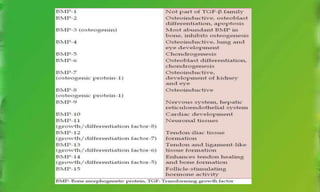
BONE MORPHOGENETIC PROTEIN
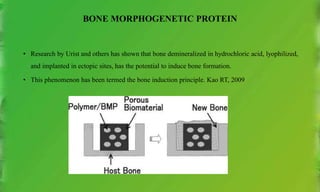
• Research by Urist and others has shown that bone demineralized in hydrochloric acid, lyophilized,
and implanted in ectopic sites, has the potential to induce bone formation.
• This phenomenon has been termed the bone induction principle. Kao RT, 2009
THE BONE MORPHOGENETIC FAMILY
• The BMPs were discovered based on their presence in purified bone inductive extracts derived from bone.
• An extensive purification (more than 300,000-fold) was required to provide protein of sufficient purity. This
suggests that the osteoinductive proteins are minor components of bone matrix, and present at lower levels than
many other growth factors.
• BMP”s have been isolated from bovine and human sources out of which bone morphogenic protein-2
(osteopontin-2 [OP-2]), bone morphogenic protein-3 - periodontal Regeneration. Massagué J 1998
• The hallmark property of BMP is the differentiation factor. BMP will differentiate an undifferentiated
mesenchymal cell into an osteoblast.
• In contrast, PDGF is a chemotactic and mitogenic factor for osteoblast like precursors. Okano T, 1990
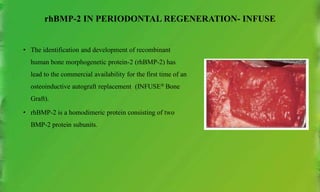
rhBMP-2 IN PERIODONTAL REGENERATION- INFUSE
• The identification and development of recombinant
human bone morphogenetic protein-2 (rhBMP-2) has
lead to the commercial availability for the first time of an
osteoinductive autograft replacement (INFUSE® Bone
Graft).
• rhBMP-2 is a homodimeric protein consisting of two
BMP-2 protein subunits.
• Studies provide an important insight that space provision appears critical to draw clinically significant
benefits from a BMP construct.
– rhBMP 2 has been combined with S atellocollagen sponge (ACS). McKay WF 2007
– rhBMP2 has also been used in a DFDBA/fibrin clot carrier. Sigurdsson TJ, 2001
– rhBMP2 and calcium phosphate cement matrix. Seeherman H Seeherman H 2006
• Hanisch O Tatakis 1997 reported that rhBMP-2/ACS at 1.5 mg/cc, INFUSE® Bone Graft, induced significant
bone formation suitable for implant placement.
CONNECTIVE TISSUE GROWTH FACTOR (CTGF)
• The CCN family consists of six multifunctional members including CCN1 (Cyr61), CCN2
(connective tissue growth factor, CTGF), CCN3 (Nov), CCN4 (WISP1), CCN5 (WISP2), and CCN6
(WISP3) (Brigstock, 2003).
• The functions of this family include embryogenesis, wound healing, and regulation of ECM
production.
• CTGF is a matricellular cysteine-rich peptide that plays a variety of important roles in cell
development and differentiation and acts to promote fibrosis in many different tissues in cooperation
with other growth factors and extracellular matrix proteins (Leask & Abraham, 2003).
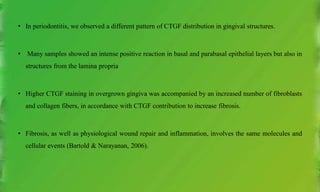
• In periodontitis, we observed a different pattern of CTGF distribution in gingival structures.
• Many samples showed an intense positive reaction in basal and parabasal epithelial layers but also in
structures from the lamina propria
• Higher CTGF staining in overgrown gingiva was accompanied by an increased number of fibroblasts
and collagen fibers, in accordance with CTGF contribution to increase fibrosis.
• Fibrosis, as well as physiological wound repair and inflammation, involves the same molecules and
cellular events (Bartold & Narayanan, 2006).
• As a consequence of inflammation, fibrosis can be the result of several events:
- abnormal release of mediators and persistence of changes in the abnormal growth
factor/cytokine profile,
- proliferation of cells with an abnormal phenotype responsible for the excessive extracellular
matrix synthesis that characterize fibrosis.
• CTGF alone does not promote fibrosis. Recent studies indicate that CTGF binds to other factors,
resulting in either inhibition or stimulation activity (Kantarci et al., 2006, Trackman & Kantarci,
2004).
• CTGF binding to VEGF results in inhibition of VEGF while CTGF binding to TGF- 1 is reported to
be stimulatory (Trackman & Kantarci, 2004).
• Therefore simultaneous production of both TGF- 1 and CTGF is required to sustain fibrosis in
gingival overgrowth.
FIBROBLAST GROWTH FACTOR (BFGF OR FGF-2).
• FGFs are a family of at least 23 structurally related polypeptides known to play a critical role in
angiogenesis and mesenchymal cell mitogenesis. In periodontium, FGF-2 is present in the
extracellular matrix, as well as in the cementum and can function as a local factor at the site (Gao et
al., 1996).
•
• In periodontitis, the presence of bFGF was reported in the gingival epithelium, inflammatory cells
and connective tissue (Laurina et al., 2009).
• They noted also a more increased expression of FGF receptor (FGFR) in hyperplasic gingival tissue
compared to normal.
• One of their conclusions was that the expression of growth factors and their receptors in sulcular
epithelium was lower than into the gingival epithelium and seems to be specific for periodontitis
(Laurina et al., 2009).
• Several studies reported that FGFs can stimulate mitogenesis and chemotaxis in periodontal ligament
cells (Takayama et al., 1997; Terranova et al., 1989).
• FGFs increased osteoblast proliferation, although they do not directly increase collagen production
by differentiated osteoblasts.
• They have shown bFGF stimulates human endothelial and periodontal ligament cell migration and
proliferation on the dentin surfaces, and that the combination of bFGF with fibronectin can further
enhanced periodontal ligament cell chemotaxis.
• Despite different concentrations of bFGF and different delivery systems used in the studies, all
showed an improvement in the periodontal tissue regeneration. Studies that evaluated more than one
concentration of bFGF suggested that its effects are dose dependent (Murakami et al., 2003).
• Some limitations exist with respect to bone volume and predictability.
• Trials utilizing topical growth factors have revealed difficulties in maintaining therapeutic levels of
proteins and to obtain optimal outcomes in vivo; of great importance is to enhance the half-life of
growth factors and their biological stability (Yun et al., 2010).
• Based on the results of studies that support in vitro biological functions of FGFs for tissue
regeneration, the largest in vivo study in the field of periodontal regenerative therapy was initiated by
Kitamura’s team.
• This was a human clinical trial projected to determine the safety and efficiency of FGF-2 for clinical
application.
• Their results support that topical application of three doses of FGF-2 during periodontal surgery
could be efficient for the regeneration of periodontal tissue (Kitamura et al., 2008).
EPIDERMAL GROWTH FACTOR (EGF)
• EGF is a multifunctional cytokine with a variety of biological functions including epithelial growth
and differentiation, and wound healing.
• In the periodontium, EGF seems to exert only a minor effect on the promotion of mitogenesis,
chemotaxis, or matrix synthesis in periodontal ligament fibroblasts (Giannobile, 1996).
• He supposed that EGF receptors (EGF-R) localization in periodontal ligament fibroblasts may
stabilize the periodontal ligament fibroblast phenotype or cellular physical characteristics.
• Buduneli et al. (2001c) evaluated the expression of EGF-receptor (EGFR) in frozen sections of
cyclosporine (CsA)-induced gingival overgrowth using immunohistochemical and semiquantitative
techniques.
• Gingival biopsies were obtained from 12 renal transplant patients receiving CsA as well as from 9
systemically and periodontally healthy individuals.
• The authors suggested that CsA affects EGFR metabolism in gingival keratinocytes resulting in an
increased number of cell surface receptors, which may eventually play a role in the pathogenesis of
gingival tissue alterations.
• In chronic periodontitis, EGFR was regionally detected in gingival epithelium in some cases (Laurina
et al., 2009).
• Other in vivo studies are needed to reveal the precise effects of EGF on soft periodontal tissue
healing.
INSULIN-LIKE GROWTH FACTORS (IGFS)
• IGFs are a family of mitogenic proteins that control growth, differentiation, and the maintenance of
differentiated function in numerous tissues.
• The IGF family includes three ligands (insulin, IGF-I, and IGF-II), their corresponding cell surface
receptors (IR, IGF-IR, and IGF-IIR), and at least six IGF-binding proteins (IGFBPs) able to bind
circulating IGFs and modulate their biological actions.
• Studies have suggested that IGF-I has an important involvement in periodontal wound healing and
regeneration.
• IGF-I is chemotactic for cells that come from the periodontal ligament and demonstrates
significant effects on the mitogenesis of periodontal ligament fibroblasts (Giannobile, 1996).
• IGF-I is able to prevent apoptosis in fibroblasts, to regulate DNA and protein synthesis in
periodontal ligament fibroblasts in vitro and to enhance soft tissue wound healing in vivo
(Werner & Katz, 2004).
• Regarding the IGF-IR expression in chronic periodontitis, Laurina et al. (2009) reported only a
weak presence in the sulcular epithelium suggesting a potential role in regeneration of
periodontal tissue. The effect of IGF-II on the metabolism of gingival fibroblasts is still uncertain
HEPATOCYTE GROWTH FACTOR (HGF)
• HGF is a multifunctional cytokine involved in the repair and regeneration of various tissues and their
protection from injury (Matsumoto & Nakamura, 1997) and recently, it has been linked also to the
development of periodontal disease (Ohshima et al., 2001; Ohnishi & Daikuhara, 2003).
• HGF may be closely involved in the pathogenesis and progression of periodontal disease because it
stimulates excessive proliferation and invasion of gingival epithelial cells and impair the
regeneration of deep collagenous structures in the periodontium (Ohshima et al., 2001).
VASCULAR ENDOTHELIAL GROWTH FACTOR (VEGF)
• Over the last two decades researchers have demonstrated that VEGF is a key regulator of
physiological and pathological angiogenesis, because it induces endothelial cell proliferation,
stimulates angiogenesis and increases vascular permeability (Ferrara, 2009).
• In the last decade, many groups focused their research on the angiogenic factors that contribute to
periodontal healing.
• In periodontitis patients, VEGF was detected within vascular endothelial cells, neutrophils, plasma
cells, and junctional, pocket and gingival epithelium (Booth et al, 1998).
• In a previous study on biopsies obtained from patients with type 2 diabetes associated gingival
overgrowth, they detected VEGF expression in keratinocytes from the basal and spinous layers and in
many capillaries (Pisoschi et al., 2009).
• Other authors reported increased VEGF expression in epithelial cells and endothelial cells in
periodontitis-affected gingiva (Guneri et al., 2004; Keles et al., 2010; Lucarini et al., 2009).
• Giannobile et al. (2003) suggested that VEGF could be an important growth factor for the onset of
gingivitis and its progression to periodontitis.
• Taken together these observations conclude that VEGF expression is related to both maintenance of
periodontal health and periodontal tissue destruction but the precise mechanism of
neovascularization remains in debate.
CARRIERS AND DELIVERY SYSTEMS FOR GROWTH FACTORS
• The kinetics of release of the growth factor from its delivery system may vary depending on the
chemistry of the factor or the delivery system and the influence of the host environment.
• For these reasons, certain conditions must be considered when selecting an appropriate carrier or
delivery system:
(1) the ability of the system to deliver the growth factor at the appropriate time and in the
proper dose,
(2) the presence of a substratum that will enhance cell recruitment and attachment and will
potentiate chemotaxis,
(3) the presence of a void space to allow for cell migration and to promote angiogenesis,
(4) the ability of the delivery system to biodegrade without generating an immune or
inflammatory response and without producing toxic waste products that would inhibit the repair process
Nano particle and Micro particle delivery
Immobilised into a scaffold Introduced into a hydrogel
• A number of carrier and delivery systems, including type-I collagen, synthetic polymers, and
hyaluronic acid gels, have been used to deliver recombinant proteins in experimental and clinical
models.
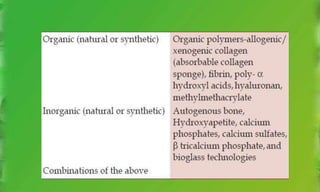
• A variety of so-called bone-graft substitutes, including demineralized bone matrix, calcium
phosphate-containing preparations {such as hydroxy- apatite, coralline hydroxyapatite, BSM } and
Bioglass are also potential carriers for recombinant proteins.
• In clinical trials in humans, type-I collagen has been used as a carrier for BMP, in conjunction with
metal cages, to induce fusion in the spine.
• This protein has been considered an attractive carrier because of its fibrillar structure and the fact
that it is the most abundant protein in the extracellular matrix of bone.
• It also promotes mineral deposition and can bind noncollagenous matrix proteins that also initiate
mineralization.
• While there are some concerns regarding the use of allogeneic collagen with respect to its potential to
induce an immune response, abundant data suggest that this risk is low.
• Although collagen has been used successfully as a carrier for BMP in a variety of animal models,
large doses of BMP have been required to produce an osteogenic effect in clinical trials of spine
fusion and periodontal applications in humans.
• This has raised the concern that collagen interferes with the pharmacokinetics of the release of BMP
and in some way limits the resultant osteogenic response.
• The pharmacokinetic profile of rhBMP-2 was evaluated with use of an assay in which the protein
was implanted in a muscle pouch with use of a variety of carrier systems (including a type-I collagen
sponge, tricalcium phosphate, hydroxyapatite, and demineralized bone matrix).
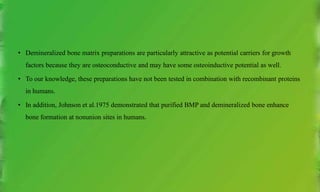
• Demineralized bone matrix preparations are particularly attractive as potential carriers for growth
factors because they are osteoconductive and may have some osteoinductive potential as well.
• To our knowledge, these preparations have not been tested in combination with recombinant proteins
in humans.
• In addition, Johnson et al.1975 demonstrated that purified BMP and demineralized bone enhance
bone formation at nonunion sites in humans.
• Polymers have also received much attention as potential delivery vehicles. Both polylactic acid
(PLA) and polyglycolic acid (PGA) because of their biocompatibility profile and ability to bind
protein, it is natural to consider using them as scaffolds to deliver peptide molecules.
• However, further investigation of the degradation profiles of various polymers is necessary to ensure
that they degrade in a manner that does not stimulate an inflammatory response.
• In addition, it will be necessary to enhance the bonding of these materials to either host bone or soft
tissue.
• Strategies will need to be developed to create a biomechanically stable construct between these
carriers and the host bone and/or surrounding soft tissue.
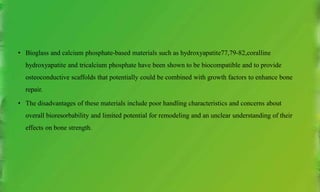
• Bioglass and calcium phosphate-based materials such as hydroxyapatite77,79-82,coralline
hydroxyapatite and tricalcium phosphate have been shown to be biocompatible and to provide
osteoconductive scaffolds that potentially could be combined with growth factors to enhance bone
repair.
• The disadvantages of these materials include poor handling characteristics and concerns about
overall bioresorbability and limited potential for remodeling and an unclear understanding of their
effects on bone strength.
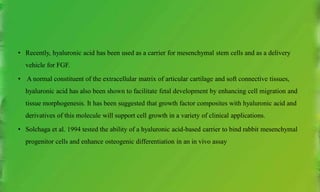
• Recently, hyaluronic acid has been used as a carrier for mesenchymal stem cells and as a delivery
vehicle for FGF.
• A normal constituent of the extracellular matrix of articular cartilage and soft connective tissues,
hyaluronic acid has also been shown to facilitate fetal development by enhancing cell migration and
tissue morphogenesis. It has been suggested that growth factor composites with hyaluronic acid and
derivatives of this molecule will support cell growth in a variety of clinical applications.
• Solchaga et al. 1994 tested the ability of a hyaluronic acid-based carrier to bind rabbit mesenchymal
progenitor cells and enhance osteogenic differentiation in an in vivo assay
• A hyaluronic acid-based gel was used as a carrier for FGF-2 in a nonhuman primate fracture model
• A single direct injection of the FGF-2 hyaluronic acid formulation enhanced local fracture-healing.
• Histological analysis revealed that osteotomy sites that had been treated with this growth factor
composite had enhanced periosteal reaction, vascularity, and cellularity when compared with the
untreated controls.
• There was no evidence of an inflammatory response to the hyaluronic acid gel.
• While it is likely that there is no ideal carrier or delivery system for all growth factors or biological
therapies, it is still unclear whether any of the currently known carriers have been truly optimized for
clinical applications.
• This field of study, which is as important as the study of the growth factor molecules, cells, and genes
themselves, will require much more emphasis as the field of biologic intervention in clinical
therapeutics progresses.
CONCLUSION
 Although growth factors function as molecular mediators of periodontal tissues, their value as
diagnostic biomarkers for periodontal tissue inflammation and/or fibrosis is yet to be elucidated.
 High-throughput technologies applied for assessment of gingival crevicular fluid and saliva will give
new promises for the use of growth factors as objective biomarkers in periodontal disease.
 In earlier studies, the application of growth factors provided different degrees of success in
stimulating wound healing in the periodontal areas.
 There is an imperious need to further evaluate the biologic mechanisms that may be responsible for
the promotion of tissue regeneration by growth factors.
 Finally, studies on growth factors delivery and improved stability seek evidence to conclusively
support the addition of growth factors strategy to the therapeutic protocol for regeneration of
periodontal tissues.
REFERENCE
• Francis J. Hughes Effects of growth factors and cytokines on osteoblast differentiation
Periodontology 2000, Vol. 41, 2006, 48–72
• William V Giannoble Matrix molecules and growth factors as indicators of periodontal disease
activity Periodontology 2000 vol 31 2003
• Catalina Pisoschi Growth Factors and Connective Tissue Homeostasis in Periodontal Disease
• Traversa B The role of growth factors, cytokines and proteases in wound management Journal of
Primary Intention Vol. 9 No. 4 November 2001
• Bartold, P.M. (1993). Platelet-derived Growth Factor Stimulates Hyaluronate but not Proteoglycan
Synthesis by Human Gingival Fibroblasts in vitro. Journal of Dental Research, Vol.72, No.11,
(November 1993), pp. 1473-1480
• Bartold, M., Narayanan, A.S. & Page, R.C. (1992). Platelet-derived growth factor reduces the
inhibitory effects of lipopolysaccharide on gingival fibroblast proliferation. Journal of Periodontal
Research, Vol.27, No.5, (September 1992), pp. 499-505
• Bartold, M. & Narayanan, A.S. (2006). Molecular and cell biology of healthy and diseased
periodontal tissues, Periodontology 2000, Vol.40, pp. 29-49
• Booth, V., Young, S., Cruchley, A., Taichman, N.S. & Paleolog, E. (1998). Vascular endothelial
growth factor in human periodontal disease. Journal of Periodontal Research, Vol.33, No.8,
(November 1998), pp. 491-499
• Buduneli, N., Kütükçüler, N., Aksu, G. & Attila, G. (2001b). Evaluation of transforming growth
factor-beta 1 in crevicular fluid of cyclosporine A-treated patients. Journal of Periodontology, Vol.
72, No.4, (April 2001), pp. 526-531
• Ellis, J.S., Morgan, C.L., Taylor, J.J. & Thomason J.M. (2004). Plasma TGF as a risk factor for
gingival owergrowth, Journal of Clinical Periodontology, Vol.31, No.10, (October 2004), pp. 863-868
• Frank, S., Madlener, M. & Werner, S. (1996). Transforming growth factors 􀇃1, 􀇃2 and 􀇃3 and their
receptors are differentially regulated during normal and impaired wound healing. Journal of
Biological Chemistry, Vol.271, No.17, (April 1996), pp. 10188-10193
• Gao, J., Jordan, T.W. & Cutress, T.W. (1996). Immunolocalisation of basic fibroblast growth factor
(bFGF) in human periodontal ligament (PDL) tissue. Journal of Periodontal Research, Vol.31, No.4,
(May 1996), pp. 260-264
• Giannobile, WV. (1996). Committee on Research, Science and Therapy of The American Academy
of Periodontology. The Potential Role of Growth and Differentiation Factors in Periodontal
Regeneration. Journal of Periodontology, Vol.67, 67, No.5, (May 1996), pp. 545-553
• Giannobile, W.V., Hernandez, R.A., Finkelman, R.D., Ryan, S., Kiritsy, C.P., D'Andrea, M. & Lynch,
S.E. (1996). Comparative effects of platelet-derived growth factor-BB and insulin-like growth factor
Journal of Periodontal Research, Vol.31, No.5, (July 1996), pp. 301–312
THANK YOU

Growth factors

  • 1.
  • 2.
    CONTENTS • INTRODUCTION • DEFINITIONAND MODE OF ACTION • CLASSIFICATION • GROWTH FACTORS Platelet-Derived Growth Factor (PDGF) Fibroblast Growth Factors (a-FGF and b-FGF) Transforming Growth Factors (TGF a and b and Bone morphogenic protein (BMP) Connective Tissue Growth Factor (CTGF) Vascular Endothelial Growth Factor (VEGF) Insulin-like Growth Factors (IGF-I, IGF-II) Epidermal Growth Factor (EGF) Hepatocyte Growth Factor (HGF) • GROWTH FACTORS AS THERAPEUTICS TOOLS AND DELIVERY IN PERIODONTICS • CONCLUSION
  • 3.
    INTRODUCTION • Growth factors- signaling agents for cells. • cell division, matrix synthesis, and tissue differentiation. • Important role in bone and cartilage formation, fracture- healing, and the repair of other musculoskeletal tissues. • Recombinant proteins, there has been considerable interest in the use of growth factors as therapeutic agents in the treatment of PERIODONTITIS.
  • 4.
    DEFINITION A family ofpolypeptide biological mediators which modulate cell responses such as cell adhesion, survival, proliferation, chemotaxis and differentiation - Periodontology 2000, 2009
  • 5.
    MODE OF ACTION Autocrinemode Paracrine mode
  • 6.
  • 7.
    RECEPTORS FOR GFS GFreceptors can be divided into two broad categories :  Cell surface receptors  Intracellular receptors. The most common prototype GF receptor is a cell surface receptor, which can be further divided into three main categories : 1. G-protein linked 2. Receptor tyrosine kinases 3. Serine threonine receptor kinases.
  • 8.
    CLASSIFICATION The most importantgrowth factors exerting functions in healthy & diseased periodontium are : • Platelet-Derived Growth Factor (PDGF) • Fibroblast Growth Factors (a-FGF and b-FGF) • Transforming Growth Factors (TGF a and b) • Bone morphogenic protein (BMP) • Connective Tissue Growth Factor (CTGF) • Vascular Endothelial Growth Factor (VEGF) • Insulin-like Growth Factors (IGF-I, IGF-II) • Epidermal Growth Factor (EGF) • Hepatocyte Growth Factor (HGF)
  • 9.
    • In theprocess of normal wound healing, the growth factors act in conjunction to form a complex arrangement of molecules that regulate cellular activity and bordering the wound. • Combinations of different growth factors yield greater repair than can be achieved by individual factors alone (Giannobile, 1996).
  • 10.
    PLATELET-DERIVED GROWTH FACTOR •Platelet-derived growth factor (PDGF) is the natural wound healing “hormone”. • It was discovered by Lynch and coworkers in the late 1980s. • There are different isoforms of PDGF (PDGF-AA, -AB, -BB),fibroblast proliferative activity in vitro (Giannobile, 1996). • PDGF BB is the most effective isoform and its effect on PDL cells have been well studied Boyan LA 1994 • Moon et al applied PDGF-BB to promote migration and proliferation of periodontal ligament fibroblasts. • PDGF is present in increased levels in the human inflamed gingiva and is mainly localized to the pocket epithelium (Pinheiro et al., 2003).
  • 11.
    • PDGF, Invitro studies had shown that exogenous application of PDGF at different concentrations (between 0,01 and 10 ng/ml) resulted in proliferation, migration and matrix synthesis in cultures of periodontal cells, including gingival and periodontal ligament fibroblasts, cementoblasts, preosteoblasts and osteoblasts in a time and dose dependence (Kaigler et al., 2006). • Even periodontal ligament fibroblasts and gingival fibroblasts have been shown to proliferate rapidly, gingival fibroblasts have been shown to fill a wound space significantly faster than periodontal ligament cells and this is an unwanted effect (Mumford et al., 2001).
  • 12.
    PLATELET RICH PLASMA Platelet-rich plasma is blood plasma that has been enriched with platelets.  As a concentrated source of autologous platelets, PRP contains several different growth factors and other cytokines that can stimulate healing of soft tissue. CLASSIFICATION - Ehrenfest et al(2009) • Pure Platelet-Rich Plasma (P-PRP) or leucocyte-poor PRP • Leucocyte- and PRP (L-PRP) • Pure platelet-rich fibrin (P-PRF) or leucocyte-poor platelet-rich fibrin • Leucocyte- and platelet-rich fibrin (L-PRF) or second-generation
  • 13.
  • 14.
    • Autologous concentrationof human platelets and a suspension of growth factors in a small volume of plasma that has been demonstrated to induce healing and regeneration of tissues, including those in the periodontal area. USES : • Periodontal defect treatment • Ridge augmentation grafting • Sinus lift grafting • Guided bone regeneration • Alveolar ridge preservation • Third molar sockets • Root coverage procedures • Implant surgery • Mandibular and maxillary reconstruction
  • 15.
    PLATELET RICH FIBRIN Platelet-richfibrin (PRF) described by Choukroun et al is a second-generation platelet concentrate which contains platelets and growth factors in the form of fibrin membranes prepared from the patient’s own blood free of any anticoagulant. Effects Of PRF (a) the fibrin clot - mechanical properties -protection of graftmaterials - biological connector between the bone particles. (b) fibrin network - cellular migration - endothelial cells - neoangiogenesis, vascularization, and survival of the graft. (c) the process of healing - persistent release of various growth factor (d) the presence of leukocytes and cytokines- self-regulation of the infectious and inflammatory processes.
  • 16.
  • 17.
  • 18.
    RECOMBINANT GROWTH FACTORS •To date, only three recombinant growth factor products have been widely used rh PDGF-BB (gel) - Huang JS 1983 rhPDGF-BB (with β tricalcium phosphate) -McGuire MK 2006 rh BMP-2 (with type I collagen sponge) - Selvig KA 2002
  • 19.
    GEM 21S • (growthenhanced matrix β TCP + PDGF), • Completely synthetic grafting system for bone and soft tissue regeneration • GEM 21S® matrix - recruitment and proliferation of bone and periodontal ligament cells - revascularization (angiogenesis) - osteoconductive, - new bone formation and periodontal regeneration • The efficacy of GEM 21S (growth enhanced matrix β TCP + PDGF), biomimmetic therapeutics were recently reported by Nevins and co workers 2003. • Studies have also suggested that the use of rh PDGF + β TCP and a collagen membrane may represent an acceptable alternative to connective tissue graft for covering gingival recession defects. McGuire MK 2006
  • 20.
    INDICATIONS GEM 21S® systemis indicated to treat osseous defects resulting from : • Intrabony periodontal defects; • Furcation periodontal defects; and • Gingival recession associated with periodontal defects. Each GEM 21S® kit consists of : (1) one cup containing 0.5 cc of ß-TCP particles (0.25 to 1.0 mm); and (2) one syringe containing a solution of 0.5 ml rhPDGF-BB (0.3 mg/ml in sodium acetate buffer).
  • 21.
    TRANSFORMING GROWTH FACTOR •TGF-superfamily - growth and differentiation factors associated to the inflammatory response, known also to be involved in apoptosis, angiogenesis, wound healing and fibrosis (Frank et al., 1996; Lawrence, 1995). • There are three TGF- isoforms important for humans, TGF- 1, 2 and 3; their amino acid sequences are 70-80% homologous but they can be distinguished by the effects on cell growth, biological interactions and receptor binding abilities (Frank et al., 1996). • TGF- 1 is expressed in epithelial, hematopoietic, and connective tissue cells (Massague, 1998).
  • 22.
    • It hasbeen intensively evaluated in relation to all types of gingival overgrowth. • Regarding TGF- 1 expression in chronic periodontitis, a positive reaction in some keratinocytes from the gingival basal epithelial layer, and pro-inflammatory cells infiltrating lamina propria increased gingival inflammation is associated with high levels of TGF- isoforms. • TGF- 1 pro-fibrotic role could be explained also by the stimulation of collagen synthesis in lamina propria. There are considerable data supporting the fact that under pathological conditions, TGF- 1 orchestrates - parenchymal, inflammatory and collagen expressing cells - control inflammation and fibrosis (Buduneli et al., 2001b; Ellis et al., 2004; Wright et al., 2001).
  • 23.
    • TGF -PDGF, EGF, and FGF, by altering their cellular response or by inducing their expression. • Combined therapies, which involved PDGF and TGF- , have demonstrated synergistic effects and enhanced regeneration. • Together, PDGF and TGF- have stimulated gingival fibroblasts and periodontal ligament cells. • Some authors reported that TGF- alone and in combination with PDGF, led to a greater proliferation of periodontal ligament cells compared to the gingival fibroblasts. • On the contrary, PDGF stimulated a significantly greater proliferation of gingival fibroblasts compared to periodontal ligament cells. • Since periodontal proliferation at the diseased site is a desired feature in periodontal regeneration and because of the limited number of studies and inconsistent results, the use of TGF- will be further emphasized and thoroughly investigated.
  • 24.
    • TGF- playsa significant role in periodontal regeneration. It is pleiotropic, and can stimulate or inhibit cell growth, an action that can interfere with its therapeutic use (Clokie & Bell, 2003). • TGF- 1 has been used for this application. The results of rhTGF- 1 for periodontal regeneration have not been consistent preclinically as shown in dogs and sheeps investigations (Mohamed et al., 1998; Tatakis et al, 2000, as cited by Kraigler et al., 2006). • These studies showed little advantages in new bone formation and no improvement in cementum regeneration when treated with rhTGF- 1. • Other research demonstrated that TGF- 1 increased the amount of bone healing adjacent to dental implants in minipigs (Clokie & Bell, 2003).
  • 25.
    BONE MORPHOGENETIC PROTEIN •Research by Urist and others has shown that bone demineralized in hydrochloric acid, lyophilized, and implanted in ectopic sites, has the potential to induce bone formation. • This phenomenon has been termed the bone induction principle. Kao RT, 2009
  • 26.
    THE BONE MORPHOGENETICFAMILY • The BMPs were discovered based on their presence in purified bone inductive extracts derived from bone. • An extensive purification (more than 300,000-fold) was required to provide protein of sufficient purity. This suggests that the osteoinductive proteins are minor components of bone matrix, and present at lower levels than many other growth factors. • BMP”s have been isolated from bovine and human sources out of which bone morphogenic protein-2 (osteopontin-2 [OP-2]), bone morphogenic protein-3 - periodontal Regeneration. Massagué J 1998 • The hallmark property of BMP is the differentiation factor. BMP will differentiate an undifferentiated mesenchymal cell into an osteoblast. • In contrast, PDGF is a chemotactic and mitogenic factor for osteoblast like precursors. Okano T, 1990
  • 28.
    rhBMP-2 IN PERIODONTALREGENERATION- INFUSE • The identification and development of recombinant human bone morphogenetic protein-2 (rhBMP-2) has lead to the commercial availability for the first time of an osteoinductive autograft replacement (INFUSE® Bone Graft). • rhBMP-2 is a homodimeric protein consisting of two BMP-2 protein subunits.
  • 29.
    • Studies providean important insight that space provision appears critical to draw clinically significant benefits from a BMP construct. – rhBMP 2 has been combined with S atellocollagen sponge (ACS). McKay WF 2007 – rhBMP2 has also been used in a DFDBA/fibrin clot carrier. Sigurdsson TJ, 2001 – rhBMP2 and calcium phosphate cement matrix. Seeherman H Seeherman H 2006 • Hanisch O Tatakis 1997 reported that rhBMP-2/ACS at 1.5 mg/cc, INFUSE® Bone Graft, induced significant bone formation suitable for implant placement.
  • 30.
    CONNECTIVE TISSUE GROWTHFACTOR (CTGF) • The CCN family consists of six multifunctional members including CCN1 (Cyr61), CCN2 (connective tissue growth factor, CTGF), CCN3 (Nov), CCN4 (WISP1), CCN5 (WISP2), and CCN6 (WISP3) (Brigstock, 2003). • The functions of this family include embryogenesis, wound healing, and regulation of ECM production. • CTGF is a matricellular cysteine-rich peptide that plays a variety of important roles in cell development and differentiation and acts to promote fibrosis in many different tissues in cooperation with other growth factors and extracellular matrix proteins (Leask & Abraham, 2003).
  • 31.
    • In periodontitis,we observed a different pattern of CTGF distribution in gingival structures. • Many samples showed an intense positive reaction in basal and parabasal epithelial layers but also in structures from the lamina propria • Higher CTGF staining in overgrown gingiva was accompanied by an increased number of fibroblasts and collagen fibers, in accordance with CTGF contribution to increase fibrosis. • Fibrosis, as well as physiological wound repair and inflammation, involves the same molecules and cellular events (Bartold & Narayanan, 2006).
  • 32.
    • As aconsequence of inflammation, fibrosis can be the result of several events: - abnormal release of mediators and persistence of changes in the abnormal growth factor/cytokine profile, - proliferation of cells with an abnormal phenotype responsible for the excessive extracellular matrix synthesis that characterize fibrosis. • CTGF alone does not promote fibrosis. Recent studies indicate that CTGF binds to other factors, resulting in either inhibition or stimulation activity (Kantarci et al., 2006, Trackman & Kantarci, 2004). • CTGF binding to VEGF results in inhibition of VEGF while CTGF binding to TGF- 1 is reported to be stimulatory (Trackman & Kantarci, 2004). • Therefore simultaneous production of both TGF- 1 and CTGF is required to sustain fibrosis in gingival overgrowth.
  • 33.
    FIBROBLAST GROWTH FACTOR(BFGF OR FGF-2). • FGFs are a family of at least 23 structurally related polypeptides known to play a critical role in angiogenesis and mesenchymal cell mitogenesis. In periodontium, FGF-2 is present in the extracellular matrix, as well as in the cementum and can function as a local factor at the site (Gao et al., 1996). •
  • 34.
    • In periodontitis,the presence of bFGF was reported in the gingival epithelium, inflammatory cells and connective tissue (Laurina et al., 2009). • They noted also a more increased expression of FGF receptor (FGFR) in hyperplasic gingival tissue compared to normal. • One of their conclusions was that the expression of growth factors and their receptors in sulcular epithelium was lower than into the gingival epithelium and seems to be specific for periodontitis (Laurina et al., 2009).
  • 35.
    • Several studiesreported that FGFs can stimulate mitogenesis and chemotaxis in periodontal ligament cells (Takayama et al., 1997; Terranova et al., 1989). • FGFs increased osteoblast proliferation, although they do not directly increase collagen production by differentiated osteoblasts. • They have shown bFGF stimulates human endothelial and periodontal ligament cell migration and proliferation on the dentin surfaces, and that the combination of bFGF with fibronectin can further enhanced periodontal ligament cell chemotaxis. • Despite different concentrations of bFGF and different delivery systems used in the studies, all showed an improvement in the periodontal tissue regeneration. Studies that evaluated more than one concentration of bFGF suggested that its effects are dose dependent (Murakami et al., 2003).
  • 36.
    • Some limitationsexist with respect to bone volume and predictability. • Trials utilizing topical growth factors have revealed difficulties in maintaining therapeutic levels of proteins and to obtain optimal outcomes in vivo; of great importance is to enhance the half-life of growth factors and their biological stability (Yun et al., 2010). • Based on the results of studies that support in vitro biological functions of FGFs for tissue regeneration, the largest in vivo study in the field of periodontal regenerative therapy was initiated by Kitamura’s team. • This was a human clinical trial projected to determine the safety and efficiency of FGF-2 for clinical application. • Their results support that topical application of three doses of FGF-2 during periodontal surgery could be efficient for the regeneration of periodontal tissue (Kitamura et al., 2008).
  • 37.
    EPIDERMAL GROWTH FACTOR(EGF) • EGF is a multifunctional cytokine with a variety of biological functions including epithelial growth and differentiation, and wound healing. • In the periodontium, EGF seems to exert only a minor effect on the promotion of mitogenesis, chemotaxis, or matrix synthesis in periodontal ligament fibroblasts (Giannobile, 1996). • He supposed that EGF receptors (EGF-R) localization in periodontal ligament fibroblasts may stabilize the periodontal ligament fibroblast phenotype or cellular physical characteristics.
  • 38.
    • Buduneli etal. (2001c) evaluated the expression of EGF-receptor (EGFR) in frozen sections of cyclosporine (CsA)-induced gingival overgrowth using immunohistochemical and semiquantitative techniques. • Gingival biopsies were obtained from 12 renal transplant patients receiving CsA as well as from 9 systemically and periodontally healthy individuals. • The authors suggested that CsA affects EGFR metabolism in gingival keratinocytes resulting in an increased number of cell surface receptors, which may eventually play a role in the pathogenesis of gingival tissue alterations. • In chronic periodontitis, EGFR was regionally detected in gingival epithelium in some cases (Laurina et al., 2009). • Other in vivo studies are needed to reveal the precise effects of EGF on soft periodontal tissue healing.
  • 39.
    INSULIN-LIKE GROWTH FACTORS(IGFS) • IGFs are a family of mitogenic proteins that control growth, differentiation, and the maintenance of differentiated function in numerous tissues. • The IGF family includes three ligands (insulin, IGF-I, and IGF-II), their corresponding cell surface receptors (IR, IGF-IR, and IGF-IIR), and at least six IGF-binding proteins (IGFBPs) able to bind circulating IGFs and modulate their biological actions. • Studies have suggested that IGF-I has an important involvement in periodontal wound healing and regeneration.
  • 40.
    • IGF-I ischemotactic for cells that come from the periodontal ligament and demonstrates significant effects on the mitogenesis of periodontal ligament fibroblasts (Giannobile, 1996). • IGF-I is able to prevent apoptosis in fibroblasts, to regulate DNA and protein synthesis in periodontal ligament fibroblasts in vitro and to enhance soft tissue wound healing in vivo (Werner & Katz, 2004). • Regarding the IGF-IR expression in chronic periodontitis, Laurina et al. (2009) reported only a weak presence in the sulcular epithelium suggesting a potential role in regeneration of periodontal tissue. The effect of IGF-II on the metabolism of gingival fibroblasts is still uncertain
  • 41.
    HEPATOCYTE GROWTH FACTOR(HGF) • HGF is a multifunctional cytokine involved in the repair and regeneration of various tissues and their protection from injury (Matsumoto & Nakamura, 1997) and recently, it has been linked also to the development of periodontal disease (Ohshima et al., 2001; Ohnishi & Daikuhara, 2003). • HGF may be closely involved in the pathogenesis and progression of periodontal disease because it stimulates excessive proliferation and invasion of gingival epithelial cells and impair the regeneration of deep collagenous structures in the periodontium (Ohshima et al., 2001).
  • 42.
    VASCULAR ENDOTHELIAL GROWTHFACTOR (VEGF) • Over the last two decades researchers have demonstrated that VEGF is a key regulator of physiological and pathological angiogenesis, because it induces endothelial cell proliferation, stimulates angiogenesis and increases vascular permeability (Ferrara, 2009). • In the last decade, many groups focused their research on the angiogenic factors that contribute to periodontal healing. • In periodontitis patients, VEGF was detected within vascular endothelial cells, neutrophils, plasma cells, and junctional, pocket and gingival epithelium (Booth et al, 1998).
  • 43.
    • In aprevious study on biopsies obtained from patients with type 2 diabetes associated gingival overgrowth, they detected VEGF expression in keratinocytes from the basal and spinous layers and in many capillaries (Pisoschi et al., 2009). • Other authors reported increased VEGF expression in epithelial cells and endothelial cells in periodontitis-affected gingiva (Guneri et al., 2004; Keles et al., 2010; Lucarini et al., 2009). • Giannobile et al. (2003) suggested that VEGF could be an important growth factor for the onset of gingivitis and its progression to periodontitis. • Taken together these observations conclude that VEGF expression is related to both maintenance of periodontal health and periodontal tissue destruction but the precise mechanism of neovascularization remains in debate.
  • 44.
    CARRIERS AND DELIVERYSYSTEMS FOR GROWTH FACTORS • The kinetics of release of the growth factor from its delivery system may vary depending on the chemistry of the factor or the delivery system and the influence of the host environment. • For these reasons, certain conditions must be considered when selecting an appropriate carrier or delivery system: (1) the ability of the system to deliver the growth factor at the appropriate time and in the proper dose, (2) the presence of a substratum that will enhance cell recruitment and attachment and will potentiate chemotaxis, (3) the presence of a void space to allow for cell migration and to promote angiogenesis, (4) the ability of the delivery system to biodegrade without generating an immune or inflammatory response and without producing toxic waste products that would inhibit the repair process
  • 46.
    Nano particle andMicro particle delivery Immobilised into a scaffold Introduced into a hydrogel
  • 47.
    • A numberof carrier and delivery systems, including type-I collagen, synthetic polymers, and hyaluronic acid gels, have been used to deliver recombinant proteins in experimental and clinical models. • A variety of so-called bone-graft substitutes, including demineralized bone matrix, calcium phosphate-containing preparations {such as hydroxy- apatite, coralline hydroxyapatite, BSM } and Bioglass are also potential carriers for recombinant proteins.
  • 48.
    • In clinicaltrials in humans, type-I collagen has been used as a carrier for BMP, in conjunction with metal cages, to induce fusion in the spine. • This protein has been considered an attractive carrier because of its fibrillar structure and the fact that it is the most abundant protein in the extracellular matrix of bone. • It also promotes mineral deposition and can bind noncollagenous matrix proteins that also initiate mineralization. • While there are some concerns regarding the use of allogeneic collagen with respect to its potential to induce an immune response, abundant data suggest that this risk is low.
  • 49.
    • Although collagenhas been used successfully as a carrier for BMP in a variety of animal models, large doses of BMP have been required to produce an osteogenic effect in clinical trials of spine fusion and periodontal applications in humans. • This has raised the concern that collagen interferes with the pharmacokinetics of the release of BMP and in some way limits the resultant osteogenic response. • The pharmacokinetic profile of rhBMP-2 was evaluated with use of an assay in which the protein was implanted in a muscle pouch with use of a variety of carrier systems (including a type-I collagen sponge, tricalcium phosphate, hydroxyapatite, and demineralized bone matrix).
  • 51.
    • Demineralized bonematrix preparations are particularly attractive as potential carriers for growth factors because they are osteoconductive and may have some osteoinductive potential as well. • To our knowledge, these preparations have not been tested in combination with recombinant proteins in humans. • In addition, Johnson et al.1975 demonstrated that purified BMP and demineralized bone enhance bone formation at nonunion sites in humans.
  • 52.
    • Polymers havealso received much attention as potential delivery vehicles. Both polylactic acid (PLA) and polyglycolic acid (PGA) because of their biocompatibility profile and ability to bind protein, it is natural to consider using them as scaffolds to deliver peptide molecules. • However, further investigation of the degradation profiles of various polymers is necessary to ensure that they degrade in a manner that does not stimulate an inflammatory response. • In addition, it will be necessary to enhance the bonding of these materials to either host bone or soft tissue. • Strategies will need to be developed to create a biomechanically stable construct between these carriers and the host bone and/or surrounding soft tissue.
  • 53.
    • Bioglass andcalcium phosphate-based materials such as hydroxyapatite77,79-82,coralline hydroxyapatite and tricalcium phosphate have been shown to be biocompatible and to provide osteoconductive scaffolds that potentially could be combined with growth factors to enhance bone repair. • The disadvantages of these materials include poor handling characteristics and concerns about overall bioresorbability and limited potential for remodeling and an unclear understanding of their effects on bone strength.
  • 54.
    • Recently, hyaluronicacid has been used as a carrier for mesenchymal stem cells and as a delivery vehicle for FGF. • A normal constituent of the extracellular matrix of articular cartilage and soft connective tissues, hyaluronic acid has also been shown to facilitate fetal development by enhancing cell migration and tissue morphogenesis. It has been suggested that growth factor composites with hyaluronic acid and derivatives of this molecule will support cell growth in a variety of clinical applications. • Solchaga et al. 1994 tested the ability of a hyaluronic acid-based carrier to bind rabbit mesenchymal progenitor cells and enhance osteogenic differentiation in an in vivo assay
  • 55.
    • A hyaluronicacid-based gel was used as a carrier for FGF-2 in a nonhuman primate fracture model • A single direct injection of the FGF-2 hyaluronic acid formulation enhanced local fracture-healing. • Histological analysis revealed that osteotomy sites that had been treated with this growth factor composite had enhanced periosteal reaction, vascularity, and cellularity when compared with the untreated controls. • There was no evidence of an inflammatory response to the hyaluronic acid gel.
  • 56.
    • While itis likely that there is no ideal carrier or delivery system for all growth factors or biological therapies, it is still unclear whether any of the currently known carriers have been truly optimized for clinical applications. • This field of study, which is as important as the study of the growth factor molecules, cells, and genes themselves, will require much more emphasis as the field of biologic intervention in clinical therapeutics progresses.
  • 57.
    CONCLUSION  Although growthfactors function as molecular mediators of periodontal tissues, their value as diagnostic biomarkers for periodontal tissue inflammation and/or fibrosis is yet to be elucidated.  High-throughput technologies applied for assessment of gingival crevicular fluid and saliva will give new promises for the use of growth factors as objective biomarkers in periodontal disease.  In earlier studies, the application of growth factors provided different degrees of success in stimulating wound healing in the periodontal areas.  There is an imperious need to further evaluate the biologic mechanisms that may be responsible for the promotion of tissue regeneration by growth factors.  Finally, studies on growth factors delivery and improved stability seek evidence to conclusively support the addition of growth factors strategy to the therapeutic protocol for regeneration of periodontal tissues.
  • 58.
    REFERENCE • Francis J.Hughes Effects of growth factors and cytokines on osteoblast differentiation Periodontology 2000, Vol. 41, 2006, 48–72 • William V Giannoble Matrix molecules and growth factors as indicators of periodontal disease activity Periodontology 2000 vol 31 2003 • Catalina Pisoschi Growth Factors and Connective Tissue Homeostasis in Periodontal Disease • Traversa B The role of growth factors, cytokines and proteases in wound management Journal of Primary Intention Vol. 9 No. 4 November 2001 • Bartold, P.M. (1993). Platelet-derived Growth Factor Stimulates Hyaluronate but not Proteoglycan Synthesis by Human Gingival Fibroblasts in vitro. Journal of Dental Research, Vol.72, No.11, (November 1993), pp. 1473-1480
  • 59.
    • Bartold, M.,Narayanan, A.S. & Page, R.C. (1992). Platelet-derived growth factor reduces the inhibitory effects of lipopolysaccharide on gingival fibroblast proliferation. Journal of Periodontal Research, Vol.27, No.5, (September 1992), pp. 499-505 • Bartold, M. & Narayanan, A.S. (2006). Molecular and cell biology of healthy and diseased periodontal tissues, Periodontology 2000, Vol.40, pp. 29-49 • Booth, V., Young, S., Cruchley, A., Taichman, N.S. & Paleolog, E. (1998). Vascular endothelial growth factor in human periodontal disease. Journal of Periodontal Research, Vol.33, No.8, (November 1998), pp. 491-499 • Buduneli, N., Kütükçüler, N., Aksu, G. & Attila, G. (2001b). Evaluation of transforming growth factor-beta 1 in crevicular fluid of cyclosporine A-treated patients. Journal of Periodontology, Vol. 72, No.4, (April 2001), pp. 526-531 • Ellis, J.S., Morgan, C.L., Taylor, J.J. & Thomason J.M. (2004). Plasma TGF as a risk factor for gingival owergrowth, Journal of Clinical Periodontology, Vol.31, No.10, (October 2004), pp. 863-868
  • 60.
    • Frank, S.,Madlener, M. & Werner, S. (1996). Transforming growth factors 􀇃1, 􀇃2 and 􀇃3 and their receptors are differentially regulated during normal and impaired wound healing. Journal of Biological Chemistry, Vol.271, No.17, (April 1996), pp. 10188-10193 • Gao, J., Jordan, T.W. & Cutress, T.W. (1996). Immunolocalisation of basic fibroblast growth factor (bFGF) in human periodontal ligament (PDL) tissue. Journal of Periodontal Research, Vol.31, No.4, (May 1996), pp. 260-264 • Giannobile, WV. (1996). Committee on Research, Science and Therapy of The American Academy of Periodontology. The Potential Role of Growth and Differentiation Factors in Periodontal Regeneration. Journal of Periodontology, Vol.67, 67, No.5, (May 1996), pp. 545-553 • Giannobile, W.V., Hernandez, R.A., Finkelman, R.D., Ryan, S., Kiritsy, C.P., D'Andrea, M. & Lynch, S.E. (1996). Comparative effects of platelet-derived growth factor-BB and insulin-like growth factor Journal of Periodontal Research, Vol.31, No.5, (July 1996), pp. 301–312
  • 61.

Editor's Notes

  • #4 As growth factors become available as therapeutic agents, it is essential that orthopaedic surgeons understand their biological characteristics and clinical potential. Growth factors are proteins that serve as signaling agents for cells. They function as part of a vast cellular communications network that influences such critical functions as cell division, matrix synthesis, and tissue differentiation.
  • #5 Growth factors (GFs) are natural biological mediators that regulate key cellular events that are part of the process of tissue repair and regeneration
  • #6 To evoke a biologic effect, a GF must be synthesized by an originating cell, travel to its target receptor, interact with target receptor, or binding protein, and activate second messengers or terminal effectors.[2,3] Local mode of action is more associated with the term GF and involves paracrine, autocrine, juxtacrine, and intracrine modes. Autocrine mode of action GFs synthesized by one cell, secreted in a soluble form outside the cell and then bind to surface receptors on the same cell to evoke an effect is an autocrine mode of action. Example includes: Transforming GF-β (TGF-β), which are produced and act on epithelial cells, and bone morphogenetic protein (BMP’s), which are produced and act on osteoblastic cells [Figure 1]. Paracrine mode GFs produced by one cell, with receptors present on another cell in the local micro environment is the paracrine mode of action. Here, the mediators are secreted in soluble form and binds to its receptors on the target cell to evoke its effect [Figure 3].
  • #7 Intracrine mode of action GFs produced by one cell and not secreted, but acts intra-cellularly to facilitate its effects is intra-crine mode of action [Figure 2] Juxtacrine mode It is similar to paracrine effects except that the factor produced by the cell of origin is a cell surface bound and requires cell contact by the target cell to evoke a response [Figure 4].
  • #8  For a GF to exert an effect, its designated receptor must be present in sufficient quantity, orientation, and functional activity to transmit appropriate stimuli. Receptor tyrosine kinase – EGF , FGF , PDGF , IGF , KGF Serine threonine receptor kinases TGF BETA MAPK – ERK – AP- 1 – TRANSCRIPTION FACTOR – BINDS TO SPECIFIC SITE ON DNA – TRANSCRIPTION OF SPECIFIC GENES OCCURS
  • #11 In vitro and in vivo studies suggest PDGF as the most thoroughly described growth factor associated with periodontal health. There are different isoforms of PDGF (PDGF-AA, -AB, -BB), and all have been shown to have a fibroblast proliferative activity in vitro (Giannobile, 1996). PDGF is present in increased levels in the human inflamed gingiva and is mainly localized to the pocket epithelium (Pinheiro et al., 2003).
  • #20 C
  • #46 DNA and growth factors can be delivered to cells through different mechanisms, including direct injection to an in vivo site, transport to a site via a carrier matrix, or introduced ex vivo prior to cell transplantation. B. Genetic material can be transferred into cells using different vectors, the most common of which are plasmids, retroviruses, adenoviruses and adeno-associated viruses. C. Growth factor delivery by gene therapy strategies aim to modulate cell proliferation, migration, matrix synthesis and differentiation.
  • #47 Biomaterial scaffolds have been used to deliver growth factors to induce new bone formation.