TimeTenses
How many do we have in American English?
TENSE, AGREEMENT,VOICE
• Verbs designate tense, the time when an action
or state of being/condition takes place.
• All verbs have the characteristic of tense or the
time when an action or state of being occurs.
Tense
• Tense is one of the functions of a verb. Everything
that happens (actions or conditions or states),
happens in present time, in past time, or in future
time. A verb indicates the time of an action, a
condition, or a state by changing its form.
English has
twelve active
verb forms.
PRESENT PAST FUTURE
SimpleTense
Use
An action or event that occurs regularly
or repeatedly.
An action that ended at a specific
point in the past.
An action that will occur
after now.
Formation Base form of the verb / base form + s Add –ed
Will + base form of the
verb
Example laugh/laughs laughed will laugh
ProgressiveTense
Use An action that is happening now.
An action was happening (past
progressive) when another action
happened (simple past).
An action that will be
happening over time, in
the future, when
something else happens.
Formation Form of be + present participle Was or were + present participle
Will + be + present
participle
Example am / is / are laughing was / were laughing will be laughing
Verbs have to agree with their
subjects in number.
• In English grammar, indicates a word is
singular or plural. In English sentences, subjects
and verbs agree in number. Such agreement
is typically called agreement. So if
the subject is singular, the verb must be singular or
if the subject is plural, the verb must be plural.
Consider these sentences:
A.The boy eats his lunch.
B.The boys eat their lunch.
A.The dog barks at strangers.
B.The dogs bark at strangers.
A.The writer enjoys learning new words.
B.The writers enjoy learning new words.
Active and Passive
Voice
In English grammar, voice shows whether the subject of a
sentence is performing the action of the verb or receiving the
action of the verb.
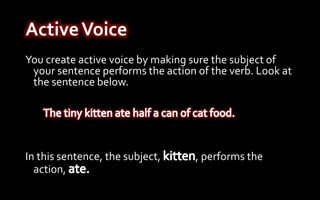
ActiveVoice
You create active voice by making sure the subject of
your sentence performs the action of the verb. Look at
the sentence below.
In this sentence, the subject, , performs the
action,
ActiveVoice
In the above sentence, the subject, ,
performs the action, .
PassiveVoice
In passive voice, rather than the subject performing the
action of the verb, the subject receives the action of
the verb.
PassiveVoice
In both of the above sentences, the subjects, can and book, are not
performing the action of the verbs, was eaten and was taken. As you
can see, the “half can of food” does not perform the action described by
the verb.
Instead, the action, was eaten, is shifted to the end of the sentence to
the noun, kitten, just in the same way the student is now the recipient
of the action was taken.
In writing, you always want to make active voice
your first choice.To recognize active and passive
voice sentences, do the following:
• Does the subject perform the action of the main verb?
If so, the sentence is in active voice.
• Does the subject sit there while something else—
named or unnamed—performs an action on it? If so,
the sentence is in passive voice.
To change passive voice to active
voice follow these three steps:
1. Delete the form of the to be verb.
2. Use an active verb form rather than the past
participial verb form.
3. Make the object of the preposition and any words
associated with the object of the preposition (but
do not include the preposition) the subject of the
sentence.
TERMINAL PUNCTUATION
In English, terminal punctuation, also called stops and end marks,
consists of the , the exclamation mark, and the question
mark.These three punctuation marks typically bring sentences to
a logical close
Period.
• Use a period to end:
(1) , which state facts and
opinions; (2) , which give
commands and directions; (3) ;
and (4) that are stated as
questions.
Declarative sentences stating
facts:
• Brasília, Brazil, was founded 21 April 1960.
• Computers are now used worldwide.
Declarative sentences stating
opinions:
• The Empire State Building is the most beautiful Art
Deco building in NewYork City.
• PracticingTai Chi is the best way to remain healthy.
Imperative sentences:
• Don’t forget your rain slicker.
• Turn left at the next corner.
Indirect questions:
• The tour guide asked if everyone was comfortable.
• He asked the woman if she knew the road to
Salamanca, Spain.
Requests that are stated as
questions:
• Would you please point out Ulaanbaatar,
Mongolia, on the map.
• Could you translate that sign over there for me,
please.
The exclamation mark (or exclamation point) follows an
exclamatory statement or an interjection and is
typically used to express strong emotion.
That was the worst play I’ve ever seen
You should be more careful with yourself
He can’t carry that by himself. Help him
You use a question mark at the end of direct questions.
Are we visiting Ayers Rock tomorrow
Where do you want me to set my shoes
Am I allowed to spin the prayer wheel

Time tenses

  • 1.
    TimeTenses How many dowe have in American English?
  • 2.
    TENSE, AGREEMENT,VOICE • Verbsdesignate tense, the time when an action or state of being/condition takes place. • All verbs have the characteristic of tense or the time when an action or state of being occurs.
  • 3.
    Tense • Tense isone of the functions of a verb. Everything that happens (actions or conditions or states), happens in present time, in past time, or in future time. A verb indicates the time of an action, a condition, or a state by changing its form.
  • 4.
  • 5.
    PRESENT PAST FUTURE SimpleTense Use Anaction or event that occurs regularly or repeatedly. An action that ended at a specific point in the past. An action that will occur after now. Formation Base form of the verb / base form + s Add –ed Will + base form of the verb Example laugh/laughs laughed will laugh ProgressiveTense Use An action that is happening now. An action was happening (past progressive) when another action happened (simple past). An action that will be happening over time, in the future, when something else happens. Formation Form of be + present participle Was or were + present participle Will + be + present participle Example am / is / are laughing was / were laughing will be laughing
  • 7.
    Verbs have toagree with their subjects in number. • In English grammar, indicates a word is singular or plural. In English sentences, subjects and verbs agree in number. Such agreement is typically called agreement. So if the subject is singular, the verb must be singular or if the subject is plural, the verb must be plural.
  • 8.
    Consider these sentences: A.Theboy eats his lunch. B.The boys eat their lunch. A.The dog barks at strangers. B.The dogs bark at strangers. A.The writer enjoys learning new words. B.The writers enjoy learning new words.
  • 9.
    Active and Passive Voice InEnglish grammar, voice shows whether the subject of a sentence is performing the action of the verb or receiving the action of the verb.
  • 10.
    ActiveVoice You create activevoice by making sure the subject of your sentence performs the action of the verb. Look at the sentence below. In this sentence, the subject, , performs the action,
  • 11.
    ActiveVoice In the abovesentence, the subject, , performs the action, .
  • 12.
    PassiveVoice In passive voice,rather than the subject performing the action of the verb, the subject receives the action of the verb.
  • 13.
    PassiveVoice In both ofthe above sentences, the subjects, can and book, are not performing the action of the verbs, was eaten and was taken. As you can see, the “half can of food” does not perform the action described by the verb. Instead, the action, was eaten, is shifted to the end of the sentence to the noun, kitten, just in the same way the student is now the recipient of the action was taken.
  • 14.
    In writing, youalways want to make active voice your first choice.To recognize active and passive voice sentences, do the following: • Does the subject perform the action of the main verb? If so, the sentence is in active voice. • Does the subject sit there while something else— named or unnamed—performs an action on it? If so, the sentence is in passive voice.
  • 15.
    To change passivevoice to active voice follow these three steps: 1. Delete the form of the to be verb. 2. Use an active verb form rather than the past participial verb form. 3. Make the object of the preposition and any words associated with the object of the preposition (but do not include the preposition) the subject of the sentence.
  • 16.
    TERMINAL PUNCTUATION In English,terminal punctuation, also called stops and end marks, consists of the , the exclamation mark, and the question mark.These three punctuation marks typically bring sentences to a logical close
  • 17.
    Period. • Use aperiod to end: (1) , which state facts and opinions; (2) , which give commands and directions; (3) ; and (4) that are stated as questions.
  • 18.
    Declarative sentences stating facts: •Brasília, Brazil, was founded 21 April 1960. • Computers are now used worldwide.
  • 19.
    Declarative sentences stating opinions: •The Empire State Building is the most beautiful Art Deco building in NewYork City. • PracticingTai Chi is the best way to remain healthy.
  • 20.
    Imperative sentences: • Don’tforget your rain slicker. • Turn left at the next corner.
  • 21.
    Indirect questions: • Thetour guide asked if everyone was comfortable. • He asked the woman if she knew the road to Salamanca, Spain.
  • 22.
    Requests that arestated as questions: • Would you please point out Ulaanbaatar, Mongolia, on the map. • Could you translate that sign over there for me, please.
  • 23.
    The exclamation mark(or exclamation point) follows an exclamatory statement or an interjection and is typically used to express strong emotion. That was the worst play I’ve ever seen You should be more careful with yourself He can’t carry that by himself. Help him
  • 24.
    You use aquestion mark at the end of direct questions. Are we visiting Ayers Rock tomorrow Where do you want me to set my shoes Am I allowed to spin the prayer wheel

Editor's Notes

  • #4 So, when you write and want to show when something occurs, the place to start is with the verb form you use.