




There are two special forms for
verbs called voice:
Active voice
Passive voice
 Active voiceActive voice is a grammatical voicegrammatical voice common in
many of the world's languages. It is the unmarkedunmarked
voice for clauses featuring a transitive verbtransitive verb in
nominative–accusative languagesnominative–accusative languages, including
EnglishEnglish and most other Indo-European languagesIndo-European languages
.
 Active voice is used in a clause whose subjectsubject
expresses the agentagent of the main verb. That is, the
subject does the action designated by the verb. A
sentence whose agent is marked as grammatical
subject is called an active sentence.
 The passive voicepassive voice is a grammatical constructiongrammatical construction
in which the subjectsubject of a sentence or clause
denotes the recipient of the action rather than the
performer. In the English languageEnglish language, the EnglishEnglish
passive voicepassive voice is formed with an auxiliaryauxiliary
verbverb (usually be or get) plus a participle (usually
the past participlepast participle) of a transitive verbtransitive verb.
 A sentence featuring the passive voice is sometimes
called a passive sentencepassive sentence, and a verb phrase in
passive voice is sometimes called a passive verb.
 The subject and object are interchanged
 The preposition BY is added before the object
 The verb is changed to past participle (3rd
form of verb)
 A new auxiliary is added to the Past Participle form of
verb.
 If the subject or the object in an active voice sentence is a
pronoun (I, we, you, he, she, they, it) it changes: (I-me; we-
us; you-you; he-him; she-her; they-them; it-it) and vice-
versa. e.g. I wrote a letter – A letter was written by me.
The prefect does keep accusing me daily – I am being
accused by the prefect daily.
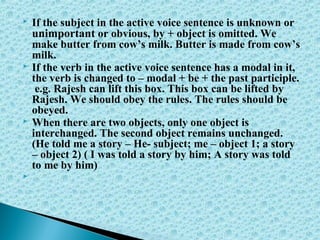
 If the subject in the active voice sentence is unknown or
unimportant or obvious, by + object is omitted. We
make butter from cow’s milk. Butter is made from cow’s
milk.
 If the verb in the active voice sentence has a modal in it,
the verb is changed to – modal + be + the past participle.
e.g. Rajesh can lift this box. This box can be lifted by
Rajesh. We should obey the rules. The rules should be
obeyed.
 When there are two objects, only one object is
interchanged. The second object remains unchanged.
(He told me a story – He- subject; me – object 1; a story
– object 2) ( I was told a story by him; A story was told
to me by him)

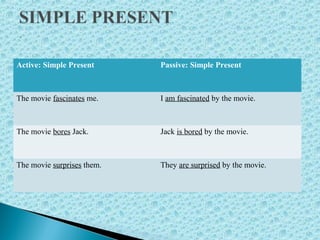
Active: Simple Present  Passive: Simple Present 
The movie fascinates me.  I am fascinated by the movie.
The movie bores Jack. Jack is bored by the movie. 
The movie surprises them. They are surprised by the movie.
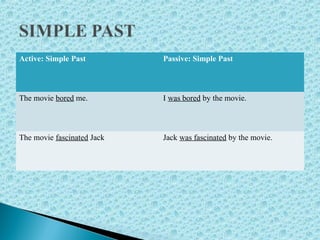
Active: Simple Past Passive: Simple Past
The movie bored me.  I was bored by the movie. 
The movie fascinated Jack Jack was fascinated by the movie. 
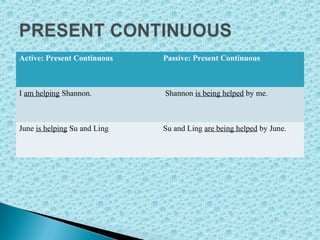
Active: Present Continuous Passive: Present Continuous
I am helping Shannon.   Shannon is being helped by me. 
June is helping Su and Ling Su and Ling are being helped by June.
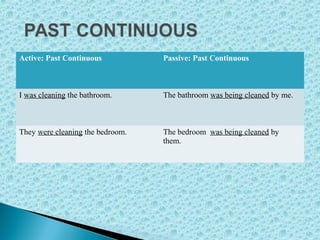
Active: Past Continuous Passive: Past Continuous
I was cleaning the bathroom.  The bathroom was being cleaned by me.
They were cleaning the bedroom.  The bedroom  was being cleaned by 
them. 
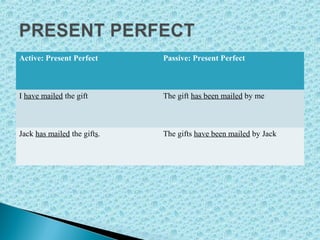
Active: Present Perfect Passive: Present Perfect
I have mailed the gift The gift has been mailed by me
Jack has mailed the gifts. The gifts have been mailed by Jack
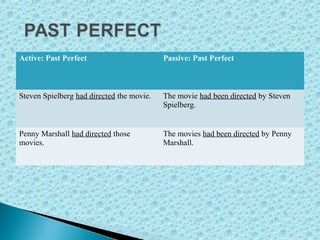
Active: Past Perfect Passive: Past Perfect
Steven Spielberg had directed the movie. The movie had been directed by Steven 
Spielberg. 
Penny Marshall had directed those 
movies.
The movies had been directed by Penny 
Marshall.
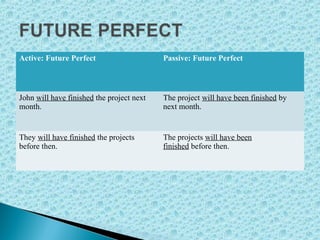
Active: Future Perfect Passive: Future Perfect
John will have finished the project next 
month. 
The project will have been finished by 
next month. 
They will have finished the projects 
before then.
The projects will have been 
finished before then.
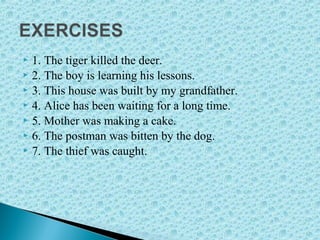
 1. The tiger killed the deer.
 2. The boy is learning his lessons.
 3. This house was built by my grandfather.
 4. Alice has been waiting for a long time.
 5. Mother was making a cake.
 6. The postman was bitten by the dog.
 7. The thief was caught.
 8. The accused were sent to jail.
 9. The loud noise frightened the baby.
 10. The dog chased the cat.
 11. The letter was posted yesterday.
 12. The oldman takes snuff.
 13. The cat drank all the milk.
 14. That boy of yours has broken my window again.
 15. These shoes of mine pinch me terribly.
 ANSWERS
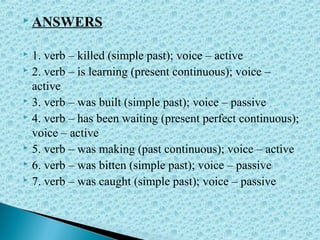
 1. verb – killed (simple past); voice – active
 2. verb – is learning (present continuous); voice –
active
 3. verb – was built (simple past); voice – passive
 4. verb – has been waiting (present perfect continuous);
voice – active
 5. verb – was making (past continuous); voice – active
 6. verb – was bitten (simple past); voice – passive
 7. verb – was caught (simple past); voice – passive
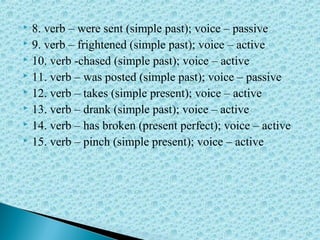
 8. verb – were sent (simple past); voice – passive
 9. verb – frightened (simple past); voice – active
 10. verb -chased (simple past); voice – active
 11. verb – was posted (simple past); voice – passive
 12. verb – takes (simple present); voice – active
 13. verb – drank (simple past); voice – active
 14. verb – has broken (present perfect); voice – active
 15. verb – pinch (simple present); voice – active
active passive voice

active passive voice

  • 3.
    There are twospecial forms for verbs called voice: Active voice Passive voice
  • 4.
     Active voiceActivevoice is a grammatical voicegrammatical voice common in many of the world's languages. It is the unmarkedunmarked voice for clauses featuring a transitive verbtransitive verb in nominative–accusative languagesnominative–accusative languages, including EnglishEnglish and most other Indo-European languagesIndo-European languages .  Active voice is used in a clause whose subjectsubject expresses the agentagent of the main verb. That is, the subject does the action designated by the verb. A sentence whose agent is marked as grammatical subject is called an active sentence.
  • 5.
     The passivevoicepassive voice is a grammatical constructiongrammatical construction in which the subjectsubject of a sentence or clause denotes the recipient of the action rather than the performer. In the English languageEnglish language, the EnglishEnglish passive voicepassive voice is formed with an auxiliaryauxiliary verbverb (usually be or get) plus a participle (usually the past participlepast participle) of a transitive verbtransitive verb.  A sentence featuring the passive voice is sometimes called a passive sentencepassive sentence, and a verb phrase in passive voice is sometimes called a passive verb.
  • 6.
     The subjectand object are interchanged  The preposition BY is added before the object  The verb is changed to past participle (3rd form of verb)  A new auxiliary is added to the Past Participle form of verb.  If the subject or the object in an active voice sentence is a pronoun (I, we, you, he, she, they, it) it changes: (I-me; we- us; you-you; he-him; she-her; they-them; it-it) and vice- versa. e.g. I wrote a letter – A letter was written by me. The prefect does keep accusing me daily – I am being accused by the prefect daily.
  • 7.
     If thesubject in the active voice sentence is unknown or unimportant or obvious, by + object is omitted. We make butter from cow’s milk. Butter is made from cow’s milk.  If the verb in the active voice sentence has a modal in it, the verb is changed to – modal + be + the past participle. e.g. Rajesh can lift this box. This box can be lifted by Rajesh. We should obey the rules. The rules should be obeyed.  When there are two objects, only one object is interchanged. The second object remains unchanged. (He told me a story – He- subject; me – object 1; a story – object 2) ( I was told a story by him; A story was told to me by him) 
  • 8.
    Active: Simple Present Passive: Simple Present  The movie fascinates me.  I am fascinated by the movie. The movie bores Jack. Jack is bored by the movie.  The movie surprises them. They are surprised by the movie.
  • 9.
    Active: Simple PastPassive: Simple Past The movie bored me.  I was bored by the movie.  The movie fascinated Jack Jack was fascinated by the movie. 
  • 10.
    Active: Present ContinuousPassive: Present Continuous I am helping Shannon.   Shannon is being helped by me.  June is helping Su and Ling Su and Ling are being helped by June.
  • 11.
    Active: Past ContinuousPassive: Past Continuous I was cleaning the bathroom.  The bathroom was being cleaned by me. They were cleaning the bedroom.  The bedroom  was being cleaned by  them. 
  • 12.
    Active: Present PerfectPassive: Present Perfect I have mailed the gift The gift has been mailed by me Jack has mailed the gifts. The gifts have been mailed by Jack
  • 13.
    Active: Past PerfectPassive: Past Perfect Steven Spielberg had directed the movie. The movie had been directed by Steven  Spielberg.  Penny Marshall had directed those  movies. The movies had been directed by Penny  Marshall.
  • 14.
    Active: Future PerfectPassive: Future Perfect John will have finished the project next  month.  The project will have been finished by  next month.  They will have finished the projects  before then. The projects will have been  finished before then.
  • 15.
     1. The tiger killed the deer.  2. The boy is learning his lessons. 3. This house was built by my grandfather.  4. Alice has been waiting for a long time.  5. Mother was making a cake.  6. The postman was bitten by the dog.  7. The thief was caught.
  • 16.
     8. Theaccused were sent to jail.  9. The loud noise frightened the baby.  10. The dog chased the cat.  11. The letter was posted yesterday.  12. The oldman takes snuff.  13. The cat drank all the milk.  14. That boy of yours has broken my window again.  15. These shoes of mine pinch me terribly.
  • 17.
     ANSWERS  1.verb – killed (simple past); voice – active  2. verb – is learning (present continuous); voice – active  3. verb – was built (simple past); voice – passive  4. verb – has been waiting (present perfect continuous); voice – active  5. verb – was making (past continuous); voice – active  6. verb – was bitten (simple past); voice – passive  7. verb – was caught (simple past); voice – passive
  • 18.
     8. verb– were sent (simple past); voice – passive  9. verb – frightened (simple past); voice – active  10. verb -chased (simple past); voice – active  11. verb – was posted (simple past); voice – passive  12. verb – takes (simple present); voice – active  13. verb – drank (simple past); voice – active  14. verb – has broken (present perfect); voice – active  15. verb – pinch (simple present); voice – active