Passive in English
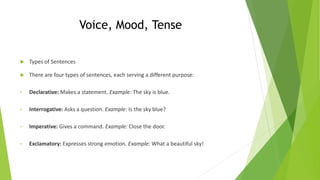
Voice, Mood, Tense
 Types of Sentences
 There are four types of sentences, each serving a different purpose:
• Declarative: Makes a statement. Example: The sky is blue.
• Interrogative: Asks a question. Example: Is the sky blue?
• Imperative: Gives a command. Example: Close the door.
• Exclamatory: Expresses strong emotion. Example: What a beautiful sky!
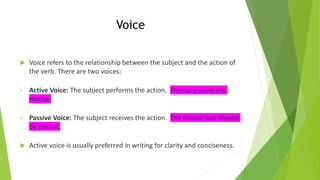
Voice
 Voice refers to the relationship between the subject and the action of
the verb. There are two voices:
• Active Voice: The subject performs the action. The cat chased the
mouse.
• Passive Voice: The subject receives the action. The mouse was chased
by the cat.
 Active voice is usually preferred in writing for clarity and conciseness.
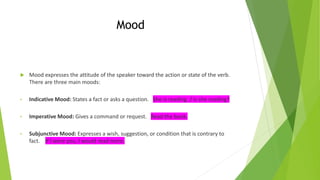
Mood
 Mood expresses the attitude of the speaker toward the action or state of the verb.
There are three main moods:
• Indicative Mood: States a fact or asks a question. She is reading. / Is she reading?
• Imperative Mood: Gives a command or request. Read the book.
• Subjunctive Mood: Expresses a wish, suggestion, or condition that is contrary to
fact. If I were you, I would read more.
Mood
Because interrogative sentences are often just rearranged versions of
sentences that use the indicative mood, the interrogative mood is
often said to be a subtype of the indicative mood or described as a
type of sentence or clause rather than a distinct mood
Tenses
 Tenses indicate the time of action or state of being as shown by
the verb. There are three main tenses, each with four aspects:
Present tense
❖Simple Present: She reads.
❖Present Continuous: She is reading.
❖Present Perfect: She has read.
❖Present Perfect Continuous: She has been reading.
Past tense
❖ Simple Past: She read.
❖ Past Continuous: She was reading.
❖ Past Perfect: She had read.
❖ Past Perfect Continuous: She had been reading.
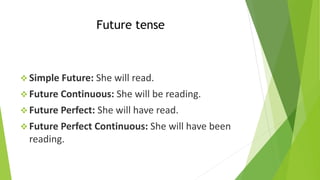
Future tense
❖ Simple Future: She will read.
❖ Future Continuous: She will be reading.
❖ Future Perfect: She will have read.
❖ Future Perfect Continuous: She will have been
reading.
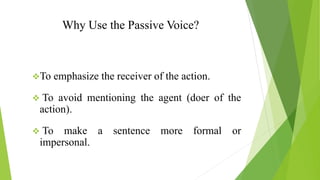
Why Use the Passive Voice?
❖To emphasize the receiver of the action.
❖ To avoid mentioning the agent (doer of the
action).
❖ To make a sentence more formal or
impersonal.
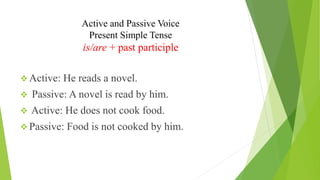
Active and Passive Voice
Present Simple Tense
is/are + past participle
❖ Active: He reads a novel.
❖ Passive: A novel is read by him.
❖ Active: He does not cook food.
❖ Passive: Food is not cooked by him.
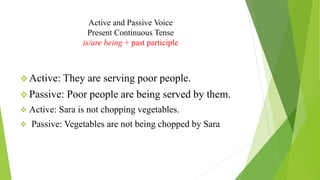
Active and Passive Voice
Present Continuous Tense
is/are being + past participle
❖ Active: They are serving poor people.
❖ Passive: Poor people are being served by them.
❖ Active: Sara is not chopping vegetables.
❖ Passive: Vegetables are not being chopped by Sara
Active and Passive Voice
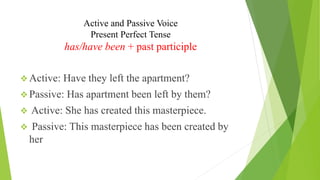
Present Perfect Tense
has/have been + past participle
❖ Active: Have they left the apartment?
❖ Passive: Has apartment been left by them?
❖ Active: She has created this masterpiece.
❖ Passive: This masterpiece has been created by
her
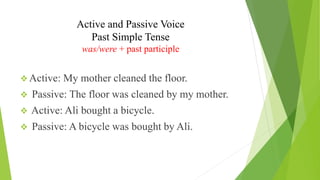
Active and Passive Voice
Past Simple Tense
was/were + past participle
❖ Active: My mother cleaned the floor.
❖ Passive: The floor was cleaned by my mother.
❖ Active: Ali bought a bicycle.
❖ Passive: A bicycle was bought by Ali.
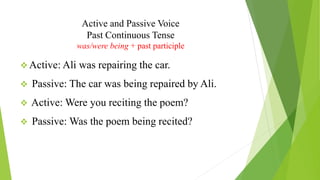
Active and Passive Voice
Past Continuous Tense
was/were being + past participle
❖ Active: Ali was repairing the car.
❖ Passive: The car was being repaired by Ali.
❖ Active: Were you reciting the poem?
❖ Passive: Was the poem being recited?
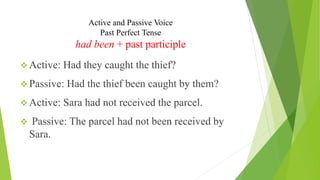
Active and Passive Voice
Past Perfect Tense
had been + past participle
❖ Active: Had they caught the thief?
❖ Passive: Had the thief been caught by them?
❖ Active: Sara had not received the parcel.
❖ Passive: The parcel had not been received by
Sara.
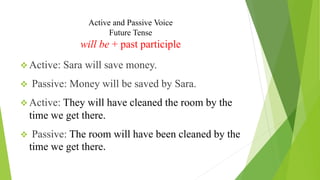
Active and Passive Voice
Future Tense
will be + past participle
❖ Active: Sara will save money.
❖ Passive: Money will be saved by Sara.
❖ Active: They will have cleaned the room by the
time we get there.
❖ Passive: The room will have been cleaned by the
time we get there.
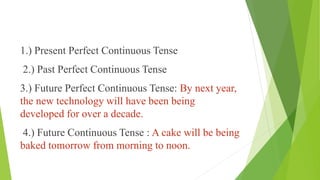
1.) Present Perfect Continuous Tense
2.) Past Perfect Continuous Tense
3.) Future Perfect Continuous Tense: By next year,
the new technology will have been being
developed for over a decade.
4.) Future Continuous Tense : A cake will be being
baked tomorrow from morning to noon.

Passive in English.pdf jdoosopaisjsjsops

  • 1.
  • 2.
    Voice, Mood, Tense Types of Sentences  There are four types of sentences, each serving a different purpose: • Declarative: Makes a statement. Example: The sky is blue. • Interrogative: Asks a question. Example: Is the sky blue? • Imperative: Gives a command. Example: Close the door. • Exclamatory: Expresses strong emotion. Example: What a beautiful sky!
  • 3.
    Voice  Voice refersto the relationship between the subject and the action of the verb. There are two voices: • Active Voice: The subject performs the action. The cat chased the mouse. • Passive Voice: The subject receives the action. The mouse was chased by the cat.  Active voice is usually preferred in writing for clarity and conciseness.
  • 4.
    Mood  Mood expressesthe attitude of the speaker toward the action or state of the verb. There are three main moods: • Indicative Mood: States a fact or asks a question. She is reading. / Is she reading? • Imperative Mood: Gives a command or request. Read the book. • Subjunctive Mood: Expresses a wish, suggestion, or condition that is contrary to fact. If I were you, I would read more.
  • 5.
    Mood Because interrogative sentencesare often just rearranged versions of sentences that use the indicative mood, the interrogative mood is often said to be a subtype of the indicative mood or described as a type of sentence or clause rather than a distinct mood
  • 6.
    Tenses  Tenses indicatethe time of action or state of being as shown by the verb. There are three main tenses, each with four aspects:
  • 7.
    Present tense ❖Simple Present:She reads. ❖Present Continuous: She is reading. ❖Present Perfect: She has read. ❖Present Perfect Continuous: She has been reading.
  • 8.
    Past tense ❖ SimplePast: She read. ❖ Past Continuous: She was reading. ❖ Past Perfect: She had read. ❖ Past Perfect Continuous: She had been reading.
  • 9.
    Future tense ❖ SimpleFuture: She will read. ❖ Future Continuous: She will be reading. ❖ Future Perfect: She will have read. ❖ Future Perfect Continuous: She will have been reading.
  • 10.
    Why Use thePassive Voice? ❖To emphasize the receiver of the action. ❖ To avoid mentioning the agent (doer of the action). ❖ To make a sentence more formal or impersonal.
  • 11.
    Active and PassiveVoice Present Simple Tense is/are + past participle ❖ Active: He reads a novel. ❖ Passive: A novel is read by him. ❖ Active: He does not cook food. ❖ Passive: Food is not cooked by him.
  • 12.
    Active and PassiveVoice Present Continuous Tense is/are being + past participle ❖ Active: They are serving poor people. ❖ Passive: Poor people are being served by them. ❖ Active: Sara is not chopping vegetables. ❖ Passive: Vegetables are not being chopped by Sara
  • 13.
    Active and PassiveVoice Present Perfect Tense has/have been + past participle ❖ Active: Have they left the apartment? ❖ Passive: Has apartment been left by them? ❖ Active: She has created this masterpiece. ❖ Passive: This masterpiece has been created by her
  • 14.
    Active and PassiveVoice Past Simple Tense was/were + past participle ❖ Active: My mother cleaned the floor. ❖ Passive: The floor was cleaned by my mother. ❖ Active: Ali bought a bicycle. ❖ Passive: A bicycle was bought by Ali.
  • 15.
    Active and PassiveVoice Past Continuous Tense was/were being + past participle ❖ Active: Ali was repairing the car. ❖ Passive: The car was being repaired by Ali. ❖ Active: Were you reciting the poem? ❖ Passive: Was the poem being recited?
  • 16.
    Active and PassiveVoice Past Perfect Tense had been + past participle ❖ Active: Had they caught the thief? ❖ Passive: Had the thief been caught by them? ❖ Active: Sara had not received the parcel. ❖ Passive: The parcel had not been received by Sara.
  • 17.
    Active and PassiveVoice Future Tense will be + past participle ❖ Active: Sara will save money. ❖ Passive: Money will be saved by Sara. ❖ Active: They will have cleaned the room by the time we get there. ❖ Passive: The room will have been cleaned by the time we get there.
  • 18.
    1.) Present PerfectContinuous Tense 2.) Past Perfect Continuous Tense 3.) Future Perfect Continuous Tense: By next year, the new technology will have been being developed for over a decade. 4.) Future Continuous Tense : A cake will be being baked tomorrow from morning to noon.