TIME MANAGEMENT


          Prepared by:
          Soft Skills Unit
Contents :
•   Introduction
•   What is Time?
•   Why Time Management is Important ?
•   Signs of Wasting Time
•   Time Wasters
•   Prioritize
       First Things First (The Pickle Jar Theory)
       4 Ds
       Four Generations of Time Management
•   Time Management Matrix
Contents :
•   Saving Time
       Delegation
       Learn to Say “No”
       Listen to Your Biological Clocks
       Effective Meetings
       Conquer Procrastination
       Use Your Waiting Time
       Build Barriers Against Interruptions
•   Scheduling
•   Time Management Tips
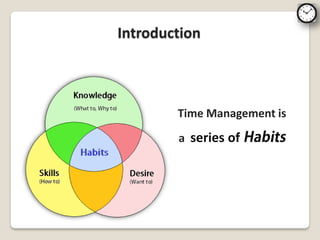
Introduction


        Time Management is
        a series of
Introduction       (cont.)


            Time Management is not a matter of
             what To Do [To Do List] only,
But a matter of what Not To Do [Not to Do List] as well.
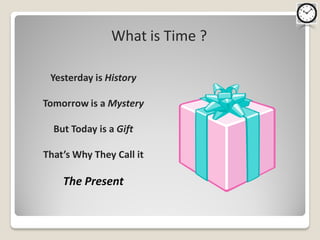
What is Time ?

 Yesterday is History

Tomorrow is a Mystery

  But Today is a Gift

That’s Why They Call it

    The Present
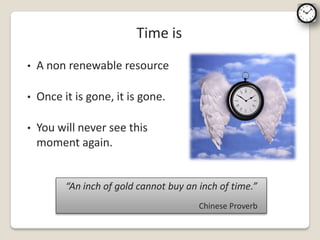
Time is
•   A non renewable resource

•   Once it is gone, it is gone.

•   You will never see this
    moment again.


          “An inch of gold cannot buy an inch of time.”
                                         Chinese Proverb
Why Time Management
    is Important ?
Why Time Management is Important ?


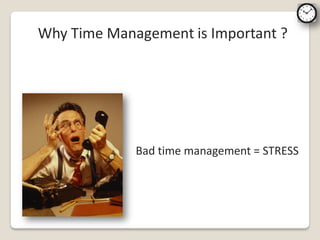
             Bad time management = STRESS
Why Time Management is Important ? (cont.)


                   You need to be organized to
                          be creative.
Why Time Management is Important ? (cont.)


                   Most people waste about
                        2 hours a day.
Why Time Management is Important ? (cont.)


                  “Remember that time is money”
                              Benjamin Franklin, 1748
To Realize the Value of:

• ONE YEAR, ask a student who failed a grade.
• ONE MONTH, ask a mother who gave birth to a premature
  baby.
• ONE WEEK, ask the editor of a weekly newspaper.
• ONE DAY, ask a daily wage laborer with kids to feed.
• ONE HOUR, ask the lovers who are waiting to meet.
• ONE MINUTE, ask a person who missed the train.
• ONE SECOND, ask a person who just avoided an accident.
• ONE MILLISECOND, ask the person who won a silver medal
  in the Olympics.
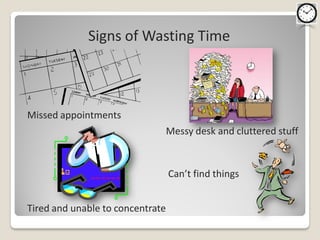
Signs of Wasting Time


Missed appointments
                                  Messy desk and cluttered stuff


                                  Can’t find things


Tired and unable to concentrate
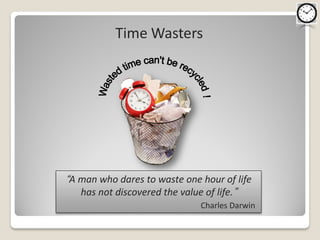
Time Wasters
Time Wasters


”A man who dares to waste one hour of life
   has not discovered the value of life.“
                              Charles Darwin
1- Lack of Focus and Direction


“Lack of direction, not lack of time, is the problem.
       We all have twenty-four hour days.”
                                            Zig Ziglar
1- Lack of Focus and Direction (Cont.)

The Five Golden Rules for Setting Goals:
1. Set goals that motivate you
2. Set SMART goals
3. Set goals in writing
4. Make an action plan
5. Stick with it
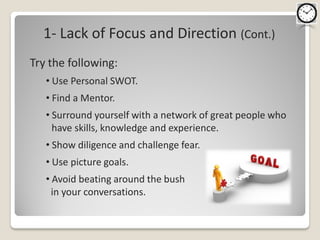
1- Lack of Focus and Direction (Cont.)
Try the following:
   • Use Personal SWOT.
   • Find a Mentor.
   • Surround yourself with a network of great people who
     have skills, knowledge and experience.
   • Show diligence and challenge fear.
   • Use picture goals.
   • Avoid beating around the bush
     in your conversations.
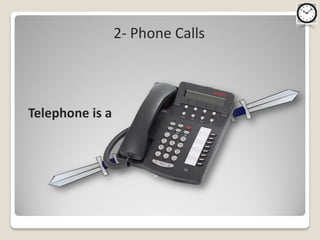
2- Phone Calls


Telephone is a
2- Phone Calls (Cont.)

Increasing phone calls Efficiency :
    1. Some features can help maximize the usefulness of the
       Telephone, such as Caller ID, Memory dial, Conference
       calling and Voice-mail service.
    2. Try hard not to receive any personal calls during the
       work hours.
    3. If you have a secretary in your office, ask him to filter
       the incoming calls.
    4. Say “I am busy right now, can you please call me later”
       gently.
2- Phone Calls (Cont.)

Increasing phone calls Efficiency :
    1. Set your goals and set the call duration before making a
       phone call.
    2. Be straight to the point.
    3. Make all your phone calls at one time.
    4. Turn phone calls into e-mails.
    5. Use speakerphone or headset so you’ll be free to work
       on other things while you’re talking or waiting.
    6. Make your calls while standing up, so you will never
       chitchat.
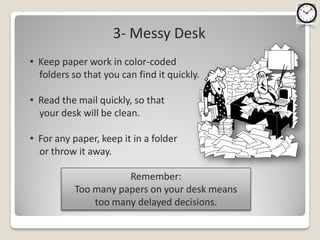
3- Messy Desk
• Keep paper work in color-coded
  folders so that you can find it quickly.

• Read the mail quickly, so that
  your desk will be clean.

• For any paper, keep it in a folder
  or throw it away.

                      Remember:
           Too many papers on your desk means
               too many delayed decisions.
4- Perfectionism
• Perfectionism isn’t the solution, it’s the problem.

• Time management is a series of choices, a skill that
  enables you to differentiate between what you need to
  do and what you’d prefer to do.

• Good organization requires setting priorities, and priorities
  remind us that time constraints truly do limit our options.

                          Remember:
80 percent of the results flow out of 20 percent of the activities.
                         (Pareto Principle)
5- Online Time-Stealers
• Some social website and Personal Blogs are made to steal
  your time, you should limit them.

• Unnecessary chatting and online Games.

• Online shopping and auctions.


         Remember:
  Time only seems to matter
    when it's running out
Prioritize
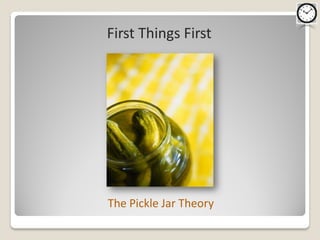
First Things First


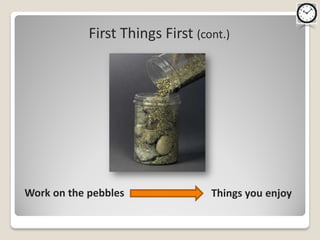
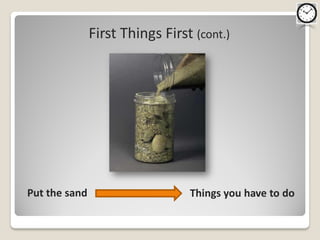
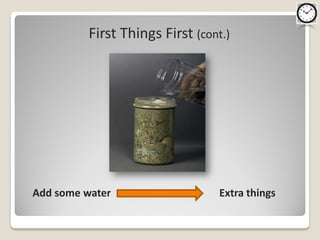
The Pickle Jar Theory
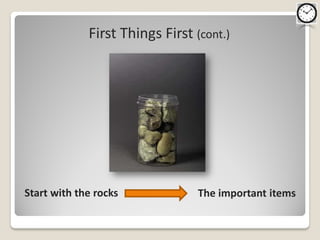
First Things First (cont.)


Start with the rocks             The important items
First Things First (cont.)


Work on the pebbles               Things you enjoy
First Things First (cont.)


Put the sand                     Things you have to do
First Things First (cont.)


Add some water                    Extra things
First Things First (cont.)


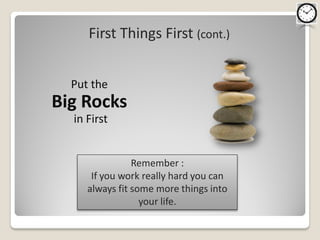
  Put the
Big Rocks
  in First


                Remember :
      If you work really hard you can
     always fit some more things into
                  your life.
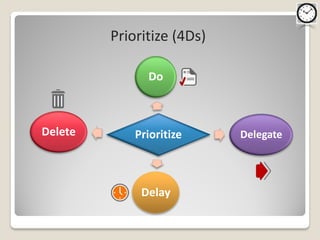
Prioritize (4Ds)

               Do


Delete       Prioritize     Delegate


              Delay
Four Generations of
Time Management
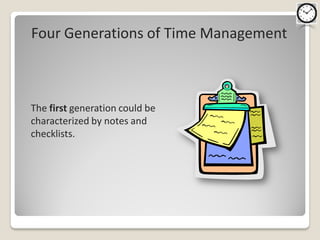
Four Generations of Time Management


The first generation could be
characterized by notes and
checklists.
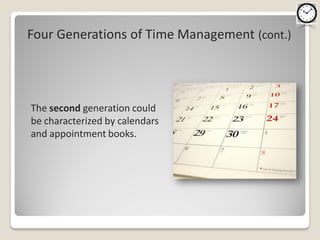
Four Generations of Time Management (cont.)


The second generation could
be characterized by calendars
and appointment books.
Four Generations of Time Management (cont.)


The third generation adds the
important idea of
prioritization, of clarifying
values and of comparing the
relative worth of activities.
Four Generations of Time Management (cont.)


The fourth generation
recognizes that the challenge
is not to manage time, but to
manage ourselves.
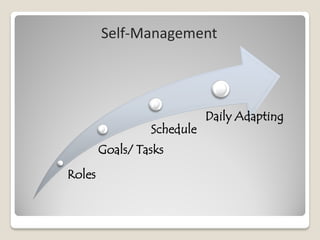
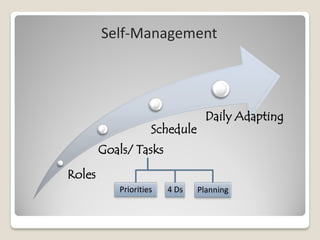
Self-Management


                            Daily Adapting
                 Schedule
        Goals/ Tasks
Roles
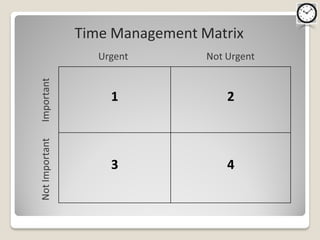
Time Management Matrix


    1              2


    3              4
Time Management Matrix (cont.)

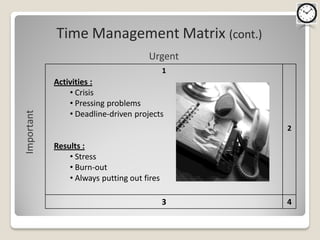
                                 1
Activities :
    • Crisis
    • Pressing problems
    • Deadline-driven projects
                                     2

Results :
    • Stress
    • Burn-out
    • Always putting out fires

                                 3   4
Time Management Matrix (cont.)

1                                 2
3    Activities :                  4
         • Trivia busy work
         • Some mail
         • Some phone calls
         • Pleasant activities
         • Time wasters
     Results :
         • Total irresponsibility
         • Fired from jobs
         • Dependent on others or
           institutions for basics
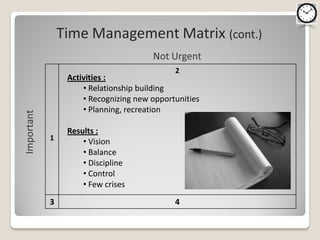
Time Management Matrix (cont.)

                                 2
     Activities :
         • Relationship building
         • Recognizing new opportunities
         • Planning, recreation

     Results :
1        • Vision
         • Balance
         • Discipline
         • Control
         • Few crises
3                                4
Time Management Matrix (cont.)

                              1                                 2
                              3
Activities :
    • Interruptions, some calls
    • Some mail, some reports
    • Some meetings
    • Proximate, pressing matters                                4
    • Popular activities
Results :
    • Short term focus        • See goals and plans as worthless
    • Crisis management       • Feel victimized, out of control
    • Reputation -            • Shallow or broken relationships
      chameleon character
Time Management Matrix (cont.)

In which Quadrant should we Live?

 Effective people stay out of Quadrants 3 and 4
  because, urgent or not, they aren't important.

 They also shrink Quadrant 1 down to size in order to
  spend more time in Quadrant 2.

 Quadrant 2 is the heart of effective personal
  management.
What is Important?

Five criteria by which you can weigh tasks (as employee):

1. Essential to your goals

2. High payoffs

3. Essential to your company’s goals

4. Essential to your boss’s goals

5. Can’t be delegated
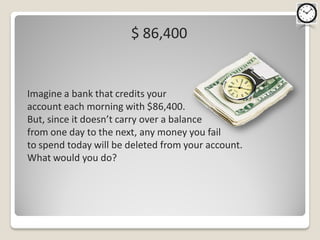
$ 86,400


Imagine a bank that credits your
account each morning with $86,400.
But, since it doesn’t carry over a balance
from one day to the next, any money you fail
to spend today will be deleted from your account.
What would you do?
Saving Time
Saving Time

• Delegation
• Learn to say “No”
• Listen to your biological clocks
• Effective meetings
• Conquer procrastination
• Use your waiting time
• Build barriers against
  interruptions
Delegation
Delegation


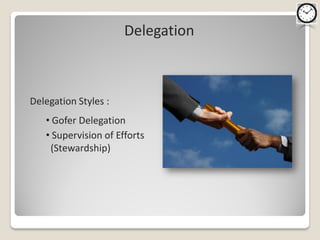
Delegation Styles :
   • Gofer Delegation
   • Supervision of Efforts
    (Stewardship)
Gofer Delegation

• Gofer delegation is extremely directive and specific.
• Dictating not only what to do, but how to do it.
• The employer must function as a “boss” micromanaging
  the progress of the “subordinate”.
• Employer wants the employee to do the task assigned, and
  only that task.
• Initiative is not welcome. Just compliance.
• Each employee's task must be followed up on, monitored and
  approved.
• This process is time consuming for the employer and boring
  for the employee.
Supervision of Efforts (Stewardship)
• Focuses on results instead of methods.
• People are able to choose the method to achieve the results.
• It takes more time up front, but has greater benefits.
• Takes the time to train, teach and guide each employee.
• It gives the employee a choice of methods and makes him
  responsible for the result.
• The employee becomes a contributing, innovative and
  responsible team member.
• Long initial training time and the need to give up control by
  trusting and having confidence in the employee.
Supervision of Efforts (Stewardship) (cont.)
 Stewardship Delegation requires a clear, upfront mutual
 understanding of commitment and expectations in
 five areas:
   1. Desired Results
   2. Guidelines
   3. Resources
   4. Accountability
   5. Consequences
Delegating Dangers
• Dispersing your workload just to get it off your plate can
  send negative messages.

• Avoid delegating over the phone or by Email, especially for
  complex projects or when delegating to someone with whom
  you have a new relationship.

• Don’t mess with due dates or priorities you establish with
  the person to whom you are delegating, this act creeps
  into micromanaging.
Delegation

                     Remember :
When you need to delegate a task, good communication
                    skills are vital.


    "Treat a man as he is and he will remain as he is.
Treat a man as he can and should be and he will become
               as he can and should be.“
                                        Stephen R. Covey
Learn to say “No”
Learn to say “No”


To say "yes" to important priorities, you have to learn to say
"no" to other activities, sometimes apparently urgent things.
Learn to say “No” (cont.)

• We say "yes" or "no" to things daily, many times a day.
  Wisdom is essential to make those judgments effectively.
• Ask yourself two questions :
    1. What will this commitment mean?
    2. If you had to take on this commitment tomorrow,
        would it—considering what you’ve planned—be a
        good use of your time?

• It's almost impossible to say "no" to the popularity
  if you don't have a bigger "yes" burning inside.
Why we can’t say “No” ?

• Don’t have priorities.
• Want to do anything to be appreciated.
• Avoiding embarrassment.
• Feeling that you are able to do many things at the same time.
• Don’t listen carefully or understand the task in the right way.
• Others expect me to say yes, so I can’t disappoint them.
• You are not good in giving excuses.
• Can’t say “No” to my boss.
How to say “No” ?
Four-step procedure that makes saying “No” safe,
diplomatic, and effective:
    • Give a reason
    • Be diplomatic
    • Suggest a trade-off
    • Don’t put off your decision

                       Remember:
          You need to be able to say “No” and
        mean it, but you may have to be persistent
               enough to get others to say
                          “Yes”.
How to say “No” ? (cont.)
Say :
 • I am a little busy now, but I will be ready the next time.
 • Because I am busy I might not give enough attention for
   the task.
 • I am sorry, I am not good in that, may be you can find
   someone better.
 • Yes I can do that, but not before the end of the month.
 • Okay, but I will make a part, when you will continue.

                         Remember :
            Be polite and gentle in all situations.
Listen to your Biological
         Clocks
Listen to your Biological Clocks

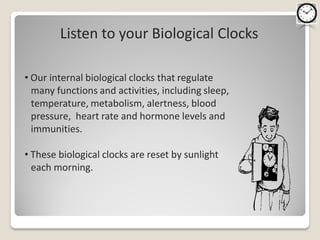
• Our internal biological clocks that regulate
  many functions and activities, including sleep,
  temperature, metabolism, alertness, blood
  pressure, heart rate and hormone levels and
  immunities.

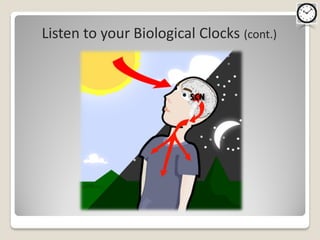
• These biological clocks are reset by sunlight
  each morning.
Listen to your Biological Clocks (cont.)

We can make more efficient use of our time by scheduling
certain activities at certain times of the day:
   8 am - 12 noon
      Cognitive, or mental, tasks such as reading, calculating
      and problem solving.
   6 am - 10 am
      Short term memory tasks such as last minute reviewing
      for tests.
   1 pm - 4 pm
      Longer term memory tasks such as memorizing
      speeches and information for application.
Listen to your Biological Clocks (cont.)

We can make more efficient use of our time by scheduling
certain activities at certain times of the day:

   2 pm to 6 pm
     You are most efficient at tasks involving the use of your
     hands such as keyboarding and carpentry.

   4 pm to 9 pm
     Evening is the best to engage in physical activity, when
     your large muscle coordination is at its peak.
Effective Meetings
Effective Meetings


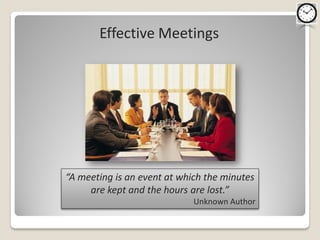
“A meeting is an event at which the minutes
     are kept and the hours are lost.”
                             Unknown Author
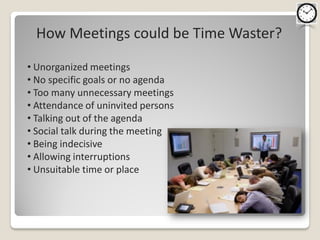
How Meetings could be Time Waster?

• Unorganized meetings
• No specific goals or no agenda
• Too many unnecessary meetings
• Attendance of uninvited persons
• Talking out of the agenda
• Social talk during the meeting
• Being indecisive
• Allowing interruptions
• Unsuitable time or place
10 Golden keys for Effective Meetings
1. Create a written agenda for each meeting.
2. Assign the meeting a clear start time and official closing time.
3. Set at least one goal for your meeting.
4. Be reasonable about the number of topics to be covered.
5. Invite only the necessary people.
6. Never schedule a meeting because it’s customary.
7. Create an environment for productivity.
8. Establish an idea bin.
9. At the meeting’s close, orally summarize all agreements,
   assignments and decisions.
10.Via a written meeting summary, list all steps to be taken to
   fulfill the meeting’s consensus.
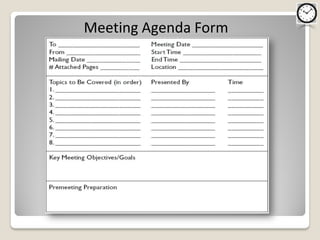
Meeting Agenda Form
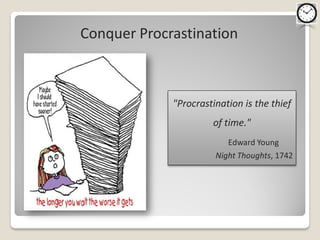
Conquer Procrastination


             "Procrastination is the thief
                      of time."
                          Edward Young
                       Night Thoughts, 1742
Why Procrastination ?
 Internal Forces
   They are primarily inner rooted. They arise from the
   procrastinator’s psyche.
   For example, If you tend to fear failure and you procrastinate
   largely for that reason, you’ll procrastinate on any task at
   which you might fear that you’ll fail.

 External Forces
   Even if you usually don’t procrastinate, your environment
   can impose procrastination on you.
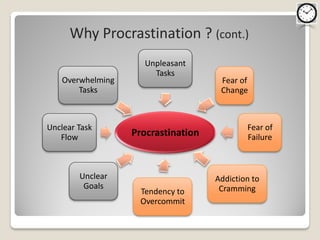
Why Procrastination ? (cont.)
                      Unpleasant
                        Tasks
    Overwhelming                      Fear of
        Tasks                         Change


Unclear Task                                 Fear of
   Flow            Procrastination           Failure


        Unclear                      Addiction to
         Goals                        Cramming
                     Tendency to
                     Overcommit
Conquer Procrastination ? (cont.)

• The task seems unpleasant
    Five strategies can help you take on a task that you avoid
    because it’s unpleasant:
        1. Do it the first thing in the day.
        2. The night before, place the task where you can’t
            miss it and use the “measles” approach.
        3. Find somebody else to do it.
        4. Make an advantage/disadvantage list.
        5. After completing the task, reward yourself with
            something that is pleasurable for you.
Conquer Procrastination ? (cont.)
• The task seems overwhelming
    Three strategies will help you accomplishing the task:
        1. Divide and conquer.
        2. Find a solitary place to do it.
        3. Ride the momentum.
• The task flow is unclear or unplanned
    Visualize the flow using Flowchart.
    Flowchart is a diagram that displays the step-by-step
    progression through a procedure or system, frequently
    using lines connecting the steps to indicate direction or
    flow.
Conquer Procrastination ? (cont.)
• Your goals are unclear
    Make general goals into specific goals by reminding yourself
    what it is, specifically, that makes the goal a goal.
    In certain situations—especially in business—goals should
    be not only clear but also measurable.
• You fear change
    If you are resisting change, any of the following might
    work for you:
          Change your physical environment.
          Change your routines and patterns.
          Do nothing.
Conquer Procrastination ? (cont.)

• You fear failure
    Believe that failure is the condiment that gives success its
    flavor. So the only thing we have to fear is fear itself.


• You tend to overcommit
    In the future, before volunteering to take on new
    commitments, take a few moments to review those
    commitments you’ve already made but haven’t completed.
Conquer Procrastination ? (cont.)

• You’re addicted to cramming
    Doing something at the last minute is a dangerous habit
    because:
         Last-minute work increases the odds of making a
          mistake.
         You have no time to correct mistakes, or even to
          discover them.
         A new, unexpected demand may come up at the last
          minute and might hurts the quality of both tasks.
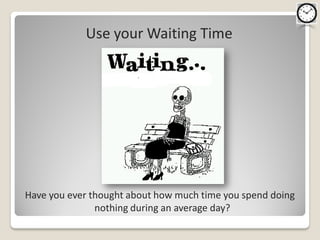
Use your Waiting Time


Have you ever thought about how much time you spend doing
               nothing during an average day?
5 Minutes


What can you accomplish in five
          minutes?
Use your Waiting Time (cont.)
• It is an important personal time management skill to make
  good use of your “waiting time”.
• Usually this is not a situation where you planned to do
  nothing…it just happened!
• Think about all of the things you could accomplish if you could
  make use of this time. For instance:
       Time you spend commuting on a train or bus
       Time you wait at the doctor for your appointment
       Time you spend on a plane, waiting for your plane, or the
         time you spend waiting for your luggage
       Time you spend “on hold” on the telephone
       Time you spend when you arrive at work or at a meeting
         earlier than you had anticipated
Use your Waiting Time (cont.)

• You can either consider these periods as “wastes of time” or
  as “gifts of time.”

• As “gifts of time”, you can use them as opportunities to
  accomplish routine tasks that are necessary, but don’t require
  large periods of time.

• Most successful people have already found that there are
  a number of things that they can accomplish while they wait.
Build Barriers against
    Interruptions
Build Barriers against Interruptions
• Interruption means that your concentration is broken,
 by an e-mail, a phone call, a request from a colleague, or
 even by yourself.
• When you change your focus, you’re
 changing your state of mind – which
 makes it hard to remember what you
 were thinking about before.

• Interruptions destroy your concentration.
 And loss of concentration = loss of
 creative work.
Minimize Interruptions
• Switch your phone onto answer phone mode.
• Close your e-mail application.
• Put a ‘Do not disturb’ notice on your office door.
• If you’re at work, make sure that everyone knows about your
  “sacred” hours.
• Find a “secret” place to work, conference room, function hall,
  or other space in your building where you could go and work,
  uninterrupted and undiscovered.
• Come to work very early or stay late.
Minimize Interruptions (cont.)

• If you have problems with constant interruptions during
  your workday, ask permission to work more flexible hours.
• Avoid walking around. Each time you move, it gives others
  the opportunity to interrupt you.
• If you are a manager, inform your team about the time they
  are allowed to interrupt you to ask or discuss any thing.
• If a colleague in your company needs to see you, suggest
  you confer in his office. It’s much easier to leave someone
  than to get that person to leave you.
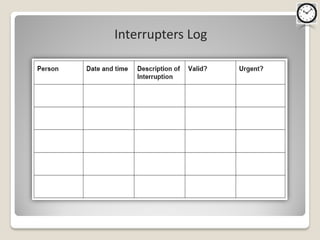
Interrupters Log
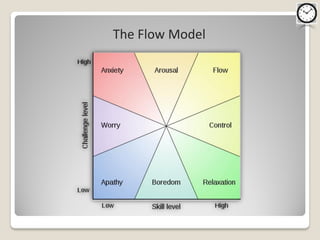
The Flow Model
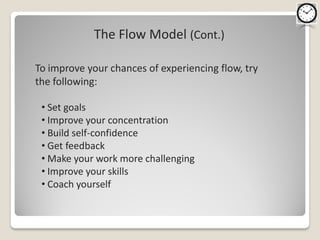
The Flow Model (Cont.)

To improve your chances of experiencing flow, try
the following:

 • Set goals
 • Improve your concentration
 • Build self-confidence
 • Get feedback
 • Make your work more challenging
 • Improve your skills
 • Coach yourself
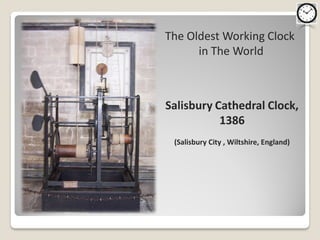
The Oldest Working Clock
      in The World


Salisbury Cathedral Clock,
           1386
 (Salisbury City , Wiltshire, England)
Scheduling
Self-Management


                                 Daily Adapting
                    Schedule
        Goals/ Tasks
Roles
           Priorities   4 Ds   Planning
Scheduling


Before scheduling you need to plan !
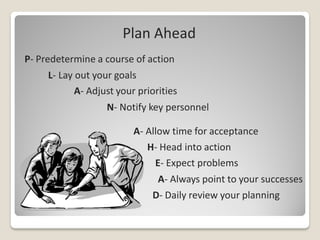
Plan Ahead
P- Predetermine a course of action
     L- Lay out your goals
            A- Adjust your priorities
                   N- Notify key personnel

                          A- Allow time for acceptance
                             H- Head into action
                               E- Expect problems
                               A- Always point to your successes
                              D- Daily review your planning
Planning

• Plan tomorrow’s tasks today.

• Use :
    Deadlines
    Milestones
    Action Plan
Planning (Cont.)


Don’t reinvent the wheel !
Scheduling

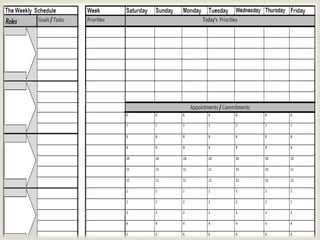
• Use Weekly scheduling.
• Allow extra time for each task.
• Stick to your schedule and be flexible.
• Consider the productivity cycles.
• Include traveling time, waiting time, interruptions,
  eating time and sleeping time.
• Use symbols and colors.
• Use technology to
  schedule your week.
Scheduling (Cont.)


“A schedule is not a puzzle, blank areas must be there.”

                                            Sharl Antoun


                      Remember:
   Focus on less, and you’ll actually achieve more.
Time Management Tips
• Give your full attention to whatever you’re doing in the
  moment, by clearing out unnecessary mental clutters.
• Set a specific hour each day to make all phone calls.
• Try not to buy too many newspapers or magazines, this
  will waste your time because you will feel guilty if you
  throw one away unread.
• Try hard not to lose your time, and never lose your temper.
• Sleeping well is a very important issue for your personal
  time management.
Time Management Tips (cont.)
• Reward yourself after finishing a task.
• Be Realistic in your Expectations.
• Create a “Not-to-do” list as well as a “To-do list”.
• It is impossible to keep abreast of the stream of Information
  that flows every day . You must become selective.
• Never try to eat the elephant with one bite. Divide and
  conquer.
              ”Nothing is particularly hard if you
                  divide it into small jobs.”
                                            Henry Ford
Time Management Tips (cont.)
• Pausing to relax and recuperate can reenergize your work
  and make you more productive.

• Before delegating, targeting the right person for the job
  should be your main priority.

• Consider swapping responsibilities, to save time and effort.

                     Remember:
    Sometimes our most productive ideas come to us in
            moments of spontaneity or play.
Time Management Tips (cont.)
• Plan tomorrow’s tasks today.

• Reconfirm appointments you made some time ago.

• Give false times and deadlines to people.

• When reading a report, read the executive summary first.

• Use the bookmark feature on your Internet browser.

• Create backups for everything critical.
Time Management Tips (cont.)
• Reserve the surface of your desk only for active projects and
  the supplies you use most.
• Keep a pad and pencil beside your phones.
• High-speed Internet connections can be very valuable.
• Manage your computer memory. Delete unused files and
  folders.
• Next time when you send e-mail, try to be brief as possible.
• Use Technology to manage your time.
Time Management Tips (cont.)
• Learn to do the right thing, not to do the thing right.

• Focus exclusively on completing high importance tasks.

• Focus on less, and you’ll actually achieve more.

• Only use multi-tasking with low importance tasks.

                        Remember:
       Great Time Management is not time-centered,
                 but task-centered. (T.N.T)
Time Management Tips (cont.)


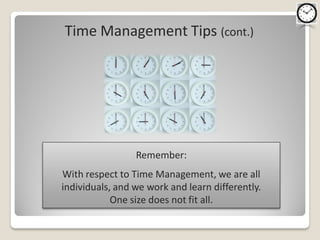
                 Remember:
With respect to Time Management, we are all
individuals, and we work and learn differently.
            One size does not fit all.
Now


What one thing could you
 do that would make a
 tremendous positive
   difference in your
      personal life
           ?
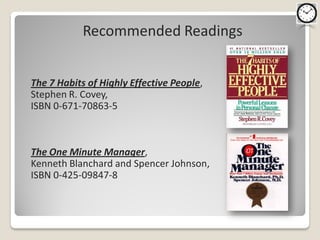
Recommended Readings


The 7 Habits of Highly Effective People,
Stephen R. Covey,
ISBN 0-671-70863-5


The One Minute Manager,
Kenneth Blanchard and Spencer Johnson,
ISBN 0-425-09847-8
References
• The seven Habits of Highly Effective People
Stephen R. Covey
• First Things First
 Steven Covey. Simon/ Schuster. 1994
• Time Management
 Marc Mancini
• Secrets of Our Body Clocks Revealed
 Perry Dawson
• The Great Time Management Secret
 Dr. Jason Raj

• www.mindtools.com

• www.leadershipanswers.com

• www.wishfulthinking.co.uk
Thanks

Time management iti students

  • 1.
    TIME MANAGEMENT Prepared by: Soft Skills Unit
  • 2.
    Contents : • Introduction • What is Time? • Why Time Management is Important ? • Signs of Wasting Time • Time Wasters • Prioritize  First Things First (The Pickle Jar Theory)  4 Ds  Four Generations of Time Management • Time Management Matrix
  • 3.
    Contents : • Saving Time  Delegation  Learn to Say “No”  Listen to Your Biological Clocks  Effective Meetings  Conquer Procrastination  Use Your Waiting Time  Build Barriers Against Interruptions • Scheduling • Time Management Tips
  • 4.
    Introduction Time Management is a series of
  • 5.
    Introduction (cont.) Time Management is not a matter of what To Do [To Do List] only, But a matter of what Not To Do [Not to Do List] as well.
  • 6.
    What is Time? Yesterday is History Tomorrow is a Mystery But Today is a Gift That’s Why They Call it The Present
  • 7.
    Time is • A non renewable resource • Once it is gone, it is gone. • You will never see this moment again. “An inch of gold cannot buy an inch of time.” Chinese Proverb
  • 8.
    Why Time Management is Important ?
  • 9.
    Why Time Managementis Important ? Bad time management = STRESS
  • 10.
    Why Time Managementis Important ? (cont.) You need to be organized to be creative.
  • 11.
    Why Time Managementis Important ? (cont.) Most people waste about 2 hours a day.
  • 12.
    Why Time Managementis Important ? (cont.) “Remember that time is money” Benjamin Franklin, 1748
  • 13.
    To Realize theValue of: • ONE YEAR, ask a student who failed a grade. • ONE MONTH, ask a mother who gave birth to a premature baby. • ONE WEEK, ask the editor of a weekly newspaper. • ONE DAY, ask a daily wage laborer with kids to feed. • ONE HOUR, ask the lovers who are waiting to meet. • ONE MINUTE, ask a person who missed the train. • ONE SECOND, ask a person who just avoided an accident. • ONE MILLISECOND, ask the person who won a silver medal in the Olympics.
  • 14.
  • 15.
    Signs of WastingTime Missed appointments Messy desk and cluttered stuff Can’t find things Tired and unable to concentrate
  • 16.
  • 17.
    Time Wasters ”A manwho dares to waste one hour of life has not discovered the value of life.“ Charles Darwin
  • 18.
    1- Lack ofFocus and Direction “Lack of direction, not lack of time, is the problem. We all have twenty-four hour days.” Zig Ziglar
  • 19.
    1- Lack ofFocus and Direction (Cont.) The Five Golden Rules for Setting Goals: 1. Set goals that motivate you 2. Set SMART goals 3. Set goals in writing 4. Make an action plan 5. Stick with it
  • 20.
    1- Lack ofFocus and Direction (Cont.) Try the following: • Use Personal SWOT. • Find a Mentor. • Surround yourself with a network of great people who have skills, knowledge and experience. • Show diligence and challenge fear. • Use picture goals. • Avoid beating around the bush in your conversations.
  • 21.
  • 22.
    2- Phone Calls(Cont.) Increasing phone calls Efficiency : 1. Some features can help maximize the usefulness of the Telephone, such as Caller ID, Memory dial, Conference calling and Voice-mail service. 2. Try hard not to receive any personal calls during the work hours. 3. If you have a secretary in your office, ask him to filter the incoming calls. 4. Say “I am busy right now, can you please call me later” gently.
  • 23.
    2- Phone Calls(Cont.) Increasing phone calls Efficiency : 1. Set your goals and set the call duration before making a phone call. 2. Be straight to the point. 3. Make all your phone calls at one time. 4. Turn phone calls into e-mails. 5. Use speakerphone or headset so you’ll be free to work on other things while you’re talking or waiting. 6. Make your calls while standing up, so you will never chitchat.
  • 24.
    3- Messy Desk •Keep paper work in color-coded folders so that you can find it quickly. • Read the mail quickly, so that your desk will be clean. • For any paper, keep it in a folder or throw it away. Remember: Too many papers on your desk means too many delayed decisions.
  • 25.
    4- Perfectionism • Perfectionismisn’t the solution, it’s the problem. • Time management is a series of choices, a skill that enables you to differentiate between what you need to do and what you’d prefer to do. • Good organization requires setting priorities, and priorities remind us that time constraints truly do limit our options. Remember: 80 percent of the results flow out of 20 percent of the activities. (Pareto Principle)
  • 26.
    5- Online Time-Stealers •Some social website and Personal Blogs are made to steal your time, you should limit them. • Unnecessary chatting and online Games. • Online shopping and auctions. Remember: Time only seems to matter when it's running out
  • 27.
  • 28.
    First Things First ThePickle Jar Theory
  • 29.
    First Things First(cont.) Start with the rocks The important items
  • 30.
    First Things First(cont.) Work on the pebbles Things you enjoy
  • 31.
    First Things First(cont.) Put the sand Things you have to do
  • 32.
    First Things First(cont.) Add some water Extra things
  • 33.
    First Things First(cont.) Put the Big Rocks in First Remember : If you work really hard you can always fit some more things into your life.
  • 34.
    Prioritize (4Ds) Do Delete Prioritize Delegate Delay
  • 35.
  • 36.
    Four Generations ofTime Management The first generation could be characterized by notes and checklists.
  • 37.
    Four Generations ofTime Management (cont.) The second generation could be characterized by calendars and appointment books.
  • 38.
    Four Generations ofTime Management (cont.) The third generation adds the important idea of prioritization, of clarifying values and of comparing the relative worth of activities.
  • 39.
    Four Generations ofTime Management (cont.) The fourth generation recognizes that the challenge is not to manage time, but to manage ourselves.
  • 40.
    Self-Management Daily Adapting Schedule Goals/ Tasks Roles
  • 41.
  • 42.
    Time Management Matrix(cont.) 1 Activities : • Crisis • Pressing problems • Deadline-driven projects 2 Results : • Stress • Burn-out • Always putting out fires 3 4
  • 43.
    Time Management Matrix(cont.) 1 2 3 Activities : 4 • Trivia busy work • Some mail • Some phone calls • Pleasant activities • Time wasters Results : • Total irresponsibility • Fired from jobs • Dependent on others or institutions for basics
  • 44.
    Time Management Matrix(cont.) 2 Activities : • Relationship building • Recognizing new opportunities • Planning, recreation Results : 1 • Vision • Balance • Discipline • Control • Few crises 3 4
  • 45.
    Time Management Matrix(cont.) 1 2 3 Activities : • Interruptions, some calls • Some mail, some reports • Some meetings • Proximate, pressing matters 4 • Popular activities Results : • Short term focus • See goals and plans as worthless • Crisis management • Feel victimized, out of control • Reputation - • Shallow or broken relationships chameleon character
  • 46.
    Time Management Matrix(cont.) In which Quadrant should we Live?  Effective people stay out of Quadrants 3 and 4 because, urgent or not, they aren't important.  They also shrink Quadrant 1 down to size in order to spend more time in Quadrant 2.  Quadrant 2 is the heart of effective personal management.
  • 47.
    What is Important? Fivecriteria by which you can weigh tasks (as employee): 1. Essential to your goals 2. High payoffs 3. Essential to your company’s goals 4. Essential to your boss’s goals 5. Can’t be delegated
  • 48.
    $ 86,400 Imagine abank that credits your account each morning with $86,400. But, since it doesn’t carry over a balance from one day to the next, any money you fail to spend today will be deleted from your account. What would you do?
  • 49.
  • 50.
    Saving Time • Delegation •Learn to say “No” • Listen to your biological clocks • Effective meetings • Conquer procrastination • Use your waiting time • Build barriers against interruptions
  • 51.
  • 52.
    Delegation Delegation Styles : • Gofer Delegation • Supervision of Efforts (Stewardship)
  • 53.
    Gofer Delegation • Goferdelegation is extremely directive and specific. • Dictating not only what to do, but how to do it. • The employer must function as a “boss” micromanaging the progress of the “subordinate”. • Employer wants the employee to do the task assigned, and only that task. • Initiative is not welcome. Just compliance. • Each employee's task must be followed up on, monitored and approved. • This process is time consuming for the employer and boring for the employee.
  • 54.
    Supervision of Efforts(Stewardship) • Focuses on results instead of methods. • People are able to choose the method to achieve the results. • It takes more time up front, but has greater benefits. • Takes the time to train, teach and guide each employee. • It gives the employee a choice of methods and makes him responsible for the result. • The employee becomes a contributing, innovative and responsible team member. • Long initial training time and the need to give up control by trusting and having confidence in the employee.
  • 55.
    Supervision of Efforts(Stewardship) (cont.) Stewardship Delegation requires a clear, upfront mutual understanding of commitment and expectations in five areas: 1. Desired Results 2. Guidelines 3. Resources 4. Accountability 5. Consequences
  • 56.
    Delegating Dangers • Dispersingyour workload just to get it off your plate can send negative messages. • Avoid delegating over the phone or by Email, especially for complex projects or when delegating to someone with whom you have a new relationship. • Don’t mess with due dates or priorities you establish with the person to whom you are delegating, this act creeps into micromanaging.
  • 57.
    Delegation Remember : When you need to delegate a task, good communication skills are vital. "Treat a man as he is and he will remain as he is. Treat a man as he can and should be and he will become as he can and should be.“ Stephen R. Covey
  • 58.
    Learn to say“No”
  • 59.
    Learn to say“No” To say "yes" to important priorities, you have to learn to say "no" to other activities, sometimes apparently urgent things.
  • 60.
    Learn to say“No” (cont.) • We say "yes" or "no" to things daily, many times a day. Wisdom is essential to make those judgments effectively. • Ask yourself two questions : 1. What will this commitment mean? 2. If you had to take on this commitment tomorrow, would it—considering what you’ve planned—be a good use of your time? • It's almost impossible to say "no" to the popularity if you don't have a bigger "yes" burning inside.
  • 61.
    Why we can’tsay “No” ? • Don’t have priorities. • Want to do anything to be appreciated. • Avoiding embarrassment. • Feeling that you are able to do many things at the same time. • Don’t listen carefully or understand the task in the right way. • Others expect me to say yes, so I can’t disappoint them. • You are not good in giving excuses. • Can’t say “No” to my boss.
  • 62.
    How to say“No” ? Four-step procedure that makes saying “No” safe, diplomatic, and effective: • Give a reason • Be diplomatic • Suggest a trade-off • Don’t put off your decision Remember: You need to be able to say “No” and mean it, but you may have to be persistent enough to get others to say “Yes”.
  • 63.
    How to say“No” ? (cont.) Say : • I am a little busy now, but I will be ready the next time. • Because I am busy I might not give enough attention for the task. • I am sorry, I am not good in that, may be you can find someone better. • Yes I can do that, but not before the end of the month. • Okay, but I will make a part, when you will continue. Remember : Be polite and gentle in all situations.
  • 64.
    Listen to yourBiological Clocks
  • 65.
    Listen to yourBiological Clocks • Our internal biological clocks that regulate many functions and activities, including sleep, temperature, metabolism, alertness, blood pressure, heart rate and hormone levels and immunities. • These biological clocks are reset by sunlight each morning.
  • 66.
    Listen to yourBiological Clocks (cont.)
  • 67.
    Listen to yourBiological Clocks (cont.) We can make more efficient use of our time by scheduling certain activities at certain times of the day:  8 am - 12 noon Cognitive, or mental, tasks such as reading, calculating and problem solving.  6 am - 10 am Short term memory tasks such as last minute reviewing for tests.  1 pm - 4 pm Longer term memory tasks such as memorizing speeches and information for application.
  • 68.
    Listen to yourBiological Clocks (cont.) We can make more efficient use of our time by scheduling certain activities at certain times of the day:  2 pm to 6 pm You are most efficient at tasks involving the use of your hands such as keyboarding and carpentry.  4 pm to 9 pm Evening is the best to engage in physical activity, when your large muscle coordination is at its peak.
  • 69.
  • 70.
    Effective Meetings “A meetingis an event at which the minutes are kept and the hours are lost.” Unknown Author
  • 71.
    How Meetings couldbe Time Waster? • Unorganized meetings • No specific goals or no agenda • Too many unnecessary meetings • Attendance of uninvited persons • Talking out of the agenda • Social talk during the meeting • Being indecisive • Allowing interruptions • Unsuitable time or place
  • 72.
    10 Golden keysfor Effective Meetings 1. Create a written agenda for each meeting. 2. Assign the meeting a clear start time and official closing time. 3. Set at least one goal for your meeting. 4. Be reasonable about the number of topics to be covered. 5. Invite only the necessary people. 6. Never schedule a meeting because it’s customary. 7. Create an environment for productivity. 8. Establish an idea bin. 9. At the meeting’s close, orally summarize all agreements, assignments and decisions. 10.Via a written meeting summary, list all steps to be taken to fulfill the meeting’s consensus.
  • 73.
  • 74.
  • 75.
    Conquer Procrastination "Procrastination is the thief of time." Edward Young Night Thoughts, 1742
  • 76.
    Why Procrastination ? Internal Forces They are primarily inner rooted. They arise from the procrastinator’s psyche. For example, If you tend to fear failure and you procrastinate largely for that reason, you’ll procrastinate on any task at which you might fear that you’ll fail.  External Forces Even if you usually don’t procrastinate, your environment can impose procrastination on you.
  • 77.
    Why Procrastination ?(cont.) Unpleasant Tasks Overwhelming Fear of Tasks Change Unclear Task Fear of Flow Procrastination Failure Unclear Addiction to Goals Cramming Tendency to Overcommit
  • 78.
    Conquer Procrastination ?(cont.) • The task seems unpleasant Five strategies can help you take on a task that you avoid because it’s unpleasant: 1. Do it the first thing in the day. 2. The night before, place the task where you can’t miss it and use the “measles” approach. 3. Find somebody else to do it. 4. Make an advantage/disadvantage list. 5. After completing the task, reward yourself with something that is pleasurable for you.
  • 79.
    Conquer Procrastination ?(cont.) • The task seems overwhelming Three strategies will help you accomplishing the task: 1. Divide and conquer. 2. Find a solitary place to do it. 3. Ride the momentum. • The task flow is unclear or unplanned Visualize the flow using Flowchart. Flowchart is a diagram that displays the step-by-step progression through a procedure or system, frequently using lines connecting the steps to indicate direction or flow.
  • 80.
    Conquer Procrastination ?(cont.) • Your goals are unclear Make general goals into specific goals by reminding yourself what it is, specifically, that makes the goal a goal. In certain situations—especially in business—goals should be not only clear but also measurable. • You fear change If you are resisting change, any of the following might work for you:  Change your physical environment.  Change your routines and patterns.  Do nothing.
  • 81.
    Conquer Procrastination ?(cont.) • You fear failure Believe that failure is the condiment that gives success its flavor. So the only thing we have to fear is fear itself. • You tend to overcommit In the future, before volunteering to take on new commitments, take a few moments to review those commitments you’ve already made but haven’t completed.
  • 82.
    Conquer Procrastination ?(cont.) • You’re addicted to cramming Doing something at the last minute is a dangerous habit because:  Last-minute work increases the odds of making a mistake.  You have no time to correct mistakes, or even to discover them.  A new, unexpected demand may come up at the last minute and might hurts the quality of both tasks.
  • 83.
  • 84.
    Use your WaitingTime Have you ever thought about how much time you spend doing nothing during an average day?
  • 85.
    5 Minutes What canyou accomplish in five minutes?
  • 86.
    Use your WaitingTime (cont.) • It is an important personal time management skill to make good use of your “waiting time”. • Usually this is not a situation where you planned to do nothing…it just happened! • Think about all of the things you could accomplish if you could make use of this time. For instance:  Time you spend commuting on a train or bus  Time you wait at the doctor for your appointment  Time you spend on a plane, waiting for your plane, or the time you spend waiting for your luggage  Time you spend “on hold” on the telephone  Time you spend when you arrive at work or at a meeting earlier than you had anticipated
  • 87.
    Use your WaitingTime (cont.) • You can either consider these periods as “wastes of time” or as “gifts of time.” • As “gifts of time”, you can use them as opportunities to accomplish routine tasks that are necessary, but don’t require large periods of time. • Most successful people have already found that there are a number of things that they can accomplish while they wait.
  • 88.
  • 89.
    Build Barriers againstInterruptions • Interruption means that your concentration is broken, by an e-mail, a phone call, a request from a colleague, or even by yourself. • When you change your focus, you’re changing your state of mind – which makes it hard to remember what you were thinking about before. • Interruptions destroy your concentration. And loss of concentration = loss of creative work.
  • 90.
    Minimize Interruptions • Switchyour phone onto answer phone mode. • Close your e-mail application. • Put a ‘Do not disturb’ notice on your office door. • If you’re at work, make sure that everyone knows about your “sacred” hours. • Find a “secret” place to work, conference room, function hall, or other space in your building where you could go and work, uninterrupted and undiscovered. • Come to work very early or stay late.
  • 91.
    Minimize Interruptions (cont.) •If you have problems with constant interruptions during your workday, ask permission to work more flexible hours. • Avoid walking around. Each time you move, it gives others the opportunity to interrupt you. • If you are a manager, inform your team about the time they are allowed to interrupt you to ask or discuss any thing. • If a colleague in your company needs to see you, suggest you confer in his office. It’s much easier to leave someone than to get that person to leave you.
  • 92.
  • 93.
  • 94.
    The Flow Model(Cont.) To improve your chances of experiencing flow, try the following: • Set goals • Improve your concentration • Build self-confidence • Get feedback • Make your work more challenging • Improve your skills • Coach yourself
  • 95.
    The Oldest WorkingClock in The World Salisbury Cathedral Clock, 1386 (Salisbury City , Wiltshire, England)
  • 96.
  • 97.
    Self-Management Daily Adapting Schedule Goals/ Tasks Roles Priorities 4 Ds Planning
  • 98.
  • 99.
    Plan Ahead P- Predeterminea course of action L- Lay out your goals A- Adjust your priorities N- Notify key personnel A- Allow time for acceptance H- Head into action E- Expect problems A- Always point to your successes D- Daily review your planning
  • 100.
    Planning • Plan tomorrow’stasks today. • Use :  Deadlines  Milestones  Action Plan
  • 101.
  • 102.
    Scheduling • Use Weeklyscheduling. • Allow extra time for each task. • Stick to your schedule and be flexible. • Consider the productivity cycles. • Include traveling time, waiting time, interruptions, eating time and sleeping time. • Use symbols and colors. • Use technology to schedule your week.
  • 104.
    Scheduling (Cont.) “A scheduleis not a puzzle, blank areas must be there.” Sharl Antoun Remember: Focus on less, and you’ll actually achieve more.
  • 105.
  • 106.
    Time Management Tips •Give your full attention to whatever you’re doing in the moment, by clearing out unnecessary mental clutters. • Set a specific hour each day to make all phone calls. • Try not to buy too many newspapers or magazines, this will waste your time because you will feel guilty if you throw one away unread. • Try hard not to lose your time, and never lose your temper. • Sleeping well is a very important issue for your personal time management.
  • 107.
    Time Management Tips(cont.) • Reward yourself after finishing a task. • Be Realistic in your Expectations. • Create a “Not-to-do” list as well as a “To-do list”. • It is impossible to keep abreast of the stream of Information that flows every day . You must become selective. • Never try to eat the elephant with one bite. Divide and conquer. ”Nothing is particularly hard if you divide it into small jobs.” Henry Ford
  • 108.
    Time Management Tips(cont.) • Pausing to relax and recuperate can reenergize your work and make you more productive. • Before delegating, targeting the right person for the job should be your main priority. • Consider swapping responsibilities, to save time and effort. Remember: Sometimes our most productive ideas come to us in moments of spontaneity or play.
  • 109.
    Time Management Tips(cont.) • Plan tomorrow’s tasks today. • Reconfirm appointments you made some time ago. • Give false times and deadlines to people. • When reading a report, read the executive summary first. • Use the bookmark feature on your Internet browser. • Create backups for everything critical.
  • 110.
    Time Management Tips(cont.) • Reserve the surface of your desk only for active projects and the supplies you use most. • Keep a pad and pencil beside your phones. • High-speed Internet connections can be very valuable. • Manage your computer memory. Delete unused files and folders. • Next time when you send e-mail, try to be brief as possible. • Use Technology to manage your time.
  • 111.
    Time Management Tips(cont.) • Learn to do the right thing, not to do the thing right. • Focus exclusively on completing high importance tasks. • Focus on less, and you’ll actually achieve more. • Only use multi-tasking with low importance tasks. Remember: Great Time Management is not time-centered, but task-centered. (T.N.T)
  • 112.
    Time Management Tips(cont.) Remember: With respect to Time Management, we are all individuals, and we work and learn differently. One size does not fit all.
  • 113.
    Now What one thingcould you do that would make a tremendous positive difference in your personal life ?
  • 114.
    Recommended Readings The 7Habits of Highly Effective People, Stephen R. Covey, ISBN 0-671-70863-5 The One Minute Manager, Kenneth Blanchard and Spencer Johnson, ISBN 0-425-09847-8
  • 115.
    References • The sevenHabits of Highly Effective People Stephen R. Covey • First Things First Steven Covey. Simon/ Schuster. 1994 • Time Management Marc Mancini • Secrets of Our Body Clocks Revealed Perry Dawson • The Great Time Management Secret Dr. Jason Raj • www.mindtools.com • www.leadershipanswers.com • www.wishfulthinking.co.uk
  • 116.