TIME MANAGEMENT

   SUBMITTED BY
    L.Meenakshi
    1st Year MBA
WHAT IS TIME MANAGEMENT
NEED FOR TIME MANAGEMENT
•   Helps to Prioritize work .
•   Get More Done In Less Time.
•   More Quality Work.
•   Keeps Things In Context.
•   Forces You To Do Things You Do Not Like.
NEED FOR TIME MANAGEMENT
             (contd..)
• Keeps You On Track
• Making Sure You Deliver What’s
  Promised.
• Time Is Limited.
• Helps Discipline Ourselves
Concept Involved
•   Planning           •   Monitoring,
•   Allocating         •   Organizing,
•   Setting Goals,     •   Scheduling,
•   Delegation,        •   Prioritizing.
•   Analysis Of Time
    Spent,
Setting priorities and goals

      Various ways we can set priorities and
goals which are listed below.
• "Work in Priority Order" - set goals and
  prioritize.
• "Set gravitational goals" - that attract actions
  automatically.
Setting priorities and goals(contd…)
• These goals are recorded and may be broken
  down into a project, an action plan, or a
  simple task list.
• For individual tasks or for goals, an
  importance rating may be
  established, deadlines may be set, and
  priorities assigned.
• This process results in a plan with a task list or
  a schedule or calendar of activities
Various analysis for setting goals

•   ABC Analysis
•   Pareto Analysis
•   The Eisenhower Method
•   POSEC method
ABC Analysis
• A technique that has been used in business
  management for a long time is the
  categorization of large data into groups.
• These groups are often marked A, B, and C—
  hence the name
ABC Analysis (Contd…)
• Activities are ranked upon these general
  criteria:
A – Tasks that are perceived as being urgent
 and important,
B – Tasks that are important but not urgent,
C – Tasks that are neither urgent nor
 important.
ABC Analysis (Contd…)
• Each group is then rank-ordered in priority. To
  further refine priority, some individuals
  choose to then force-rank all "B" items as
  either "A" or "C".
• ABC analysis can incorporate more than three
  groups.
• ABC analysis is frequently combined
  with Pareto analysis
Pareto Analysis
• Idea is 80% of tasks can be completed in 20%
  of the disposable time.
• Sort tasks into two parts.
• According to this form of Pareto analysis it is
  recommended that tasks that fall into the first
  category be assigned a higher priority.
Pareto Analysis (Contd…)
• Applied to increase productivity.
• It is assumed that 80% of the productivity can
  be achieved by doing 20% of the tasks.
• Similarly, 80% of results can be attributed to
  20% of activity.
• If productivity is the aim of time
  management, then these tasks should be
  prioritized higher.
Pareto Analysis (Contd…)
• It depends on the method adopted to
  complete the task.
• There is always a simpler and easy way to
  complete the task.
• If one uses a complex way, it will be time
  consuming.
• So, one should always try to find out the
  alternate ways to complete each task.
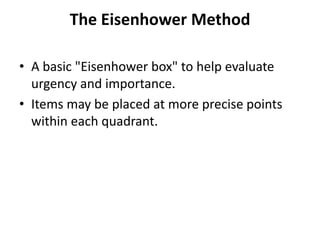
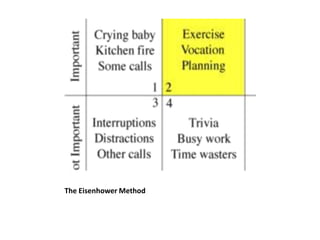
The Eisenhower Method

• A basic "Eisenhower box" to help evaluate
  urgency and importance.
• Items may be placed at more precise points
  within each quadrant.
The Eisenhower Method

Time management (ppt)

  • 1.
    TIME MANAGEMENT SUBMITTED BY L.Meenakshi 1st Year MBA
  • 2.
    WHAT IS TIMEMANAGEMENT
  • 3.
    NEED FOR TIMEMANAGEMENT • Helps to Prioritize work . • Get More Done In Less Time. • More Quality Work. • Keeps Things In Context. • Forces You To Do Things You Do Not Like.
  • 4.
    NEED FOR TIMEMANAGEMENT (contd..) • Keeps You On Track • Making Sure You Deliver What’s Promised. • Time Is Limited. • Helps Discipline Ourselves
  • 5.
    Concept Involved • Planning • Monitoring, • Allocating • Organizing, • Setting Goals, • Scheduling, • Delegation, • Prioritizing. • Analysis Of Time Spent,
  • 6.
    Setting priorities andgoals Various ways we can set priorities and goals which are listed below. • "Work in Priority Order" - set goals and prioritize. • "Set gravitational goals" - that attract actions automatically.
  • 7.
    Setting priorities andgoals(contd…) • These goals are recorded and may be broken down into a project, an action plan, or a simple task list. • For individual tasks or for goals, an importance rating may be established, deadlines may be set, and priorities assigned. • This process results in a plan with a task list or a schedule or calendar of activities
  • 8.
    Various analysis forsetting goals • ABC Analysis • Pareto Analysis • The Eisenhower Method • POSEC method
  • 9.
    ABC Analysis • Atechnique that has been used in business management for a long time is the categorization of large data into groups. • These groups are often marked A, B, and C— hence the name
  • 10.
    ABC Analysis (Contd…) •Activities are ranked upon these general criteria: A – Tasks that are perceived as being urgent and important, B – Tasks that are important but not urgent, C – Tasks that are neither urgent nor important.
  • 11.
    ABC Analysis (Contd…) •Each group is then rank-ordered in priority. To further refine priority, some individuals choose to then force-rank all "B" items as either "A" or "C". • ABC analysis can incorporate more than three groups. • ABC analysis is frequently combined with Pareto analysis
  • 12.
    Pareto Analysis • Ideais 80% of tasks can be completed in 20% of the disposable time. • Sort tasks into two parts. • According to this form of Pareto analysis it is recommended that tasks that fall into the first category be assigned a higher priority.
  • 13.
    Pareto Analysis (Contd…) •Applied to increase productivity. • It is assumed that 80% of the productivity can be achieved by doing 20% of the tasks. • Similarly, 80% of results can be attributed to 20% of activity. • If productivity is the aim of time management, then these tasks should be prioritized higher.
  • 14.
    Pareto Analysis (Contd…) •It depends on the method adopted to complete the task. • There is always a simpler and easy way to complete the task. • If one uses a complex way, it will be time consuming. • So, one should always try to find out the alternate ways to complete each task.
  • 15.
    The Eisenhower Method •A basic "Eisenhower box" to help evaluate urgency and importance. • Items may be placed at more precise points within each quadrant.
  • 16.