Concrete Technology
Dr. Mohd. Zameeruddin
Assistant professor,
Department of Civil Engineering,
MGM’s College of Engineering, Nanded (m.s)
BlogSpot: mzsengineeringtechnologies
Email: zameerstd1@hotmail.com;
md_zameeruddin@mgmcen.ac.in
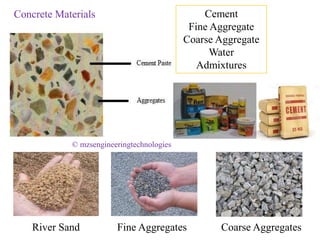
Concrete Materials Cement
Fine Aggregate
Coarse Aggregate
Water
Admixtures
River Sand Fine Aggregates Coarse Aggregates
© mzsengineeringtechnologies
Concrete Materials
Modern concrete invariably have additional ingredients other than four
components mentioned earlier
1. Chemical admixtures:
(accelerators, set retarders, water reducers, etc)
2. Chemical admixtures:
(Fly ash, Silica fume, Rice hush ash, and other pozzolanic material)
© mzsengineeringtechnologies
Components of Concrete
Concrete is made up of components sachets, aggregation of stones,
which we called as aggregate embedded in cement mortar that is a
cement-sand mortar, in his hardened state concrete is an aggregation of
stones or similar hard material embedded in what we call cement-sand
mortar. The aggregates, aggregates in normal concrete forms this
skeleton matrix; it is about 60 to 65 percent by volume and rest all is 25
percent is a paste; now paste means cement and water, that combines to
paste.
© mzsengineeringtechnologies
Advantages and Disadvantages of Concrete
Advantages
Lower life cycle cost
Mould-ability
Robustness (Resistance against slide)
Can be designed for desired property
Disadvantages
Lower tensile strength
Lower ductility (brittle)
© mzsengineeringtechnologies
Properties of Good Concrete
1. Strength
2. Durability
3. Density
4. Workability
5. Water Tightness
6. Resistance to wear and tear
Types of Concrete
1. According to binding material used
2. According to design
3. According to purpose
According to binding
material used
a. Cement concrete
b. Lime concrete
c. Cement-lime concrete
According to design
a. Plain cement concrete (PPC)
b. Reinforced cement concrete (RCC)
c. Pre stressed cement concrete (PSC)
d. Precast concrete
According to purpose
a. Vacuum concrete
b. Air entrained concrete
c. Light weight concrete
d. Pump concrete
e. Self compacting
concrete
© mzsengineeringtechnologies
Types of Concrete
Grades of Concrete IS 456: 2000 (rev)
© mzsengineeringtechnologies
Quality Control in concrete
1. The variation of quality of constituent materials
2. Variation in the mix proportion
3. Variation in the quality of batching and mixing
4. The quality of overall workmanship and supervision at the site.
Poor, Good, Fair
The field control i.e. inspection and
testing, is an important factor to be
considered for quality control.
Concrete should be tested at its fresh
and hardened stages to assess their
strength. Accelerated strength tests by
which a reliable idea about the
potential 28 day strength can be
obtained within few hours are
effective control tools.
© mzsengineeringtechnologies
Where does quality control begin?
It begins in the production of material used in concrete
(Sampling and testing):
•Portland cement
•Pozzolana
•Coarse and Fine Aggregate
Quality Control in concrete © mzsengineeringtechnologies
Uniformity of concrete
production will be no
greater than the
uniformity of materials
used in the concrete.
Quality Control in concrete
How does quality control continue?
•Handling and stockpiling
•Batching and Mixing
•Sampling and testing fresh concrete
•Transporting and placing the freshly mixed concrete.
© mzsengineeringtechnologies
To know the quality of concrete,
We can do the several tests.
Tests on Fresh Concrete:
•The Slump test
•The Compacting Factor Test
Tests on Hardened Concrete
•Compression Test
•Tensile Strength Test (Split Cylinder Test)
•Flexural Strength Test
Quality Control in concrete
Slump Test
Compression Test
Split tensile Test
Flexural Test © mzsengineeringtechnologies

Introduction

  • 1.
    Concrete Technology Dr. Mohd.Zameeruddin Assistant professor, Department of Civil Engineering, MGM’s College of Engineering, Nanded (m.s) BlogSpot: mzsengineeringtechnologies Email: zameerstd1@hotmail.com; md_zameeruddin@mgmcen.ac.in
  • 2.
    Concrete Materials Cement FineAggregate Coarse Aggregate Water Admixtures River Sand Fine Aggregates Coarse Aggregates © mzsengineeringtechnologies
  • 3.
    Concrete Materials Modern concreteinvariably have additional ingredients other than four components mentioned earlier 1. Chemical admixtures: (accelerators, set retarders, water reducers, etc) 2. Chemical admixtures: (Fly ash, Silica fume, Rice hush ash, and other pozzolanic material) © mzsengineeringtechnologies
  • 4.
    Components of Concrete Concreteis made up of components sachets, aggregation of stones, which we called as aggregate embedded in cement mortar that is a cement-sand mortar, in his hardened state concrete is an aggregation of stones or similar hard material embedded in what we call cement-sand mortar. The aggregates, aggregates in normal concrete forms this skeleton matrix; it is about 60 to 65 percent by volume and rest all is 25 percent is a paste; now paste means cement and water, that combines to paste. © mzsengineeringtechnologies
  • 5.
    Advantages and Disadvantagesof Concrete Advantages Lower life cycle cost Mould-ability Robustness (Resistance against slide) Can be designed for desired property Disadvantages Lower tensile strength Lower ductility (brittle) © mzsengineeringtechnologies
  • 6.
    Properties of GoodConcrete 1. Strength 2. Durability 3. Density 4. Workability 5. Water Tightness 6. Resistance to wear and tear Types of Concrete 1. According to binding material used 2. According to design 3. According to purpose According to binding material used a. Cement concrete b. Lime concrete c. Cement-lime concrete According to design a. Plain cement concrete (PPC) b. Reinforced cement concrete (RCC) c. Pre stressed cement concrete (PSC) d. Precast concrete According to purpose a. Vacuum concrete b. Air entrained concrete c. Light weight concrete d. Pump concrete e. Self compacting concrete © mzsengineeringtechnologies
  • 7.
  • 8.
    Grades of ConcreteIS 456: 2000 (rev) © mzsengineeringtechnologies
  • 9.
    Quality Control inconcrete 1. The variation of quality of constituent materials 2. Variation in the mix proportion 3. Variation in the quality of batching and mixing 4. The quality of overall workmanship and supervision at the site. Poor, Good, Fair The field control i.e. inspection and testing, is an important factor to be considered for quality control. Concrete should be tested at its fresh and hardened stages to assess their strength. Accelerated strength tests by which a reliable idea about the potential 28 day strength can be obtained within few hours are effective control tools. © mzsengineeringtechnologies
  • 10.
    Where does qualitycontrol begin? It begins in the production of material used in concrete (Sampling and testing): •Portland cement •Pozzolana •Coarse and Fine Aggregate Quality Control in concrete © mzsengineeringtechnologies Uniformity of concrete production will be no greater than the uniformity of materials used in the concrete.
  • 11.
    Quality Control inconcrete How does quality control continue? •Handling and stockpiling •Batching and Mixing •Sampling and testing fresh concrete •Transporting and placing the freshly mixed concrete. © mzsengineeringtechnologies
  • 12.
    To know thequality of concrete, We can do the several tests. Tests on Fresh Concrete: •The Slump test •The Compacting Factor Test Tests on Hardened Concrete •Compression Test •Tensile Strength Test (Split Cylinder Test) •Flexural Strength Test Quality Control in concrete Slump Test Compression Test Split tensile Test Flexural Test © mzsengineeringtechnologies