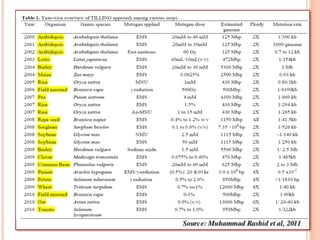
TILLING AND ECO-TILLING
FOR CROP IMPROVEMENT
WHY TILLING…….?
 The present methods for targeted gene inactivation are
RNAi and T-DNA insertion.
 Transgenic RNAi technology or introduced transposons
complicate field testing and may not be accepted by the
consumer.
 To overcome the limitations of knocking out the entire
gene and to expand knowledge of active gene mutations.
 Regenerating whole plants through tissue culture is a
practical hindrance to apply these technologies.

TILLING Workflow:
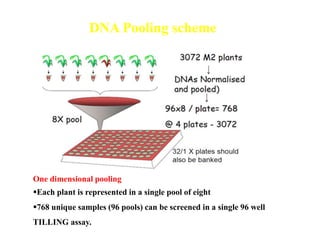
DNA Pooling scheme
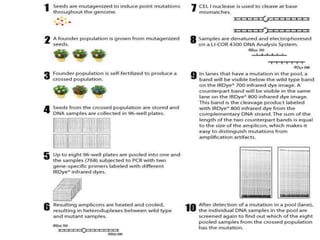
One dimensional pooling –
Each plant is represented in a single pool of eight
768 unique samples (96 pools) can be screened in a single 96 well
TILLING assay.
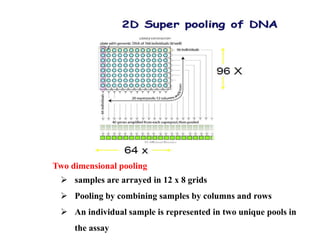
Two dimensional pooling
 samples are arrayed in 12 x 8 grids
 Pooling by combining samples by columns and rows
 An individual sample is represented in two unique pools in
the assay
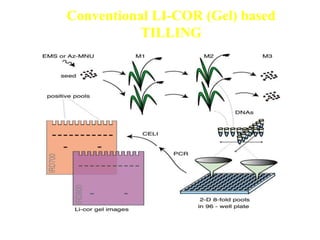
Conventional LI-COR (Gel) based
TILLING
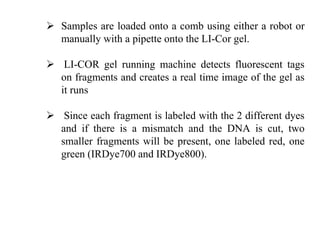
 Samples are loaded onto a comb using either a robot or
manually with a pipette onto the LI-Cor gel.
 LI-COR gel running machine detects fluorescent tags
on fragments and creates a real time image of the gel as
it runs
 Since each fragment is labeled with the 2 different dyes
and if there is a mismatch and the DNA is cut, two
smaller fragments will be present, one labeled red, one
green (IRDye700 and IRDye800).
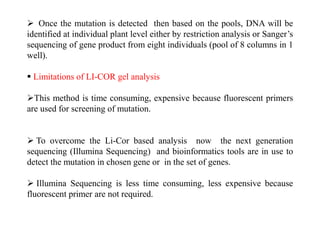
 Once the mutation is detected then based on the pools, DNA will be
identified at individual plant level either by restriction analysis or Sanger’s
sequencing of gene product from eight individuals (pool of 8 columns in 1
well).
 Limitations of LI-COR gel analysis
This method is time consuming, expensive because fluorescent primers
are used for screening of mutation.
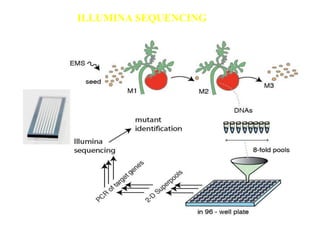
 To overcome the Li-Cor based analysis now the next generation
sequencing (Illumina Sequencing) and bioinformatics tools are in use to
detect the mutation in chosen gene or in the set of genes.
 Illumina Sequencing is less time consuming, less expensive because
fluorescent primer are not required.
ILLUMINA SEQUENCING
Advantages Eco-TILLING
 Valuable tool for mining for SNPs in germplasm,and in
assessing heterozygosity,
 Uncovering variants for disease resistance,
 Ascertaining the function of a gene or regulatory element by
detecting natural variants.
 EcoTILLING can also be a good technique to employ
especially when working with a well established population
with thoroughly characterized morphological data.
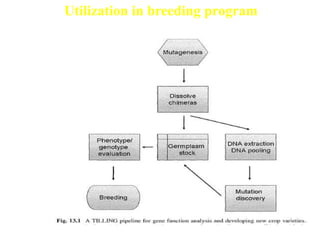
Utilization in breeding program
TILLING AND ECOTILLING.pptx

TILLING AND ECOTILLING.pptx

  • 1.
  • 6.
    WHY TILLING…….?  Thepresent methods for targeted gene inactivation are RNAi and T-DNA insertion.  Transgenic RNAi technology or introduced transposons complicate field testing and may not be accepted by the consumer.  To overcome the limitations of knocking out the entire gene and to expand knowledge of active gene mutations.  Regenerating whole plants through tissue culture is a practical hindrance to apply these technologies.
  • 9.
  • 10.
    DNA Pooling scheme Onedimensional pooling – Each plant is represented in a single pool of eight 768 unique samples (96 pools) can be screened in a single 96 well TILLING assay.
  • 11.
    Two dimensional pooling samples are arrayed in 12 x 8 grids  Pooling by combining samples by columns and rows  An individual sample is represented in two unique pools in the assay
  • 15.
  • 16.
     Samples areloaded onto a comb using either a robot or manually with a pipette onto the LI-Cor gel.  LI-COR gel running machine detects fluorescent tags on fragments and creates a real time image of the gel as it runs  Since each fragment is labeled with the 2 different dyes and if there is a mismatch and the DNA is cut, two smaller fragments will be present, one labeled red, one green (IRDye700 and IRDye800).
  • 17.
     Once themutation is detected then based on the pools, DNA will be identified at individual plant level either by restriction analysis or Sanger’s sequencing of gene product from eight individuals (pool of 8 columns in 1 well).  Limitations of LI-COR gel analysis This method is time consuming, expensive because fluorescent primers are used for screening of mutation.  To overcome the Li-Cor based analysis now the next generation sequencing (Illumina Sequencing) and bioinformatics tools are in use to detect the mutation in chosen gene or in the set of genes.  Illumina Sequencing is less time consuming, less expensive because fluorescent primer are not required.
  • 18.
  • 34.
    Advantages Eco-TILLING  Valuabletool for mining for SNPs in germplasm,and in assessing heterozygosity,  Uncovering variants for disease resistance,  Ascertaining the function of a gene or regulatory element by detecting natural variants.  EcoTILLING can also be a good technique to employ especially when working with a well established population with thoroughly characterized morphological data.
  • 35.