WEB SEVICES:WIKI,
E-LIBRARY
By
ANJANA V VIJAYAN
NO 3
ENGLISH
WIKI
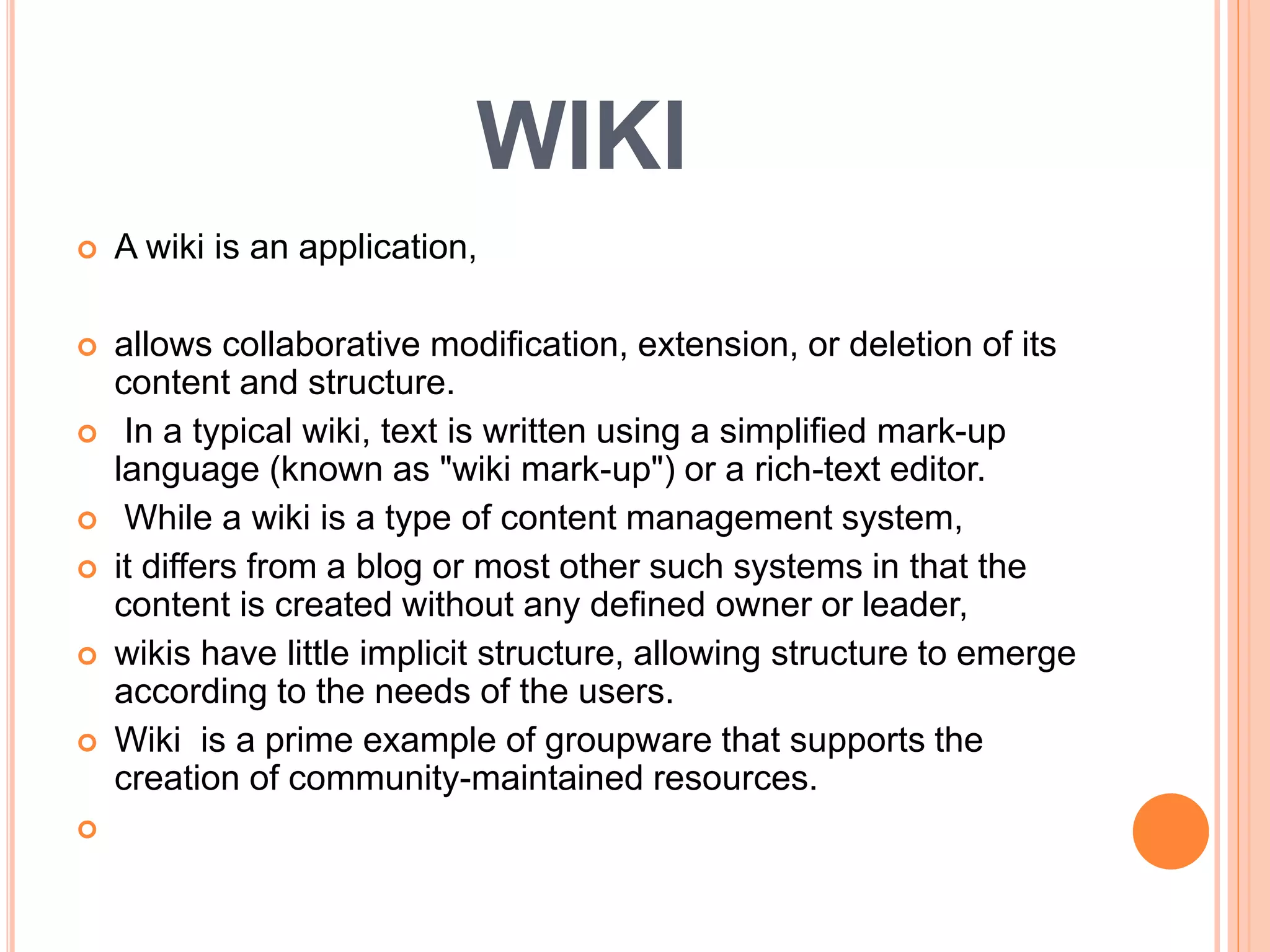
 A wiki is an application,
 allows collaborative modification, extension, or deletion of its
content and structure.
 In a typical wiki, text is written using a simplified mark-up
language (known as "wiki mark-up") or a rich-text editor.
 While a wiki is a type of content management system,
 it differs from a blog or most other such systems in that the
content is created without any defined owner or leader,
 wikis have little implicit structure, allowing structure to emerge
according to the needs of the users.
 Wiki is a prime example of groupware that supports the
creation of community-maintained resources.

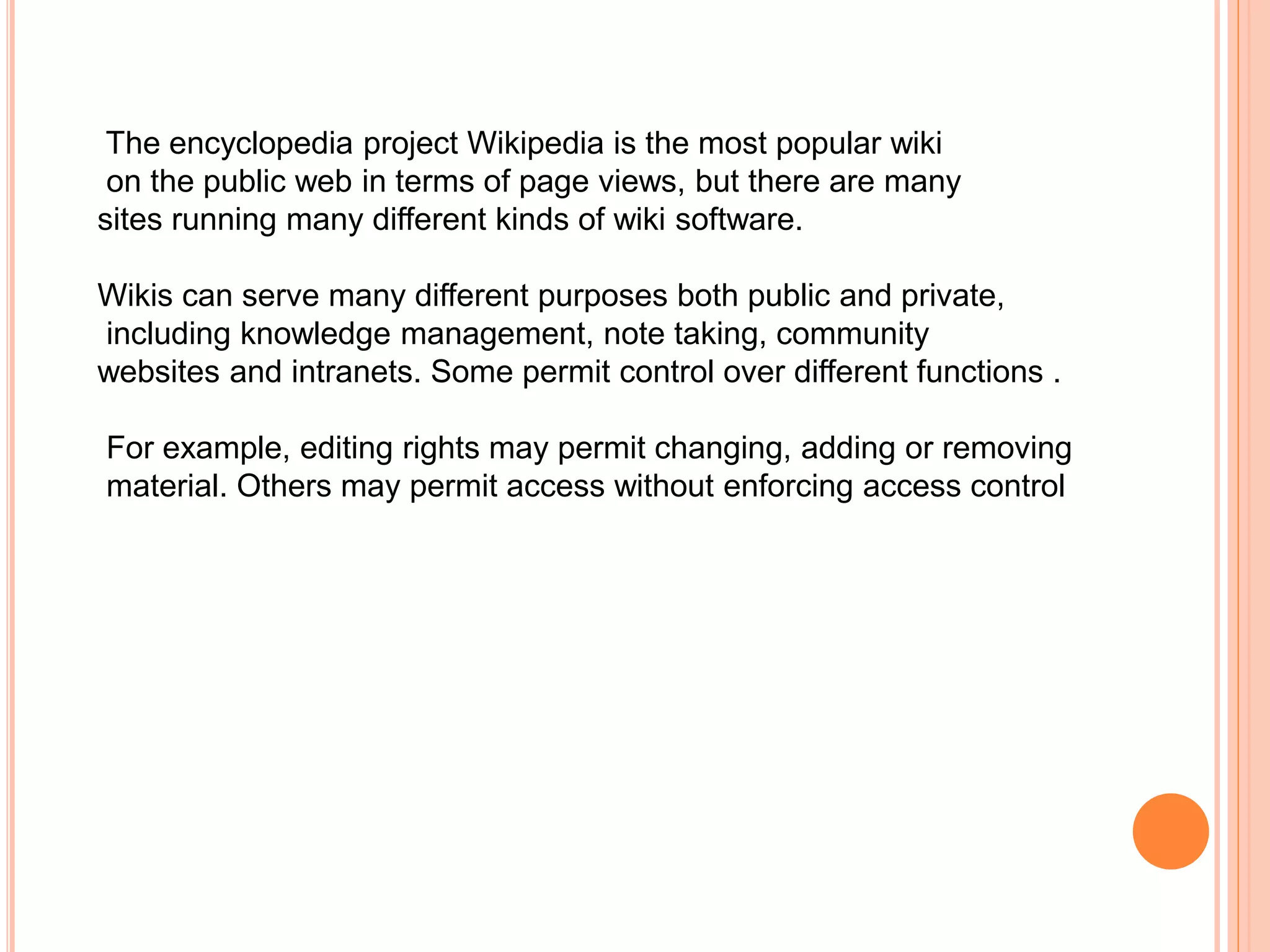
The encyclopedia project Wikipedia is the most popular wiki
on the public web in terms of page views, but there are many
sites running many different kinds of wiki software.
Wikis can serve many different purposes both public and private,
including knowledge management, note taking, community
websites and intranets. Some permit control over different functions .
For example, editing rights may permit changing, adding or removing
material. Others may permit access without enforcing access control
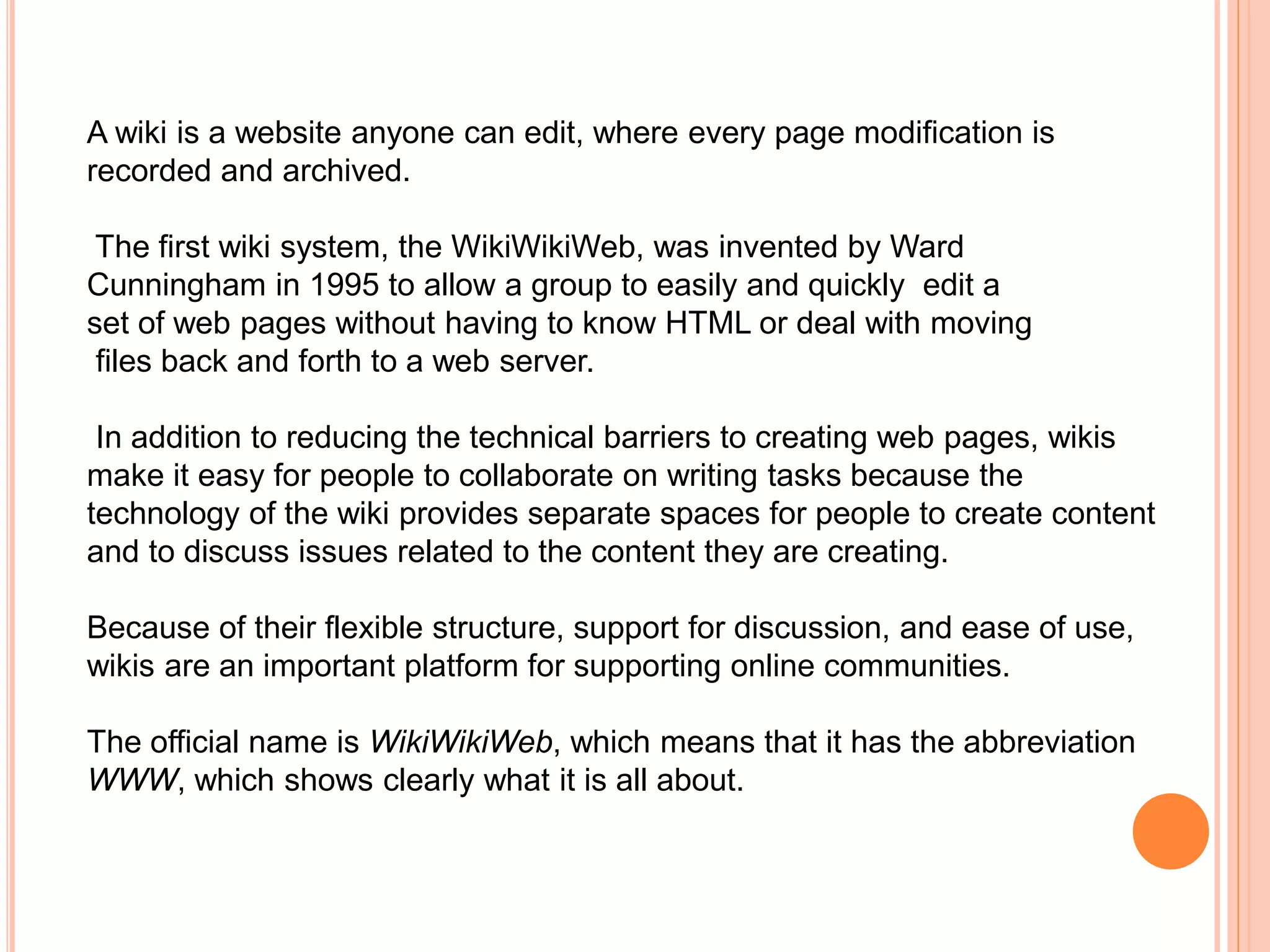
A wiki is a website anyone can edit, where every page modification is
recorded and archived.
The first wiki system, the WikiWikiWeb, was invented by Ward
Cunningham in 1995 to allow a group to easily and quickly edit a
set of web pages without having to know HTML or deal with moving
files back and forth to a web server.
In addition to reducing the technical barriers to creating web pages, wikis
make it easy for people to collaborate on writing tasks because the
technology of the wiki provides separate spaces for people to create content
and to discuss issues related to the content they are creating.
Because of their flexible structure, support for discussion, and ease of use,
wikis are an important platform for supporting online communities.
The official name is WikiWikiWeb, which means that it has the abbreviation
WWW, which shows clearly what it is all about.
Just like the World Wide Web, a wiki is based on an arbitrary number of
Web pages that present information.
The word “wiki” is not an abbreviation, but a Hawaiian-language word for
“fast.” Some busses or taxis in Hawaii are called “Wiki-Wiki.”
A Wiki can present information fast, where “fast” refers to the time from an
idea to its presentation.
There are now many types of wiki software.
These applications are installed onto a web server and they handle the
storage of files, revision history, user Information, and other back-end data.
Wikis are created using this software.
CHARACTERISTIC’S OF WIKI
A wiki invites all users to edit any page or to create new pages within the
wiki Web site, using only a plain-vanilla Web browser without any extra
add-ons.
Wiki promotes meaningful topic associations between different pages by
making page link creation almost intuitively easy and showing whether an
intended target page exists or not.
A wiki is not a carefully crafted site for casual visitors.
Instead, it seeks to involve the visitor in an ongoing process of
creation and collaboration that constantly changes the Web site landscape.
A wiki enables communities to write documents collaboratively, using a
simple mark-up language and a web browser.
A single page in a wiki website is referred to as a “wiki page” while the
entire collection of pages, which are usually well interconnected by
hyperlinks, is “the wiki”.
A wiki is essentially a database for creating, browsing, and searching
through information.
A wiki allows non-linear, evolving, complex and networked text, argument
and interaction.
A defining characteristic of wiki technology is the ease with which pages can
be created and updated.
Generally, there is no review before modifications are accepted.
Many wikis are open to alteration by the general public without requiring
registration of user accounts.
Many edits can be made in real-time and appear almost instantly online.
Advantages
•anyone can edit
•easy to use and learn
•Wikis are instantaneous so there is no need to wait for a publisher to
create a new edition or update information
•people located in different parts of the world can work on the same
document
•the wiki software keeps track of every edit made and it's a simple
process to revert back to a previous version of an article
•widens access to the power of web publishing to non-technical users
•the wiki has no predetermined structure - consequently it is a flexible
tool which can be used for a wide range of applications
•there are a wide range of open source software wiki's to choose from
so licensing costs shouldn't be a barrier to installing an institutional wiki
Disadvantages
•Anyone can edit so this may be too open for some applications, for
example confidential documentation. However it is possible to regulate
user access.
•Open to SPAM and Vandalism if not managed properly. There are easy
ways to restore a page however, and on WikiEducator you must be
logged in to edit pages so this reduces vandalism by automated spam
bots.
•Requires Internet connectivity to collaborate, but technologies to
produce print versions of articles are improving
•The flexibility of a wiki's structure can mean that information becomes
disorganised. As a wiki grows, the community plans and administers the
structure collaboratively.
•The usual guidelines for healthy computer use apply
E-LIBRARY
An e-library or Digital library is a physical site and/ or website that provide
around the clock online access to digitized audio, video, and written material.
It provides free copies of books, journals, etc. available to the users.
Normally these materials are classics which have no copyright digital formats
(as opposed to print, microform, or other media) and accessible by computers.
The digital content may be stored locally, or accessed remotely via computer
networks.
A digital library is a type of information retrieval system.
Digital Libraries are an increasingly popular research area that encompasses
more than traditional information retrieval or database methods and
techniques.
Advantages of the e-library
No physical boundary: The user of an e-library need not to go to the
library physically, people from all over the world could gain access to the
same information, as long as an Internet connection is available.
Round the clock availability: Digital libraries can be accessed at any time,
24 hours a day and 365 days of the year
Multiple accesses: The same resources can be used at the same time by a
number of users.
Structured approach: e-library provides access to much richer content in
a more structured manner i.e. we can easily move from the catalog to the
particular book then to a particular chapter and so on.
Information retrieval: The user is able to use any search term bellowing
to the word or phrase of the entire collection. E-library will provide very
user friendly interfaces, giving click able access to its resources.
Preservation and conservation: An exact copy of the original can be
made any number of times without any degradation in quality.
Space: Whereas traditional libraries are limited by storage space,
e- libraries have the potential to store much more information, simply
because digital information requires very little physical space to
contain them. When the library had no space for extension
digitization is the only solution.
Networking: A particular e-library can provide the link to any other
resources of other e-library very easily thus a seamlessly integrated
resource sharing can be achieved.
Cost: The cost of maintaining an e-library is much lower than that of a
traditional library. A traditional library must spend large sums of
money paying for staff, book maintains, rent, and additional books.
e-libraries do away with these fees.
Disadvantages of the E-Library
Copyright: Digitization violates the copy right law as the thought content
of one author can be freely transfer by other without his acknowledgement.
Speed of access: - As more and more computer are connected to the
Internet its speed of access reasonably decreasing. If new technology
will not evolve to solve the problem then in near future Internet will be
full of error messages.
Initial cost is high: - The infrastructure cost of e-library i.e. the cost of
hardware, software; leasing communication circuit is generally very high.
.
Efficiency: - With the much larger volume of digital information, finding
the right material for a specific. Task becomes increasingly difficult.
Environment: e-libraries cannot reproduce the environment of a
traditional library. Many people also find reading printed material to
be easier than reading material on a computer screen.
Preservation: Due to technological developments, an e- library can
rapidly become out-of-date and its data may become inaccessible.

Technology ppt

  • 1.
  • 2.
    WIKI  A wikiis an application,  allows collaborative modification, extension, or deletion of its content and structure.  In a typical wiki, text is written using a simplified mark-up language (known as "wiki mark-up") or a rich-text editor.  While a wiki is a type of content management system,  it differs from a blog or most other such systems in that the content is created without any defined owner or leader,  wikis have little implicit structure, allowing structure to emerge according to the needs of the users.  Wiki is a prime example of groupware that supports the creation of community-maintained resources. 
  • 3.
    The encyclopedia projectWikipedia is the most popular wiki on the public web in terms of page views, but there are many sites running many different kinds of wiki software. Wikis can serve many different purposes both public and private, including knowledge management, note taking, community websites and intranets. Some permit control over different functions . For example, editing rights may permit changing, adding or removing material. Others may permit access without enforcing access control
  • 4.
    A wiki isa website anyone can edit, where every page modification is recorded and archived. The first wiki system, the WikiWikiWeb, was invented by Ward Cunningham in 1995 to allow a group to easily and quickly edit a set of web pages without having to know HTML or deal with moving files back and forth to a web server. In addition to reducing the technical barriers to creating web pages, wikis make it easy for people to collaborate on writing tasks because the technology of the wiki provides separate spaces for people to create content and to discuss issues related to the content they are creating. Because of their flexible structure, support for discussion, and ease of use, wikis are an important platform for supporting online communities. The official name is WikiWikiWeb, which means that it has the abbreviation WWW, which shows clearly what it is all about.
  • 5.
    Just like theWorld Wide Web, a wiki is based on an arbitrary number of Web pages that present information. The word “wiki” is not an abbreviation, but a Hawaiian-language word for “fast.” Some busses or taxis in Hawaii are called “Wiki-Wiki.” A Wiki can present information fast, where “fast” refers to the time from an idea to its presentation. There are now many types of wiki software. These applications are installed onto a web server and they handle the storage of files, revision history, user Information, and other back-end data. Wikis are created using this software.
  • 6.
    CHARACTERISTIC’S OF WIKI Awiki invites all users to edit any page or to create new pages within the wiki Web site, using only a plain-vanilla Web browser without any extra add-ons. Wiki promotes meaningful topic associations between different pages by making page link creation almost intuitively easy and showing whether an intended target page exists or not. A wiki is not a carefully crafted site for casual visitors. Instead, it seeks to involve the visitor in an ongoing process of creation and collaboration that constantly changes the Web site landscape.
  • 7.
    A wiki enablescommunities to write documents collaboratively, using a simple mark-up language and a web browser. A single page in a wiki website is referred to as a “wiki page” while the entire collection of pages, which are usually well interconnected by hyperlinks, is “the wiki”. A wiki is essentially a database for creating, browsing, and searching through information. A wiki allows non-linear, evolving, complex and networked text, argument and interaction. A defining characteristic of wiki technology is the ease with which pages can be created and updated. Generally, there is no review before modifications are accepted. Many wikis are open to alteration by the general public without requiring registration of user accounts. Many edits can be made in real-time and appear almost instantly online.
  • 8.
    Advantages •anyone can edit •easyto use and learn •Wikis are instantaneous so there is no need to wait for a publisher to create a new edition or update information •people located in different parts of the world can work on the same document •the wiki software keeps track of every edit made and it's a simple process to revert back to a previous version of an article •widens access to the power of web publishing to non-technical users •the wiki has no predetermined structure - consequently it is a flexible tool which can be used for a wide range of applications •there are a wide range of open source software wiki's to choose from so licensing costs shouldn't be a barrier to installing an institutional wiki
  • 9.
    Disadvantages •Anyone can editso this may be too open for some applications, for example confidential documentation. However it is possible to regulate user access. •Open to SPAM and Vandalism if not managed properly. There are easy ways to restore a page however, and on WikiEducator you must be logged in to edit pages so this reduces vandalism by automated spam bots. •Requires Internet connectivity to collaborate, but technologies to produce print versions of articles are improving •The flexibility of a wiki's structure can mean that information becomes disorganised. As a wiki grows, the community plans and administers the structure collaboratively. •The usual guidelines for healthy computer use apply
  • 10.
  • 11.
    An e-library orDigital library is a physical site and/ or website that provide around the clock online access to digitized audio, video, and written material. It provides free copies of books, journals, etc. available to the users. Normally these materials are classics which have no copyright digital formats (as opposed to print, microform, or other media) and accessible by computers. The digital content may be stored locally, or accessed remotely via computer networks. A digital library is a type of information retrieval system. Digital Libraries are an increasingly popular research area that encompasses more than traditional information retrieval or database methods and techniques.
  • 12.
    Advantages of thee-library No physical boundary: The user of an e-library need not to go to the library physically, people from all over the world could gain access to the same information, as long as an Internet connection is available. Round the clock availability: Digital libraries can be accessed at any time, 24 hours a day and 365 days of the year Multiple accesses: The same resources can be used at the same time by a number of users. Structured approach: e-library provides access to much richer content in a more structured manner i.e. we can easily move from the catalog to the particular book then to a particular chapter and so on. Information retrieval: The user is able to use any search term bellowing to the word or phrase of the entire collection. E-library will provide very user friendly interfaces, giving click able access to its resources.
  • 13.
    Preservation and conservation:An exact copy of the original can be made any number of times without any degradation in quality. Space: Whereas traditional libraries are limited by storage space, e- libraries have the potential to store much more information, simply because digital information requires very little physical space to contain them. When the library had no space for extension digitization is the only solution. Networking: A particular e-library can provide the link to any other resources of other e-library very easily thus a seamlessly integrated resource sharing can be achieved. Cost: The cost of maintaining an e-library is much lower than that of a traditional library. A traditional library must spend large sums of money paying for staff, book maintains, rent, and additional books. e-libraries do away with these fees.
  • 14.
    Disadvantages of theE-Library Copyright: Digitization violates the copy right law as the thought content of one author can be freely transfer by other without his acknowledgement. Speed of access: - As more and more computer are connected to the Internet its speed of access reasonably decreasing. If new technology will not evolve to solve the problem then in near future Internet will be full of error messages. Initial cost is high: - The infrastructure cost of e-library i.e. the cost of hardware, software; leasing communication circuit is generally very high. .
  • 15.
    Efficiency: - Withthe much larger volume of digital information, finding the right material for a specific. Task becomes increasingly difficult. Environment: e-libraries cannot reproduce the environment of a traditional library. Many people also find reading printed material to be easier than reading material on a computer screen. Preservation: Due to technological developments, an e- library can rapidly become out-of-date and its data may become inaccessible.