TORNADO Presented by Venkata Ramana
TORNADO Interoduction of Tornado Cheracteristics of Tornado Torando formation Types of tornadoes Effects of Tornado Tornado safty
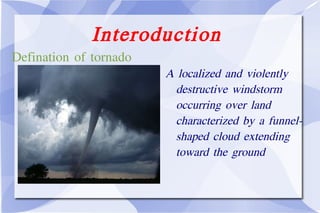
Interoduction A localized and violently destructive windstorm occurring over land characterized by a funnel-shaped cloud extending toward the ground Defination of tornado
Characteristics Tornado generally apperes in funnel shape Most Tornadoes have wind speeds between 40km/h and 110km/h. Majority if Tornadoes in the world occur in  the Tornado Alley region of the United States also occur in North America, South Africa, South-Centeral and eastren Asia,Australia,New Zealand,Philippines.
Continued At each year more then1000 Tornadoes hit the  united states A typical tornado travels at around 10-20 miles per hour.  Most tornadoes occur during the months of May, June, July and August in the late afternoon and evenings
Continued Tornadoes generally travel from the southwest at an average speed of 70 miles per hour. Torando rotates in circle  in a counter clockwise direction. Scientests generally this roatation is called  mesocyclone. A tornado is also commonly referred to as a "twister". The term "cyclone" is used as a synonymfor "tornado"
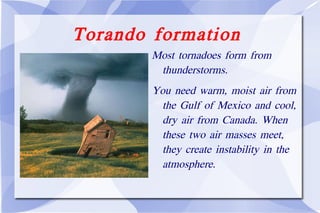
Torando formation Most tornadoes form from thunderstorms. You need warm, moist air from the Gulf of Mexico and cool, dry air from Canada. When these two air masses meet, they create instability in the atmosphere.
Continued A change in wind direction and an increase in wind speed with increasing height creates an invisible, horizontal spinning effect in the lower atmosphere. An area of rotation, 2-6 miles wide, now extends through much of the storm.  Most strong and violent tornadoes form within this area of strong rotation.
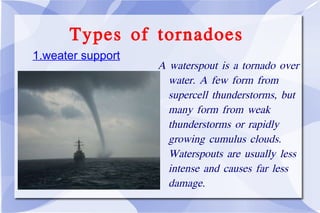
Types of tornadoes A waterspout is a tornado over water. A few form from supercell thunderstorms, but many form from weak thunderstorms or rapidly growing cumulus clouds. Waterspouts are usually less intense and causes far less damage. 1.weater support
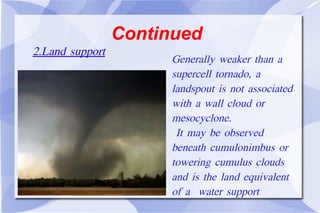
Continued Generally weaker than a supercell tornado, a landspout is not associated with a wall cloud or mesocyclone. It may be observed beneath cumulonimbus or towering cumulus clouds and is the land equivalent of a  water support 2.Land support
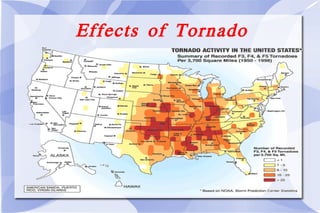
Effects of Tornado
Effects of Tornado 1. Tornadoes can make People die. 2. At each year 5000 average number of  people  were  died. 3. The most extreme tornado in recorded history was  the Tri-State Tornado. 4.which roared through parts of Missouri, Illinois, and Indiana on March 18, 1925.
Continued 5. it is the deadliest single tornado in United States  history (695 dead). 6. The deadliest tornado in world history was the  Daultipur-Salturia Tornado in Bangladesh on April  26, 1989, which killed approximately 1300 people.
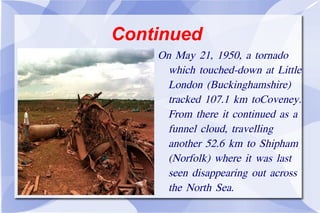
Continued On May 21, 1950, a tornado which touched-down at Little London (Buckinghamshire) tracked 107.1 km toCoveney. From there it continued as a funnel cloud, travelling another 52.6 km to Shipham (Norfolk) where it was last seen disappearing out across the North Sea.

Tornado

  • 1.
    TORNADO Presented byVenkata Ramana
  • 2.
    TORNADO Interoduction ofTornado Cheracteristics of Tornado Torando formation Types of tornadoes Effects of Tornado Tornado safty
  • 3.
    Interoduction A localizedand violently destructive windstorm occurring over land characterized by a funnel-shaped cloud extending toward the ground Defination of tornado
  • 4.
    Characteristics Tornado generallyapperes in funnel shape Most Tornadoes have wind speeds between 40km/h and 110km/h. Majority if Tornadoes in the world occur in the Tornado Alley region of the United States also occur in North America, South Africa, South-Centeral and eastren Asia,Australia,New Zealand,Philippines.
  • 5.
    Continued At eachyear more then1000 Tornadoes hit the united states A typical tornado travels at around 10-20 miles per hour. Most tornadoes occur during the months of May, June, July and August in the late afternoon and evenings
  • 6.
    Continued Tornadoes generallytravel from the southwest at an average speed of 70 miles per hour. Torando rotates in circle in a counter clockwise direction. Scientests generally this roatation is called mesocyclone. A tornado is also commonly referred to as a "twister". The term "cyclone" is used as a synonymfor "tornado"
  • 7.
    Torando formation Mosttornadoes form from thunderstorms. You need warm, moist air from the Gulf of Mexico and cool, dry air from Canada. When these two air masses meet, they create instability in the atmosphere.
  • 8.
    Continued A changein wind direction and an increase in wind speed with increasing height creates an invisible, horizontal spinning effect in the lower atmosphere. An area of rotation, 2-6 miles wide, now extends through much of the storm. Most strong and violent tornadoes form within this area of strong rotation.
  • 9.
    Types of tornadoesA waterspout is a tornado over water. A few form from supercell thunderstorms, but many form from weak thunderstorms or rapidly growing cumulus clouds. Waterspouts are usually less intense and causes far less damage. 1.weater support
  • 10.
    Continued Generally weakerthan a supercell tornado, a landspout is not associated with a wall cloud or mesocyclone. It may be observed beneath cumulonimbus or towering cumulus clouds and is the land equivalent of a water support 2.Land support
  • 11.
  • 12.
    Effects of Tornado1. Tornadoes can make People die. 2. At each year 5000 average number of people were died. 3. The most extreme tornado in recorded history was the Tri-State Tornado. 4.which roared through parts of Missouri, Illinois, and Indiana on March 18, 1925.
  • 13.
    Continued 5. itis the deadliest single tornado in United States history (695 dead). 6. The deadliest tornado in world history was the Daultipur-Salturia Tornado in Bangladesh on April 26, 1989, which killed approximately 1300 people.
  • 14.
    Continued On May21, 1950, a tornado which touched-down at Little London (Buckinghamshire) tracked 107.1 km toCoveney. From there it continued as a funnel cloud, travelling another 52.6 km to Shipham (Norfolk) where it was last seen disappearing out across the North Sea.