CYCLONE
WHAT IS CYCLONE
• Cyclone refers to any spinning storm that rotates around a low-
pressure centre.
• Closed low-level atmospheric circulation, strong winds, and a spiral
arrangement of thunderstorms that produce a heavy rain.
• Cyclones are characterised by inward spiral winds that rotate about
a zone of low air pressure.
• Warm core cyclones such as tropical cyclones and subtropical
cyclones are lie within the synoptic scale.
• Meso cyclones, tornadoes are lie within the smaller meso scale.
• Cyclones are also seen on the extra terrestrial planets. Such as
Mars, Neptune.
• Cyclones form due to latent heat driven by significant thunderstorm
activity.
TYPES OF CYCLONES
 The term ‘cyclone’ actually refers to several
different types of storm.
 There are three types of cyclones.
1. Tropical Cyclones
2. Polar cyclones
3. Meso cyclones
TROPICAL CYCLONES
• Tropical cyclones are what most people are familiar with
because these are cyclones that occur over the tropical
ocean regions. Hurricanes and typhoons are actually
types of tropical cyclones, but they have different names
so that it’s clear where that storm is occurring.
Hurricanes are found in the Atlantic and Northeast
pacific, typhoons are found in Northwest pacific.
POLAR CYCLONES
• Polar cyclones are cyclones that occur in polar region
like Greenland, Siberia and Antarctica. Unlike tropical
cyclones, Polar Cyclones are usually stronger in winter
months.
MESOCYCLONE
• Meso cyclone is a cyclone that occurs when part
of a thunderstorm cloud starts to spin, which
may eventually lead to a tornado. 'Meso' means
'middle’.
FORMATION OF CYCLONES
HOW CYCLONES FORM
 Tropical cyclones form only over warm ocean waters near the equator.
 To form a cyclone, warm, moist air over the ocean rises upward from
near the surface.
 As this air moves up and away from the ocean surface, it leaves is less
air near the surface. So basically as the warm air rises, it causes an
area of lower air pressure below.
 Air from surrounding areas with higher air pressure pushes in to the low
pressure area. Then this new “cool” air becomes warm and moist and
rises, too. And the cycle continues…
 As the warmed, moist air rises and cools the water in the air forms
clouds. The whole system of clouds and wind spins and grows, fed by
the ocean’s heat and water evaporating from the ocean surface.
 As the storm system rotates faster and faster, an eye forms in the
centre. It is very calm and clear in the eye, with very low air pressure.
Higher pressure air from above flows down into the eye.
 When the winds in the rotating storm reach 39 mph (63 kmph), the
storm is called a “tropical storm”. And when the wind speeds reach 74
mph (119 kmph), the storm is officially a “tropical cyclone” or
“hurricane”.
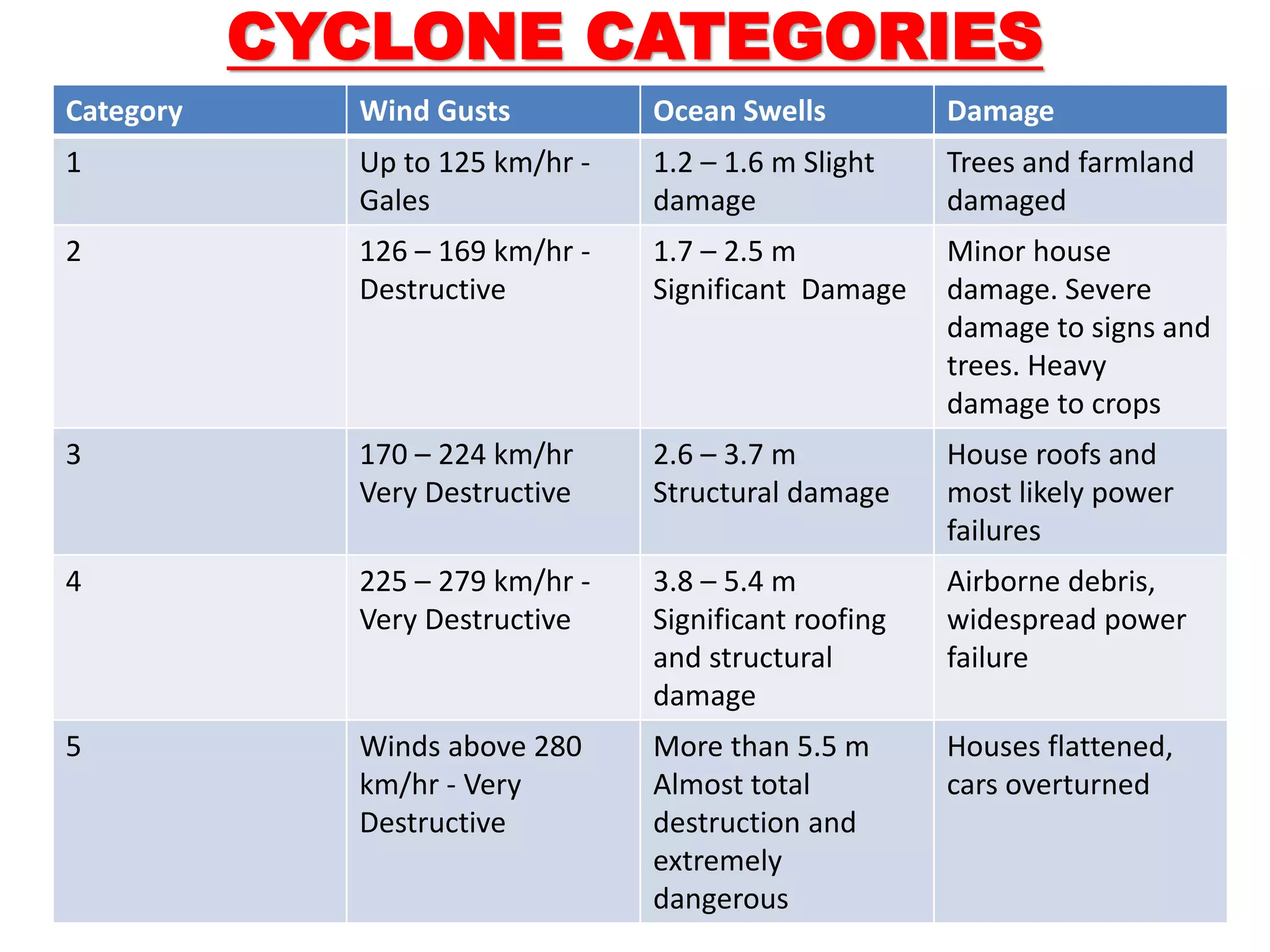
CYCLONE CATEGORIES
Category Wind Gusts Ocean Swells Damage
1 Up to 125 km/hr -
Gales
1.2 – 1.6 m Slight
damage
Trees and farmland
damaged
2 126 – 169 km/hr -
Destructive
1.7 – 2.5 m
Significant Damage
Minor house
damage. Severe
damage to signs and
trees. Heavy
damage to crops
3 170 – 224 km/hr
Very Destructive
2.6 – 3.7 m
Structural damage
House roofs and
most likely power
failures
4 225 – 279 km/hr -
Very Destructive
3.8 – 5.4 m
Significant roofing
and structural
damage
Airborne debris,
widespread power
failure
5 Winds above 280
km/hr - Very
Destructive
More than 5.5 m
Almost total
destruction and
extremely
dangerous
Houses flattened,
cars overturned
CAUSES OF CYCLONES
CAUSES OF CYCLONE
 The main source of energy for cyclones is the warm oceans in the
tropical regions.
 They are caused in areas with lower atmospheric pressure.
 Usually, areas located near the equator face cyclones.
 What causes cyclones is the rising of warm air over the ocean
surface.
 Once the warm air rises, the surrounding cool air rushes into this
space.
 The cool air heats up and again rises in the atmosphere.
 This process goes on to take place continuously.
 The rapid rise causes the formation of an eye-like structure in the
center.
 Likewise, the low-pressure area gets continually filled with high-
pressure wind.
IMPACTS OF CYCLONES
• The main impact of cyclone includes heavy rainfall, strong wind, large storm surges at
landfall, and tornadoes. The destruction from a cyclone depends mainly on its intensity, its
size, and its location after the cyclone has passed, devastation often continues. Some of
the impacts of cyclones are:
 WIND
The wind from a category one cyclones cause minimal damage to shrubbery and trees.
Category 5 storms are the most forceful, bringing winds of more than 156mph. Wind this
fact can rip trees from the ground and flatten buildings.
 FLOODING
Cyclones can produce flooding in two ways. First, tropical cyclone frequently causes a
surge in ocean waters causing sea levels to rise above normal. These surges sometimes
called tidal waves, can drown people and animals, and are often the greatest killer in
cyclone.
 EROSION
A cyclone’s high wind can erode the soil, there by damaging existing vegetation and
ecosystems. This erosion leaves the area exposed and prone to even more wind erosion.
Sand and soil that is blown into other areas can damage the vegetation.
 STORM CHURN
Storm churn happens when a cyclone winds churn up cold water as it moves across the
ocean. This churning lowers the water temperature after the storm has passed, squelching
the formation of new storms.
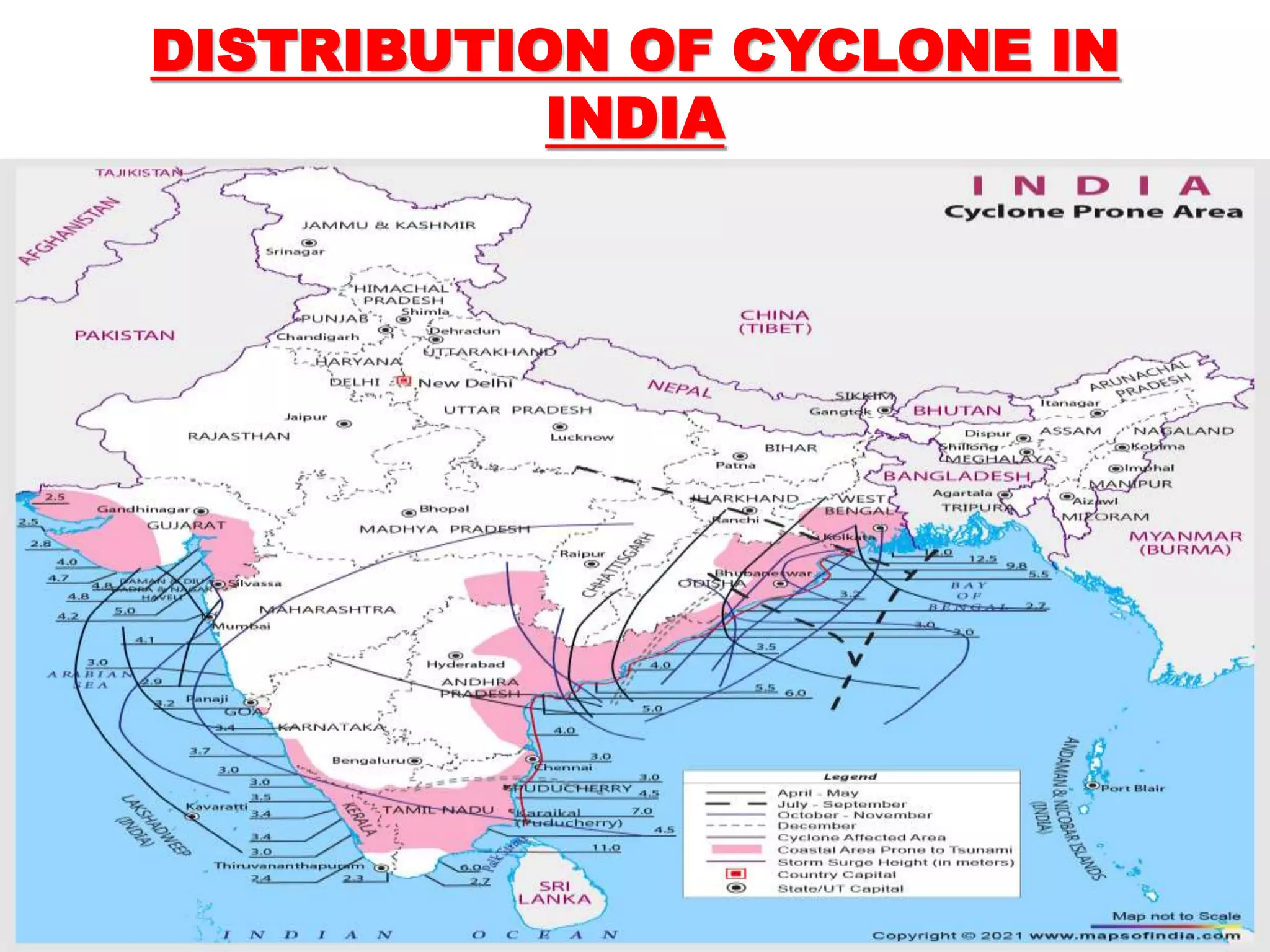
DISTRIBUTION OF CYCLONE IN
INDIA
AREAS OF CYCLONE IN INDIA
• With about 6 percent of the world wide cyclones, the Indian
subcontinent is one of the worst cyclone affected areas of the world.
• About 8 percent of the total land area, particularly along the eastern
coast and Gujarat coast is vulnerable to cyclones.
• Indian Ocean is one of six major cyclone prone regions of the world. On
an average, about 5-6percent tropical cyclones are formed in the Bay of
Bengal and the Arabian sea every year.
• The eastern coast is more prone to cyclones .The total cyclones
generated in the Indian ocean, strike the east coast of India.
• There are two definite seasons of cyclones in the north Indian ocean.
One is from May to June and the other from mid September to mid –
December.
SOME SEVERE CYCLONES
RECENTLY HELD IN INDIA
1. In West Bengal the cyclone named Komen held in the year 2015, Roanu in
2016 and Mora in 2017 .
2. In Andhra Pradesh the cyclone named Lehar occurs in the year 2013, Hud hud
in 2014 and Kyant in 2016.
3. In Kerala the cyclone named Nada occurs in 2016 and Vardah in 2016 .
4. In Maharashtra the cyclone named ARB 02 occurs in 1994 and phyan in 2009.
5. In Tamil Nadu the cyclone named Madi in 2013, Roanu in 2016, Kyant in 2016,
Nada in 2016 and Vardh in 2016.
EFFECTS OF CYCLONES
• Cyclones cause heavy rainfall and landslides.
• They cause lot of harm to towns and villages, causing severe damage kuccha
houses.
• They harm the ecosystem of the surrounding regions. • Civic facilities are
disturbed.
• Agricultural land is severely affected, especially in terms of water supply and
soil erosion.
• It cause harm to human, plant and animal life.
• Communications systems are badly affected due to cyclones
• Cyclones are the upper ocean heat content, the vertical shear of the
environment wind, interaction with other weather systems, impact of dry air
and landfall.
• Social costs includes, loss of life and livelihood, loss of crops leading to food
scarcity.
• Education and other services destroyed, increased burden government to
rebuild areas affected, and meant for other projects must now be used repair
the damage done by the cyclones.
. • Cyclones can make the sewage pipes block up and stop working and sewage
can split everywhere which also causes disease.
SAFETY MEASURES OF CYCLONE
• Check with your local council or your buildings
control authority to see if your home has been
built to cyclones standards.
• Check that the walls, roofs and eaves of your
home are secure.
• Trim tree tops and branches well clear of your
home (get council permission) .
• Preferably fit shutters, or at least metal screen, to
all glass areas.
• Clear your property of loose material that could
blow about and possibly cause injury or damage
during extreme winds.
BEFORE CYCLONE
• Cyclone forecasting involves predicting where a
tropical cyclone is going to track over the next
five days, every six to twelve hours.
• The forecasting has evolved from a single station
approach to a comprehensive approach which
uses a variety of meteorological tools and
methods to make predictions.
• The weather of a particular location can show
signs of approaching cyclone, such as increasing
swell, falling barometric pressure, increasing tides
and heavy rainfall.
CYCLONE FORECASTING
BEFORE CYCLONE
• People should evacuate faster as soon as
warning is issued.
• If requested by local authorities, collect
children from school or childcare centre and go
home.
• Park vehicles under solid shelter.
• Put wooden or plastic outdoor furniture in
your pool or inside with other loose items.
• Close shutters or board-up or heavily tape all
windows
DURING CYCLONE
• Disconnect all electrical appliances. Listen to your
battery radio for updates.
• Stay inside and shelter in the strongest part of the
building.
• If the building starts to break up, protect yourself
with mattresses, rugs or blankets under a strong
table or bench or hold on to a solid fixture, e.g. a
water pipe.
• Beware the calm eye. If the wind drops, don’t think
the cyclone is over: violent winds will soon resume
from another direction. Wait for the official ‘all
clear’.
AFTER THE CYCLONE
• Don’t go outside until officially advised it is safe.
• Check for gas leaks. Don’t use electric appliances if
wet.
• Listen to local radio for official warnings and
advice.
• If you have to evacuate, or did so earlier, don’t
return until advised. Use a recommended route
and don’t rush.
• Beware of damaged power lines, bridges,
buildings, trees, and don’t enter floodwaters.
• Do not drink water from unknown sources as it
may be contaminated.
ADVANTAGES OF TROPICAL CYCLONES
• Heat Balance - Tropical cyclones help maintain the
global heat balance by moving warm tropical air
away from the equator, towards the poles.
• Rainfall – Without a doubt, this is the most
important benefit of a cyclone.
• Sea life - Increased rainfall from cyclones help river
systems by flushing out muds, carving out new
channels and opening up areas to inundation of
the wet lands there by increasing both nesting and
food supplies.
• Relieve drought conditions.
MANAGEMENT OF CYCLONES
• There are many structural and non-structural
measures for effective disaster management of
cyclones.
• The structural measures include construction of
cyclone shelters, construction of cyclone
resistant buildings, road links, bridges, canals,
drains, saline embankments, surface water tanks,
communication and power transmission
networks etc.
CONCLUSION
• Cyclone refers to any spinning storm that
rotates around a low pressure.
•Tropical cyclones present a complex variety of
weather & water hazards.
• Tropical cyclones are often not well
understood.
• They require a considerable amount of
education before & during an event.
• Preparation & planning can help mitigate
losses.
THANK YOU

CYCLONE NEW PPT TODAY.pptx

  • 1.
  • 2.
    WHAT IS CYCLONE •Cyclone refers to any spinning storm that rotates around a low- pressure centre. • Closed low-level atmospheric circulation, strong winds, and a spiral arrangement of thunderstorms that produce a heavy rain. • Cyclones are characterised by inward spiral winds that rotate about a zone of low air pressure. • Warm core cyclones such as tropical cyclones and subtropical cyclones are lie within the synoptic scale. • Meso cyclones, tornadoes are lie within the smaller meso scale. • Cyclones are also seen on the extra terrestrial planets. Such as Mars, Neptune. • Cyclones form due to latent heat driven by significant thunderstorm activity.
  • 3.
    TYPES OF CYCLONES The term ‘cyclone’ actually refers to several different types of storm.  There are three types of cyclones. 1. Tropical Cyclones 2. Polar cyclones 3. Meso cyclones
  • 4.
    TROPICAL CYCLONES • Tropicalcyclones are what most people are familiar with because these are cyclones that occur over the tropical ocean regions. Hurricanes and typhoons are actually types of tropical cyclones, but they have different names so that it’s clear where that storm is occurring. Hurricanes are found in the Atlantic and Northeast pacific, typhoons are found in Northwest pacific.
  • 5.
    POLAR CYCLONES • Polarcyclones are cyclones that occur in polar region like Greenland, Siberia and Antarctica. Unlike tropical cyclones, Polar Cyclones are usually stronger in winter months.
  • 6.
    MESOCYCLONE • Meso cycloneis a cyclone that occurs when part of a thunderstorm cloud starts to spin, which may eventually lead to a tornado. 'Meso' means 'middle’.
  • 7.
  • 8.
    HOW CYCLONES FORM Tropical cyclones form only over warm ocean waters near the equator.  To form a cyclone, warm, moist air over the ocean rises upward from near the surface.  As this air moves up and away from the ocean surface, it leaves is less air near the surface. So basically as the warm air rises, it causes an area of lower air pressure below.  Air from surrounding areas with higher air pressure pushes in to the low pressure area. Then this new “cool” air becomes warm and moist and rises, too. And the cycle continues…  As the warmed, moist air rises and cools the water in the air forms clouds. The whole system of clouds and wind spins and grows, fed by the ocean’s heat and water evaporating from the ocean surface.  As the storm system rotates faster and faster, an eye forms in the centre. It is very calm and clear in the eye, with very low air pressure. Higher pressure air from above flows down into the eye.  When the winds in the rotating storm reach 39 mph (63 kmph), the storm is called a “tropical storm”. And when the wind speeds reach 74 mph (119 kmph), the storm is officially a “tropical cyclone” or “hurricane”.
  • 9.
    CYCLONE CATEGORIES Category WindGusts Ocean Swells Damage 1 Up to 125 km/hr - Gales 1.2 – 1.6 m Slight damage Trees and farmland damaged 2 126 – 169 km/hr - Destructive 1.7 – 2.5 m Significant Damage Minor house damage. Severe damage to signs and trees. Heavy damage to crops 3 170 – 224 km/hr Very Destructive 2.6 – 3.7 m Structural damage House roofs and most likely power failures 4 225 – 279 km/hr - Very Destructive 3.8 – 5.4 m Significant roofing and structural damage Airborne debris, widespread power failure 5 Winds above 280 km/hr - Very Destructive More than 5.5 m Almost total destruction and extremely dangerous Houses flattened, cars overturned
  • 10.
  • 11.
    CAUSES OF CYCLONE The main source of energy for cyclones is the warm oceans in the tropical regions.  They are caused in areas with lower atmospheric pressure.  Usually, areas located near the equator face cyclones.  What causes cyclones is the rising of warm air over the ocean surface.  Once the warm air rises, the surrounding cool air rushes into this space.  The cool air heats up and again rises in the atmosphere.  This process goes on to take place continuously.  The rapid rise causes the formation of an eye-like structure in the center.  Likewise, the low-pressure area gets continually filled with high- pressure wind.
  • 12.
    IMPACTS OF CYCLONES •The main impact of cyclone includes heavy rainfall, strong wind, large storm surges at landfall, and tornadoes. The destruction from a cyclone depends mainly on its intensity, its size, and its location after the cyclone has passed, devastation often continues. Some of the impacts of cyclones are:  WIND The wind from a category one cyclones cause minimal damage to shrubbery and trees. Category 5 storms are the most forceful, bringing winds of more than 156mph. Wind this fact can rip trees from the ground and flatten buildings.  FLOODING Cyclones can produce flooding in two ways. First, tropical cyclone frequently causes a surge in ocean waters causing sea levels to rise above normal. These surges sometimes called tidal waves, can drown people and animals, and are often the greatest killer in cyclone.  EROSION A cyclone’s high wind can erode the soil, there by damaging existing vegetation and ecosystems. This erosion leaves the area exposed and prone to even more wind erosion. Sand and soil that is blown into other areas can damage the vegetation.  STORM CHURN Storm churn happens when a cyclone winds churn up cold water as it moves across the ocean. This churning lowers the water temperature after the storm has passed, squelching the formation of new storms.
  • 13.
  • 14.
    AREAS OF CYCLONEIN INDIA • With about 6 percent of the world wide cyclones, the Indian subcontinent is one of the worst cyclone affected areas of the world. • About 8 percent of the total land area, particularly along the eastern coast and Gujarat coast is vulnerable to cyclones. • Indian Ocean is one of six major cyclone prone regions of the world. On an average, about 5-6percent tropical cyclones are formed in the Bay of Bengal and the Arabian sea every year. • The eastern coast is more prone to cyclones .The total cyclones generated in the Indian ocean, strike the east coast of India. • There are two definite seasons of cyclones in the north Indian ocean. One is from May to June and the other from mid September to mid – December.
  • 15.
    SOME SEVERE CYCLONES RECENTLYHELD IN INDIA 1. In West Bengal the cyclone named Komen held in the year 2015, Roanu in 2016 and Mora in 2017 . 2. In Andhra Pradesh the cyclone named Lehar occurs in the year 2013, Hud hud in 2014 and Kyant in 2016. 3. In Kerala the cyclone named Nada occurs in 2016 and Vardah in 2016 . 4. In Maharashtra the cyclone named ARB 02 occurs in 1994 and phyan in 2009. 5. In Tamil Nadu the cyclone named Madi in 2013, Roanu in 2016, Kyant in 2016, Nada in 2016 and Vardh in 2016.
  • 16.
    EFFECTS OF CYCLONES •Cyclones cause heavy rainfall and landslides. • They cause lot of harm to towns and villages, causing severe damage kuccha houses. • They harm the ecosystem of the surrounding regions. • Civic facilities are disturbed. • Agricultural land is severely affected, especially in terms of water supply and soil erosion. • It cause harm to human, plant and animal life. • Communications systems are badly affected due to cyclones • Cyclones are the upper ocean heat content, the vertical shear of the environment wind, interaction with other weather systems, impact of dry air and landfall. • Social costs includes, loss of life and livelihood, loss of crops leading to food scarcity. • Education and other services destroyed, increased burden government to rebuild areas affected, and meant for other projects must now be used repair the damage done by the cyclones. . • Cyclones can make the sewage pipes block up and stop working and sewage can split everywhere which also causes disease.
  • 17.
    SAFETY MEASURES OFCYCLONE • Check with your local council or your buildings control authority to see if your home has been built to cyclones standards. • Check that the walls, roofs and eaves of your home are secure. • Trim tree tops and branches well clear of your home (get council permission) . • Preferably fit shutters, or at least metal screen, to all glass areas. • Clear your property of loose material that could blow about and possibly cause injury or damage during extreme winds.
  • 18.
    BEFORE CYCLONE • Cycloneforecasting involves predicting where a tropical cyclone is going to track over the next five days, every six to twelve hours. • The forecasting has evolved from a single station approach to a comprehensive approach which uses a variety of meteorological tools and methods to make predictions. • The weather of a particular location can show signs of approaching cyclone, such as increasing swell, falling barometric pressure, increasing tides and heavy rainfall.
  • 19.
  • 20.
    BEFORE CYCLONE • Peopleshould evacuate faster as soon as warning is issued. • If requested by local authorities, collect children from school or childcare centre and go home. • Park vehicles under solid shelter. • Put wooden or plastic outdoor furniture in your pool or inside with other loose items. • Close shutters or board-up or heavily tape all windows
  • 21.
    DURING CYCLONE • Disconnectall electrical appliances. Listen to your battery radio for updates. • Stay inside and shelter in the strongest part of the building. • If the building starts to break up, protect yourself with mattresses, rugs or blankets under a strong table or bench or hold on to a solid fixture, e.g. a water pipe. • Beware the calm eye. If the wind drops, don’t think the cyclone is over: violent winds will soon resume from another direction. Wait for the official ‘all clear’.
  • 22.
    AFTER THE CYCLONE •Don’t go outside until officially advised it is safe. • Check for gas leaks. Don’t use electric appliances if wet. • Listen to local radio for official warnings and advice. • If you have to evacuate, or did so earlier, don’t return until advised. Use a recommended route and don’t rush. • Beware of damaged power lines, bridges, buildings, trees, and don’t enter floodwaters. • Do not drink water from unknown sources as it may be contaminated.
  • 23.
    ADVANTAGES OF TROPICALCYCLONES • Heat Balance - Tropical cyclones help maintain the global heat balance by moving warm tropical air away from the equator, towards the poles. • Rainfall – Without a doubt, this is the most important benefit of a cyclone. • Sea life - Increased rainfall from cyclones help river systems by flushing out muds, carving out new channels and opening up areas to inundation of the wet lands there by increasing both nesting and food supplies. • Relieve drought conditions.
  • 24.
    MANAGEMENT OF CYCLONES •There are many structural and non-structural measures for effective disaster management of cyclones. • The structural measures include construction of cyclone shelters, construction of cyclone resistant buildings, road links, bridges, canals, drains, saline embankments, surface water tanks, communication and power transmission networks etc.
  • 25.
    CONCLUSION • Cyclone refersto any spinning storm that rotates around a low pressure. •Tropical cyclones present a complex variety of weather & water hazards. • Tropical cyclones are often not well understood. • They require a considerable amount of education before & during an event. • Preparation & planning can help mitigate losses.
  • 26.