THROMBOPHLEBITIS
Presented by – Abhinav Kumar ,
B.Th.O ,Final year
(A.K.U)
Definition:
•Thrombophlebitis is a
circulatory condition that occurs
when a blood clot, which
developed due to a venous
inflammation, inhibits the blood
flow .
Types :
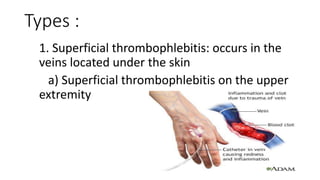
1. Superficial thrombophlebitis: occurs in the
veins located under the skin
a) Superficial thrombophlebitis on the upper
extremity
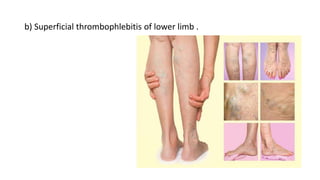
b) Superficial thrombophlebitis of lower limb .
2.Thrombophlebitis migrans: multiple
inflammations in different areas
•A deep vein thrombosis, which mostly
occurs without any inflammation process,
will usually be referred to as a
phlebothrombosis.
Causes :
•The causes of superficial thrombophlebitis are
different for the lower and upper extremities.
-For the upper extremity :most commonly the
insertion of venous catheters into peripheral
veins , the possible invasion of bacteria in the
area of the catheter, and the effect of the inserted
chemicals.
- For the lower extremity:
•Varicose veins
•Immobilisation (also pre- and post-surgery)
•Trauma or surgical interventions (especially including
interventions which include the removal of lymph
nodes)
•Pregnancy, and maternal and birth-related conditions
•Cancerous malformations
•Obesity
•History of thrombosis
•Autoimmune diseases
•Use of hormonal therapies (e.g. the
contraceptive pill or hormonal replacement
therapy)
•Smoking (also as a higher associated risk factor
to arteriosclerosis)
Pathogenesis:
•The pathway of the development of the disease
can be split into two stages:
1.Inflammation process in the vessel (due to a
slow in blood circulation, inflammation factors,
and possibly the exposure to risk factors).
2. Secondary development of a thrombus (the
blood clods around the inflamed tissue of the
vessel, fibrous material builds up and forms a
thrombus).
Symptoms:
• Swelling
• Redness
• Tenderness around the vein area .
• Warm to touch of the hand
Diagnosis :
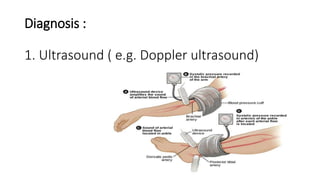
1. Ultrasound ( e.g. Doppler ultrasound)
2. D – dimper test
A D-dimer test is a simple blood test that can help your healthcare
provider determine if you may have a blood clotting condition.
you have a high level of D-dimer in your blood .
3. MR venography and CT venography :
If the results of your ultrasound aren’t clear, your doctor will use
these imaging studies to confirm the presence of a clot. They will
inject a dye into your vein and the image will show up on an X-ray.
Possible side effects include pain and an allergic reaction to the
dye.
Complication :
• Although thrombophlebitis has been considered a fairly
benign disease, some research indicates that there is a
correlation of a higher prevalence of deep vein thrombosis
(phlebothrombosis) in patients with superficial
thrombophlebitis. This condition can be tested for with the
Homan’s Sign Test
• Another serious condition related complication is pulmonary
embolism .
Prevention :
• Patients should be advised to stretch their legs Frequently
when he / she long time drive a car .
• Walking and exercises that increase blood circulation are
effective measures to keep the blood flow steady.
• Wearing compress stockings are often used as a prevention
method for patients who are at a higher risk of developing
thrombosis.
• Routine changing and cleaning of intravenous (IV) lines help
to prevent thrombophlebitis of the upper extremity.
Treatment:
• Conservative treatment:
-Thrombolysis agent
- Topical treatments (e.g. with Heparin spray gel) to reduce local
symptoms .
- Anti-coagulants which are blood-thinning medications (such as
Fondaparinux/Arixtra 2.5mg)
- Anti-inflammatory medication (e.g. non-steroidal anti-
inflammatory drugs)
• Operative treatment
- Stenting procedures, a surgical intervention where a metal
cage is inserted into the clotted vein to reopen the blockage,
is most commonly used for deep vein thrombosis .
- Varicose vein stripping (surgical intervention) .
- Surgery to remove the entire clogged vein (in extreme cases)
.
• Physiotherapy treatment
Acute treatment depends on location, extent, symptoms, and
underlying medical condition, but generally include:
- Warm compression
- Elevate the limb above the heart level.
- Encouraging circulation (walking around) and limb-specific
exercises that activate the skeletal-muscle pump.
THROMBOPHLEBITIS.pptx

THROMBOPHLEBITIS.pptx

  • 1.
    THROMBOPHLEBITIS Presented by –Abhinav Kumar , B.Th.O ,Final year (A.K.U)
  • 2.
    Definition: •Thrombophlebitis is a circulatorycondition that occurs when a blood clot, which developed due to a venous inflammation, inhibits the blood flow .
  • 3.
    Types : 1. Superficialthrombophlebitis: occurs in the veins located under the skin a) Superficial thrombophlebitis on the upper extremity
  • 4.
  • 5.
    2.Thrombophlebitis migrans: multiple inflammationsin different areas •A deep vein thrombosis, which mostly occurs without any inflammation process, will usually be referred to as a phlebothrombosis.
  • 6.
    Causes : •The causesof superficial thrombophlebitis are different for the lower and upper extremities. -For the upper extremity :most commonly the insertion of venous catheters into peripheral veins , the possible invasion of bacteria in the area of the catheter, and the effect of the inserted chemicals.
  • 7.
    - For thelower extremity: •Varicose veins •Immobilisation (also pre- and post-surgery) •Trauma or surgical interventions (especially including interventions which include the removal of lymph nodes) •Pregnancy, and maternal and birth-related conditions
  • 8.
    •Cancerous malformations •Obesity •History ofthrombosis •Autoimmune diseases •Use of hormonal therapies (e.g. the contraceptive pill or hormonal replacement therapy) •Smoking (also as a higher associated risk factor to arteriosclerosis)
  • 9.
    Pathogenesis: •The pathway ofthe development of the disease can be split into two stages: 1.Inflammation process in the vessel (due to a slow in blood circulation, inflammation factors, and possibly the exposure to risk factors).
  • 10.
    2. Secondary developmentof a thrombus (the blood clods around the inflamed tissue of the vessel, fibrous material builds up and forms a thrombus).
  • 11.
    Symptoms: • Swelling • Redness •Tenderness around the vein area . • Warm to touch of the hand
  • 12.
    Diagnosis : 1. Ultrasound( e.g. Doppler ultrasound)
  • 13.
    2. D –dimper test A D-dimer test is a simple blood test that can help your healthcare provider determine if you may have a blood clotting condition. you have a high level of D-dimer in your blood . 3. MR venography and CT venography : If the results of your ultrasound aren’t clear, your doctor will use these imaging studies to confirm the presence of a clot. They will inject a dye into your vein and the image will show up on an X-ray. Possible side effects include pain and an allergic reaction to the dye.
  • 14.
    Complication : • Althoughthrombophlebitis has been considered a fairly benign disease, some research indicates that there is a correlation of a higher prevalence of deep vein thrombosis (phlebothrombosis) in patients with superficial thrombophlebitis. This condition can be tested for with the Homan’s Sign Test • Another serious condition related complication is pulmonary embolism .
  • 15.
    Prevention : • Patientsshould be advised to stretch their legs Frequently when he / she long time drive a car . • Walking and exercises that increase blood circulation are effective measures to keep the blood flow steady. • Wearing compress stockings are often used as a prevention method for patients who are at a higher risk of developing thrombosis. • Routine changing and cleaning of intravenous (IV) lines help to prevent thrombophlebitis of the upper extremity.
  • 16.
    Treatment: • Conservative treatment: -Thrombolysisagent - Topical treatments (e.g. with Heparin spray gel) to reduce local symptoms . - Anti-coagulants which are blood-thinning medications (such as Fondaparinux/Arixtra 2.5mg) - Anti-inflammatory medication (e.g. non-steroidal anti- inflammatory drugs)
  • 17.
    • Operative treatment -Stenting procedures, a surgical intervention where a metal cage is inserted into the clotted vein to reopen the blockage, is most commonly used for deep vein thrombosis . - Varicose vein stripping (surgical intervention) . - Surgery to remove the entire clogged vein (in extreme cases) .
  • 18.
    • Physiotherapy treatment Acutetreatment depends on location, extent, symptoms, and underlying medical condition, but generally include: - Warm compression - Elevate the limb above the heart level. - Encouraging circulation (walking around) and limb-specific exercises that activate the skeletal-muscle pump.