Presentation Of
Database Management System
Introduction
• Name: MD. Wasim Akram
• ID: UG 02 22 09 016
• Department: CSE
Topic
• Threats of Database In E-Commerce
What Is Commerce
• Commerce
• CCommerce: Exchange of Goods /
  Services
• SContracting parties: Buyer and Seller
• CFundamental principles: Trust and
  Security
• S
What is E Commerce
• E-Commerce
• EAutomation of commercial transactions
  using computer and communication
  technologies
• t Facilitated by Internet and WWW
• F Business-to-Business: EDI
• BBusiness-to-Consumer: WWW retailing
Continued
•   CSome features:
•   –Easy, global access, 24 hour availability
•   –Customized products and services
•   –Back Office integration
•   –Additional revenue stream
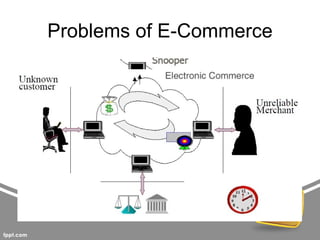
Problems of E-Commerce
E-Commerce risks
•   ECustomer's risks
•   –Stolen credentials or password
•   –Dishonest merchant
•   –Disputes over transaction
•   –Inappropriate use of transaction details
•   - Merchant’s risk
Continued
• Forged or copied instruments
• –Disputed charges
• –Insufficient funds in customer’s account
• –Unauthorized redistribution of purchased
  items
• i Main issue: Secure payment scheme
Overview
•   Levels of data security
•   Authorization in databases
•   Application Vulnerabilities
•   Summary and References
Levels of Data Security
•   Human level: Corrupt/careless User
•   Network/User Interface
•   Database application program
•   Database system
•   Operating System
•   Physical level
Database Threats
• Disclosure of valuable and private
  information could irreparably damage a
  company
• Security is often enforced through the use
  of privileges
• Some databases are inherently insecure
  and rely on the Web server to enforce
  security measures
Continued
• Threats to database result in the loss or
  degradation of some or all of the following
  security goals: integrity, availability, and
  confidentially.
  – Loss of integrity
  – Loss of availability
  – Loss of confidentially
Explanation Of Threats in Database
•   1. Privilege abuse: When database users are provided with
    privileges that exceeds their day-to-day job requirement, these
    privileges may be abused intentionally or unintentionally.
•   3. Database rootkits: A database rootkit is a program or a
    procedure that is hidden inside the database and that provides
    administrator-level privileges to gain access to the data in the
    database. These rootkits may even turn off alerts triggered by
    Intrusion Prevention Systems (IPS).
•   4. Weak authentication: Weak authentication models allow
    attackers to employ strategies such as social engineering and brute
    force to obtain database login credentials and assume the identity of
    legitimate database users.
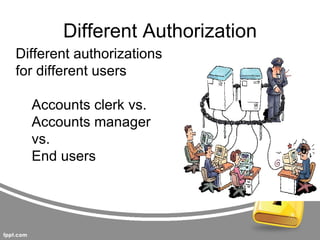
Different Authorization
Different authorizations
for different users

  Accounts clerk vs.
  Accounts manager
  vs.
  End users
Database/Application Security
• Ensure that only authenticated users can
  access the system
• And can access (read/update) only
  data/interfaces that they are authorized to
  access
How to protect database
• To protect database against these types
  of 4 kinds of countermeasures can be
  implemented:
  – Access control
  – Inference control
  – Flow control
  – Encryption
Conclusion
• Thank you my Honorable Teacher for
  giving me the privilege for this
  Presentation………

• Any questions?????

Threats

  • 1.
  • 2.
    Introduction • Name: MD.Wasim Akram • ID: UG 02 22 09 016 • Department: CSE
  • 3.
    Topic • Threats ofDatabase In E-Commerce
  • 4.
    What Is Commerce •Commerce • CCommerce: Exchange of Goods / Services • SContracting parties: Buyer and Seller • CFundamental principles: Trust and Security • S
  • 5.
    What is ECommerce • E-Commerce • EAutomation of commercial transactions using computer and communication technologies • t Facilitated by Internet and WWW • F Business-to-Business: EDI • BBusiness-to-Consumer: WWW retailing
  • 6.
    Continued • CSome features: • –Easy, global access, 24 hour availability • –Customized products and services • –Back Office integration • –Additional revenue stream
  • 7.
  • 8.
    E-Commerce risks • ECustomer's risks • –Stolen credentials or password • –Dishonest merchant • –Disputes over transaction • –Inappropriate use of transaction details • - Merchant’s risk
  • 9.
    Continued • Forged orcopied instruments • –Disputed charges • –Insufficient funds in customer’s account • –Unauthorized redistribution of purchased items • i Main issue: Secure payment scheme
  • 10.
    Overview • Levels of data security • Authorization in databases • Application Vulnerabilities • Summary and References
  • 11.
    Levels of DataSecurity • Human level: Corrupt/careless User • Network/User Interface • Database application program • Database system • Operating System • Physical level
  • 12.
    Database Threats • Disclosureof valuable and private information could irreparably damage a company • Security is often enforced through the use of privileges • Some databases are inherently insecure and rely on the Web server to enforce security measures
  • 13.
    Continued • Threats todatabase result in the loss or degradation of some or all of the following security goals: integrity, availability, and confidentially. – Loss of integrity – Loss of availability – Loss of confidentially
  • 14.
    Explanation Of Threatsin Database • 1. Privilege abuse: When database users are provided with privileges that exceeds their day-to-day job requirement, these privileges may be abused intentionally or unintentionally. • 3. Database rootkits: A database rootkit is a program or a procedure that is hidden inside the database and that provides administrator-level privileges to gain access to the data in the database. These rootkits may even turn off alerts triggered by Intrusion Prevention Systems (IPS). • 4. Weak authentication: Weak authentication models allow attackers to employ strategies such as social engineering and brute force to obtain database login credentials and assume the identity of legitimate database users.
  • 15.
    Different Authorization Different authorizations fordifferent users Accounts clerk vs. Accounts manager vs. End users
  • 16.
    Database/Application Security • Ensurethat only authenticated users can access the system • And can access (read/update) only data/interfaces that they are authorized to access
  • 17.
    How to protectdatabase • To protect database against these types of 4 kinds of countermeasures can be implemented: – Access control – Inference control – Flow control – Encryption
  • 18.
    Conclusion • Thank youmy Honorable Teacher for giving me the privilege for this Presentation……… • Any questions?????