Database Security
Ghezal Ahmad Zia
Information Systems Department
Faculty of Computer Science
Kabul University
ghezalahmadzia@yahoo.com
May 16, 2014
Ghezal Ahmad Zia (@ISD-CSF-KU) Database Security May 16, 2014 1 / 42
Contents I
1 Introduction
2 Main Aspect of Database Security
Integrity
Confidentiality
Availability
3 Access Control
Discretionary Access Control
Mandatory Access Control
4 Conclusion
5 References
Ghezal Ahmad Zia (@ISD-CSF-KU) Database Security May 16, 2014 2 / 42
How to think about Insecurity?
Ghezal Ahmad Zia (@ISD-CSF-KU) Database Security May 16, 2014 3 / 42
How to think about Insecurity?
People are part of the problem...
Ghezal Ahmad Zia (@ISD-CSF-KU) Database Security May 16, 2014 3 / 42
How to think about Insecurity?
People are part of the problem...
Bad guys don’t follow rules
Ghezal Ahmad Zia (@ISD-CSF-KU) Database Security May 16, 2014 3 / 42
How to think about Insecurity?
People are part of the problem...
Bad guys don’t follow rules
Need to understand what sort of attack possible to compromise a
system
Prerequisite to understand what to protect in a system!
Ghezal Ahmad Zia (@ISD-CSF-KU) Database Security May 16, 2014 3 / 42
Causes of Software Security Incidents
Ghezal Ahmad Zia (@ISD-CSF-KU) Database Security May 16, 2014 4 / 42
Causes of Software Security Incidents
Buggy software and wrong configurations
Unsafe program languages
Complex programs
Ghezal Ahmad Zia (@ISD-CSF-KU) Database Security May 16, 2014 4 / 42
Causes of Software Security Incidents
Buggy software and wrong configurations
Unsafe program languages
Complex programs
Lack of awareness and education
Few courses in computer security
Programming text books do not emphasize security
Ghezal Ahmad Zia (@ISD-CSF-KU) Database Security May 16, 2014 4 / 42
Causes of Software Security Incidents
Buggy software and wrong configurations
Unsafe program languages
Complex programs
Lack of awareness and education
Few courses in computer security
Programming text books do not emphasize security
Poor usability
Security sometimes makes things harder to use
Ghezal Ahmad Zia (@ISD-CSF-KU) Database Security May 16, 2014 4 / 42
Causes of Software Security Incidents
Buggy software and wrong configurations
Unsafe program languages
Complex programs
Lack of awareness and education
Few courses in computer security
Programming text books do not emphasize security
Poor usability
Security sometimes makes things harder to use
Economic factors
Consumers do not care about security
Security is difficult, expensive and takes time
Few security audits
Ghezal Ahmad Zia (@ISD-CSF-KU) Database Security May 16, 2014 4 / 42
Causes of Software Security Incidents
Buggy software and wrong configurations
Unsafe program languages
Complex programs
Lack of awareness and education
Few courses in computer security
Programming text books do not emphasize security
Poor usability
Security sometimes makes things harder to use
Economic factors
Consumers do not care about security
Security is difficult, expensive and takes time
Few security audits
Human Factor
Ghezal Ahmad Zia (@ISD-CSF-KU) Database Security May 16, 2014 4 / 42
Human Factor
Who are the attackers?
Ghezal Ahmad Zia (@ISD-CSF-KU) Database Security May 16, 2014 5 / 42
Human Factor
Who are the attackers?
Why do the attack systems?
Ghezal Ahmad Zia (@ISD-CSF-KU) Database Security May 16, 2014 5 / 42
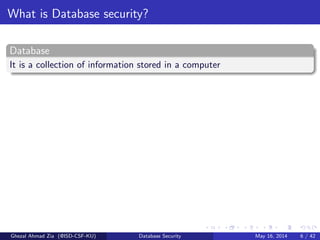
What is Database security?
Ghezal Ahmad Zia (@ISD-CSF-KU) Database Security May 16, 2014 6 / 42
What is Database security?
Database
It is a collection of information stored in a computer
Ghezal Ahmad Zia (@ISD-CSF-KU) Database Security May 16, 2014 6 / 42
What is Database security?
Database
It is a collection of information stored in a computer
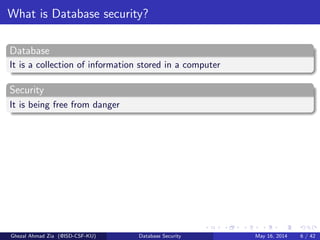
Security
It is being free from danger
Ghezal Ahmad Zia (@ISD-CSF-KU) Database Security May 16, 2014 6 / 42
What is Database security?
Database
It is a collection of information stored in a computer
Security
It is being free from danger
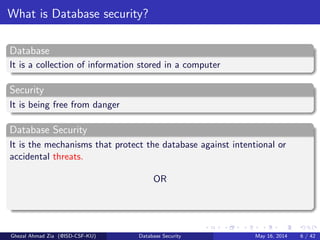
Database Security
It is the mechanisms that protect the database against intentional or
accidental threats.
OR
Ghezal Ahmad Zia (@ISD-CSF-KU) Database Security May 16, 2014 6 / 42
What is Database security?
Database
It is a collection of information stored in a computer
Security
It is being free from danger
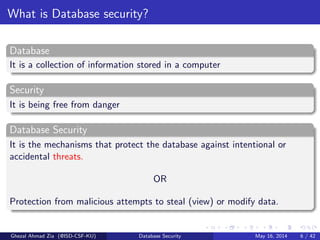
Database Security
It is the mechanisms that protect the database against intentional or
accidental threats.
OR
Protection from malicious attempts to steal (view) or modify data.
Ghezal Ahmad Zia (@ISD-CSF-KU) Database Security May 16, 2014 6 / 42
What is Threats?
Ghezal Ahmad Zia (@ISD-CSF-KU) Database Security May 16, 2014 7 / 42
What is Threats?
Threats - Any situation or event, whether intensional or accidental,
that may adversely affect a system and consequently the
organization.
Ghezal Ahmad Zia (@ISD-CSF-KU) Database Security May 16, 2014 7 / 42
What is Threats?
Threats - Any situation or event, whether intensional or accidental,
that may adversely affect a system and consequently the
organization.
Computer Systems
Databases
Ghezal Ahmad Zia (@ISD-CSF-KU) Database Security May 16, 2014 7 / 42
Threats
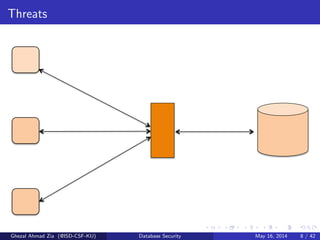
Ghezal Ahmad Zia (@ISD-CSF-KU) Database Security May 16, 2014 8 / 42
Threats
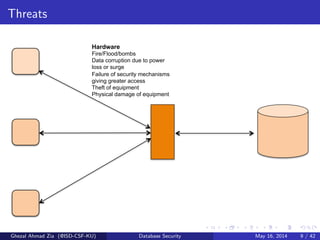
Hardware
Fire/Flood/bombs
Data corruption due to power
loss or surge
Failure of security mechanisms
giving greater access
Theft of equipment
Physical damage of equipment
Ghezal Ahmad Zia (@ISD-CSF-KU) Database Security May 16, 2014 9 / 42
Threats
Hardware
Fire/Flood/bombs
Data corruption due to power
loss or surge
Failure of security mechanisms
giving greater access
Theft of equipment
Physical damage of equipment
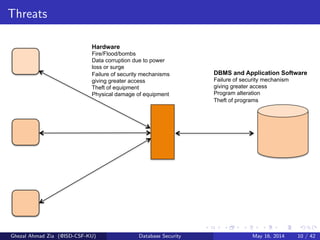
DBMS and Application Software
Failure of security mechanism
giving greater access
Program alteration
Theft of programs
Ghezal Ahmad Zia (@ISD-CSF-KU) Database Security May 16, 2014 10 / 42
Threats
Hardware
Fire/Flood/bombs
Data corruption due to power
loss or surge
Failure of security mechanisms
giving greater access
Theft of equipment
Physical damage of equipment
DBMS and Application Software
Failure of security mechanism
giving greater access
Program alteration
Theft of programs
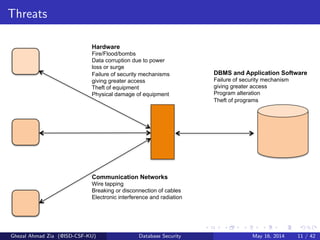
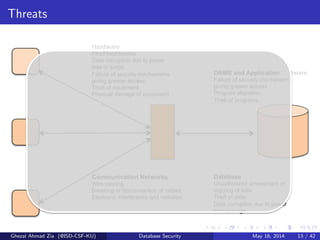
Communication Networks
Wire tapping
Breaking or disconnection of cables
Electronic interference and radiation
Ghezal Ahmad Zia (@ISD-CSF-KU) Database Security May 16, 2014 11 / 42
Threats
Hardware
Fire/Flood/bombs
Data corruption due to power
loss or surge
Failure of security mechanisms
giving greater access
Theft of equipment
Physical damage of equipment
DBMS and Application Software
Failure of security mechanism
giving greater access
Program alteration
Theft of programs
Communication Networks
Wire tapping
Breaking or disconnection of cables
Electronic interference and radiation
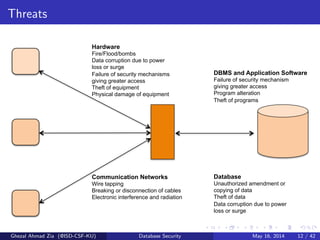
Database
Unauthorized amendment or
copying of data
Theft of data
Data corruption due to power
loss or surge
Ghezal Ahmad Zia (@ISD-CSF-KU) Database Security May 16, 2014 12 / 42
Threats
Hardware
Fire/Flood/bombs
Data corruption due to power
loss or surge
Failure of security mechanisms
giving greater access
Theft of equipment
Physical damage of equipment
DBMS and Application Software
Failure of security mechanism
giving greater access
Program alteration
Theft of programs
Communication Networks
Wire tapping
Breaking or disconnection of cables
Electronic interference and radiation
Database
Unauthorized amendment or
copying of data
Theft of data
Data corruption due to power
loss or surge
Ghezal Ahmad Zia (@ISD-CSF-KU) Database Security May 16, 2014 13 / 42
Threats
Hardware
Fire/Flood/bombs
Data corruption due to power
loss or surge
Failure of security mechanisms
giving greater access
Theft of equipment
Physical damage of equipment
DBMS and Application Software
Failure of security mechanism
giving greater access
Program alteration
Theft of programs
Communication Networks
Wire tapping
Breaking or disconnection of cables
Electronic interference and radiation
Database
Unauthorized amendment or
copying of data
Theft of data
Data corruption due to power
loss or surge
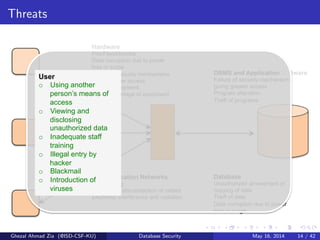
User
o  Using another
person’s means of
access
o  Viewing and
disclosing
unauthorized data
o  Inadequate staff
training
o  Illegal entry by
hacker
o  Blackmail
o  Introduction of
viruses
Ghezal Ahmad Zia (@ISD-CSF-KU) Database Security May 16, 2014 14 / 42
Threats
Hardware
Fire/Flood/bombs
Data corruption due to power
loss or surge
Failure of security mechanisms
giving greater access
Theft of equipment
Physical damage of equipment
DBMS and Application Software
Failure of security mechanism
giving greater access
Program alteration
Theft of programs
Communication Networks
Wire tapping
Breaking or disconnection of cables
Electronic interference and radiation
Database
Unauthorized amendment or
copying of data
Theft of data
Data corruption due to power
loss or surge
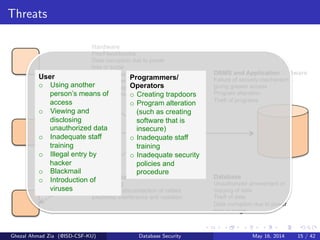
Programmers/
Operators
o  Creating trapdoors
o  Program alteration
(such as creating
software that is
insecure)
o  Inadequate staff
training
o  Inadequate security
policies and
procedure
User
o  Using another
person’s means of
access
o  Viewing and
disclosing
unauthorized data
o  Inadequate staff
training
o  Illegal entry by
hacker
o  Blackmail
o  Introduction of
viruses
Ghezal Ahmad Zia (@ISD-CSF-KU) Database Security May 16, 2014 15 / 42
Threats
Hardware
Fire/Flood/bombs
Data corruption due to power
loss or surge
Failure of security mechanisms
giving greater access
Theft of equipment
Physical damage of equipment
DBMS and Application Software
Failure of security mechanism
giving greater access
Program alteration
Theft of programs
Communication Networks
Wire tapping
Breaking or disconnection of cables
Electronic interference and radiation
Database
Unauthorized amendment or
copying of data
Theft of data
Data corruption due to power
loss or surge
Programmers/
Operators
o  Creating trapdoors
o  Program alteration
(such as creating
software that is
insecure)
o  Inadequate staff
training
o  Inadequate security
policies and
procedure
User
o  Using another
person’s means of
access
o  Viewing and
disclosing
unauthorized data
o  Inadequate staff
training
o  Illegal entry by
hacker
o  Blackmail
o  Introduction of
viruses
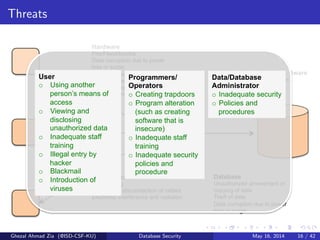
Data/Database
Administrator
o  Inadequate security
o  Policies and
procedures
Ghezal Ahmad Zia (@ISD-CSF-KU) Database Security May 16, 2014 16 / 42
Definition of Database security
Ghezal Ahmad Zia (@ISD-CSF-KU) Database Security May 16, 2014 17 / 42
Definition of Database security
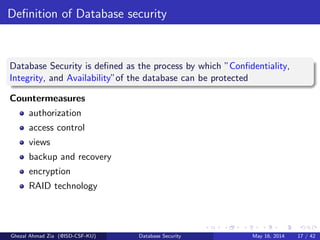
Database Security is defined as the process by which ”Confidentiality,
Integrity, and Availability”of the database can be protected
Ghezal Ahmad Zia (@ISD-CSF-KU) Database Security May 16, 2014 17 / 42
Definition of Database security
Database Security is defined as the process by which ”Confidentiality,
Integrity, and Availability”of the database can be protected
Countermeasures
authorization
access control
views
backup and recovery
encryption
RAID technology
Ghezal Ahmad Zia (@ISD-CSF-KU) Database Security May 16, 2014 17 / 42
Database security Concepts
Ghezal Ahmad Zia (@ISD-CSF-KU) Database Security May 16, 2014 18 / 42
Database security Concepts
Three Main Aspects
Confidentiality
Integrity
Availability
Ghezal Ahmad Zia (@ISD-CSF-KU) Database Security May 16, 2014 18 / 42
Database security Concepts
Three Main Aspects
Confidentiality
Integrity
Availability
Threats to databases:
Ghezal Ahmad Zia (@ISD-CSF-KU) Database Security May 16, 2014 18 / 42
Database security Concepts
Three Main Aspects
Confidentiality
Integrity
Availability
Threats to databases:
Ghezal Ahmad Zia (@ISD-CSF-KU) Database Security May 16, 2014 18 / 42
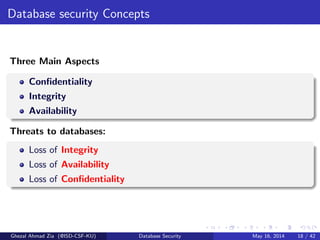
Database security Concepts
Three Main Aspects
Confidentiality
Integrity
Availability
Threats to databases:
Loss of Integrity
Loss of Availability
Loss of Confidentiality
Ghezal Ahmad Zia (@ISD-CSF-KU) Database Security May 16, 2014 18 / 42
Confidentiality
Confidentiality
No one can read our data / communication unless we want them to
Ghezal Ahmad Zia (@ISD-CSF-KU) Database Security May 16, 2014 19 / 42
Confidentiality
Confidentiality
No one can read our data / communication unless we want them to
It is protecting the database from unauthorized users.
Ghezal Ahmad Zia (@ISD-CSF-KU) Database Security May 16, 2014 19 / 42
Confidentiality
Confidentiality
No one can read our data / communication unless we want them to
It is protecting the database from unauthorized users.
Ensures that users are allowed to do the things they are trying to do.
Ghezal Ahmad Zia (@ISD-CSF-KU) Database Security May 16, 2014 19 / 42
Confidentiality
Confidentiality
No one can read our data / communication unless we want them to
It is protecting the database from unauthorized users.
Ensures that users are allowed to do the things they are trying to do.
For example:
The employees should not see the salaries of their managers.
Ghezal Ahmad Zia (@ISD-CSF-KU) Database Security May 16, 2014 19 / 42
Confidentiality
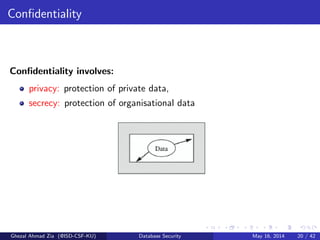
Confidentiality involves:
privacy: protection of private data,
secrecy: protection of organisational data
Ghezal Ahmad Zia (@ISD-CSF-KU) Database Security May 16, 2014 20 / 42
Integrity
Integrity
No one can manipulate our data / processing / communication unless
we want them to
Ghezal Ahmad Zia (@ISD-CSF-KU) Database Security May 16, 2014 21 / 42
Integrity
Integrity
No one can manipulate our data / processing / communication unless
we want them to
Protecting the database from authorized users.
Ghezal Ahmad Zia (@ISD-CSF-KU) Database Security May 16, 2014 21 / 42
Integrity
Integrity
No one can manipulate our data / processing / communication unless
we want them to
Protecting the database from authorized users.
Ensures that what users are trying to do is correct
For example:
An employee should be able to modify his or her own information.
Ghezal Ahmad Zia (@ISD-CSF-KU) Database Security May 16, 2014 21 / 42
Integrity
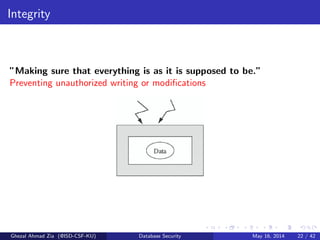
”Making sure that everything is as it is supposed to be.”
Preventing unauthorized writing or modifications
Ghezal Ahmad Zia (@ISD-CSF-KU) Database Security May 16, 2014 22 / 42
Availability
Availability
We can access our data / conduct our processing / use our
communication capabilities when we want to
Ghezal Ahmad Zia (@ISD-CSF-KU) Database Security May 16, 2014 23 / 42
Availability
Availability
We can access our data / conduct our processing / use our
communication capabilities when we want to
Authorized users should be able to access data for Legal Purposes as
necessary
Ghezal Ahmad Zia (@ISD-CSF-KU) Database Security May 16, 2014 23 / 42
Availability
Availability
We can access our data / conduct our processing / use our
communication capabilities when we want to
Authorized users should be able to access data for Legal Purposes as
necessary
For example:
Payment orders regarding taxes should be made on time by the tax law.
Ghezal Ahmad Zia (@ISD-CSF-KU) Database Security May 16, 2014 23 / 42
Availability
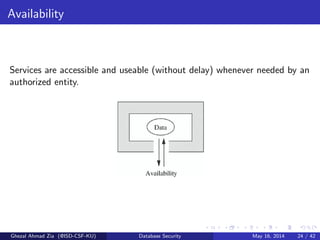
Services are accessible and useable (without delay) whenever needed by an
authorized entity.
Ghezal Ahmad Zia (@ISD-CSF-KU) Database Security May 16, 2014 24 / 42
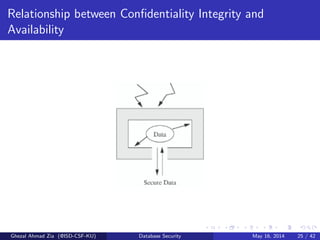
Relationship between Confidentiality Integrity and
Availability
Ghezal Ahmad Zia (@ISD-CSF-KU) Database Security May 16, 2014 25 / 42
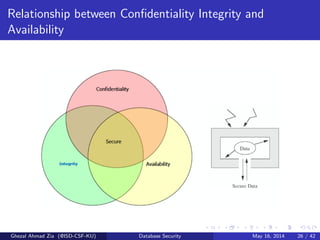
Relationship between Confidentiality Integrity and
Availability
Ghezal Ahmad Zia (@ISD-CSF-KU) Database Security May 16, 2014 26 / 42
Thanks for your attention!
Ghezal Ahmad Zia (@ISD-CSF-KU) Database Security May 16, 2014 27 / 42
Integrity
How is data integrity preserved?
Through Data integrity Constraints
Ghezal Ahmad Zia (@ISD-CSF-KU) Database Security May 16, 2014 28 / 42
Integrity
How is data integrity preserved?
Through Data integrity Constraints
Constraints restrict data values that can be inserted or updated
Ghezal Ahmad Zia (@ISD-CSF-KU) Database Security May 16, 2014 28 / 42
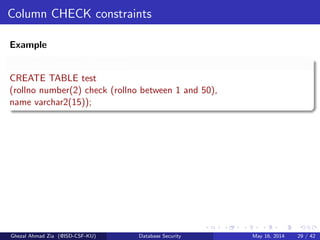
Column CHECK constraints
Example
Validity Checking Example
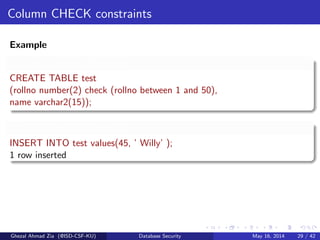
CREATE TABLE test
(rollno number(2) check (rollno between 1 and 50),
name varchar2(15));
Ghezal Ahmad Zia (@ISD-CSF-KU) Database Security May 16, 2014 29 / 42
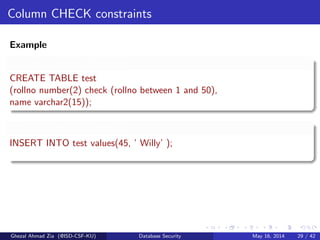
Column CHECK constraints
Example
Validity Checking Example
CREATE TABLE test
(rollno number(2) check (rollno between 1 and 50),
name varchar2(15));
Validity Checking Example
INSERT INTO test values(45, ’ Willy’ );
Ghezal Ahmad Zia (@ISD-CSF-KU) Database Security May 16, 2014 29 / 42
Column CHECK constraints
Example
Validity Checking Example
CREATE TABLE test
(rollno number(2) check (rollno between 1 and 50),
name varchar2(15));
Validity Checking Example
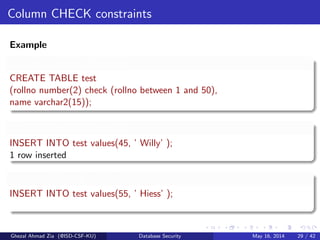
INSERT INTO test values(45, ’ Willy’ );
1 row inserted
Ghezal Ahmad Zia (@ISD-CSF-KU) Database Security May 16, 2014 29 / 42
Column CHECK constraints
Example
Validity Checking Example
CREATE TABLE test
(rollno number(2) check (rollno between 1 and 50),
name varchar2(15));
Validity Checking Example
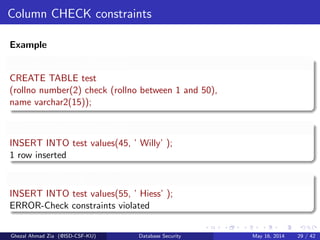
INSERT INTO test values(45, ’ Willy’ );
1 row inserted
Validity Checking Example
INSERT INTO test values(55, ’ Hiess’ );
Ghezal Ahmad Zia (@ISD-CSF-KU) Database Security May 16, 2014 29 / 42
Column CHECK constraints
Example
Validity Checking Example
CREATE TABLE test
(rollno number(2) check (rollno between 1 and 50),
name varchar2(15));
Validity Checking Example
INSERT INTO test values(45, ’ Willy’ );
1 row inserted
Validity Checking Example
INSERT INTO test values(55, ’ Hiess’ );
ERROR-Check constraints violated
Ghezal Ahmad Zia (@ISD-CSF-KU) Database Security May 16, 2014 29 / 42
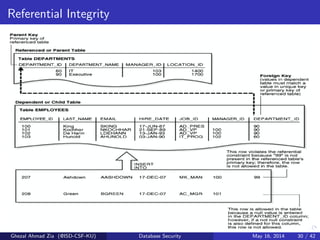
Referential Integrity
Ghezal Ahmad Zia (@ISD-CSF-KU) Database Security May 16, 2014 30 / 42
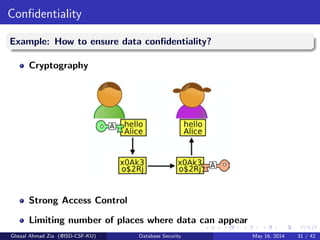
Confidentiality
Example: How to ensure data confidentiality?
Ghezal Ahmad Zia (@ISD-CSF-KU) Database Security May 16, 2014 31 / 42
Confidentiality
Example: How to ensure data confidentiality?
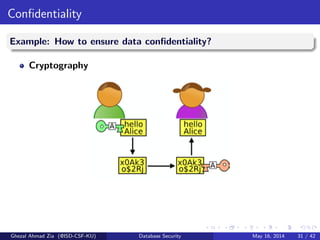
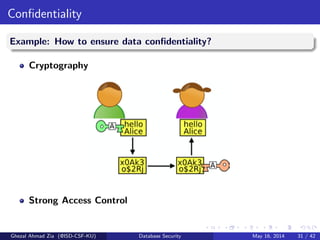
Cryptography
Ghezal Ahmad Zia (@ISD-CSF-KU) Database Security May 16, 2014 31 / 42
Confidentiality
Example: How to ensure data confidentiality?
Cryptography
Ghezal Ahmad Zia (@ISD-CSF-KU) Database Security May 16, 2014 31 / 42
Confidentiality
Example: How to ensure data confidentiality?
Cryptography
Strong Access Control
Ghezal Ahmad Zia (@ISD-CSF-KU) Database Security May 16, 2014 31 / 42
Confidentiality
Example: How to ensure data confidentiality?
Cryptography
Strong Access Control
Limiting number of places where data can appear
Ghezal Ahmad Zia (@ISD-CSF-KU) Database Security May 16, 2014 31 / 42
Access Control
Ghezal Ahmad Zia (@ISD-CSF-KU) Database Security May 16, 2014 32 / 42
Access Control
An identity permits access to resources
In computer security this is called
Ghezal Ahmad Zia (@ISD-CSF-KU) Database Security May 16, 2014 32 / 42
Access Control
An identity permits access to resources
In computer security this is called
Access Control
Authorization
We talk about:
Subjects (for whom an action is performed)
Ghezal Ahmad Zia (@ISD-CSF-KU) Database Security May 16, 2014 32 / 42
Access Control
An identity permits access to resources
In computer security this is called
Access Control
Authorization
We talk about:
Subjects (for whom an action is performed)
Objects (upon what an action is performed)
Ghezal Ahmad Zia (@ISD-CSF-KU) Database Security May 16, 2014 32 / 42
Access Control
An identity permits access to resources
In computer security this is called
Access Control
Authorization
We talk about:
Subjects (for whom an action is performed)
Objects (upon what an action is performed)
Operations (the type of action performed)
Ghezal Ahmad Zia (@ISD-CSF-KU) Database Security May 16, 2014 32 / 42
Access Control Models
A DBMS provides access control mechanisms to help implement a security
policy.
Ghezal Ahmad Zia (@ISD-CSF-KU) Database Security May 16, 2014 33 / 42
Access Control Models
A DBMS provides access control mechanisms to help implement a security
policy.
Two complementary types of mechanism:
Ghezal Ahmad Zia (@ISD-CSF-KU) Database Security May 16, 2014 33 / 42
Access Control Models
A DBMS provides access control mechanisms to help implement a security
policy.
Two complementary types of mechanism:
1 Discretionary access control (DAC)
Ghezal Ahmad Zia (@ISD-CSF-KU) Database Security May 16, 2014 33 / 42
Access Control Models
A DBMS provides access control mechanisms to help implement a security
policy.
Two complementary types of mechanism:
1 Discretionary access control (DAC)
2 Mandatory access control (MAC)
Ghezal Ahmad Zia (@ISD-CSF-KU) Database Security May 16, 2014 33 / 42
Discretionary Access Control
Ghezal Ahmad Zia (@ISD-CSF-KU) Database Security May 16, 2014 34 / 42
Discretionary Access Control
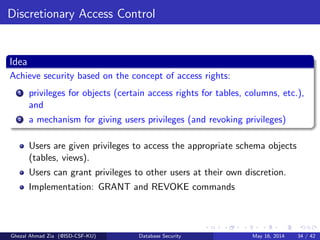
Idea
Achieve security based on the concept of access rights:
1 privileges for objects
Ghezal Ahmad Zia (@ISD-CSF-KU) Database Security May 16, 2014 34 / 42
Discretionary Access Control
Idea
Achieve security based on the concept of access rights:
1 privileges for objects (certain access rights for tables, columns, etc.),
and
Ghezal Ahmad Zia (@ISD-CSF-KU) Database Security May 16, 2014 34 / 42
Discretionary Access Control
Idea
Achieve security based on the concept of access rights:
1 privileges for objects (certain access rights for tables, columns, etc.),
and
2 a mechanism for giving users privileges (and revoking privileges)
Ghezal Ahmad Zia (@ISD-CSF-KU) Database Security May 16, 2014 34 / 42
Discretionary Access Control
Idea
Achieve security based on the concept of access rights:
1 privileges for objects (certain access rights for tables, columns, etc.),
and
2 a mechanism for giving users privileges (and revoking privileges)
Users are given privileges to access the appropriate schema objects
(tables, views).
Ghezal Ahmad Zia (@ISD-CSF-KU) Database Security May 16, 2014 34 / 42
Discretionary Access Control
Idea
Achieve security based on the concept of access rights:
1 privileges for objects (certain access rights for tables, columns, etc.),
and
2 a mechanism for giving users privileges (and revoking privileges)
Users are given privileges to access the appropriate schema objects
(tables, views).
Users can grant privileges to other users at their own discretion.
Ghezal Ahmad Zia (@ISD-CSF-KU) Database Security May 16, 2014 34 / 42
Discretionary Access Control
Idea
Achieve security based on the concept of access rights:
1 privileges for objects (certain access rights for tables, columns, etc.),
and
2 a mechanism for giving users privileges (and revoking privileges)
Users are given privileges to access the appropriate schema objects
(tables, views).
Users can grant privileges to other users at their own discretion.
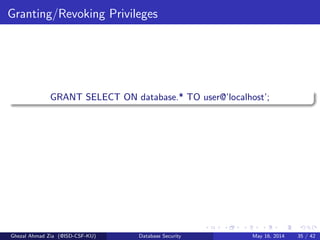
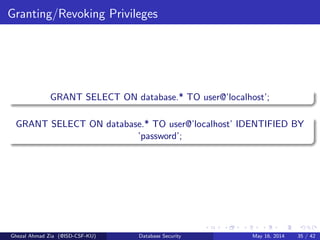
Implementation: GRANT and REVOKE commands
Ghezal Ahmad Zia (@ISD-CSF-KU) Database Security May 16, 2014 34 / 42
Granting/Revoking Privileges
GRANT SELECT ON database.* TO user@’localhost’;
Ghezal Ahmad Zia (@ISD-CSF-KU) Database Security May 16, 2014 35 / 42
Granting/Revoking Privileges
GRANT SELECT ON database.* TO user@’localhost’;
GRANT SELECT ON database.* TO user@’localhost’ IDENTIFIED BY
’password’;
Ghezal Ahmad Zia (@ISD-CSF-KU) Database Security May 16, 2014 35 / 42
DBMSs and Web Security
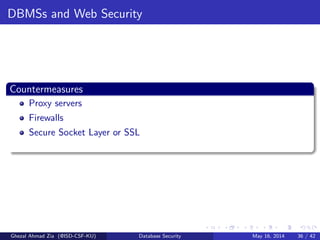
Countermeasures
Proxy servers
Firewalls
Secure Socket Layer or SSL
Ghezal Ahmad Zia (@ISD-CSF-KU) Database Security May 16, 2014 36 / 42
DBMSs and Web Security
Countermeasures
Proxy servers
Firewalls
Secure Socket Layer or SSL Which is used extensively to secure
e-commerce on the Internet today.
Ghezal Ahmad Zia (@ISD-CSF-KU) Database Security May 16, 2014 36 / 42
Proxy Servers
Ghezal Ahmad Zia (@ISD-CSF-KU) Database Security May 16, 2014 37 / 42
Proxy Servers
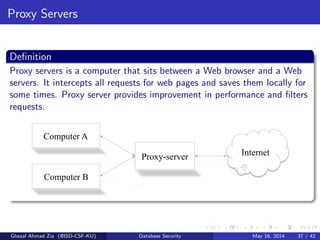
Definition
Proxy servers is a computer that sits between a Web browser and a Web
servers. It intercepts all requests for web pages and saves them locally for
some times. Proxy server provides improvement in performance and filters
requests.
Ghezal Ahmad Zia (@ISD-CSF-KU) Database Security May 16, 2014 37 / 42
Proxy Servers
Definition
Proxy servers is a computer that sits between a Web browser and a Web
servers. It intercepts all requests for web pages and saves them locally for
some times. Proxy server provides improvement in performance and filters
requests.
Computer A
Computer B
Proxy-server Internet
Ghezal Ahmad Zia (@ISD-CSF-KU) Database Security May 16, 2014 37 / 42
Firewalls
Ghezal Ahmad Zia (@ISD-CSF-KU) Database Security May 16, 2014 38 / 42
Firewalls
Firewalls
Is a system that prevents unauthorized access to or from private network.
Implemented in software, hardware or both.
Packet filter
Application gateway
Proxy server
Ghezal Ahmad Zia (@ISD-CSF-KU) Database Security May 16, 2014 38 / 42
Conclusion
Data security is critical.
Requires security at different levels.
Several technical solutions .
But human training is essential.
Ghezal Ahmad Zia (@ISD-CSF-KU) Database Security May 16, 2014 39 / 42
References
Mark Stamp
INFORMATION SECURITY PRINCIPLES AND PRACTICE
Mark Stamp
Database Systems
Security , Chapter 19, 541
Michael Gertz
Handbook of Database Security Applications and Trends
Dorothy Elizabeth Robling Denning
Cryptography and Data Security
Ghezal Ahmad Zia (@ISD-CSF-KU) Database Security May 16, 2014 40 / 42
Thanks for your attention!
Ghezal Ahmad Zia (@ISD-CSF-KU) Database Security May 16, 2014 41 / 42

Database Security

  • 1.
    Database Security Ghezal AhmadZia Information Systems Department Faculty of Computer Science Kabul University ghezalahmadzia@yahoo.com May 16, 2014 Ghezal Ahmad Zia (@ISD-CSF-KU) Database Security May 16, 2014 1 / 42
  • 2.
    Contents I 1 Introduction 2Main Aspect of Database Security Integrity Confidentiality Availability 3 Access Control Discretionary Access Control Mandatory Access Control 4 Conclusion 5 References Ghezal Ahmad Zia (@ISD-CSF-KU) Database Security May 16, 2014 2 / 42
  • 3.
    How to thinkabout Insecurity? Ghezal Ahmad Zia (@ISD-CSF-KU) Database Security May 16, 2014 3 / 42
  • 4.
    How to thinkabout Insecurity? People are part of the problem... Ghezal Ahmad Zia (@ISD-CSF-KU) Database Security May 16, 2014 3 / 42
  • 5.
    How to thinkabout Insecurity? People are part of the problem... Bad guys don’t follow rules Ghezal Ahmad Zia (@ISD-CSF-KU) Database Security May 16, 2014 3 / 42
  • 6.
    How to thinkabout Insecurity? People are part of the problem... Bad guys don’t follow rules Need to understand what sort of attack possible to compromise a system Prerequisite to understand what to protect in a system! Ghezal Ahmad Zia (@ISD-CSF-KU) Database Security May 16, 2014 3 / 42
  • 7.
    Causes of SoftwareSecurity Incidents Ghezal Ahmad Zia (@ISD-CSF-KU) Database Security May 16, 2014 4 / 42
  • 8.
    Causes of SoftwareSecurity Incidents Buggy software and wrong configurations Unsafe program languages Complex programs Ghezal Ahmad Zia (@ISD-CSF-KU) Database Security May 16, 2014 4 / 42
  • 9.
    Causes of SoftwareSecurity Incidents Buggy software and wrong configurations Unsafe program languages Complex programs Lack of awareness and education Few courses in computer security Programming text books do not emphasize security Ghezal Ahmad Zia (@ISD-CSF-KU) Database Security May 16, 2014 4 / 42
  • 10.
    Causes of SoftwareSecurity Incidents Buggy software and wrong configurations Unsafe program languages Complex programs Lack of awareness and education Few courses in computer security Programming text books do not emphasize security Poor usability Security sometimes makes things harder to use Ghezal Ahmad Zia (@ISD-CSF-KU) Database Security May 16, 2014 4 / 42
  • 11.
    Causes of SoftwareSecurity Incidents Buggy software and wrong configurations Unsafe program languages Complex programs Lack of awareness and education Few courses in computer security Programming text books do not emphasize security Poor usability Security sometimes makes things harder to use Economic factors Consumers do not care about security Security is difficult, expensive and takes time Few security audits Ghezal Ahmad Zia (@ISD-CSF-KU) Database Security May 16, 2014 4 / 42
  • 12.
    Causes of SoftwareSecurity Incidents Buggy software and wrong configurations Unsafe program languages Complex programs Lack of awareness and education Few courses in computer security Programming text books do not emphasize security Poor usability Security sometimes makes things harder to use Economic factors Consumers do not care about security Security is difficult, expensive and takes time Few security audits Human Factor Ghezal Ahmad Zia (@ISD-CSF-KU) Database Security May 16, 2014 4 / 42
  • 13.
    Human Factor Who arethe attackers? Ghezal Ahmad Zia (@ISD-CSF-KU) Database Security May 16, 2014 5 / 42
  • 14.
    Human Factor Who arethe attackers? Why do the attack systems? Ghezal Ahmad Zia (@ISD-CSF-KU) Database Security May 16, 2014 5 / 42
  • 15.
    What is Databasesecurity? Ghezal Ahmad Zia (@ISD-CSF-KU) Database Security May 16, 2014 6 / 42
  • 16.
    What is Databasesecurity? Database It is a collection of information stored in a computer Ghezal Ahmad Zia (@ISD-CSF-KU) Database Security May 16, 2014 6 / 42
  • 17.
    What is Databasesecurity? Database It is a collection of information stored in a computer Security It is being free from danger Ghezal Ahmad Zia (@ISD-CSF-KU) Database Security May 16, 2014 6 / 42
  • 18.
    What is Databasesecurity? Database It is a collection of information stored in a computer Security It is being free from danger Database Security It is the mechanisms that protect the database against intentional or accidental threats. OR Ghezal Ahmad Zia (@ISD-CSF-KU) Database Security May 16, 2014 6 / 42
  • 19.
    What is Databasesecurity? Database It is a collection of information stored in a computer Security It is being free from danger Database Security It is the mechanisms that protect the database against intentional or accidental threats. OR Protection from malicious attempts to steal (view) or modify data. Ghezal Ahmad Zia (@ISD-CSF-KU) Database Security May 16, 2014 6 / 42
  • 20.
    What is Threats? GhezalAhmad Zia (@ISD-CSF-KU) Database Security May 16, 2014 7 / 42
  • 21.
    What is Threats? Threats- Any situation or event, whether intensional or accidental, that may adversely affect a system and consequently the organization. Ghezal Ahmad Zia (@ISD-CSF-KU) Database Security May 16, 2014 7 / 42
  • 22.
    What is Threats? Threats- Any situation or event, whether intensional or accidental, that may adversely affect a system and consequently the organization. Computer Systems Databases Ghezal Ahmad Zia (@ISD-CSF-KU) Database Security May 16, 2014 7 / 42
  • 23.
    Threats Ghezal Ahmad Zia(@ISD-CSF-KU) Database Security May 16, 2014 8 / 42
  • 24.
    Threats Hardware Fire/Flood/bombs Data corruption dueto power loss or surge Failure of security mechanisms giving greater access Theft of equipment Physical damage of equipment Ghezal Ahmad Zia (@ISD-CSF-KU) Database Security May 16, 2014 9 / 42
  • 25.
    Threats Hardware Fire/Flood/bombs Data corruption dueto power loss or surge Failure of security mechanisms giving greater access Theft of equipment Physical damage of equipment DBMS and Application Software Failure of security mechanism giving greater access Program alteration Theft of programs Ghezal Ahmad Zia (@ISD-CSF-KU) Database Security May 16, 2014 10 / 42
  • 26.
    Threats Hardware Fire/Flood/bombs Data corruption dueto power loss or surge Failure of security mechanisms giving greater access Theft of equipment Physical damage of equipment DBMS and Application Software Failure of security mechanism giving greater access Program alteration Theft of programs Communication Networks Wire tapping Breaking or disconnection of cables Electronic interference and radiation Ghezal Ahmad Zia (@ISD-CSF-KU) Database Security May 16, 2014 11 / 42
  • 27.
    Threats Hardware Fire/Flood/bombs Data corruption dueto power loss or surge Failure of security mechanisms giving greater access Theft of equipment Physical damage of equipment DBMS and Application Software Failure of security mechanism giving greater access Program alteration Theft of programs Communication Networks Wire tapping Breaking or disconnection of cables Electronic interference and radiation Database Unauthorized amendment or copying of data Theft of data Data corruption due to power loss or surge Ghezal Ahmad Zia (@ISD-CSF-KU) Database Security May 16, 2014 12 / 42
  • 28.
    Threats Hardware Fire/Flood/bombs Data corruption dueto power loss or surge Failure of security mechanisms giving greater access Theft of equipment Physical damage of equipment DBMS and Application Software Failure of security mechanism giving greater access Program alteration Theft of programs Communication Networks Wire tapping Breaking or disconnection of cables Electronic interference and radiation Database Unauthorized amendment or copying of data Theft of data Data corruption due to power loss or surge Ghezal Ahmad Zia (@ISD-CSF-KU) Database Security May 16, 2014 13 / 42
  • 29.
    Threats Hardware Fire/Flood/bombs Data corruption dueto power loss or surge Failure of security mechanisms giving greater access Theft of equipment Physical damage of equipment DBMS and Application Software Failure of security mechanism giving greater access Program alteration Theft of programs Communication Networks Wire tapping Breaking or disconnection of cables Electronic interference and radiation Database Unauthorized amendment or copying of data Theft of data Data corruption due to power loss or surge User o  Using another person’s means of access o  Viewing and disclosing unauthorized data o  Inadequate staff training o  Illegal entry by hacker o  Blackmail o  Introduction of viruses Ghezal Ahmad Zia (@ISD-CSF-KU) Database Security May 16, 2014 14 / 42
  • 30.
    Threats Hardware Fire/Flood/bombs Data corruption dueto power loss or surge Failure of security mechanisms giving greater access Theft of equipment Physical damage of equipment DBMS and Application Software Failure of security mechanism giving greater access Program alteration Theft of programs Communication Networks Wire tapping Breaking or disconnection of cables Electronic interference and radiation Database Unauthorized amendment or copying of data Theft of data Data corruption due to power loss or surge Programmers/ Operators o  Creating trapdoors o  Program alteration (such as creating software that is insecure) o  Inadequate staff training o  Inadequate security policies and procedure User o  Using another person’s means of access o  Viewing and disclosing unauthorized data o  Inadequate staff training o  Illegal entry by hacker o  Blackmail o  Introduction of viruses Ghezal Ahmad Zia (@ISD-CSF-KU) Database Security May 16, 2014 15 / 42
  • 31.
    Threats Hardware Fire/Flood/bombs Data corruption dueto power loss or surge Failure of security mechanisms giving greater access Theft of equipment Physical damage of equipment DBMS and Application Software Failure of security mechanism giving greater access Program alteration Theft of programs Communication Networks Wire tapping Breaking or disconnection of cables Electronic interference and radiation Database Unauthorized amendment or copying of data Theft of data Data corruption due to power loss or surge Programmers/ Operators o  Creating trapdoors o  Program alteration (such as creating software that is insecure) o  Inadequate staff training o  Inadequate security policies and procedure User o  Using another person’s means of access o  Viewing and disclosing unauthorized data o  Inadequate staff training o  Illegal entry by hacker o  Blackmail o  Introduction of viruses Data/Database Administrator o  Inadequate security o  Policies and procedures Ghezal Ahmad Zia (@ISD-CSF-KU) Database Security May 16, 2014 16 / 42
  • 32.
    Definition of Databasesecurity Ghezal Ahmad Zia (@ISD-CSF-KU) Database Security May 16, 2014 17 / 42
  • 33.
    Definition of Databasesecurity Database Security is defined as the process by which ”Confidentiality, Integrity, and Availability”of the database can be protected Ghezal Ahmad Zia (@ISD-CSF-KU) Database Security May 16, 2014 17 / 42
  • 34.
    Definition of Databasesecurity Database Security is defined as the process by which ”Confidentiality, Integrity, and Availability”of the database can be protected Countermeasures authorization access control views backup and recovery encryption RAID technology Ghezal Ahmad Zia (@ISD-CSF-KU) Database Security May 16, 2014 17 / 42
  • 35.
    Database security Concepts GhezalAhmad Zia (@ISD-CSF-KU) Database Security May 16, 2014 18 / 42
  • 36.
    Database security Concepts ThreeMain Aspects Confidentiality Integrity Availability Ghezal Ahmad Zia (@ISD-CSF-KU) Database Security May 16, 2014 18 / 42
  • 37.
    Database security Concepts ThreeMain Aspects Confidentiality Integrity Availability Threats to databases: Ghezal Ahmad Zia (@ISD-CSF-KU) Database Security May 16, 2014 18 / 42
  • 38.
    Database security Concepts ThreeMain Aspects Confidentiality Integrity Availability Threats to databases: Ghezal Ahmad Zia (@ISD-CSF-KU) Database Security May 16, 2014 18 / 42
  • 39.
    Database security Concepts ThreeMain Aspects Confidentiality Integrity Availability Threats to databases: Loss of Integrity Loss of Availability Loss of Confidentiality Ghezal Ahmad Zia (@ISD-CSF-KU) Database Security May 16, 2014 18 / 42
  • 40.
    Confidentiality Confidentiality No one canread our data / communication unless we want them to Ghezal Ahmad Zia (@ISD-CSF-KU) Database Security May 16, 2014 19 / 42
  • 41.
    Confidentiality Confidentiality No one canread our data / communication unless we want them to It is protecting the database from unauthorized users. Ghezal Ahmad Zia (@ISD-CSF-KU) Database Security May 16, 2014 19 / 42
  • 42.
    Confidentiality Confidentiality No one canread our data / communication unless we want them to It is protecting the database from unauthorized users. Ensures that users are allowed to do the things they are trying to do. Ghezal Ahmad Zia (@ISD-CSF-KU) Database Security May 16, 2014 19 / 42
  • 43.
    Confidentiality Confidentiality No one canread our data / communication unless we want them to It is protecting the database from unauthorized users. Ensures that users are allowed to do the things they are trying to do. For example: The employees should not see the salaries of their managers. Ghezal Ahmad Zia (@ISD-CSF-KU) Database Security May 16, 2014 19 / 42
  • 44.
    Confidentiality Confidentiality involves: privacy: protectionof private data, secrecy: protection of organisational data Ghezal Ahmad Zia (@ISD-CSF-KU) Database Security May 16, 2014 20 / 42
  • 45.
    Integrity Integrity No one canmanipulate our data / processing / communication unless we want them to Ghezal Ahmad Zia (@ISD-CSF-KU) Database Security May 16, 2014 21 / 42
  • 46.
    Integrity Integrity No one canmanipulate our data / processing / communication unless we want them to Protecting the database from authorized users. Ghezal Ahmad Zia (@ISD-CSF-KU) Database Security May 16, 2014 21 / 42
  • 47.
    Integrity Integrity No one canmanipulate our data / processing / communication unless we want them to Protecting the database from authorized users. Ensures that what users are trying to do is correct For example: An employee should be able to modify his or her own information. Ghezal Ahmad Zia (@ISD-CSF-KU) Database Security May 16, 2014 21 / 42
  • 48.
    Integrity ”Making sure thateverything is as it is supposed to be.” Preventing unauthorized writing or modifications Ghezal Ahmad Zia (@ISD-CSF-KU) Database Security May 16, 2014 22 / 42
  • 49.
    Availability Availability We can accessour data / conduct our processing / use our communication capabilities when we want to Ghezal Ahmad Zia (@ISD-CSF-KU) Database Security May 16, 2014 23 / 42
  • 50.
    Availability Availability We can accessour data / conduct our processing / use our communication capabilities when we want to Authorized users should be able to access data for Legal Purposes as necessary Ghezal Ahmad Zia (@ISD-CSF-KU) Database Security May 16, 2014 23 / 42
  • 51.
    Availability Availability We can accessour data / conduct our processing / use our communication capabilities when we want to Authorized users should be able to access data for Legal Purposes as necessary For example: Payment orders regarding taxes should be made on time by the tax law. Ghezal Ahmad Zia (@ISD-CSF-KU) Database Security May 16, 2014 23 / 42
  • 52.
    Availability Services are accessibleand useable (without delay) whenever needed by an authorized entity. Ghezal Ahmad Zia (@ISD-CSF-KU) Database Security May 16, 2014 24 / 42
  • 53.
    Relationship between ConfidentialityIntegrity and Availability Ghezal Ahmad Zia (@ISD-CSF-KU) Database Security May 16, 2014 25 / 42
  • 54.
    Relationship between ConfidentialityIntegrity and Availability Ghezal Ahmad Zia (@ISD-CSF-KU) Database Security May 16, 2014 26 / 42
  • 55.
    Thanks for yourattention! Ghezal Ahmad Zia (@ISD-CSF-KU) Database Security May 16, 2014 27 / 42
  • 56.
    Integrity How is dataintegrity preserved? Through Data integrity Constraints Ghezal Ahmad Zia (@ISD-CSF-KU) Database Security May 16, 2014 28 / 42
  • 57.
    Integrity How is dataintegrity preserved? Through Data integrity Constraints Constraints restrict data values that can be inserted or updated Ghezal Ahmad Zia (@ISD-CSF-KU) Database Security May 16, 2014 28 / 42
  • 58.
    Column CHECK constraints Example ValidityChecking Example CREATE TABLE test (rollno number(2) check (rollno between 1 and 50), name varchar2(15)); Ghezal Ahmad Zia (@ISD-CSF-KU) Database Security May 16, 2014 29 / 42
  • 59.
    Column CHECK constraints Example ValidityChecking Example CREATE TABLE test (rollno number(2) check (rollno between 1 and 50), name varchar2(15)); Validity Checking Example INSERT INTO test values(45, ’ Willy’ ); Ghezal Ahmad Zia (@ISD-CSF-KU) Database Security May 16, 2014 29 / 42
  • 60.
    Column CHECK constraints Example ValidityChecking Example CREATE TABLE test (rollno number(2) check (rollno between 1 and 50), name varchar2(15)); Validity Checking Example INSERT INTO test values(45, ’ Willy’ ); 1 row inserted Ghezal Ahmad Zia (@ISD-CSF-KU) Database Security May 16, 2014 29 / 42
  • 61.
    Column CHECK constraints Example ValidityChecking Example CREATE TABLE test (rollno number(2) check (rollno between 1 and 50), name varchar2(15)); Validity Checking Example INSERT INTO test values(45, ’ Willy’ ); 1 row inserted Validity Checking Example INSERT INTO test values(55, ’ Hiess’ ); Ghezal Ahmad Zia (@ISD-CSF-KU) Database Security May 16, 2014 29 / 42
  • 62.
    Column CHECK constraints Example ValidityChecking Example CREATE TABLE test (rollno number(2) check (rollno between 1 and 50), name varchar2(15)); Validity Checking Example INSERT INTO test values(45, ’ Willy’ ); 1 row inserted Validity Checking Example INSERT INTO test values(55, ’ Hiess’ ); ERROR-Check constraints violated Ghezal Ahmad Zia (@ISD-CSF-KU) Database Security May 16, 2014 29 / 42
  • 63.
    Referential Integrity Ghezal AhmadZia (@ISD-CSF-KU) Database Security May 16, 2014 30 / 42
  • 64.
    Confidentiality Example: How toensure data confidentiality? Ghezal Ahmad Zia (@ISD-CSF-KU) Database Security May 16, 2014 31 / 42
  • 65.
    Confidentiality Example: How toensure data confidentiality? Cryptography Ghezal Ahmad Zia (@ISD-CSF-KU) Database Security May 16, 2014 31 / 42
  • 66.
    Confidentiality Example: How toensure data confidentiality? Cryptography Ghezal Ahmad Zia (@ISD-CSF-KU) Database Security May 16, 2014 31 / 42
  • 67.
    Confidentiality Example: How toensure data confidentiality? Cryptography Strong Access Control Ghezal Ahmad Zia (@ISD-CSF-KU) Database Security May 16, 2014 31 / 42
  • 68.
    Confidentiality Example: How toensure data confidentiality? Cryptography Strong Access Control Limiting number of places where data can appear Ghezal Ahmad Zia (@ISD-CSF-KU) Database Security May 16, 2014 31 / 42
  • 69.
    Access Control Ghezal AhmadZia (@ISD-CSF-KU) Database Security May 16, 2014 32 / 42
  • 70.
    Access Control An identitypermits access to resources In computer security this is called Ghezal Ahmad Zia (@ISD-CSF-KU) Database Security May 16, 2014 32 / 42
  • 71.
    Access Control An identitypermits access to resources In computer security this is called Access Control Authorization We talk about: Subjects (for whom an action is performed) Ghezal Ahmad Zia (@ISD-CSF-KU) Database Security May 16, 2014 32 / 42
  • 72.
    Access Control An identitypermits access to resources In computer security this is called Access Control Authorization We talk about: Subjects (for whom an action is performed) Objects (upon what an action is performed) Ghezal Ahmad Zia (@ISD-CSF-KU) Database Security May 16, 2014 32 / 42
  • 73.
    Access Control An identitypermits access to resources In computer security this is called Access Control Authorization We talk about: Subjects (for whom an action is performed) Objects (upon what an action is performed) Operations (the type of action performed) Ghezal Ahmad Zia (@ISD-CSF-KU) Database Security May 16, 2014 32 / 42
  • 74.
    Access Control Models ADBMS provides access control mechanisms to help implement a security policy. Ghezal Ahmad Zia (@ISD-CSF-KU) Database Security May 16, 2014 33 / 42
  • 75.
    Access Control Models ADBMS provides access control mechanisms to help implement a security policy. Two complementary types of mechanism: Ghezal Ahmad Zia (@ISD-CSF-KU) Database Security May 16, 2014 33 / 42
  • 76.
    Access Control Models ADBMS provides access control mechanisms to help implement a security policy. Two complementary types of mechanism: 1 Discretionary access control (DAC) Ghezal Ahmad Zia (@ISD-CSF-KU) Database Security May 16, 2014 33 / 42
  • 77.
    Access Control Models ADBMS provides access control mechanisms to help implement a security policy. Two complementary types of mechanism: 1 Discretionary access control (DAC) 2 Mandatory access control (MAC) Ghezal Ahmad Zia (@ISD-CSF-KU) Database Security May 16, 2014 33 / 42
  • 78.
    Discretionary Access Control GhezalAhmad Zia (@ISD-CSF-KU) Database Security May 16, 2014 34 / 42
  • 79.
    Discretionary Access Control Idea Achievesecurity based on the concept of access rights: 1 privileges for objects Ghezal Ahmad Zia (@ISD-CSF-KU) Database Security May 16, 2014 34 / 42
  • 80.
    Discretionary Access Control Idea Achievesecurity based on the concept of access rights: 1 privileges for objects (certain access rights for tables, columns, etc.), and Ghezal Ahmad Zia (@ISD-CSF-KU) Database Security May 16, 2014 34 / 42
  • 81.
    Discretionary Access Control Idea Achievesecurity based on the concept of access rights: 1 privileges for objects (certain access rights for tables, columns, etc.), and 2 a mechanism for giving users privileges (and revoking privileges) Ghezal Ahmad Zia (@ISD-CSF-KU) Database Security May 16, 2014 34 / 42
  • 82.
    Discretionary Access Control Idea Achievesecurity based on the concept of access rights: 1 privileges for objects (certain access rights for tables, columns, etc.), and 2 a mechanism for giving users privileges (and revoking privileges) Users are given privileges to access the appropriate schema objects (tables, views). Ghezal Ahmad Zia (@ISD-CSF-KU) Database Security May 16, 2014 34 / 42
  • 83.
    Discretionary Access Control Idea Achievesecurity based on the concept of access rights: 1 privileges for objects (certain access rights for tables, columns, etc.), and 2 a mechanism for giving users privileges (and revoking privileges) Users are given privileges to access the appropriate schema objects (tables, views). Users can grant privileges to other users at their own discretion. Ghezal Ahmad Zia (@ISD-CSF-KU) Database Security May 16, 2014 34 / 42
  • 84.
    Discretionary Access Control Idea Achievesecurity based on the concept of access rights: 1 privileges for objects (certain access rights for tables, columns, etc.), and 2 a mechanism for giving users privileges (and revoking privileges) Users are given privileges to access the appropriate schema objects (tables, views). Users can grant privileges to other users at their own discretion. Implementation: GRANT and REVOKE commands Ghezal Ahmad Zia (@ISD-CSF-KU) Database Security May 16, 2014 34 / 42
  • 85.
    Granting/Revoking Privileges GRANT SELECTON database.* TO user@’localhost’; Ghezal Ahmad Zia (@ISD-CSF-KU) Database Security May 16, 2014 35 / 42
  • 86.
    Granting/Revoking Privileges GRANT SELECTON database.* TO user@’localhost’; GRANT SELECT ON database.* TO user@’localhost’ IDENTIFIED BY ’password’; Ghezal Ahmad Zia (@ISD-CSF-KU) Database Security May 16, 2014 35 / 42
  • 87.
    DBMSs and WebSecurity Countermeasures Proxy servers Firewalls Secure Socket Layer or SSL Ghezal Ahmad Zia (@ISD-CSF-KU) Database Security May 16, 2014 36 / 42
  • 88.
    DBMSs and WebSecurity Countermeasures Proxy servers Firewalls Secure Socket Layer or SSL Which is used extensively to secure e-commerce on the Internet today. Ghezal Ahmad Zia (@ISD-CSF-KU) Database Security May 16, 2014 36 / 42
  • 89.
    Proxy Servers Ghezal AhmadZia (@ISD-CSF-KU) Database Security May 16, 2014 37 / 42
  • 90.
    Proxy Servers Definition Proxy serversis a computer that sits between a Web browser and a Web servers. It intercepts all requests for web pages and saves them locally for some times. Proxy server provides improvement in performance and filters requests. Ghezal Ahmad Zia (@ISD-CSF-KU) Database Security May 16, 2014 37 / 42
  • 91.
    Proxy Servers Definition Proxy serversis a computer that sits between a Web browser and a Web servers. It intercepts all requests for web pages and saves them locally for some times. Proxy server provides improvement in performance and filters requests. Computer A Computer B Proxy-server Internet Ghezal Ahmad Zia (@ISD-CSF-KU) Database Security May 16, 2014 37 / 42
  • 92.
    Firewalls Ghezal Ahmad Zia(@ISD-CSF-KU) Database Security May 16, 2014 38 / 42
  • 93.
    Firewalls Firewalls Is a systemthat prevents unauthorized access to or from private network. Implemented in software, hardware or both. Packet filter Application gateway Proxy server Ghezal Ahmad Zia (@ISD-CSF-KU) Database Security May 16, 2014 38 / 42
  • 94.
    Conclusion Data security iscritical. Requires security at different levels. Several technical solutions . But human training is essential. Ghezal Ahmad Zia (@ISD-CSF-KU) Database Security May 16, 2014 39 / 42
  • 95.
    References Mark Stamp INFORMATION SECURITYPRINCIPLES AND PRACTICE Mark Stamp Database Systems Security , Chapter 19, 541 Michael Gertz Handbook of Database Security Applications and Trends Dorothy Elizabeth Robling Denning Cryptography and Data Security Ghezal Ahmad Zia (@ISD-CSF-KU) Database Security May 16, 2014 40 / 42
  • 96.
    Thanks for yourattention! Ghezal Ahmad Zia (@ISD-CSF-KU) Database Security May 16, 2014 41 / 42