Intercostal space
Dr. Mohamed El fiky
Professor of anatomy and embryology
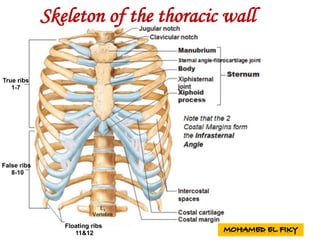
Floating ribs
11&12
True ribs
1-7
False ribs
8-10
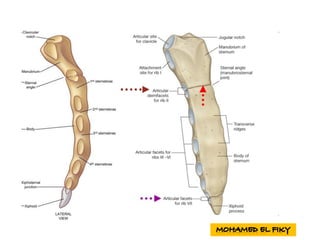
Skeleton of the thoracic wall
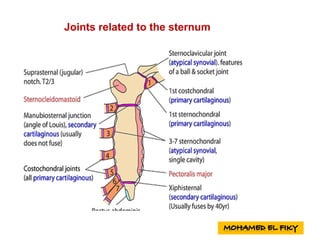
Joints related to the sternum
Superior thoracic aperture
Thoracic inlet
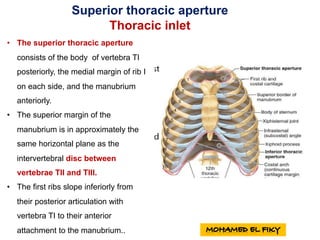
• The superior thoracic aperture
consists of the body of vertebra TI
posteriorly, the medial margin of rib I
on each side, and the manubrium
anteriorly.
• The superior margin of the
manubrium is in approximately the
same horizontal plane as the
intervertebral disc between
vertebrae TII and TIII.
• The first ribs slope inferiorly from
their posterior articulation with
vertebra TI to their anterior
attachment to the manubrium..
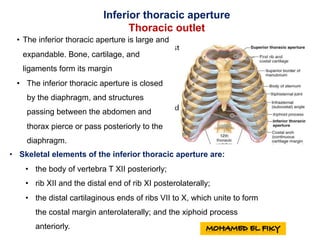
• The inferior thoracic aperture is large and
expandable. Bone, cartilage, and
ligaments form its margin
• The inferior thoracic aperture is closed
by the diaphragm, and structures
passing between the abdomen and
thorax pierce or pass posteriorly to the
diaphragm.
Inferior thoracic aperture
Thoracic outlet
• Skeletal elements of the inferior thoracic aperture are:
• the body of vertebra T XII posteriorly;
• rib XII and the distal end of rib XI posterolaterally;
• the distal cartilaginous ends of ribs VII to X, which unite to form
the costal margin anterolaterally; and the xiphoid process
anteriorly.
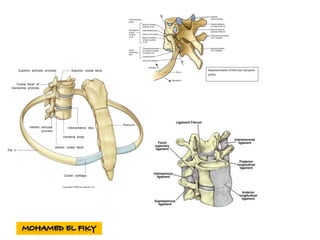
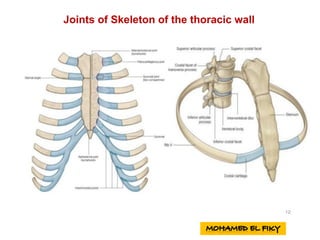
Joints of Skeleton of the thoracic wall
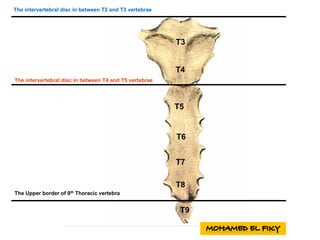
The intervertebral disc in between T2 and T3 vertebrae
The intervertebral disc in between T4 and T5 vertebrae
The Upper border of 9th
Thoracic vertebra
T3
T4
T5
T6
T7
T8
T9
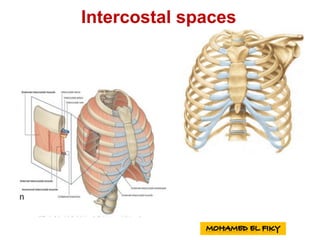
Intercostal spaces
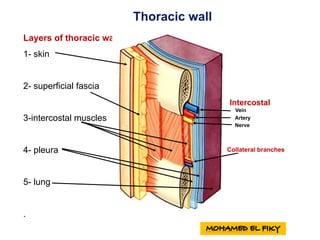
Thoracic wall
Layers of thoracic wall :
1- skin
2- superficial fascia
3-intercostal muscles
4- pleura
5- lung
.
Artery
Vein
Nerve
Intercostal
Collateral branches
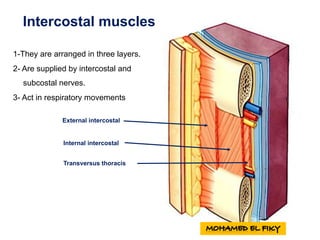
Intercostal muscles
1-They are arranged in three layers.
2- Are supplied by intercostal and
subcostal nerves.
3- Act in respiratory movements
External intercostal
Internal intercostal
Transversus thoracis
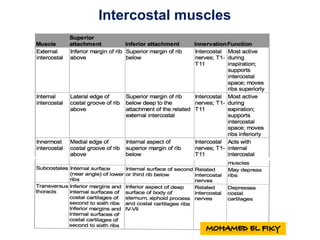
Intercostal muscles
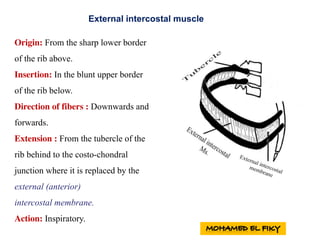
Origin: From the sharp lower border
of the rib above.
Insertion: In the blunt upper border
of the rib below.
Direction of fibers : Downwards and
forwards.
Extension : From the tubercle of the
rib behind to the costo-chondral
junction where it is replaced by the
external (anterior)
intercostal membrane.
Action: Inspiratory.
External intercostal muscle
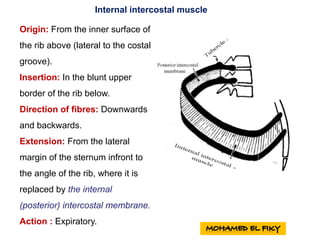
Internal intercostal muscle
Origin: From the inner surface of
the rib above (lateral to the costal
groove).
Insertion: In the blunt upper
border of the rib below.
Direction of fibres: Downwards
and backwards.
Extension: From the lateral
margin of the sternum infront to
the angle of the rib, where it is
replaced by the internal
(posterior) intercostal membrane.
Action : Expiratory.
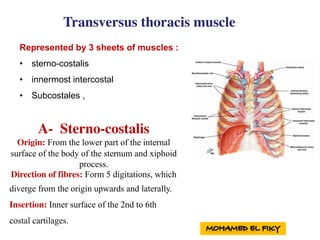
Transversus thoracis muscle
Represented by 3 sheets of muscles :
• sterno-costalis
• innermost intercostal
• Subcostales ,
A- Sterno-costalis
Origin: From the lower part of the internal
surface of the body of the sternum and xiphoid
process.
Direction of fibres: Form 5 digitations, which
diverge from the origin upwards and laterally.
Insertion: Inner surface of the 2nd to 6th
costal cartilages.
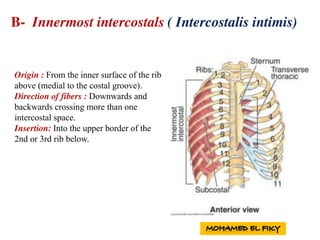
B- Innermost intercostals ( Intercostalis intimis)
Origin : From the inner surface of the rib
above (medial to the costal groove).
Direction of fibers : Downwards and
backwards crossing more than one
intercostal space.
Insertion: Into the upper border of the
2nd or 3rd rib below.
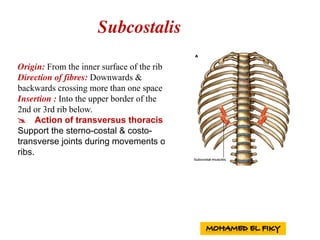
Subcostalis
Origin: From the inner surface of the rib
Direction of fibres: Downwards &
backwards crossing more than one space
Insertion : Into the upper border of the
2nd or 3rd rib below.
@ Action of transversus thoracis :
Support the sterno-costal & costo-
transverse joints during movements of
ribs.
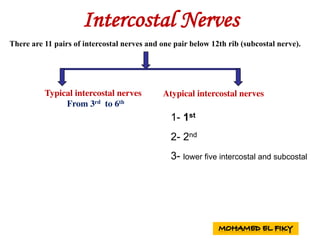
Intercostal Nerves
There are 11 pairs of intercostal nerves and one pair below 12th rib (subcostal nerve).
Typical intercostal nerves
From 3rd to 6th
Atypical intercostal nerves
1- 1st
2- 2nd
3- lower five intercostal and subcostal
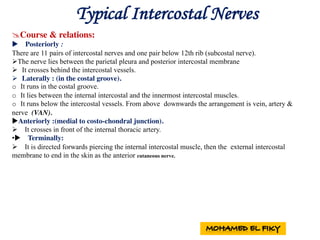
@Course & relations:
u Posteriorly : Intercostal nerves
There are 11 pairs of intercostal nerves and one pair below 12th rib (subcostal nerve).
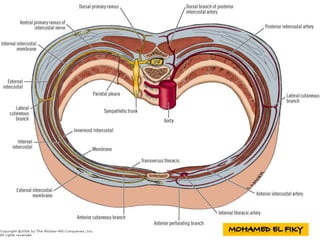
ØThe nerve lies between the parietal pleura and posterior intercostal membrane
Ø It crosses behind the intercostal vessels.
Ø Laterally : (in the costal groove).
o It runs in the costal groove.
o It lies between the internal intercostal and the innermost intercostal muscles.
o It runs below the intercostal vessels. From above downwards the arrangement is vein, artery &
nerve (VAN).
uAnteriorly :(medial to costo-chondral junction).
Ø It crosses in front of the internal thoracic artery.
•u Terminally:
Ø It is directed forwards piercing the internal intercostal muscle, then the external intercostal
membrane to end in the skin as the anterior cutaneous nerve.
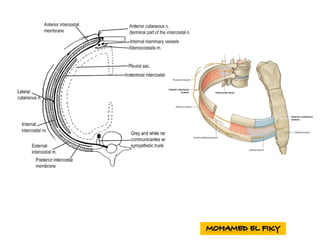
Typical Intercostal Nerves
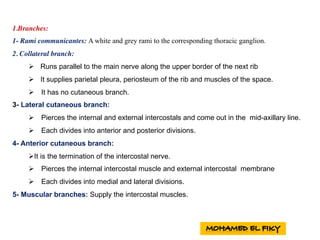
1.Branches:
1- Rami communicantes: A white and grey rami to the corresponding thoracic ganglion.
2. Collateral branch:
Ø Runs parallel to the main nerve along the upper border of the next rib
Ø It supplies parietal pleura, periosteum of the rib and muscles of the space.
Ø It has no cutaneous branch.
3- Lateral cutaneous branch:
Ø Pierces the internal and external intercostals and come out in the mid-axillary line.
Ø Each divides into anterior and posterior divisions.
4- Anterior cutaneous branch:
ØIt is the termination of the intercostal nerve.
Ø Pierces the internal intercostal muscle and external intercostal membrane
Ø Each divides into medial and lateral divisions.
5- Muscular branches: Supply the intercostal muscles.
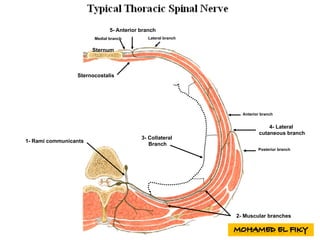
1- Rami communicants
2- Muscular branches
3- Collateral
Branch
4- Lateral
cutaneous branch
Anterior branch
Posterior branch
Sternocostalis
Sternum
5- Anterior branch
Lateral branchMedial branch
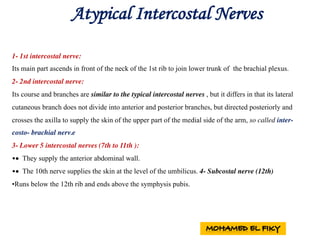
Atypical Intercostal Nerves
1- 1st intercostal nerve:
Its main part ascends in front of the neck of the 1st rib to join lower trunk of the brachial plexus.
2- 2nd intercostal nerve:
Its course and branches are similar to the typical intercostal nerves , but it differs in that its lateral
cutaneous branch does not divide into anterior and posterior branches, but directed posteriorly and
crosses the axilla to supply the skin of the upper part of the medial side of the arm, so called inter-
costo- brachial nerv.e
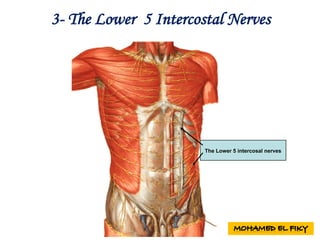
3- Lower 5 intercostal nerves (7th to 11th ):
•• They supply the anterior abdominal wall.
•• The 10th nerve supplies the skin at the level of the umbilicus. 4- Subcostal nerve (12th)
•Runs below the 12th rib and ends above the symphysis pubis.
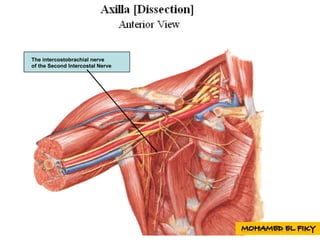
The intercostobrachial nerve
of the Second Intercostal Nerve
The Lower 5 intercosal nerves
3- The Lower 5 Intercostal Nerves
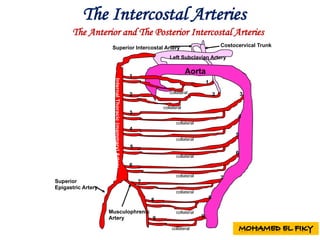
Aorta
Left Subclavian Artery
InternalThoracic(mammary)Artery
Costocervical TrunkSuperior Intercostal Artery
Superior
Epigastric Artery
Musculophrenic
Artery
1
2
3
4
5
6
7
8
9
1
2 3
4
5
6
7
8
9
collateral
collateral
collateral
collateral
collateral
collateral
collateral
collateral
collateral
The Anterior and The Posterior Intercostal Arteries
The Intercostal Arteries
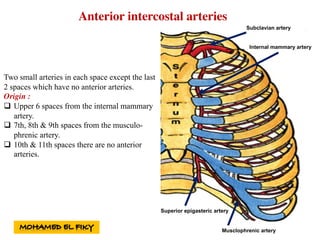
Two small arteries in each space except the last
2 spaces which have no anterior arteries.
Origin :
q Upper 6 spaces from the internal mammary
artery.
q 7th, 8th & 9th spaces from the musculo-
phrenic artery.
q 10th & 11th spaces there are no anterior
arteries.
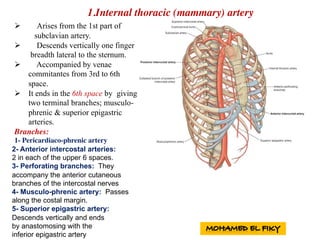
Anterior intercostal arteries
Subclavian artery
Internal mammary artery
Superior epigasteric artery
Musclophrenic artery
Ø Arises from the 1st part of
subclavian artery.
Ø Descends vertically one finger
breadth lateral to the sternum.
Ø Accompanied by venae
commitantes from 3rd to 6th
space.
Ø It ends in the 6th space by giving
two terminal branches; musculo-
phrenic & superior epigastric
arteries.
Branches:
1- Pericardiaco-phrenic artery
2- Anterior intercostal arteries:
2 in each of the upper 6 spaces.
3- Perforating branches: They
accompany the anterior cutaneous
branches of the intercostal nerves
4- Musculo-phrenic artery: Passes
along the costal margin.
5- Superior epigastric artery:
Descends vertically and ends
by anastomosing with the
inferior epigastric artery
1.Internal thoracic (mammary) artery
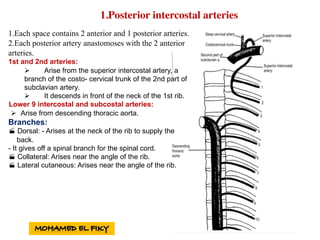
1.Posterior intercostal arteries
1.Each space contains 2 anterior and 1 posterior arteries.
2.Each posterior artery anastomoses with the 2 anterior
arteries.
1st and 2nd arteries:
Ø Arise from the superior intercostal artery, a
branch of the costo- cervical trunk of the 2nd part of
subclavian artery.
Ø It descends in front of the neck of the 1st rib.
Lower 9 intercostal and subcostal arteries:
Ø Arise from descending thoracic aorta.
Branches:
· Dorsal: - Arises at the neck of the rib to supply the
back.
- It gives off a spinal branch for the spinal cord.
· Collateral: Arises near the angle of the rib.
· Lateral cutaneous: Arises near the angle of the rib.
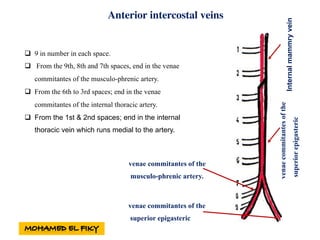
q 9 in number in each space.
q From the 9th, 8th and 7th spaces, end in the venae
commitantes of the musculo-phrenic artery.
q From the 6th to 3rd spaces; end in the venae
commitantes of the internal thoracic artery.
q From the 1st & 2nd spaces; end in the internal
thoracic vein which runs medial to the artery.
Anterior intercostal veins
venae commitantes of the
musculo-phrenic artery.
venae commitantes of the
superior epigasteric
venaecommitantesofthe
superiorepigasteric
Internalmammryvein
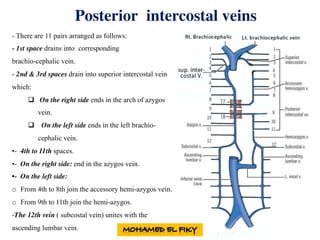
Posterior intercostal veins
- There are 11 pairs arranged as follows:
- 1st space drains into corresponding
brachio-cephalic vein.
- 2nd & 3rd spaces drain into superior intercostal vein
which:
q On the right side ends in the arch of azygos
vein.
q On the left side ends in the left brachio-
cephalic vein.
•- 4th to 11th spaces.
•- On the right side: end in the azygos vein.
•- On the left side:
o From 4th to 8th join the accessory hemi-azygos vein.
o From 9th to 11th join the hemi-azygos.
-The 12th vein ( subcostal vein) unites with the
ascending lumbar vein.
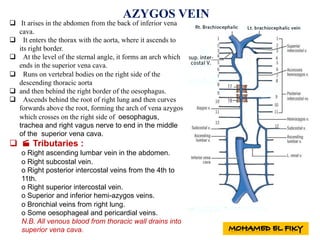
AZYGOS VEIN
q It arises in the abdomen from the back of inferior vena
cava.
q It enters the thorax with the aorta, where it ascends to
its right border.
q At the level of the sternal angle, it forms an arch which
ends in the superior vena cava.
q Runs on vertebral bodies on the right side of the
descending thoracic aorta
q and then behind the right border of the oesophagus.
q Ascends behind the root of right lung and then curves
forwards above the root, forming the arch of vena azygos
which crosses on the right side of oesophagus,
trachea and right vagus nerve to end in the middle
of the superior vena cava.
q · Tributaries :
o Right ascending lumbar vein in the abdomen.
o Right subcostal vein.
o Right posterior intercostal veins from the 4th to
11th.
o Right superior intercostal vein.
o Superior and inferior hemi-azygos veins.
o Bronchial veins from right lung.
o Some oesophageal and pericardial veins.
N.B. All venous blood from thoracic wall drains into
superior vena cava.
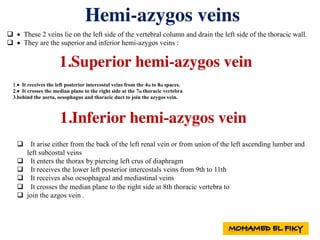
Hemi-azygos veins
q • These 2 veins lie on the left side of the vertebral column and drain the left side of the thoracic wall.
q • They are the superior and inferior hemi-azygos veins :
1.• It receives the left posterior intercostal veins from the 4th to 8th spaces.
2.• It crosses the median plane to the right side at the 7th thoracic vertebra
3.behind the aorta, oesophagus and thoracic duct to join the azygos vein.
1.Superior hemi-azygos vein
1.Inferior hemi-azygos vein
q It arise either from the back of the left renal vein or from union of the left ascending lumber and
left subcostal veins
q It enters the thorax by piercing left crus of diaphragm
q It receives the lower left posterior intercostals veins from 9th to 11th
q It receives also oesophageal and mediastinal veins
q It crosses the median plane to the right side at 8th thoracic vertebra to
q join the azgos vein .
Thank You
Dr. Fiky Thorax

Thoracic wall

  • 1.
    Intercostal space Dr. MohamedEl fiky Professor of anatomy and embryology
  • 2.
    Floating ribs 11&12 True ribs 1-7 Falseribs 8-10 Skeleton of the thoracic wall
  • 4.
    Joints related tothe sternum
  • 6.
    Superior thoracic aperture Thoracicinlet • The superior thoracic aperture consists of the body of vertebra TI posteriorly, the medial margin of rib I on each side, and the manubrium anteriorly. • The superior margin of the manubrium is in approximately the same horizontal plane as the intervertebral disc between vertebrae TII and TIII. • The first ribs slope inferiorly from their posterior articulation with vertebra TI to their anterior attachment to the manubrium..
  • 7.
    • The inferiorthoracic aperture is large and expandable. Bone, cartilage, and ligaments form its margin • The inferior thoracic aperture is closed by the diaphragm, and structures passing between the abdomen and thorax pierce or pass posteriorly to the diaphragm. Inferior thoracic aperture Thoracic outlet • Skeletal elements of the inferior thoracic aperture are: • the body of vertebra T XII posteriorly; • rib XII and the distal end of rib XI posterolaterally; • the distal cartilaginous ends of ribs VII to X, which unite to form the costal margin anterolaterally; and the xiphoid process anteriorly.
  • 8.
    Joints of Skeletonof the thoracic wall
  • 9.
    The intervertebral discin between T2 and T3 vertebrae The intervertebral disc in between T4 and T5 vertebrae The Upper border of 9th Thoracic vertebra T3 T4 T5 T6 T7 T8 T9
  • 10.
  • 11.
    Thoracic wall Layers ofthoracic wall : 1- skin 2- superficial fascia 3-intercostal muscles 4- pleura 5- lung . Artery Vein Nerve Intercostal Collateral branches
  • 12.
    Intercostal muscles 1-They arearranged in three layers. 2- Are supplied by intercostal and subcostal nerves. 3- Act in respiratory movements External intercostal Internal intercostal Transversus thoracis
  • 13.
  • 14.
    Origin: From thesharp lower border of the rib above. Insertion: In the blunt upper border of the rib below. Direction of fibers : Downwards and forwards. Extension : From the tubercle of the rib behind to the costo-chondral junction where it is replaced by the external (anterior) intercostal membrane. Action: Inspiratory. External intercostal muscle
  • 15.
    Internal intercostal muscle Origin:From the inner surface of the rib above (lateral to the costal groove). Insertion: In the blunt upper border of the rib below. Direction of fibres: Downwards and backwards. Extension: From the lateral margin of the sternum infront to the angle of the rib, where it is replaced by the internal (posterior) intercostal membrane. Action : Expiratory.
  • 16.
    Transversus thoracis muscle Representedby 3 sheets of muscles : • sterno-costalis • innermost intercostal • Subcostales , A- Sterno-costalis Origin: From the lower part of the internal surface of the body of the sternum and xiphoid process. Direction of fibres: Form 5 digitations, which diverge from the origin upwards and laterally. Insertion: Inner surface of the 2nd to 6th costal cartilages.
  • 17.
    B- Innermost intercostals( Intercostalis intimis) Origin : From the inner surface of the rib above (medial to the costal groove). Direction of fibers : Downwards and backwards crossing more than one intercostal space. Insertion: Into the upper border of the 2nd or 3rd rib below.
  • 18.
    Subcostalis Origin: From theinner surface of the rib Direction of fibres: Downwards & backwards crossing more than one space Insertion : Into the upper border of the 2nd or 3rd rib below. @ Action of transversus thoracis : Support the sterno-costal & costo- transverse joints during movements of ribs.
  • 19.
    Intercostal Nerves There are11 pairs of intercostal nerves and one pair below 12th rib (subcostal nerve). Typical intercostal nerves From 3rd to 6th Atypical intercostal nerves 1- 1st 2- 2nd 3- lower five intercostal and subcostal
  • 20.
    @Course & relations: uPosteriorly : Intercostal nerves There are 11 pairs of intercostal nerves and one pair below 12th rib (subcostal nerve). ØThe nerve lies between the parietal pleura and posterior intercostal membrane Ø It crosses behind the intercostal vessels. Ø Laterally : (in the costal groove). o It runs in the costal groove. o It lies between the internal intercostal and the innermost intercostal muscles. o It runs below the intercostal vessels. From above downwards the arrangement is vein, artery & nerve (VAN). uAnteriorly :(medial to costo-chondral junction). Ø It crosses in front of the internal thoracic artery. •u Terminally: Ø It is directed forwards piercing the internal intercostal muscle, then the external intercostal membrane to end in the skin as the anterior cutaneous nerve. Typical Intercostal Nerves
  • 22.
    1.Branches: 1- Rami communicantes:A white and grey rami to the corresponding thoracic ganglion. 2. Collateral branch: Ø Runs parallel to the main nerve along the upper border of the next rib Ø It supplies parietal pleura, periosteum of the rib and muscles of the space. Ø It has no cutaneous branch. 3- Lateral cutaneous branch: Ø Pierces the internal and external intercostals and come out in the mid-axillary line. Ø Each divides into anterior and posterior divisions. 4- Anterior cutaneous branch: ØIt is the termination of the intercostal nerve. Ø Pierces the internal intercostal muscle and external intercostal membrane Ø Each divides into medial and lateral divisions. 5- Muscular branches: Supply the intercostal muscles.
  • 23.
    1- Rami communicants 2-Muscular branches 3- Collateral Branch 4- Lateral cutaneous branch Anterior branch Posterior branch Sternocostalis Sternum 5- Anterior branch Lateral branchMedial branch
  • 24.
    Atypical Intercostal Nerves 1-1st intercostal nerve: Its main part ascends in front of the neck of the 1st rib to join lower trunk of the brachial plexus. 2- 2nd intercostal nerve: Its course and branches are similar to the typical intercostal nerves , but it differs in that its lateral cutaneous branch does not divide into anterior and posterior branches, but directed posteriorly and crosses the axilla to supply the skin of the upper part of the medial side of the arm, so called inter- costo- brachial nerv.e 3- Lower 5 intercostal nerves (7th to 11th ): •• They supply the anterior abdominal wall. •• The 10th nerve supplies the skin at the level of the umbilicus. 4- Subcostal nerve (12th) •Runs below the 12th rib and ends above the symphysis pubis.
  • 25.
    The intercostobrachial nerve ofthe Second Intercostal Nerve
  • 26.
    The Lower 5intercosal nerves 3- The Lower 5 Intercostal Nerves
  • 27.
    Aorta Left Subclavian Artery InternalThoracic(mammary)Artery CostocervicalTrunkSuperior Intercostal Artery Superior Epigastric Artery Musculophrenic Artery 1 2 3 4 5 6 7 8 9 1 2 3 4 5 6 7 8 9 collateral collateral collateral collateral collateral collateral collateral collateral collateral The Anterior and The Posterior Intercostal Arteries The Intercostal Arteries
  • 29.
    Two small arteriesin each space except the last 2 spaces which have no anterior arteries. Origin : q Upper 6 spaces from the internal mammary artery. q 7th, 8th & 9th spaces from the musculo- phrenic artery. q 10th & 11th spaces there are no anterior arteries. Anterior intercostal arteries Subclavian artery Internal mammary artery Superior epigasteric artery Musclophrenic artery
  • 30.
    Ø Arises fromthe 1st part of subclavian artery. Ø Descends vertically one finger breadth lateral to the sternum. Ø Accompanied by venae commitantes from 3rd to 6th space. Ø It ends in the 6th space by giving two terminal branches; musculo- phrenic & superior epigastric arteries. Branches: 1- Pericardiaco-phrenic artery 2- Anterior intercostal arteries: 2 in each of the upper 6 spaces. 3- Perforating branches: They accompany the anterior cutaneous branches of the intercostal nerves 4- Musculo-phrenic artery: Passes along the costal margin. 5- Superior epigastric artery: Descends vertically and ends by anastomosing with the inferior epigastric artery 1.Internal thoracic (mammary) artery
  • 31.
    1.Posterior intercostal arteries 1.Eachspace contains 2 anterior and 1 posterior arteries. 2.Each posterior artery anastomoses with the 2 anterior arteries. 1st and 2nd arteries: Ø Arise from the superior intercostal artery, a branch of the costo- cervical trunk of the 2nd part of subclavian artery. Ø It descends in front of the neck of the 1st rib. Lower 9 intercostal and subcostal arteries: Ø Arise from descending thoracic aorta. Branches: · Dorsal: - Arises at the neck of the rib to supply the back. - It gives off a spinal branch for the spinal cord. · Collateral: Arises near the angle of the rib. · Lateral cutaneous: Arises near the angle of the rib.
  • 32.
    q 9 innumber in each space. q From the 9th, 8th and 7th spaces, end in the venae commitantes of the musculo-phrenic artery. q From the 6th to 3rd spaces; end in the venae commitantes of the internal thoracic artery. q From the 1st & 2nd spaces; end in the internal thoracic vein which runs medial to the artery. Anterior intercostal veins venae commitantes of the musculo-phrenic artery. venae commitantes of the superior epigasteric venaecommitantesofthe superiorepigasteric Internalmammryvein
  • 33.
    Posterior intercostal veins -There are 11 pairs arranged as follows: - 1st space drains into corresponding brachio-cephalic vein. - 2nd & 3rd spaces drain into superior intercostal vein which: q On the right side ends in the arch of azygos vein. q On the left side ends in the left brachio- cephalic vein. •- 4th to 11th spaces. •- On the right side: end in the azygos vein. •- On the left side: o From 4th to 8th join the accessory hemi-azygos vein. o From 9th to 11th join the hemi-azygos. -The 12th vein ( subcostal vein) unites with the ascending lumbar vein.
  • 34.
    AZYGOS VEIN q Itarises in the abdomen from the back of inferior vena cava. q It enters the thorax with the aorta, where it ascends to its right border. q At the level of the sternal angle, it forms an arch which ends in the superior vena cava. q Runs on vertebral bodies on the right side of the descending thoracic aorta q and then behind the right border of the oesophagus. q Ascends behind the root of right lung and then curves forwards above the root, forming the arch of vena azygos which crosses on the right side of oesophagus, trachea and right vagus nerve to end in the middle of the superior vena cava. q · Tributaries : o Right ascending lumbar vein in the abdomen. o Right subcostal vein. o Right posterior intercostal veins from the 4th to 11th. o Right superior intercostal vein. o Superior and inferior hemi-azygos veins. o Bronchial veins from right lung. o Some oesophageal and pericardial veins. N.B. All venous blood from thoracic wall drains into superior vena cava.
  • 35.
    Hemi-azygos veins q •These 2 veins lie on the left side of the vertebral column and drain the left side of the thoracic wall. q • They are the superior and inferior hemi-azygos veins : 1.• It receives the left posterior intercostal veins from the 4th to 8th spaces. 2.• It crosses the median plane to the right side at the 7th thoracic vertebra 3.behind the aorta, oesophagus and thoracic duct to join the azygos vein. 1.Superior hemi-azygos vein 1.Inferior hemi-azygos vein q It arise either from the back of the left renal vein or from union of the left ascending lumber and left subcostal veins q It enters the thorax by piercing left crus of diaphragm q It receives the lower left posterior intercostals veins from 9th to 11th q It receives also oesophageal and mediastinal veins q It crosses the median plane to the right side at 8th thoracic vertebra to q join the azgos vein .
  • 36.