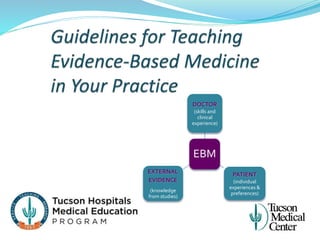
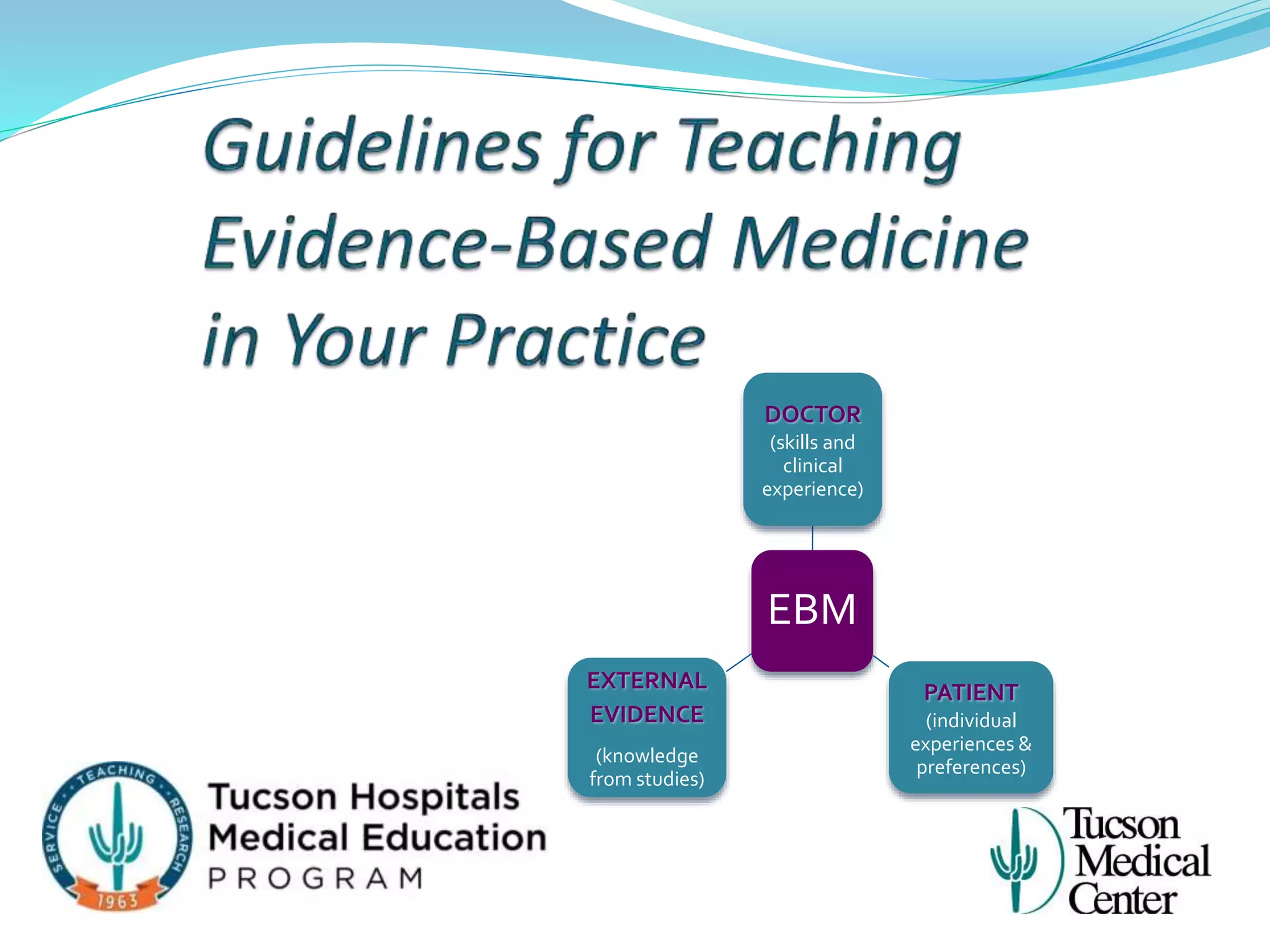
EBM
DOCTOR
(skills and
clinical
experience)
PATIENT
(individual
experiences &
preferences)
EXTERNAL
EVIDENCE
(knowledge
from studies)
Know
Do
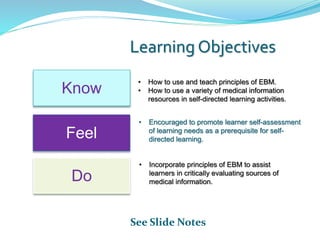
Learning Objectives
• How to use and teach principles of EBM.
• How to use a variety of medical information
resources in self-directed learning activities.
• Encouraged to promote learner self-assessment
of learning needs as a prerequisite for self-
directed learning.
• Incorporate principles of EBM to assist
learners in critically evaluating sources of
medical information.
See Slide Notes
Feel
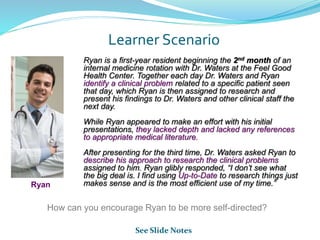
Learner Scenario
Ryan is a first-year resident beginning the 2nd month of an
internal medicine rotation with Dr. Waters at the Feel Good
Health Center. Together each day Dr. Waters and Ryan
identify a clinical problem related to a specific patient seen
that day, which Ryan is then assigned to research and
present his findings to Dr. Waters and other clinical staff the
next day.
While Ryan appeared to make an effort with his initial
presentations, they lacked depth and lacked any references
to appropriate medical literature.
After presenting for the third time, Dr. Waters asked Ryan to
describe his approach to research the clinical problems
assigned to him. Ryan glibly responded, “I don’t see what
the big deal is. I find using Up-to-Date to research things just
makes sense and is the most efficient use of my time.”Ryan
How can you encourage Ryan to be more self-directed?
See Slide Notes
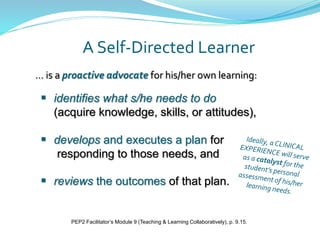
A Self-Directed Learner
 identifies what s/he needs to do
(acquire knowledge, skills, or attitudes),
 develops and executes a plan for
responding to those needs, and
 reviews the outcomes of that plan.
… is a proactive advocate for his/her own learning:
PEP2 Facilitator’s Module 9 (Teaching & Learning Collaboratively), p. 9.15.
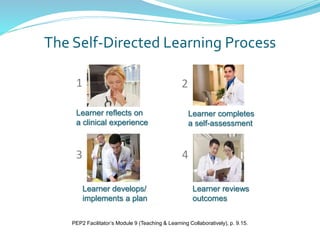
The Self-Directed Learning Process
1 2
43
Learner reflects on
a clinical experience
Learner completes
a self-assessment
Learner develops/
implements a plan
Learner reviews
outcomes
PEP2 Facilitator’s Module 9 (Teaching & Learning Collaboratively), p. 9.15.
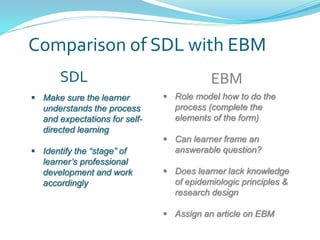
Comparison of SDL with EBM
 Make sure the learner
understands the process
and expectations for self-
directed learning
 Identify the “stage” of
learner’s professional
development and work
accordingly
 Role model how to do the
process (complete the
elements of the form)
 Can learner frame an
answerable question?
 Does learner lack knowledge
of epidemiologic principles &
research design
 Assign an article on EBM
SDL EBM
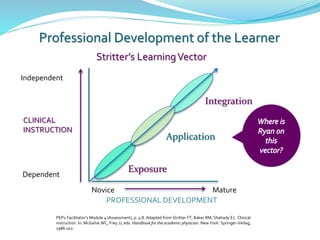
Professional Development of the Learner
Exposure
Application
Integration
Novice Mature
PROFESSIONAL DEVELOPMENT
Stritter’s LearningVector
Independent
CLINICAL
INSTRUCTION
Dependent
PEP2 Facilitator’s Module 4 (Assessment), p. 4.8. Adapted from Stritter FT, Baker RM, Shahady EJ. Clinical
instruction. In: McGahie WC, Frey JJ, eds. Handbook for the academic physician. New York: Springer-Verlag,
1986:102.
How do Roles ofTrainee
and Preceptor Change in SDL?
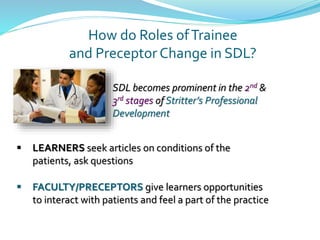
 LEARNERS seek articles on conditions of the
patients, ask questions
 FACULTY/PRECEPTORS give learners opportunities
to interact with patients and feel a part of the practice
SDL becomes prominent in the 2nd &
3rd stages of Stritter’s Professional
Development
SDL Activities for Learners
 Use Clinical Guidelines
(e.g., Asthma, COPD, Coronary Artery Disease, Diabetes, Heart
Failure)
 Understand Principles of Efficient
Resource Utilization
 Develop Skills in Patient Education
PEP2 Facilitator’s Module 9 (Teaching & Learning Collaboratively), p. 9.19.
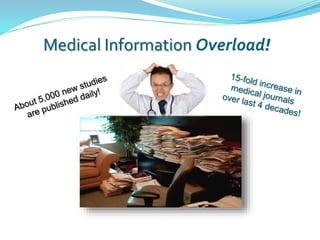
Medical Information Overload!
What strategies do
you use to keep current
with medical
knowledge and clinical
practices?
Do you teach this to your learners?
What is Evidence-based Medicine?
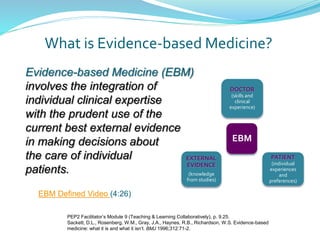
Evidence-based Medicine (EBM)
involves the integration of
individual clinical expertise
with the prudent use of the
current best external evidence
in making decisions about
the care of individual
patients.
EBM
DOCTOR
(skills and
clinical
experience)
PATIENT
(individual
experiences
and
preferences)
EXTERNAL
EVIDENCE
(knowledge
from studies)
PEP2 Facilitator’s Module 9 (Teaching & Learning Collaboratively), p. 9.25.
Sackett, D.L., Rosenberg, W.M., Gray, J.A., Haynes, R.B., Richardson, W.S. Evidence-based
medicine: what it is and what it isn’t. BMJ 1996;312:71-2.
EBM Defined Video (4:26)
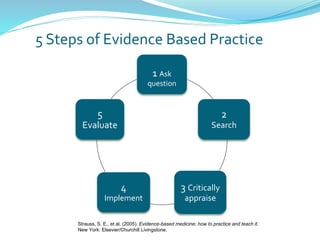
1 Ask
question
2
Search
3 Critically
appraise
4
Implement
5
Evaluate
5 Steps of Evidence Based Practice
Strauss, S. E., et al, (2005). Evidence-based medicine: how to practice and teach it.
New York: Elsevier/Churchill Livingstone.
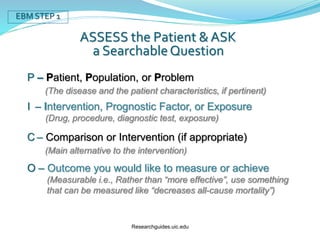
EBM STEP 1
ASSESS the Patient & ASK
a SearchableQuestion
P – Patient, Population, or Problem
(The disease and the patient characteristics, if pertinent)
I – Intervention, Prognostic Factor, or Exposure
(Drug, procedure, diagnostic test, exposure)
C – Comparison or Intervention (if appropriate)
(Main alternative to the intervention)
O – Outcome you would like to measure or achieve
(Measurable i.e., Rather than “more effective”, use something
that can be measured like “decreases all-cause mortality”)
Researchguides.uic.edu
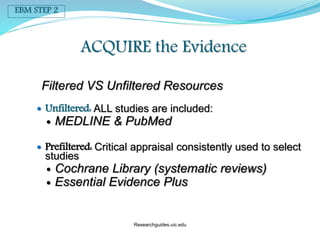
Filtered VS Unfiltered Resources
 Unfiltered: ALL studies are included:
 MEDLINE & PubMed
 Prefiltered: Critical appraisal consistently used to select
studies
 Cochrane Library (systematic reviews)
 Essential Evidence Plus
ACQUIRE the Evidence
EBM STEP 2
Researchguides.uic.edu
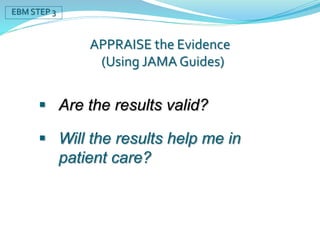
APPRAISE the Evidence
(Using JAMA Guides)
EBM STEP 3
 Are the results valid?
 Will the results help me in
patient care?
EBM STEPs 4-5
EMB Step 4: APPLY the
Evidence
EBM Step 5: ASSESS the
Outcome;
Communication
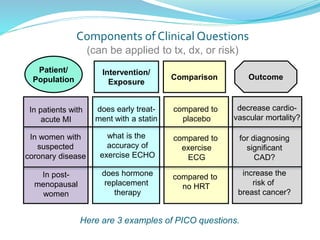
Patient/
Population Outcome
Intervention/
Exposure
Comparison
In patients with
acute MI
In post-
menopausal
women
In women with
suspected
coronary disease
does early treat-
ment with a statin
what is the
accuracy of
exercise ECHO
does hormone
replacement
therapy
compared to
placebo
compared to
exercise
ECG
compared to
no HRT
decrease cardio-
vascular mortality?
for diagnosing
significant
CAD?
increase the
risk of
breast cancer?
Components of Clinical Questions
(can be applied to tx, dx, or risk)
Here are 3 examples of PICO questions.
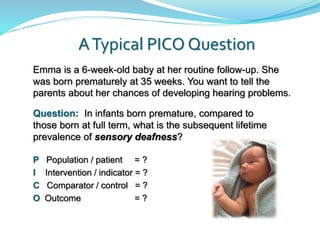
ATypical PICO Question
P Population / patient = ?
I Intervention / indicator = ?
C Comparator / control = ?
O Outcome = ?
Emma is a 6-week-old baby at her routine follow-up. She
was born prematurely at 35 weeks. You want to tell the
parents about her chances of developing hearing problems.
Question: In infants born premature, compared to
those born at full term, what is the subsequent lifetime
prevalence of sensory deafness?
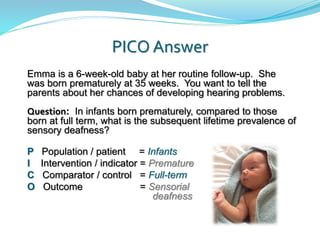
PICO Answer
Emma is a 6-week-old baby at her routine follow-up. She
was born prematurely at 35 weeks. You want to tell the
parents about her chances of developing hearing problems.
Question: In infants born prematurely, compared to those
born at full term, what is the subsequent lifetime prevalence of
sensory deafness?
P Population / patient = Infants
I Intervention / indicator = Premature
C Comparator / control = Full-term
O Outcome = Sensorial
deafness
Nonadherence to practice guidelines
remains the major barrier to successful
practice of EBM.
Major Barrier to Practice EBM?
Timmermans, S., & Mauck, A. (2005). The Promises and Pitfalls
of Evidence-Based Medicine. Health Affairs, 24(1):18-28.
Select at least one of the ideas
shared about EBM to implement.
What will you keep the same?
What will you do more of?
What will you do less of?
What will you stop doing?
What will you do differently & how will you do it?
What will you add?
LEARN – REFLECT -TEACH

Guidelines for Teaching Evidence-Based Medicine in Your Practice

  • 1.
  • 2.
    Know Do Learning Objectives • Howto use and teach principles of EBM. • How to use a variety of medical information resources in self-directed learning activities. • Encouraged to promote learner self-assessment of learning needs as a prerequisite for self- directed learning. • Incorporate principles of EBM to assist learners in critically evaluating sources of medical information. See Slide Notes Feel
  • 3.
    Learner Scenario Ryan isa first-year resident beginning the 2nd month of an internal medicine rotation with Dr. Waters at the Feel Good Health Center. Together each day Dr. Waters and Ryan identify a clinical problem related to a specific patient seen that day, which Ryan is then assigned to research and present his findings to Dr. Waters and other clinical staff the next day. While Ryan appeared to make an effort with his initial presentations, they lacked depth and lacked any references to appropriate medical literature. After presenting for the third time, Dr. Waters asked Ryan to describe his approach to research the clinical problems assigned to him. Ryan glibly responded, “I don’t see what the big deal is. I find using Up-to-Date to research things just makes sense and is the most efficient use of my time.”Ryan How can you encourage Ryan to be more self-directed? See Slide Notes
  • 4.
    A Self-Directed Learner identifies what s/he needs to do (acquire knowledge, skills, or attitudes),  develops and executes a plan for responding to those needs, and  reviews the outcomes of that plan. … is a proactive advocate for his/her own learning: PEP2 Facilitator’s Module 9 (Teaching & Learning Collaboratively), p. 9.15.
  • 5.
    The Self-Directed LearningProcess 1 2 43 Learner reflects on a clinical experience Learner completes a self-assessment Learner develops/ implements a plan Learner reviews outcomes PEP2 Facilitator’s Module 9 (Teaching & Learning Collaboratively), p. 9.15.
  • 6.
    Comparison of SDLwith EBM  Make sure the learner understands the process and expectations for self- directed learning  Identify the “stage” of learner’s professional development and work accordingly  Role model how to do the process (complete the elements of the form)  Can learner frame an answerable question?  Does learner lack knowledge of epidemiologic principles & research design  Assign an article on EBM SDL EBM
  • 7.
    Professional Development ofthe Learner Exposure Application Integration Novice Mature PROFESSIONAL DEVELOPMENT Stritter’s LearningVector Independent CLINICAL INSTRUCTION Dependent PEP2 Facilitator’s Module 4 (Assessment), p. 4.8. Adapted from Stritter FT, Baker RM, Shahady EJ. Clinical instruction. In: McGahie WC, Frey JJ, eds. Handbook for the academic physician. New York: Springer-Verlag, 1986:102.
  • 8.
    How do RolesofTrainee and Preceptor Change in SDL?  LEARNERS seek articles on conditions of the patients, ask questions  FACULTY/PRECEPTORS give learners opportunities to interact with patients and feel a part of the practice SDL becomes prominent in the 2nd & 3rd stages of Stritter’s Professional Development
  • 9.
    SDL Activities forLearners  Use Clinical Guidelines (e.g., Asthma, COPD, Coronary Artery Disease, Diabetes, Heart Failure)  Understand Principles of Efficient Resource Utilization  Develop Skills in Patient Education PEP2 Facilitator’s Module 9 (Teaching & Learning Collaboratively), p. 9.19.
  • 10.
  • 11.
    What strategies do youuse to keep current with medical knowledge and clinical practices? Do you teach this to your learners?
  • 12.
    What is Evidence-basedMedicine? Evidence-based Medicine (EBM) involves the integration of individual clinical expertise with the prudent use of the current best external evidence in making decisions about the care of individual patients. EBM DOCTOR (skills and clinical experience) PATIENT (individual experiences and preferences) EXTERNAL EVIDENCE (knowledge from studies) PEP2 Facilitator’s Module 9 (Teaching & Learning Collaboratively), p. 9.25. Sackett, D.L., Rosenberg, W.M., Gray, J.A., Haynes, R.B., Richardson, W.S. Evidence-based medicine: what it is and what it isn’t. BMJ 1996;312:71-2. EBM Defined Video (4:26)
  • 13.
    1 Ask question 2 Search 3 Critically appraise 4 Implement 5 Evaluate 5Steps of Evidence Based Practice Strauss, S. E., et al, (2005). Evidence-based medicine: how to practice and teach it. New York: Elsevier/Churchill Livingstone.
  • 14.
    EBM STEP 1 ASSESSthe Patient & ASK a SearchableQuestion P – Patient, Population, or Problem (The disease and the patient characteristics, if pertinent) I – Intervention, Prognostic Factor, or Exposure (Drug, procedure, diagnostic test, exposure) C – Comparison or Intervention (if appropriate) (Main alternative to the intervention) O – Outcome you would like to measure or achieve (Measurable i.e., Rather than “more effective”, use something that can be measured like “decreases all-cause mortality”) Researchguides.uic.edu
  • 15.
    Filtered VS UnfilteredResources  Unfiltered: ALL studies are included:  MEDLINE & PubMed  Prefiltered: Critical appraisal consistently used to select studies  Cochrane Library (systematic reviews)  Essential Evidence Plus ACQUIRE the Evidence EBM STEP 2 Researchguides.uic.edu
  • 16.
    APPRAISE the Evidence (UsingJAMA Guides) EBM STEP 3  Are the results valid?  Will the results help me in patient care?
  • 17.
    EBM STEPs 4-5 EMBStep 4: APPLY the Evidence EBM Step 5: ASSESS the Outcome; Communication
  • 18.
    Patient/ Population Outcome Intervention/ Exposure Comparison In patientswith acute MI In post- menopausal women In women with suspected coronary disease does early treat- ment with a statin what is the accuracy of exercise ECHO does hormone replacement therapy compared to placebo compared to exercise ECG compared to no HRT decrease cardio- vascular mortality? for diagnosing significant CAD? increase the risk of breast cancer? Components of Clinical Questions (can be applied to tx, dx, or risk) Here are 3 examples of PICO questions.
  • 19.
    ATypical PICO Question PPopulation / patient = ? I Intervention / indicator = ? C Comparator / control = ? O Outcome = ? Emma is a 6-week-old baby at her routine follow-up. She was born prematurely at 35 weeks. You want to tell the parents about her chances of developing hearing problems. Question: In infants born premature, compared to those born at full term, what is the subsequent lifetime prevalence of sensory deafness?
  • 20.
    PICO Answer Emma isa 6-week-old baby at her routine follow-up. She was born prematurely at 35 weeks. You want to tell the parents about her chances of developing hearing problems. Question: In infants born prematurely, compared to those born at full term, what is the subsequent lifetime prevalence of sensory deafness? P Population / patient = Infants I Intervention / indicator = Premature C Comparator / control = Full-term O Outcome = Sensorial deafness
  • 21.
    Nonadherence to practiceguidelines remains the major barrier to successful practice of EBM. Major Barrier to Practice EBM? Timmermans, S., & Mauck, A. (2005). The Promises and Pitfalls of Evidence-Based Medicine. Health Affairs, 24(1):18-28.
  • 22.
    Select at leastone of the ideas shared about EBM to implement.
  • 23.
    What will youkeep the same? What will you do more of? What will you do less of? What will you stop doing? What will you do differently & how will you do it? What will you add? LEARN – REFLECT -TEACH