Know
Learning Objectives
• Define Glassick’s six elements of scholarship.
• Compare and contrast scholarly teaching with
the scholarship of teaching and learning (SoTL).
• Describe different types of educational
scholarship.
• Feel comfortable with doing scholarly
teaching.
Feel
Do
• Apply elements of educational scholarship
to your work.
You Can Engage in the Scholarship of
Teaching & Learning (SoTL)
1. Do you have an idea for a research project?
2. Do you have some idea how to approach
this research?
3. Do you have a data collection and research
plan in mind?
SoTL = Scholarship of Teaching & Learning
We Are AllTeachers
We Ask Questions
About HowWe
Are Doing
And HowWe Can Do
Better
SoTL Helps to
AnswerThose
Questions
And Creates
UnderstandingAbout
Teaching and
Learning for
Everyone
Many of Us Are ScholarlyTeachers…
What and HowWeTeach is Informed
by the Scholarship of Others
AREA Is an ACTIVITY
When…
Is SCHOLARSHIP
When…
Clinical Care andTreatment ProvidingTreatment to
Patients
Teaching, publishing or
presenting procedures to or
for other clinicians
Teaching Teaching andAssessing
Students
Teaching OtherTeachers to
Teach andAssess
Outreach Telling theCommunity
About Services
Informing Others How to
Design, Implement,
EvaluateThose Services
Research Perform RCTs or Other
Experiments
Inform Other Researchers
of the Results
Source: Adapted from Morahan, 2008.
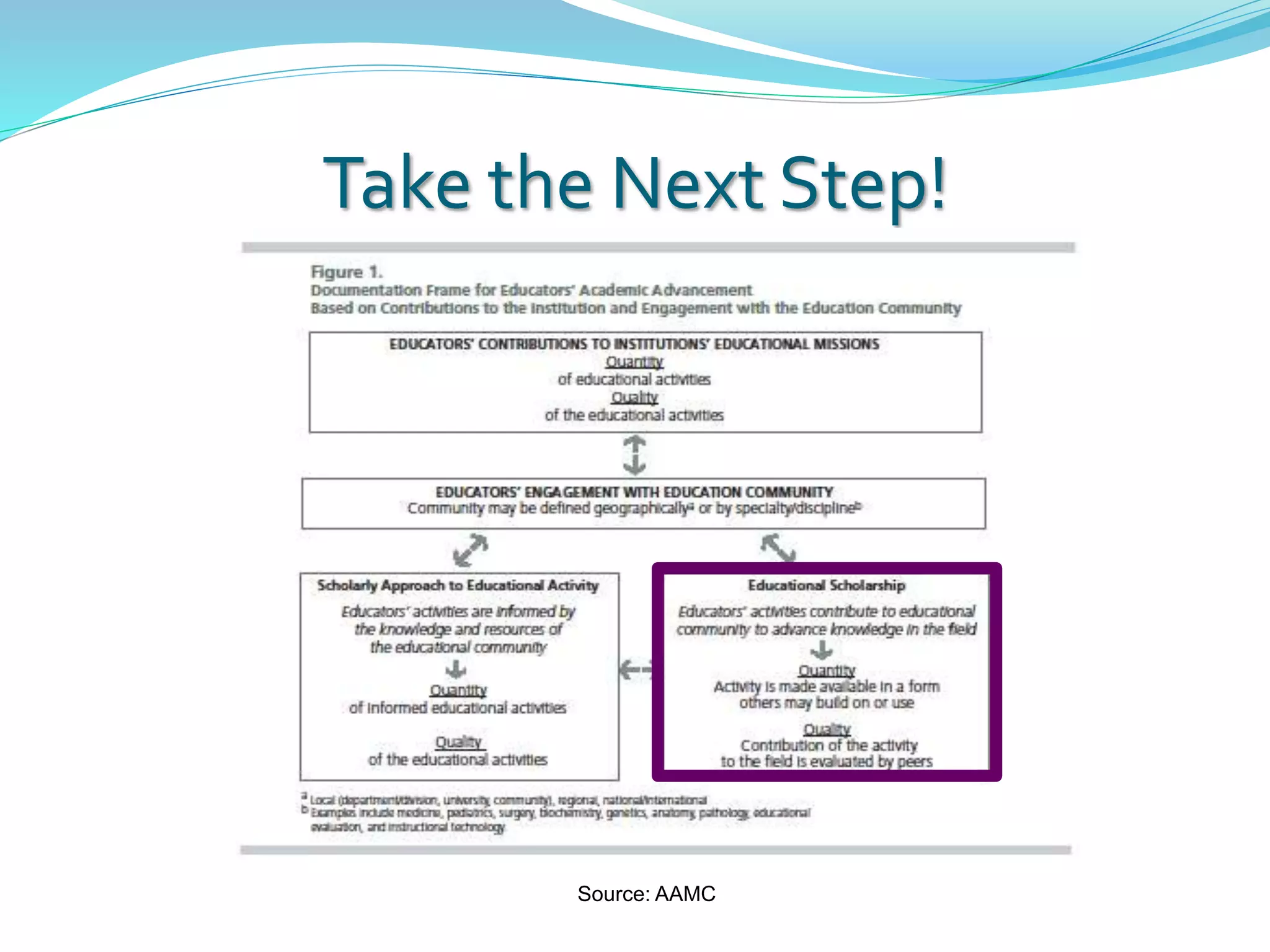
Take the Next Step!
Source: AAMC
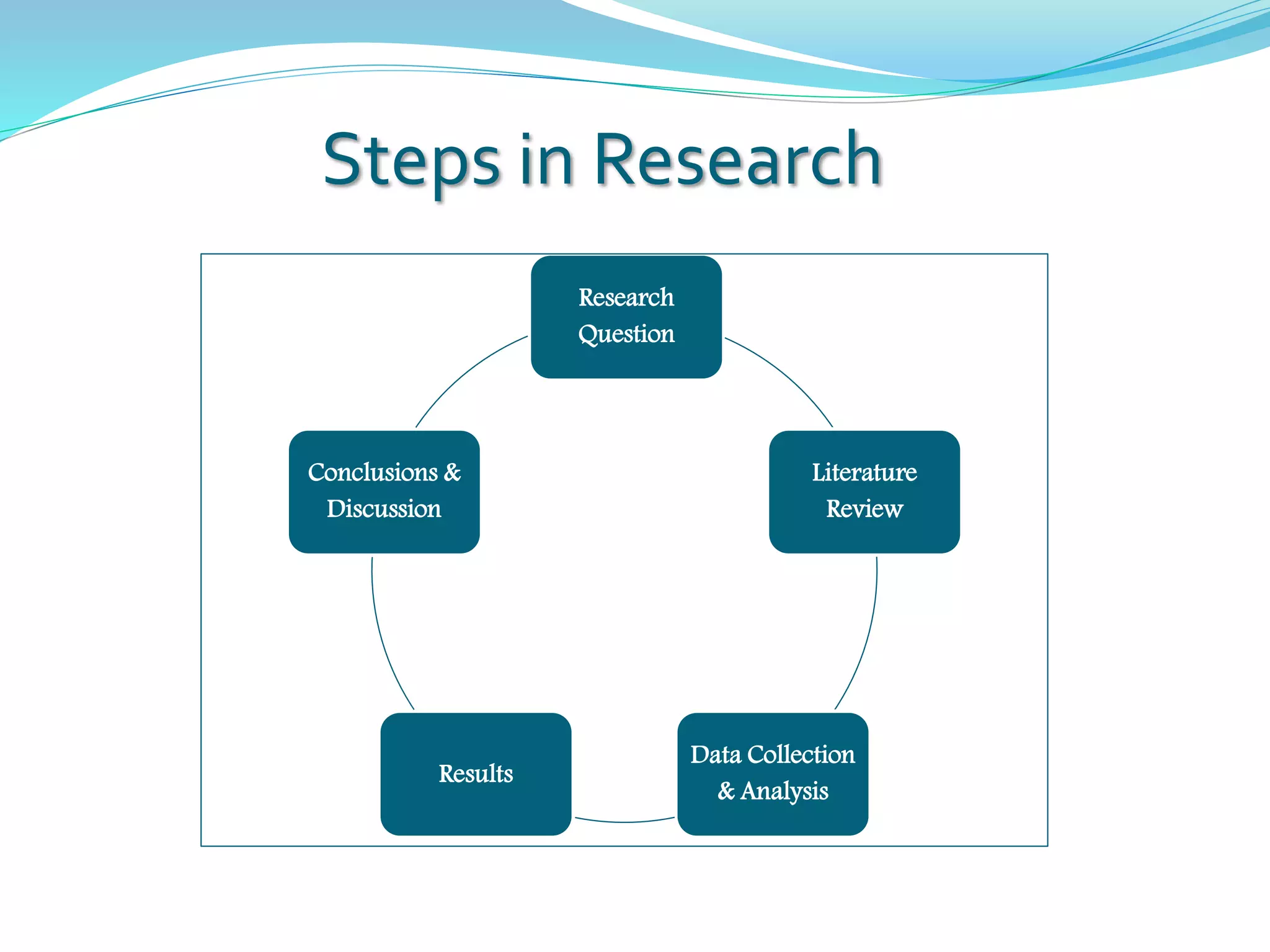
SoTL Uses Research Methods Applied to a
Medical Education Setting
Research
Question
Literature
Review
Data Collection
& Analysis
Results
Conclusions &
Discussion
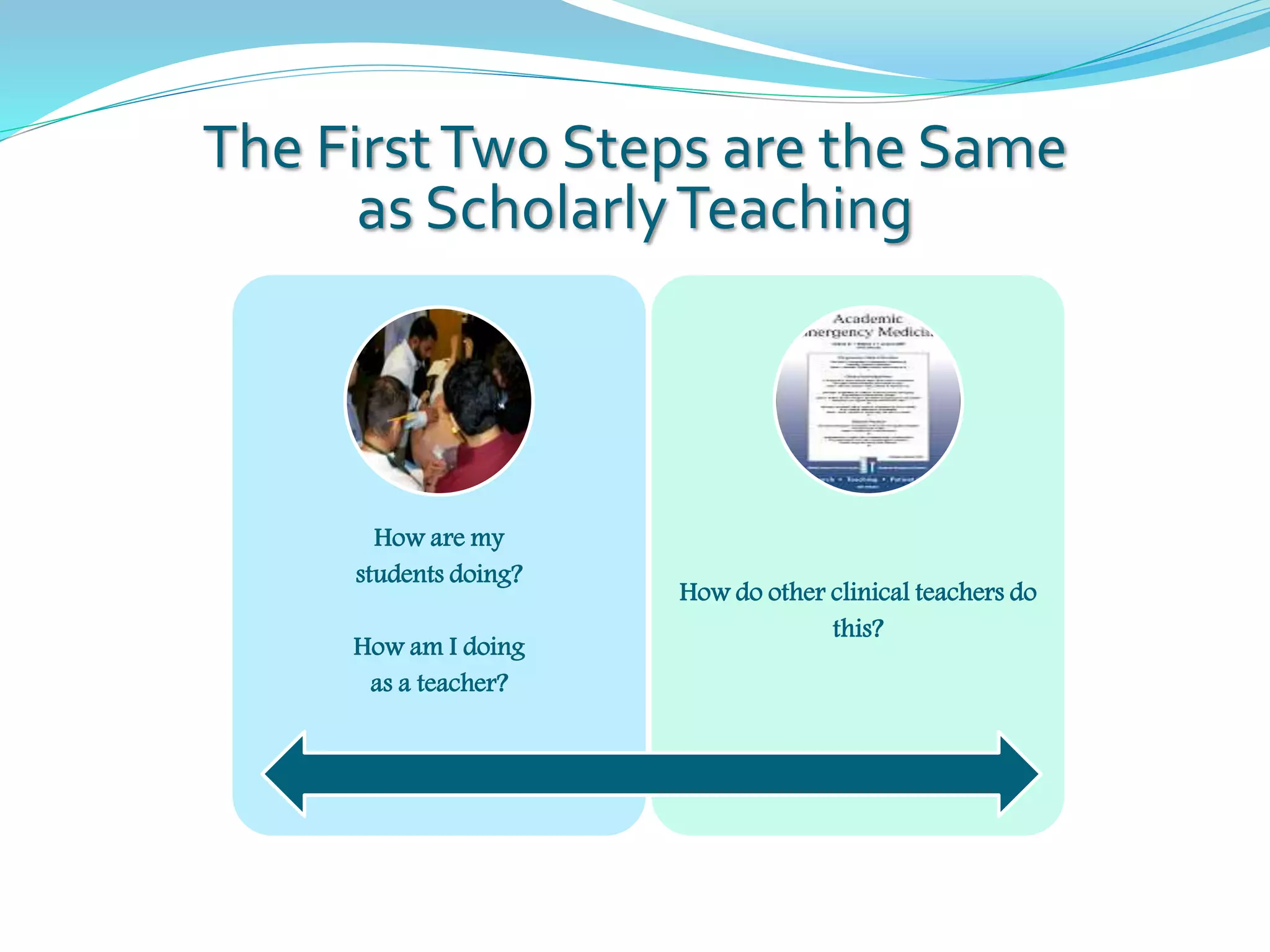
The FirstTwo Steps are the Same
as ScholarlyTeaching
How are my
students doing?
How am I doing
as a teacher?
How do other clinical teachers do
this?
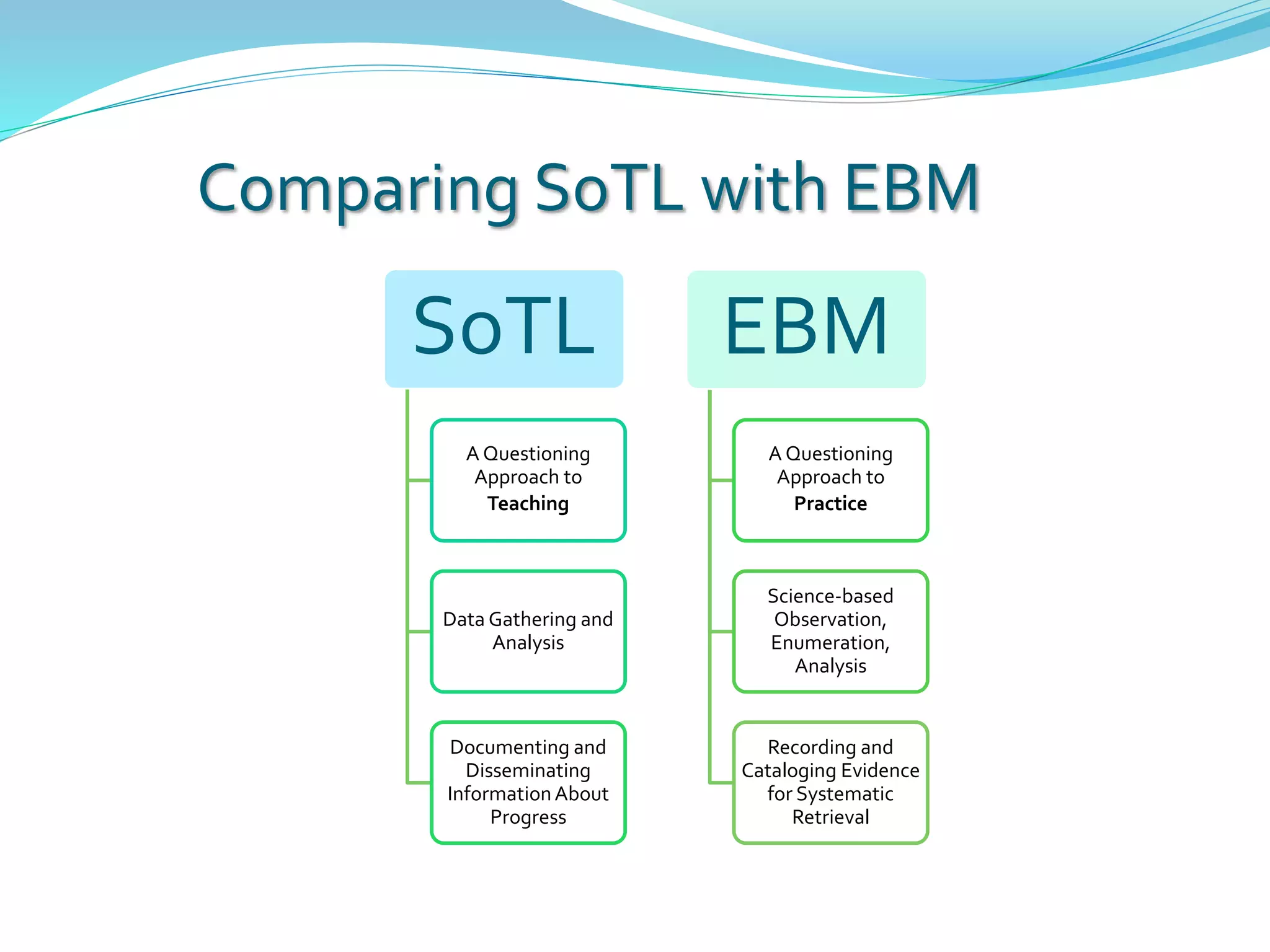
SoTL
A Questioning
Approach to
Teaching
Data Gathering and
Analysis
Documenting and
Disseminating
InformationAbout
Progress
EBM
A Questioning
Approach to
Practice
Science-based
Observation,
Enumeration,
Analysis
Recording and
Cataloging Evidence
for Systematic
Retrieval
Comparing SoTL with EBM
Research
Question
Literature
Review
Data Collection
& Analysis
Results
Conclusions &
Discussion
Steps in Research
What data can I
easily get that tells
me about my and
my students
performance?
How do I look at
these data in a way
that lets me answer
my research
question?
What does this
information mean
for me and my
students?
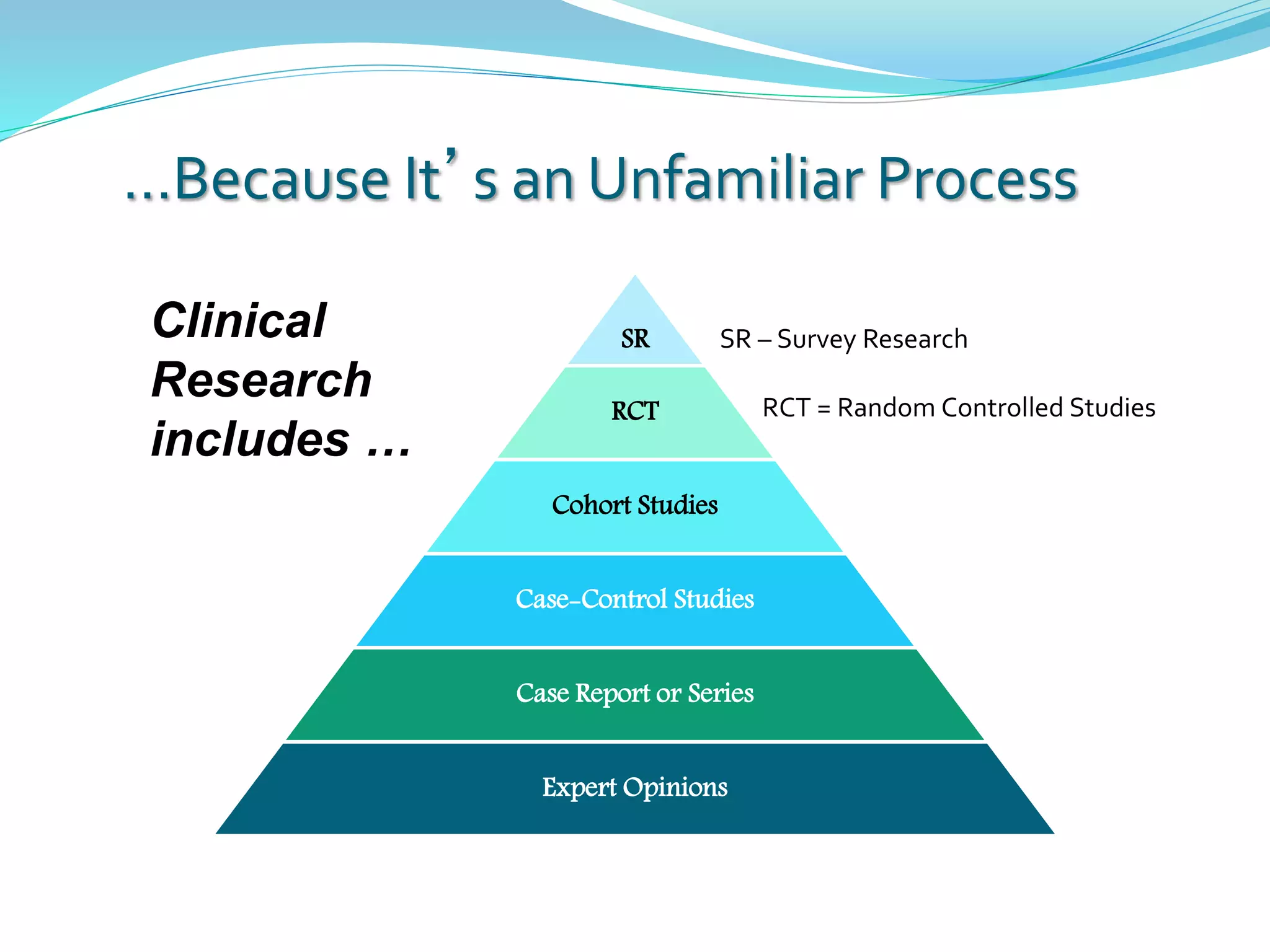
…Because It’s an Unfamiliar Process
SR
RCT
Cohort Studies
Case-Control Studies
Case Report or Series
Expert Opinions
SR – Survey Research
RCT = Random Controlled Studies
Clinical
Research
includes …
Glassick’s Six Measures of
Scholarship
1
• Clear Goals
2
• Preparation
3
• Appropriate Methods
4
• Adequate Results
5
• Effective Presentation
(In the Public Domain, others can Build Off It)
6
• ReflectiveCritique
Source: Glassick, 2000
Resources for SoTL
Develop Project Ideas
Start a Research Plan
Literature Review on
What Others Have
Done
Components of SoTL
Month Tasks
Dec Explore possible projects
Jan Complete literature search
Feb Develop a statement of goals/sub-goals
Mar Determine methods, materials, resources
Apr Develop timeline and target dates; submit
proposal to IRB
May-Jun Gather and/or create materials
Jul Complete “first draft”
Aug Edit, troubleshoot, and finalize project
Sep-Nov Present project
SuggestedTimeline
for Scholarly Projects
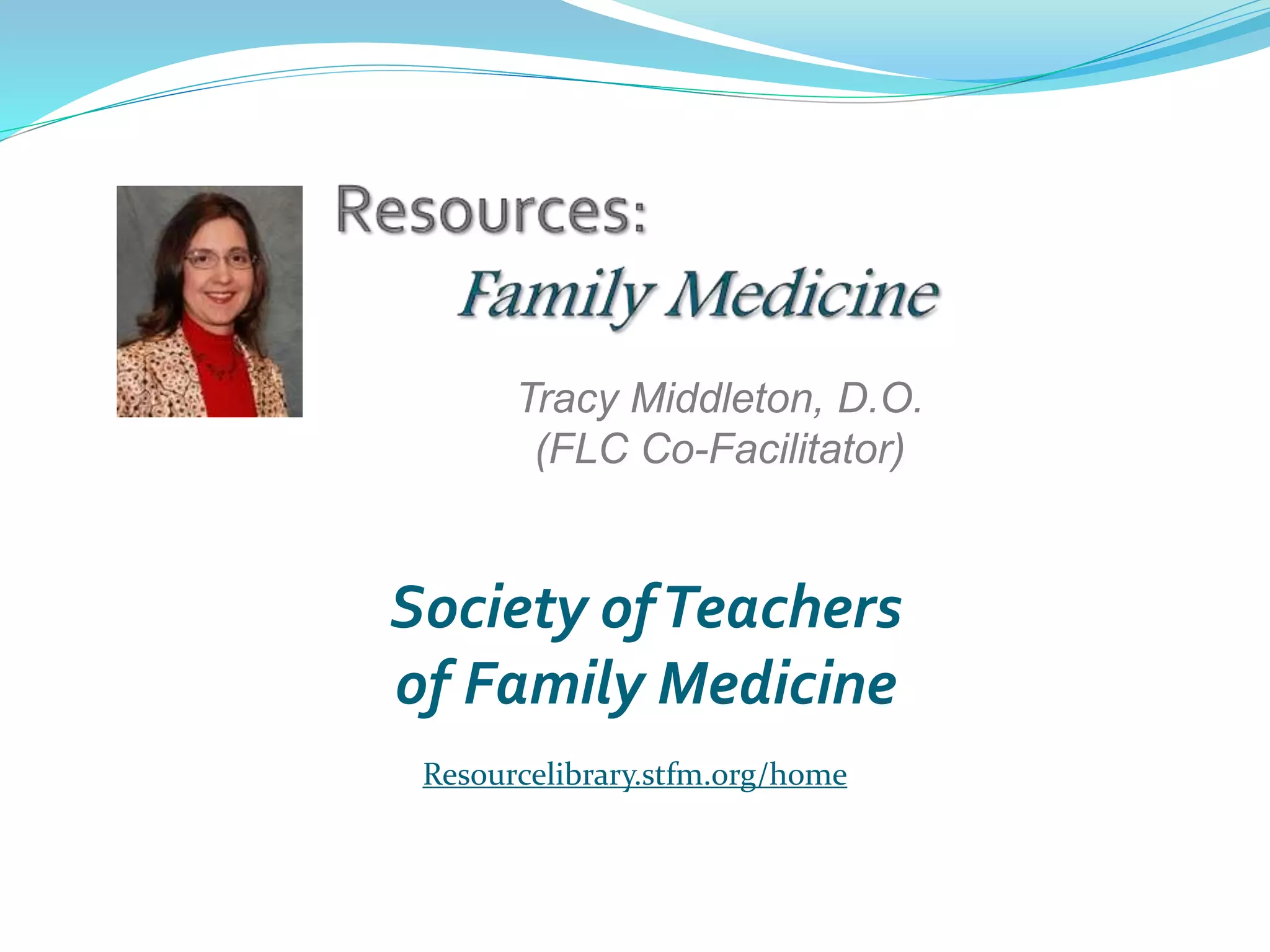
Tracy Middleton, D.O.
(FLC Co-Facilitator)
Society ofTeachers
of Family Medicine
Resourcelibrary.stfm.org/home
How &Where do I cite aWork
posted to FMDRL on my CV?
o Jones L. Ambulatory Teaching. Family Medicine
Digital Resources Library; 2010.
Available from: http://www.fmdrl.org/203.
o Possible CV sections:
- Peer Reviewed Education Material
- Enduring Materials (Peer-reviewed and
Non-Peer reviewed)
- Electronic Publications Curriculum Development
- Other Forms of Educational Scholarship
Charles (Chip) Finch, D.O.
(FLC Co-Facilitator)
Society of Academic Emergency Medicine
Resources:
Emergency Medicine
Faculty Development
Academic Articles
Resources
Linda Carr, Ph.D.
(FLC Co-Facilitator)
AcadMed-Conducting Research in Health Professions Education – see Academic Medicine
Special Supplement, November 2016.The AM Last Pages appear in this anthology.
http://journals.lww.com/academicmedicine/Documents/ACM.LastPage.e-book.FINAL.fromW-K.pdf
Creating SoTL Projects (University of Central Florida College of Medicine)
Links provide information for three stages of SoTL research projects:
1. Designing and Beginning; 2. Implementing & Managing; 3. Writing & Publishing
http://www.fctl.ucf.edu/ResearchAndScholarship/SoTL/creatingSoTLProjects/
Center for Collaborative Action Research (Pepperdine University) – Links together educators and
researchers. Website includes interactive guide, tutorials, resources, websites, and journals
(http://cadres.pepperdine.edu/ccar/)
Venues for Peer Review & Public Dissemination in Medical Education
• MedEdPortal (https://www.mededportal.org)
• Society ofTeachers of Family Medicine Resource Library (http://www.stfm.org)
Examples of
ScholarlyTeaching Projects 1
 Precepting in the Ambulatory Setting: Concordance Between
Resident Reports and Patient Understanding
 AllTied Up: The Medical Student Suturing andTechnical Skills
Experience
 Online EducationalWebsite Improves Residents Contentment
and Access to Educational Materials
Examples of
ScholarlyTeaching Projects 2
 Improving Timeliness of Discharge Summaries Dictated by
Internal Medicine Residents
 Impact of Audience Response Systems (Clickers) on
Modern Medical Education in a Pediatric Residency
Program
 Evaluation of Medical Student Attitudes Towards
Complimentary and Alternative Medicine / Integrated
Medicine (CAM/IM)
 Who is My Doctor? The Use of Business Cards on an
Internal Medicine Teaching Service to Improve Patient
Identification of their Hospital Physicians and Patient
Satisfaction
Curve of Scholarly Activity
1. Identify an idea for a research project.
2. Reflect on how you might approach this
research?
3. Settle on a data collection and a research
plan.
What will you keep the same?
What will you do more of?
What will you do less of?
What will you stop doing?
What will you do differently & how will you do it?
What will you add?
LEARN – REFLECT -
TEACH

Research in the scholarship of teaching

  • 2.
    Know Learning Objectives • DefineGlassick’s six elements of scholarship. • Compare and contrast scholarly teaching with the scholarship of teaching and learning (SoTL). • Describe different types of educational scholarship. • Feel comfortable with doing scholarly teaching. Feel Do • Apply elements of educational scholarship to your work.
  • 3.
    You Can Engagein the Scholarship of Teaching & Learning (SoTL)
  • 4.
    1. Do youhave an idea for a research project? 2. Do you have some idea how to approach this research? 3. Do you have a data collection and research plan in mind? SoTL = Scholarship of Teaching & Learning
  • 5.
    We Are AllTeachers WeAsk Questions About HowWe Are Doing And HowWe Can Do Better SoTL Helps to AnswerThose Questions And Creates UnderstandingAbout Teaching and Learning for Everyone
  • 6.
    Many of UsAre ScholarlyTeachers… What and HowWeTeach is Informed by the Scholarship of Others AREA Is an ACTIVITY When… Is SCHOLARSHIP When… Clinical Care andTreatment ProvidingTreatment to Patients Teaching, publishing or presenting procedures to or for other clinicians Teaching Teaching andAssessing Students Teaching OtherTeachers to Teach andAssess Outreach Telling theCommunity About Services Informing Others How to Design, Implement, EvaluateThose Services Research Perform RCTs or Other Experiments Inform Other Researchers of the Results Source: Adapted from Morahan, 2008.
  • 7.
    Take the NextStep! Source: AAMC
  • 8.
    SoTL Uses ResearchMethods Applied to a Medical Education Setting Research Question Literature Review Data Collection & Analysis Results Conclusions & Discussion
  • 9.
    The FirstTwo Stepsare the Same as ScholarlyTeaching How are my students doing? How am I doing as a teacher? How do other clinical teachers do this?
  • 10.
    SoTL A Questioning Approach to Teaching DataGathering and Analysis Documenting and Disseminating InformationAbout Progress EBM A Questioning Approach to Practice Science-based Observation, Enumeration, Analysis Recording and Cataloging Evidence for Systematic Retrieval Comparing SoTL with EBM
  • 11.
  • 12.
    What data canI easily get that tells me about my and my students performance? How do I look at these data in a way that lets me answer my research question? What does this information mean for me and my students?
  • 13.
    …Because It’s anUnfamiliar Process SR RCT Cohort Studies Case-Control Studies Case Report or Series Expert Opinions SR – Survey Research RCT = Random Controlled Studies Clinical Research includes …
  • 14.
    Glassick’s Six Measuresof Scholarship 1 • Clear Goals 2 • Preparation 3 • Appropriate Methods 4 • Adequate Results 5 • Effective Presentation (In the Public Domain, others can Build Off It) 6 • ReflectiveCritique Source: Glassick, 2000
  • 15.
  • 16.
    Develop Project Ideas Starta Research Plan Literature Review on What Others Have Done Components of SoTL
  • 17.
    Month Tasks Dec Explorepossible projects Jan Complete literature search Feb Develop a statement of goals/sub-goals Mar Determine methods, materials, resources Apr Develop timeline and target dates; submit proposal to IRB May-Jun Gather and/or create materials Jul Complete “first draft” Aug Edit, troubleshoot, and finalize project Sep-Nov Present project SuggestedTimeline for Scholarly Projects
  • 18.
    Tracy Middleton, D.O. (FLCCo-Facilitator) Society ofTeachers of Family Medicine Resourcelibrary.stfm.org/home
  • 19.
    How &Where doI cite aWork posted to FMDRL on my CV? o Jones L. Ambulatory Teaching. Family Medicine Digital Resources Library; 2010. Available from: http://www.fmdrl.org/203. o Possible CV sections: - Peer Reviewed Education Material - Enduring Materials (Peer-reviewed and Non-Peer reviewed) - Electronic Publications Curriculum Development - Other Forms of Educational Scholarship
  • 20.
    Charles (Chip) Finch,D.O. (FLC Co-Facilitator) Society of Academic Emergency Medicine Resources: Emergency Medicine Faculty Development Academic Articles Resources
  • 21.
    Linda Carr, Ph.D. (FLCCo-Facilitator) AcadMed-Conducting Research in Health Professions Education – see Academic Medicine Special Supplement, November 2016.The AM Last Pages appear in this anthology. http://journals.lww.com/academicmedicine/Documents/ACM.LastPage.e-book.FINAL.fromW-K.pdf Creating SoTL Projects (University of Central Florida College of Medicine) Links provide information for three stages of SoTL research projects: 1. Designing and Beginning; 2. Implementing & Managing; 3. Writing & Publishing http://www.fctl.ucf.edu/ResearchAndScholarship/SoTL/creatingSoTLProjects/ Center for Collaborative Action Research (Pepperdine University) – Links together educators and researchers. Website includes interactive guide, tutorials, resources, websites, and journals (http://cadres.pepperdine.edu/ccar/) Venues for Peer Review & Public Dissemination in Medical Education • MedEdPortal (https://www.mededportal.org) • Society ofTeachers of Family Medicine Resource Library (http://www.stfm.org)
  • 22.
    Examples of ScholarlyTeaching Projects1  Precepting in the Ambulatory Setting: Concordance Between Resident Reports and Patient Understanding  AllTied Up: The Medical Student Suturing andTechnical Skills Experience  Online EducationalWebsite Improves Residents Contentment and Access to Educational Materials
  • 23.
    Examples of ScholarlyTeaching Projects2  Improving Timeliness of Discharge Summaries Dictated by Internal Medicine Residents  Impact of Audience Response Systems (Clickers) on Modern Medical Education in a Pediatric Residency Program  Evaluation of Medical Student Attitudes Towards Complimentary and Alternative Medicine / Integrated Medicine (CAM/IM)  Who is My Doctor? The Use of Business Cards on an Internal Medicine Teaching Service to Improve Patient Identification of their Hospital Physicians and Patient Satisfaction
  • 24.
  • 25.
    1. Identify anidea for a research project. 2. Reflect on how you might approach this research? 3. Settle on a data collection and a research plan.
  • 26.
    What will youkeep the same? What will you do more of? What will you do less of? What will you stop doing? What will you do differently & how will you do it? What will you add? LEARN – REFLECT - TEACH