Know
Do
Learning Objectives
• The benefit and application of direct
observation in teaching trainees.
• How to observe trainees in their interactions
with patients.
• Empowered to conduct more objective
observations of trainees’ behaviors.
• Orient trainees to direct observation and
feedback.
• Build meaningful feedback into the direct
observation process.
• Require action planning after each direct
observation.
Feel
Crime Scene Challenge
 You have 2 minutes to study the next photograph.
 Pay attention to the details.
 Do NOT write anything down until you project
the next slide.
Set your stop watch for 2 minutes.
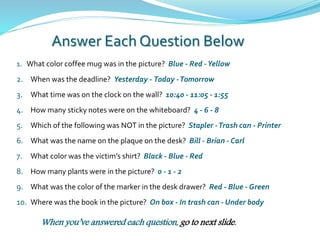
1. What color coffee mug was in the picture? Blue - Red -Yellow
2. When was the deadline? Yesterday - Today -Tomorrow
3. What time was on the clock on the wall? 10:40 - 11:05 - 1:55
4. How many sticky notes were on the whiteboard? 4 - 6 - 8
5. Which of the following was NOT in the picture? Stapler -Trash can - Printer
6. What was the name on the plaque on the desk? Bill - Brian - Carl
7. What color was the victim’s shirt? Black - Blue - Red
8. How many plants were in the picture? 0 - 1 - 2
9. What was the color of the marker in the desk drawer? Red - Blue - Green
10. Where was the book in the picture? On box - In trash can - Under body
Answer Each Question Below
When you’ve answered each question, go to next slide.
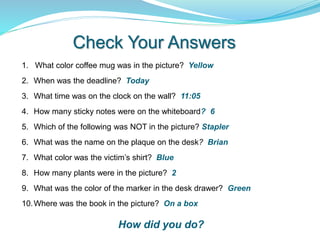
1. What color coffee mug was in the picture? Yellow
2. When was the deadline? Today
3. What time was on the clock on the wall? 11:05
4. How many sticky notes were on the whiteboard? 6
5. Which of the following was NOT in the picture? Stapler
6. What was the name on the plaque on the desk? Brian
7. What color was the victim’s shirt? Blue
8. How many plants were in the picture? 2
9. What was the color of the marker in the desk drawer? Green
10.Where was the book in the picture? On a box
Check Your Answers
How did you do?
Importance of Direct Observation
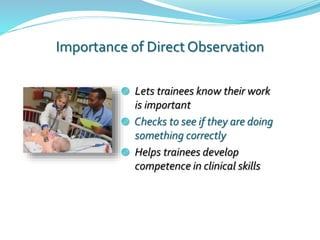
 Lets trainees know their work
is important
 Checks to see if they are doing
something correctly
 Helps trainees develop
competence in clinical skills
4 Rules for Observation
① Correct positioning
② Minimize external interruptions
③ Avoid intrusions
④ Be prepared
E Holmboe, MD – Direct Observation by Faculty. In E. S. Holmboe & R.E. Hawkins (Eds.)
(2008). Practical Guide to the Evaluation of Clinical Competence, p. 122.
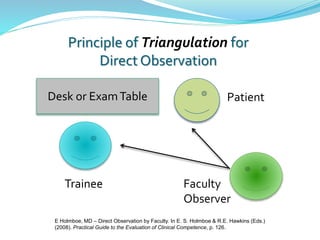
Principle of Triangulation for
Direct Observation
Desk or ExamTable Patient
Trainee Faculty
Observer
E Holmboe, MD – Direct Observation by Faculty. In E. S. Holmboe & R.E. Hawkins (Eds.)
(2008). Practical Guide to the Evaluation of Clinical Competence, p. 126.
Benefits of Observation
 Establishes a baseline
 Reinforces the importance of the
student
 Can assess student’s abilities
 Reminds you that evaluation is not
your only job as a teacher
 Prevents the halo effect
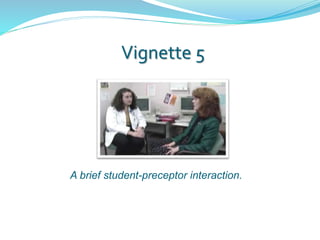
Vignette 5
A brief student-preceptor interaction.
Mechanics of Observation
Who is present?
What roles are they playing?
What is happening?
What tone (voice) are people using?
What activity (body language) is occurring?
What is the pattern, pace of the interaction?
Where is this happening?
Learn to focus on BEHAVIOR, not the person.
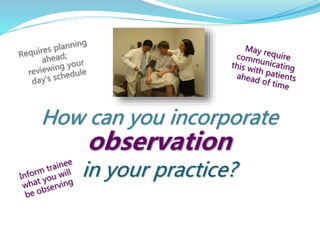
How can you incorporate
observation
in your practice?
Applications of
Direct Observation
 Assess the student’s clinical skills—
interviewing style, technique and organization of PE
 Distinguish specific parts of the
encounter—opening, background history, explanation/
management of plan, closure
 Observe the student in hallway interactions
with preceptors or clinic staff
14
 Look for specific behaviors regarding the
process of the visit—putting patient at ease,
communicating clearly, listening attentively
 Separate the content issues—patient’s
expectations, psychosocial context, appropriate exam
 Observe how student communicates
attitudes—body language, voice, pace, touch
Applications of
Direct Observation, cont.
15
PEP2 Facilitator’s Module 3 (Observation), p. 3.7.
Applications of
Direct Observation, cont.
 Observe effect of the interaction on the
patient—Confusion? Satisfaction? Questions?
 Organize, prioritize, and balance examples
of positive and negative items prior to
providing feedback
 Differentiate between observation and
interpretation—remember, the challenge in observation
is withholding judgment.
ObservationTips
① Do It!
② Active Watching (the challenge in observation
is withholding judgment)
③ Be Observed
④ Observe the Behavior (learn to focus on
behavior and not the person)
“Merely looking at the sick is not observing.”
-- Florence Nightingale
Daily record your
LEARNER’S
PERFORMANCE, noting:
 1 thing DONE WELL
 1 thing TO IMPROVE
 YOUR PLAN to help
her/him improve
Best PracticeTip
Be intentional about observing
your learners directly during
patient visits/procedures and
provide meaningful feedback.
What will you keep the same?
What will you do more of?
What will you do less of?
What will you stop doing?
What will you do differently & how will you do it?
What will you add?
LEARN – REFLECT -TEACH

Learning to "SEE": Using Direct Observation in Teaching Trainees

  • 2.
    Know Do Learning Objectives • Thebenefit and application of direct observation in teaching trainees. • How to observe trainees in their interactions with patients. • Empowered to conduct more objective observations of trainees’ behaviors. • Orient trainees to direct observation and feedback. • Build meaningful feedback into the direct observation process. • Require action planning after each direct observation. Feel
  • 3.
    Crime Scene Challenge You have 2 minutes to study the next photograph.  Pay attention to the details.  Do NOT write anything down until you project the next slide. Set your stop watch for 2 minutes.
  • 5.
    1. What colorcoffee mug was in the picture? Blue - Red -Yellow 2. When was the deadline? Yesterday - Today -Tomorrow 3. What time was on the clock on the wall? 10:40 - 11:05 - 1:55 4. How many sticky notes were on the whiteboard? 4 - 6 - 8 5. Which of the following was NOT in the picture? Stapler -Trash can - Printer 6. What was the name on the plaque on the desk? Bill - Brian - Carl 7. What color was the victim’s shirt? Black - Blue - Red 8. How many plants were in the picture? 0 - 1 - 2 9. What was the color of the marker in the desk drawer? Red - Blue - Green 10. Where was the book in the picture? On box - In trash can - Under body Answer Each Question Below When you’ve answered each question, go to next slide.
  • 6.
    1. What colorcoffee mug was in the picture? Yellow 2. When was the deadline? Today 3. What time was on the clock on the wall? 11:05 4. How many sticky notes were on the whiteboard? 6 5. Which of the following was NOT in the picture? Stapler 6. What was the name on the plaque on the desk? Brian 7. What color was the victim’s shirt? Blue 8. How many plants were in the picture? 2 9. What was the color of the marker in the desk drawer? Green 10.Where was the book in the picture? On a box Check Your Answers How did you do?
  • 7.
    Importance of DirectObservation  Lets trainees know their work is important  Checks to see if they are doing something correctly  Helps trainees develop competence in clinical skills
  • 8.
    4 Rules forObservation ① Correct positioning ② Minimize external interruptions ③ Avoid intrusions ④ Be prepared E Holmboe, MD – Direct Observation by Faculty. In E. S. Holmboe & R.E. Hawkins (Eds.) (2008). Practical Guide to the Evaluation of Clinical Competence, p. 122.
  • 9.
    Principle of Triangulationfor Direct Observation Desk or ExamTable Patient Trainee Faculty Observer E Holmboe, MD – Direct Observation by Faculty. In E. S. Holmboe & R.E. Hawkins (Eds.) (2008). Practical Guide to the Evaluation of Clinical Competence, p. 126.
  • 10.
    Benefits of Observation Establishes a baseline  Reinforces the importance of the student  Can assess student’s abilities  Reminds you that evaluation is not your only job as a teacher  Prevents the halo effect
  • 11.
    Vignette 5 A briefstudent-preceptor interaction.
  • 12.
    Mechanics of Observation Whois present? What roles are they playing? What is happening? What tone (voice) are people using? What activity (body language) is occurring? What is the pattern, pace of the interaction? Where is this happening? Learn to focus on BEHAVIOR, not the person.
  • 13.
    How can youincorporate observation in your practice?
  • 14.
    Applications of Direct Observation Assess the student’s clinical skills— interviewing style, technique and organization of PE  Distinguish specific parts of the encounter—opening, background history, explanation/ management of plan, closure  Observe the student in hallway interactions with preceptors or clinic staff 14
  • 15.
     Look forspecific behaviors regarding the process of the visit—putting patient at ease, communicating clearly, listening attentively  Separate the content issues—patient’s expectations, psychosocial context, appropriate exam  Observe how student communicates attitudes—body language, voice, pace, touch Applications of Direct Observation, cont. 15 PEP2 Facilitator’s Module 3 (Observation), p. 3.7.
  • 16.
    Applications of Direct Observation,cont.  Observe effect of the interaction on the patient—Confusion? Satisfaction? Questions?  Organize, prioritize, and balance examples of positive and negative items prior to providing feedback  Differentiate between observation and interpretation—remember, the challenge in observation is withholding judgment.
  • 17.
    ObservationTips ① Do It! ②Active Watching (the challenge in observation is withholding judgment) ③ Be Observed ④ Observe the Behavior (learn to focus on behavior and not the person) “Merely looking at the sick is not observing.” -- Florence Nightingale
  • 18.
    Daily record your LEARNER’S PERFORMANCE,noting:  1 thing DONE WELL  1 thing TO IMPROVE  YOUR PLAN to help her/him improve Best PracticeTip
  • 19.
    Be intentional aboutobserving your learners directly during patient visits/procedures and provide meaningful feedback.
  • 20.
    What will youkeep the same? What will you do more of? What will you do less of? What will you stop doing? What will you do differently & how will you do it? What will you add? LEARN – REFLECT -TEACH