Chapter 3
 To have an effective argument of your own,
you must learn how to include arguments of
others into your paper first.
 One way to do this is through summary,
which is putting into your own words what
someone else is saying.
 However, there are other ways of
incorporating what others are saying.
 The art of quoting!
 Yes—it is an art to quote others in a way that
it helps (not hurts!) your argument.
 Unfortunately, not all students take this art so
seriously…
a. Quoting someone else gives your own
writing more credibility. It proves someone
else agrees with you in your argument.
b. Quoting can be more specific and useful
than summarizing;
c. An author’s point can be so relevant to your
argument that you don’t want to summarize
it, for this runs the risk of distorting his/her
point.
d. Quoting someone else is rewriting the ideas
into your own words.
 1) It is important to use quotations, or,
quote authors directly in some cases. Which
reason does not apply?
 Hopefully, you answered “D” for this
question. Quoting is NOT rewriting
someone else’s argument into your own
words. In fact, it is quite the opposite.
 To quote someone directly means to take a
specific part of his/her text, put quotation
marks around it, and then frame it so it fits
into your argument.
 To frame it means to introduce and explain
the quote, no matter what.
 Framing and explaining quotes are covered in
this PowerPoint, but all the nitty-gritty is
covered in a separate presentation.
 For now, let’s just focus on quoting and what
it means, in general.
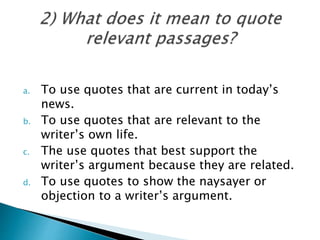
a. To use quotes that are current in today’s
news.
b. To use quotes that are relevant to the
writer’s own life.
c. The use quotes that best support the
writer’s argument because they are related.
d. To use quotes to show the naysayer or
objection to a writer’s argument.
 The use quotes that best support the writer’s
argument because they are related.
 You must know what you want to quote.
 In other words, it must be relevant to your
argument, not random!
 Like summarizing an author’s argument, it
takes going back to the text to find exactly
what it is you want extract.
 In this case, your annotations will be very
helpful; you won’t have to reread the whole
text, perhaps, but you can zero in on the
quotes and passages you’ve already marked.
3) What are some common mistakes that
writers make when it comes to quoting?
 Writers often quote too little.
◦ Why? Maybe they don’t want to go back to the text
to find the exact words.
 Writers quote too much.
◦ Why? Maybe they don’t have the confidence or they
don’t fully understand what they want to quote.
 Worst of all, writers don’t explain the quote.
◦ They’ve incorporated the quote, but the quote isn’t
explained; for instance, the writer doesn’t say why
it is important!
 Once you have found relevant quotes, you
need to make sure you explain how and why
they are relevant to your argument.
 To do that, writers must “frame” their quotes.
 Quotes that are framed have a lead-in and a
follow-up. They are introduced and
explained.
 Quotes that are not framed are often called
“dangling” quotations or “hit-and-run”
quotations.
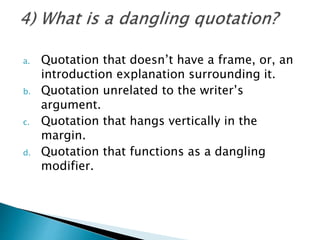
a. Quotation that doesn’t have a frame, or, an
introduction explanation surrounding it.
b. Quotation unrelated to the writer’s
argument.
c. Quotation that hangs vertically in the
margin.
d. Quotation that functions as a dangling
modifier.
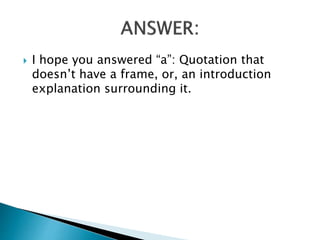
 I hope you answered “a”: Quotation that
doesn’t have a frame, or, an introduction
explanation surrounding it.
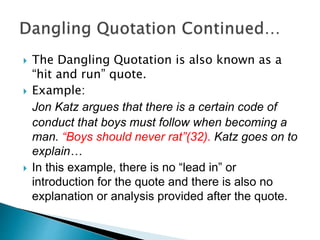
 The Dangling Quotation is also known as a
“hit and run” quote.
 Example:
Jon Katz argues that there is a certain code of
conduct that boys must follow when becoming a
man. “Boys should never rat”(32). Katz goes on to
explain…
 In this example, there is no “lead in” or
introduction for the quote and there is also no
explanation or analysis provided after the quote.
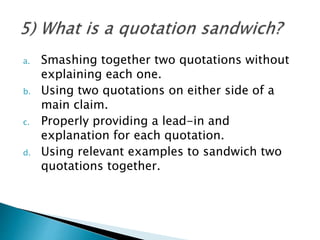
a. Smashing together two quotations without
explaining each one.
b. Using two quotations on either side of a
main claim.
c. Properly providing a lead-in and
explanation for each quotation.
d. Using relevant examples to sandwich two
quotations together.
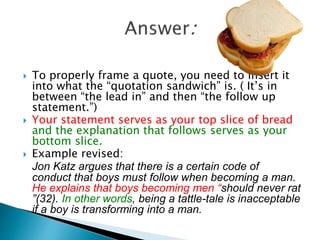
 To properly frame a quote, you need to insert it
into what the “quotation sandwich” is. ( It’s in
between “the lead in” and then “the follow up
statement.”)
 Your statement serves as your top slice of bread
and the explanation that follows serves as your
bottom slice.
 Example revised:
Jon Katz argues that there is a certain code of
conduct that boys must follow when becoming a man.
He explains that boys becoming men “should never rat
”(32). In other words, being a tattle-tale is inacceptable
if a boy is transforming into a man.
 According to X, “________.”
 In her essay “____,” X argues that “_____.”
 X agrees when she writes, “________.”
 In X’s view, “____________.”
 X himself writes, “_________________.”
Example: Katzs explains that boys becoming men
“should never rat ”(32).
It is highly recommended that you memorize a
couple of these!
 In other words, X believes…
 X’s point is that…
 In making this comment, X urges us to…
 Meaning,…
 This means that…
Example: He explains that boys becoming men
“should never rat ”(32). In other words, being a
tattle-tale is inacceptable if a boy is transforming
into a man.
You should memorize a couple of these follow up
templates as well!
 Chapter 3 provides a new way of integrating
the arguments of others into your text:
quoting directly.
 To quote directly, find the most relevant
quotes you want to use.
 Always frame your quote: provide a lead in
and follow up to introduce and explain your
quote and how it fits your argument.
 Never leave a quote dangling or one that is
“hit and run.”

They Say, I Say: Chapter 3

  • 1.
  • 2.
     To havean effective argument of your own, you must learn how to include arguments of others into your paper first.  One way to do this is through summary, which is putting into your own words what someone else is saying.  However, there are other ways of incorporating what others are saying.
  • 3.
     The artof quoting!  Yes—it is an art to quote others in a way that it helps (not hurts!) your argument.  Unfortunately, not all students take this art so seriously…
  • 4.
    a. Quoting someoneelse gives your own writing more credibility. It proves someone else agrees with you in your argument. b. Quoting can be more specific and useful than summarizing; c. An author’s point can be so relevant to your argument that you don’t want to summarize it, for this runs the risk of distorting his/her point. d. Quoting someone else is rewriting the ideas into your own words.
  • 5.
     1) Itis important to use quotations, or, quote authors directly in some cases. Which reason does not apply?  Hopefully, you answered “D” for this question. Quoting is NOT rewriting someone else’s argument into your own words. In fact, it is quite the opposite.
  • 6.
     To quotesomeone directly means to take a specific part of his/her text, put quotation marks around it, and then frame it so it fits into your argument.  To frame it means to introduce and explain the quote, no matter what.  Framing and explaining quotes are covered in this PowerPoint, but all the nitty-gritty is covered in a separate presentation.  For now, let’s just focus on quoting and what it means, in general.
  • 7.
    a. To usequotes that are current in today’s news. b. To use quotes that are relevant to the writer’s own life. c. The use quotes that best support the writer’s argument because they are related. d. To use quotes to show the naysayer or objection to a writer’s argument.
  • 8.
     The usequotes that best support the writer’s argument because they are related.
  • 9.
     You mustknow what you want to quote.  In other words, it must be relevant to your argument, not random!  Like summarizing an author’s argument, it takes going back to the text to find exactly what it is you want extract.  In this case, your annotations will be very helpful; you won’t have to reread the whole text, perhaps, but you can zero in on the quotes and passages you’ve already marked.
  • 10.
    3) What aresome common mistakes that writers make when it comes to quoting?
  • 11.
     Writers oftenquote too little. ◦ Why? Maybe they don’t want to go back to the text to find the exact words.  Writers quote too much. ◦ Why? Maybe they don’t have the confidence or they don’t fully understand what they want to quote.  Worst of all, writers don’t explain the quote. ◦ They’ve incorporated the quote, but the quote isn’t explained; for instance, the writer doesn’t say why it is important!
  • 12.
     Once youhave found relevant quotes, you need to make sure you explain how and why they are relevant to your argument.  To do that, writers must “frame” their quotes.  Quotes that are framed have a lead-in and a follow-up. They are introduced and explained.  Quotes that are not framed are often called “dangling” quotations or “hit-and-run” quotations.
  • 13.
    a. Quotation thatdoesn’t have a frame, or, an introduction explanation surrounding it. b. Quotation unrelated to the writer’s argument. c. Quotation that hangs vertically in the margin. d. Quotation that functions as a dangling modifier.
  • 14.
     I hopeyou answered “a”: Quotation that doesn’t have a frame, or, an introduction explanation surrounding it.
  • 15.
     The DanglingQuotation is also known as a “hit and run” quote.  Example: Jon Katz argues that there is a certain code of conduct that boys must follow when becoming a man. “Boys should never rat”(32). Katz goes on to explain…  In this example, there is no “lead in” or introduction for the quote and there is also no explanation or analysis provided after the quote.
  • 16.
    a. Smashing togethertwo quotations without explaining each one. b. Using two quotations on either side of a main claim. c. Properly providing a lead-in and explanation for each quotation. d. Using relevant examples to sandwich two quotations together.
  • 17.
     To properlyframe a quote, you need to insert it into what the “quotation sandwich” is. ( It’s in between “the lead in” and then “the follow up statement.”)  Your statement serves as your top slice of bread and the explanation that follows serves as your bottom slice.  Example revised: Jon Katz argues that there is a certain code of conduct that boys must follow when becoming a man. He explains that boys becoming men “should never rat ”(32). In other words, being a tattle-tale is inacceptable if a boy is transforming into a man.
  • 18.
     According toX, “________.”  In her essay “____,” X argues that “_____.”  X agrees when she writes, “________.”  In X’s view, “____________.”  X himself writes, “_________________.” Example: Katzs explains that boys becoming men “should never rat ”(32). It is highly recommended that you memorize a couple of these!
  • 19.
     In otherwords, X believes…  X’s point is that…  In making this comment, X urges us to…  Meaning,…  This means that… Example: He explains that boys becoming men “should never rat ”(32). In other words, being a tattle-tale is inacceptable if a boy is transforming into a man. You should memorize a couple of these follow up templates as well!
  • 20.
     Chapter 3provides a new way of integrating the arguments of others into your text: quoting directly.  To quote directly, find the most relevant quotes you want to use.  Always frame your quote: provide a lead in and follow up to introduce and explain your quote and how it fits your argument.  Never leave a quote dangling or one that is “hit and run.”