
Levels of Formality in Writing
The goal of this lesson
Is to help you understand and master the
differences between different levels diction
that are appropriate/inappropriate for
different circumstances.
diction= the choice and use of words and phrases
in speech or writing.
Who is your audience?
What is your purpose?
To know what level of formality to use, you need to answer
these two questions first.
• Most people don’t speak to their classmates
the way they speak to their grandparents;
• they don’t speak to their grandparents the
way they write for their teachers; and the
way they write for their teachers is not how
they would write a college scholarship essay.
• The way they would write a letter to a friend
about their vacation is different from the way
they write a letter to the city council asking
for a dog park.
These differences are part of what is meant by
levels of formality.
Formality = the rules and etiquette that guide behavior
& language.
Think and Respond.
How would you answer this question -
“How are you today?”
If you were speaking to . . .
• A) a possible employer?
• B) writing on a friend’s Facebook page?
• C) your boy(girl)friend’s mom?
• D) talking to your great-aunt in the nursing
home?
• E) the principal?
• F) the President of the United States?
• G) a store clerk ringing up your groceries?
Levels of Formality
•For the most part, levels of formality can be
understood through 3 general areas:
– informal,
– semi-formal, and
– formal.
•Language that would be completely acceptable in
one context can be inappropriate in another.
Context = the circumstances that form the setting
Is it appropriate?
Language that would be completely acceptable in one context
can be inappropriate in another.
Think of words that you might say to a close
friend in conversation. You would not use the
same words in a conversation with the librarian.
You would not use the same words with her that
you would use to speak to the nice old lady at
church who baked you cookies.
It is important, therefore, to understand
the goals and the audience of your
writing, and use language consistent with
your goals and audience.
What is the purpose you want to achieve by using your
language at this time?
Who is your audience?
What is your purpose?
Colloquial Language
Colloquial language is the language of every day
conversation.
It changes rapidly by topic, audience, situation and can
be very different for various areas of the country.
Most people master several forms of colloquial
language for different situations.
Text messaging, personal emails, and the language of
social networking sites all use various written forms of
colloquial writing.
And as you already know...
...colloquial language...
• ...is SELDOM appropriate for
– Academic
– Business, or
– Legal writing.
• If you are quoting someone directly, it
can be appropriate, but take care not
to disrupt your overall tone.
Tweeting and Texting...
• ...have created new and vital forms of written
colloquial language. Consider this tweet
#YouGetMajorPointsIf U dont tweet how gr8 u are..stay
humble, never 4get ur roots, the ppl who helped u, stay
loyal and never lie!
Ten years ago, this would have been gibberish!
Think and Respond
Using texting/tweeting shorthand, compose
messages about these situations:
1. It is Earth Day and you want to urge all your friends to
recycle and reuse.
2. It is close to election day and you want to spread the
message about how important it is to vote.
Informal Language
• Informal language tries to capture some
of the flow of every day speech.
• It mostly sticks to the rules of standard
written English, but imprecise word choice
and contractions are acceptable, so long
as the meaning is clear.
• It generally uses complete sentences, but
some use of sentence fragments is
common especially for emphasis.
Informal Language (continued)
• Informal writing is meant for a wide audience;
the purpose is usually to express a personal
idea; most online blogging and personal
essays use informal writing.
• Contractions are acceptable.
• Use of the first and second person (“I,” “you”)
is acceptable.
Semi-Formal Language
• Semi-formal language is the writing of
magazines like The Smithsonian or
websites like Mental Floss that are aimed
at a general but thoughtful audience.
• Complete sentences are used.
• Contractions are written out (“can not”
“did not,” etc.”
• Limited use of first and second person for
specific effect is common.
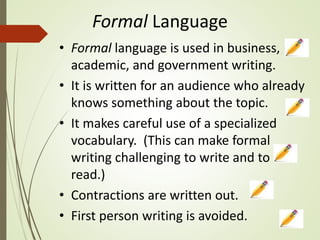
Formal Language
• Formal language is used in business,
academic, and government writing.
• It is written for an audience who already
knows something about the topic.
• It makes careful use of a specialized
vocabulary. (This can make formal
writing challenging to write and to
read.)
• Contractions are written out.
• First person writing is avoided.
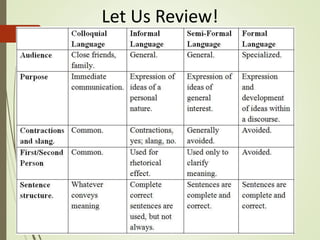
Let Us Review!
For the following scenarios, indicate
which level of diction – colloquial,
informal, semi-formal, or formal–you
would be likely to use.
3. You text a friend to say you’ll be
hanging out at the mall this afternoon.
4. You apply for a job at a large bank
where your uncle is a manager.
5. You write a personal essay about
your decision to start smoking when
you were thirteen and to stop when
you were sixteen.
For the following examples of writing –
decide what level of formality they
represent.
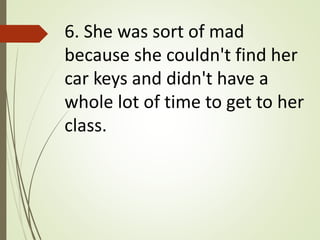
6. She was sort of mad
because she couldn't find her
car keys and didn't have a
whole lot of time to get to her
class.
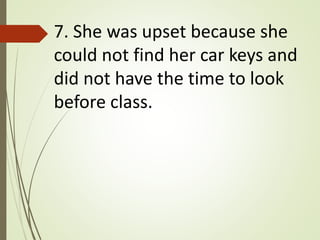
7. She was upset because she
could not find her car keys and
did not have the time to look
before class.
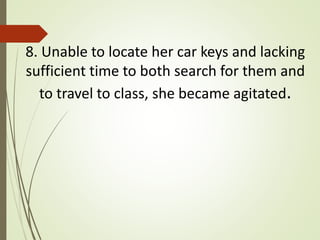
8. Unable to locate her car keys and lacking
sufficient time to both search for them and
to travel to class, she became agitated.
9. The evolution and strategic positioning
of private equity firms (general partners)
themselves (versus previous research
focused on buyout portfolio firm
implications). Specifically, we provide a
conceptual configuration of private equity
firms along two dimensions: their financial
structure emphasis (the strategic use of
debt versus equity among private equity
portfolio firms) and the diversified scope of
their portfolio firms.
10. Analyzing the causes and
effects of the civil war depends in
large part on the point of view of
who is talking.
11. If you buy that garbage about how
teens don't know the difference
between a text message and a history
paper, you should read more.
The following sentences have a portion
of the sentence underlined and in red.
Decide which answer would best fit in
that part of each sentence.
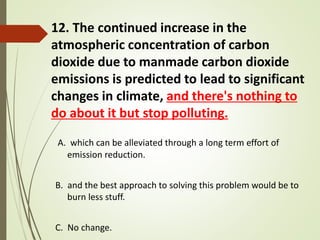
12. The continued increase in the
atmospheric concentration of carbon
dioxide due to manmade carbon dioxide
emissions is predicted to lead to significant
changes in climate, and there's nothing to
do about it but stop polluting.
A. which can be alleviated through a long term effort of
emission reduction.
B. and the best approach to solving this problem would be to
burn less stuff.
C. No change.
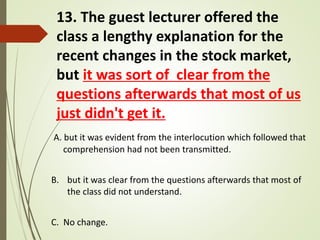
13. The guest lecturer offered the
class a lengthy explanation for the
recent changes in the stock market,
but it was sort of clear from the
questions afterwards that most of us
just didn't get it.
A. but it was evident from the interlocution which followed that
comprehension had not been transmitted.
B. but it was clear from the questions afterwards that most of
the class did not understand.
C. No change.
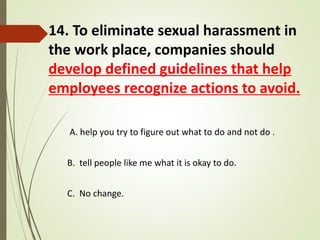
14. To eliminate sexual harassment in
the work place, companies should
develop defined guidelines that help
employees recognize actions to avoid.
A. help you try to figure out what to do and not do .
B. tell people like me what it is okay to do.
C. No change.
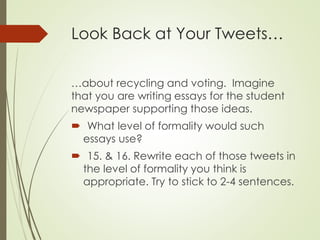
Look Back at Your Tweets…
…about recycling and voting. Imagine
that you are writing essays for the student
newspaper supporting those ideas.
 What level of formality would such
essays use?
 15. & 16. Rewrite each of those tweets in
the level of formality you think is
appropriate. Try to stick to 2-4 sentences.
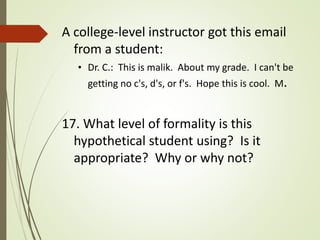
A college-level instructor got this email
from a student:
• Dr. C.: This is malik. About my grade. I can't be
getting no c's, d's, or f's. Hope this is cool. M.
17. What level of formality is this
hypothetical student using? Is it
appropriate? Why or why not?
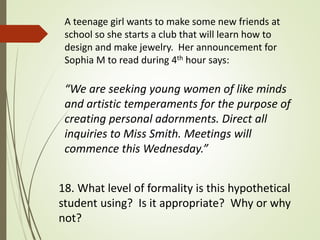
A teenage girl wants to make some new friends at
school so she starts a club that will learn how to
design and make jewelry. Her announcement for
Sophia M to read during 4th hour says:
“We are seeking young women of like minds
and artistic temperaments for the purpose of
creating personal adornments. Direct all
inquiries to Miss Smith. Meetings will
commence this Wednesday.”
18. What level of formality is this hypothetical
student using? Is it appropriate? Why or why
not?
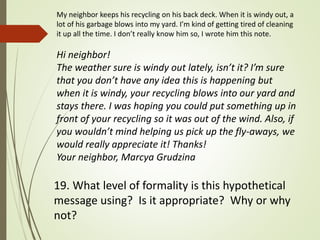
19. What level of formality is this hypothetical
message using? Is it appropriate? Why or why
not?
My neighbor keeps his recycling on his back deck. When it is windy out, a
lot of his garbage blows into my yard. I’m kind of getting tired of cleaning
it up all the time. I don’t really know him so, I wrote him this note.
Hi neighbor!
The weather sure is windy out lately, isn’t it? I’m sure
that you don’t have any idea this is happening but
when it is windy, your recycling blows into our yard and
stays there. I was hoping you could put something up in
front of your recycling so it was out of the wind. Also, if
you wouldn’t mind helping us pick up the fly-aways, we
would really appreciate it! Thanks!
Your neighbor, Marcya Grudzina
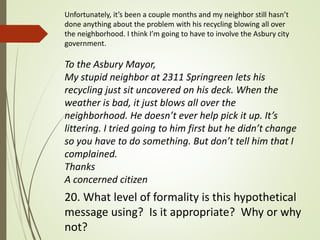
Unfortunately, it’s been a couple months and my neighbor still hasn’t
done anything about the problem with his recycling blowing all over
the neighborhood. I think I’m going to have to involve the Asbury city
government.
To the Asbury Mayor,
My stupid neighbor at 2311 Springreen lets his
recycling just sit uncovered on his deck. When the
weather is bad, it just blows all over the
neighborhood. He doesn’t ever help pick it up. It’s
littering. I tried going to him first but he didn’t change
so you have to do something. But don’t tell him that I
complained.
Thanks
A concerned citizen
20. What level of formality is this hypothetical
message using? Is it appropriate? Why or why
not?
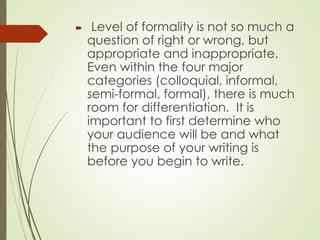
 Level of formality is not so much a
question of right or wrong, but
appropriate and inappropriate.
Even within the four major
categories (colloquial, informal,
semi-formal, formal), there is much
room for differentiation. It is
important to first determine who
your audience will be and what
the purpose of your writing is
before you begin to write.

Writing - Formality & Audience

  • 1.
  • 2.
    The goal ofthis lesson Is to help you understand and master the differences between different levels diction that are appropriate/inappropriate for different circumstances. diction= the choice and use of words and phrases in speech or writing. Who is your audience? What is your purpose? To know what level of formality to use, you need to answer these two questions first.
  • 3.
    • Most peopledon’t speak to their classmates the way they speak to their grandparents; • they don’t speak to their grandparents the way they write for their teachers; and the way they write for their teachers is not how they would write a college scholarship essay. • The way they would write a letter to a friend about their vacation is different from the way they write a letter to the city council asking for a dog park.
  • 4.
    These differences arepart of what is meant by levels of formality. Formality = the rules and etiquette that guide behavior & language.
  • 5.
    Think and Respond. Howwould you answer this question - “How are you today?” If you were speaking to . . . • A) a possible employer? • B) writing on a friend’s Facebook page? • C) your boy(girl)friend’s mom? • D) talking to your great-aunt in the nursing home? • E) the principal? • F) the President of the United States? • G) a store clerk ringing up your groceries?
  • 6.
    Levels of Formality •Forthe most part, levels of formality can be understood through 3 general areas: – informal, – semi-formal, and – formal. •Language that would be completely acceptable in one context can be inappropriate in another. Context = the circumstances that form the setting
  • 7.
    Is it appropriate? Languagethat would be completely acceptable in one context can be inappropriate in another. Think of words that you might say to a close friend in conversation. You would not use the same words in a conversation with the librarian. You would not use the same words with her that you would use to speak to the nice old lady at church who baked you cookies.
  • 8.
    It is important,therefore, to understand the goals and the audience of your writing, and use language consistent with your goals and audience. What is the purpose you want to achieve by using your language at this time? Who is your audience? What is your purpose?
  • 9.
    Colloquial Language Colloquial languageis the language of every day conversation. It changes rapidly by topic, audience, situation and can be very different for various areas of the country. Most people master several forms of colloquial language for different situations. Text messaging, personal emails, and the language of social networking sites all use various written forms of colloquial writing. And as you already know...
  • 10.
    ...colloquial language... • ...isSELDOM appropriate for – Academic – Business, or – Legal writing. • If you are quoting someone directly, it can be appropriate, but take care not to disrupt your overall tone.
  • 11.
    Tweeting and Texting... •...have created new and vital forms of written colloquial language. Consider this tweet #YouGetMajorPointsIf U dont tweet how gr8 u are..stay humble, never 4get ur roots, the ppl who helped u, stay loyal and never lie! Ten years ago, this would have been gibberish!
  • 12.
    Think and Respond Usingtexting/tweeting shorthand, compose messages about these situations: 1. It is Earth Day and you want to urge all your friends to recycle and reuse. 2. It is close to election day and you want to spread the message about how important it is to vote.
  • 13.
    Informal Language • Informallanguage tries to capture some of the flow of every day speech. • It mostly sticks to the rules of standard written English, but imprecise word choice and contractions are acceptable, so long as the meaning is clear. • It generally uses complete sentences, but some use of sentence fragments is common especially for emphasis.
  • 14.
    Informal Language (continued) •Informal writing is meant for a wide audience; the purpose is usually to express a personal idea; most online blogging and personal essays use informal writing. • Contractions are acceptable. • Use of the first and second person (“I,” “you”) is acceptable.
  • 15.
    Semi-Formal Language • Semi-formallanguage is the writing of magazines like The Smithsonian or websites like Mental Floss that are aimed at a general but thoughtful audience. • Complete sentences are used. • Contractions are written out (“can not” “did not,” etc.” • Limited use of first and second person for specific effect is common.
  • 16.
    Formal Language • Formallanguage is used in business, academic, and government writing. • It is written for an audience who already knows something about the topic. • It makes careful use of a specialized vocabulary. (This can make formal writing challenging to write and to read.) • Contractions are written out. • First person writing is avoided.
  • 17.
  • 18.
    For the followingscenarios, indicate which level of diction – colloquial, informal, semi-formal, or formal–you would be likely to use.
  • 19.
    3. You texta friend to say you’ll be hanging out at the mall this afternoon. 4. You apply for a job at a large bank where your uncle is a manager. 5. You write a personal essay about your decision to start smoking when you were thirteen and to stop when you were sixteen.
  • 20.
    For the followingexamples of writing – decide what level of formality they represent.
  • 21.
    6. She wassort of mad because she couldn't find her car keys and didn't have a whole lot of time to get to her class.
  • 22.
    7. She wasupset because she could not find her car keys and did not have the time to look before class.
  • 23.
    8. Unable tolocate her car keys and lacking sufficient time to both search for them and to travel to class, she became agitated.
  • 24.
    9. The evolutionand strategic positioning of private equity firms (general partners) themselves (versus previous research focused on buyout portfolio firm implications). Specifically, we provide a conceptual configuration of private equity firms along two dimensions: their financial structure emphasis (the strategic use of debt versus equity among private equity portfolio firms) and the diversified scope of their portfolio firms.
  • 25.
    10. Analyzing thecauses and effects of the civil war depends in large part on the point of view of who is talking.
  • 26.
    11. If youbuy that garbage about how teens don't know the difference between a text message and a history paper, you should read more.
  • 27.
    The following sentenceshave a portion of the sentence underlined and in red. Decide which answer would best fit in that part of each sentence.
  • 28.
    12. The continuedincrease in the atmospheric concentration of carbon dioxide due to manmade carbon dioxide emissions is predicted to lead to significant changes in climate, and there's nothing to do about it but stop polluting. A. which can be alleviated through a long term effort of emission reduction. B. and the best approach to solving this problem would be to burn less stuff. C. No change.
  • 29.
    13. The guestlecturer offered the class a lengthy explanation for the recent changes in the stock market, but it was sort of clear from the questions afterwards that most of us just didn't get it. A. but it was evident from the interlocution which followed that comprehension had not been transmitted. B. but it was clear from the questions afterwards that most of the class did not understand. C. No change.
  • 30.
    14. To eliminatesexual harassment in the work place, companies should develop defined guidelines that help employees recognize actions to avoid. A. help you try to figure out what to do and not do . B. tell people like me what it is okay to do. C. No change.
  • 31.
    Look Back atYour Tweets… …about recycling and voting. Imagine that you are writing essays for the student newspaper supporting those ideas.  What level of formality would such essays use?  15. & 16. Rewrite each of those tweets in the level of formality you think is appropriate. Try to stick to 2-4 sentences.
  • 32.
    A college-level instructorgot this email from a student: • Dr. C.: This is malik. About my grade. I can't be getting no c's, d's, or f's. Hope this is cool. M. 17. What level of formality is this hypothetical student using? Is it appropriate? Why or why not?
  • 33.
    A teenage girlwants to make some new friends at school so she starts a club that will learn how to design and make jewelry. Her announcement for Sophia M to read during 4th hour says: “We are seeking young women of like minds and artistic temperaments for the purpose of creating personal adornments. Direct all inquiries to Miss Smith. Meetings will commence this Wednesday.” 18. What level of formality is this hypothetical student using? Is it appropriate? Why or why not?
  • 34.
    19. What levelof formality is this hypothetical message using? Is it appropriate? Why or why not? My neighbor keeps his recycling on his back deck. When it is windy out, a lot of his garbage blows into my yard. I’m kind of getting tired of cleaning it up all the time. I don’t really know him so, I wrote him this note. Hi neighbor! The weather sure is windy out lately, isn’t it? I’m sure that you don’t have any idea this is happening but when it is windy, your recycling blows into our yard and stays there. I was hoping you could put something up in front of your recycling so it was out of the wind. Also, if you wouldn’t mind helping us pick up the fly-aways, we would really appreciate it! Thanks! Your neighbor, Marcya Grudzina
  • 35.
    Unfortunately, it’s beena couple months and my neighbor still hasn’t done anything about the problem with his recycling blowing all over the neighborhood. I think I’m going to have to involve the Asbury city government. To the Asbury Mayor, My stupid neighbor at 2311 Springreen lets his recycling just sit uncovered on his deck. When the weather is bad, it just blows all over the neighborhood. He doesn’t ever help pick it up. It’s littering. I tried going to him first but he didn’t change so you have to do something. But don’t tell him that I complained. Thanks A concerned citizen 20. What level of formality is this hypothetical message using? Is it appropriate? Why or why not?
  • 36.
     Level offormality is not so much a question of right or wrong, but appropriate and inappropriate. Even within the four major categories (colloquial, informal, semi-formal, formal), there is much room for differentiation. It is important to first determine who your audience will be and what the purpose of your writing is before you begin to write.