   Only quote when you can‟t say it any
    better yourself.
   Or to use a person‟s words against him
    or her
   Or if the original is of a complex, legal
    nature
   Direct quotes should not exceed 1/5 of
    your total paper.
   Be sure to quote accurately.
   Use ellipses when material is left out.
     Ellipses are three periods — with a space
      before and after each one.
     Example: “Reading carefully . . . is not optional.”
     Ellipses are not necessary if it is obvious to your
      reader that material has been left out.
     Example: Paul complained that the room was “too
      hot.”
   The first time a person is quoted, the
    quote must be preceded by an
    introduction.
   An introduction contains important
    information about the person being
    quoted.
   Example:
       According to Mary Smith, director of pediatric
        research at Harvard University Medical
        Center, “SIDS can be prevented.”
   The second time a person is quoted, a
    simple attribution will suffice.
       An attribution usually consists of a transition plus
        the last name of the person being quoted.
       Some common attributions:
           According to Smith,
           Smith also points out . . . .
           Smith‟s findings indicate . . . .
           Smith says that . . . .
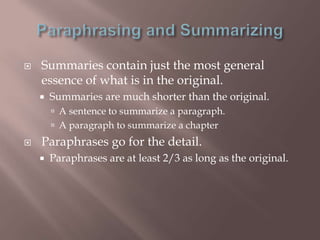
   Summaries contain just the most general
    essence of what is in the original.
       Summaries are much shorter than the original.
         A sentence to summarize a paragraph.
         A paragraph to summarize a chapter
   Paraphrases go for the detail.
       Paraphrases are at least 2/3 as long as the original.
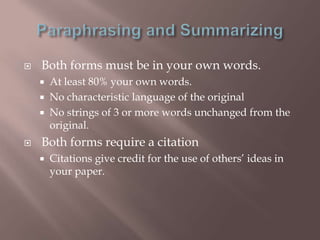
   Both forms must be in your own words.
       At least 80% your own words.
       No characteristic language of the original
       No strings of 3 or more words unchanged from the
        original.
   Both forms require a citation
       Citations give credit for the use of others‟ ideas in
        your paper.
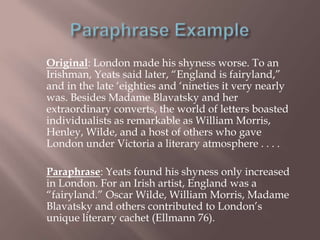
Original: London made his shyness worse. To an
Irishman, Yeats said later, “England is fairyland,”
and in the late „eighties and „nineties it very nearly
was. Besides Madame Blavatsky and her
extraordinary converts, the world of letters boasted
individualists as remarkable as William Morris,
Henley, Wilde, and a host of others who gave
London under Victoria a literary atmosphere . . . .

Paraphrase: Yeats found his shyness only increased
in London. For an Irish artist, England was a
“fairyland.” Oscar Wilde, William Morris, Madame
Blavatsky and others contributed to London‟s
unique literary cachet (Ellmann 76).
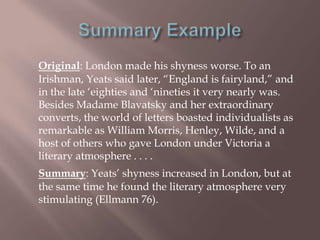
Original: London made his shyness worse. To an
Irishman, Yeats said later, “England is fairyland,” and
in the late „eighties and „nineties it very nearly was.
Besides Madame Blavatsky and her extraordinary
converts, the world of letters boasted individualists as
remarkable as William Morris, Henley, Wilde, and a
host of others who gave London under Victoria a
literary atmosphere . . . .
Summary: Yeats‟ shyness increased in London, but at
the same time he found the literary atmosphere very
stimulating (Ellmann 76).

Quoting, para

  • 1.
    Only quote when you can‟t say it any better yourself.  Or to use a person‟s words against him or her  Or if the original is of a complex, legal nature  Direct quotes should not exceed 1/5 of your total paper.
  • 2.
    Be sure to quote accurately.  Use ellipses when material is left out.  Ellipses are three periods — with a space before and after each one.  Example: “Reading carefully . . . is not optional.”  Ellipses are not necessary if it is obvious to your reader that material has been left out.  Example: Paul complained that the room was “too hot.”
  • 3.
    The first time a person is quoted, the quote must be preceded by an introduction.  An introduction contains important information about the person being quoted.  Example:  According to Mary Smith, director of pediatric research at Harvard University Medical Center, “SIDS can be prevented.”
  • 4.
    The second time a person is quoted, a simple attribution will suffice.  An attribution usually consists of a transition plus the last name of the person being quoted.  Some common attributions:  According to Smith,  Smith also points out . . . .  Smith‟s findings indicate . . . .  Smith says that . . . .
  • 5.
    Summaries contain just the most general essence of what is in the original.  Summaries are much shorter than the original.  A sentence to summarize a paragraph.  A paragraph to summarize a chapter  Paraphrases go for the detail.  Paraphrases are at least 2/3 as long as the original.
  • 6.
    Both forms must be in your own words.  At least 80% your own words.  No characteristic language of the original  No strings of 3 or more words unchanged from the original.  Both forms require a citation  Citations give credit for the use of others‟ ideas in your paper.
  • 7.
    Original: London madehis shyness worse. To an Irishman, Yeats said later, “England is fairyland,” and in the late „eighties and „nineties it very nearly was. Besides Madame Blavatsky and her extraordinary converts, the world of letters boasted individualists as remarkable as William Morris, Henley, Wilde, and a host of others who gave London under Victoria a literary atmosphere . . . . Paraphrase: Yeats found his shyness only increased in London. For an Irish artist, England was a “fairyland.” Oscar Wilde, William Morris, Madame Blavatsky and others contributed to London‟s unique literary cachet (Ellmann 76).
  • 8.
    Original: London madehis shyness worse. To an Irishman, Yeats said later, “England is fairyland,” and in the late „eighties and „nineties it very nearly was. Besides Madame Blavatsky and her extraordinary converts, the world of letters boasted individualists as remarkable as William Morris, Henley, Wilde, and a host of others who gave London under Victoria a literary atmosphere . . . . Summary: Yeats‟ shyness increased in London, but at the same time he found the literary atmosphere very stimulating (Ellmann 76).