Exposition Writing
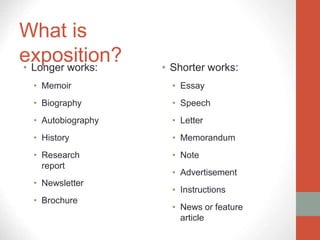
What is
exposition?
• Longer works:
• Memoir
• Biography
• Autobiography
• History
• Research
report
• Newsletter
• Brochure
• Shorter works:
• Essay
• Speech
• Letter
• Memorandum
• Note
• Advertisement
• Instructions
• News or feature
article
Why
?
• The overall purpose of writing exposition has two parts:
• You state your assertion (your opinion, perspective, your
point of view, or how you’re going to treat your subject).
• You support or back up your assertion with evidence.
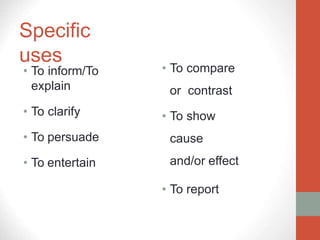
Specific
uses
• To inform/To
explain
• To clarify
• To persuade
• To entertain
• To compare
or contrast
• To show
cause
and/or effect
• To report
How do you do
it?
• First, figure out who your audience is -- that will affect
what you say and how you say it.
• Second, figure out what your purpose is -- that is the
end result, the reaction you want to get from your
audience.
Then
what? • You need to generate as
many pieces of support
(evidence) as you can to
help back up your
assertion.
What is
evidence?
• Personal experience
or observation
• Typical situations
• Hypothetical
situations
• Generalized
situations
• Facts
• Names
• Statistics
• References to
authorities
• Experts
• Documents
• Anecdotes
• Explanations
and
interpretations
• Extended or brief
• Quotations
Evidence must
be:
• Accurate
• Supportive, not contradictory
• Relevant
• Specific, detailed, precise, vivid
• Interesting
• Clear and easy to understand
• Representative (not the
exception)
• Cited, if necessary.
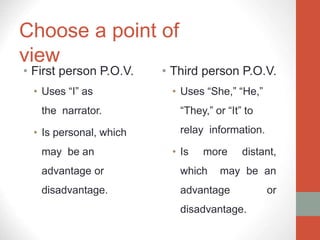
Choose a point of
view
• First person P.O.V.
• Uses “I” as
the narrator.
• Is personal, which
may be an
advantage or
disadvantage.
• Third person P.O.V.
• Uses “She,” “He,”
“They,” or “It” to
relay information.
• Is more distant,
which may be an
advantage or
disadvantage.
Thesis
statement
• A good thesis statement is clear, opinionated, and
specific.
• It relays:
• The topic of discussion.
• How you will treat that topic.
• Perhaps the focus of the discussion about that topic.
• It includes every major idea in the essay.
A special note on
structure
• An exemplification essay is usually highly structured.
• It has a stated, clearly identifiable thesis statement.
• Alas, if I cannot identify your thesis, the highest grade the
paper will receive is a “D,” so this is important!
Ways to
organize
• Chronological
• Spatial
• Emphatic
• Moderate-
Weak- Strong
• Simple to
complex
• You need:
• Strong thesis
• Clear topic sentences
-- that support the
overall thesis.
• Evidence that
supports each topic
sentence
• A clear conclusion
Transitions
• Use suitable transitional words and
phrases.
For
instance
For
example
To
illustrate
A classic
example
Als
o
In
addition
Additionall
y
•
•
•
•
•
•
•
• A case in point
is
• Avoid unimaginative transitions like “My first example
is…”
Never
!
• Never write the following types of sentences:
• “In this paragraph, I will explain…”
• In this essay, I will discuss…”
• Those are fine, even expected, in a scientific or
mathematical paper, but for the typical English paper
they are simply terrible, absolutely horrible!
• Additionally, you never really need to write:
• “I feel…” “I believe…” or “I think…” If it’s your paper, then
the reader already knows they’re your thoughts, beliefs or
feelings.
Significanc
e
• Good essays have importance; they answer a need, a
question or problem that has been posed.
• The reader never puts down the essay and says, “So
what?”
• You need to convey to your reader why your
essay is important to read.
Citing
sources
• Within the
text:
•
• After a quotation or a
paraphrase, give credit to
your source of information.
• That credit goes within
parenthesis and has a
name and a page
number, such as (Jones
6-7).
This brief reference should
point the reader to the more
detailed reference at the end
of the text.
• At the end of the text:
• Create a “Works Cited”
page where you give all of
the detailed information
where a reader could find
your specific source.
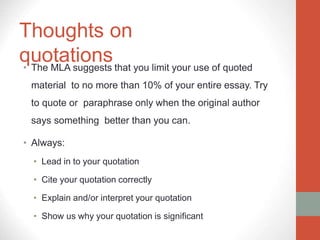
Thoughts on
quotations
• The MLA suggests that you limit your use of quoted
material to no more than 10% of your entire essay. Try
to quote or paraphrase only when the original author
says something better than you can.
• Always:
• Lead in to your quotation
• Cite your quotation correctly
• Explain and/or interpret your quotation
• Show us why your quotation is significant
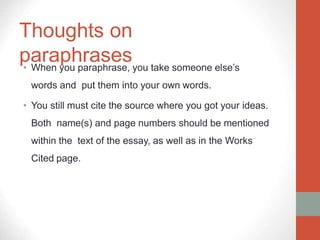
Thoughts on
paraphrases
• When you paraphrase, you take someone else’s
words and put them into your own words.
• You still must cite the source where you got your ideas.
Both name(s) and page numbers should be mentioned
within the text of the essay, as well as in the Works
Cited page.
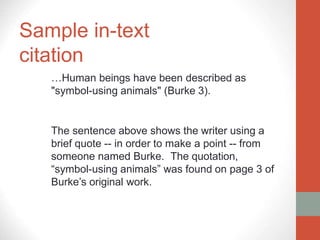
Sample in-text
citation
…Human beings have been described as
"symbol-using animals" (Burke 3).
The sentence above shows the writer using a
brief quote -- in order to make a point -- from
someone named Burke. The quotation,
“symbol-using animals” was found on page 3 of
Burke’s original work.
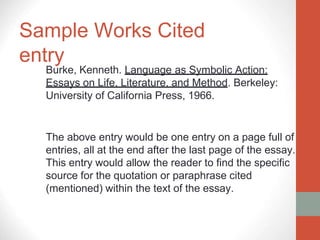
Sample Works Cited
entry
Burke, Kenneth. Language as Symbolic Action:
Essays on Life, Literature, and Method. Berkeley:
University of California Press, 1966.
The above entry would be one entry on a page full of
entries, all at the end after the last page of the essay.
This entry would allow the reader to find the specific
source for the quotation or paraphrase cited
(mentioned) within the text of the essay.
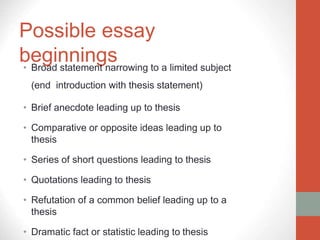
Possible essay
beginnings
• Broad statement narrowing to a limited subject
(end introduction with thesis statement)
• Brief anecdote leading up to thesis
• Comparative or opposite ideas leading up to
thesis
• Series of short questions leading to thesis
• Quotations leading to thesis
• Refutation of a common belief leading up to a
thesis
• Dramatic fact or statistic leading to thesis
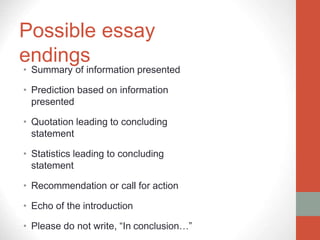
Possible essay
endings
• Summary of information presented
• Prediction based on information
presented
• Quotation leading to concluding
statement
• Statistics leading to concluding
statement
• Recommendation or call for action
• Echo of the introduction
• Please do not write, “In conclusion…”
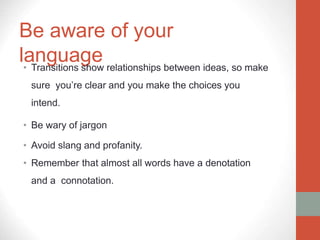
Be aware of your
language
• Transitions show relationships between ideas, so make
sure you’re clear and you make the choices you
intend.
• Be wary of jargon
• Avoid slang and profanity.
• Remember that almost all words have a denotation
and a connotation.
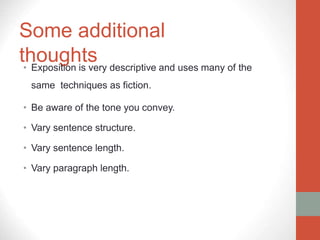
Some additional
thoughts
• Exposition is very descriptive and uses many of the
same techniques as fiction.
• Be aware of the tone you convey.
• Vary sentence structure.
• Vary sentence length.
• Vary paragraph length.
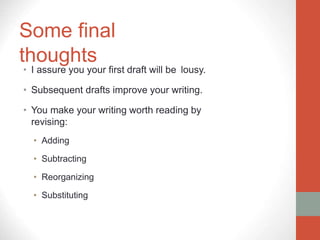
Some final
thoughts
• I assure you your first draft will be lousy.
• Subsequent drafts improve your writing.
• You make your writing worth reading by
revising:
• Adding
• Subtracting
• Reorganizing
• Substituting
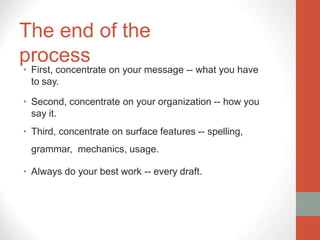
The end of the
process
• First, concentrate on your message -- what you have
to say.
• Second, concentrate on your organization -- how you
say it.
• Third, concentrate on surface features -- spelling,
grammar, mechanics, usage.
• Always do your best work -- every draft.

how to write exposition.pptx

  • 1.
  • 2.
    What is exposition? • Longerworks: • Memoir • Biography • Autobiography • History • Research report • Newsletter • Brochure • Shorter works: • Essay • Speech • Letter • Memorandum • Note • Advertisement • Instructions • News or feature article
  • 3.
    Why ? • The overallpurpose of writing exposition has two parts: • You state your assertion (your opinion, perspective, your point of view, or how you’re going to treat your subject). • You support or back up your assertion with evidence.
  • 4.
    Specific uses • To inform/To explain •To clarify • To persuade • To entertain • To compare or contrast • To show cause and/or effect • To report
  • 5.
    How do youdo it? • First, figure out who your audience is -- that will affect what you say and how you say it. • Second, figure out what your purpose is -- that is the end result, the reaction you want to get from your audience.
  • 6.
    Then what? • Youneed to generate as many pieces of support (evidence) as you can to help back up your assertion.
  • 7.
    What is evidence? • Personalexperience or observation • Typical situations • Hypothetical situations • Generalized situations • Facts • Names • Statistics • References to authorities • Experts • Documents • Anecdotes • Explanations and interpretations • Extended or brief • Quotations
  • 8.
    Evidence must be: • Accurate •Supportive, not contradictory • Relevant • Specific, detailed, precise, vivid • Interesting • Clear and easy to understand • Representative (not the exception) • Cited, if necessary.
  • 9.
    Choose a pointof view • First person P.O.V. • Uses “I” as the narrator. • Is personal, which may be an advantage or disadvantage. • Third person P.O.V. • Uses “She,” “He,” “They,” or “It” to relay information. • Is more distant, which may be an advantage or disadvantage.
  • 10.
    Thesis statement • A goodthesis statement is clear, opinionated, and specific. • It relays: • The topic of discussion. • How you will treat that topic. • Perhaps the focus of the discussion about that topic. • It includes every major idea in the essay.
  • 11.
    A special noteon structure • An exemplification essay is usually highly structured. • It has a stated, clearly identifiable thesis statement. • Alas, if I cannot identify your thesis, the highest grade the paper will receive is a “D,” so this is important!
  • 12.
    Ways to organize • Chronological •Spatial • Emphatic • Moderate- Weak- Strong • Simple to complex • You need: • Strong thesis • Clear topic sentences -- that support the overall thesis. • Evidence that supports each topic sentence • A clear conclusion
  • 13.
    Transitions • Use suitabletransitional words and phrases. For instance For example To illustrate A classic example Als o In addition Additionall y • • • • • • • • A case in point is • Avoid unimaginative transitions like “My first example is…”
  • 14.
    Never ! • Never writethe following types of sentences: • “In this paragraph, I will explain…” • In this essay, I will discuss…” • Those are fine, even expected, in a scientific or mathematical paper, but for the typical English paper they are simply terrible, absolutely horrible! • Additionally, you never really need to write: • “I feel…” “I believe…” or “I think…” If it’s your paper, then the reader already knows they’re your thoughts, beliefs or feelings.
  • 15.
    Significanc e • Good essayshave importance; they answer a need, a question or problem that has been posed. • The reader never puts down the essay and says, “So what?” • You need to convey to your reader why your essay is important to read.
  • 16.
    Citing sources • Within the text: • •After a quotation or a paraphrase, give credit to your source of information. • That credit goes within parenthesis and has a name and a page number, such as (Jones 6-7). This brief reference should point the reader to the more detailed reference at the end of the text. • At the end of the text: • Create a “Works Cited” page where you give all of the detailed information where a reader could find your specific source.
  • 17.
    Thoughts on quotations • TheMLA suggests that you limit your use of quoted material to no more than 10% of your entire essay. Try to quote or paraphrase only when the original author says something better than you can. • Always: • Lead in to your quotation • Cite your quotation correctly • Explain and/or interpret your quotation • Show us why your quotation is significant
  • 18.
    Thoughts on paraphrases • Whenyou paraphrase, you take someone else’s words and put them into your own words. • You still must cite the source where you got your ideas. Both name(s) and page numbers should be mentioned within the text of the essay, as well as in the Works Cited page.
  • 19.
    Sample in-text citation …Human beingshave been described as "symbol-using animals" (Burke 3). The sentence above shows the writer using a brief quote -- in order to make a point -- from someone named Burke. The quotation, “symbol-using animals” was found on page 3 of Burke’s original work.
  • 20.
    Sample Works Cited entry Burke,Kenneth. Language as Symbolic Action: Essays on Life, Literature, and Method. Berkeley: University of California Press, 1966. The above entry would be one entry on a page full of entries, all at the end after the last page of the essay. This entry would allow the reader to find the specific source for the quotation or paraphrase cited (mentioned) within the text of the essay.
  • 21.
    Possible essay beginnings • Broadstatement narrowing to a limited subject (end introduction with thesis statement) • Brief anecdote leading up to thesis • Comparative or opposite ideas leading up to thesis • Series of short questions leading to thesis • Quotations leading to thesis • Refutation of a common belief leading up to a thesis • Dramatic fact or statistic leading to thesis
  • 22.
    Possible essay endings • Summaryof information presented • Prediction based on information presented • Quotation leading to concluding statement • Statistics leading to concluding statement • Recommendation or call for action • Echo of the introduction • Please do not write, “In conclusion…”
  • 23.
    Be aware ofyour language • Transitions show relationships between ideas, so make sure you’re clear and you make the choices you intend. • Be wary of jargon • Avoid slang and profanity. • Remember that almost all words have a denotation and a connotation.
  • 24.
    Some additional thoughts • Expositionis very descriptive and uses many of the same techniques as fiction. • Be aware of the tone you convey. • Vary sentence structure. • Vary sentence length. • Vary paragraph length.
  • 25.
    Some final thoughts • Iassure you your first draft will be lousy. • Subsequent drafts improve your writing. • You make your writing worth reading by revising: • Adding • Subtracting • Reorganizing • Substituting
  • 26.
    The end ofthe process • First, concentrate on your message -- what you have to say. • Second, concentrate on your organization -- how you say it. • Third, concentrate on surface features -- spelling, grammar, mechanics, usage. • Always do your best work -- every draft.