They Say, I Say – Ch 3

‘AS HE HIMSELF PUTS IT’ OR
THE ART OF QUOTING
The Art of Quoting

 A quote is the use of an outside source’s exact
  words in an essay, enclosed in quotation
  marks, to support or clarify the writer’s ideas.
 The use of a quote can lend credibility to your
  summaries and ensure that you are using the
  source fairly and accurately.
Using Quotes

 A common error regarding quote occurs
  when writers assume quotes speak for
  themselves.
 There are two ways of avoiding this error:
   Choosing quotations which directly support your
    ideas
   Framing your quotes by telling who said them,
    what they mean, and explaining their connection
    to your text.
Quoting Relevant Passages

 In order to pick effective quotes, you first
  need to think about how a quote will support
  a particular point you are making.
 You may also find that as your paper evolves
  you might need to find new quotes to support
  your ideas and delete old quotes which no
  longer fit with your ideas.
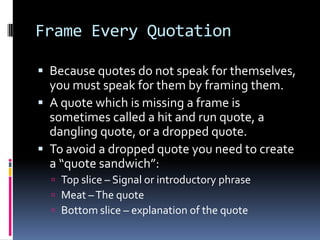
Frame Every Quotation

 Because quotes do not speak for themselves,
  you must speak for them by framing them.
 A quote which is missing a frame is
  sometimes called a hit and run quote, a
  dangling quote, or a dropped quote.
 To avoid a dropped quote you need to create
  a “quote sandwich”:
   Top slice – Signal or introductory phrase
   Meat – The quote
   Bottom slice – explanation of the quote
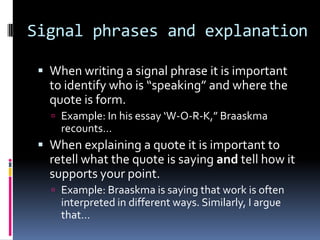
Signal phrases and explanation

  When writing a signal phrase it is important
   to identify who is “speaking” and where the
   quote is form.
    Example: In his essay ‘W-O-R-K,” Braaskma
     recounts…
  When explaining a quote it is important to
   retell what the quote is saying and tell how it
   supports your point.
    Example: Braaskma is saying that work is often
     interpreted in different ways. Similarly, I argue
     that…
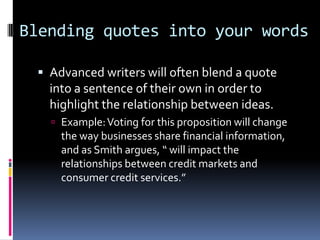
Blending quotes into your words

  Advanced writers will often blend a quote
   into a sentence of their own in order to
   highlight the relationship between ideas.
    Example: Voting for this proposition will change
     the way businesses share financial information,
     and as Smith argues, “ will impact the
     relationships between credit markets and
     consumer credit services.”

They say chapter 3

  • 1.
    They Say, ISay – Ch 3 ‘AS HE HIMSELF PUTS IT’ OR THE ART OF QUOTING
  • 2.
    The Art ofQuoting  A quote is the use of an outside source’s exact words in an essay, enclosed in quotation marks, to support or clarify the writer’s ideas.  The use of a quote can lend credibility to your summaries and ensure that you are using the source fairly and accurately.
  • 3.
    Using Quotes  Acommon error regarding quote occurs when writers assume quotes speak for themselves.  There are two ways of avoiding this error:  Choosing quotations which directly support your ideas  Framing your quotes by telling who said them, what they mean, and explaining their connection to your text.
  • 4.
    Quoting Relevant Passages In order to pick effective quotes, you first need to think about how a quote will support a particular point you are making.  You may also find that as your paper evolves you might need to find new quotes to support your ideas and delete old quotes which no longer fit with your ideas.
  • 5.
    Frame Every Quotation Because quotes do not speak for themselves, you must speak for them by framing them.  A quote which is missing a frame is sometimes called a hit and run quote, a dangling quote, or a dropped quote.  To avoid a dropped quote you need to create a “quote sandwich”:  Top slice – Signal or introductory phrase  Meat – The quote  Bottom slice – explanation of the quote
  • 6.
    Signal phrases andexplanation  When writing a signal phrase it is important to identify who is “speaking” and where the quote is form.  Example: In his essay ‘W-O-R-K,” Braaskma recounts…  When explaining a quote it is important to retell what the quote is saying and tell how it supports your point.  Example: Braaskma is saying that work is often interpreted in different ways. Similarly, I argue that…
  • 7.
    Blending quotes intoyour words  Advanced writers will often blend a quote into a sentence of their own in order to highlight the relationship between ideas.  Example: Voting for this proposition will change the way businesses share financial information, and as Smith argues, “ will impact the relationships between credit markets and consumer credit services.”