Distinguishing
What You Say
from
What They Say
Chapter 5
Who says what?
 You’ve finally put in your oars and are
participating in this much discussed conversation
that your professor keeps talking about…
 And as you move your oars around, identifying
what others are saying and then stating what you
have to say, the water churns…
 And suddenly, it’s difficult to know who is saying
what anymore because all these ideas are all
stirred together!
 So how do we keep our readers from getting
confused by what we believe versus what
others believe?
The goal:
This chapter focuses on helping
you to move away from what
others are saying to what you
are saying without confusing
your readers about who is
saying what.
Voice Markers
Before we begin, we must be able to identify
voice markers, or, voice-identifying signals.
1. So, what are voice markers?
a. Using an “I” in the text to signify when
the writer agrees or disagrees with an
author.
b. Using descriptive words to develop the
writer’s voice.
c. Words in a text that function like clues
and signal or help to distinguish the
different perspectives in an essay.
d. Ways of incorporating dialogue in an
essay.
The Answer
 Words in a text that function like clues and
signal or help to distinguish the different
perspectives in an essay.
 Writers use signal verbs to show when they
are writing about other perspectives other
than their own.
Voice Markers cont’d
2. Why should we as readers pay
attention to these voice
markers when reading an
author’s text?
a. The reader won’t know when to stop
reading.
b. The reader will lose his/her own voice while
reading.
c. Without markers, the content can be
confusing to the reader.
d. Voice markers in a reading can shed light on
The Answer
 Without markers, the content can be
confusing to the reader.
 Think of your dear reader, your professor, for
instance. Sometimes it is very difficult for me
to identify where one author’s ideas ends and
yours begins.
 This happens because I am not inside your
head: to you, the difference is very clear, but
for me, I don’t know where your thoughts
begin or end unless you put it directly on the
paper!
Wrap up: Voice Markers
1. To avoid confusion, make sure that at
every point your readers can clearly tell
who is saying what.
2. This is often easier said than done as our
own ideas become entwined with others’
ideas.
3. Therefore, consider using some of the
templates to help you make that distinction.
(See pages 71-72)
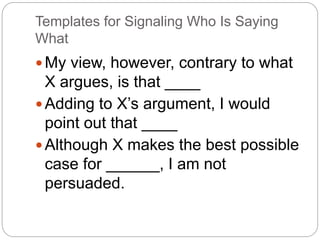
Templates for Signaling Who Is Saying
What
My view, however, contrary to what
X argues, is that ____
Adding to X’s argument, I would
point out that ____
Although X makes the best possible
case for ______, I am not
persuaded.
To I or not to I?
 For many of you, you’ve been told never to
use “I” when writing academic essays. Why?
 Some professors think it makes your essays
too subjective and self-indulgent i.e. me, me,
me!
 However, it would be very difficult to use many
of the templates in our book as well as these
voice markers to show where you stand if you
couldn’t use “I”.
 NOTE: Always check with your professor first
about using “I”. There is no set rule about
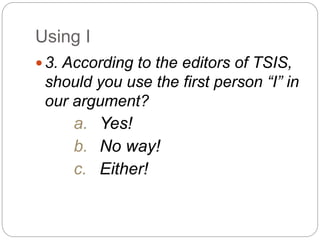
Using I
 3. According to the editors of TSIS,
should you use the first person “I” in
our argument?
a. Yes!
b. No way!
c. Either!
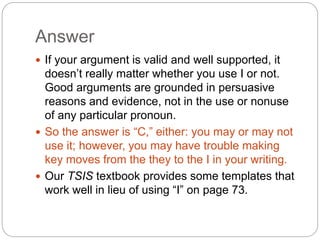
Answer
 If your argument is valid and well supported, it
doesn’t really matter whether you use I or not.
Good arguments are grounded in persuasive
reasons and evidence, not in the use or nonuse
of any particular pronoun.
 So the answer is “C,” either: you may or may not
use it; however, you may have trouble making
key moves from the they to the I in your writing.
 Our TSIS textbook provides some templates that
work well in lieu of using “I” on page 73.
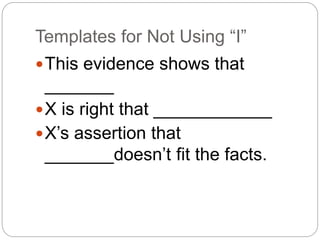
Templates for Not Using “I”
This evidence shows that
_______
X is right that ____________
X’s assertion that
_______doesn’t fit the facts.
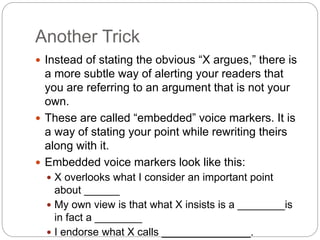
Another Trick
 Instead of stating the obvious “X argues,” there is
a more subtle way of alerting your readers that
you are referring to an argument that is not your
own.
 These are called “embedded” voice markers. It is
a way of stating your point while rewriting theirs
along with it.
 Embedded voice markers look like this:
 X overlooks what I consider an important point
about ______
 My own view is that what X insists is a ________is
in fact a ________
 I endorse what X calls _______________.
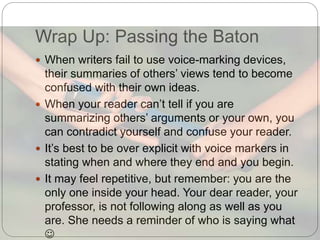
Wrap Up: Passing the Baton
 When writers fail to use voice-marking devices,
their summaries of others’ views tend to become
confused with their own ideas.
 When your reader can’t tell if you are
summarizing others’ arguments or your own, you
can contradict yourself and confuse your reader.
 It’s best to be over explicit with voice markers in
stating when and where they end and you begin.
 It may feel repetitive, but remember: you are the
only one inside your head. Your dear reader, your
professor, is not following along as well as you
are. She needs a reminder of who is saying what


They Say, I Say: Chapter 5

  • 1.
  • 2.
    Who says what? You’ve finally put in your oars and are participating in this much discussed conversation that your professor keeps talking about…  And as you move your oars around, identifying what others are saying and then stating what you have to say, the water churns…  And suddenly, it’s difficult to know who is saying what anymore because all these ideas are all stirred together!  So how do we keep our readers from getting confused by what we believe versus what others believe?
  • 3.
    The goal: This chapterfocuses on helping you to move away from what others are saying to what you are saying without confusing your readers about who is saying what.
  • 4.
    Voice Markers Before webegin, we must be able to identify voice markers, or, voice-identifying signals. 1. So, what are voice markers? a. Using an “I” in the text to signify when the writer agrees or disagrees with an author. b. Using descriptive words to develop the writer’s voice. c. Words in a text that function like clues and signal or help to distinguish the different perspectives in an essay. d. Ways of incorporating dialogue in an essay.
  • 5.
    The Answer  Wordsin a text that function like clues and signal or help to distinguish the different perspectives in an essay.  Writers use signal verbs to show when they are writing about other perspectives other than their own.
  • 6.
    Voice Markers cont’d 2.Why should we as readers pay attention to these voice markers when reading an author’s text? a. The reader won’t know when to stop reading. b. The reader will lose his/her own voice while reading. c. Without markers, the content can be confusing to the reader. d. Voice markers in a reading can shed light on
  • 7.
    The Answer  Withoutmarkers, the content can be confusing to the reader.  Think of your dear reader, your professor, for instance. Sometimes it is very difficult for me to identify where one author’s ideas ends and yours begins.  This happens because I am not inside your head: to you, the difference is very clear, but for me, I don’t know where your thoughts begin or end unless you put it directly on the paper!
  • 8.
    Wrap up: VoiceMarkers 1. To avoid confusion, make sure that at every point your readers can clearly tell who is saying what. 2. This is often easier said than done as our own ideas become entwined with others’ ideas. 3. Therefore, consider using some of the templates to help you make that distinction. (See pages 71-72)
  • 9.
    Templates for SignalingWho Is Saying What My view, however, contrary to what X argues, is that ____ Adding to X’s argument, I would point out that ____ Although X makes the best possible case for ______, I am not persuaded.
  • 10.
    To I ornot to I?  For many of you, you’ve been told never to use “I” when writing academic essays. Why?  Some professors think it makes your essays too subjective and self-indulgent i.e. me, me, me!  However, it would be very difficult to use many of the templates in our book as well as these voice markers to show where you stand if you couldn’t use “I”.  NOTE: Always check with your professor first about using “I”. There is no set rule about
  • 11.
    Using I  3.According to the editors of TSIS, should you use the first person “I” in our argument? a. Yes! b. No way! c. Either!
  • 12.
    Answer  If yourargument is valid and well supported, it doesn’t really matter whether you use I or not. Good arguments are grounded in persuasive reasons and evidence, not in the use or nonuse of any particular pronoun.  So the answer is “C,” either: you may or may not use it; however, you may have trouble making key moves from the they to the I in your writing.  Our TSIS textbook provides some templates that work well in lieu of using “I” on page 73.
  • 13.
    Templates for NotUsing “I” This evidence shows that _______ X is right that ____________ X’s assertion that _______doesn’t fit the facts.
  • 14.
    Another Trick  Insteadof stating the obvious “X argues,” there is a more subtle way of alerting your readers that you are referring to an argument that is not your own.  These are called “embedded” voice markers. It is a way of stating your point while rewriting theirs along with it.  Embedded voice markers look like this:  X overlooks what I consider an important point about ______  My own view is that what X insists is a ________is in fact a ________  I endorse what X calls _______________.
  • 15.
    Wrap Up: Passingthe Baton  When writers fail to use voice-marking devices, their summaries of others’ views tend to become confused with their own ideas.  When your reader can’t tell if you are summarizing others’ arguments or your own, you can contradict yourself and confuse your reader.  It’s best to be over explicit with voice markers in stating when and where they end and you begin.  It may feel repetitive, but remember: you are the only one inside your head. Your dear reader, your professor, is not following along as well as you are. She needs a reminder of who is saying what 