Why Reference?
Why Reference?
Yourbenefit
• To show off!
• To add authority to
your argument
• To add credibility
to your
information
Reader’s
benefit
• To understand the
context of your work
• To allow your reader to
track down your
research
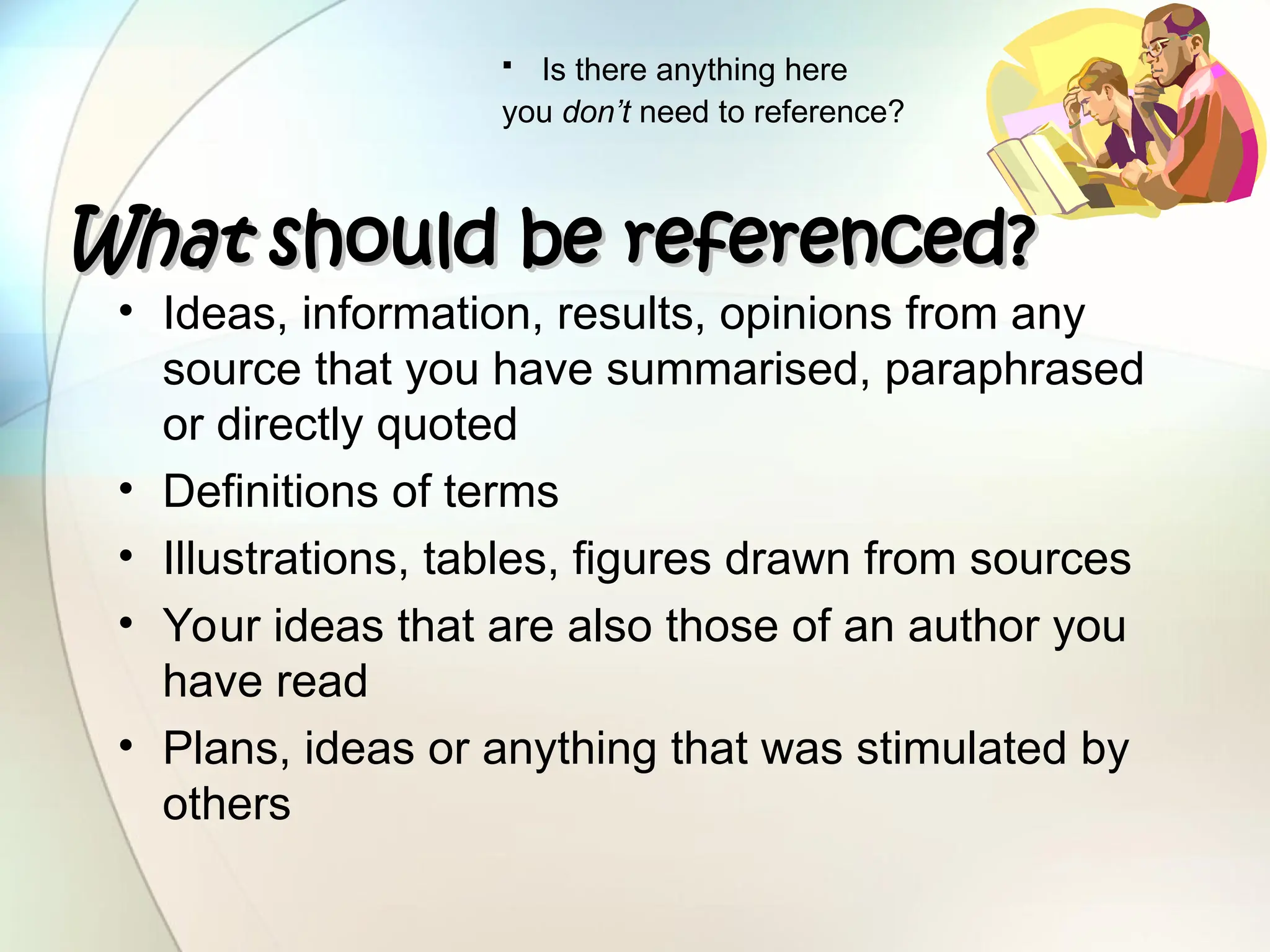
• Ideas, information,results, opinions from any
source that you have summarised, paraphrased
or directly quoted
• Definitions of terms
• Illustrations, tables, figures drawn from sources
• Your ideas that are also those of an author you
have read
• Plans, ideas or anything that was stimulated by
others
What
What should be referenced?
should be referenced?
Is there anything here
you don’t need to reference?
7.
Guiding principles
Guiding principles
•Respect the
• Creation of ideas by others
• Concept of intellectual property
• Acknowledge the ideas of others
But,
• Don’t reference “common
knowledge”
8.
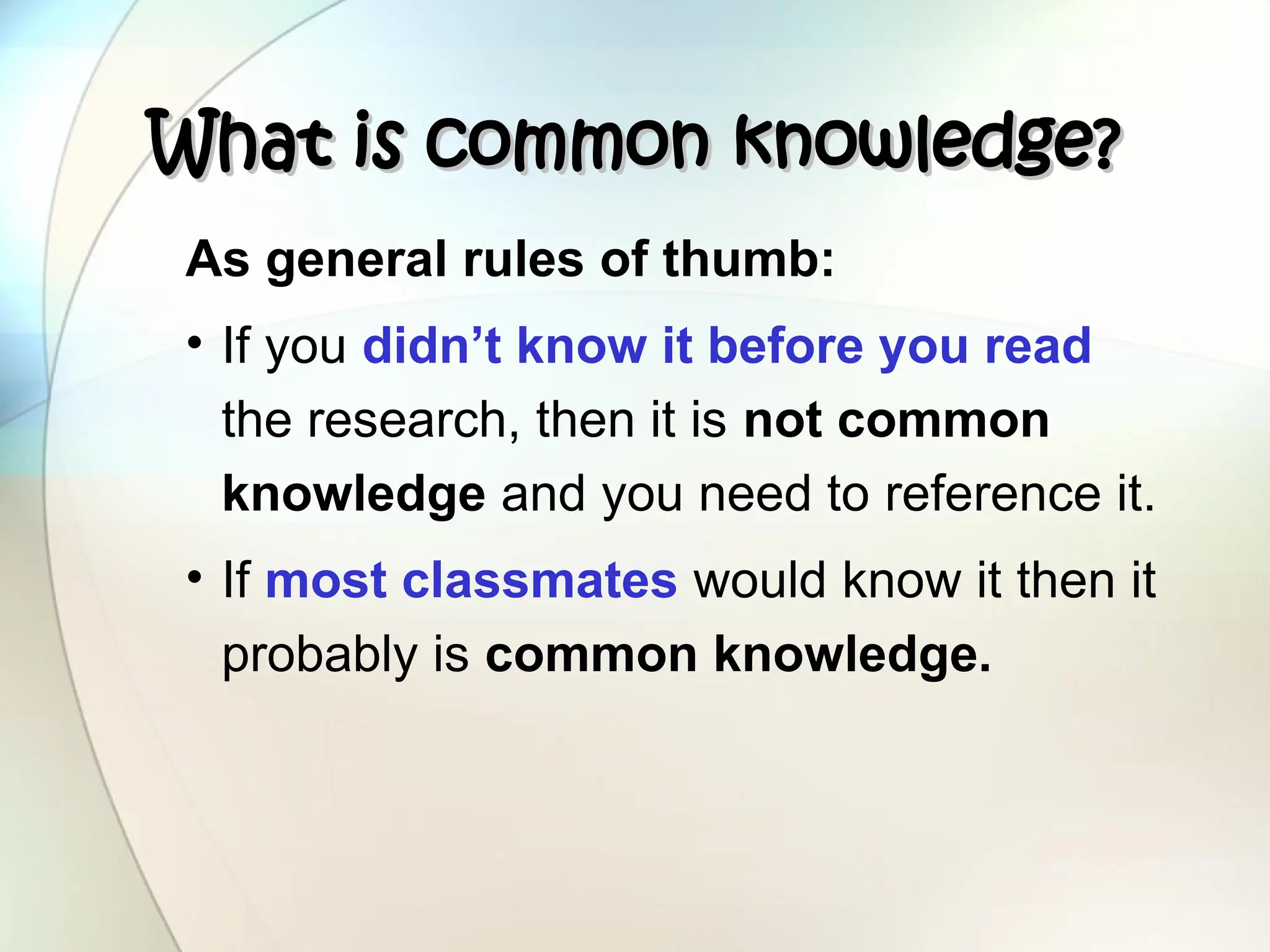
What is commonknowledge?
What is common knowledge?
As general rules of thumb:
• If you didn’t know it before you read
the research, then it is not common
knowledge and you need to reference it.
• If most classmates would know it then it
probably is common knowledge.
9.
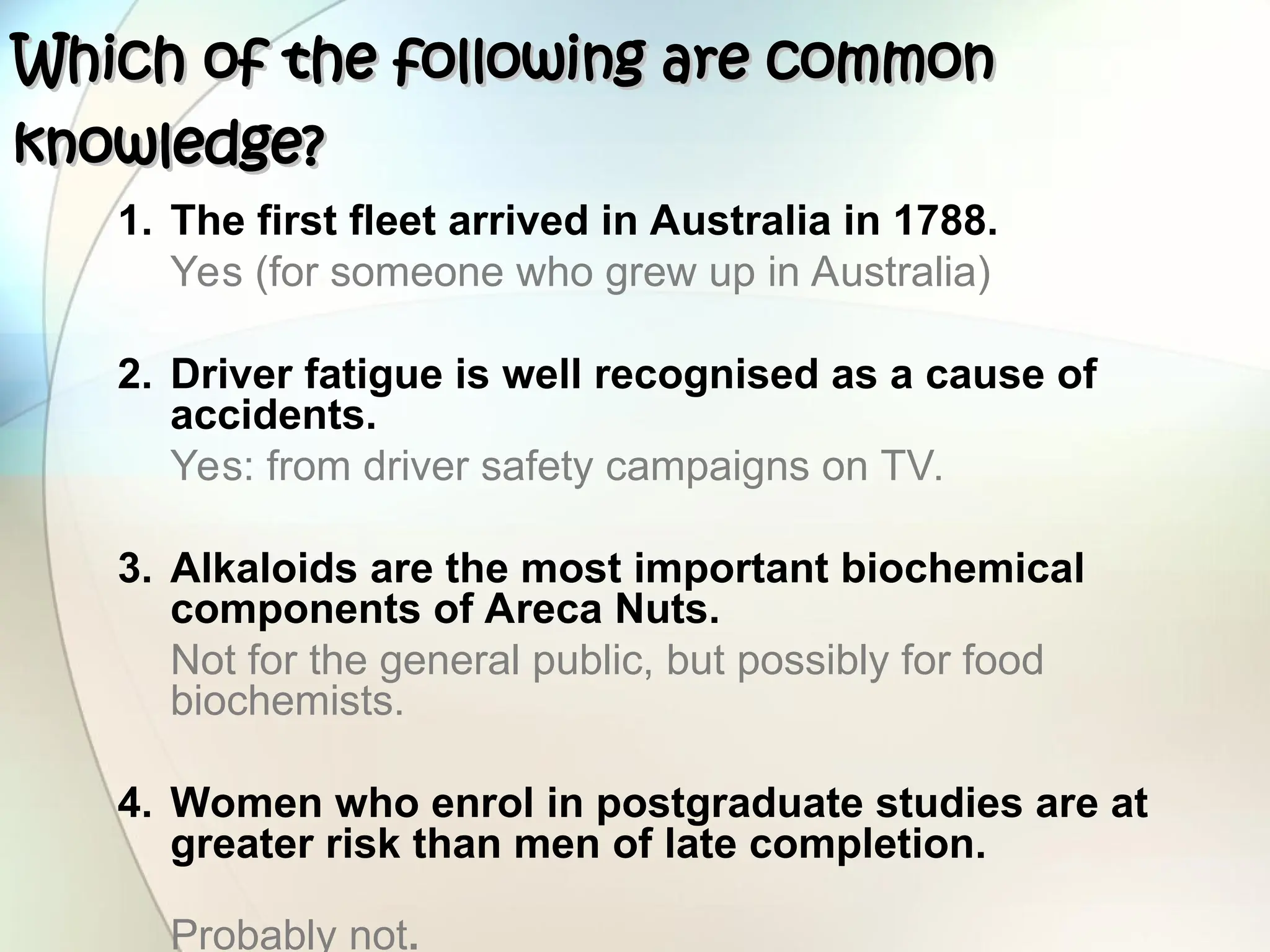
1. The firstfleet arrived in Australia in 1788.
Yes (for someone who grew up in Australia)
2. Driver fatigue is well recognised as a cause of
accidents.
Yes: from driver safety campaigns on TV.
3. Alkaloids are the most important biochemical
components of Areca Nuts.
Not for the general public, but possibly for food
biochemists.
4. Women who enrol in postgraduate studies are at
greater risk than men of late completion.
Probably not.
Which of the following are common
Which of the following are common
knowledge?
knowledge?
10.
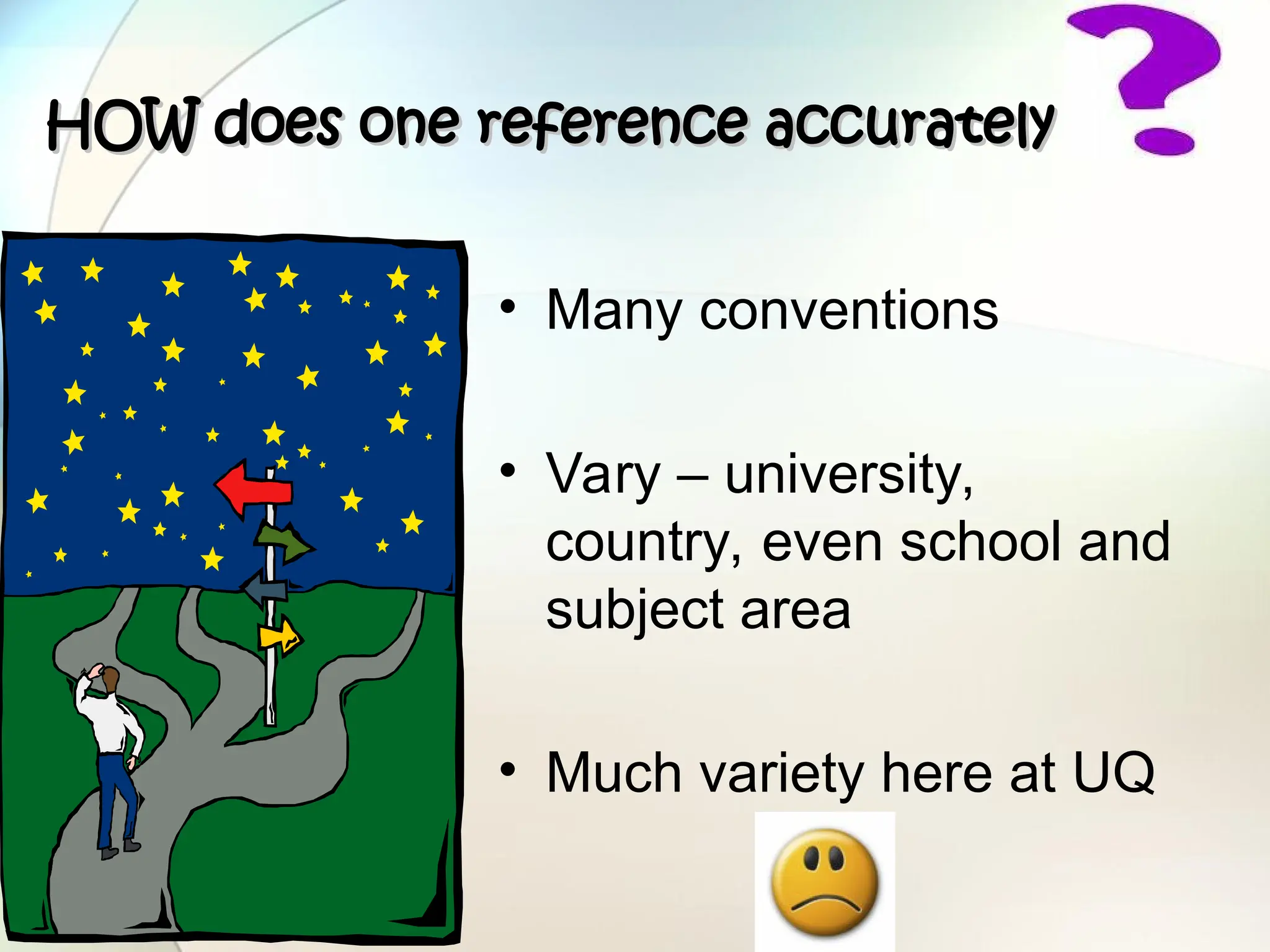
HOW does onereference accurately
HOW does one reference accurately
• Many conventions
• Vary – university,
country, even school and
subject area
• Much variety here at UQ
11.
Guidance from:
• Faculty,school or subject guides
• Software such as RefWorks, EndNote
• Library homepage
• Websites devoted to referencing!
• Articles you read
12.
Common requirements of
Commonrequirements of
all
all conventions
conventions
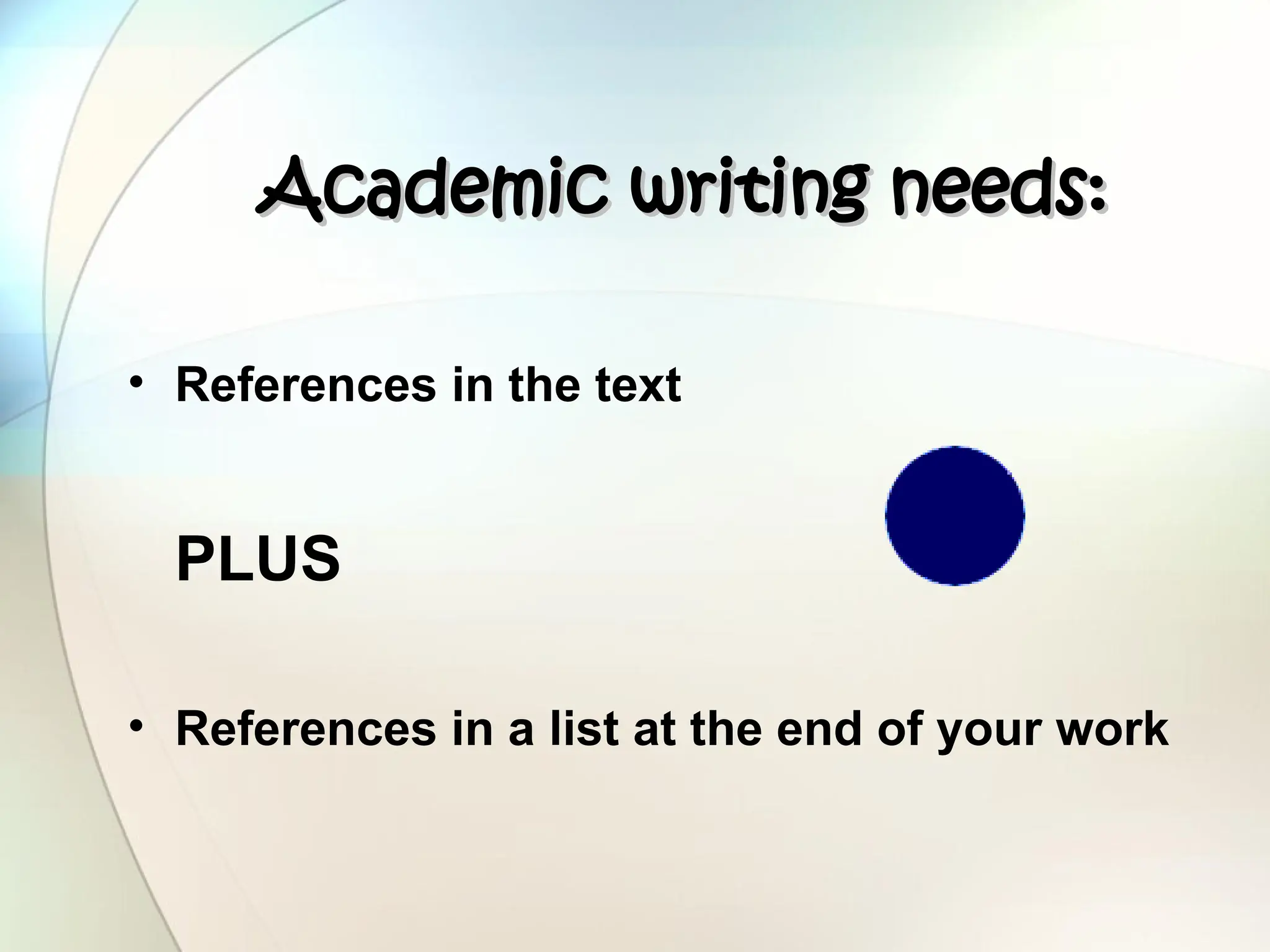
• Acknowledge within the text
• Acknowledge closely as possible to the
point
• Include all sources referred to in a list at
the end of your essay
• This list is usually called a Reference List
• Sometimes called List of Works
Consulted or Bibliography
• Include all details about the sources in
your list
13.
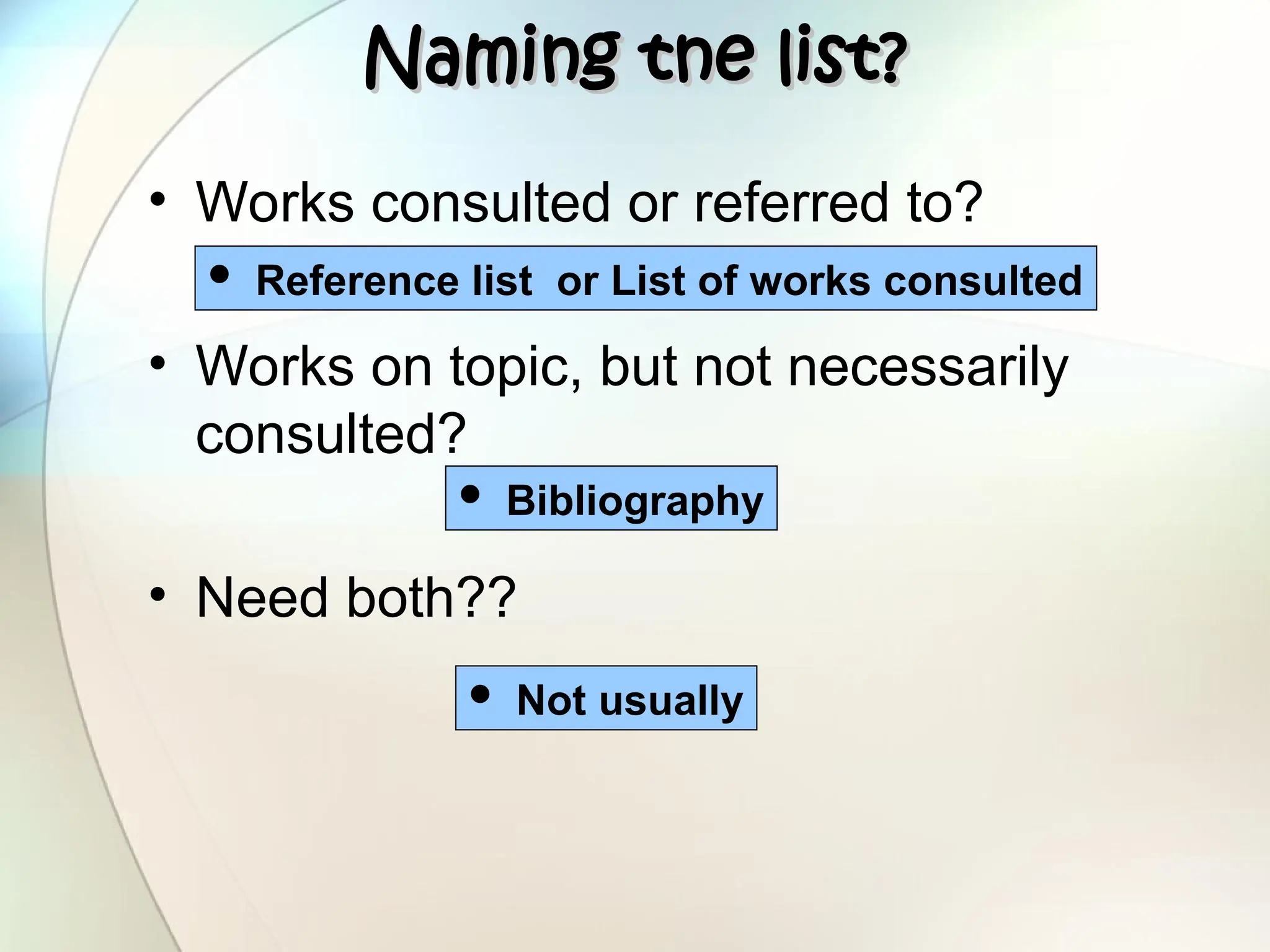
Naming tne list?
Namingtne list?
• Works consulted or referred to?
• Works on topic, but not necessarily
consulted?
• Need both??
Reference list or List of works consulted
Bibliography
Not usually
14.
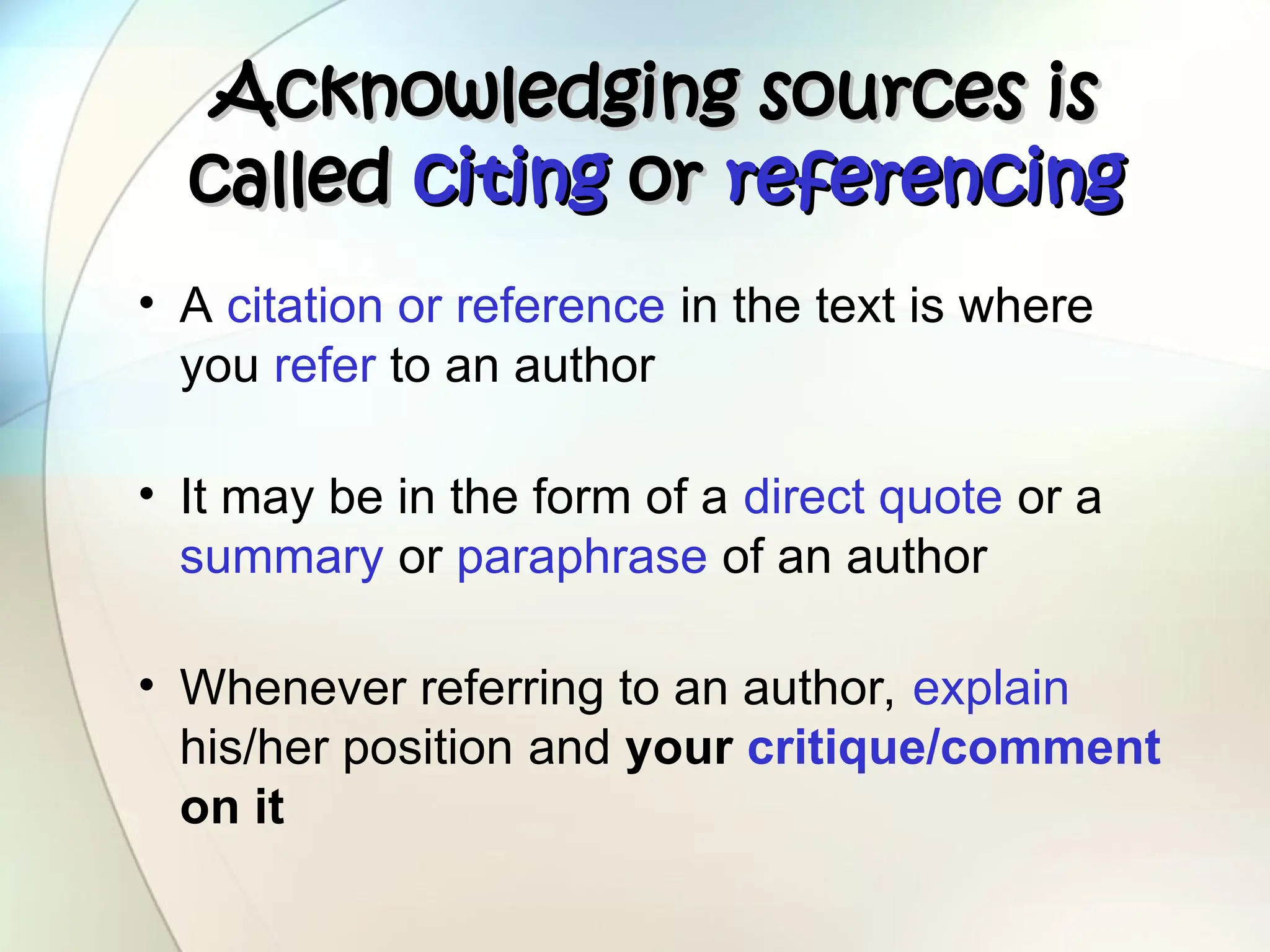
Acknowledging sources is
Acknowledgingsources is
called
called citing
citing or
or referencing
referencing
• A citation or reference in the text is where
you refer to an author
• It may be in the form of a direct quote or a
summary or paraphrase of an author
• Whenever referring to an author, explain
his/her position and your critique/comment
on it
15.
Quotations
• Use exactwords
• Use them to support or illustrate your
argument
• Avoid lengthy/frequent quotations
• Use the exact spelling and punctuation
from the source, even when it is rong [sic]!
• Quotes are not included in your word count
16.
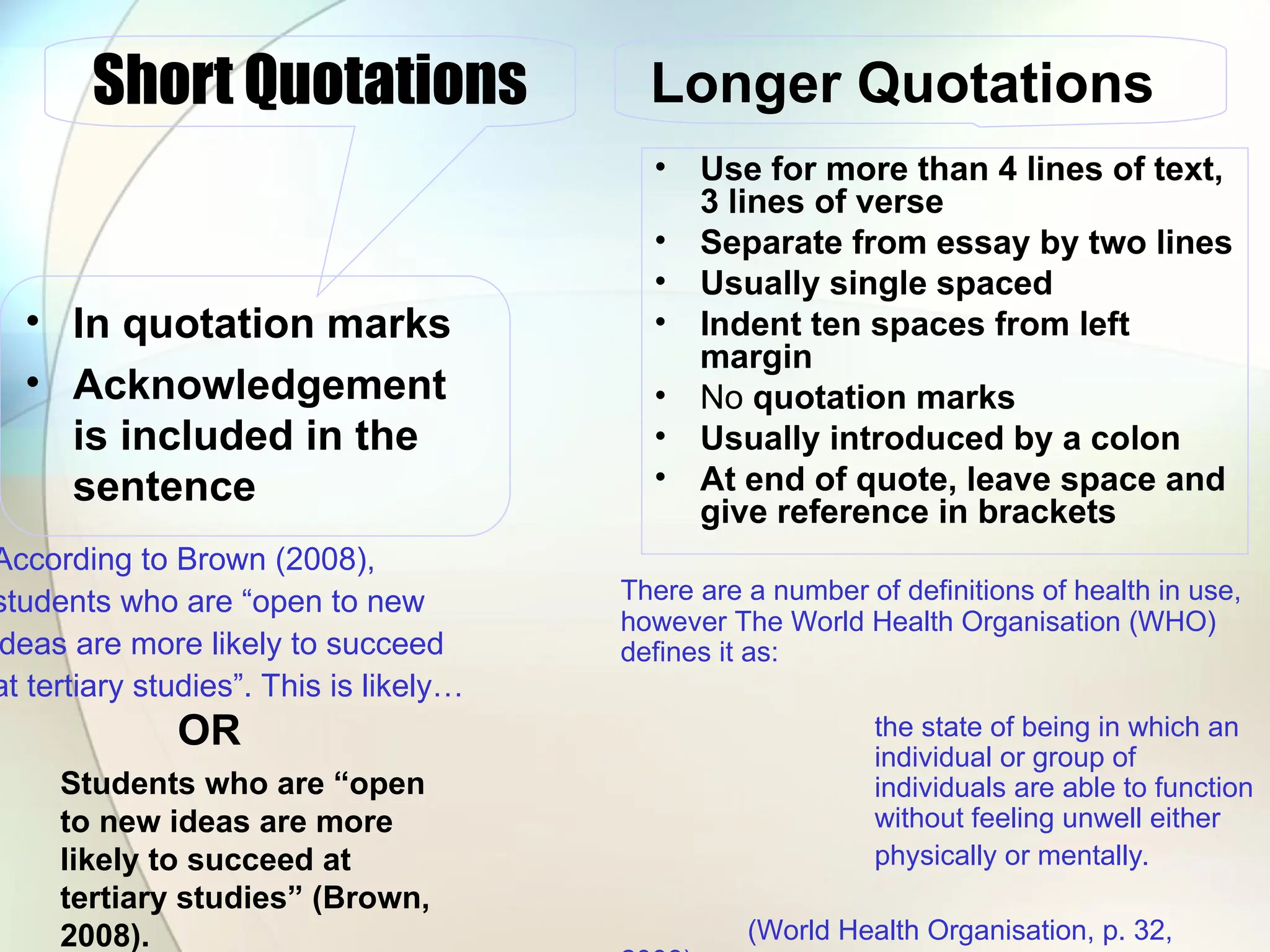
• Use formore than 4 lines of text,
3 lines of verse
• Separate from essay by two lines
• Usually single spaced
• Indent ten spaces from left
margin
• No quotation marks
• Usually introduced by a colon
• At end of quote, leave space and
give reference in brackets
Short Quotations
• In quotation marks
• Acknowledgement
is included in the
sentence
Longer Quotations
According to Brown (2008),
students who are “open to new
deas are more likely to succeed
at tertiary studies”. This is likely…
There are a number of definitions of health in use,
however The World Health Organisation (WHO)
defines it as:
the state of being in which an
individual or group of
individuals are able to function
without feeling unwell either
physically or mentally.
(World Health Organisation, p. 32,
OR
Students who are “open
to new ideas are more
likely to succeed at
tertiary studies” (Brown,
2008).
17.
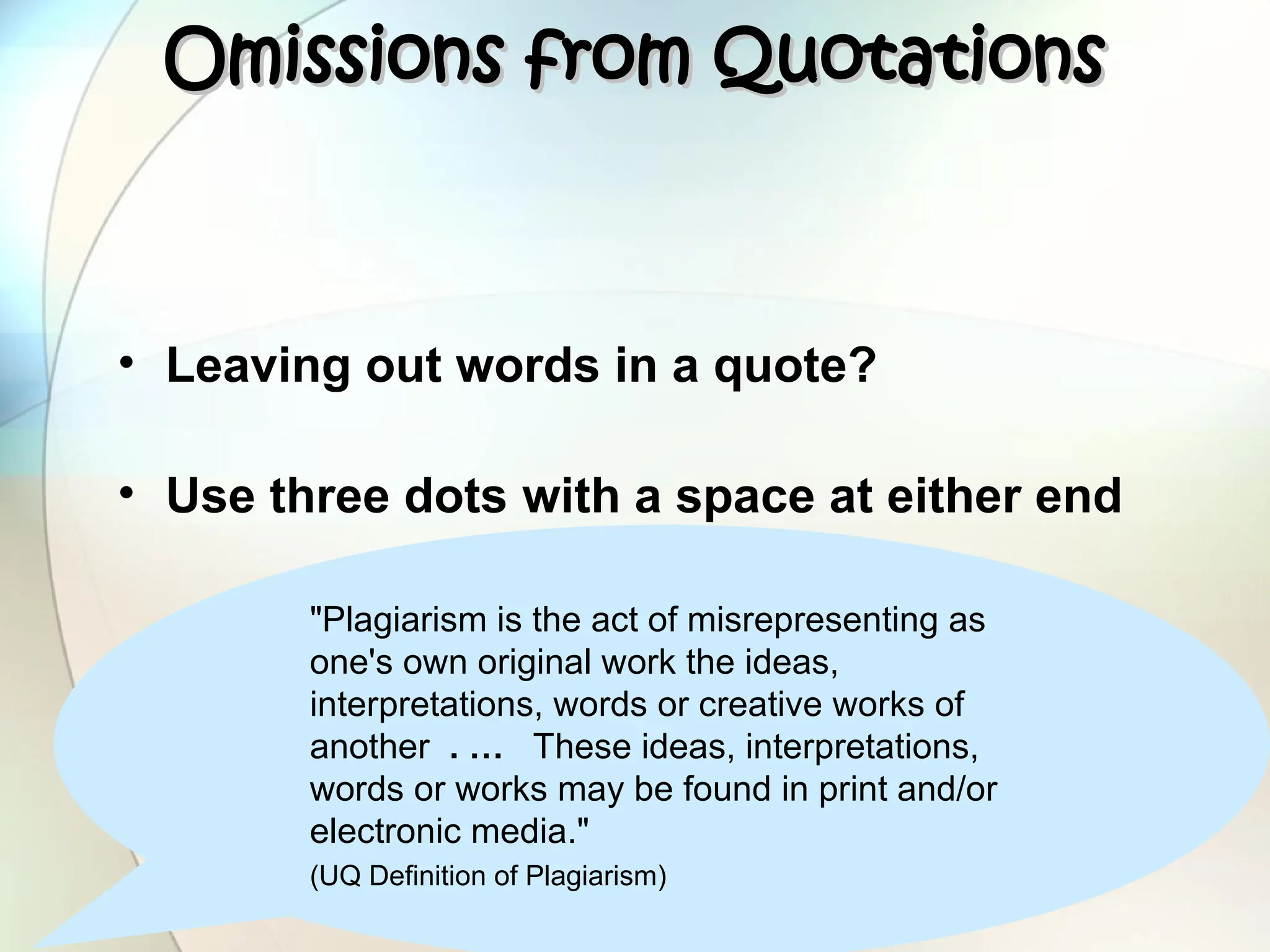
"Plagiarism is theact of misrepresenting as
one's own original work the ideas,
interpretations, words or creative works of
another . … These ideas, interpretations,
words or works may be found in print and/or
electronic media."
(UQ Definition of Plagiarism)
Omissions from Quotations
Omissions from Quotations
• Leaving out words in a quote?
• Use three dots with a space at either end
18.
Additions to quotations
Additionsto quotations
• Inside the quote:
• Use square [---] brackets
• This shows your comment, explanation
• [sic] shows your accuracy of
transcription but an error in the original
• Use of italics indicates your emphasis
of words
19.
Square bracket examples:
Squarebracket examples:
It is the “disparate
expectations of
language [which]
contribute to
misunderstanding
and confusion
between staff and
their students”
(Meyer, 1988,
p.89).
… but plagiarism is
literary fraud whereby
‘one writer sets forth
the words or ideas of
another writer as his
[sic] own in order to get
gain’ (Hatch, 1992,
p.12).
20.
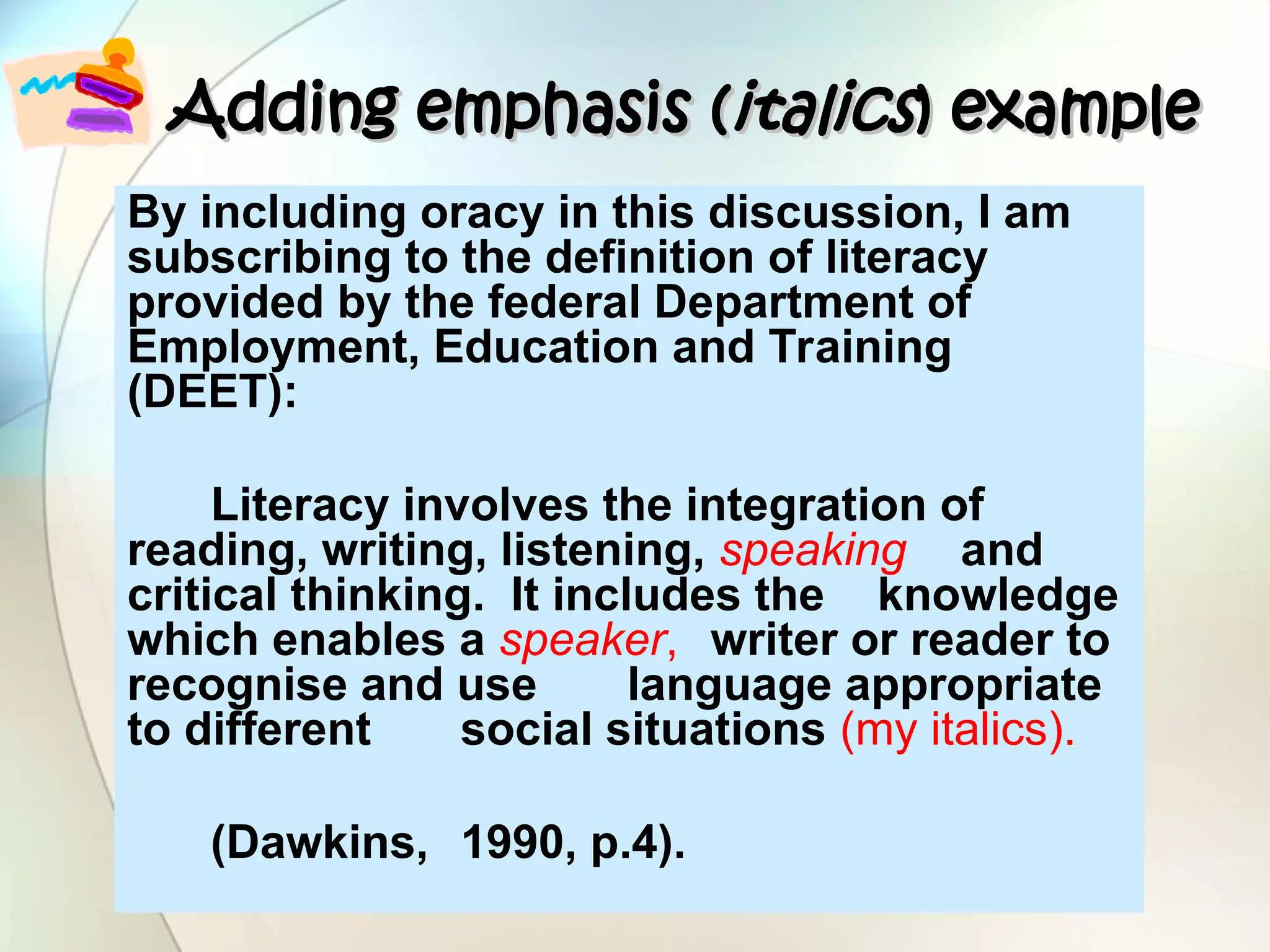
Adding emphasis (
Addingemphasis (italics
italics) example
) example
By including oracy in this discussion, I am
subscribing to the definition of literacy
provided by the federal Department of
Employment, Education and Training
(DEET):
Literacy involves the integration of
reading, writing, listening, speaking and
critical thinking. It includes the knowledge
which enables a speaker, writer or reader to
recognise and use language appropriate
to different social situations (my italics).
(Dawkins, 1990, p.4).
21.
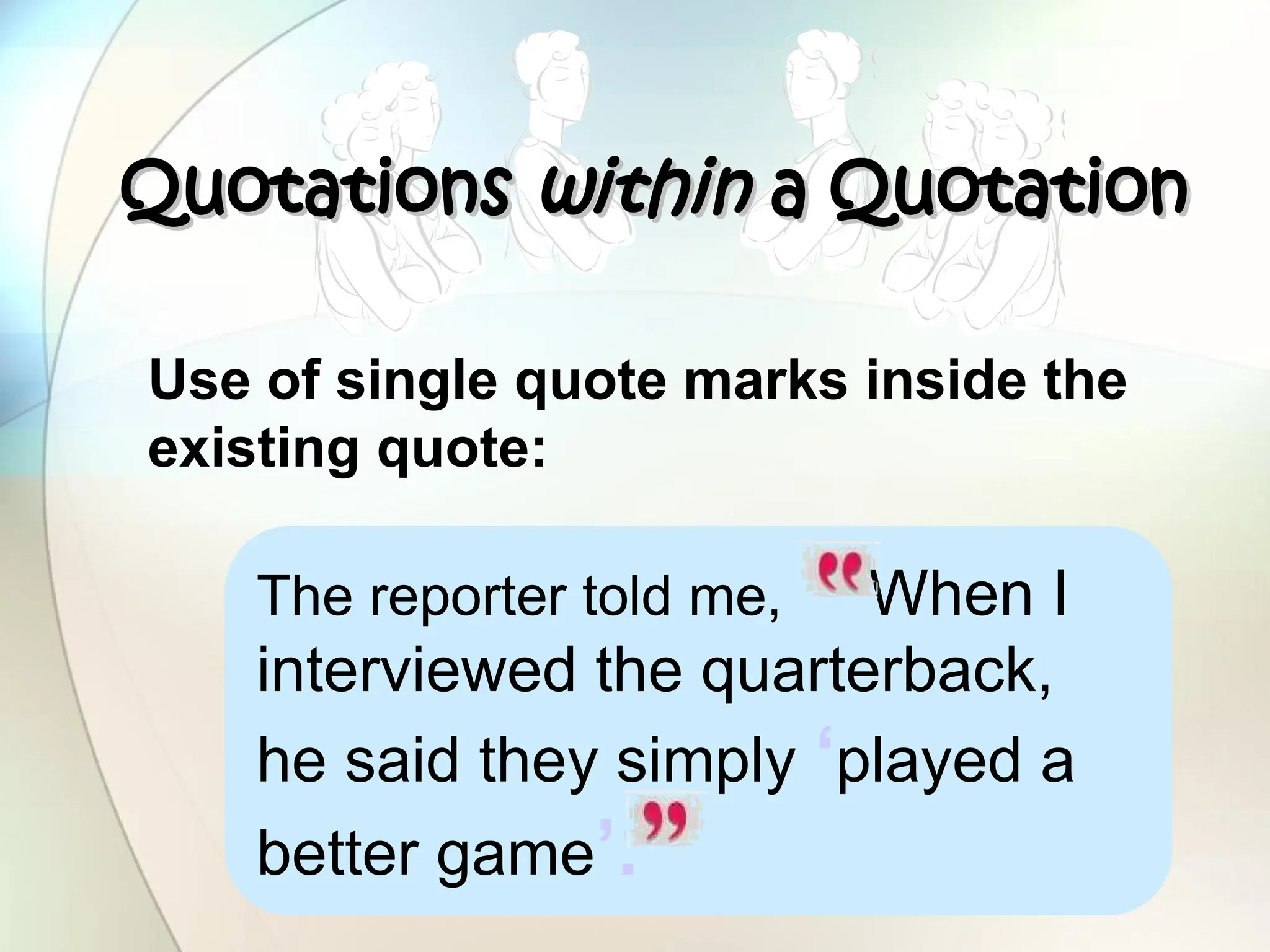
The reporter toldme, When I
interviewed the quarterback,
he said they simply ‘played a
better game’.
Quotations
Quotations within
within a Quotation
a Quotation
Use of single quote marks inside the
existing quote:
22.
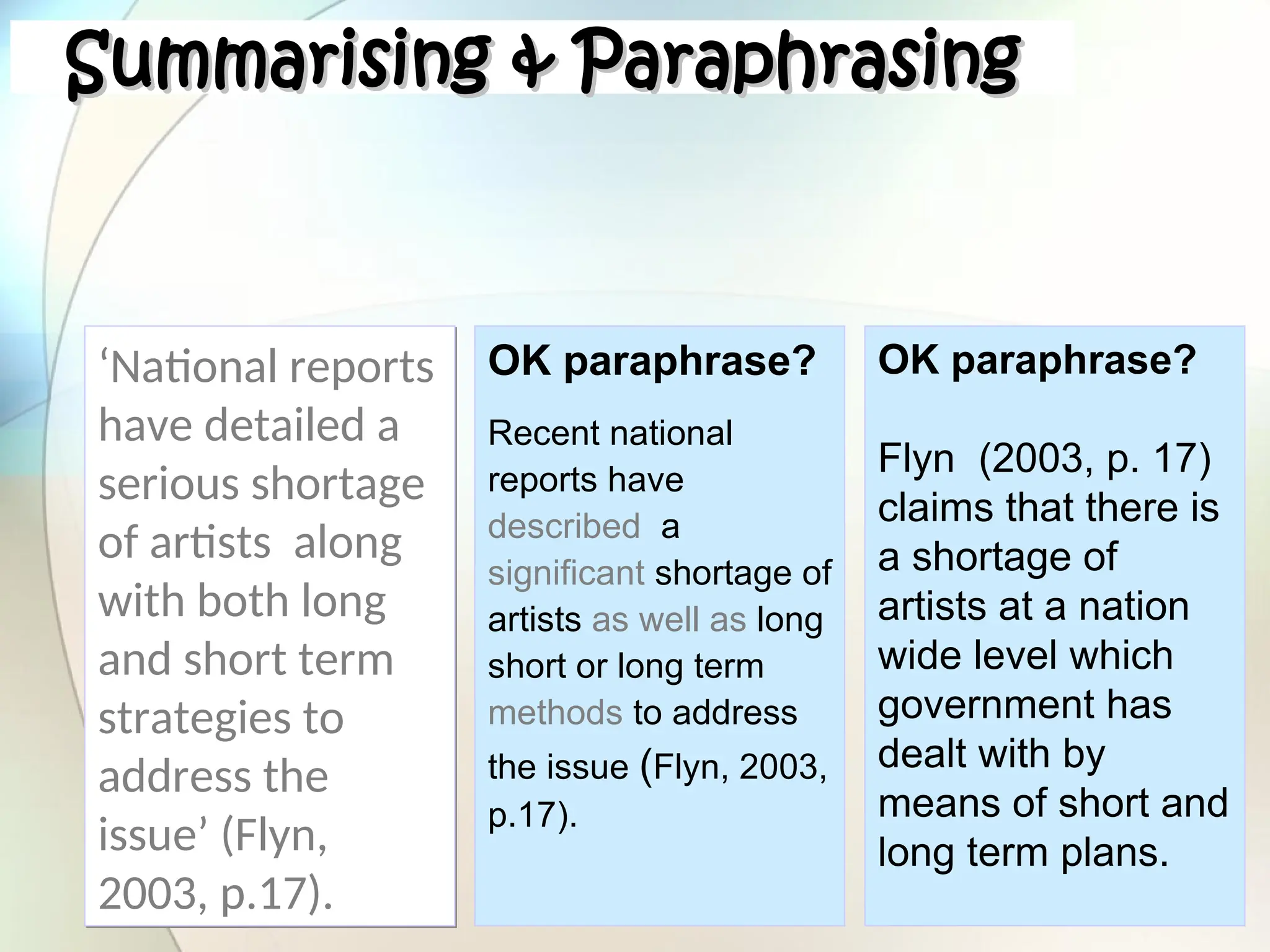
OK paraphrase?
Flyn (2003,p. 17)
claims that there is
a shortage of
artists at a nation
wide level which
government has
dealt with by
means of short and
long term plans.
Summarising & Paraphrasing
Summarising & Paraphrasing
OK paraphrase?
Recent national
reports have
described a
significant shortage of
artists as well as long
short or long term
methods to address
the issue (Flyn, 2003,
p.17).
‘National reports
have detailed a
serious shortage
of artists along
with both long
and short term
strategies to
address the
issue’ (Flyn,
2003, p.17).
23.
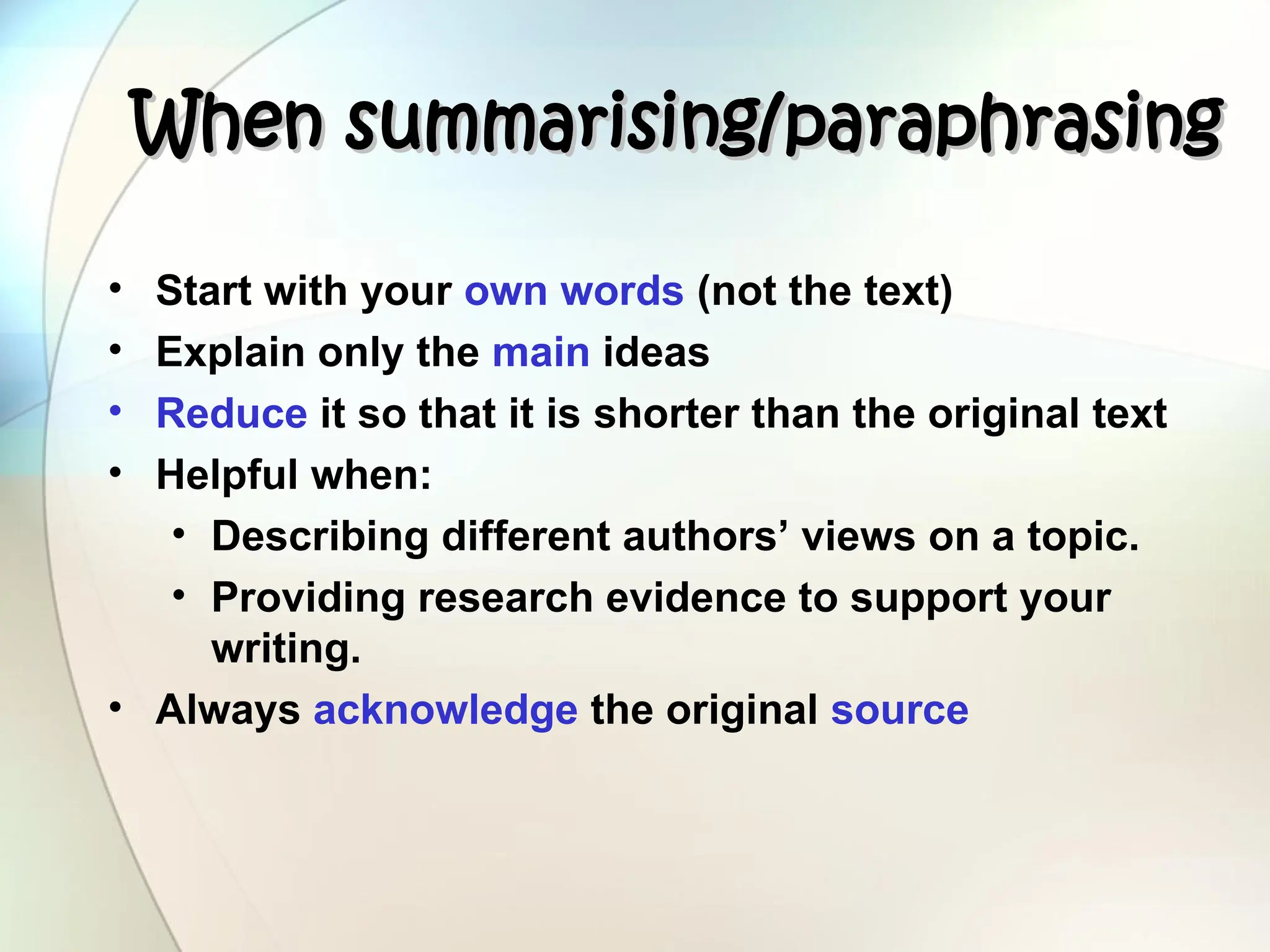
When summarising/paraphrasing
When summarising/paraphrasing
•Start with your own words (not the text)
• Explain only the main ideas
• Reduce it so that it is shorter than the original text
• Helpful when:
• Describing different authors’ views on a topic.
• Providing research evidence to support your
writing.
• Always acknowledge the original source
24.
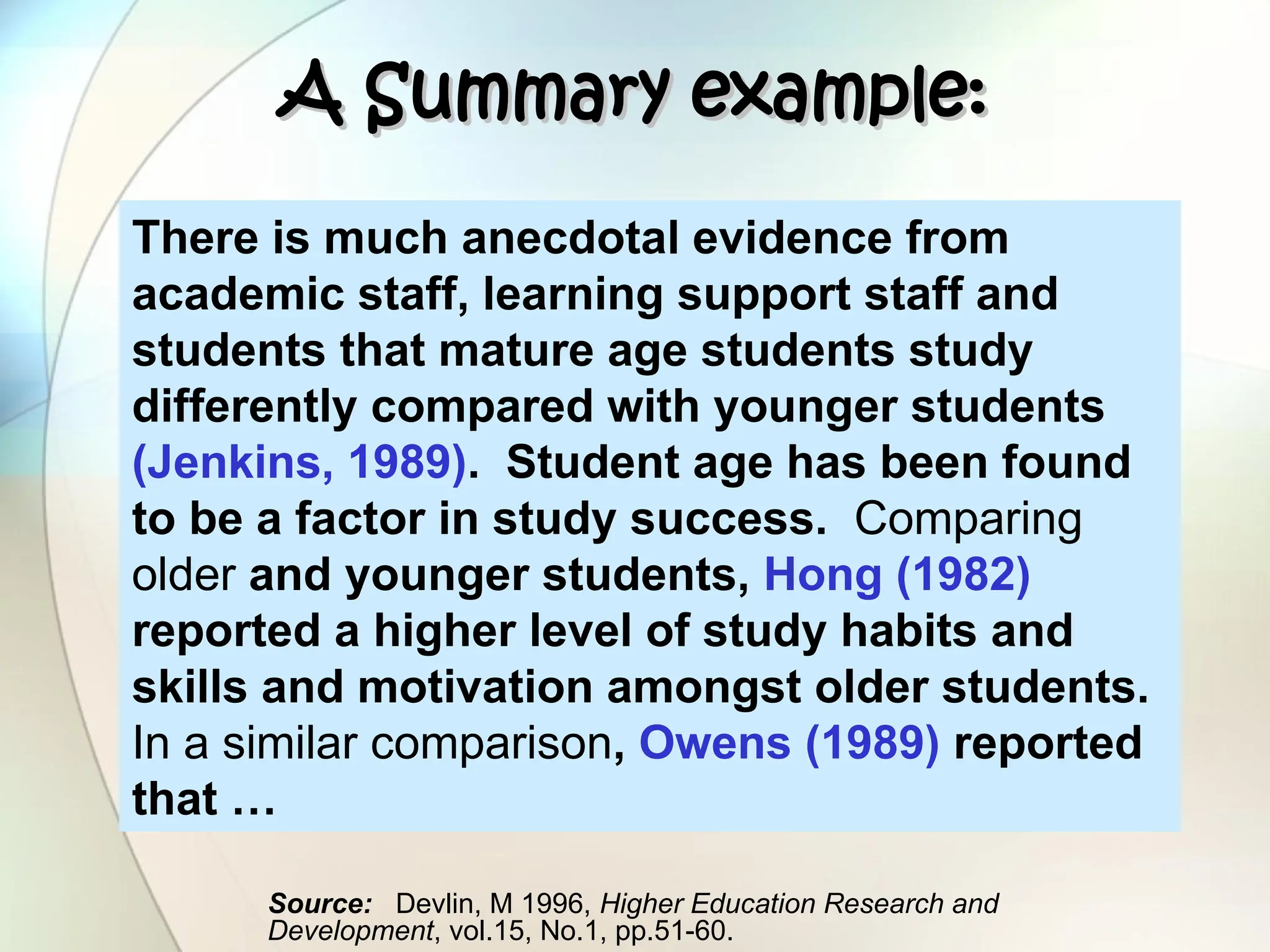
A Summary example:
ASummary example:
There is much anecdotal evidence from
academic staff, learning support staff and
students that mature age students study
differently compared with younger students
(Jenkins, 1989). Student age has been found
to be a factor in study success. Comparing
older and younger students, Hong (1982)
reported a higher level of study habits and
skills and motivation amongst older students.
In a similar comparison, Owens (1989) reported
that …
Source: Devlin, M 1996, Higher Education Research and
Development, vol.15, No.1, pp.51-60.
25.
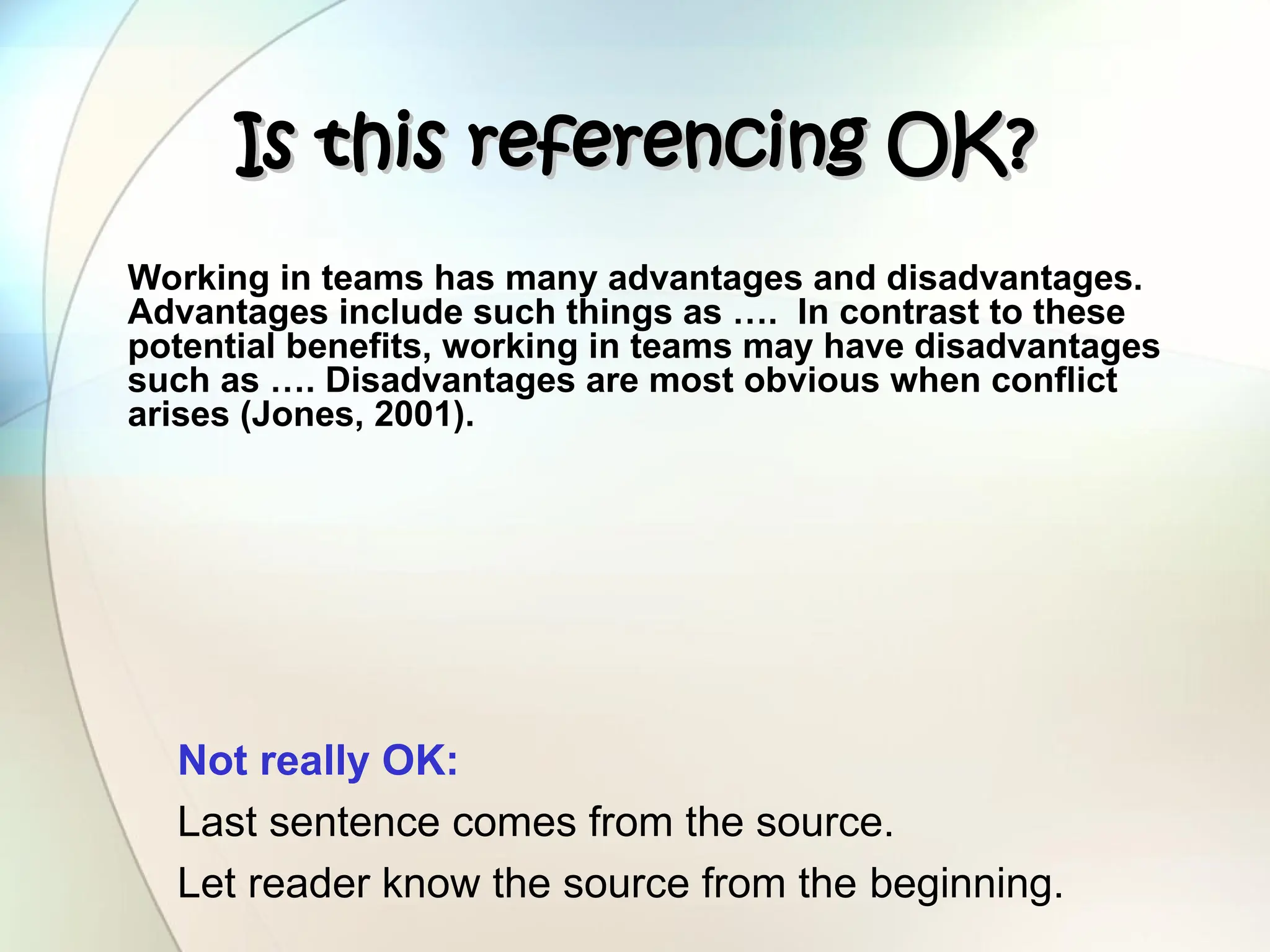
Is this referencingOK?
Is this referencing OK?
Working in teams has many advantages and disadvantages.
Advantages include such things as …. In contrast to these
potential benefits, working in teams may have disadvantages
such as …. Disadvantages are most obvious when conflict
arises (Jones, 2001).
Not really OK:
Last sentence comes from the source.
Let reader know the source from the beginning.
26.
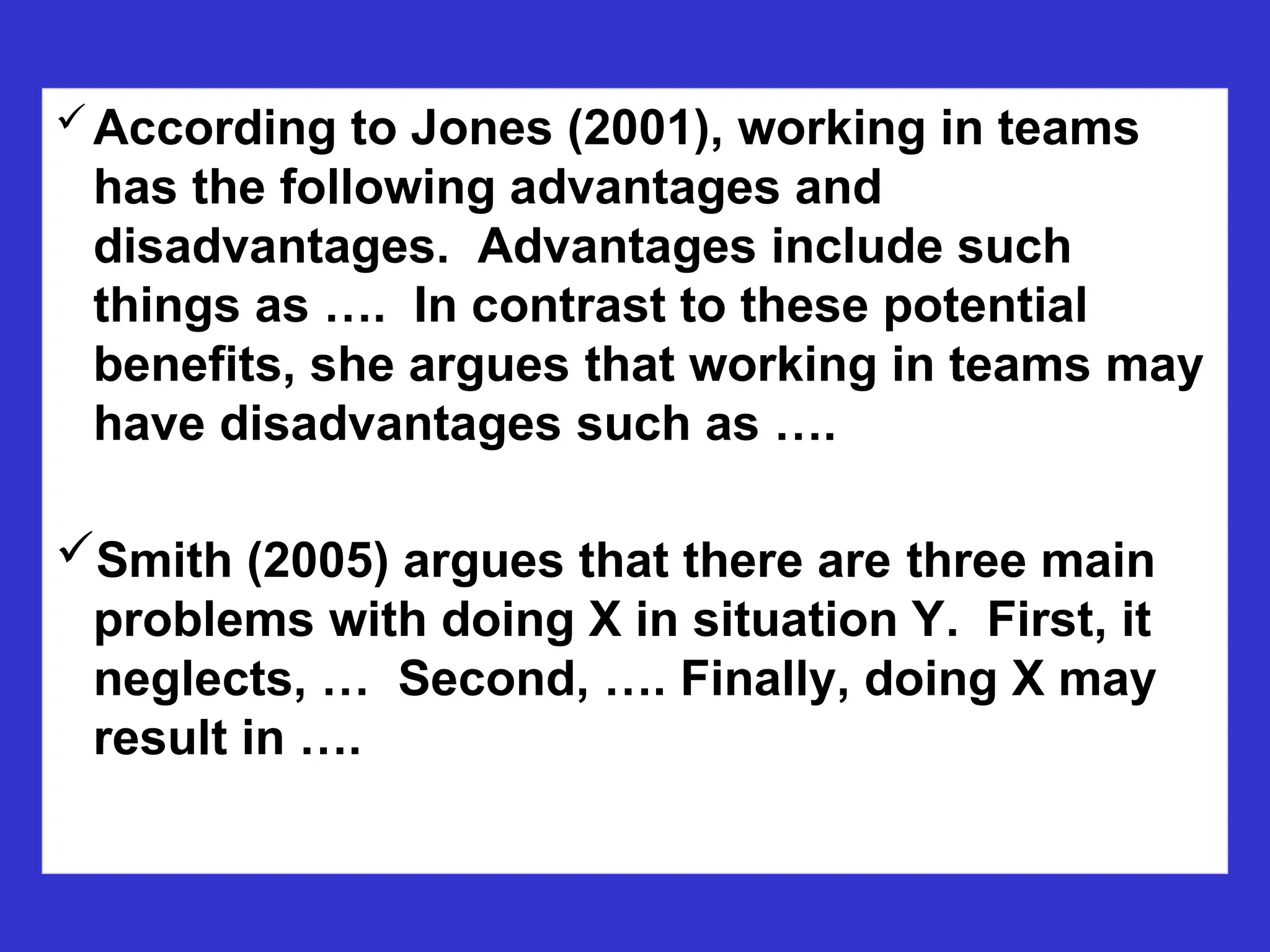
According to Jones(2001), working in teams
has the following advantages and
disadvantages. Advantages include such
things as …. In contrast to these potential
benefits, she argues that working in teams may
have disadvantages such as ….
Smith (2005) argues that there are three main
problems with doing X in situation Y. First, it
neglects, … Second, …. Finally, doing X may
result in ….
27.
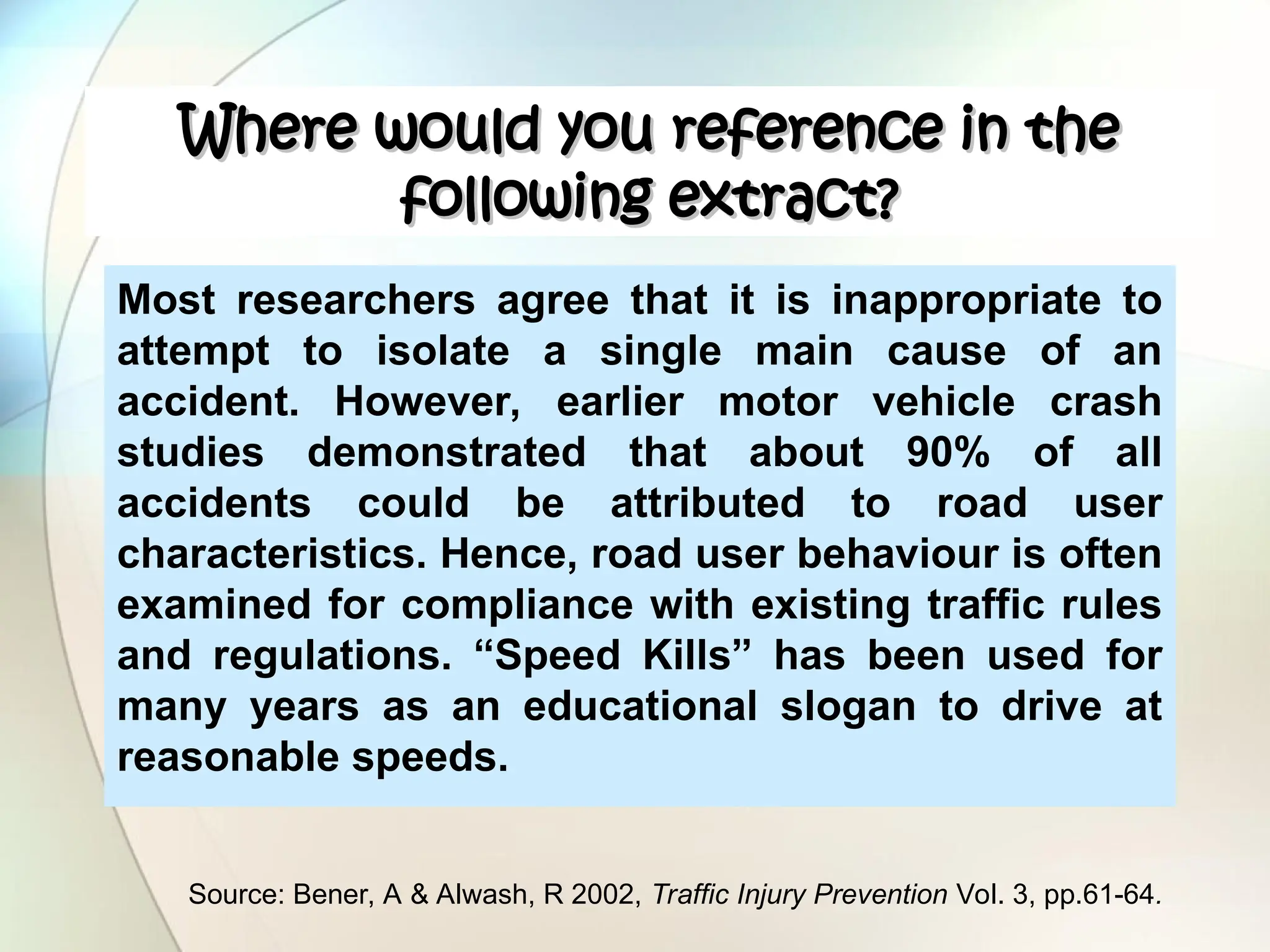
Where would youreference in the
Where would you reference in the
following extract?
following extract?
Most researchers agree that it is inappropriate to
attempt to isolate a single main cause of an
accident. However, earlier motor vehicle crash
studies demonstrated that about 90% of all
accidents could be attributed to road user
characteristics. Hence, road user behaviour is often
examined for compliance with existing traffic rules
and regulations. “Speed Kills” has been used for
many years as an educational slogan to drive at
reasonable speeds.
Source: Bener, A & Alwash, R 2002, Traffic Injury Prevention Vol. 3, pp.61-64.
28.
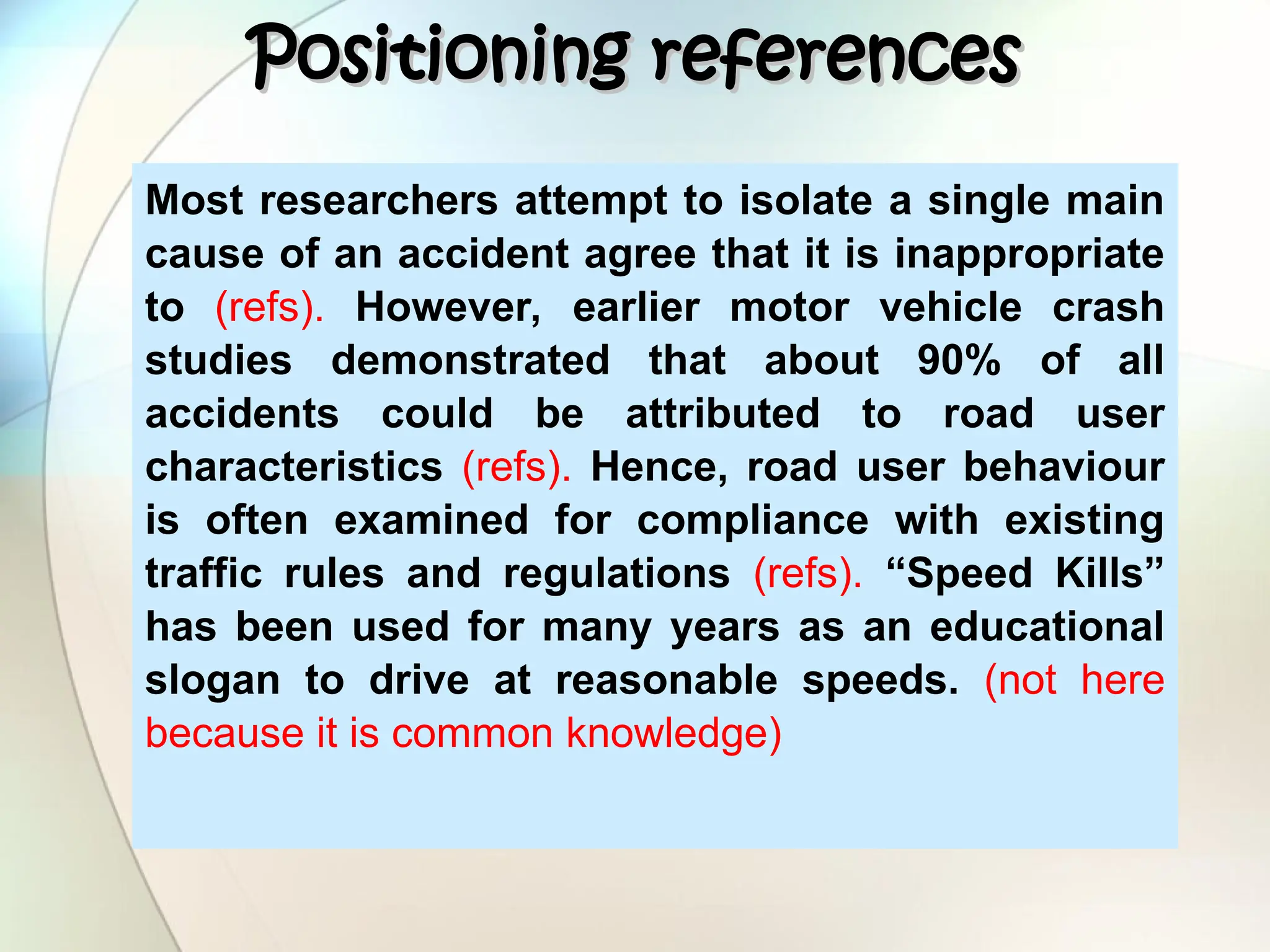
Positioning references
Positioning references
Mostresearchers attempt to isolate a single main
cause of an accident agree that it is inappropriate
to (refs). However, earlier motor vehicle crash
studies demonstrated that about 90% of all
accidents could be attributed to road user
characteristics (refs). Hence, road user behaviour
is often examined for compliance with existing
traffic rules and regulations (refs). “Speed Kills”
has been used for many years as an educational
slogan to drive at reasonable speeds. (not here
because it is common knowledge)
29.
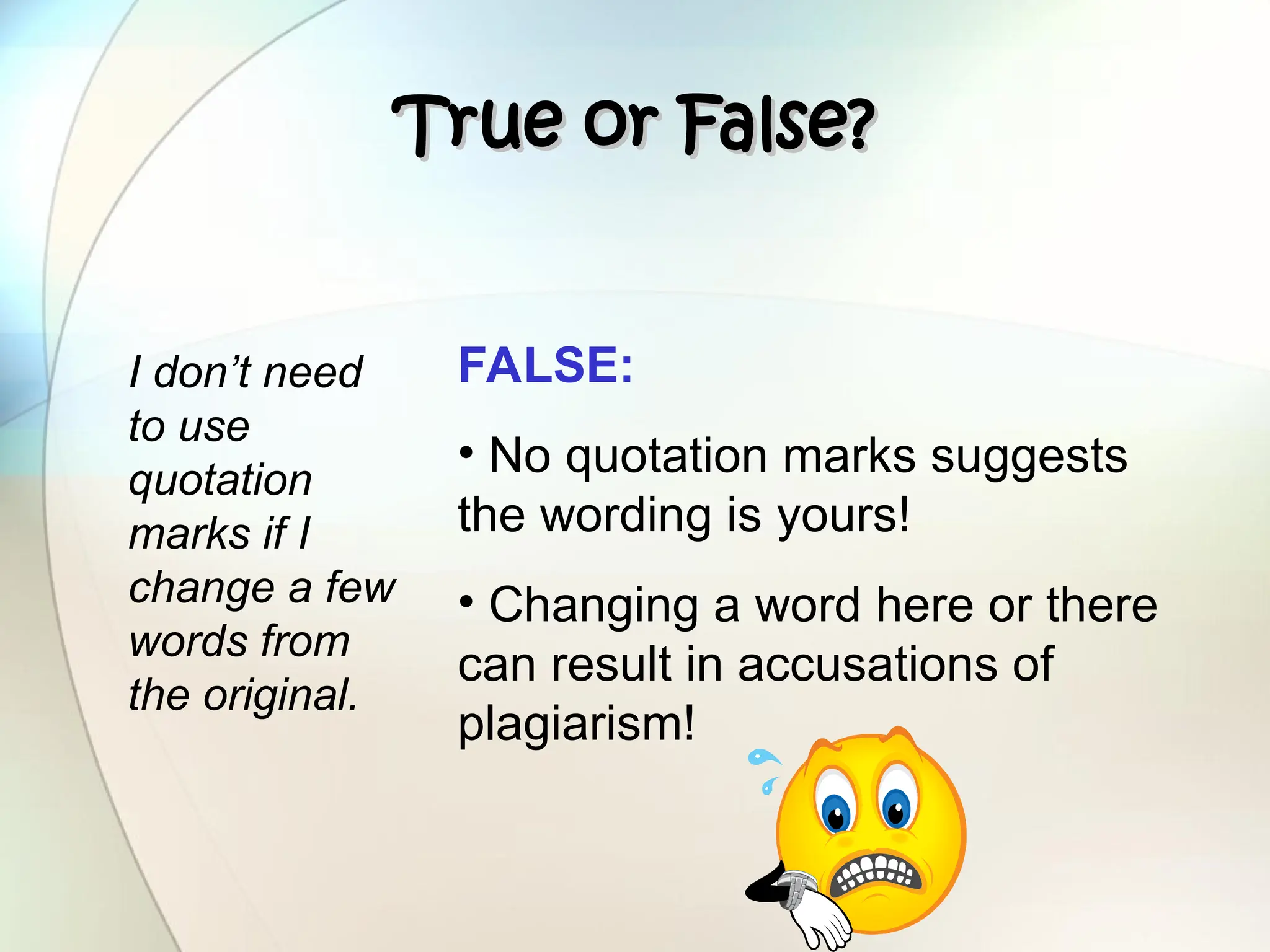
True or False?
Trueor False?
I don’t need
to use
quotation
marks if I
change a few
words from
the original.
FALSE:
• No quotation marks suggests
the wording is yours!
• Changing a word here or there
can result in accusations of
plagiarism!
30.
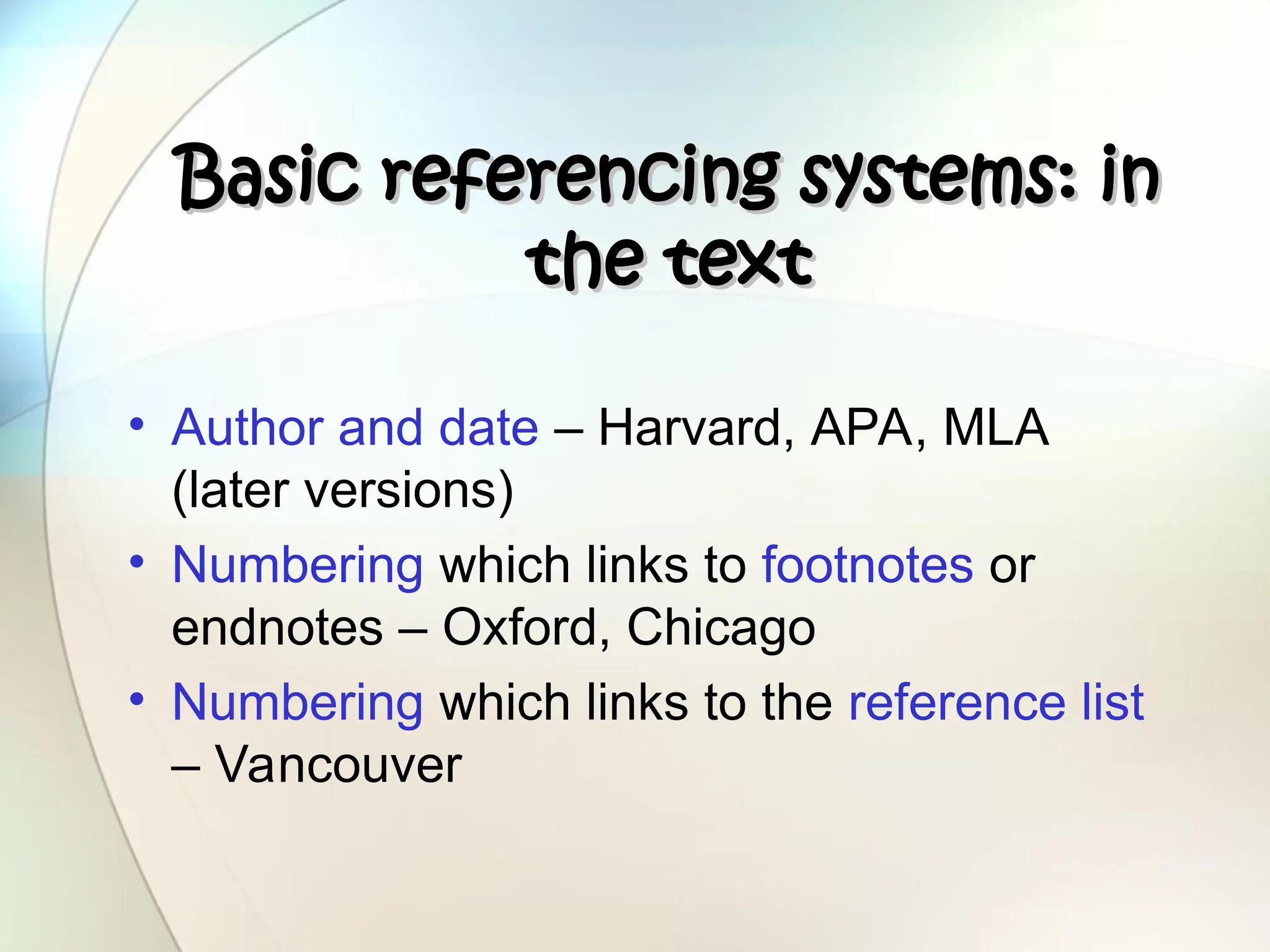
Basic referencing systems:in
Basic referencing systems: in
the text
the text
• Author and date – Harvard, APA, MLA
(later versions)
• Numbering which links to footnotes or
endnotes – Oxford, Chicago
• Numbering which links to the reference list
– Vancouver
31.
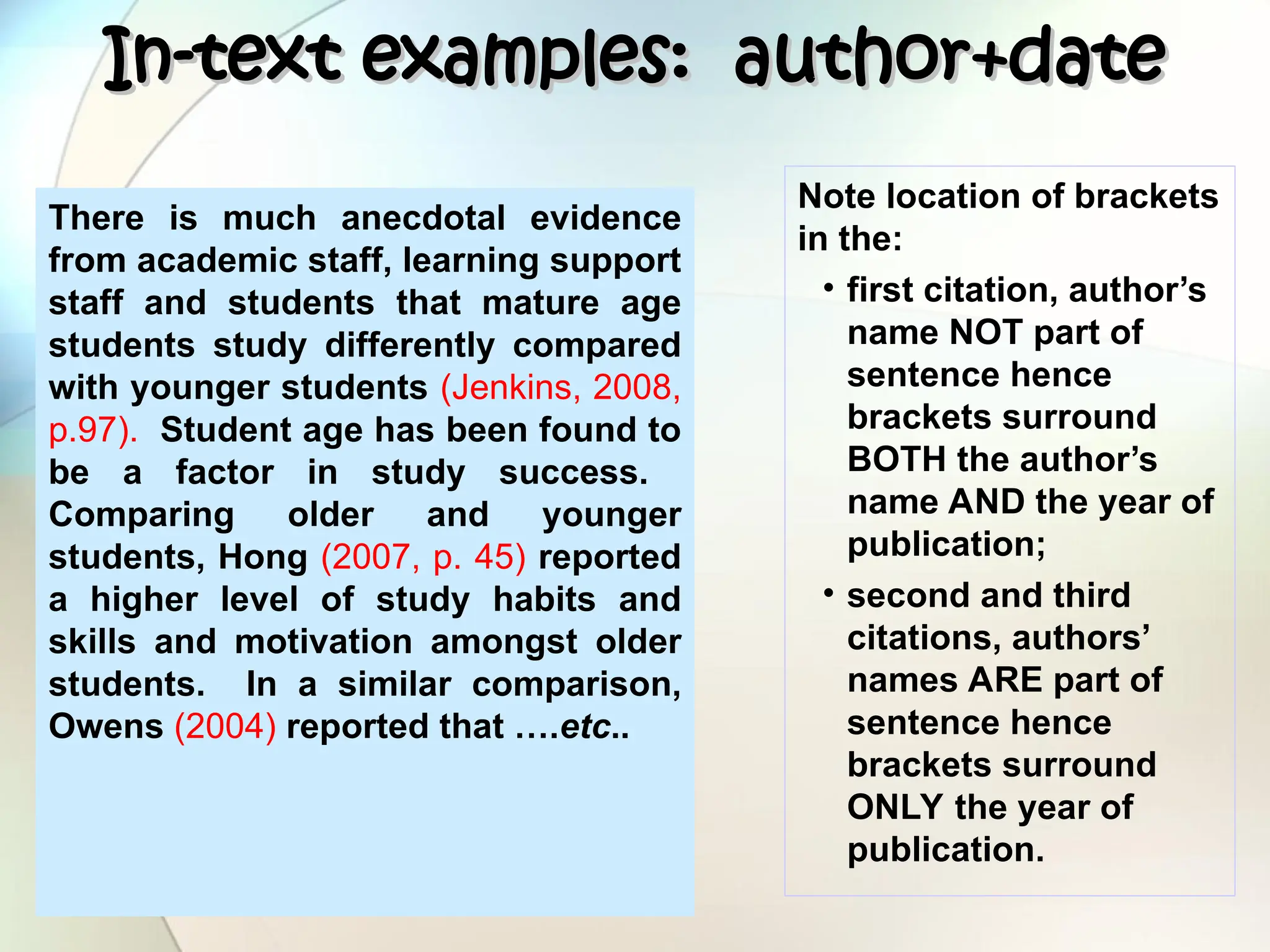
In-text examples: author+date
In-textexamples: author+date
There is much anecdotal evidence
from academic staff, learning support
staff and students that mature age
students study differently compared
with younger students (Jenkins, 2008,
p.97). Student age has been found to
be a factor in study success.
Comparing older and younger
students, Hong (2007, p. 45) reported
a higher level of study habits and
skills and motivation amongst older
students. In a similar comparison,
Owens (2004) reported that ….etc..
Note location of brackets
in the:
• first citation, author’s
name NOT part of
sentence hence
brackets surround
BOTH the author’s
name AND the year of
publication;
• second and third
citations, authors’
names ARE part of
sentence hence
brackets surround
ONLY the year of
publication.
32.
In-text example: numerical
In-textexample: numerical
Surveys have consistently
found that more people
mention alcohol as a cause
of drug-related death than
tobacco [2, 3]. Similarly,
alcohol is more likely to be
viewed as part of the ‘drug
problem’ than tobacco,
although both tobacco and
alcohol are mentioned far
less frequently than either
heroin or marijuana [2].
Nevertheless, alcohol
accounts for a wide range of
community problems, such
as … [4–6].
Note
• Citations appear in the same
places as for author-date
system,
• numbers instead of author’s
name and date of publication
used to identify which
reference in the reference
list the idea(s) came from.
• In this case, square brackets
have been used around
numbers. In other systems,
the numbers are written as
superscripts to the text.
33.
In-text, numerical
In-text, numerical
Thus,although Barlogie et al.
[4] found an incidence of <2%
of deep vein thromboses
using thalidomide with
chemotherapy, it would still be
important to consider that
thalidomide might cause
thromboembolism, ….
… This is supported by the
smaller doses used in the
early data from Osman and
Comenzo [3] where patients
were on 100mg for …
Note:
• Numerical system
used in
conjunction with
reference to
author(s)
• Used to highlight
who has done
what or simply to
vary sentence
structure in order to
keep writing
interesting.
34.
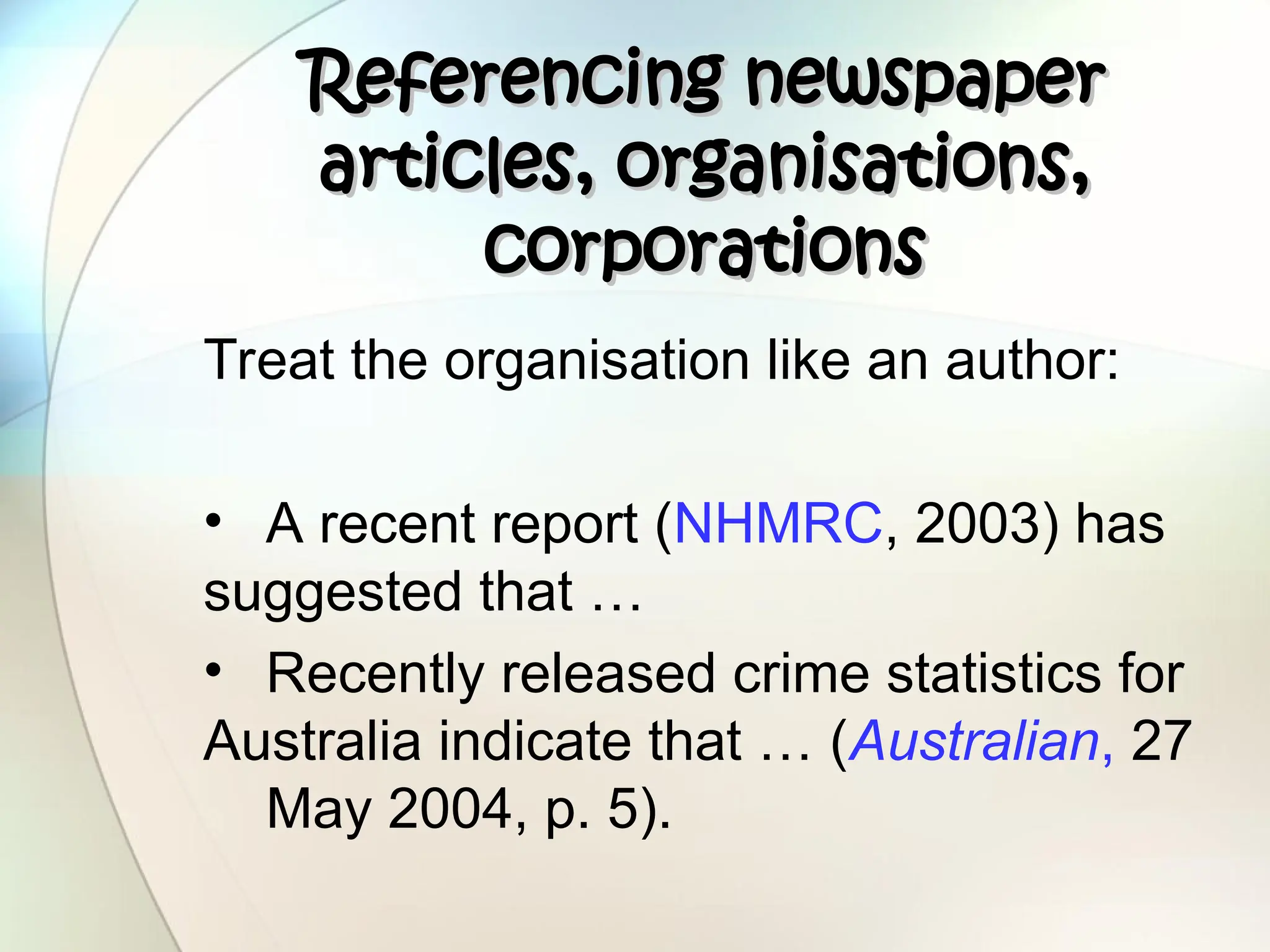
Referencing newspaper
Referencing newspaper
articles,organisations,
articles, organisations,
corporations
corporations
Treat the organisation like an author:
• A recent report (NHMRC, 2003) has
suggested that …
• Recently released crime statistics for
Australia indicate that … (Australian, 27
May 2004, p. 5).
35.
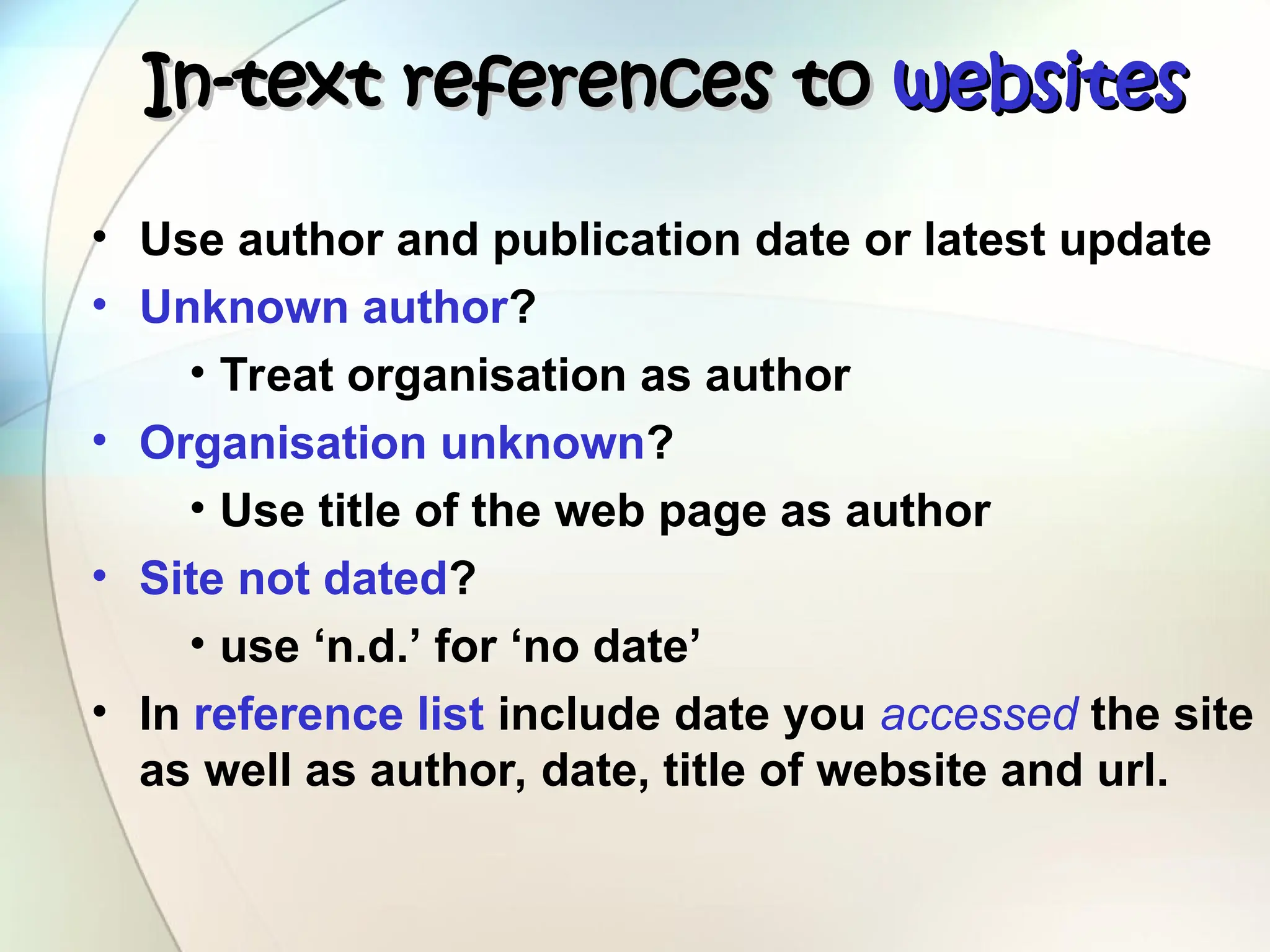
In-text references to
In-textreferences to websites
websites
• Use author and publication date or latest update
• Unknown author?
• Treat organisation as author
• Organisation unknown?
• Use title of the web page as author
• Site not dated?
• use ‘n.d.’ for ‘no date’
• In reference list include date you accessed the site
as well as author, date, title of website and url.
36.
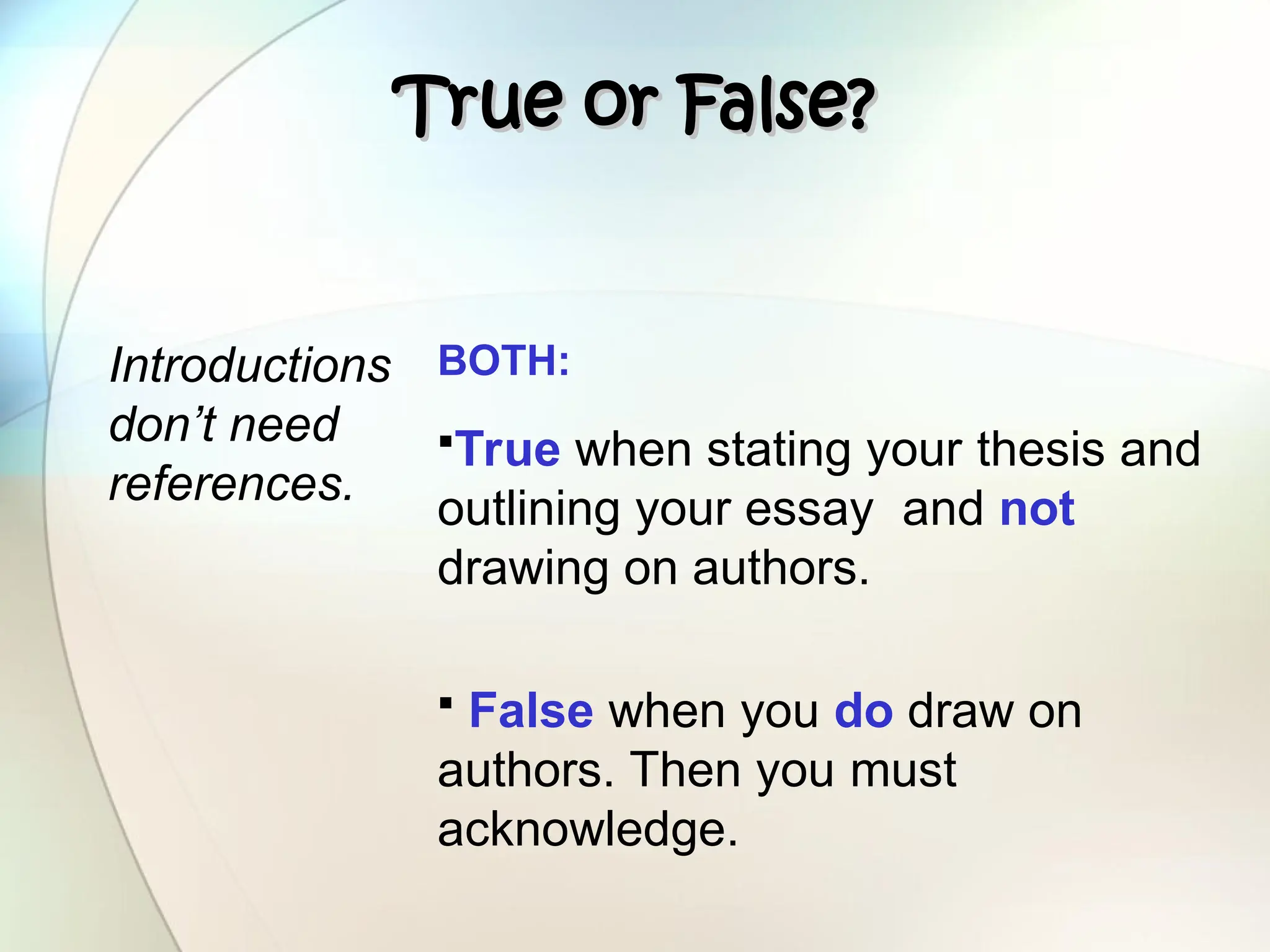
True or False?
Trueor False?
Introductions
don’t need
references.
BOTH:
True when stating your thesis and
outlining your essay and not
drawing on authors.
False when you do draw on
authors. Then you must
acknowledge.
37.
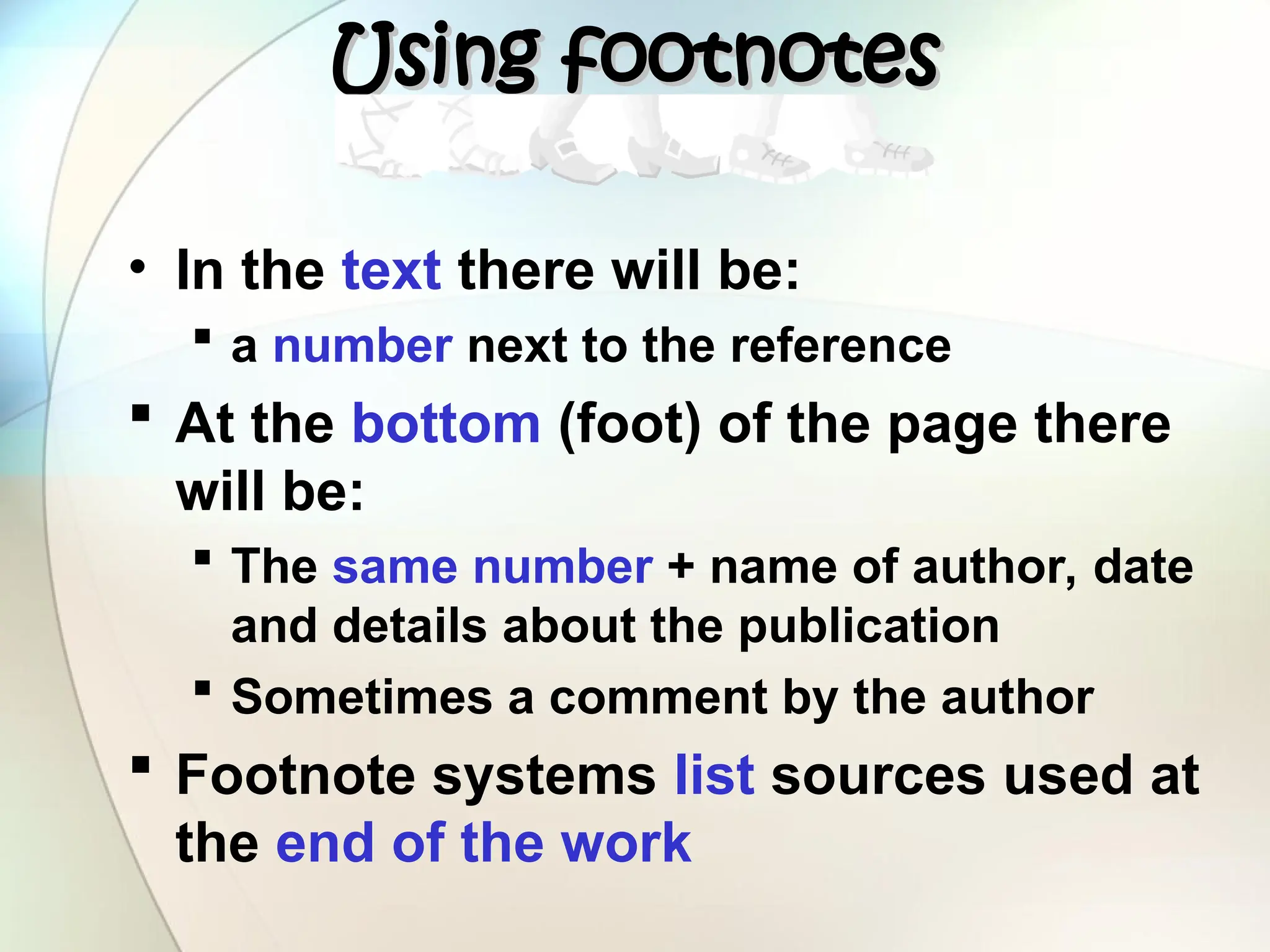
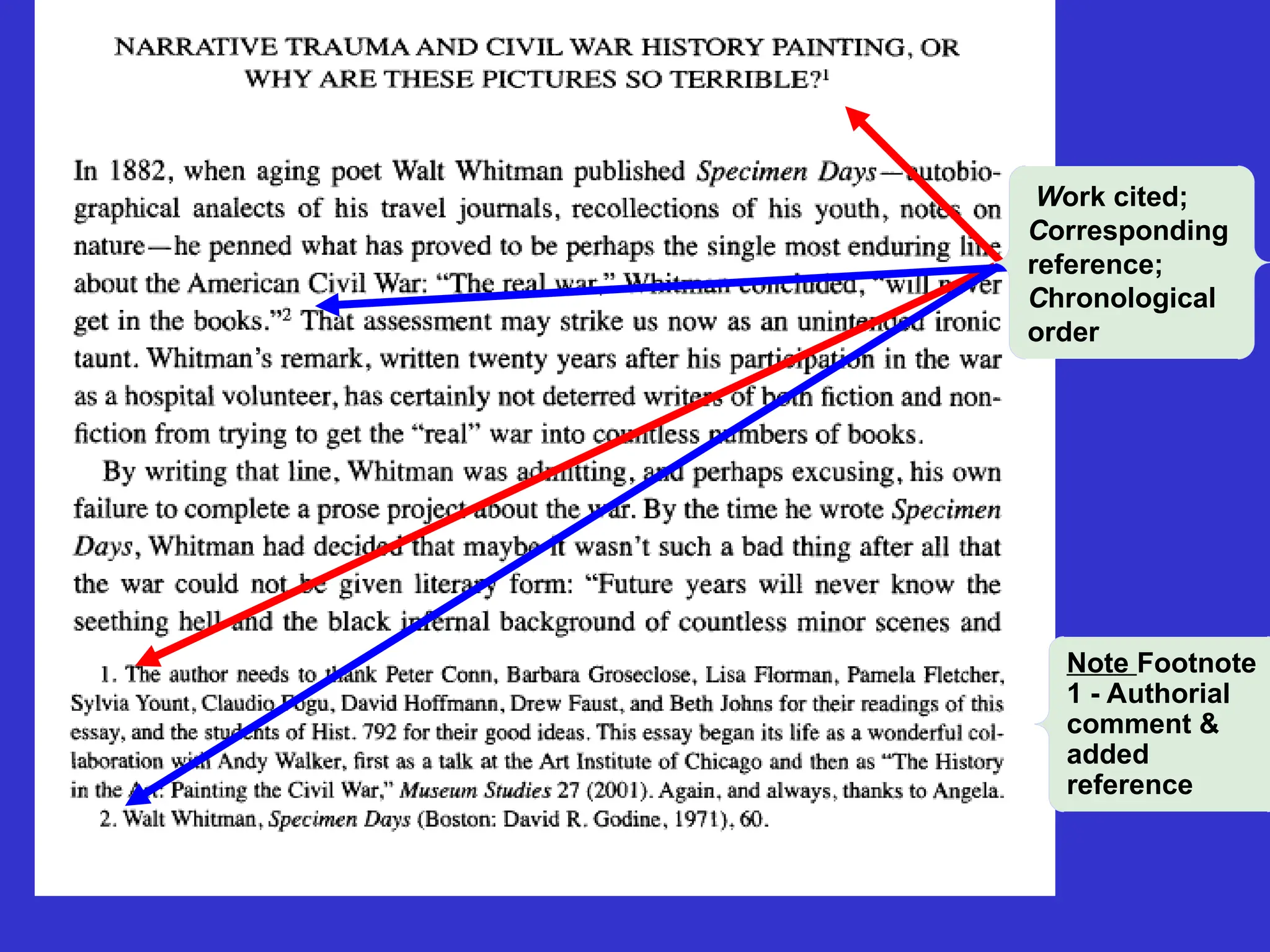
Using footnotes
Using footnotes
•In the text there will be:
a number next to the reference
At the bottom (foot) of the page there
will be:
The same number + name of author, date
and details about the publication
Sometimes a comment by the author
Footnote systems list sources used at
the end of the work
38.
Note Footnote
1 -Authorial
comment &
added
reference
Work cited;
Corresponding
reference;
Chronological
order
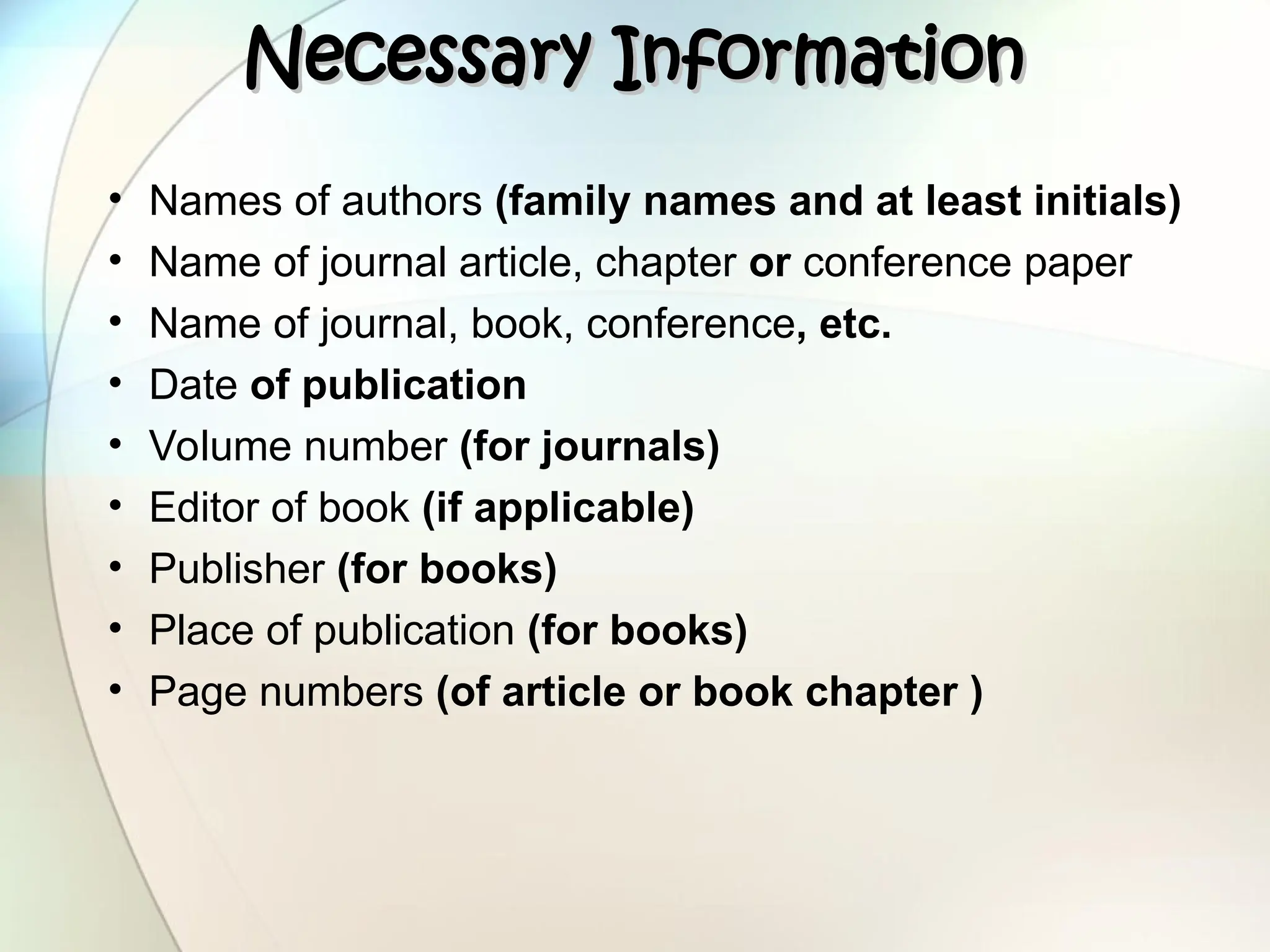
Necessary Information
Necessary Information
•Names of authors (family names and at least initials)
• Name of journal article, chapter or conference paper
• Name of journal, book, conference, etc.
• Date of publication
• Volume number (for journals)
• Editor of book (if applicable)
• Publisher (for books)
• Place of publication (for books)
• Page numbers (of article or book chapter )
42.
Basic Referencing Systems:
BasicReferencing Systems:
Reference Lists
Reference Lists
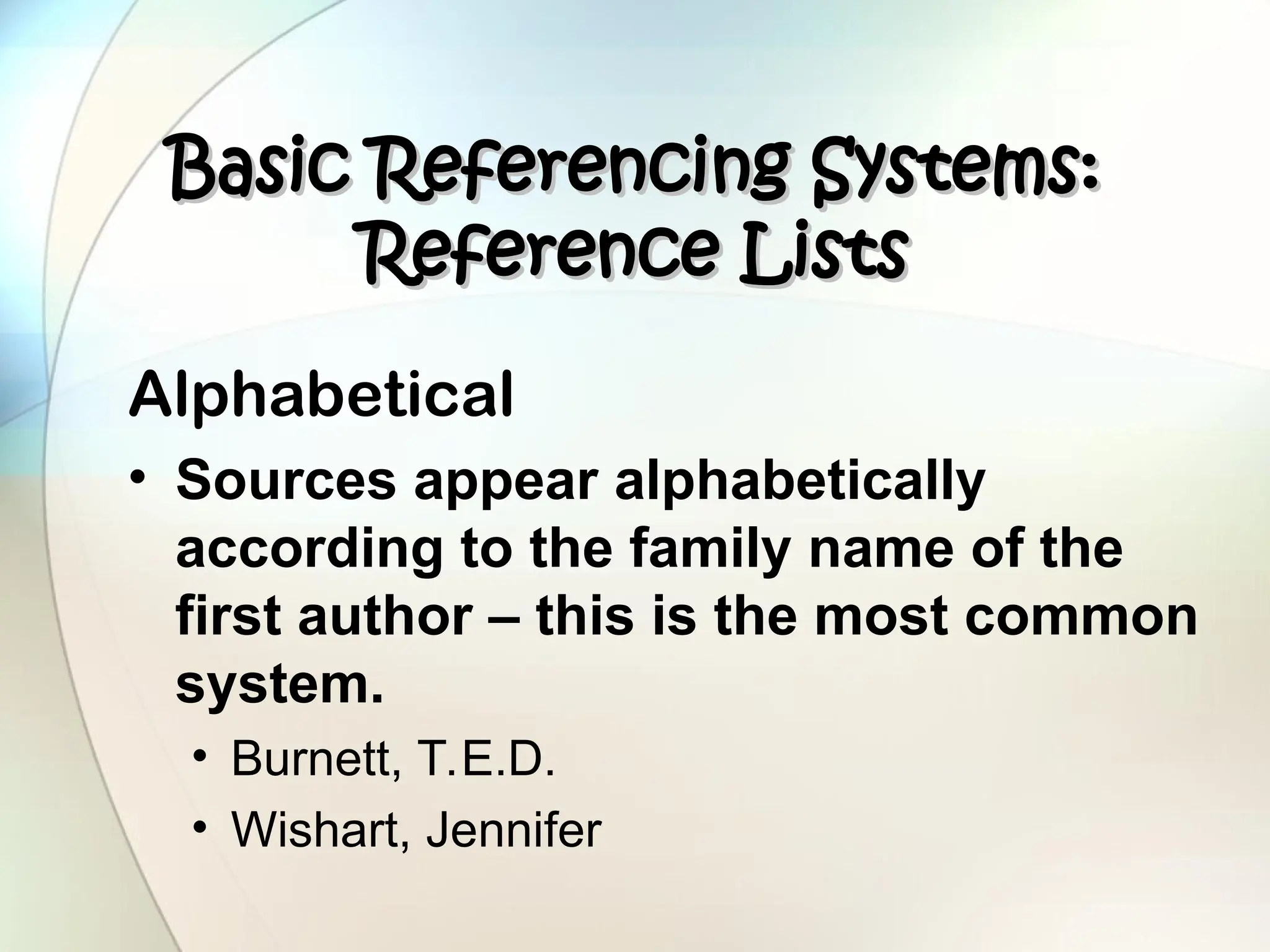
Alphabetical
• Sources appear alphabetically
according to the family name of the
first author – this is the most common
system.
• Burnett, T.E.D.
• Wishart, Jennifer
43.
Examples: reference listsfor
Examples: reference lists for
author-date citations
author-date citations
Barry, M and Molyneux, M
1992, “Ethical dilemmas in
malaria drug and vaccine
trials: a bioethical
perspective”, J Med Ethics,
vol. 18, pp.189-192.
Christakis, NA 1992, “Ethics
and local: engaging cross-
cultural variation in the
ethics for clinical research”,
Soc Sci Med, vol. 35,
pp.1079-1091.
Format: [Author’s family
name, Initial, year of
publication. Title of article.
Title of Journal, Volume
number, page numbers of
article.]
Organised alphabetically by
first author’s family name (in
red).
Note that lines after the first
are indented to make it easy
to see where each
reference begins.
44.
Examples: reference listsfor
Examples: reference lists for
author-date citations
author-date citations
Strang J, Smith, M and Spurrell
S 1992, “The Community
Drug Team”, British Journal of
Addiction, vol. 87, pp.169-78.
[Journal article]
Tripp, M 2003, In: Judson, H (ed.)
Heroin Addiction in Britain, pp
46-93, Harcourt Brace
Jovanovich: New York.
[Chapter in edited book]
White, P 2008, Study Secrets,
HBJ Books, London.
[Book]
Look out for differences
APA uses brackets
around year of
publication
APA uses place of
publication before
publisher
Full stops after initials in
APA, but not Harvard
45.
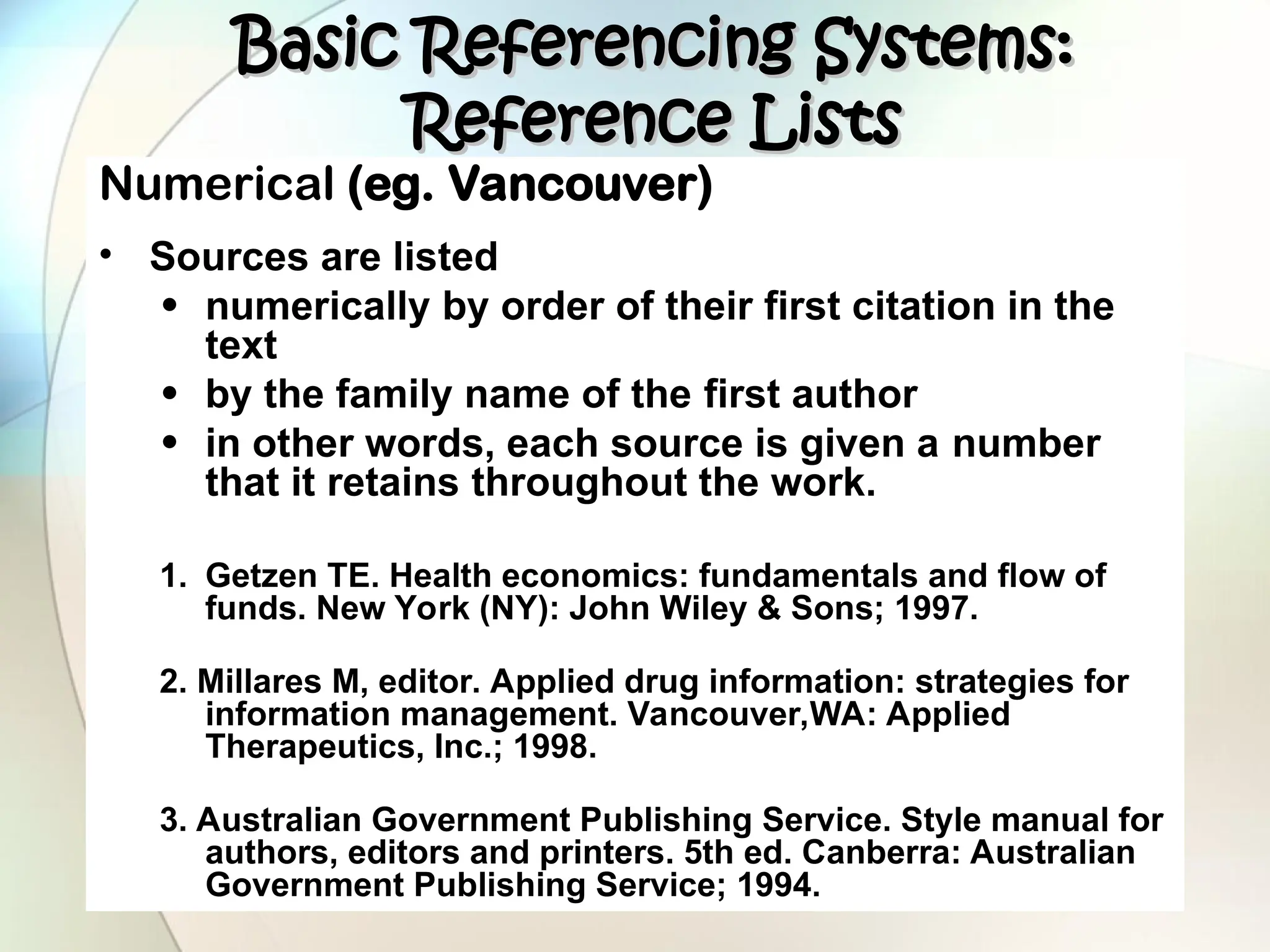
Numerical (eg. Vancouver)
•Sources are listed
• numerically by order of their first citation in the
text
• by the family name of the first author
• in other words, each source is given a number
that it retains throughout the work.
1. Getzen TE. Health economics: fundamentals and flow of
funds. New York (NY): John Wiley & Sons; 1997.
2. Millares M, editor. Applied drug information: strategies for
information management. Vancouver,WA: Applied
Therapeutics, Inc.; 1998.
3. Australian Government Publishing Service. Style manual for
authors, editors and printers. 5th ed. Canberra: Australian
Government Publishing Service; 1994.
Basic Referencing Systems:
Basic Referencing Systems:
Reference Lists
Reference Lists
46.
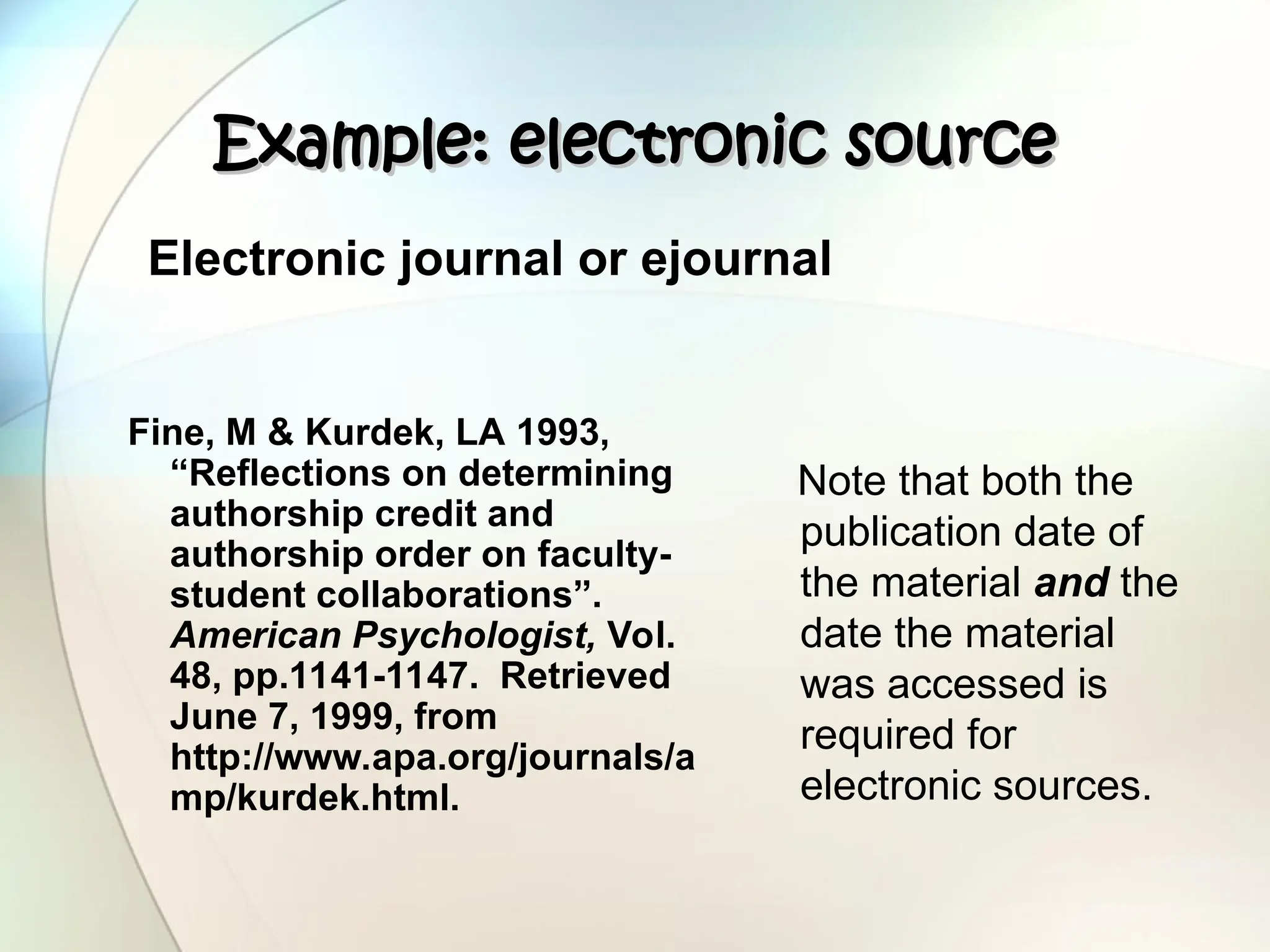
Example: electronic source
Example:electronic source
Fine, M & Kurdek, LA 1993,
“Reflections on determining
authorship credit and
authorship order on faculty-
student collaborations”.
American Psychologist, Vol.
48, pp.1141-1147. Retrieved
June 7, 1999, from
http://www.apa.org/journals/a
mp/kurdek.html.
Note that both the
publication date of
the material and the
date the material
was accessed is
required for
electronic sources.
Electronic journal or ejournal
47.
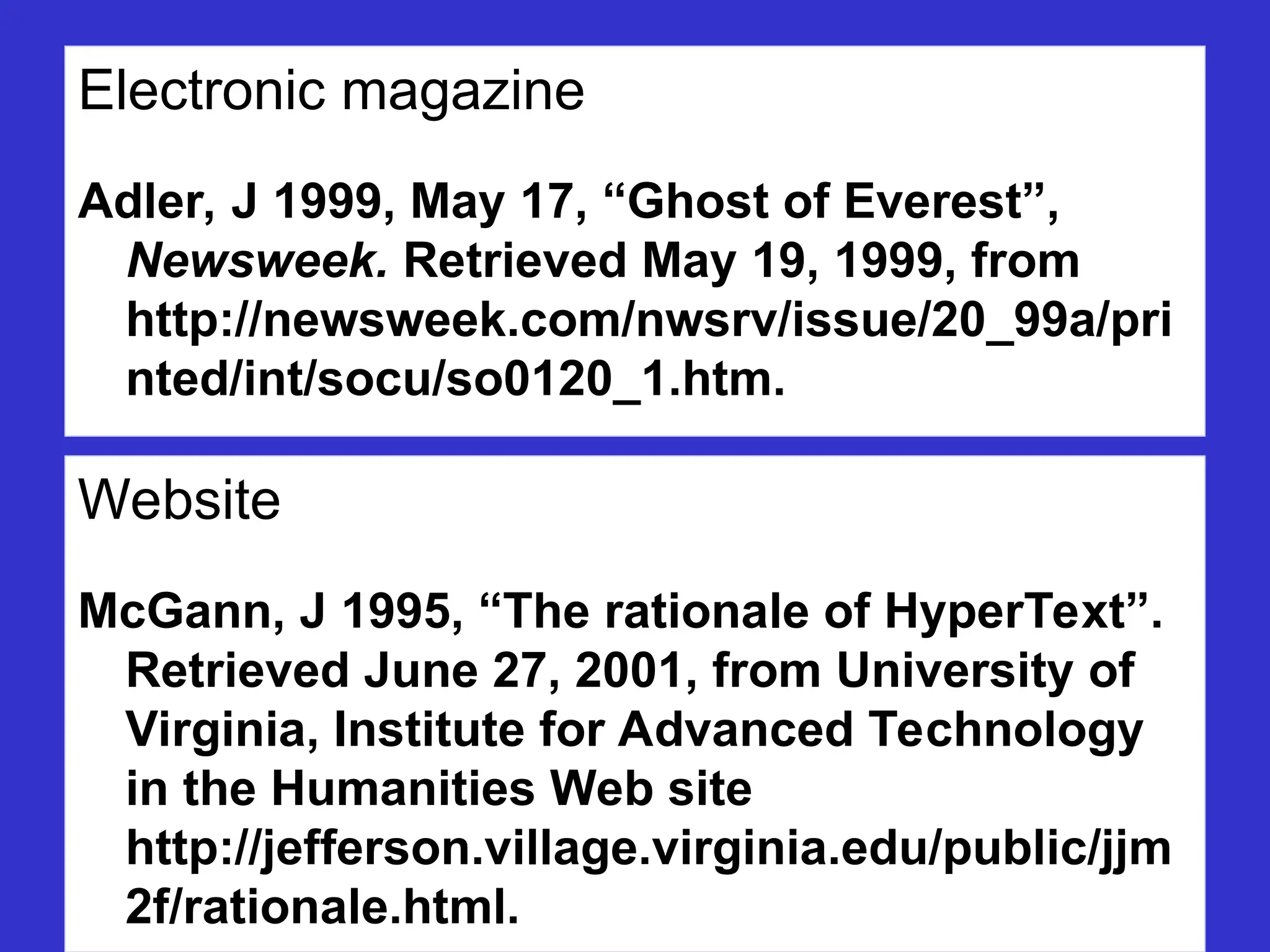
Electronic magazine
Adler, J1999, May 17, “Ghost of Everest”,
Newsweek. Retrieved May 19, 1999, from
http://newsweek.com/nwsrv/issue/20_99a/pri
nted/int/socu/so0120_1.htm.
Website
McGann, J 1995, “The rationale of HyperText”.
Retrieved June 27, 2001, from University of
Virginia, Institute for Advanced Technology
in the Humanities Web site
http://jefferson.village.virginia.edu/public/jjm
2f/rationale.html.
48.
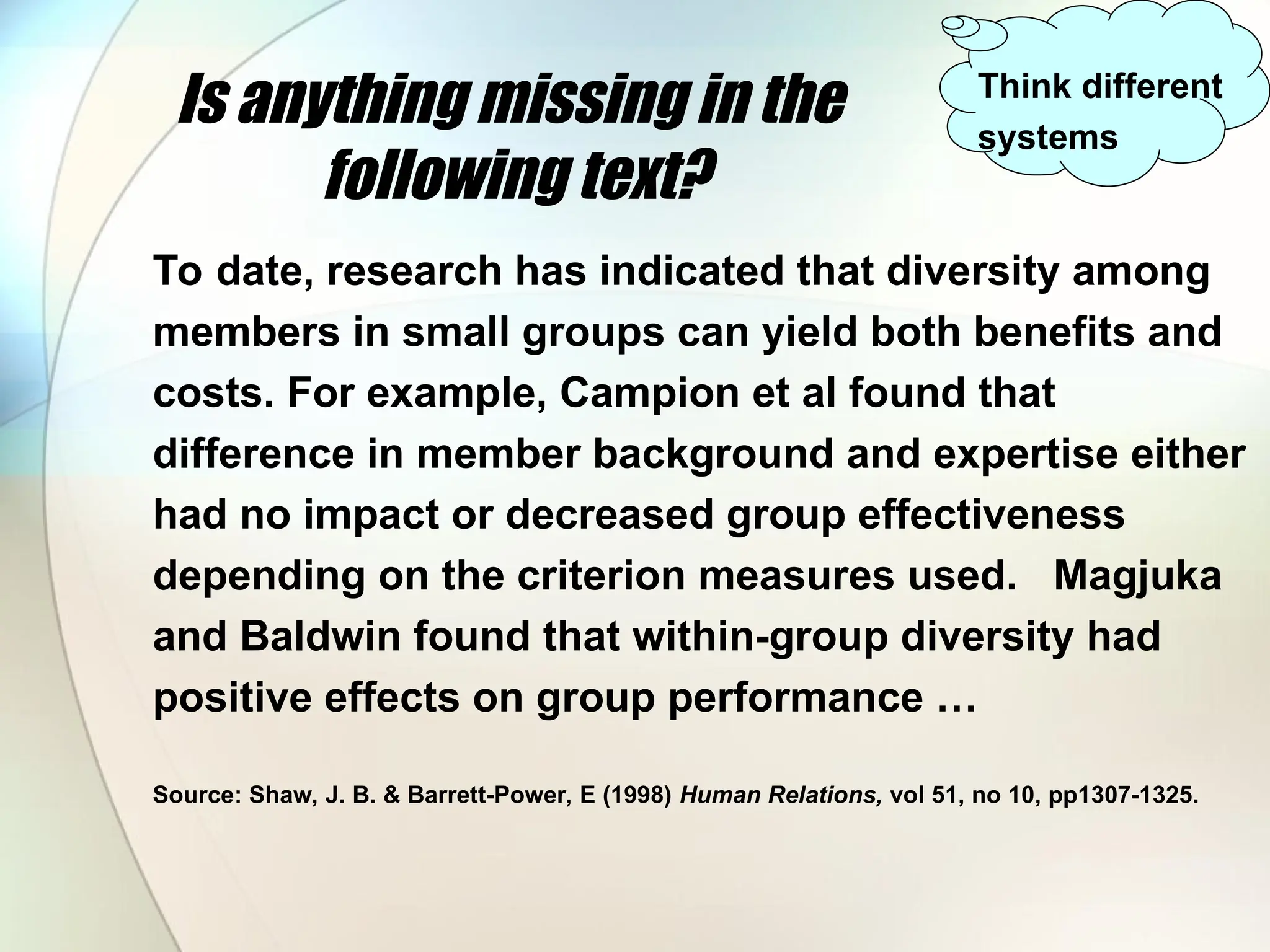
Is anything missingin the
following text?
To date, research has indicated that diversity among
members in small groups can yield both benefits and
costs. For example, Campion et al found that
difference in member background and expertise either
had no impact or decreased group effectiveness
depending on the criterion measures used. Magjuka
and Baldwin found that within-group diversity had
positive effects on group performance …
Source: Shaw, J. B. & Barrett-Power, E (1998) Human Relations, vol 51, no 10, pp1307-1325.
Think different
systems
49.
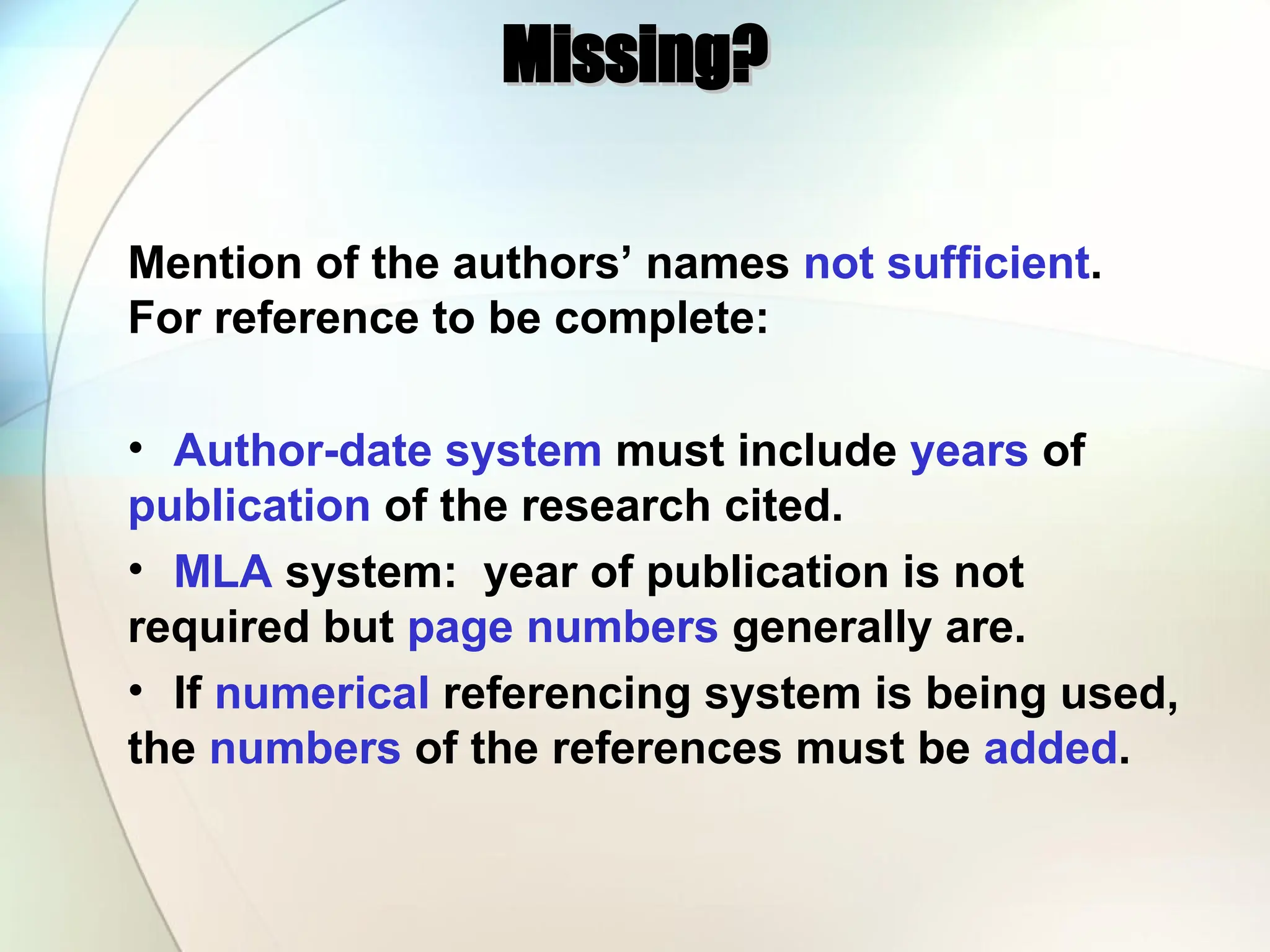
Missing?
Missing?
Mention of theauthors’ names not sufficient.
For reference to be complete:
• Author-date system must include years of
publication of the research cited.
• MLA system: year of publication is not
required but page numbers generally are.
• If numerical referencing system is being used,
the numbers of the references must be added.
50.
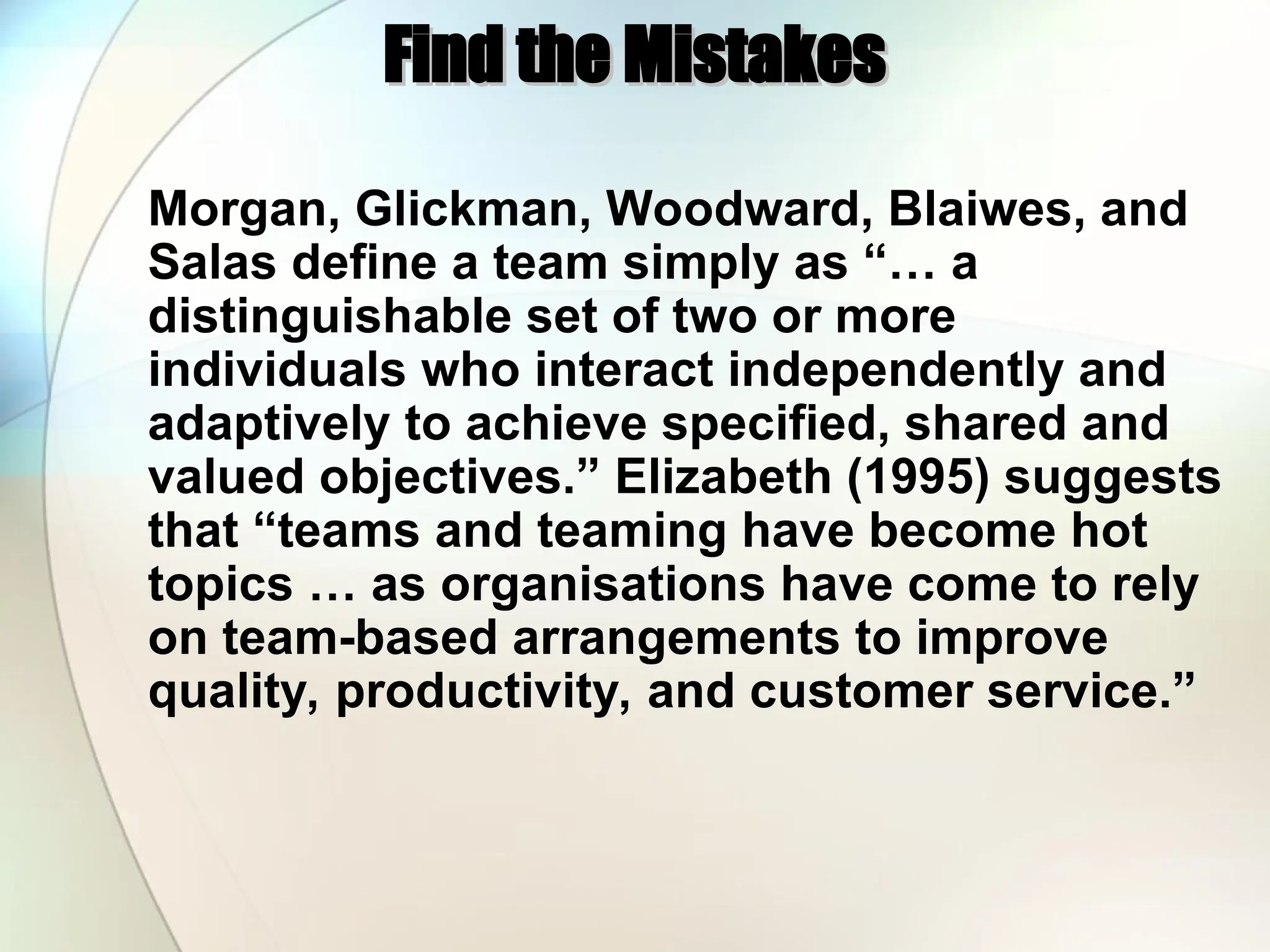
Find the Mistakes
Findthe Mistakes
Morgan, Glickman, Woodward, Blaiwes, and
Salas define a team simply as “… a
distinguishable set of two or more
individuals who interact independently and
adaptively to achieve specified, shared and
valued objectives.” Elizabeth (1995) suggests
that “teams and teaming have become hot
topics … as organisations have come to rely
on team-based arrangements to improve
quality, productivity, and customer service.”
51.
Mistakes?
Mistakes?
Morgan et al.(1986, p. 3) define a team simply as “…
a distinguishable set of two or more individuals who
interact independently and adaptively to achieve
specified, shared and valued objectives”. [Elizabeth
not family name of author] suggests that “teams and
teaming have become hot topics … as organisations
have come to rely on team-based arrangements to
improve quality, productivity, and customer service.”
Note: “et al.” is Latin for “and others”, and is generally used in the in-text
citation (not generally in the reference list) if an article has three or more
authors. Check the relevant style guide for the precise rules of the usage
of et al.
52.
Avoiding plagiarism
Avoiding plagiarism
•Reduce the amount of direct
paraphrasing you have to do
• Rather, take notes (wherever
possible) at a distance from the text
• But how?
53.
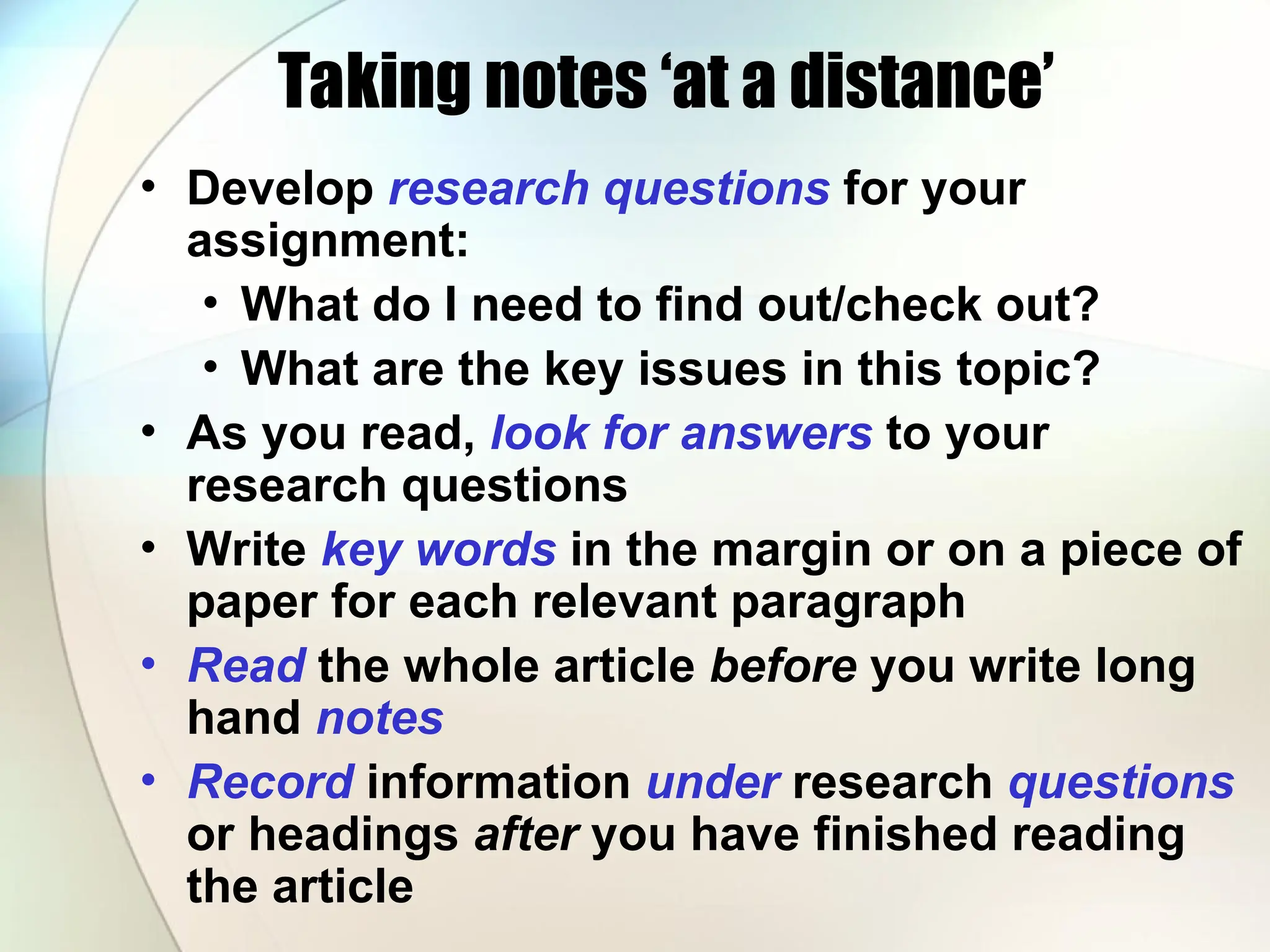
Taking notes ‘ata distance’
• Develop research questions for your
assignment:
• What do I need to find out/check out?
• What are the key issues in this topic?
• As you read, look for answers to your
research questions
• Write key words in the margin or on a piece of
paper for each relevant paragraph
• Read the whole article before you write long
hand notes
• Record information under research questions
or headings after you have finished reading
the article
54.
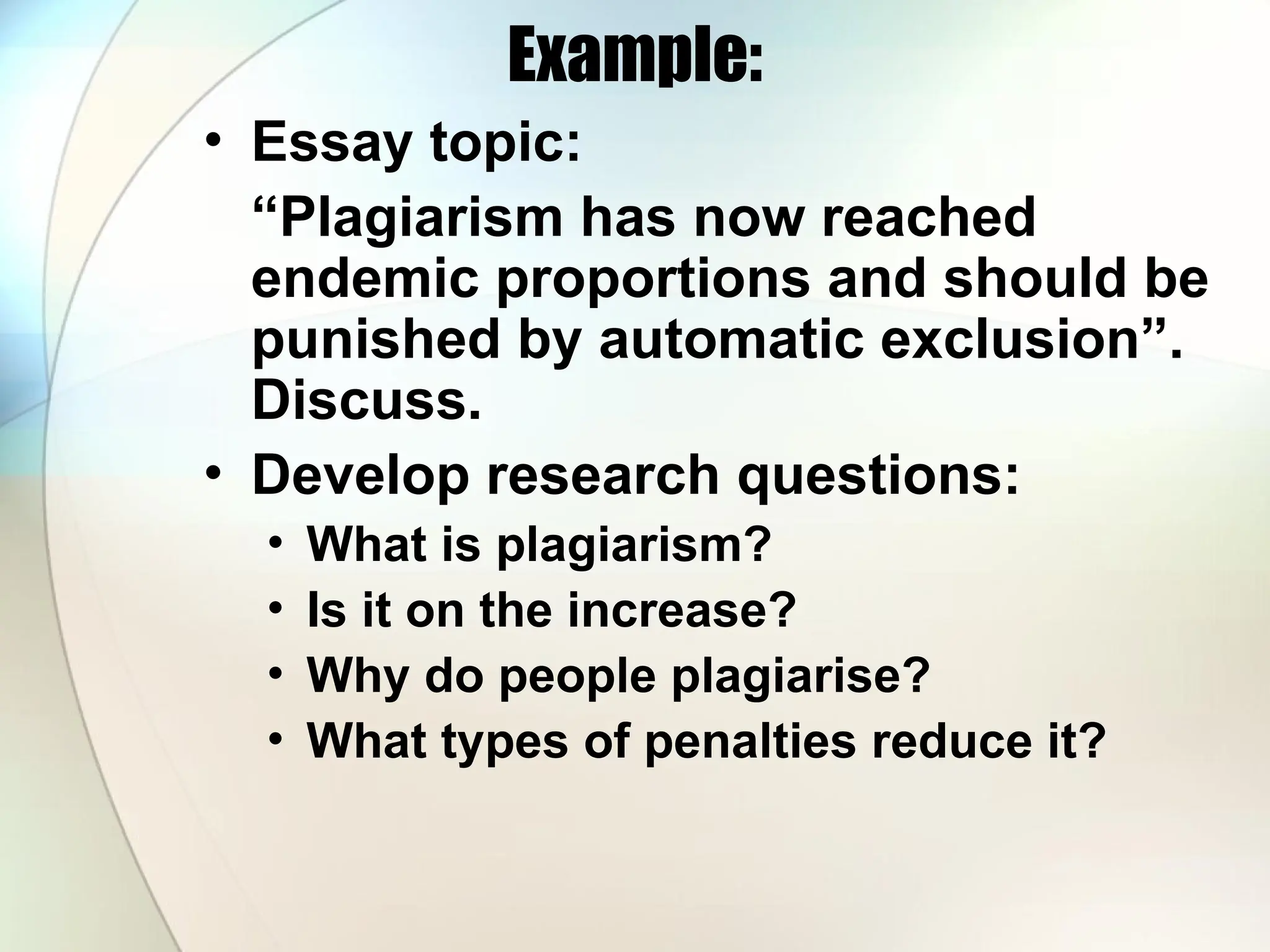
Example:
• Essay topic:
“Plagiarismhas now reached
endemic proportions and should be
punished by automatic exclusion”.
Discuss.
• Develop research questions:
• What is plagiarism?
• Is it on the increase?
• Why do people plagiarise?
• What types of penalties reduce it?
55.
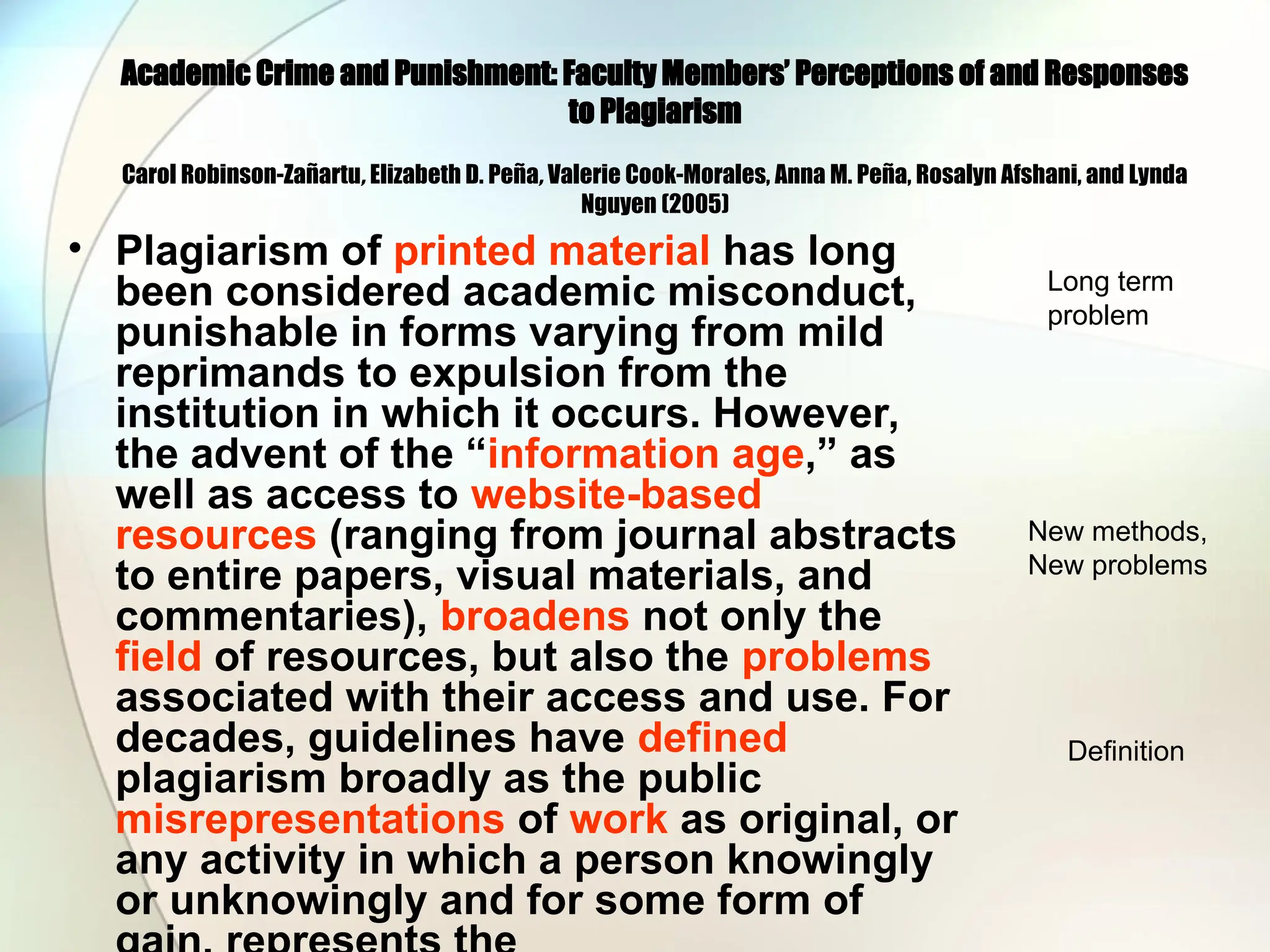
Academic Crime andPunishment: Faculty Members’ Perceptions of and Responses
to Plagiarism
Carol Robinson-Zañartu, Elizabeth D. Peña, Valerie Cook-Morales, Anna M. Peña, Rosalyn Afshani, and Lynda
Nguyen (2005)
• Plagiarism of printed material has long
been considered academic misconduct,
punishable in forms varying from mild
reprimands to expulsion from the
institution in which it occurs. However,
the advent of the “information age,” as
well as access to website-based
resources (ranging from journal abstracts
to entire papers, visual materials, and
commentaries), broadens not only the
field of resources, but also the problems
associated with their access and use. For
decades, guidelines have defined
plagiarism broadly as the public
misrepresentations of work as original, or
any activity in which a person knowingly
or unknowingly and for some form of
Long term
problem
New methods,
New problems
Definition
56.
• work ofanother as his/her own
(Decoo, 2002; Lindey, 1952; Office of
Research Integrity [ORI], 1994; Office
of Science and Technology Policy,
2000). Martin (1994) specifies
multiple kinds of plagiarism, from
plagiarism of authorship (whole
documents) to word-for-word
plagiarism (unacknowledged use of
whole phrases or paragraphs),
paraphrasing plagiarism, and
plagiarism of secondary sources. He
raises the intriguing issue that most
concern in academe is centered on
the least serious of these. The least
serious (in his estimation), word-for-
word plagiarism, is the easiest to
detect and the most frequently
punished; the most difficult to detect
(plagiarism of authorship) is least
frequently punished because it is
most difficult to find and prove.
Types
Severity
57.
Note take
Note takeafter
after reading:
reading:
• What is plagiarism?
• Defn. Decoo, 2002; Lindey, 1952; Office of
Research Integrity [ORI], 1994; Office of
Science and Technology Policy, 2000) in
Robinson-Z (2005)
• Martin (1994) – types: authorship, word for
word, paraphrasing, secondary sources in
RZ
• Is it on the increase?
• Robinson-Zanartu (2005) – more
opportunities
• Why do people plagiarise?
• Ignorance (Robinson-Zanartu, 2005)
58.
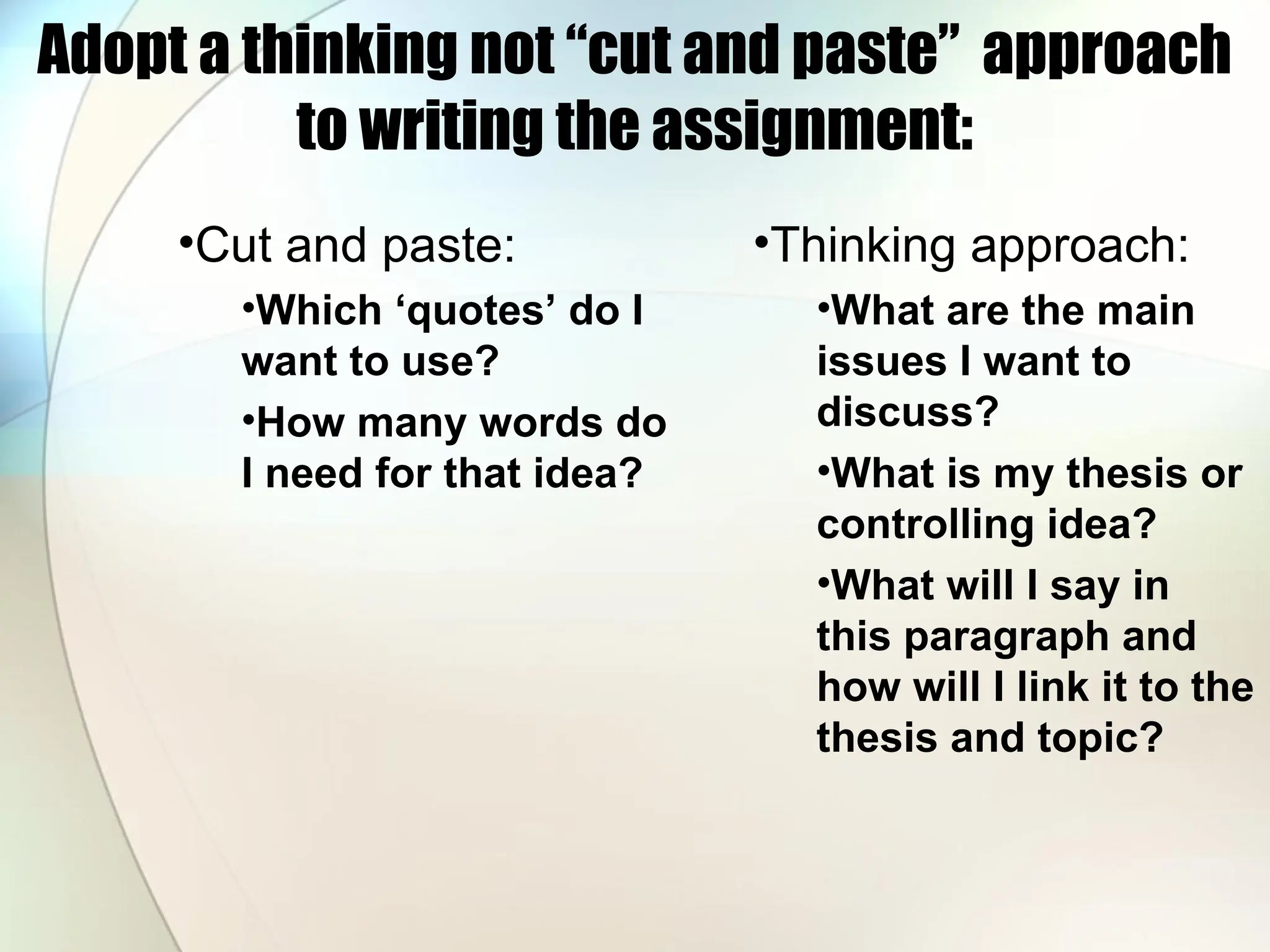
Adopt a thinkingnot “cut and paste” approach
to writing the assignment:
•Cut and paste:
•Which ‘quotes’ do I
want to use?
•How many words do
I need for that idea?
•Thinking approach:
•What are the main
issues I want to
discuss?
•What is my thesis or
controlling idea?
•What will I say in
this paragraph and
how will I link it to the
thesis and topic?
59.
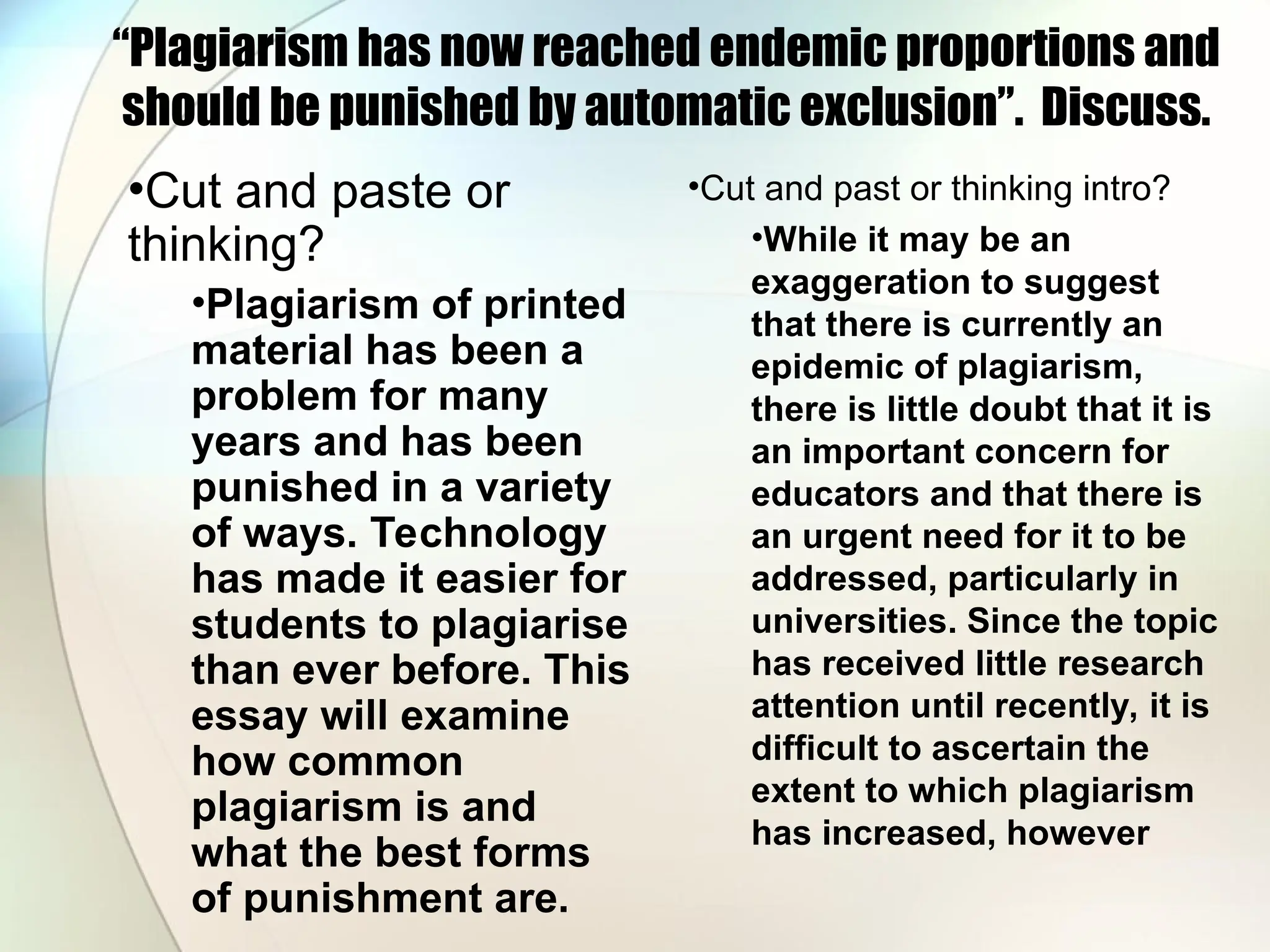
“Plagiarism has nowreached endemic proportions and
should be punished by automatic exclusion”. Discuss.
•Cut and paste or
thinking?
•Plagiarism of printed
material has been a
problem for many
years and has been
punished in a variety
of ways. Technology
has made it easier for
students to plagiarise
than ever before. This
essay will examine
how common
plagiarism is and
what the best forms
of punishment are.
•Cut and past or thinking intro?
•While it may be an
exaggeration to suggest
that there is currently an
epidemic of plagiarism,
there is little doubt that it is
an important concern for
educators and that there is
an urgent need for it to be
addressed, particularly in
universities. Since the topic
has received little research
attention until recently, it is
difficult to ascertain the
extent to which plagiarism
has increased, however
60.
“Plagiarism has nowreached endemic proportions and should
be punished by automatic exclusion”. Discuss.
there are several good
reasons why plagiarism
should be discouraged.
This essay will present an
examination of strategies
that can be used to
minimise plagiarism –
both punitive and
preventative. The
argument that the best
way to discourage
plagiarism is skill
development, rather than
punishment, will be
presented.
61.
Turnitin (www.turnitin.com)
• Youcan use Turnitin to identify
inadvertent plagiarism before you
hand in your assignment
• Lecturers can use Turnitin reports to
identify plagiarism.
• Allow time before you hand in to give
the system time to generate a report.
62.
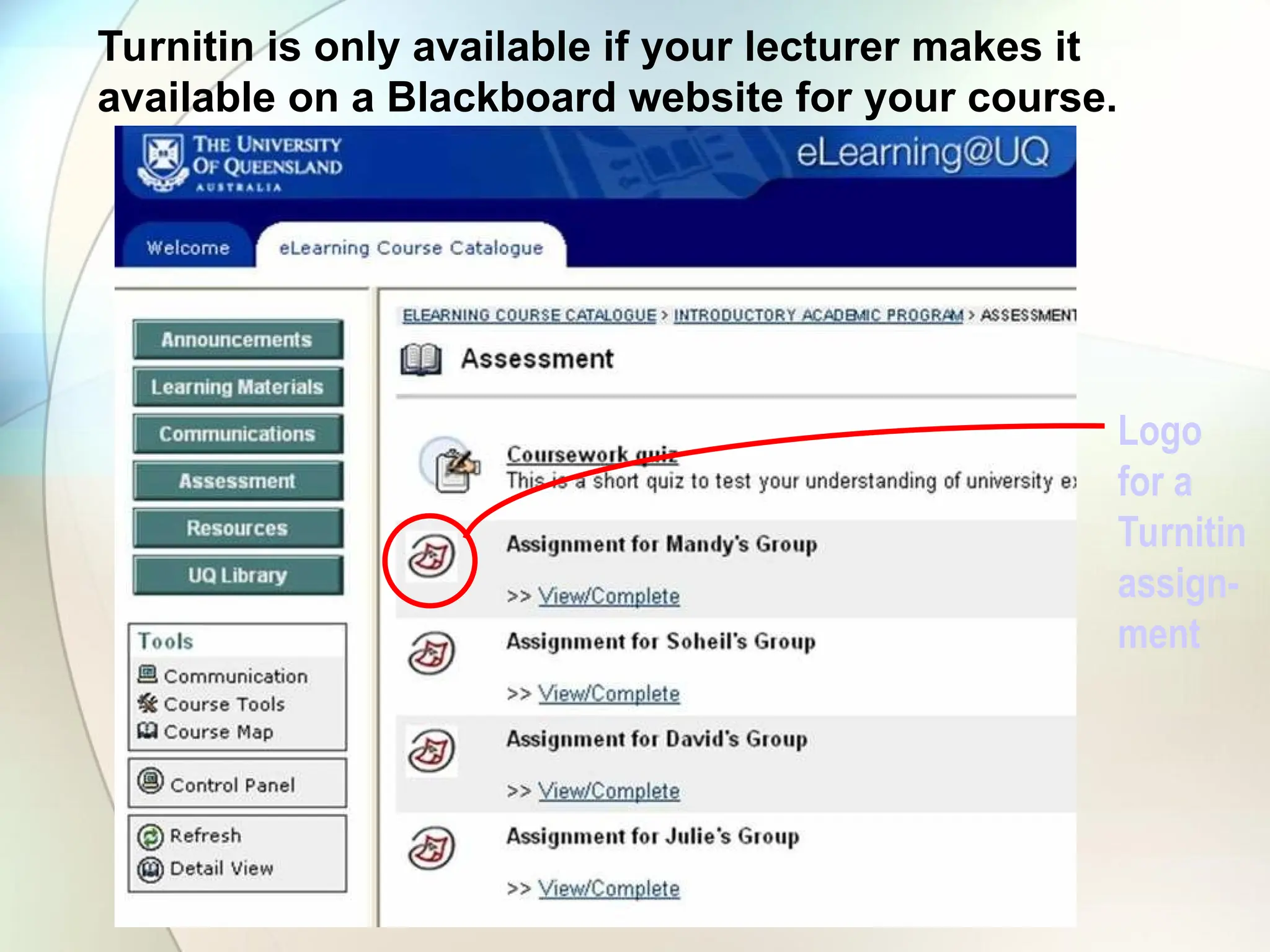
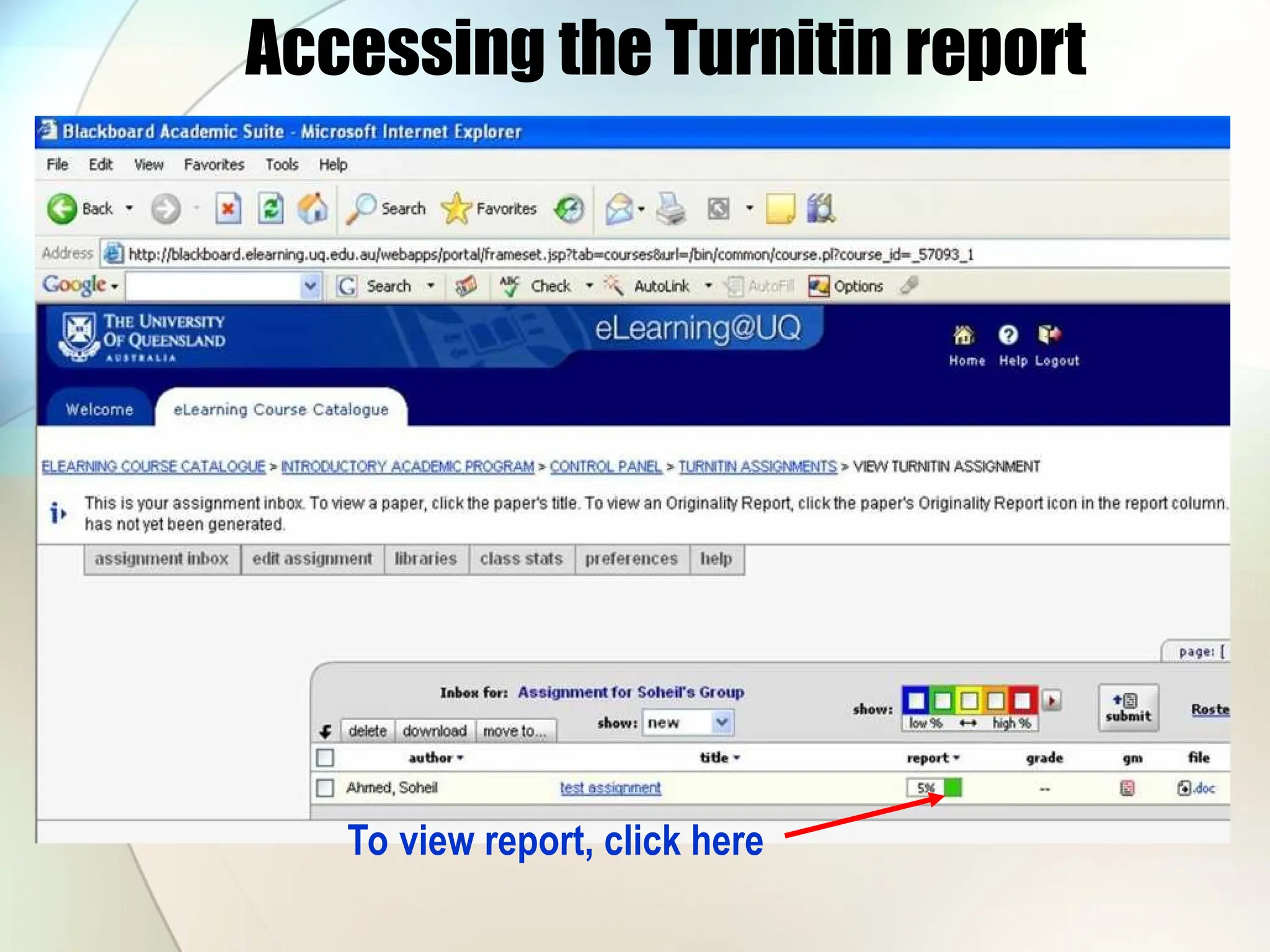
Turnitin is onlyavailable if your lecturer makes it
available on a Blackboard website for your course.
Logo
for a
Turnitin
assign-
ment
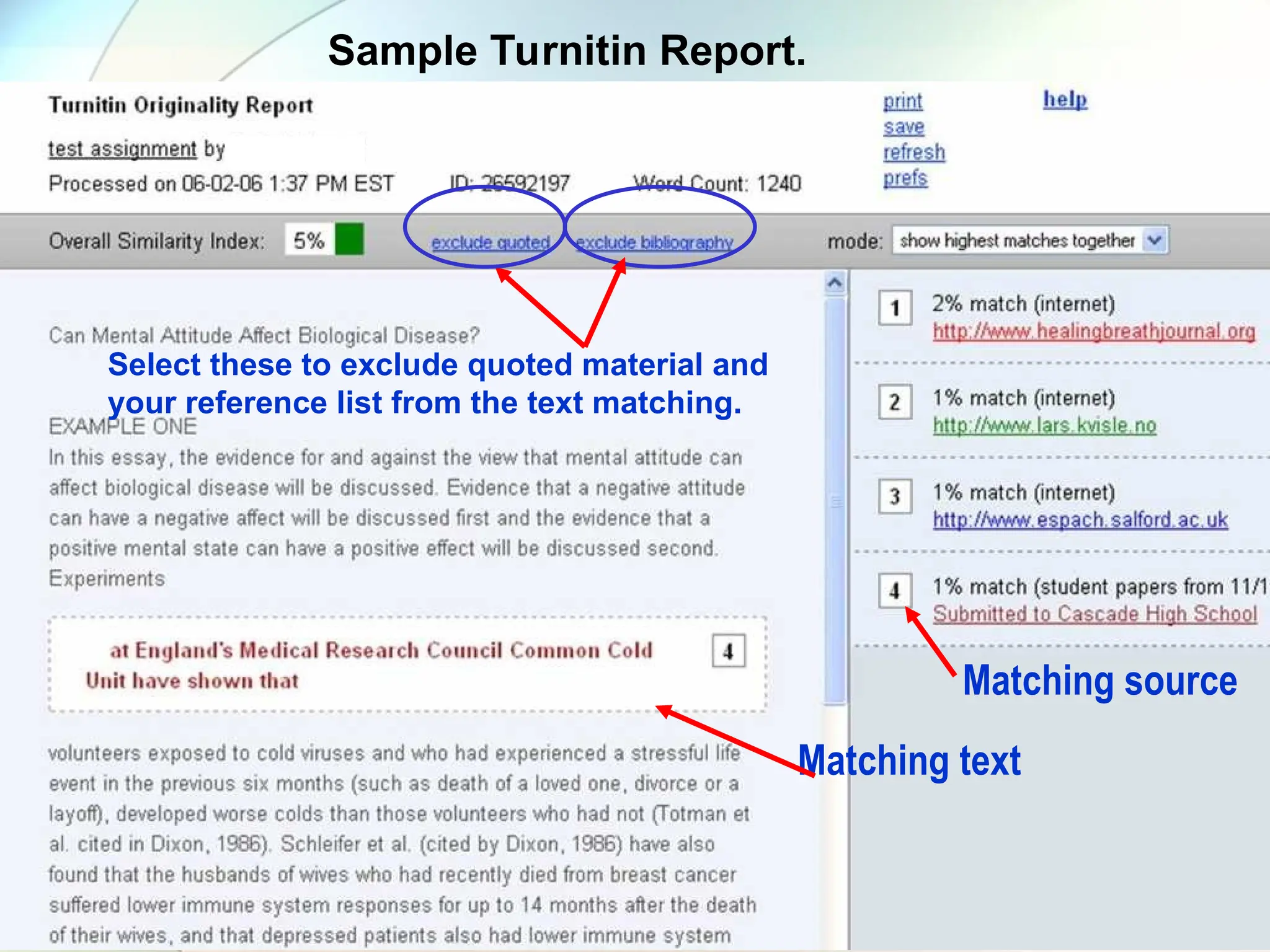
Sample Turnitin Report.
Matchingtext
Matching source
Select these to exclude quoted material and
your reference list from the text matching.
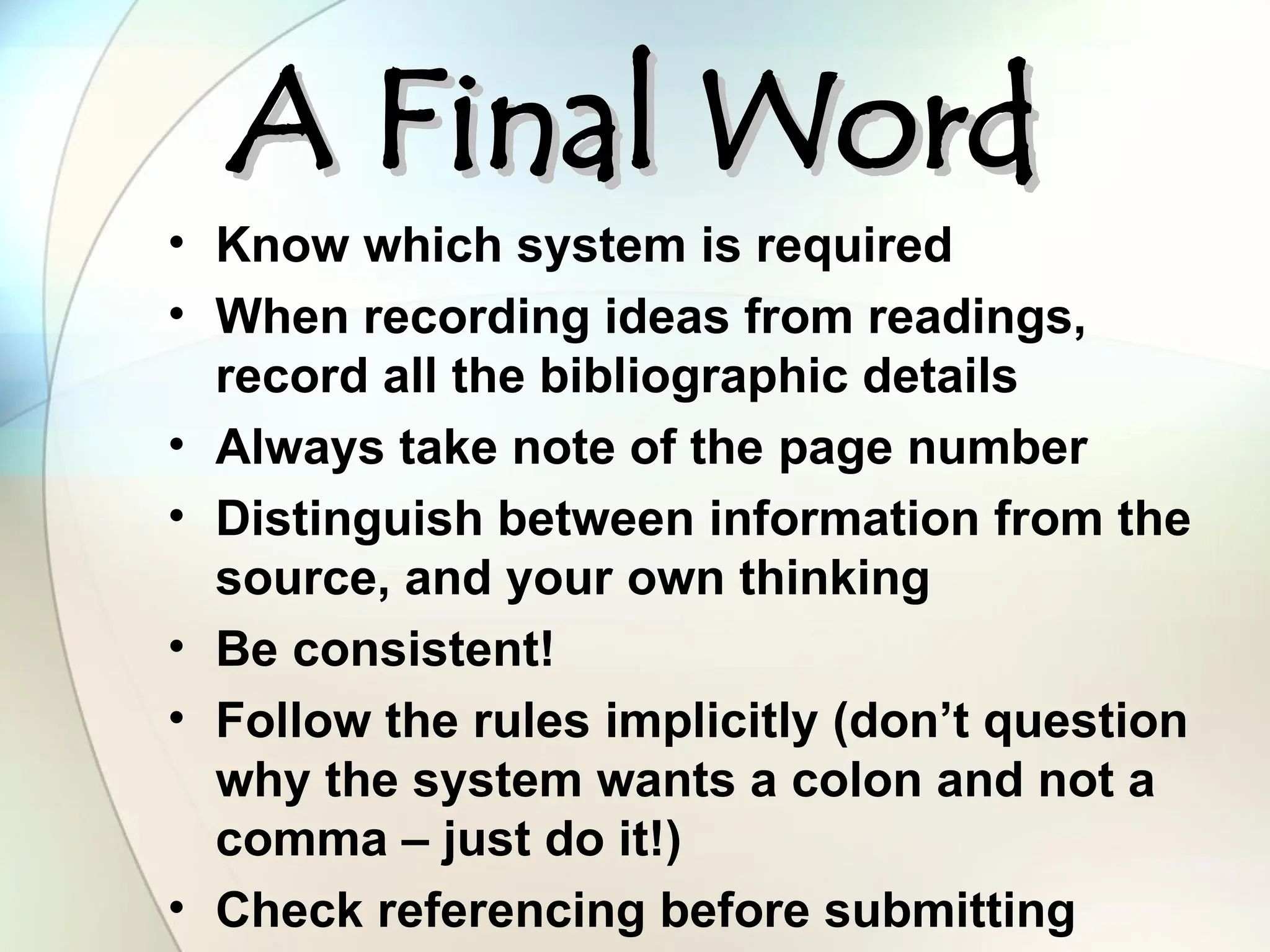
65.
A Final Word
AFinal Word
• Know which system is required
• When recording ideas from readings,
record all the bibliographic details
• Always take note of the page number
• Distinguish between information from the
source, and your own thinking
• Be consistent!
• Follow the rules implicitly (don’t question
why the system wants a colon and not a
comma – just do it!)
• Check referencing before submitting
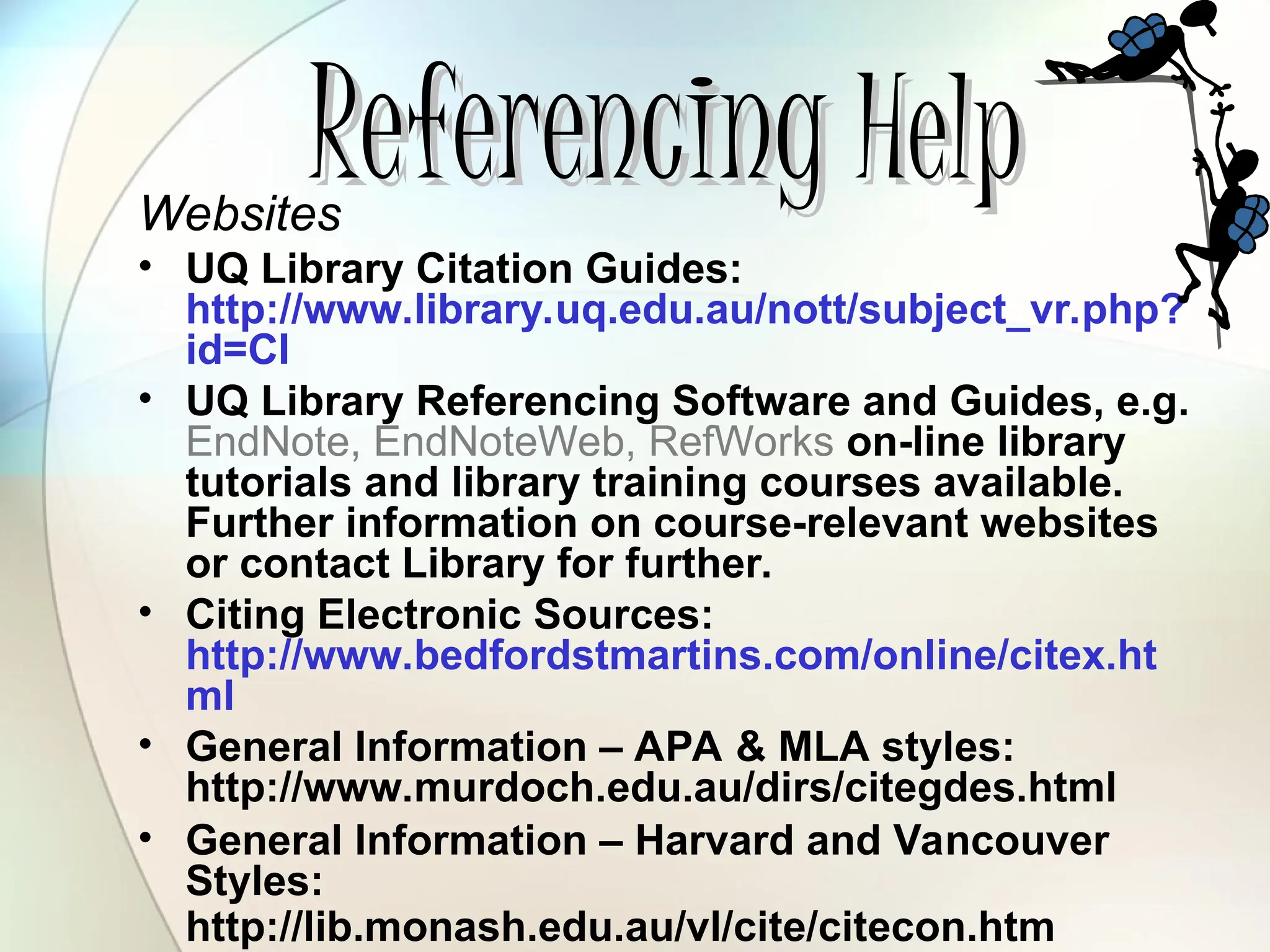
66.
Referencing
Referencing Help
Help
Websites
• UQLibrary Citation Guides:
http://www.library.uq.edu.au/nott/subject_vr.php?
id=CI
• UQ Library Referencing Software and Guides, e.g.
EndNote, EndNoteWeb, RefWorks on-line library
tutorials and library training courses available.
Further information on course-relevant websites
or contact Library for further.
• Citing Electronic Sources:
http://www.bedfordstmartins.com/online/citex.ht
ml
• General Information – APA & MLA styles:
http://www.murdoch.edu.au/dirs/citegdes.html
• General Information – Harvard and Vancouver
Styles:
http://lib.monash.edu.au/vl/cite/citecon.htm
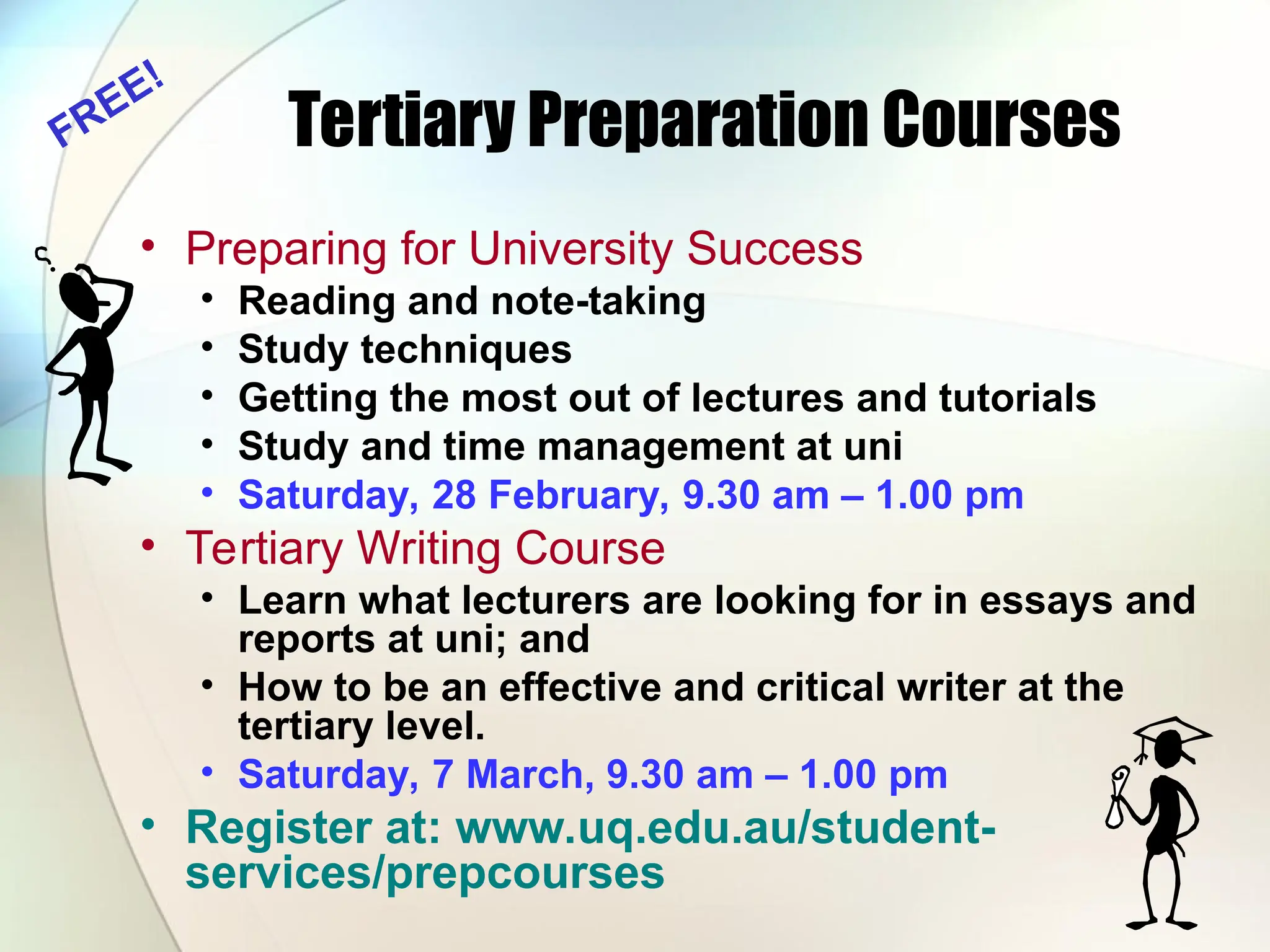
Tertiary Preparation Courses
•Preparing for University Success
• Reading and note-taking
• Study techniques
• Getting the most out of lectures and tutorials
• Study and time management at uni
• Saturday, 28 February, 9.30 am – 1.00 pm
• Tertiary Writing Course
• Learn what lecturers are looking for in essays and
reports at uni; and
• How to be an effective and critical writer at the
tertiary level.
• Saturday, 7 March, 9.30 am – 1.00 pm
• Register at: www.uq.edu.au/student-
services/prepcourses
FREE!
Editor's Notes
#61 TURNIT IN – software that the uni uses to combat plagiarism. It can be useful tool, not only for the lecturers but also for you. Allow time before you hand in your assignment though for a report to be generated and for you to respond to this. It will depend on whether your lecturer or tutor allows you to access such facilities though.
#62 This is the view of a typical blackboard site –
![Quotations
• Use exact words
• Use them to support or illustrate your
argument
• Avoid lengthy/frequent quotations
• Use the exact spelling and punctuation
from the source, even when it is rong [sic]!
• Quotes are not included in your word count](https://image.slidesharecdn.com/referencingom-250224090011-81c0093f/75/Referencing-on-line-documents-or-academic-papersppt-15-2048.jpg)
![Additions to quotations
Additions to quotations
• Inside the quote:
• Use square [---] brackets
• This shows your comment, explanation
• [sic] shows your accuracy of
transcription but an error in the original
• Use of italics indicates your emphasis
of words](https://image.slidesharecdn.com/referencingom-250224090011-81c0093f/75/Referencing-on-line-documents-or-academic-papersppt-18-2048.jpg)
![Square bracket examples:
Square bracket examples:
It is the “disparate
expectations of
language [which]
contribute to
misunderstanding
and confusion
between staff and
their students”
(Meyer, 1988,
p.89).
… but plagiarism is
literary fraud whereby
‘one writer sets forth
the words or ideas of
another writer as his
[sic] own in order to get
gain’ (Hatch, 1992,
p.12).](https://image.slidesharecdn.com/referencingom-250224090011-81c0093f/75/Referencing-on-line-documents-or-academic-papersppt-19-2048.jpg)
![In-text example: numerical
In-text example: numerical
Surveys have consistently
found that more people
mention alcohol as a cause
of drug-related death than
tobacco [2, 3]. Similarly,
alcohol is more likely to be
viewed as part of the ‘drug
problem’ than tobacco,
although both tobacco and
alcohol are mentioned far
less frequently than either
heroin or marijuana [2].
Nevertheless, alcohol
accounts for a wide range of
community problems, such
as … [4–6].
Note
• Citations appear in the same
places as for author-date
system,
• numbers instead of author’s
name and date of publication
used to identify which
reference in the reference
list the idea(s) came from.
• In this case, square brackets
have been used around
numbers. In other systems,
the numbers are written as
superscripts to the text.](https://image.slidesharecdn.com/referencingom-250224090011-81c0093f/75/Referencing-on-line-documents-or-academic-papersppt-32-2048.jpg)
![In-text, numerical
In-text, numerical
Thus, although Barlogie et al.
[4] found an incidence of <2%
of deep vein thromboses
using thalidomide with
chemotherapy, it would still be
important to consider that
thalidomide might cause
thromboembolism, ….
… This is supported by the
smaller doses used in the
early data from Osman and
Comenzo [3] where patients
were on 100mg for …
Note:
• Numerical system
used in
conjunction with
reference to
author(s)
• Used to highlight
who has done
what or simply to
vary sentence
structure in order to
keep writing
interesting.](https://image.slidesharecdn.com/referencingom-250224090011-81c0093f/75/Referencing-on-line-documents-or-academic-papersppt-33-2048.jpg)
![Examples: reference lists for
Examples: reference lists for
author-date citations
author-date citations
Barry, M and Molyneux, M
1992, “Ethical dilemmas in
malaria drug and vaccine
trials: a bioethical
perspective”, J Med Ethics,
vol. 18, pp.189-192.
Christakis, NA 1992, “Ethics
and local: engaging cross-
cultural variation in the
ethics for clinical research”,
Soc Sci Med, vol. 35,
pp.1079-1091.
Format: [Author’s family
name, Initial, year of
publication. Title of article.
Title of Journal, Volume
number, page numbers of
article.]
Organised alphabetically by
first author’s family name (in
red).
Note that lines after the first
are indented to make it easy
to see where each
reference begins.](https://image.slidesharecdn.com/referencingom-250224090011-81c0093f/75/Referencing-on-line-documents-or-academic-papersppt-43-2048.jpg)
![Examples: reference lists for
Examples: reference lists for
author-date citations
author-date citations
Strang J, Smith, M and Spurrell
S 1992, “The Community
Drug Team”, British Journal of
Addiction, vol. 87, pp.169-78.
[Journal article]
Tripp, M 2003, In: Judson, H (ed.)
Heroin Addiction in Britain, pp
46-93, Harcourt Brace
Jovanovich: New York.
[Chapter in edited book]
White, P 2008, Study Secrets,
HBJ Books, London.
[Book]
Look out for differences
APA uses brackets
around year of
publication
APA uses place of
publication before
publisher
Full stops after initials in
APA, but not Harvard](https://image.slidesharecdn.com/referencingom-250224090011-81c0093f/75/Referencing-on-line-documents-or-academic-papersppt-44-2048.jpg)
![Mistakes?
Mistakes?
Morgan et al. (1986, p. 3) define a team simply as “…
a distinguishable set of two or more individuals who
interact independently and adaptively to achieve
specified, shared and valued objectives”. [Elizabeth
not family name of author] suggests that “teams and
teaming have become hot topics … as organisations
have come to rely on team-based arrangements to
improve quality, productivity, and customer service.”
Note: “et al.” is Latin for “and others”, and is generally used in the in-text
citation (not generally in the reference list) if an article has three or more
authors. Check the relevant style guide for the precise rules of the usage
of et al.](https://image.slidesharecdn.com/referencingom-250224090011-81c0093f/75/Referencing-on-line-documents-or-academic-papersppt-51-2048.jpg)
![• work of another as his/her own
(Decoo, 2002; Lindey, 1952; Office of
Research Integrity [ORI], 1994; Office
of Science and Technology Policy,
2000). Martin (1994) specifies
multiple kinds of plagiarism, from
plagiarism of authorship (whole
documents) to word-for-word
plagiarism (unacknowledged use of
whole phrases or paragraphs),
paraphrasing plagiarism, and
plagiarism of secondary sources. He
raises the intriguing issue that most
concern in academe is centered on
the least serious of these. The least
serious (in his estimation), word-for-
word plagiarism, is the easiest to
detect and the most frequently
punished; the most difficult to detect
(plagiarism of authorship) is least
frequently punished because it is
most difficult to find and prove.
Types
Severity](https://image.slidesharecdn.com/referencingom-250224090011-81c0093f/75/Referencing-on-line-documents-or-academic-papersppt-56-2048.jpg)
![Note take
Note take after
after reading:
reading:
• What is plagiarism?
• Defn. Decoo, 2002; Lindey, 1952; Office of
Research Integrity [ORI], 1994; Office of
Science and Technology Policy, 2000) in
Robinson-Z (2005)
• Martin (1994) – types: authorship, word for
word, paraphrasing, secondary sources in
RZ
• Is it on the increase?
• Robinson-Zanartu (2005) – more
opportunities
• Why do people plagiarise?
• Ignorance (Robinson-Zanartu, 2005)](https://image.slidesharecdn.com/referencingom-250224090011-81c0093f/75/Referencing-on-line-documents-or-academic-papersppt-57-2048.jpg)



![4. EDUCATIONAL PSYCHOLOGY EDITED[1].pptx](https://cdn.slidesharecdn.com/ss_thumbnails/4-250224085157-3c676047-thumbnail.jpg?width=640&height=640&fit=bounds)


![Upper_resp_tract_edited_for_2024_cohort[1].pptx](https://cdn.slidesharecdn.com/ss_thumbnails/upperresptracteditedfor2024cohort1-250225134620-84a86c8f-thumbnail.jpg?width=640&height=640&fit=bounds)
![The Immune system edited for 2024 cohort[1].pptx](https://cdn.slidesharecdn.com/ss_thumbnails/theimmunesystemeditedfor2024cohort1-250224085036-4b3e6a28-thumbnail.jpg?width=640&height=640&fit=bounds)
![Acute Respiratory Infections(ARI)__PRESENTATION[1].pptx](https://cdn.slidesharecdn.com/ss_thumbnails/aripresentation1-241020112302-e350d353-thumbnail.jpg?width=640&height=640&fit=bounds)
![Acute Respiratory Infection Guidelines(ARI)__PRESENTATION[1].pptx](https://cdn.slidesharecdn.com/ss_thumbnails/aripresentation1-241114171345-63d1411f-thumbnail.jpg?width=640&height=640&fit=bounds)
![management of Chest_trauma for nursing [1].ppt](https://cdn.slidesharecdn.com/ss_thumbnails/malamulochesttrauma1-241127110255-71befbaa-thumbnail.jpg?width=640&height=640&fit=bounds)
![Chest_trauma types and management[1].ppt](https://cdn.slidesharecdn.com/ss_thumbnails/malamulochesttrauma1-241126062258-4b388e87-thumbnail.jpg?width=640&height=640&fit=bounds)
![INTER-PERSONAL COMMUNICATION IN NURSING [1].pptx](https://cdn.slidesharecdn.com/ss_thumbnails/inter-communication1-250309103945-e946794c-thumbnail.jpg?width=640&height=640&fit=bounds)
![ASTHMA_IN_CHILDREN for NURSING STUDENT[1].pptx](https://cdn.slidesharecdn.com/ss_thumbnails/malamuloasthmainchildren1-241125202930-914bc525-thumbnail.jpg?width=640&height=640&fit=bounds)
![20971INTRODUCTION_TO_HIV&AIDS for nursing students[1].ppt](https://cdn.slidesharecdn.com/ss_thumbnails/20971introductiontohivaids1-250225134220-578a1188-thumbnail.jpg?width=640&height=640&fit=bounds)

![Simulation based learning _Rev[1].ppt JOAB.ppt](https://cdn.slidesharecdn.com/ss_thumbnails/emamatiyafinalrev1-250309104337-a8877e76-thumbnail.jpg?width=640&height=640&fit=bounds)
![Pneumocystis_jirovecii_pneumonia[1].pptx](https://cdn.slidesharecdn.com/ss_thumbnails/malamulo-pneumocystisjiroveciipneumonia1-241127111242-957cc6eb-thumbnail.jpg?width=640&height=640&fit=bounds)
![BURNS assessment and management_GRP_1_PPT[1].pptx](https://cdn.slidesharecdn.com/ss_thumbnails/burnsgrp1ppt1-241020072724-5845af38-thumbnail.jpg?width=640&height=640&fit=bounds)
![ECTOPIC_PREGNANCY_disorders of reproductive organs_1_(3)[1].ppt](https://cdn.slidesharecdn.com/ss_thumbnails/ectopicpregnancyupg131-241020092422-a0e8252f-thumbnail.jpg?width=640&height=640&fit=bounds)
![MANAGEMNT OF JAUNDICE FOR NURSING STUDENTSt[1].ppt](https://cdn.slidesharecdn.com/ss_thumbnails/jaundiceeditedfor2024cohort1-250318173231-642cf8e8-thumbnail.jpg?width=640&height=640&fit=bounds)
![Integrated Management -IMNCI_case_management_process[1].pptx](https://cdn.slidesharecdn.com/ss_thumbnails/imncicasemanagementprocess1-241018200546-4cf422ad-thumbnail.jpg?width=640&height=640&fit=bounds)


