
Master Thesis Proposal
                     Presentation


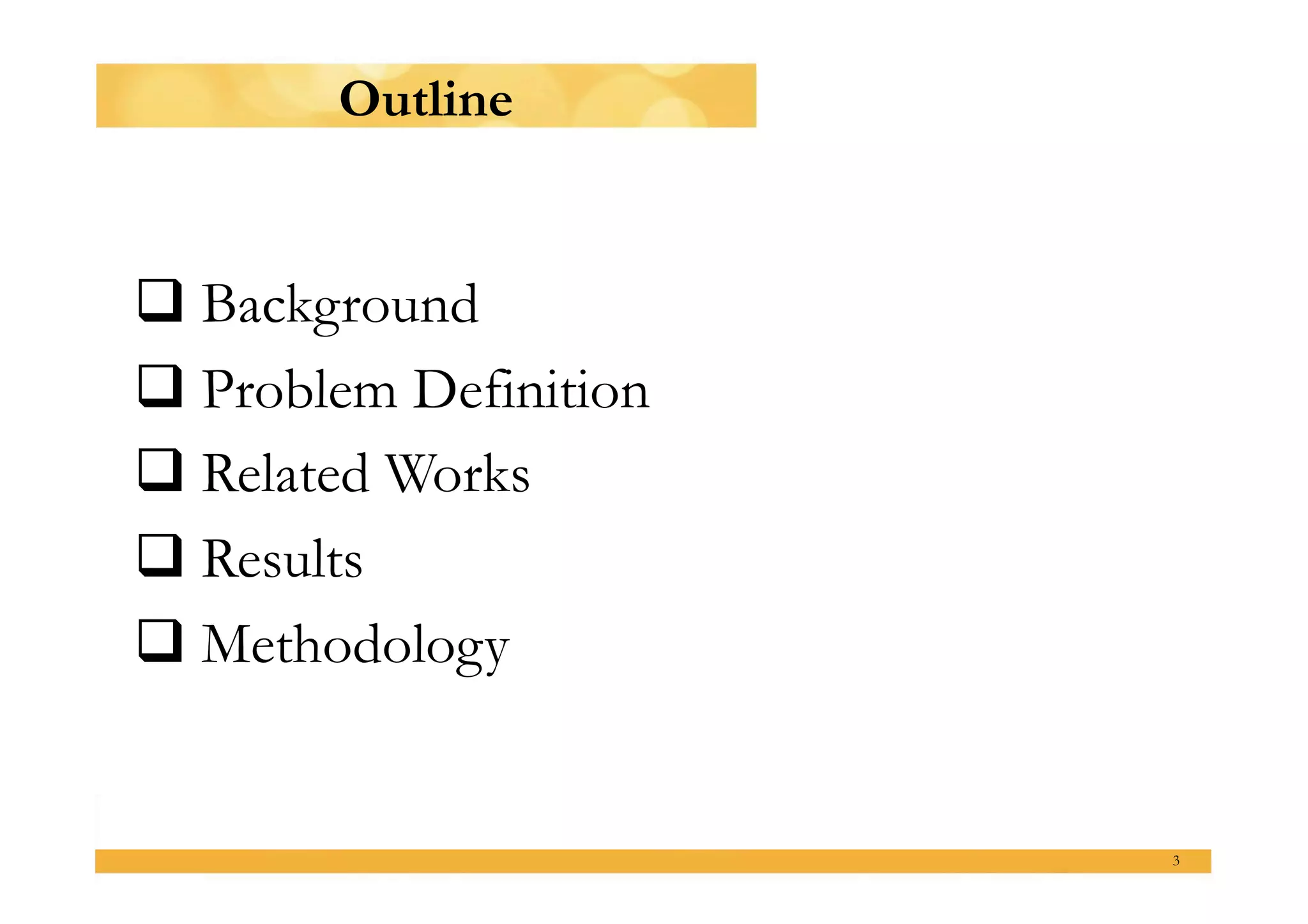
          Business Models for
   Mobile Broadband Media Services –
      Case Study Indonesia Telecom Market


                       Laili Aidi

Jan Markendahl       Greger Blennerud     KonradTolmar
  (Supervisor)          (Supervisor)       (Examiner)
Question


   How to make the media services
delivered on top of mobile broadband
      become profitable business
             in Indonesia?


                                       2
Outline


 Background
 Problem Definition
 Related Works
 Results
 Methodology


                       3
Background


 Shift in usage and expectation
 Mobile broadband as preferred access
 Potencies in multimedia services
 Sustainable media business challenges
    ommon challenges
   C
    nique market characteristics challenges
   U


                                               4
Problem Definition


 Mobile user’s characteristic?
 Current actors and strategies?
 Potential MNO’s positions and roles?
 Challenges and solutions?


                                         5
Related Works
  usiness Model, Actor, Network
 B
   Bottom-line Analysis
  Elnegaard et all (2009), Bohlin (2007)
   Schematic-reasoning approaches
  Camponovo-Pigneur (2007), Ballon (2007), Bendahan et all
    (2003), Markendahl (2007)

 Technology Acceptance
   TAM, UTAUT, ..
   Modified
    Nysveen et all (2005), Pagani (2004) and Lu et all (2005)

                                                                6
Expected Results
 Strategies identification
    Assessment of existing BMs
    Insight Indonesia telecom landscape
Supply-side and existing ecosystem analysis

 Market understanding
    Loyalty & satisfaction
    Willingness to pay & continue
    Expectation & perception
demand-side analysis

 Recommendation
     sses feasibility solutions
    A
     ighlight suitable options
    H
                                              7
Methodology
  Mixed approach
          Qualitative
          Quantitative (complementing)*


  Literature study
          Business model, actor, network
          Technology acceptance
          Industrial & technological background


  Data collection
          Value framework
         Content, Expert sampling and Interview
          Empirical framework
         Random sampling, Secondary source
*J.W. Creswell. Research design: qualitative, quantitative, and mixed method approaches. London: Sage Publications, Inc., 2003   8
Methodology
   ata Analysis
  D
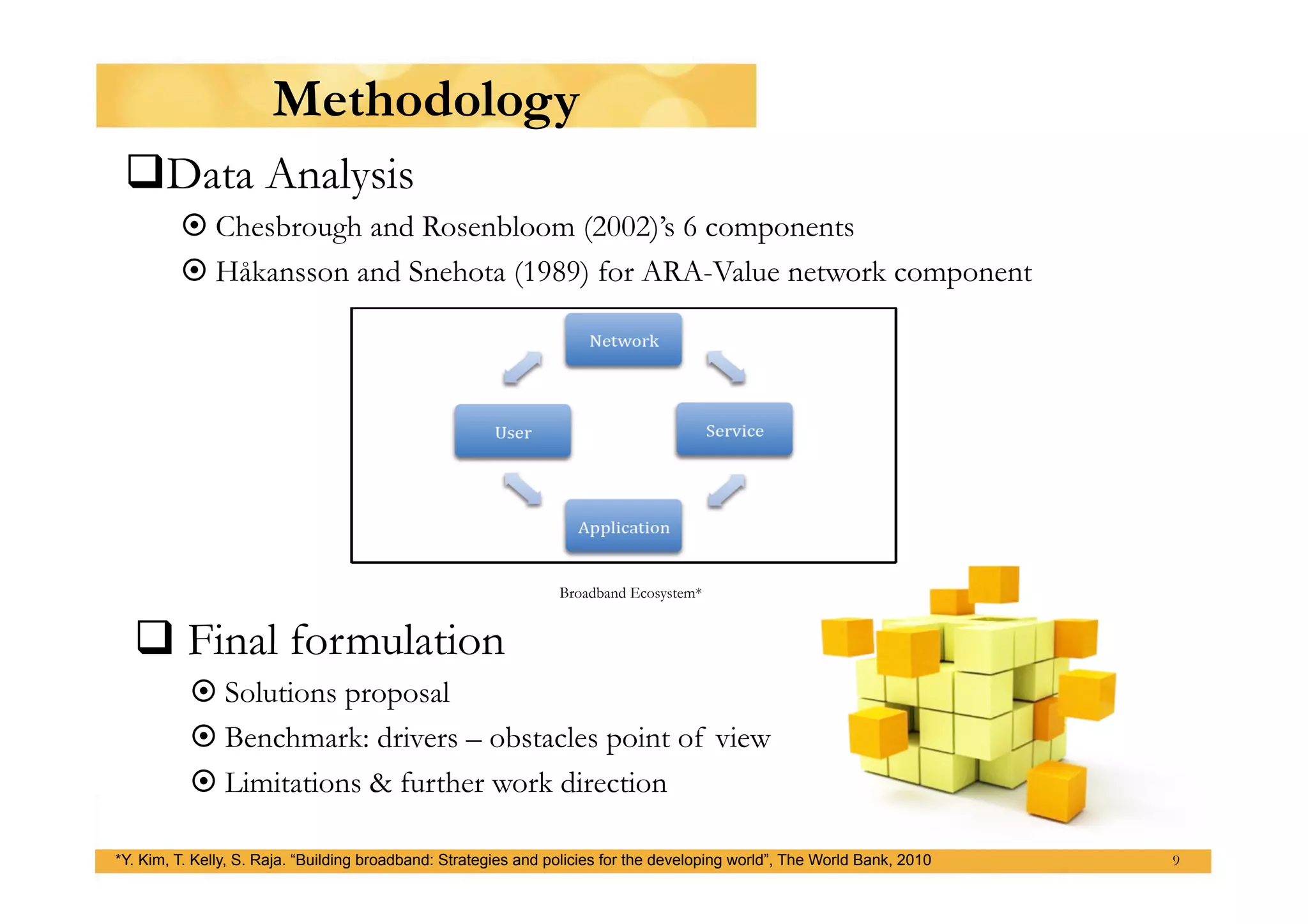
          Chesbrough and Rosenbloom (2002)’s 6 components
          Håkansson and Snehota (1989) for ARA-Value network component


                                                                 Broadband Ecosystem*


   Final formulation
           Solutions proposal
           Benchmark: drivers – obstacles point of view
           Limitations & further work direction

*Y. Kim, T. Kelly, S. Raja. “Building broadband: Strategies and policies for the developing world”, The World Bank, 2010   9
Tack!
Questions ?


              11
Backup Slides
BM-A-N
  ottom-line
 B
 RAN investment, cost elements dimensioning,
 forecasted traffic demand
   Elnegaard et all (2009)
    Medium-large European country density, HSPA,
    cost elements evaluation, forecasted traffic &
    ARPU, profitability evaluation
   Bohlin (2007)
     Fictive country (avg. European country) density,
    4G, cost elements evaluation, forecasted traffic,
    required ARPU
                                                        13
BM-A-N
  chematic-reasoning
 S
    amponovo and Pigneur (2007)
   C
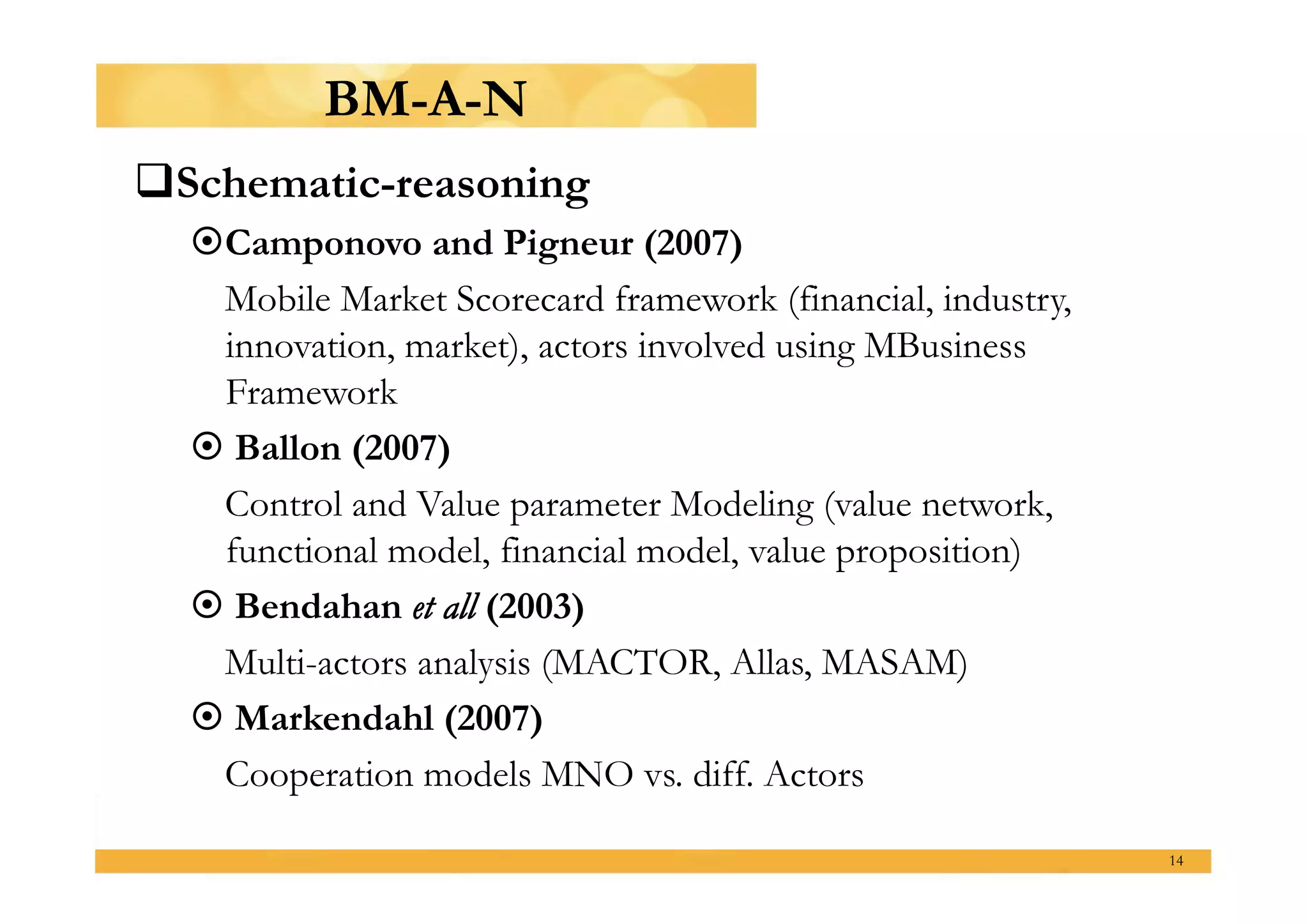
   Mobile Market Scorecard framework (financial, industry,
   innovation, market), actors involved using MBusiness
   Framework
   Ballon (2007)
   Control and Value parameter Modeling (value network,
   functional model, financial model, value proposition)
   Bendahan et all (2003)
   Multi-actors analysis (MACTOR, Allas, MASAM)
   Markendahl (2007)
   Cooperation models MNO vs. diff. Actors

                                                             14
Technology Acceptance
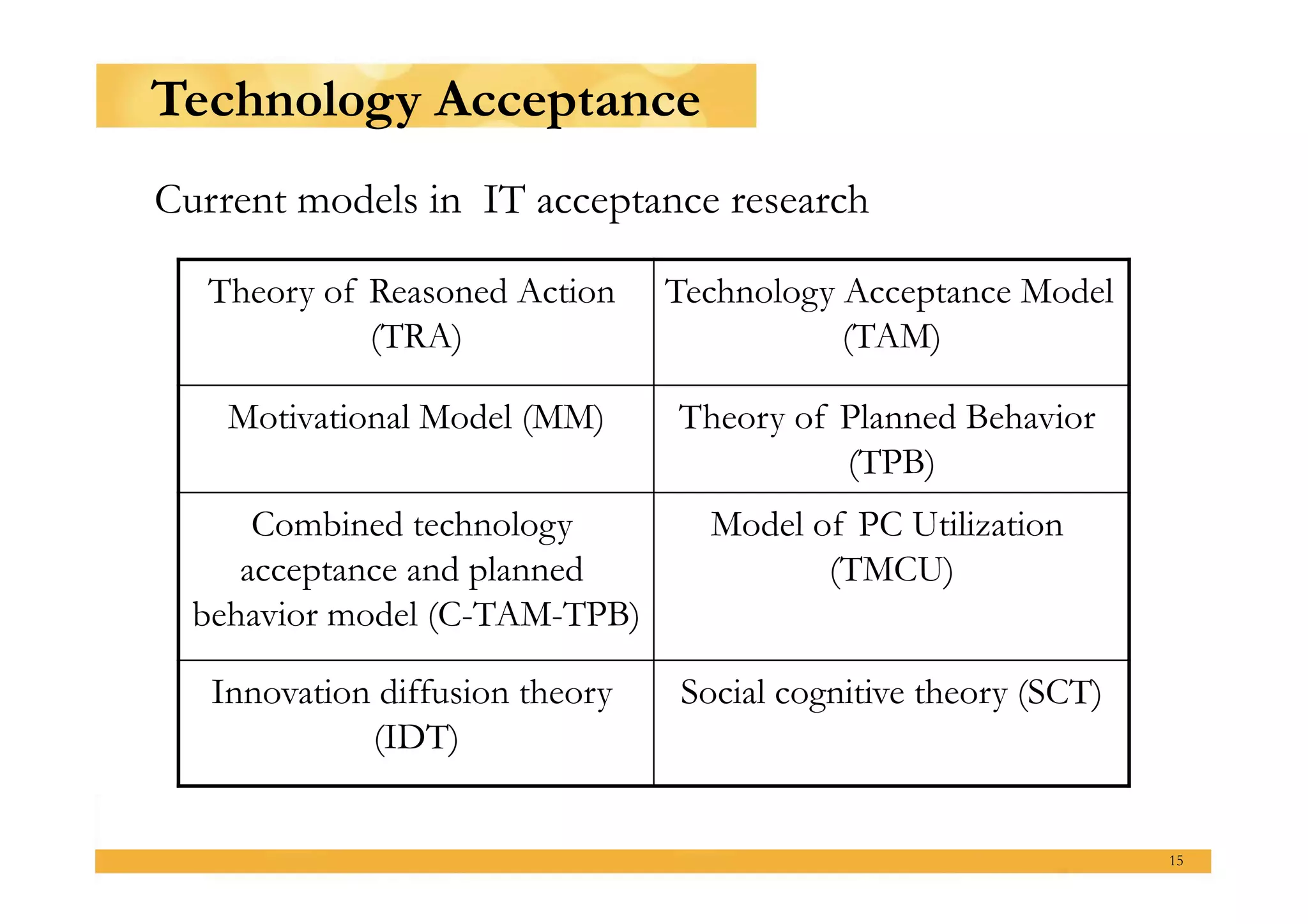
Current models in IT acceptance research

   Theory of Reasoned Action     Technology Acceptance Model
             (TRA)                          (TAM)

    Motivational Model (MM)      Theory of Planned Behavior
                                           (TPB)
      Combined technology          Model of PC Utilization
     acceptance and planned               (TMCU)
  behavior model (C-TAM-TPB)

   Innovation diffusion theory   Social cognitive theory (SCT)
             (IDT)


                                                                 15
Technology Acceptance
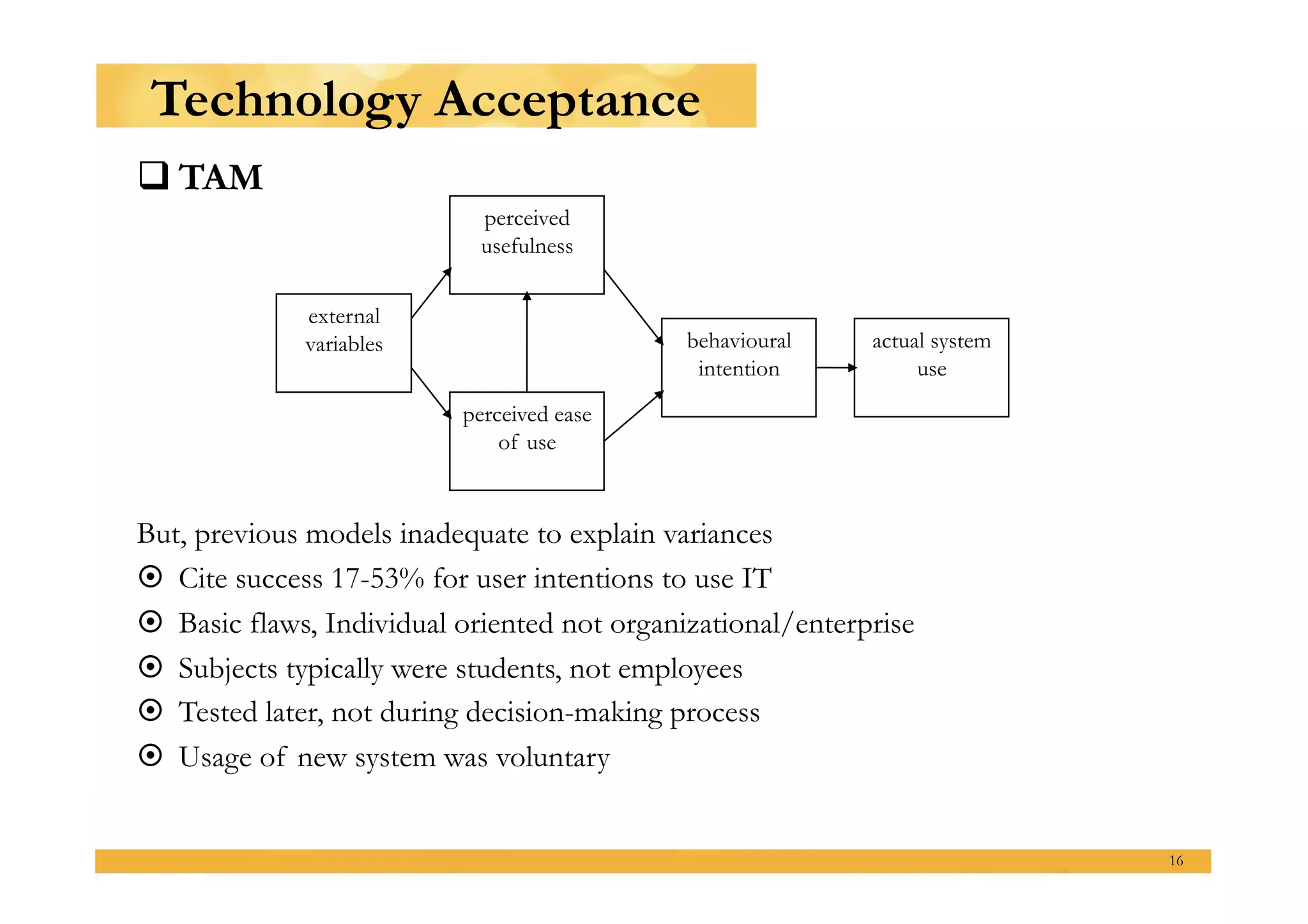
 TAM
                            perceived
                            usefulness


              external
              variables                      behavioural     actual system
                                              intention           use
                           perceived ease
                               of use


But, previous models inadequate to explain variances
  Cite success 17-53% for user intentions to use IT
  Basic flaws, Individual oriented not organizational/enterprise
  Subjects typically were students, not employees
  Tested later, not during decision-making process
  Usage of new system was voluntary


                                                                             16
Technology Acceptance
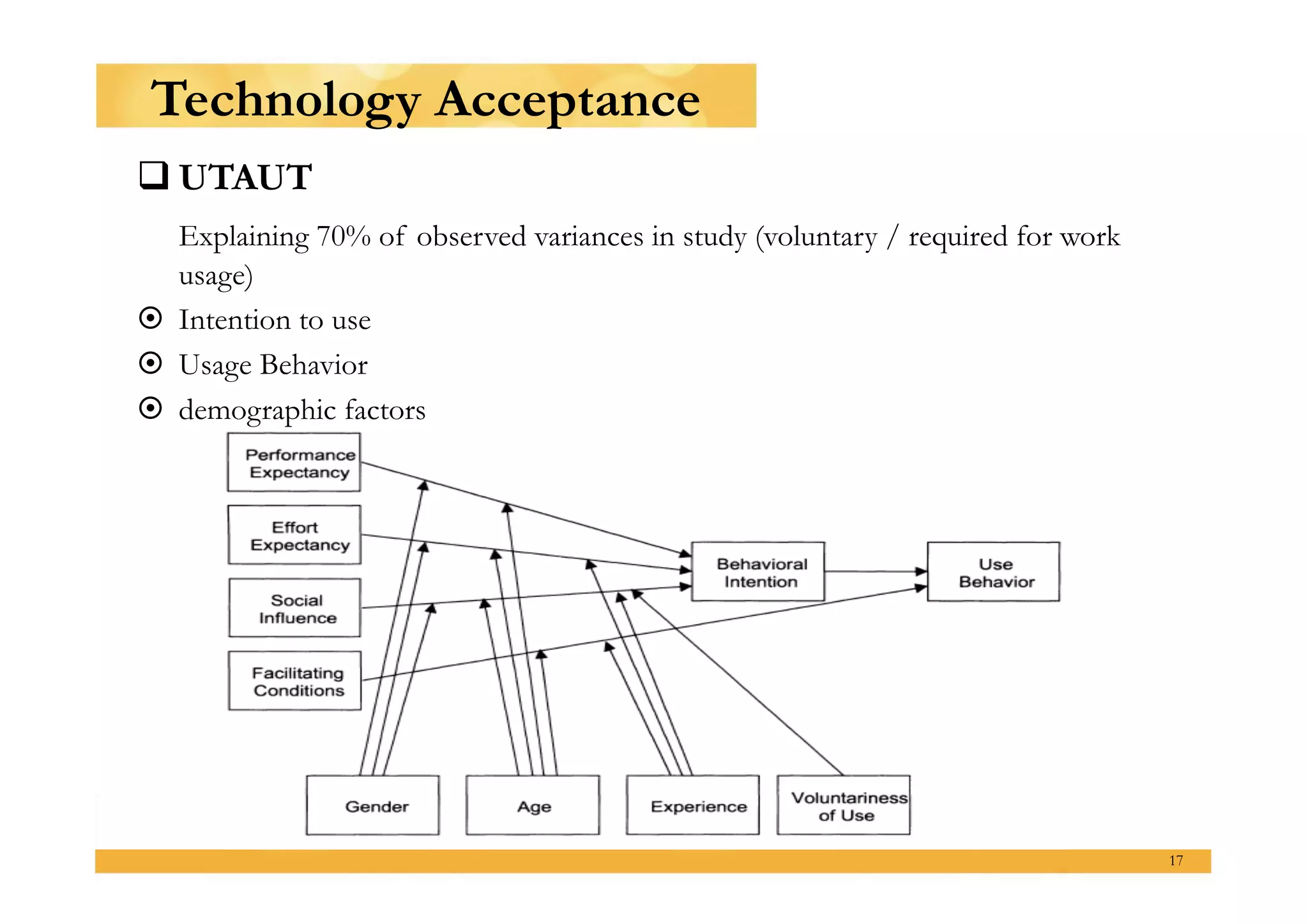
 UTAUT
   Explaining 70% of observed variances in study (voluntary / required for work
   usage)
  Intention to use
  Usage Behavior
  demographic factors


                                                                                  17

Master Thesis Proposal Presentation: Business Models for Mobile-broadband Media Services – Case Study Indonesia Telecom Market

  • 1.
    Master Thesis Proposal Presentation Business Models for Mobile Broadband Media Services – Case Study Indonesia Telecom Market Laili Aidi Jan Markendahl Greger Blennerud KonradTolmar (Supervisor) (Supervisor) (Examiner)
  • 2.
    Question How to make the media services delivered on top of mobile broadband become profitable business in Indonesia? 2
  • 3.
  • 4.
    Background  Shift in usageand expectation  Mobile broadband as preferred access  Potencies in multimedia services  Sustainable media business challenges   ommon challenges C   nique market characteristics challenges U 4
  • 5.
    Problem Definition  Mobile user’scharacteristic?  Current actors and strategies?  Potential MNO’s positions and roles?  Challenges and solutions? 5
  • 6.
    Related Works   usinessModel, Actor, Network B  Bottom-line Analysis Elnegaard et all (2009), Bohlin (2007)  Schematic-reasoning approaches Camponovo-Pigneur (2007), Ballon (2007), Bendahan et all (2003), Markendahl (2007)  Technology Acceptance  TAM, UTAUT, ..  Modified Nysveen et all (2005), Pagani (2004) and Lu et all (2005) 6
  • 7.
    Expected Results  Strategies identification  Assessment of existing BMs  Insight Indonesia telecom landscape Supply-side and existing ecosystem analysis  Market understanding  Loyalty & satisfaction  Willingness to pay & continue  Expectation & perception demand-side analysis  Recommendation   sses feasibility solutions A   ighlight suitable options H 7
  • 8.
    Methodology  Mixed approach  Qualitative  Quantitative (complementing)*  Literature study  Business model, actor, network  Technology acceptance  Industrial & technological background  Data collection  Value framework Content, Expert sampling and Interview  Empirical framework Random sampling, Secondary source *J.W. Creswell. Research design: qualitative, quantitative, and mixed method approaches. London: Sage Publications, Inc., 2003 8
  • 9.
    Methodology   ataAnalysis D  Chesbrough and Rosenbloom (2002)’s 6 components  Håkansson and Snehota (1989) for ARA-Value network component Broadband Ecosystem*  Final formulation  Solutions proposal  Benchmark: drivers – obstacles point of view  Limitations & further work direction *Y. Kim, T. Kelly, S. Raja. “Building broadband: Strategies and policies for the developing world”, The World Bank, 2010 9
  • 10.
  • 11.
  • 12.
  • 13.
    BM-A-N   ottom-line B RAN investment, cost elements dimensioning, forecasted traffic demand  Elnegaard et all (2009) Medium-large European country density, HSPA, cost elements evaluation, forecasted traffic & ARPU, profitability evaluation  Bohlin (2007) Fictive country (avg. European country) density, 4G, cost elements evaluation, forecasted traffic, required ARPU 13
  • 14.
    BM-A-N   chematic-reasoning S   amponovo and Pigneur (2007) C Mobile Market Scorecard framework (financial, industry, innovation, market), actors involved using MBusiness Framework  Ballon (2007) Control and Value parameter Modeling (value network, functional model, financial model, value proposition)  Bendahan et all (2003) Multi-actors analysis (MACTOR, Allas, MASAM)  Markendahl (2007) Cooperation models MNO vs. diff. Actors 14
  • 15.
    Technology Acceptance Current modelsin IT acceptance research Theory of Reasoned Action Technology Acceptance Model (TRA) (TAM) Motivational Model (MM) Theory of Planned Behavior (TPB) Combined technology Model of PC Utilization acceptance and planned (TMCU) behavior model (C-TAM-TPB) Innovation diffusion theory Social cognitive theory (SCT) (IDT) 15
  • 16.
    Technology Acceptance  TAM perceived usefulness external variables behavioural actual system intention use perceived ease of use But, previous models inadequate to explain variances   Cite success 17-53% for user intentions to use IT   Basic flaws, Individual oriented not organizational/enterprise   Subjects typically were students, not employees   Tested later, not during decision-making process   Usage of new system was voluntary 16
  • 17.
    Technology Acceptance  UTAUT Explaining 70% of observed variances in study (voluntary / required for work usage)   Intention to use   Usage Behavior   demographic factors 17