CUSTOMER SATISFACTION IN MOBILE PHONE
 SERVICES IN BANGLADESH: A SURVEY RESEARCH
                                 Assistant Professor Mohammed Belal Uddin
                                                       Comilla University, Bangladesh
                                                        Email: belal_137@yahoo.com
                                              Assistant Professor Bilkis Akhter
                                                    University of Dhaka, Bangladesh
                                                    Email: bilkis_akhter@ yahoo.com

   Abstract:
   This study seeks to explore customer satisfaction and its influencing factors
   of the mobile phone operation industry in Bangladesh. Data were collected
   through a questionnaire survey form a diversified representative sample. An
   iterated factor analysis with principal component analysis (PCA) and
   structural equation modeling (SEM) including measurement model and
   structural model were applied to analyze data. The empirical results
   demonstrate that service quality and fair price have indirect influence on
   customer satisfaction of a mass service industry (i.e., mobile phone
   operators) through perceive value. Perceived value has mediating role
   between quality, charge fairness and satisfaction. Furthermore, result shows
   that fair price has positive direct impact on customer satisfaction, whereas,
   the results did not find any significant direct impact of service quality on
   customer satisfaction.      Mobile phone operators are recommended to
   formulate operations and marketing strategies that focus on expectations of
   customers to enhance level of satisfaction. Similar industries may reveal
   similar relationship features in respect to these relationship constructs, if they
   are under similar category.

   Keywords: Service quality, Price, Perceived value, Customer satisfaction,
   mobile phone service


     Introduction                            regulatory       systems,      restricted
     Mobile phone services are the fast      openness, and concentrated market
growing services in telecommunication        orientation. Effective regulation, more
industry in Bangladesh. This sector is       openness, and entrance of competitive
showing an inspiring growth in last few      firms including launching a new state-
years. Land phone market has no              owned mobile phone service company
competency to compete with mobile            foster competition in this sector since
phone market. Land phone market              2005. It is assumed that, currently the
faces some problems such as weak and         number of mobile phone subscriber is
inadequate infrastructure, corruption,       more than 46 million and expected it will
long procedures, limited income of           cross 60 million by 2012 (Hasan, 2008).
consumers etc. It is expected that                Telecommunication sector of a
Bangladesh will be the third biggest         country can tremendously affect the
telecom market in Asia after China and       society with different products and
India (Hasan, 2008). But mobile phone        services which is also true for
service charges in Bangladesh were           Bangladesh. In Bangladesh, mobile
high before 2005 because of weak             phone operators are contributing a lot
Management&Marketing, volume X, issue 1/2012                                              21

with their services by the creation of          which is about 56.36 million
value     to    the    society.     Citycell,   subscribers.
GrameenPhone,            Robi        (Aktel),         Mobile phone operators provide
Banglalink,      Teletalk     (state-owned      voice service and value added services
company), and Airtel(Warid) are the             including SMS (short message service),
mobile phone service providers in               MMS (multimedia message service),
Bangladesh.          Citycell       (Pacific    ringtone, games, electronic transaction,
Bangladesh Telecom Limited) is the first        and      web      browsing      etc.    The
mobile phone operator of Bangladesh             improvement        of    service     quality,
which, obtained a license in the name           perceived value, and satisfaction ensure
as Bangladesh Telecom Limited (BTL)             customer loyalty (Kuo et al., 2009; Lai et
to operate cellular, paging, and other          al., 2009; Wu and Liang, 2009). These
wireless communication networks in              are the key source of success in the
1989 and in 1990 a joint venture                business and competitive advantage.
Hutchison Bangladesh Telecom Limited            Besides, voice services proving value
(HBTL) was incorporated. Citycell               added services are becoming great
started its commercial operation from           prospect for mobile phone service
1993.      Ministry    of     Posts     and     providers. Since the studies regarding
Telecommunications of Bangladesh in             service      quality     and       customer
November 28, 1996 gave license to               satisfaction issues in telecom industry is
Grameenphone and in March 26, 1997              limited and there is no available
Grameenphone launched its service.              measurement scales for service quality,
Grameenphone has built the largest              especially in Bangladesh, this study
cellular network in the country and             attempts to design the measurement
introduced the pre-paid service in              scales for factors affecting customer
September 1999. Telecom Malaysia                satisfaction      and      for     customer
International (Bangladesh) commenced            satisfaction itself. The objectives of this
its operation in 1997 under the brand           study are firstly, to recognize the
name Aktel which is a joint venture             influencing      factors     of    customer
company between Axiata Group                    satisfaction       and        post-purchase
Berhad, Malaysia and NTT DOCOMO                 intentions. Secondly, to examine the
INC, Japan. The company changed its             interrelationship between customer
brand name Aktel with the brand name            satisfaction and influencing factors of
Robi on 28th March, 2008. Under the             satisfaction such as service quality,
Companies        Act,    1994,      Teletalk    price, and perceived value. The result of
Bangladesh Limited (the “Company”)              this study has managerial and academic
was incorporated on 26 December,                implications. Managers of mobile phone
2004 as a public limited company.               service providers can use the findings
Bangladesh Government sponsored the             as sources of reference to manage their
company. In February 2005, Banglalink           business and improve their service
entered the telecommunication sector of         quality, and academicians can use the
Bangladesh and it became one of the             finding for application of service
fastest growing mobile operators. In            marketing field and further extension of
July 2007, a joint venture between Abu          this topic or related topics.
Dhabi Group & SingTel Group named                     The rest of the paper is structured
as Warid Telecom started its operation          as follows. The next section provides
in Bangladesh. Later on its ownership           the     theoretical     background      and
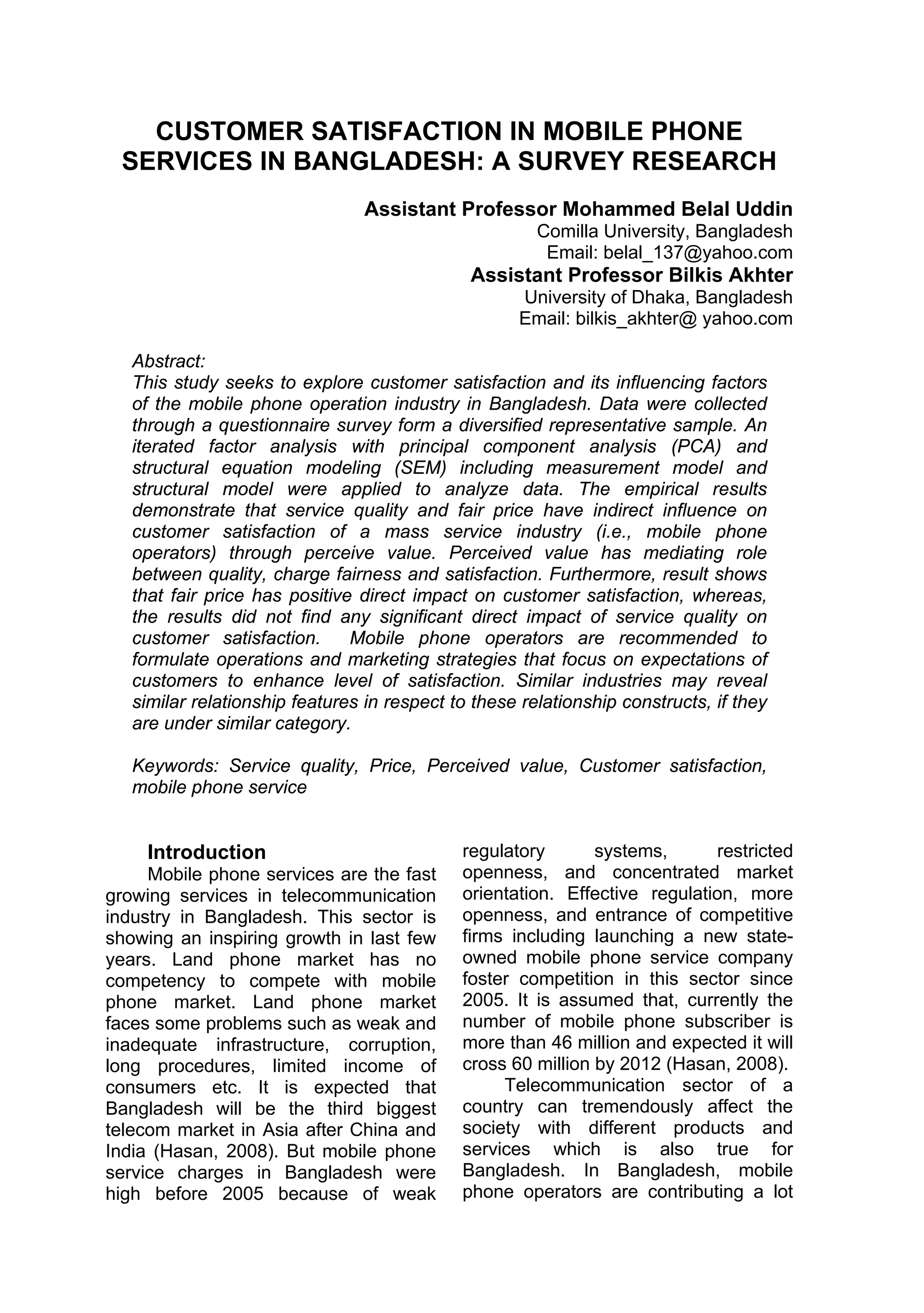
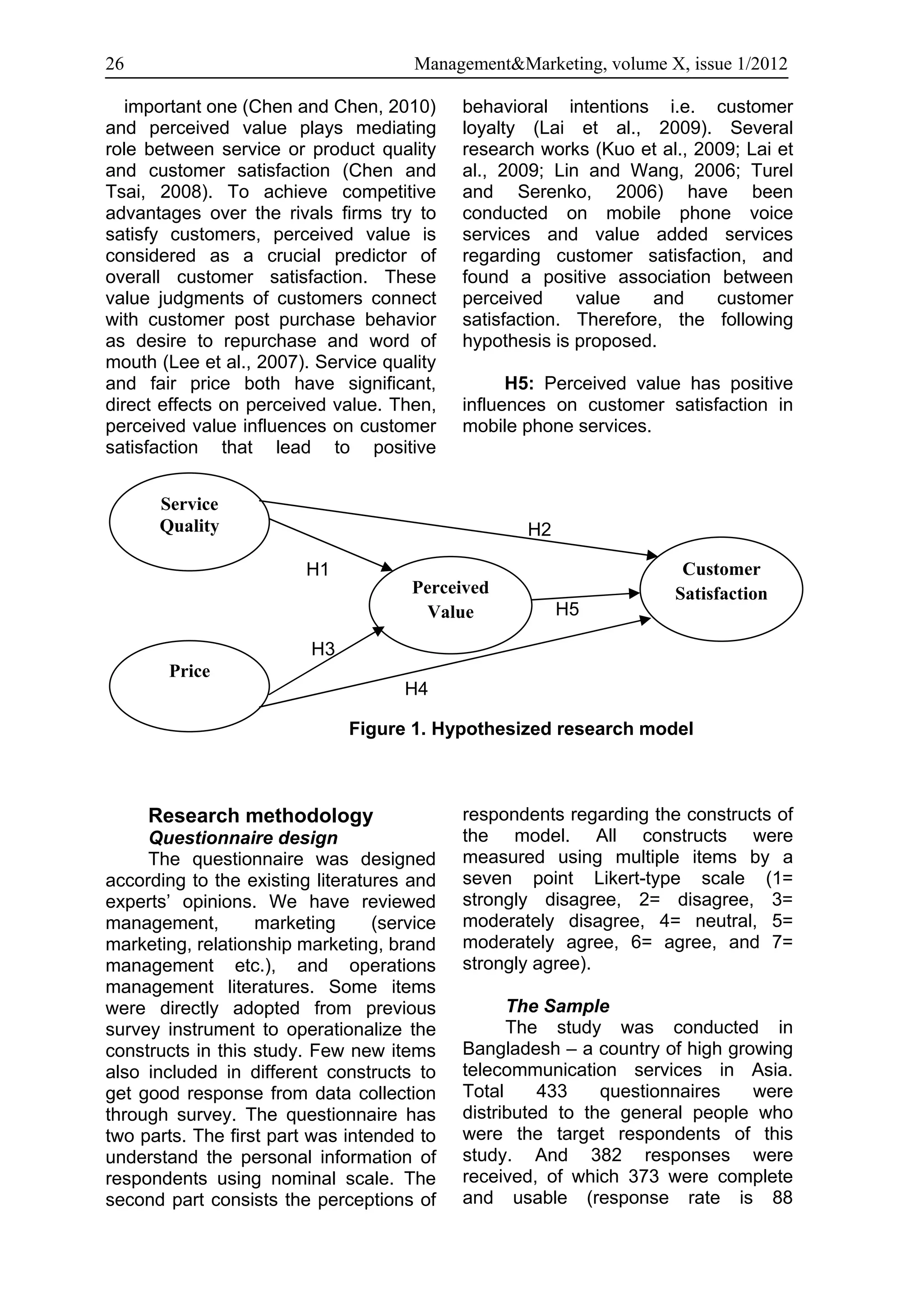
has changed and now it is providing             hypotheses (see Figure-1) of the study.
service with the name Airtel. All of these      The following two sections outline
mobile phone operators in Bangladesh            research      methodology       and    offer
are competing with each other to                statistical analysis and major findings of
capture a major portion of market share         the study. The last section presents
22                                      Management&Marketing, volume X, issue 1/2012

 discussion,      theoretical       and       this study, and guidelines for further
managerial implications, limitations of       study.

   Theoretical background and                 the utility of that product or service
hypotheses development                        comparing with expectation. Recently
      Service quality                         marketing researchers and managers
      Service quality is the gap between      are focusing on value perceptions as a
customers’ expectation and actual             key strategic component to explain
performance of a service (Parasuraman         customer satisfaction and loyalty (Lin
et al., 1985; 1988). Mentioning five          and Wang, 2006). To assess value
dimensions      such      as   tangibility,   perception      customers       consider
responsiveness, reliability, assurance,       perceived benefits relative to sacrifice
and empathy; Parasuraman et al.,              (Lee et al., 2007). Except monetary
(1988) developed the SERVQUAL                 sacrifice perceived value assessment
model. The conceptual framework and           includes       social      psychological
measurement method of this model              perspective and non monetary costs
have been heavily criticized by several       such as search cost, transaction cost,
scholars. In 1992, the alternative            negotiation cost, and consumption of
method, referred to as SERVPERF, was          time (Kuo et al., 2009; Chen and Tsai,
proposed by Cronin and Taylor. They           2008). Purchasing some goods or
argued that, to assess service quality,       services sometimes has some meaning
perception of customers regarding the         that increases social status as well as
performance of service provides better        value of the customers in the society.
results than using SERVQUAL. Along            Customer desire to obtain or retain of
with other researchers in 1994,               any product or service is reflected by
Parasuraman et al. also mentioned that        value perception. Value perception
measurement           method        using     deals     with   the    agreement       of
SERVPERF is better than using                 performance of product or service and
SERVQUAL, though SERVQUAL can                 the value system of customer (Neap
provides better diagnostic results of         and Celik, 1999). Thus, perceived value
service quality. Service quality has a        is a consumers’ evaluation of perceived
distinct constructs and distinguish           benefits with expectation and sacrifice.
features for different services. For
instance, website service quality                   Relationship between service
depends on usability, usefulness of           quality and perceived value
content, adequacy of information,                   With the consumption of any
accessibility, and interaction (Yang et       product or service customers have
al., 2005). On the other hand, Kuo et al.     some benefits expectation based on
(2009) proposed four dimensions of            their advance sacrifice of resources.
service quality of mobile value-added         Perceived value is the appraisal of the
services including customer service and       expected      benefits    with    actual
system reliability, navigation and visual     performance of the products or
design, content quality, and connection       services. Several scholars examined
speed. Thus, this study will concentrate      association between service quality and
on perceived service quality of mobile        perceived value in their studies
phone services in Bangladesh.                 (Hutchinson et al., 2009; Kuo et al.,
                                              2009; Lai et al., 2009; Wu and Liang,
     Perceived value                          2009). They found high service quality
     Value is the quality or expectation      is correlated with high perceived value.
in mind. Perceived value is the               Experience about service quality
customers’ psychological assessment           positively and significantly persuade
regarding the product and service about       perceived value of a customer (Chen
Management&Marketing, volume X, issue 1/2012                                           23

and Chen, 2010). By studying luxury         factors are responsive employees,
hotel-restaurant industry in Taiwan Wu      well-mannered employees, educated
and Linag (2009) stated that, to            employees, cooperative employees,
increase customer experiential value        correctness of billing, billing relevance,
hotel managers should emphasize on          competitive pricing, service feature,
three quality aspects including service     superior value, billing transparency and
environment,       employee       service   fast service. Alternative options and
performance, and interaction with           products/services available for a
clients. Therefore, there exists a          customer may create differences in
positive relationship between service       satisfaction level. Organizations can
quality aspect and experiential well as     accomplish customer satisfaction by
perceived value. Kuo et al. (2009), Lai     satisfying their customers’ needs and
et al. (2009), and Turel and Serenko        wants (La Barbera and Mazursky,
(2006) studied relationship between         1983).     Customer      Satisfaction    is
service quality and perceived value         customers’ collective conception of a
along with other constructs in mobile       firm’s service performance (Johnson
phone service industry and found            and Fornell, 1991). In case of mobile
service quality positively motivate         commerce, customer satisfaction is
perceived value. Having influencing role    customer’s post-purchase appraisal and
of service quality also is an antecedent    emotional response or reaction to the
of value perceptions (Hutchinson et al.,    overall product or service familiarity in a
2009). Thus, there is a positive            mobile commerce environment (Lin and
relationship      between       customer    Wang, 2006).
perceptions of service quality and value
perceptions, and service quality is the            Relationship between service
best predictor of perceived value. So,      quality and customer satisfaction
we posit:                                          Customer satisfaction literature
                                            discusses about satisfaction model in
      H1: Service quality has positive      marketing. According to the satisfaction
influences on perceived value in mobile     model       customer      satisfaction      is
phone services.                             influenced by service quality. When
                                            customers get expected service quality,
      Customer satisfaction                 it    leads     to    higher     satisfaction
      Customer satisfaction is the          (Hutchinson et al., 2009). The difference
authentic expression of the status of       between customers’ expectations and
satisfaction will differ from person to     the real performance is reflected as
person      and     product/service  to     perceived service quality. The higher
product/service and is an appraisal of      perceived performance has a positive
how products and services of a              association with higher perceived
company meet up or exceed customer          service quality. And expectation has a
anticipation.    Satisfaction   is  the     negative relationship with perceived
consequence of a number of both             service      quality.     So,     perceived
psychological and physical factors          performance has direct and positive
which associate with satisfaction           relationship with satisfaction (Chen,
behaviors. Kotler (2000) defined            2008). Tourists’ perceived experience
satisfaction as: “a person’s feeling of     quality    influences      positively    and
pleasure or disappointment resulting        significantly both perceived value and
from comparing a product’s perceived        satisfaction, in the tourism context
performance (or outcome) in relation to     (Chen and Chen, 2010). In the
his or her expectations”. Hokanson          telecommunication context, service
(1995) focuses on different factors         quality implies network quality which
affecting customer satisfaction and the     includes clarity of voice reproduction,
24                                      Management&Marketing, volume X, issue 1/2012

   indoor    and     outdoor     coverage,    performance, potentials have an
smoothness of connectivity along with         incorporation effect on performance and
effective delivery of other value added       satisfaction    judgments      and     for
services (Gerpott et al., 2001). Service      inconsistency potentials have no effect
quality is the determinant of customer        on performance and satisfaction
satisfaction (Cronin and Taylor, 1992)        judgments (Voss et al., 1998). The
and by ensuring good service quality;         perceived price fairness related to
telecom operators can enrich customer         different levels intangible services has
satisfaction (Kuo et al., 2009). A positive   direct or indirect effect on customer
behavioral intention is the refection of      loyalty in case of banks, auto repair and
satisfaction that is also influenced by       maintenance shops, and (gasoline)
service quality. A negative intention is      filling stations (Lien and Yu-Ching,
the outcome of dissatisfaction that may       2006). Consumers' knowledge of prices
arise from experiences of customers           may be affected by economic
regarding      service     quality    issue   environmental factors such as interest
(Zeithaml et al., 1996). Gerpott et al.       rates, unemployment, inflation, country
(2001), Kim et al. (2004), Kuo et al.         of study, and passage of time and GDP
(2009), and Lin and Wang (2006)               growth (Estelami et al., 2001).
studied telecommunication customer
satisfaction aspects in Germany, Korea,             Relationship between price and
Taiwan, and Taiwan respectively and           perceived value
found the positive relationship between             Customers are always cost
service      quality     and      customer    concern. They want such an exchange
satisfaction. Thus, we propose:               where benefits exceed the outlays
                                              (monetary and nonmonetary costs).
      H2: Service quality has positive        Reduction of outlays related with
influences on customer satisfaction in        purchasing process, is one the way to
mobile phone services.                        enhance perceived value (Chen and
                                              Hu, 2010). Customer value is a function
      Price                                   of quality and price. It provides a
      In finance price is termed as the       competitive advantage when firms take
amount of payment requested by the            cost-cutting    imitative      to   ensure
seller of goods or services. The ratio        customer value (Spiteri and Dion,
between two products exchanged                2004). Real price competitiveness is an
quantity is defined as price from             important determinant of customer
economic point of view. Price is              value. Price satisfaction increases the
determined by several factors such as         value perception and there is a direct
willingness of the buyer to pay,              relationship between price and value
willingness to accept, costs, markup,         (Ralston, 2003). Perceived value is
legal     environment,     intensity    of    influenced by price factors and non
competition price substitute products         price factors. Monetary price includes
etc. For different product/brand quality      advertised     sale     price,    advertise
price also varies and price has influence     reference price, shipment and handling
on economic performance of a product          charges. Whereas, searching costs,
or brand quality (Etgar, 1981). Price         product or service evaluation, time effort
fluctuations in many service industries       etc. are included in nonmonetary price
results in price-performance and the          (Grewal et al., 2003). Monterey value is
level of price-performance stability          the part of value perception of
moderates the relationship between            customers. To capture market share,
performance potential and successive          Chinese mobile phone operators
performance         and       satisfaction    provide competitive pricing strategies
judgments. For consistency in price and       such as free offer and low charges. If
Management&Marketing, volume X, issue 1/2012                                        25

customers feel these offers are             the customers in general. If the
reasonable and acceptable, they             reasons for increase in price are
perceive these offers as monetary value     indefensible then it can be treated as
under their value perception (Deng et       unfair by the customers (Xia et al.,
al., 2010). Customers may be highly         2004; Campbell, 1999). The reason for
price-conscious or less price-conscious.    an increase in price is reasonable if it is
Highly    price-conscious     customers     related to the factors external to the firm
response quickly with price changes         such as increase in supplier’s price. On
than that of less price-conscious           the other hand, reasons are inexcusable
customers, and price is a significant       when the factors are internal to the firm
predictor of their value perception as      such as increase in profit margin
well as repeat purchase behavior            (Vaidyanathan and Aggarwal, 2003).
(Hidalgo et al., 2008). Price has an        Customers can be attracted to a retail
impact on customer buying behavior          store by using price and special
and value perception. Price needs           promotions (Grewal, et al., 1998). Thus,
special consideration to assess value       we posit:
perception     of     customers,     not
generalized along with other factors              H4: Fair price has positive
(Lockyer, 2005). Therefore, we propose:     influences on customer satisfaction in
                                            mobile phone services.
      H3: Fair price has positive
influences on perceived value in mobile           Relationship between perceived
phone services.                             value and customer satisfaction
                                                   Value judgments of customers
      Relationship between price and        have influence on satisfaction, and
customer satisfaction                       perceived value is considered as a
      Customers’ perception about price     powerful      measure     of     customer
is that the forces of supply and demand     satisfaction      and      post-purchase
determine the market price and they         intentions.      Recently       marketing
also consider that price is a pointer of    managers and researchers are focusing
product or service quality. Customer        more on value judgments of customers.
satisfaction is affected by the price       Transactional satisfaction and overall
awareness (Varki and Colgate, 2001;         satisfaction are two types of customer
Iyer and Evanschitzky, 2006). Price         satisfaction. Transactional satisfaction is
level, value for money and special offers   related with particular buying judgment,
may result in both satisfaction and         whereas, overall satisfaction is related
dissatisfaction and price fairness, price   with overall experience and value
perceptibility and price processibility     judgment (Spiteri and Dion, 2004).
may result in dissatisfaction for           Customer satisfaction is positively
customers (Zielke, 2008). In addition to    influenced by perceived value. The
the various levels of product price, a      extent of satisfaction depends on extent
mixture of price awareness dimensions       of perceived value and higher level of
have potentiality to intimidate the         perceived value lead to higher level of
customers’ satisfaction (Diller, 2000;      customer satisfaction (Kuo et al., 2009;
Matzler and Pramhas, 2004; Matzler et       Turel and Serenko, 2006). Customer
al., 2006). Perceptions of customers        satisfaction tends to positive post
about price fairness have been major        purchase behavior, thus, satisfaction
concern due to huge interest of mass        playas a mediating role in the
people (Xia et al., 2004, Martin et al.,    relationship of perceived value and
2009). When the price of a product or       behavioral intentions (Lin and Wang,
service is increased or decreased there     2006). Among the determinants of
is an instant response from the side of     satisfaction perceived value is the
26                                     Management&Marketing, volume X, issue 1/2012

   important one (Chen and Chen, 2010)       behavioral intentions i.e. customer
and perceived value plays mediating          loyalty (Lai et al., 2009). Several
role between service or product quality      research works (Kuo et al., 2009; Lai et
and customer satisfaction (Chen and          al., 2009; Lin and Wang, 2006; Turel
Tsai, 2008). To achieve competitive          and Serenko, 2006) have been
advantages over the rivals firms try to      conducted on mobile phone voice
satisfy customers, perceived value is        services and value added services
considered as a crucial predictor of         regarding customer satisfaction, and
overall customer satisfaction. These         found a positive association between
value judgments of customers connect         perceived     value    and    customer
with customer post purchase behavior         satisfaction. Therefore, the following
as desire to repurchase and word of          hypothesis is proposed.
mouth (Lee et al., 2007). Service quality
and fair price both have significant,              H5: Perceived value has positive
direct effects on perceived value. Then,     influences on customer satisfaction in
perceived value influences on customer       mobile phone services.
satisfaction that lead to positive


      Service
      Quality                                       H2

                         H1                                            Customer
                                      Perceived                       Satisfaction
                                       Value             H5          H5

                          H3
        Price
        Price                         H4

                               Figure 1. Hypothesized research model


     Research methodology                    respondents regarding the constructs of
     Questionnaire design                    the model. All constructs were
     The questionnaire was designed          measured using multiple items by a
according to the existing literatures and    seven point Likert-type scale (1=
experts’ opinions. We have reviewed          strongly disagree, 2= disagree, 3=
management,        marketing      (service   moderately disagree, 4= neutral, 5=
marketing, relationship marketing, brand     moderately agree, 6= agree, and 7=
management etc.), and operations             strongly agree).
management literatures. Some items
were directly adopted from previous                The Sample
survey instrument to operationalize the            The study was conducted in
constructs in this study. Few new items      Bangladesh – a country of high growing
also included in different constructs to     telecommunication services in Asia.
get good response from data collection       Total     433    questionnaires   were
through survey. The questionnaire has        distributed to the general people who
two parts. The first part was intended to    were the target respondents of this
understand the personal information of       study. And 382 responses were
respondents using nominal scale. The         received, of which 373 were complete
second part consists the perceptions of      and usable (response rate is 88
Management&Marketing, volume X, issue 1/2012                                          27

percent, whereas, effective response          graduation,      and     21     percent
rate is approximately 98 percent). Sixty-     completed        post-graduation.     The
two percent (62 percent) respondents          summary statistics of the survey are
were men and 38 percent were women.           shown in Table 1. In order to control
60 percent respondents were up to             common method biases, it was assured
thirty years, 15 percent were thirty-one      to respondents that there was no right
to forty years, 16 percent were forty-one     or wrong answers and they should
to fifty years, and 9 percent were above      provide answer as honestly as possible
fifty years old. 22 percent respondents       and no information will be shared with
were involved in government service, 21       other person or organization. It has
percent were in private service, 18           been also assured that the respondents’
percent were in business, 16 percent          identity will not be disclosed i.e. as like
were housewife, and 23 percent were           answers to be anonymous and the
student respondents. 35 percent               information of this survey will be used
respondents completed up to college           for researchers’ academic purpose.
level education, 40 percent completed

                                                                         Table 1
                 Summary statistics of questionnaire survey
    Constructs         No. of  Mean        SD           Sources of scale
                       items
Service quality           6    5.992      0.857    Chae et al., 2002; Wouters,
                                                     2004; Yang et al., 2005
Price                     4    5.550      1.092    Kim and Lee, 2010; Zielke,
                                                               2008
Perceived value           3    4.782      1.203       Chen and Tsai, 2008;
                                                       Cronin et. al., 2000;
                                                   Hutchinson et al., 2009; Lai
                                                           et al., 2009
Customer                  6    5.090      1.409     Chae et al., 2002; Lin and
satisfaction                                       wang, 2006; Olorunniwo et
                                                            al., 2006
 SD = standard deviation

     Analyses and Results                     obtained using Bartlett’s sphericity test,
      Structural    equation     modeling     which suggests that the inter-correlation
(SEM) was employed in this study to           matrix contains sufficient common
test proposed model and hypotheses            variance to make factor analysis
and used AMOS 17.0 as the analysis            worthwhile. For EFA, the Principal
instrument. For parameter estimation,         Component Analysis (PCA), with
maximum likelihood method was                 varimax rotation and eigenvalue greater
adopted. Measurement model and                than 1 was used. As a conservative
structural model test were used to test       heuristic, a cut-off point as 0.50
fitness of the model. The exploratory         (suppress absolute value less than
factor analysis (EFA) was performed to        0.50) was imposed in factor analysis
understand underlying relationship of         that enhance the total reliability of the
factors and data reduction purpose. To        questionnaire. We restricted the number
determine whether the data were               of factors to four as the theoretical
appropriate for factor analysis, a Bartlett   background of this study has total four
sphericity test was performed. A KMO          underlying factors. As suggested by the
(Kaiser–Meyer-Olkin) value of 0.868           results of EFA one item (v6) was
and significance level of .000 were           removed. Table-2 shows the rotated
28                                     Management&Marketing, volume X, issue 1/2012

   factor loadings and their respective      rule of thumb of 0.70 (Nunnally, 1978),
eigenvalue and cronbach alpha values.        that expresses a good internal
It is notable that all calculated alpha      consistency among items within each
values are above the widely recognized       construct.

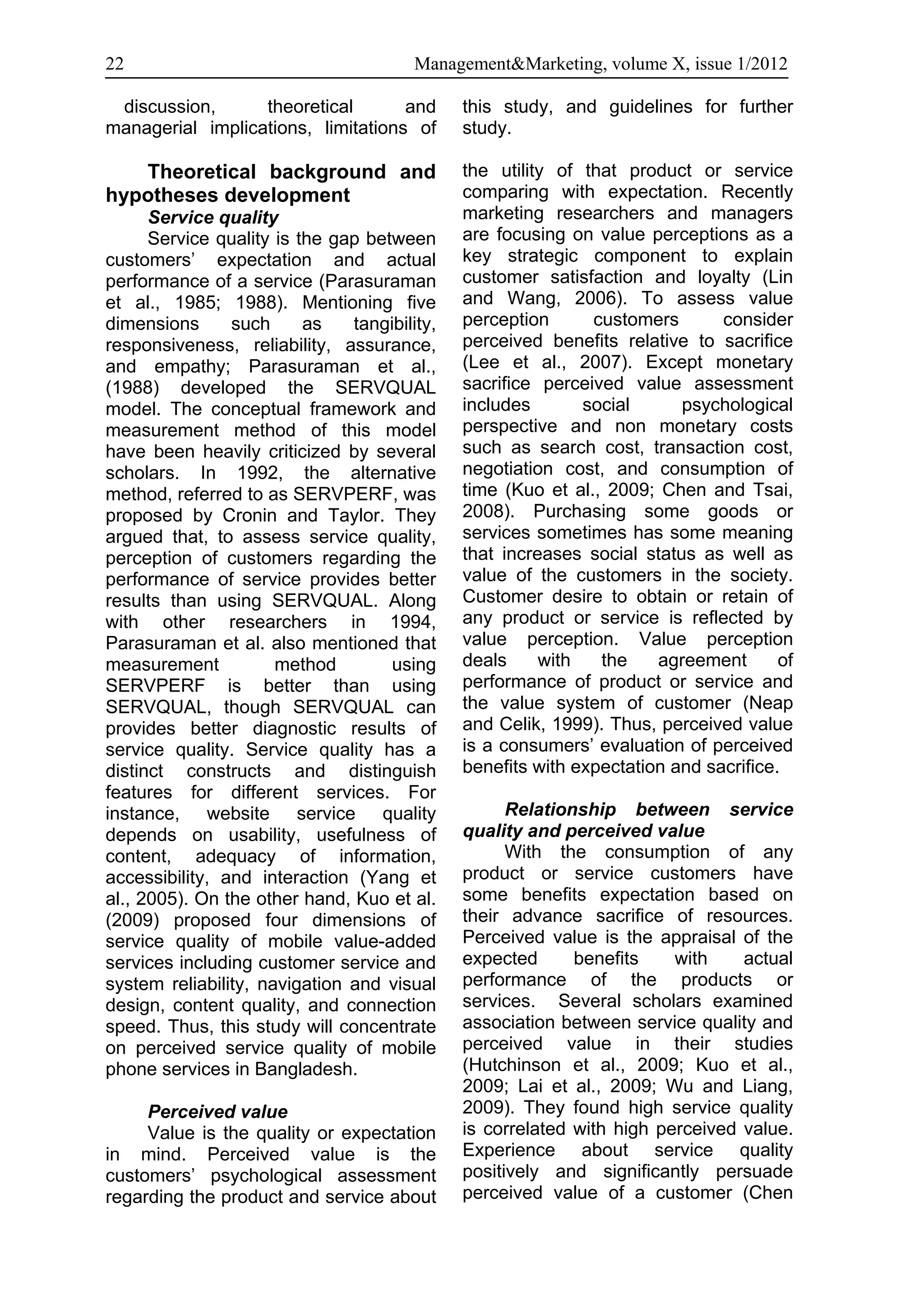
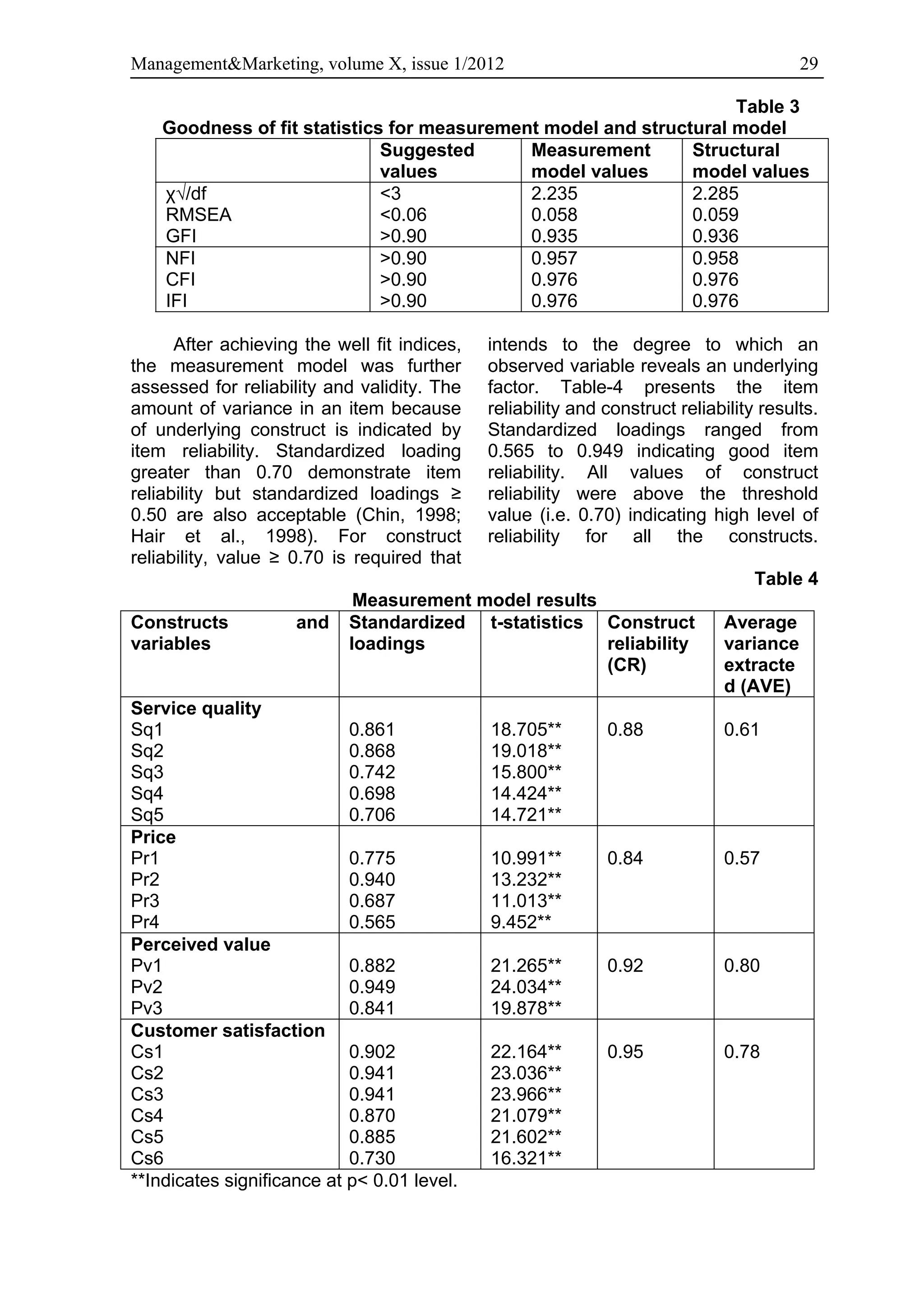
                                                                              Table 2
                               Result of factor analysis
No.                Service         Price            Perceived        Customer
                   quality                          value            satisfaction
Sq1                0.868
Sq2                0.882
Sq3                0.816
Sq4                0.770
Sq5                0.742
Pr1                                 0.758
Pr2                                 0.775
Pr3                                 0.863
Pr4                                 0.841
Pv1                                                0.874
Pv2                                                0.868
Pv3                                                0.852
Cs1                                                                  0.910
Cs2                                                                  0.933
Cs3                                                                  0.932
Cs4                                                                  0.894
Cs5                                                                  0.921
Cs6                                                                  0.739
Eigenvalue         6.770            3.405          2.091             1.707
Varience           35.630           17.922         11.003            8.982
explained (%)
Cronbach           0.887            0.852          0.919             0.957
alpha
Overall cronbach alpha is 0.899.

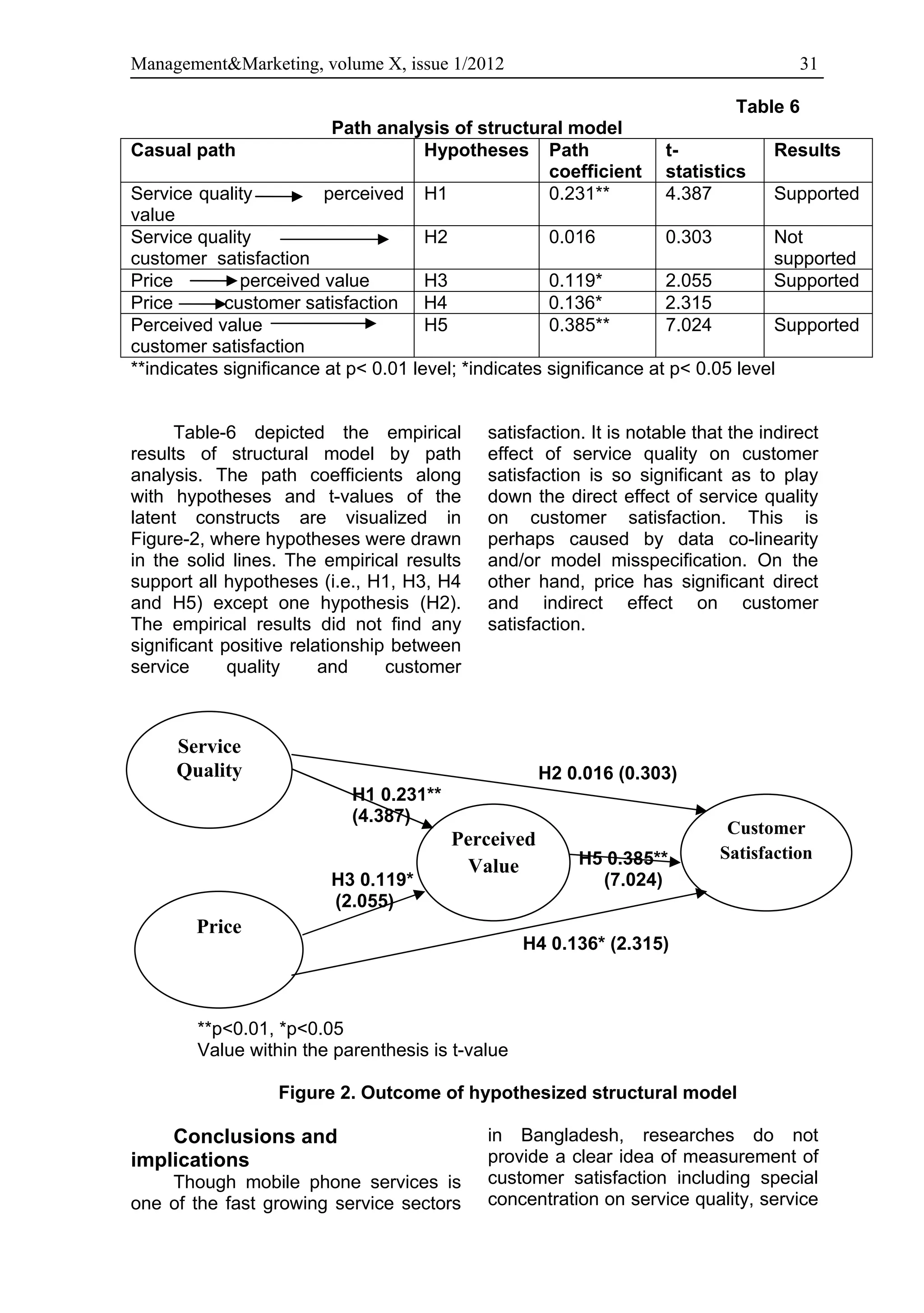
      Measurement model                      (χ√/df) ratio, root mean-square error of
      Confirmatory factor analysis (CFA)     approximation (RMSEA), goodness of fit
was conducted to have a more rigorous        index    (GFI),     normed    fit index
interpretation of customer satisfaction.     (NFI),comparative fit index (CFI),
The CFA model or Measurement model           incremental fit index (IFI). As Table-3
was employed to identify and determine       shows χ√/df = 2.235, RMSEA = 0.058,
the relationships of variables within the    GFI = 0.935, NFI = 0.957, CFI = 0.976,
model. To evaluate the goodness-of-fit       and IFI = 0.976. All measures fulfill the
of model several measures of indices         suggested values. Therefore, CFA
are used as suggested by Hair et al.         model can be said as a good fit model.
(1998), Iacobucci (2010), Schumacker
(1992): Chi-square/degrees of freedom
Management&Marketing, volume X, issue 1/2012                                             29

                                                                    Table 3
    Goodness of fit statistics for measurement model and structural model
                              Suggested      Measurement       Structural
                              values         model values      model values
    χ√/df                     <3             2.235             2.285
    RMSEA                     <0.06          0.058             0.059
    GFI                       >0.90          0.935             0.936
    NFI                       >0.90          0.957             0.958
    CFI                       >0.90          0.976             0.976
    IFI                       >0.90          0.976             0.976

      After achieving the well fit indices,   intends to the degree to which an
the measurement model was further             observed variable reveals an underlying
assessed for reliability and validity. The    factor. Table-4 presents the item
amount of variance in an item because         reliability and construct reliability results.
of underlying construct is indicated by       Standardized loadings ranged from
item reliability. Standardized loading        0.565 to 0.949 indicating good item
greater than 0.70 demonstrate item            reliability. All values of construct
reliability but standardized loadings ≥       reliability were above the threshold
0.50 are also acceptable (Chin, 1998;         value (i.e. 0.70) indicating high level of
Hair et al., 1998). For construct             reliability for all the constructs.
reliability, value ≥ 0.70 is required that
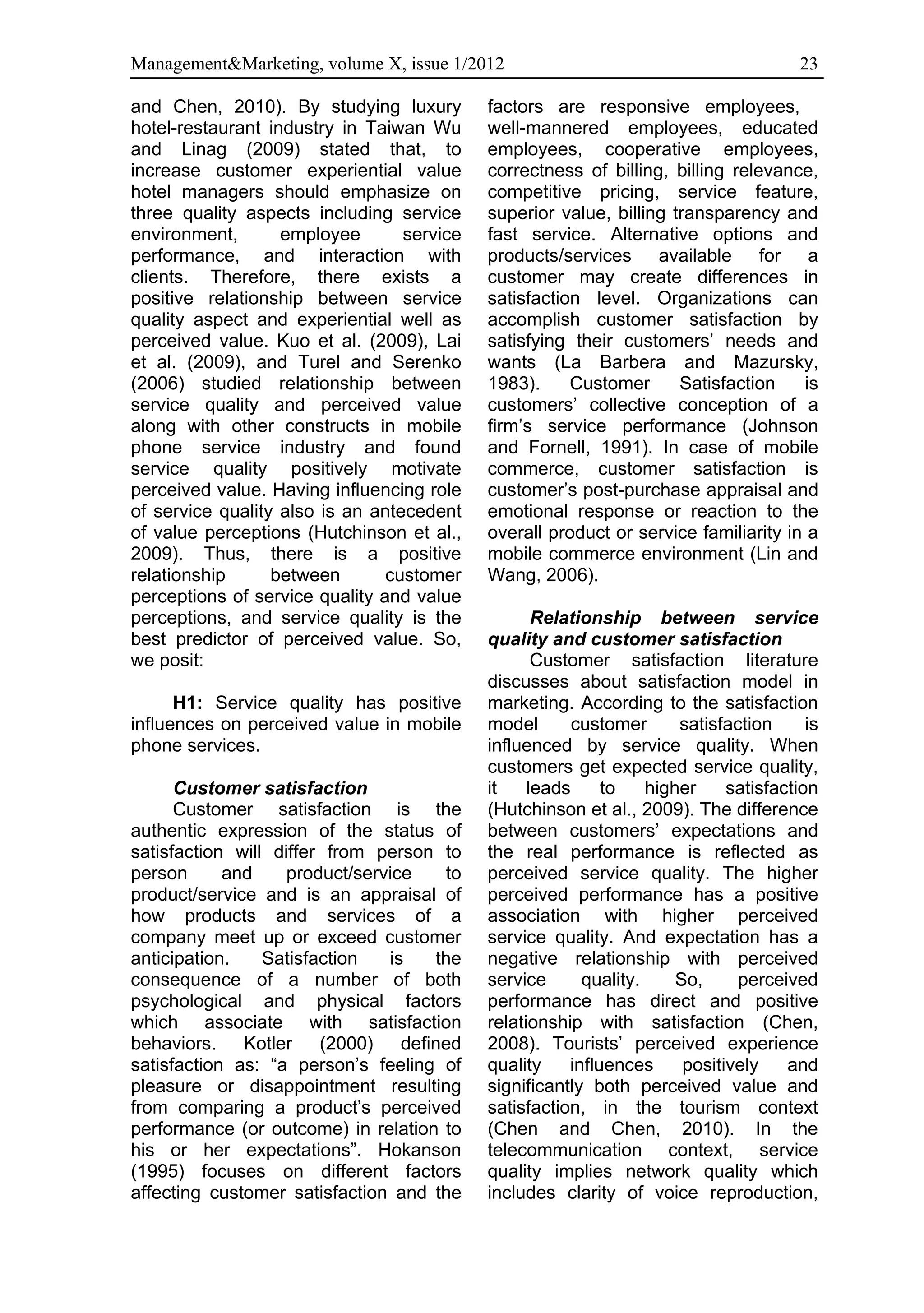
                                                                                   Table 4
                             Measurement model results
Constructs           and    Standardized t-statistics Construct               Average
variables                   loadings                   reliability            variance
                                                       (CR)                   extracte
                                                                              d (AVE)
Service quality
Sq1                         0.861             18.705**        0.88            0.61
Sq2                         0.868             19.018**
Sq3                         0.742             15.800**
Sq4                         0.698             14.424**
Sq5                         0.706             14.721**
Price
Pr1                         0.775             10.991**        0.84            0.57
Pr2                         0.940             13.232**
Pr3                         0.687             11.013**
Pr4                         0.565             9.452**
Perceived value
Pv1                         0.882             21.265**        0.92            0.80
Pv2                         0.949             24.034**
Pv3                         0.841             19.878**
Customer satisfaction
Cs1                         0.902             22.164**        0.95            0.78
Cs2                         0.941             23.036**
Cs3                         0.941             23.966**
Cs4                         0.870             21.079**
Cs5                         0.885             21.602**
Cs6                         0.730             16.321**
**Indicates significance at p< 0.01 level.
30                                     Management&Marketing, volume X, issue 1/2012

   CR= (∑ Standardized loadings) √ ⁄ [(∑ Standardized loadings) √ + ∑ (measurement
indicator error)]
AVE = ∑ (Standardized loadings√) ⁄ [∑ (Standardized loadings√) + ∑ (measurement indicator
error)]

      After being assured that a scale        items offer good measures to their
instrument provides necessary levels of       respective latent construct because of
reliability, this study stepped to scale      all t-statistics values are statistically
validity.     Under    construct  validity    significant at 0.01 level and confirmed
convergent validity and discriminant          convergent validity of the constructs.
validity were tested in this study. The       Average variance extracted (AVE) is
degree to which dimensional measures          also used to assess discriminant validity
of the same concept are correlated is         (Fornell and Larcker, 1981). The role of
assessed by convergent validity. To           thumb is that the average variance
assess convergent validity average            extracted (AVE) values should be
variance extracted (AVE) is used              greater than corresponding squired
(Fornell and Larcker, 1981; Hair et al.,      inter-construct correlation estimates
1998).       Representation    of  latent     (SIC) in the model. Table-5 shows the
constructs by items is truly denoted as       average variance extracted (AVE)
higher as the average variance                estimates in the diagonal values and
extracted is higher. For latent construct     corresponding squired inter-construct
the average variance extracted (AVE)          correlation estimates (SIC) values,
should be more than 0.50 (Hair et al.,        supportive evidence for discriminant
1998). Table-4 shows the average              validity. For example, (Table-5) average
variance extracted (AVE) values for           variance extracted (AVE) estimate for
constructs ranged from 0.61 to 0.80           price was 0.57 and corresponding
exceeded the threshold value 0.50,            squired      inter-construct    correlation
supportive evidence for convergent            estimates (SIC) values were 0.09, and
validity. Moreover, in a CFA setting, t-      0.06 for perceived value and customer
statistics related to factor loadings is      satisfaction respectively, an indication of
assessed to measure convergent                discriminant validity.
validity (Rao and Troshani, 2007). All
                                                                                Table 5
                    Squared correlations between constructs
                   Service       Price         Perceived                Customer
                   quality                     value                    satisfaction
Service quality        0.61*
Price                  0.11          0.57*

Perceived             0.12           0.09            0.80*
value
Customer              0.04           0.06            0.20                    0.78*
satisfaction
*Diagonal elements are average variance extracted (AVE)

     Structural model                         (Hair et al., 1998; Iacobucci, 2010;
     Table-3 shows the common                 Schumacker, 1992) the evidence of a
model-fit indices, recommended values         good model fit was revealed. Given the
and results of the test of structural         good fit of the model, the estimated path
model fitness. As shown in Table-3,           coefficients of the structural model were
comparison of all fit indices with their      then examined to evaluate the
corresponding recommended values              hypotheses.
Management&Marketing, volume X, issue 1/2012                                           31

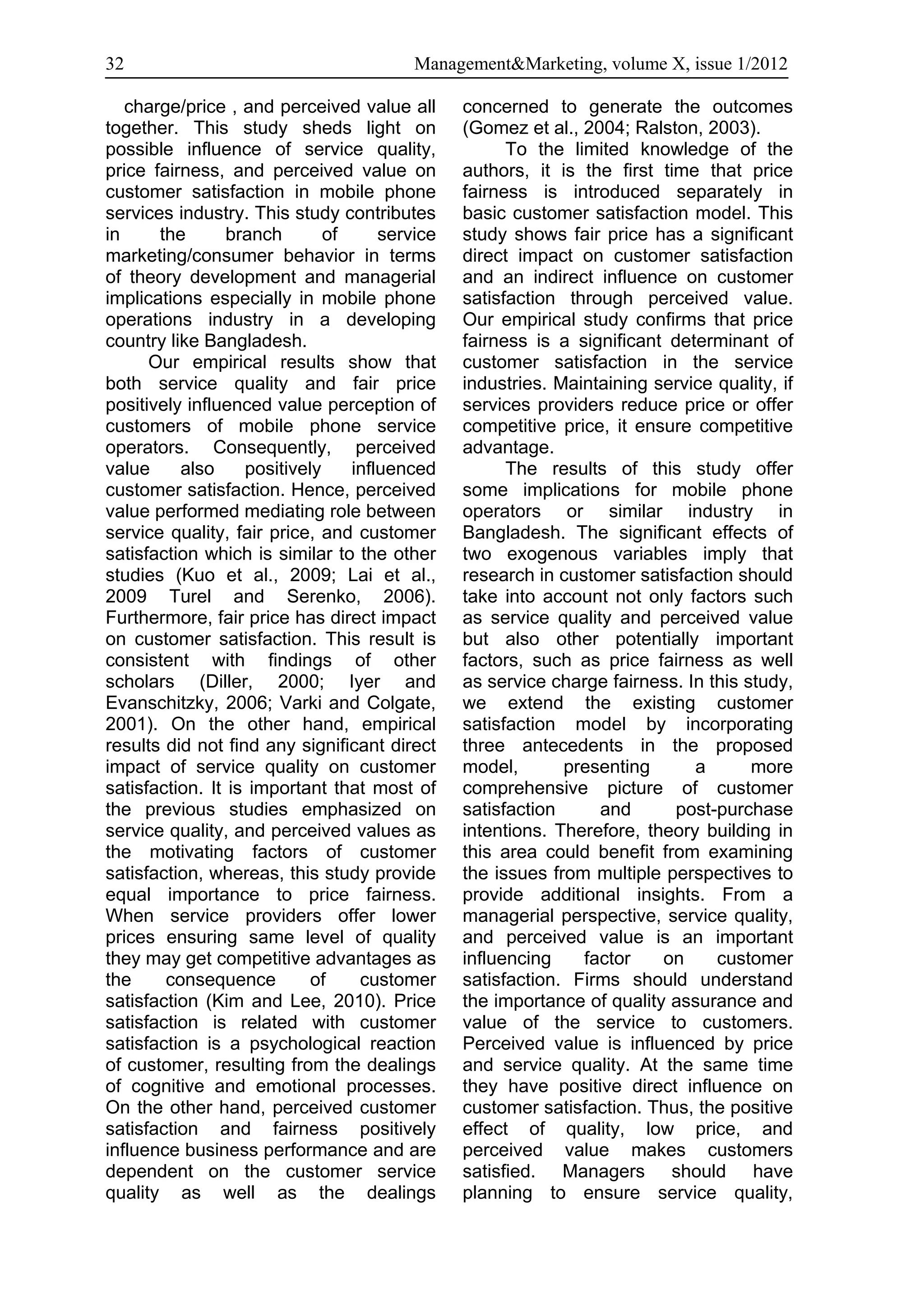
                                                                              Table 6
                         Path analysis of structural model
Casual path                        Hypotheses Path                   t-            Results
                                                  coefficient        statistics
Service quality         perceived H1              0.231**            4.387         Supported
value
Service quality                       H2              0.016          0.303         Not
customer satisfaction                                                              supported
Price         perceived value         H3              0.119*         2.055         Supported
Price       customer satisfaction H4                  0.136*         2.315
Perceived value                       H5              0.385**        7.024         Supported
customer satisfaction
**indicates significance at p< 0.01 level; *indicates significance at p< 0.05 level


      Table-6 depicted the empirical         satisfaction. It is notable that the indirect
results of structural model by path          effect of service quality on customer
analysis. The path coefficients along        satisfaction is so significant as to play
with hypotheses and t-values of the          down the direct effect of service quality
latent constructs are visualized in          on customer satisfaction. This is
Figure-2, where hypotheses were drawn        perhaps caused by data co-linearity
in the solid lines. The empirical results    and/or model misspecification. On the
support all hypotheses (i.e., H1, H3, H4     other hand, price has significant direct
and H5) except one hypothesis (H2).          and indirect effect on customer
The empirical results did not find any       satisfaction.
significant positive relationship between
service      quality     and     customer


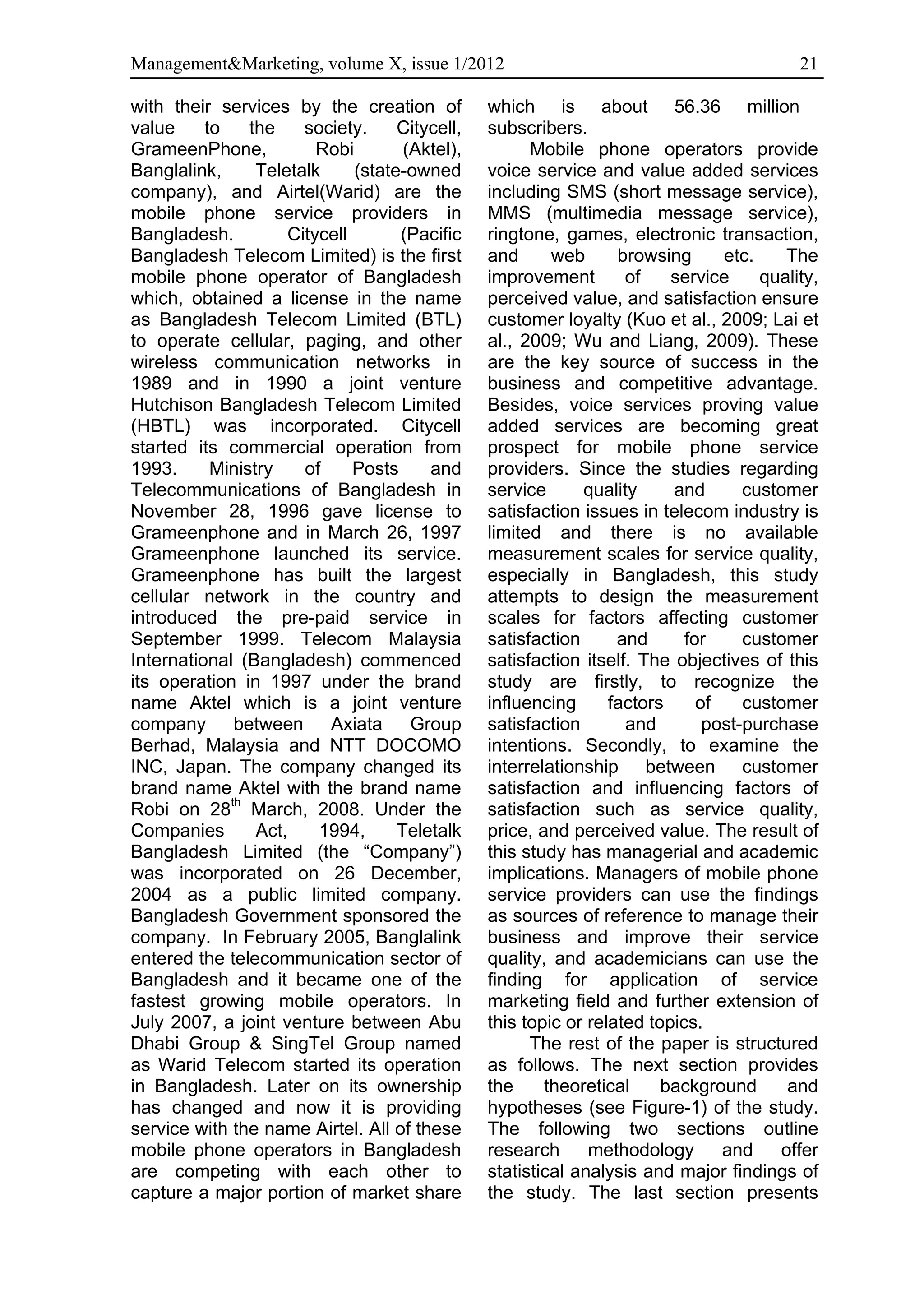
     Service
     Quality                                        H2 0.016 (0.303)
                           H1 0.231**
                           (4.387)
                                                                             Customer
                                        Perceived
                                                         H5 0.385**         Satisfaction
                                         Value
                         H3 0.119*                         (7.024)
        Price            (2.055)
        Price
                                                  H4 0.136* (2.315)


        **p<0.01, *p<0.05
        Value within the parenthesis is t-value

                  Figure 2. Outcome of hypothesized structural model

    Conclusions and                          in Bangladesh, researches do not
implications                                 provide a clear idea of measurement of
    Though mobile phone services is          customer satisfaction including special
one of the fast growing service sectors      concentration on service quality, service
32                                       Management&Marketing, volume X, issue 1/2012

   charge/price , and perceived value all      concerned to generate the outcomes
together. This study sheds light on            (Gomez et al., 2004; Ralston, 2003).
possible influence of service quality,               To the limited knowledge of the
price fairness, and perceived value on         authors, it is the first time that price
customer satisfaction in mobile phone          fairness is introduced separately in
services industry. This study contributes      basic customer satisfaction model. This
in     the       branch       of     service   study shows fair price has a significant
marketing/consumer behavior in terms           direct impact on customer satisfaction
of theory development and managerial           and an indirect influence on customer
implications especially in mobile phone        satisfaction through perceived value.
operations industry in a developing            Our empirical study confirms that price
country like Bangladesh.                       fairness is a significant determinant of
      Our empirical results show that          customer satisfaction in the service
both service quality and fair price            industries. Maintaining service quality, if
positively influenced value perception of      services providers reduce price or offer
customers of mobile phone service              competitive price, it ensure competitive
operators. Consequently, perceived             advantage.
value     also     positively    influenced          The results of this study offer
customer satisfaction. Hence, perceived        some implications for mobile phone
value performed mediating role between         operators or similar industry in
service quality, fair price, and customer      Bangladesh. The significant effects of
satisfaction which is similar to the other     two exogenous variables imply that
studies (Kuo et al., 2009; Lai et al.,         research in customer satisfaction should
2009 Turel and Serenko, 2006).                 take into account not only factors such
Furthermore, fair price has direct impact      as service quality and perceived value
on customer satisfaction. This result is       but also other potentially important
consistent with findings of other              factors, such as price fairness as well
scholars (Diller, 2000; Iyer and               as service charge fairness. In this study,
Evanschitzky, 2006; Varki and Colgate,         we extend the existing customer
2001). On the other hand, empirical            satisfaction model by incorporating
results did not find any significant direct    three antecedents in the proposed
impact of service quality on customer          model,       presenting      a       more
satisfaction. It is important that most of     comprehensive picture of customer
the previous studies emphasized on             satisfaction     and       post-purchase
service quality, and perceived values as       intentions. Therefore, theory building in
the motivating factors of customer             this area could benefit from examining
satisfaction, whereas, this study provide      the issues from multiple perspectives to
equal importance to price fairness.            provide additional insights. From a
When service providers offer lower             managerial perspective, service quality,
prices ensuring same level of quality          and perceived value is an important
they may get competitive advantages as         influencing    factor    on     customer
the     consequence         of    customer     satisfaction. Firms should understand
satisfaction (Kim and Lee, 2010). Price        the importance of quality assurance and
satisfaction is related with customer          value of the service to customers.
satisfaction is a psychological reaction       Perceived value is influenced by price
of customer, resulting from the dealings       and service quality. At the same time
of cognitive and emotional processes.          they have positive direct influence on
On the other hand, perceived customer          customer satisfaction. Thus, the positive
satisfaction and fairness positively           effect of quality, low price, and
influence business performance and are         perceived value makes customers
dependent on the customer service              satisfied. Managers should have
quality as well as the dealings                planning to ensure service quality,
Management&Marketing, volume X, issue 1/2012                                       33

competitive price, increased perceived      survey customer satisfaction. Another
value of customers to achieve               limitation is this study only focuses on
competitive advantages over their rivals.   one sector (mobile phone operations).
      There are some limitations of the     Future study should utilize this
study that could be addressed in future     methodology for several industries in
research in this area. Due to the           mass service to confirm the model
exploratory nature of the study, only       identified for customer satisfaction.
three factors deemed the most               Finally, further study should address the
important in influencing satisfaction of    customer satisfaction issues on other
customer are included. In particular,       typology of service such service factory,
some constructs from the social and         service shop, and professional service.
cultural aspects could also be used to


REFERENCES

Baker, D. A., and Crompton, J. L. (2000), “Quality, satisfaction and behavioral
    intentions”, Annals of Tourism Research, 27(3), 785-804.
Campbell, M.C. (1999), “Perceptions of price unfairness: antecedents and
   consequences”, Journal of Marketing Research, 36, 187-199.
Chae, M., Kim, J., Kim, H., and Ryu, H. (2002), “Information quality for mobile
    internet services: A theoretical model with empirical validation”, Electronic
    Markets, 12(1), 38-46.
Chen, C-F. (2008), “Investigating structural relationships between service quality,
    perceived value, satisfaction, and behavioral intentions for air passengers:
    Evidence from Taiwan”, Transportation Research Part A, 42, 709-717.
Chen, C-F., and Tsai, M.H. (2008), “Perceived value, satisfaction, and loyalty of TV
    travel product shopping: Involvement as a moderator”, Tourism Management,
    29, 1166-1171.
Chen, C-F., and Chen, F-S. (2010), “Experience quality, perceived value,
    satisfaction and behavioral intentions for heritage tourists”, Tourism
    Management, 31, 29-35.
Chen, P-T., and Hu, H-H. (2010), “The effect of relational benefits on perceived
    value in relation to customer loyalty: An empirical study in the Australian coffee
    outlets industry”, International Journal of Hospitality Management, 29, 405-
    412.
Chin, W. (1998), “The partial least square approach for structural equation
     modeling. In G. A. Marcoulides (Ed.)”, Modern methods for business research.
     Hillsdale, NJ: Lawrence Erlbaum Associates, 295–336.
Cronin, J. J., and Taylor, S. A. (1992), “Measuring service quality: A reexamination
     and Extension”, Journal of Marketing, 56(3), 55-68.
Deng, Z., Lu, Y., Wei, K.K., and Zhang, J. (2010), “Understanding customer
    satisfaction and loyalty: An empirical study of mobile instant messages in
    China”, International Journal of Information Management, 30, 289-300.
Diller, H. (2000), “Preiszufriedenheit bei Dienstleistungen. Konzeptualisierung und
   explorative empirische Befunde”, Die Betriebswirtschaft (DBW), 60 (5), 570-587.
34                                    Management&Marketing, volume X, issue 1/2012

  Estelami, H., Lehmann, D.R., and Holden, A.C. (2001), “Macro-economic
    determinants of consumer price knowledge: A meta-analysis of four decades
    of research”    International Journal of Research in Marketing, 18(4), 341-
    355.
Etgar, M., and Malhotra, N. K. (1981), “Determinants of Price Dependency:
     Personal and Perceptual Factors”, The Journal of Consumer Research, 8(2),
     217-222.
Fornell, C., and Larcker, D. (1981), “Evaluating structural equation models with
    unobservable variables and measurement error”, Journal of Marketing
    Research, 18(1), 39–50.
Gerpott, T.J., Rams, W., and Schindler, A. (2001), “Customer retention, loyalty, and
    satisfaction in the German mobile cellular telecommunications market”,
    Telecommunications Policy, 25, 249-269.
Grewal, D., Krishnan R., Baker J., and Borin N. (1998), “The effect of Store Name,
    Brand Name & Price Discount on Consumers’ Evaluation and Purchase
    Intentions”, Journal of Retailing, 74(3), 331-352.
Grewal, D., Kent B. M., and Krishnan R. (1998), “The Effects of Price-Comparison
    Advertising on Buyers' Perceptions of Acquisition Value, Transaction Value
    and Behavioral Intentions”, Journal of Marketing, 62, 46-59.
Grewal, D., Iyer, G.R., Krishnan, R., and Sharma, A. (2003), “The Internet and the
    price-value-loyalty chain”, Journal of Business Research, 56, 391-398.
Hair, J., Anderson, R., Tatham, R., and Black, W. (1998), “Multivariate data analysis
      (5th ed.)”, Upper Saddle River, New Jersey: Prentice Hall.
Hasan, M. (2008), “Mobile phone operators in Bangladesh”, The Daily Star, 1st July.
Hidalgo, P., Manzur, E., Olavarrieta, S., and Farías, P. (2008), “Customer retention
     and price matching: The AFPs case”, Journal of Business Research, 61, 691-
     696.
Hokanson, S. (1995), “The Deeper You Analyse, The More You Satisfy Customers”,
    Marketing News. , 16.
Hutchinson, J., Lai, F., and Wang, Y. (2009), “Understanding the relationships of
    quality, value, equity, satisfaction, and behavioral intentions among golf
    travelers”, Tourism Management, 30, 298-308.
Iacobucci, D. (2010), “Structural equations modeling: Fit Indices, sample size, and
     advanced Topics”, Journal of Consumer Psychology, 20, 90–98.
Iyer, G., and Evanschitzky, H. (2006), “Dimensions of satisfaction in retail settings.
      In: Avlonitis, G.J., Papavassiliou, N., Papastathopoulou, P. (Eds.), Sustainable
      marketing Leadership. A synthesis of Polymorphous Axioms, Strategies and
      Tactics”, Proceedings of the 35th EMAC Conference, Athens, Greece.
Johnson, M.D., and Fornell, C. (1991), “A framework for comparing customer
    satisfaction across individuals and product categories”, Journal of Economic
    Psychology, 12(2), 267-286.
Kim, M-K., Park, M-C., and Jeong, D-H. (2004), “The effects of customer
    satisfaction and switching barrier on customer loyalty in Korean mobile
    telecommunication service”,Telecommunications Policy, 28, 145-159.
Management&Marketing, volume X, issue 1/2012                                        35

Kim, Y.K., and Lee, H.R. (2010), “Customer satisfaction using low cost carriers”.
     Tourism Management, 32(2), 235-243.
Kotler, P. (2000), “Marketing Management”, 10th ed., New Jersey, Prentice-Hall.
Kuo, Y-F., Wu, C-M., and Deng, W-J. (2009), “The relationships among service
     quality, perceived value, customer satisfaction, and post-purchase intention in
     mobile value-added services”, Computers in Human Behavior, 25, 887-896.
LaBarbera, P.A., and Mazursky, D. (1983), “A Longitudinal Assessment of
    Consumer Satisfaction, Dissatisfaction: the Dynamic Aspect of Cognitive
    Process”, Journal of Marketing Research, 20, 393-404.
Lai, F., Griffin, M.,and Babin, B.J. (2009), “How quality, value, image, and
     satisfaction create loyalty at a Chinese telecom” Journal of Business
     Research, 62, 980-986.
Lee, C-K., Yoon, Y-S., and Lee, S-K. (2007), “Investigating the relationships among
     perceived value, satisfaction, and recommendations: The case of the Korean
     DMZ”, Tourism Management, 28, 204-214.
Lien, T., and Yu-Ching, C. (2006), “The determinants of customer loyalty: An
     analysis of intangible factors in three service industries”, International Journal
     of Commerce and Management, 16(3/4), 162-177.
Lin, H-H., and Wang, Y-S. (2006), “An examination of the determinants of customer
   loyalty in mobile commerce contexts”, Information & Management, 43, 271-282.
Lockyer, T. (2005), “The perceived importance of price as one hotel selection
    dimension”, Tourism Management, 26, 529-537.
Martin, W. C., Ponder, N., and Lueg, J. E. (2009), “Price fairness perceptions and
     customer loyalty in a retail context”, Journal of Business Research, 62, 588-
     593.
Matzler, K., and Pramhas, N. (2004), “Preiszufriedenheit—prospect theory oder
     Kano-model? In: Hinterhuber, H.H., Matzler, K. (Eds.)”, Kundenorientierte
     Unternehmensfu¨     hrung.      Kundenorientierung—Kundenzufriedenheit—
     Kundenbindung, 4th ed. Gabler, Wiesbaden, 181-193.
Matzler, K., Wurtele, A., and Renzl, B. (2006), “Dimensions of price satisfaction: a
     study in the retail banking industry”, International Journal of Bank Marketing,
     24(4), 216-231.
Neap, H.S., and Celik, T. (1999), “Value of a Product: A Definition”, International
    Journal of Value-Based Management, 12(2), 181-191.
Nunnally, J. (1978), “Psychometric Theory”, McGraw-Hill, New York, NY.
Parasuraman, A., Zeithaml, V. A., and Berry, L. L. (1985) “A conceptual model of
    service quality and its implications for future research”, Journal of Marketing,
    49(4), 41-50.
Parasuraman, A., Zeithaml, V. A., and Berry, L. L. (1988), “SERVQUAL: A multiple-
    item scale for measuring consumer perceptions of service quality”, Journal of
    Retailing, 64(1), 12-40.
Parasuraman, A., Zeithaml, V. A., and Berry, L. L. (1994), “Reassessment of
    expectation as a comparison in measuring service quality: Implications for
    further research”, Journal of Marketing, 58(1), 111-124.
36                                    Management&Marketing, volume X, issue 1/2012

  Ralston, R.W. (2003), “The effects of customer service, branding, and price on
    the perceived value of local telephone service”, Journal of Business Research,
    56, 201-213.
Rao, S., and Troshani, I. (2007), “A conceptual framework and propositions for the
     acceptance of mobile service”, Journal of Theoretical and Applied Electronic
     Commerce Research, 2(2), 61-73.
Schumacker, R.E. (1992), “Goodness of Fit Criteria in Structural Equations Models”,
    Paper presented at the annual meeting of the American Educational Research
    Association, San Francisco CA, April, 22-24.
Spiteri, J.M., and Dion, P.A. (2004), “Customer value, overall satisfaction, end-user
     loyalty, and market performance in detail intensive industries”, Industrial
     Marketing Management, 33, 675-687.
Turel, O., and Serenko, A. (2006), “Satisfaction with mobile services in Canada: An
     empirical Investigation”, Telecommunications Policy, 30, 314-331.
Vaidyanathan, R., and Aggarwal, P. (2003), “Who is the fairest of them all? An
     attributional approach to price fairness perceptions”, Journal Business
     Research, 56,453-63.
Varki, S., and Colgate, M. (2001), “The role of price perceptions in an integrated
     model of behavioral intentions”, Journal of Service Research 3 (3), 232-240.
Voss, G.B., Parasuraman, A., and Grewal, D. (1998), “The Roles of Price,
    Performance, and Expectations in Determining Satisfaction in Service
    Exchanges”, The Journal of Marketing, 62(4), 46-61.
Wu, C.H-J., and Liang, R.D. (2009), “Effect of experiential value on customer
    satisfaction with service encounters in luxury-hotel restaurants”, International
    Journal of Hospitality Management, 28, 586-593.
Xia, L., Monroe, K. B. and Cox, J. L. (2004), “The price if unfair! A conceptual
     framework of price fairness perceptions”, Journal of Marketing, 68, 1-15.
Yang, Z., Cai, S., Zhou, Z., and Zhou, N. (2005), “Development and validation of an
    instrument to measure user perceived service quality of information presenting
    Web portals”, Information & Management, 42, 575-589.
Yoo, D. K., Park, J. A. (2007), “Perceived service quality: analyzing relationships
     among employees, customers, and financial performance”, International
     Journal of Quality & Reliability Management, 24(9), 908-926.
Zeithaml, V.A., Berry, L.L., and Parasuraman, A. (1996), “The Behavioral
     Consequences of Service Quality”, The Journal of Marketing, 60(2), 31-46.
Zielke, S. (2008), “Exploring asymmetric effects in the formation of retail price
     satisfaction”, Journal of Retailing and Consumer Services, 15, 335-347.

2 15 1_12_fff

  • 1.
    CUSTOMER SATISFACTION INMOBILE PHONE SERVICES IN BANGLADESH: A SURVEY RESEARCH Assistant Professor Mohammed Belal Uddin Comilla University, Bangladesh Email: belal_137@yahoo.com Assistant Professor Bilkis Akhter University of Dhaka, Bangladesh Email: bilkis_akhter@ yahoo.com Abstract: This study seeks to explore customer satisfaction and its influencing factors of the mobile phone operation industry in Bangladesh. Data were collected through a questionnaire survey form a diversified representative sample. An iterated factor analysis with principal component analysis (PCA) and structural equation modeling (SEM) including measurement model and structural model were applied to analyze data. The empirical results demonstrate that service quality and fair price have indirect influence on customer satisfaction of a mass service industry (i.e., mobile phone operators) through perceive value. Perceived value has mediating role between quality, charge fairness and satisfaction. Furthermore, result shows that fair price has positive direct impact on customer satisfaction, whereas, the results did not find any significant direct impact of service quality on customer satisfaction. Mobile phone operators are recommended to formulate operations and marketing strategies that focus on expectations of customers to enhance level of satisfaction. Similar industries may reveal similar relationship features in respect to these relationship constructs, if they are under similar category. Keywords: Service quality, Price, Perceived value, Customer satisfaction, mobile phone service Introduction regulatory systems, restricted Mobile phone services are the fast openness, and concentrated market growing services in telecommunication orientation. Effective regulation, more industry in Bangladesh. This sector is openness, and entrance of competitive showing an inspiring growth in last few firms including launching a new state- years. Land phone market has no owned mobile phone service company competency to compete with mobile foster competition in this sector since phone market. Land phone market 2005. It is assumed that, currently the faces some problems such as weak and number of mobile phone subscriber is inadequate infrastructure, corruption, more than 46 million and expected it will long procedures, limited income of cross 60 million by 2012 (Hasan, 2008). consumers etc. It is expected that Telecommunication sector of a Bangladesh will be the third biggest country can tremendously affect the telecom market in Asia after China and society with different products and India (Hasan, 2008). But mobile phone services which is also true for service charges in Bangladesh were Bangladesh. In Bangladesh, mobile high before 2005 because of weak phone operators are contributing a lot
  • 2.
    Management&Marketing, volume X,issue 1/2012 21 with their services by the creation of which is about 56.36 million value to the society. Citycell, subscribers. GrameenPhone, Robi (Aktel), Mobile phone operators provide Banglalink, Teletalk (state-owned voice service and value added services company), and Airtel(Warid) are the including SMS (short message service), mobile phone service providers in MMS (multimedia message service), Bangladesh. Citycell (Pacific ringtone, games, electronic transaction, Bangladesh Telecom Limited) is the first and web browsing etc. The mobile phone operator of Bangladesh improvement of service quality, which, obtained a license in the name perceived value, and satisfaction ensure as Bangladesh Telecom Limited (BTL) customer loyalty (Kuo et al., 2009; Lai et to operate cellular, paging, and other al., 2009; Wu and Liang, 2009). These wireless communication networks in are the key source of success in the 1989 and in 1990 a joint venture business and competitive advantage. Hutchison Bangladesh Telecom Limited Besides, voice services proving value (HBTL) was incorporated. Citycell added services are becoming great started its commercial operation from prospect for mobile phone service 1993. Ministry of Posts and providers. Since the studies regarding Telecommunications of Bangladesh in service quality and customer November 28, 1996 gave license to satisfaction issues in telecom industry is Grameenphone and in March 26, 1997 limited and there is no available Grameenphone launched its service. measurement scales for service quality, Grameenphone has built the largest especially in Bangladesh, this study cellular network in the country and attempts to design the measurement introduced the pre-paid service in scales for factors affecting customer September 1999. Telecom Malaysia satisfaction and for customer International (Bangladesh) commenced satisfaction itself. The objectives of this its operation in 1997 under the brand study are firstly, to recognize the name Aktel which is a joint venture influencing factors of customer company between Axiata Group satisfaction and post-purchase Berhad, Malaysia and NTT DOCOMO intentions. Secondly, to examine the INC, Japan. The company changed its interrelationship between customer brand name Aktel with the brand name satisfaction and influencing factors of Robi on 28th March, 2008. Under the satisfaction such as service quality, Companies Act, 1994, Teletalk price, and perceived value. The result of Bangladesh Limited (the “Company”) this study has managerial and academic was incorporated on 26 December, implications. Managers of mobile phone 2004 as a public limited company. service providers can use the findings Bangladesh Government sponsored the as sources of reference to manage their company. In February 2005, Banglalink business and improve their service entered the telecommunication sector of quality, and academicians can use the Bangladesh and it became one of the finding for application of service fastest growing mobile operators. In marketing field and further extension of July 2007, a joint venture between Abu this topic or related topics. Dhabi Group & SingTel Group named The rest of the paper is structured as Warid Telecom started its operation as follows. The next section provides in Bangladesh. Later on its ownership the theoretical background and has changed and now it is providing hypotheses (see Figure-1) of the study. service with the name Airtel. All of these The following two sections outline mobile phone operators in Bangladesh research methodology and offer are competing with each other to statistical analysis and major findings of capture a major portion of market share the study. The last section presents
  • 3.
    22 Management&Marketing, volume X, issue 1/2012 discussion, theoretical and this study, and guidelines for further managerial implications, limitations of study. Theoretical background and the utility of that product or service hypotheses development comparing with expectation. Recently Service quality marketing researchers and managers Service quality is the gap between are focusing on value perceptions as a customers’ expectation and actual key strategic component to explain performance of a service (Parasuraman customer satisfaction and loyalty (Lin et al., 1985; 1988). Mentioning five and Wang, 2006). To assess value dimensions such as tangibility, perception customers consider responsiveness, reliability, assurance, perceived benefits relative to sacrifice and empathy; Parasuraman et al., (Lee et al., 2007). Except monetary (1988) developed the SERVQUAL sacrifice perceived value assessment model. The conceptual framework and includes social psychological measurement method of this model perspective and non monetary costs have been heavily criticized by several such as search cost, transaction cost, scholars. In 1992, the alternative negotiation cost, and consumption of method, referred to as SERVPERF, was time (Kuo et al., 2009; Chen and Tsai, proposed by Cronin and Taylor. They 2008). Purchasing some goods or argued that, to assess service quality, services sometimes has some meaning perception of customers regarding the that increases social status as well as performance of service provides better value of the customers in the society. results than using SERVQUAL. Along Customer desire to obtain or retain of with other researchers in 1994, any product or service is reflected by Parasuraman et al. also mentioned that value perception. Value perception measurement method using deals with the agreement of SERVPERF is better than using performance of product or service and SERVQUAL, though SERVQUAL can the value system of customer (Neap provides better diagnostic results of and Celik, 1999). Thus, perceived value service quality. Service quality has a is a consumers’ evaluation of perceived distinct constructs and distinguish benefits with expectation and sacrifice. features for different services. For instance, website service quality Relationship between service depends on usability, usefulness of quality and perceived value content, adequacy of information, With the consumption of any accessibility, and interaction (Yang et product or service customers have al., 2005). On the other hand, Kuo et al. some benefits expectation based on (2009) proposed four dimensions of their advance sacrifice of resources. service quality of mobile value-added Perceived value is the appraisal of the services including customer service and expected benefits with actual system reliability, navigation and visual performance of the products or design, content quality, and connection services. Several scholars examined speed. Thus, this study will concentrate association between service quality and on perceived service quality of mobile perceived value in their studies phone services in Bangladesh. (Hutchinson et al., 2009; Kuo et al., 2009; Lai et al., 2009; Wu and Liang, Perceived value 2009). They found high service quality Value is the quality or expectation is correlated with high perceived value. in mind. Perceived value is the Experience about service quality customers’ psychological assessment positively and significantly persuade regarding the product and service about perceived value of a customer (Chen
  • 4.
    Management&Marketing, volume X,issue 1/2012 23 and Chen, 2010). By studying luxury factors are responsive employees, hotel-restaurant industry in Taiwan Wu well-mannered employees, educated and Linag (2009) stated that, to employees, cooperative employees, increase customer experiential value correctness of billing, billing relevance, hotel managers should emphasize on competitive pricing, service feature, three quality aspects including service superior value, billing transparency and environment, employee service fast service. Alternative options and performance, and interaction with products/services available for a clients. Therefore, there exists a customer may create differences in positive relationship between service satisfaction level. Organizations can quality aspect and experiential well as accomplish customer satisfaction by perceived value. Kuo et al. (2009), Lai satisfying their customers’ needs and et al. (2009), and Turel and Serenko wants (La Barbera and Mazursky, (2006) studied relationship between 1983). Customer Satisfaction is service quality and perceived value customers’ collective conception of a along with other constructs in mobile firm’s service performance (Johnson phone service industry and found and Fornell, 1991). In case of mobile service quality positively motivate commerce, customer satisfaction is perceived value. Having influencing role customer’s post-purchase appraisal and of service quality also is an antecedent emotional response or reaction to the of value perceptions (Hutchinson et al., overall product or service familiarity in a 2009). Thus, there is a positive mobile commerce environment (Lin and relationship between customer Wang, 2006). perceptions of service quality and value perceptions, and service quality is the Relationship between service best predictor of perceived value. So, quality and customer satisfaction we posit: Customer satisfaction literature discusses about satisfaction model in H1: Service quality has positive marketing. According to the satisfaction influences on perceived value in mobile model customer satisfaction is phone services. influenced by service quality. When customers get expected service quality, Customer satisfaction it leads to higher satisfaction Customer satisfaction is the (Hutchinson et al., 2009). The difference authentic expression of the status of between customers’ expectations and satisfaction will differ from person to the real performance is reflected as person and product/service to perceived service quality. The higher product/service and is an appraisal of perceived performance has a positive how products and services of a association with higher perceived company meet up or exceed customer service quality. And expectation has a anticipation. Satisfaction is the negative relationship with perceived consequence of a number of both service quality. So, perceived psychological and physical factors performance has direct and positive which associate with satisfaction relationship with satisfaction (Chen, behaviors. Kotler (2000) defined 2008). Tourists’ perceived experience satisfaction as: “a person’s feeling of quality influences positively and pleasure or disappointment resulting significantly both perceived value and from comparing a product’s perceived satisfaction, in the tourism context performance (or outcome) in relation to (Chen and Chen, 2010). In the his or her expectations”. Hokanson telecommunication context, service (1995) focuses on different factors quality implies network quality which affecting customer satisfaction and the includes clarity of voice reproduction,
  • 5.
    24 Management&Marketing, volume X, issue 1/2012 indoor and outdoor coverage, performance, potentials have an smoothness of connectivity along with incorporation effect on performance and effective delivery of other value added satisfaction judgments and for services (Gerpott et al., 2001). Service inconsistency potentials have no effect quality is the determinant of customer on performance and satisfaction satisfaction (Cronin and Taylor, 1992) judgments (Voss et al., 1998). The and by ensuring good service quality; perceived price fairness related to telecom operators can enrich customer different levels intangible services has satisfaction (Kuo et al., 2009). A positive direct or indirect effect on customer behavioral intention is the refection of loyalty in case of banks, auto repair and satisfaction that is also influenced by maintenance shops, and (gasoline) service quality. A negative intention is filling stations (Lien and Yu-Ching, the outcome of dissatisfaction that may 2006). Consumers' knowledge of prices arise from experiences of customers may be affected by economic regarding service quality issue environmental factors such as interest (Zeithaml et al., 1996). Gerpott et al. rates, unemployment, inflation, country (2001), Kim et al. (2004), Kuo et al. of study, and passage of time and GDP (2009), and Lin and Wang (2006) growth (Estelami et al., 2001). studied telecommunication customer satisfaction aspects in Germany, Korea, Relationship between price and Taiwan, and Taiwan respectively and perceived value found the positive relationship between Customers are always cost service quality and customer concern. They want such an exchange satisfaction. Thus, we propose: where benefits exceed the outlays (monetary and nonmonetary costs). H2: Service quality has positive Reduction of outlays related with influences on customer satisfaction in purchasing process, is one the way to mobile phone services. enhance perceived value (Chen and Hu, 2010). Customer value is a function Price of quality and price. It provides a In finance price is termed as the competitive advantage when firms take amount of payment requested by the cost-cutting imitative to ensure seller of goods or services. The ratio customer value (Spiteri and Dion, between two products exchanged 2004). Real price competitiveness is an quantity is defined as price from important determinant of customer economic point of view. Price is value. Price satisfaction increases the determined by several factors such as value perception and there is a direct willingness of the buyer to pay, relationship between price and value willingness to accept, costs, markup, (Ralston, 2003). Perceived value is legal environment, intensity of influenced by price factors and non competition price substitute products price factors. Monetary price includes etc. For different product/brand quality advertised sale price, advertise price also varies and price has influence reference price, shipment and handling on economic performance of a product charges. Whereas, searching costs, or brand quality (Etgar, 1981). Price product or service evaluation, time effort fluctuations in many service industries etc. are included in nonmonetary price results in price-performance and the (Grewal et al., 2003). Monterey value is level of price-performance stability the part of value perception of moderates the relationship between customers. To capture market share, performance potential and successive Chinese mobile phone operators performance and satisfaction provide competitive pricing strategies judgments. For consistency in price and such as free offer and low charges. If
  • 6.
    Management&Marketing, volume X,issue 1/2012 25 customers feel these offers are the customers in general. If the reasonable and acceptable, they reasons for increase in price are perceive these offers as monetary value indefensible then it can be treated as under their value perception (Deng et unfair by the customers (Xia et al., al., 2010). Customers may be highly 2004; Campbell, 1999). The reason for price-conscious or less price-conscious. an increase in price is reasonable if it is Highly price-conscious customers related to the factors external to the firm response quickly with price changes such as increase in supplier’s price. On than that of less price-conscious the other hand, reasons are inexcusable customers, and price is a significant when the factors are internal to the firm predictor of their value perception as such as increase in profit margin well as repeat purchase behavior (Vaidyanathan and Aggarwal, 2003). (Hidalgo et al., 2008). Price has an Customers can be attracted to a retail impact on customer buying behavior store by using price and special and value perception. Price needs promotions (Grewal, et al., 1998). Thus, special consideration to assess value we posit: perception of customers, not generalized along with other factors H4: Fair price has positive (Lockyer, 2005). Therefore, we propose: influences on customer satisfaction in mobile phone services. H3: Fair price has positive influences on perceived value in mobile Relationship between perceived phone services. value and customer satisfaction Value judgments of customers Relationship between price and have influence on satisfaction, and customer satisfaction perceived value is considered as a Customers’ perception about price powerful measure of customer is that the forces of supply and demand satisfaction and post-purchase determine the market price and they intentions. Recently marketing also consider that price is a pointer of managers and researchers are focusing product or service quality. Customer more on value judgments of customers. satisfaction is affected by the price Transactional satisfaction and overall awareness (Varki and Colgate, 2001; satisfaction are two types of customer Iyer and Evanschitzky, 2006). Price satisfaction. Transactional satisfaction is level, value for money and special offers related with particular buying judgment, may result in both satisfaction and whereas, overall satisfaction is related dissatisfaction and price fairness, price with overall experience and value perceptibility and price processibility judgment (Spiteri and Dion, 2004). may result in dissatisfaction for Customer satisfaction is positively customers (Zielke, 2008). In addition to influenced by perceived value. The the various levels of product price, a extent of satisfaction depends on extent mixture of price awareness dimensions of perceived value and higher level of have potentiality to intimidate the perceived value lead to higher level of customers’ satisfaction (Diller, 2000; customer satisfaction (Kuo et al., 2009; Matzler and Pramhas, 2004; Matzler et Turel and Serenko, 2006). Customer al., 2006). Perceptions of customers satisfaction tends to positive post about price fairness have been major purchase behavior, thus, satisfaction concern due to huge interest of mass playas a mediating role in the people (Xia et al., 2004, Martin et al., relationship of perceived value and 2009). When the price of a product or behavioral intentions (Lin and Wang, service is increased or decreased there 2006). Among the determinants of is an instant response from the side of satisfaction perceived value is the
  • 7.
    26 Management&Marketing, volume X, issue 1/2012 important one (Chen and Chen, 2010) behavioral intentions i.e. customer and perceived value plays mediating loyalty (Lai et al., 2009). Several role between service or product quality research works (Kuo et al., 2009; Lai et and customer satisfaction (Chen and al., 2009; Lin and Wang, 2006; Turel Tsai, 2008). To achieve competitive and Serenko, 2006) have been advantages over the rivals firms try to conducted on mobile phone voice satisfy customers, perceived value is services and value added services considered as a crucial predictor of regarding customer satisfaction, and overall customer satisfaction. These found a positive association between value judgments of customers connect perceived value and customer with customer post purchase behavior satisfaction. Therefore, the following as desire to repurchase and word of hypothesis is proposed. mouth (Lee et al., 2007). Service quality and fair price both have significant, H5: Perceived value has positive direct effects on perceived value. Then, influences on customer satisfaction in perceived value influences on customer mobile phone services. satisfaction that lead to positive Service Quality H2 H1 Customer Perceived Satisfaction Value H5 H5 H3 Price Price H4 Figure 1. Hypothesized research model Research methodology respondents regarding the constructs of Questionnaire design the model. All constructs were The questionnaire was designed measured using multiple items by a according to the existing literatures and seven point Likert-type scale (1= experts’ opinions. We have reviewed strongly disagree, 2= disagree, 3= management, marketing (service moderately disagree, 4= neutral, 5= marketing, relationship marketing, brand moderately agree, 6= agree, and 7= management etc.), and operations strongly agree). management literatures. Some items were directly adopted from previous The Sample survey instrument to operationalize the The study was conducted in constructs in this study. Few new items Bangladesh – a country of high growing also included in different constructs to telecommunication services in Asia. get good response from data collection Total 433 questionnaires were through survey. The questionnaire has distributed to the general people who two parts. The first part was intended to were the target respondents of this understand the personal information of study. And 382 responses were respondents using nominal scale. The received, of which 373 were complete second part consists the perceptions of and usable (response rate is 88
  • 8.
    Management&Marketing, volume X,issue 1/2012 27 percent, whereas, effective response graduation, and 21 percent rate is approximately 98 percent). Sixty- completed post-graduation. The two percent (62 percent) respondents summary statistics of the survey are were men and 38 percent were women. shown in Table 1. In order to control 60 percent respondents were up to common method biases, it was assured thirty years, 15 percent were thirty-one to respondents that there was no right to forty years, 16 percent were forty-one or wrong answers and they should to fifty years, and 9 percent were above provide answer as honestly as possible fifty years old. 22 percent respondents and no information will be shared with were involved in government service, 21 other person or organization. It has percent were in private service, 18 been also assured that the respondents’ percent were in business, 16 percent identity will not be disclosed i.e. as like were housewife, and 23 percent were answers to be anonymous and the student respondents. 35 percent information of this survey will be used respondents completed up to college for researchers’ academic purpose. level education, 40 percent completed Table 1 Summary statistics of questionnaire survey Constructs No. of Mean SD Sources of scale items Service quality 6 5.992 0.857 Chae et al., 2002; Wouters, 2004; Yang et al., 2005 Price 4 5.550 1.092 Kim and Lee, 2010; Zielke, 2008 Perceived value 3 4.782 1.203 Chen and Tsai, 2008; Cronin et. al., 2000; Hutchinson et al., 2009; Lai et al., 2009 Customer 6 5.090 1.409 Chae et al., 2002; Lin and satisfaction wang, 2006; Olorunniwo et al., 2006 SD = standard deviation Analyses and Results obtained using Bartlett’s sphericity test, Structural equation modeling which suggests that the inter-correlation (SEM) was employed in this study to matrix contains sufficient common test proposed model and hypotheses variance to make factor analysis and used AMOS 17.0 as the analysis worthwhile. For EFA, the Principal instrument. For parameter estimation, Component Analysis (PCA), with maximum likelihood method was varimax rotation and eigenvalue greater adopted. Measurement model and than 1 was used. As a conservative structural model test were used to test heuristic, a cut-off point as 0.50 fitness of the model. The exploratory (suppress absolute value less than factor analysis (EFA) was performed to 0.50) was imposed in factor analysis understand underlying relationship of that enhance the total reliability of the factors and data reduction purpose. To questionnaire. We restricted the number determine whether the data were of factors to four as the theoretical appropriate for factor analysis, a Bartlett background of this study has total four sphericity test was performed. A KMO underlying factors. As suggested by the (Kaiser–Meyer-Olkin) value of 0.868 results of EFA one item (v6) was and significance level of .000 were removed. Table-2 shows the rotated
  • 9.
    28 Management&Marketing, volume X, issue 1/2012 factor loadings and their respective rule of thumb of 0.70 (Nunnally, 1978), eigenvalue and cronbach alpha values. that expresses a good internal It is notable that all calculated alpha consistency among items within each values are above the widely recognized construct. Table 2 Result of factor analysis No. Service Price Perceived Customer quality value satisfaction Sq1 0.868 Sq2 0.882 Sq3 0.816 Sq4 0.770 Sq5 0.742 Pr1 0.758 Pr2 0.775 Pr3 0.863 Pr4 0.841 Pv1 0.874 Pv2 0.868 Pv3 0.852 Cs1 0.910 Cs2 0.933 Cs3 0.932 Cs4 0.894 Cs5 0.921 Cs6 0.739 Eigenvalue 6.770 3.405 2.091 1.707 Varience 35.630 17.922 11.003 8.982 explained (%) Cronbach 0.887 0.852 0.919 0.957 alpha Overall cronbach alpha is 0.899. Measurement model (χ√/df) ratio, root mean-square error of Confirmatory factor analysis (CFA) approximation (RMSEA), goodness of fit was conducted to have a more rigorous index (GFI), normed fit index interpretation of customer satisfaction. (NFI),comparative fit index (CFI), The CFA model or Measurement model incremental fit index (IFI). As Table-3 was employed to identify and determine shows χ√/df = 2.235, RMSEA = 0.058, the relationships of variables within the GFI = 0.935, NFI = 0.957, CFI = 0.976, model. To evaluate the goodness-of-fit and IFI = 0.976. All measures fulfill the of model several measures of indices suggested values. Therefore, CFA are used as suggested by Hair et al. model can be said as a good fit model. (1998), Iacobucci (2010), Schumacker (1992): Chi-square/degrees of freedom
  • 10.
    Management&Marketing, volume X,issue 1/2012 29 Table 3 Goodness of fit statistics for measurement model and structural model Suggested Measurement Structural values model values model values χ√/df <3 2.235 2.285 RMSEA <0.06 0.058 0.059 GFI >0.90 0.935 0.936 NFI >0.90 0.957 0.958 CFI >0.90 0.976 0.976 IFI >0.90 0.976 0.976 After achieving the well fit indices, intends to the degree to which an the measurement model was further observed variable reveals an underlying assessed for reliability and validity. The factor. Table-4 presents the item amount of variance in an item because reliability and construct reliability results. of underlying construct is indicated by Standardized loadings ranged from item reliability. Standardized loading 0.565 to 0.949 indicating good item greater than 0.70 demonstrate item reliability. All values of construct reliability but standardized loadings ≥ reliability were above the threshold 0.50 are also acceptable (Chin, 1998; value (i.e. 0.70) indicating high level of Hair et al., 1998). For construct reliability for all the constructs. reliability, value ≥ 0.70 is required that Table 4 Measurement model results Constructs and Standardized t-statistics Construct Average variables loadings reliability variance (CR) extracte d (AVE) Service quality Sq1 0.861 18.705** 0.88 0.61 Sq2 0.868 19.018** Sq3 0.742 15.800** Sq4 0.698 14.424** Sq5 0.706 14.721** Price Pr1 0.775 10.991** 0.84 0.57 Pr2 0.940 13.232** Pr3 0.687 11.013** Pr4 0.565 9.452** Perceived value Pv1 0.882 21.265** 0.92 0.80 Pv2 0.949 24.034** Pv3 0.841 19.878** Customer satisfaction Cs1 0.902 22.164** 0.95 0.78 Cs2 0.941 23.036** Cs3 0.941 23.966** Cs4 0.870 21.079** Cs5 0.885 21.602** Cs6 0.730 16.321** **Indicates significance at p< 0.01 level.
  • 11.
    30 Management&Marketing, volume X, issue 1/2012 CR= (∑ Standardized loadings) √ ⁄ [(∑ Standardized loadings) √ + ∑ (measurement indicator error)] AVE = ∑ (Standardized loadings√) ⁄ [∑ (Standardized loadings√) + ∑ (measurement indicator error)] After being assured that a scale items offer good measures to their instrument provides necessary levels of respective latent construct because of reliability, this study stepped to scale all t-statistics values are statistically validity. Under construct validity significant at 0.01 level and confirmed convergent validity and discriminant convergent validity of the constructs. validity were tested in this study. The Average variance extracted (AVE) is degree to which dimensional measures also used to assess discriminant validity of the same concept are correlated is (Fornell and Larcker, 1981). The role of assessed by convergent validity. To thumb is that the average variance assess convergent validity average extracted (AVE) values should be variance extracted (AVE) is used greater than corresponding squired (Fornell and Larcker, 1981; Hair et al., inter-construct correlation estimates 1998). Representation of latent (SIC) in the model. Table-5 shows the constructs by items is truly denoted as average variance extracted (AVE) higher as the average variance estimates in the diagonal values and extracted is higher. For latent construct corresponding squired inter-construct the average variance extracted (AVE) correlation estimates (SIC) values, should be more than 0.50 (Hair et al., supportive evidence for discriminant 1998). Table-4 shows the average validity. For example, (Table-5) average variance extracted (AVE) values for variance extracted (AVE) estimate for constructs ranged from 0.61 to 0.80 price was 0.57 and corresponding exceeded the threshold value 0.50, squired inter-construct correlation supportive evidence for convergent estimates (SIC) values were 0.09, and validity. Moreover, in a CFA setting, t- 0.06 for perceived value and customer statistics related to factor loadings is satisfaction respectively, an indication of assessed to measure convergent discriminant validity. validity (Rao and Troshani, 2007). All Table 5 Squared correlations between constructs Service Price Perceived Customer quality value satisfaction Service quality 0.61* Price 0.11 0.57* Perceived 0.12 0.09 0.80* value Customer 0.04 0.06 0.20 0.78* satisfaction *Diagonal elements are average variance extracted (AVE) Structural model (Hair et al., 1998; Iacobucci, 2010; Table-3 shows the common Schumacker, 1992) the evidence of a model-fit indices, recommended values good model fit was revealed. Given the and results of the test of structural good fit of the model, the estimated path model fitness. As shown in Table-3, coefficients of the structural model were comparison of all fit indices with their then examined to evaluate the corresponding recommended values hypotheses.
  • 12.
    Management&Marketing, volume X,issue 1/2012 31 Table 6 Path analysis of structural model Casual path Hypotheses Path t- Results coefficient statistics Service quality perceived H1 0.231** 4.387 Supported value Service quality H2 0.016 0.303 Not customer satisfaction supported Price perceived value H3 0.119* 2.055 Supported Price customer satisfaction H4 0.136* 2.315 Perceived value H5 0.385** 7.024 Supported customer satisfaction **indicates significance at p< 0.01 level; *indicates significance at p< 0.05 level Table-6 depicted the empirical satisfaction. It is notable that the indirect results of structural model by path effect of service quality on customer analysis. The path coefficients along satisfaction is so significant as to play with hypotheses and t-values of the down the direct effect of service quality latent constructs are visualized in on customer satisfaction. This is Figure-2, where hypotheses were drawn perhaps caused by data co-linearity in the solid lines. The empirical results and/or model misspecification. On the support all hypotheses (i.e., H1, H3, H4 other hand, price has significant direct and H5) except one hypothesis (H2). and indirect effect on customer The empirical results did not find any satisfaction. significant positive relationship between service quality and customer Service Quality H2 0.016 (0.303) H1 0.231** (4.387) Customer Perceived H5 0.385** Satisfaction Value H3 0.119* (7.024) Price (2.055) Price H4 0.136* (2.315) **p<0.01, *p<0.05 Value within the parenthesis is t-value Figure 2. Outcome of hypothesized structural model Conclusions and in Bangladesh, researches do not implications provide a clear idea of measurement of Though mobile phone services is customer satisfaction including special one of the fast growing service sectors concentration on service quality, service
  • 13.
    32 Management&Marketing, volume X, issue 1/2012 charge/price , and perceived value all concerned to generate the outcomes together. This study sheds light on (Gomez et al., 2004; Ralston, 2003). possible influence of service quality, To the limited knowledge of the price fairness, and perceived value on authors, it is the first time that price customer satisfaction in mobile phone fairness is introduced separately in services industry. This study contributes basic customer satisfaction model. This in the branch of service study shows fair price has a significant marketing/consumer behavior in terms direct impact on customer satisfaction of theory development and managerial and an indirect influence on customer implications especially in mobile phone satisfaction through perceived value. operations industry in a developing Our empirical study confirms that price country like Bangladesh. fairness is a significant determinant of Our empirical results show that customer satisfaction in the service both service quality and fair price industries. Maintaining service quality, if positively influenced value perception of services providers reduce price or offer customers of mobile phone service competitive price, it ensure competitive operators. Consequently, perceived advantage. value also positively influenced The results of this study offer customer satisfaction. Hence, perceived some implications for mobile phone value performed mediating role between operators or similar industry in service quality, fair price, and customer Bangladesh. The significant effects of satisfaction which is similar to the other two exogenous variables imply that studies (Kuo et al., 2009; Lai et al., research in customer satisfaction should 2009 Turel and Serenko, 2006). take into account not only factors such Furthermore, fair price has direct impact as service quality and perceived value on customer satisfaction. This result is but also other potentially important consistent with findings of other factors, such as price fairness as well scholars (Diller, 2000; Iyer and as service charge fairness. In this study, Evanschitzky, 2006; Varki and Colgate, we extend the existing customer 2001). On the other hand, empirical satisfaction model by incorporating results did not find any significant direct three antecedents in the proposed impact of service quality on customer model, presenting a more satisfaction. It is important that most of comprehensive picture of customer the previous studies emphasized on satisfaction and post-purchase service quality, and perceived values as intentions. Therefore, theory building in the motivating factors of customer this area could benefit from examining satisfaction, whereas, this study provide the issues from multiple perspectives to equal importance to price fairness. provide additional insights. From a When service providers offer lower managerial perspective, service quality, prices ensuring same level of quality and perceived value is an important they may get competitive advantages as influencing factor on customer the consequence of customer satisfaction. Firms should understand satisfaction (Kim and Lee, 2010). Price the importance of quality assurance and satisfaction is related with customer value of the service to customers. satisfaction is a psychological reaction Perceived value is influenced by price of customer, resulting from the dealings and service quality. At the same time of cognitive and emotional processes. they have positive direct influence on On the other hand, perceived customer customer satisfaction. Thus, the positive satisfaction and fairness positively effect of quality, low price, and influence business performance and are perceived value makes customers dependent on the customer service satisfied. Managers should have quality as well as the dealings planning to ensure service quality,
  • 14.
    Management&Marketing, volume X,issue 1/2012 33 competitive price, increased perceived survey customer satisfaction. Another value of customers to achieve limitation is this study only focuses on competitive advantages over their rivals. one sector (mobile phone operations). There are some limitations of the Future study should utilize this study that could be addressed in future methodology for several industries in research in this area. Due to the mass service to confirm the model exploratory nature of the study, only identified for customer satisfaction. three factors deemed the most Finally, further study should address the important in influencing satisfaction of customer satisfaction issues on other customer are included. In particular, typology of service such service factory, some constructs from the social and service shop, and professional service. cultural aspects could also be used to REFERENCES Baker, D. A., and Crompton, J. L. (2000), “Quality, satisfaction and behavioral intentions”, Annals of Tourism Research, 27(3), 785-804. Campbell, M.C. (1999), “Perceptions of price unfairness: antecedents and consequences”, Journal of Marketing Research, 36, 187-199. Chae, M., Kim, J., Kim, H., and Ryu, H. (2002), “Information quality for mobile internet services: A theoretical model with empirical validation”, Electronic Markets, 12(1), 38-46. Chen, C-F. (2008), “Investigating structural relationships between service quality, perceived value, satisfaction, and behavioral intentions for air passengers: Evidence from Taiwan”, Transportation Research Part A, 42, 709-717. Chen, C-F., and Tsai, M.H. (2008), “Perceived value, satisfaction, and loyalty of TV travel product shopping: Involvement as a moderator”, Tourism Management, 29, 1166-1171. Chen, C-F., and Chen, F-S. (2010), “Experience quality, perceived value, satisfaction and behavioral intentions for heritage tourists”, Tourism Management, 31, 29-35. Chen, P-T., and Hu, H-H. (2010), “The effect of relational benefits on perceived value in relation to customer loyalty: An empirical study in the Australian coffee outlets industry”, International Journal of Hospitality Management, 29, 405- 412. Chin, W. (1998), “The partial least square approach for structural equation modeling. In G. A. Marcoulides (Ed.)”, Modern methods for business research. Hillsdale, NJ: Lawrence Erlbaum Associates, 295–336. Cronin, J. J., and Taylor, S. A. (1992), “Measuring service quality: A reexamination and Extension”, Journal of Marketing, 56(3), 55-68. Deng, Z., Lu, Y., Wei, K.K., and Zhang, J. (2010), “Understanding customer satisfaction and loyalty: An empirical study of mobile instant messages in China”, International Journal of Information Management, 30, 289-300. Diller, H. (2000), “Preiszufriedenheit bei Dienstleistungen. Konzeptualisierung und explorative empirische Befunde”, Die Betriebswirtschaft (DBW), 60 (5), 570-587.
  • 15.
    34 Management&Marketing, volume X, issue 1/2012 Estelami, H., Lehmann, D.R., and Holden, A.C. (2001), “Macro-economic determinants of consumer price knowledge: A meta-analysis of four decades of research” International Journal of Research in Marketing, 18(4), 341- 355. Etgar, M., and Malhotra, N. K. (1981), “Determinants of Price Dependency: Personal and Perceptual Factors”, The Journal of Consumer Research, 8(2), 217-222. Fornell, C., and Larcker, D. (1981), “Evaluating structural equation models with unobservable variables and measurement error”, Journal of Marketing Research, 18(1), 39–50. Gerpott, T.J., Rams, W., and Schindler, A. (2001), “Customer retention, loyalty, and satisfaction in the German mobile cellular telecommunications market”, Telecommunications Policy, 25, 249-269. Grewal, D., Krishnan R., Baker J., and Borin N. (1998), “The effect of Store Name, Brand Name & Price Discount on Consumers’ Evaluation and Purchase Intentions”, Journal of Retailing, 74(3), 331-352. Grewal, D., Kent B. M., and Krishnan R. (1998), “The Effects of Price-Comparison Advertising on Buyers' Perceptions of Acquisition Value, Transaction Value and Behavioral Intentions”, Journal of Marketing, 62, 46-59. Grewal, D., Iyer, G.R., Krishnan, R., and Sharma, A. (2003), “The Internet and the price-value-loyalty chain”, Journal of Business Research, 56, 391-398. Hair, J., Anderson, R., Tatham, R., and Black, W. (1998), “Multivariate data analysis (5th ed.)”, Upper Saddle River, New Jersey: Prentice Hall. Hasan, M. (2008), “Mobile phone operators in Bangladesh”, The Daily Star, 1st July. Hidalgo, P., Manzur, E., Olavarrieta, S., and Farías, P. (2008), “Customer retention and price matching: The AFPs case”, Journal of Business Research, 61, 691- 696. Hokanson, S. (1995), “The Deeper You Analyse, The More You Satisfy Customers”, Marketing News. , 16. Hutchinson, J., Lai, F., and Wang, Y. (2009), “Understanding the relationships of quality, value, equity, satisfaction, and behavioral intentions among golf travelers”, Tourism Management, 30, 298-308. Iacobucci, D. (2010), “Structural equations modeling: Fit Indices, sample size, and advanced Topics”, Journal of Consumer Psychology, 20, 90–98. Iyer, G., and Evanschitzky, H. (2006), “Dimensions of satisfaction in retail settings. In: Avlonitis, G.J., Papavassiliou, N., Papastathopoulou, P. (Eds.), Sustainable marketing Leadership. A synthesis of Polymorphous Axioms, Strategies and Tactics”, Proceedings of the 35th EMAC Conference, Athens, Greece. Johnson, M.D., and Fornell, C. (1991), “A framework for comparing customer satisfaction across individuals and product categories”, Journal of Economic Psychology, 12(2), 267-286. Kim, M-K., Park, M-C., and Jeong, D-H. (2004), “The effects of customer satisfaction and switching barrier on customer loyalty in Korean mobile telecommunication service”,Telecommunications Policy, 28, 145-159.
  • 16.
    Management&Marketing, volume X,issue 1/2012 35 Kim, Y.K., and Lee, H.R. (2010), “Customer satisfaction using low cost carriers”. Tourism Management, 32(2), 235-243. Kotler, P. (2000), “Marketing Management”, 10th ed., New Jersey, Prentice-Hall. Kuo, Y-F., Wu, C-M., and Deng, W-J. (2009), “The relationships among service quality, perceived value, customer satisfaction, and post-purchase intention in mobile value-added services”, Computers in Human Behavior, 25, 887-896. LaBarbera, P.A., and Mazursky, D. (1983), “A Longitudinal Assessment of Consumer Satisfaction, Dissatisfaction: the Dynamic Aspect of Cognitive Process”, Journal of Marketing Research, 20, 393-404. Lai, F., Griffin, M.,and Babin, B.J. (2009), “How quality, value, image, and satisfaction create loyalty at a Chinese telecom” Journal of Business Research, 62, 980-986. Lee, C-K., Yoon, Y-S., and Lee, S-K. (2007), “Investigating the relationships among perceived value, satisfaction, and recommendations: The case of the Korean DMZ”, Tourism Management, 28, 204-214. Lien, T., and Yu-Ching, C. (2006), “The determinants of customer loyalty: An analysis of intangible factors in three service industries”, International Journal of Commerce and Management, 16(3/4), 162-177. Lin, H-H., and Wang, Y-S. (2006), “An examination of the determinants of customer loyalty in mobile commerce contexts”, Information & Management, 43, 271-282. Lockyer, T. (2005), “The perceived importance of price as one hotel selection dimension”, Tourism Management, 26, 529-537. Martin, W. C., Ponder, N., and Lueg, J. E. (2009), “Price fairness perceptions and customer loyalty in a retail context”, Journal of Business Research, 62, 588- 593. Matzler, K., and Pramhas, N. (2004), “Preiszufriedenheit—prospect theory oder Kano-model? In: Hinterhuber, H.H., Matzler, K. (Eds.)”, Kundenorientierte Unternehmensfu¨ hrung. Kundenorientierung—Kundenzufriedenheit— Kundenbindung, 4th ed. Gabler, Wiesbaden, 181-193. Matzler, K., Wurtele, A., and Renzl, B. (2006), “Dimensions of price satisfaction: a study in the retail banking industry”, International Journal of Bank Marketing, 24(4), 216-231. Neap, H.S., and Celik, T. (1999), “Value of a Product: A Definition”, International Journal of Value-Based Management, 12(2), 181-191. Nunnally, J. (1978), “Psychometric Theory”, McGraw-Hill, New York, NY. Parasuraman, A., Zeithaml, V. A., and Berry, L. L. (1985) “A conceptual model of service quality and its implications for future research”, Journal of Marketing, 49(4), 41-50. Parasuraman, A., Zeithaml, V. A., and Berry, L. L. (1988), “SERVQUAL: A multiple- item scale for measuring consumer perceptions of service quality”, Journal of Retailing, 64(1), 12-40. Parasuraman, A., Zeithaml, V. A., and Berry, L. L. (1994), “Reassessment of expectation as a comparison in measuring service quality: Implications for further research”, Journal of Marketing, 58(1), 111-124.
  • 17.
    36 Management&Marketing, volume X, issue 1/2012 Ralston, R.W. (2003), “The effects of customer service, branding, and price on the perceived value of local telephone service”, Journal of Business Research, 56, 201-213. Rao, S., and Troshani, I. (2007), “A conceptual framework and propositions for the acceptance of mobile service”, Journal of Theoretical and Applied Electronic Commerce Research, 2(2), 61-73. Schumacker, R.E. (1992), “Goodness of Fit Criteria in Structural Equations Models”, Paper presented at the annual meeting of the American Educational Research Association, San Francisco CA, April, 22-24. Spiteri, J.M., and Dion, P.A. (2004), “Customer value, overall satisfaction, end-user loyalty, and market performance in detail intensive industries”, Industrial Marketing Management, 33, 675-687. Turel, O., and Serenko, A. (2006), “Satisfaction with mobile services in Canada: An empirical Investigation”, Telecommunications Policy, 30, 314-331. Vaidyanathan, R., and Aggarwal, P. (2003), “Who is the fairest of them all? An attributional approach to price fairness perceptions”, Journal Business Research, 56,453-63. Varki, S., and Colgate, M. (2001), “The role of price perceptions in an integrated model of behavioral intentions”, Journal of Service Research 3 (3), 232-240. Voss, G.B., Parasuraman, A., and Grewal, D. (1998), “The Roles of Price, Performance, and Expectations in Determining Satisfaction in Service Exchanges”, The Journal of Marketing, 62(4), 46-61. Wu, C.H-J., and Liang, R.D. (2009), “Effect of experiential value on customer satisfaction with service encounters in luxury-hotel restaurants”, International Journal of Hospitality Management, 28, 586-593. Xia, L., Monroe, K. B. and Cox, J. L. (2004), “The price if unfair! A conceptual framework of price fairness perceptions”, Journal of Marketing, 68, 1-15. Yang, Z., Cai, S., Zhou, Z., and Zhou, N. (2005), “Development and validation of an instrument to measure user perceived service quality of information presenting Web portals”, Information & Management, 42, 575-589. Yoo, D. K., Park, J. A. (2007), “Perceived service quality: analyzing relationships among employees, customers, and financial performance”, International Journal of Quality & Reliability Management, 24(9), 908-926. Zeithaml, V.A., Berry, L.L., and Parasuraman, A. (1996), “The Behavioral Consequences of Service Quality”, The Journal of Marketing, 60(2), 31-46. Zielke, S. (2008), “Exploring asymmetric effects in the formation of retail price satisfaction”, Journal of Retailing and Consumer Services, 15, 335-347.