International Journal of Informatics and Communication Technology (IJ-ICT)
Vol.6, No.3, December 2017, pp. 189~198
ISSN: 2252-8776, DOI: 10.11591/ijict.v6i3.pp189-198  189
Journal homepage: http://iaesjournal.com/online/index.php/IJICT
Analysis of Competition Between Content Providers in the
Internet Market
M’hamed Outanoute*1
, Hamid Garmani2
, Mohamed Baslam3
, Rachid El Ayachi4
, Belaid Bouikhalene5
1,2,3,4
Faculty of Sciences and Techniques , Sultan Moulay Slimane University, Beni Mellal, Morocco
5
Polydisciplinary Faculty , Sultan Moulay Slimane University, Beni Mellal, Morocco
Article Info ABSTRACT
Article history:
Received Aug 10th
, 2017
Revised Oct 25th
, 2017
Accepted Aug 8th
, 2017
In the Internet market, content providers (CPs) continue to play a primordial
role in the pro-cess of accessing different types of data: Images, Texts,
Videos ..etc. Competition in this area is fierce, customers are looking for
providers that offer them good content ( credibility of content and quality of
service) with a reasonable price. In this work, we analyze this competition
between CPs and the economic influence of their strategies on the market.
We formulate our problem as a non-cooperative game among multiple CPs
for the same market. Through a detailed analysis, we prove uniqueness of
pure Nash Equilibrium (NE). Further-more, a fully distributed algorithm to
converge to the NE point is presented. In order to quantify how efficient is
the NE point, a detailed analysis of the Price of Anarchy (PoA) is adopted to
ensure the performance of the system at equilibrium. Finally, we provide an
extensive numerical study to describe the interactions between CPs and to
point out the importance of quality of service (QoS) and credibility of
content in the market.
Keyword:
Content Providers
Game Theory
Nash Equilibrium
Price of Anarchy
Pricing-QoS
Copyright © 2017 Institute of Advanced Engineering and Science.
All rights reserved.
Corresponding Author:
M’hamed Outanoute
Faculty of Sciences and Techniques, Sultan Moulay Sliman University
Beni Melal, Morocco
(00212)676218940
Email: mhamed.outanoute@gmail.com
1. INTRODUCTION
The current internet has enabled numerous distributed applications and services. However, providers
gener-ally face many challenges in determining technical and economic solutions to providing services[1].
Key challenges are how to price and bill these services and how to establish economic relationships with
other providers that are necessary to provide end-to-end services. Equilibrium models for the internet
generally assume basic economic rela-tionships and consider price as the only factor that affects users
demand (see [2][3][4]). However, in new paradigms for the internet and even in the case of supply chain
networks, price is not the only factor and Quality of Service (QoS), i.e., the ability to provide different
priorities to applications, users, or data flows, comes into play (see [5] [6] [7] [8] [9] ).
Our contribution in this work is to expand the study on the internet domain by adding a utility model
on income from content providers (CPs). CPs can be social networks, internet search engines, or any other
websites. In this framework, we propose a modeling competition between CPs based on the parameters of
price and credibility of content that is used to measure the effectiveness of content provided by the CP.
Credibility is a function that depends on the QoS and quality of content (QoC).
Customer behavior is modeled by the function demand that depends on providers policies. We use
game theory to study the behavior of CPs in the internet. Then we study the impact of their decisions on
customers and other CPs. We focus our studies on the non-cooperative games in terms of stable solutions,
which are the pure strategy Nash Equilibria (NE) of the game. We do not consider mixed strategy equilibria,
because our environment requires a concrete strategy rather than a randomized strategy, which would be the
 ISSN: 2252-8776
IJECE Vol. 6, No. 3, December 2017 : 189 – 198
190
result of a mixed strategy. Hence, when using the term Nash equilibrium we mean pure strategy exact NE
unless mentioned otherwise.
CPs may be faced with the question of ”how to choose in what content to specialize” [10]. E.
Altman considers several CPs that are faced with a similar problem and study the impact of their decisions on
each other using a game theoretic approach. The author shows that the problem of selecting the content type
is equivalent to a congestion game. In [11], the authors have studied game problems involving two types of
CPs : one that corresponds to independent CPs, and one that correspond to CPs that have exclusive
agreements with Internet Service Providers (ISPs). The cost for the internet users who are subscribers of
some ISP of fetching content from an independent CP or from a CP that has an exclusive agreement with
another ISP, was assumed to be larger than for fetching it from the CP that has an exclusive agreement with
their own ISP.
Weijie Wu et al. consider a Stackelberg game, where the CP decides reward first, and after that, the
peers decide amount of capacity [5]. The CP rewards the peers based on the amount of upload capacity they
contribute. From CP point of view, it aims at minimizing its total cost, i.e., the cost of uploading and the cost
of rewarding the peers. The utility of a peer is the reward it receives, minus its cost of upload contribution.
The rest of the paper is organized as follows : in section 2., we describe the problem model. In
section 3., we formulate our model as a non-cooperative game. We present numerical results in section 4. and
conclude our work in section 5.
2. PROBLEM MODELING
In this section, we formulate the interaction among content providers (CPs) as a non-cooperative
game. Each CP chooses credibility of content and the corresponding price. We consider a system with N
content providers. Let pi and ci, be, respectively, the tariff and the credibility of content guaranteed by CPi.
Now, each customer seeks to the content provider which allows him to meet a credibility of content sufficient
to satisfy his/her needs, at suitable price. We consider that behaviors of customer’s has been handled by a
simple function so called demand functions, see equation (1). This later depends on the price and credibility
of content strategies of all. CPs are supposed to know the effect of their policy on the customer’s.
2.1. Model of Content Credibility Function
We assume that the function of the credibility of content ci of CPi is a function of the quality of
service qsi and quality content qci above which is written as follows :
The quality of content provided can be specified for a specific domain of content, e.g., video
streaming.
2.2. Demand Model
IJ-ICT ISSN: 2252-8776 
Analysis of Competition Fronting the Popularity… (Hamid Garmani)
191
Assumption 1 and 2 will be needed to ensure the uniqueness of the resulting equilibrium. It is
furthermore a reasonable condition, in that Assumption 1 (resp. Assumption 2 ) implies that the influence of
a CP price (resp. credibility of content) is significantly greater on its observed demand than the prices (resp.
credibilities of content) of its competi-tors. This condition could then take into account the presence of
customer loyalties and/or imperfect knowledge of competitors prices [13].
2.3. Utility model for CP
3. NON-COOPERATIVE GAME FORMULATION
 ISSN: 2252-8776
IJECE Vol. 6, No. 3, December 2017 : 189 – 198
192
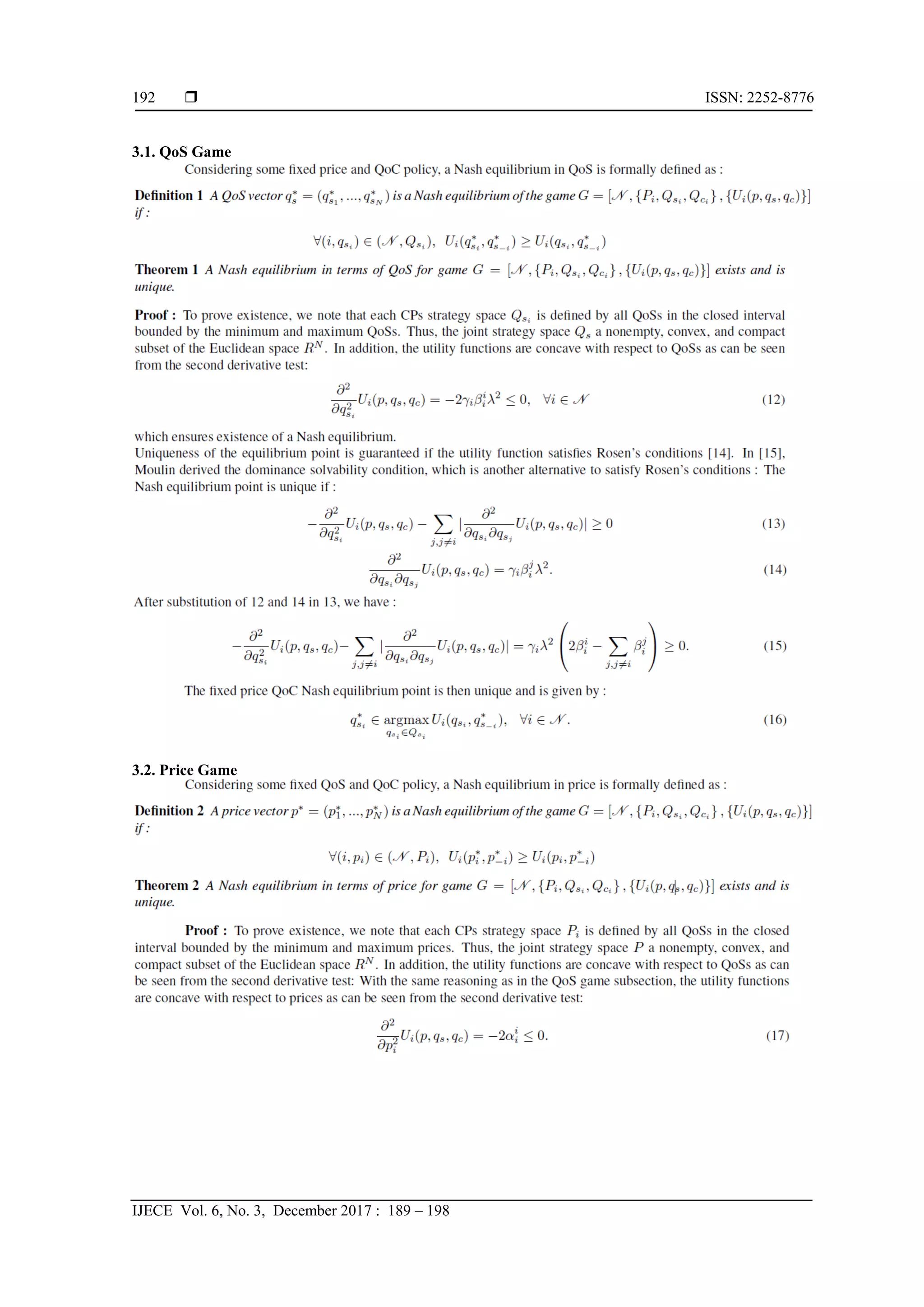
3.1. QoS Game
3.2. Price Game
IJ-ICT ISSN: 2252-8776 
Analysis of Competition Fronting the Popularity… (Hamid Garmani)
193
3.3. QoC Game
3.4. Joint Price, QoC and QoS Game
In the subsections cited above, we have shown the existence and the uniqueness of NE, by fixing
each time one of the parameters. The next task is to determine the price, QoS and QoC at equilibrium. This
calculation will be based on the best response algorithm:
 ISSN: 2252-8776
IJECE Vol. 6, No. 3, December 2017 : 189 – 198
194
3.5. Price of Anarchy
The concept of social welfare [16], is defined as the sum of the utilities of all agents in the systems
(i.e. Providers). It is well known in game theory that agent selfishness, such as in a Nash equilibrium, does
not lead in general to a socially efficient situation. As a measure of the loss of efficiency due to the
divergence of user interests, we use the Price of Anarchy (PoA) [17], this latter is a measure of the loss of
efficiency due to actors’ selfishness. This loss has been defined in [17] as the worst-case ratio comparing the
global efficiency measure (that has to be chosen) at an outcome of the noncooperative game played among
actors, to the optimal value of that efficiency measure. A PoA close to 1 indicates that the equilibrium is
approximately socially optimal, and thus the consequences of selfish behavior are relatively benign. The term
Price of Anarchy was first used by Koutsoupias and Papadimitriou [17] but the idea of measuring
inefficiency of equilibrium is older. The concept in its current form was designed to be the analogue of the
”approximation ratio” in Approximation Algorithms or the ”competitive ratio” in Online Algorithms. As in
[18], we measure the loss of efficiency due to actors selfishness as the quotient between the social welfare
obtained at the Nash equilibrium and the maximum value of the social welfare:
4. NUMERICAL INVESTIGATIONS
To clarify and show how to take advantage from our theoretical study, we suggest to study
numerically the market share game while considering the best response dynamics and expressions of demand
as well as utility functions of CPs. Hence, we consider a system with tree CPs seeking to maximize their
respective revenues. Table 1 represents the system parameter values considered in this numerical study.
Table 1. System parameters used for numerical examples
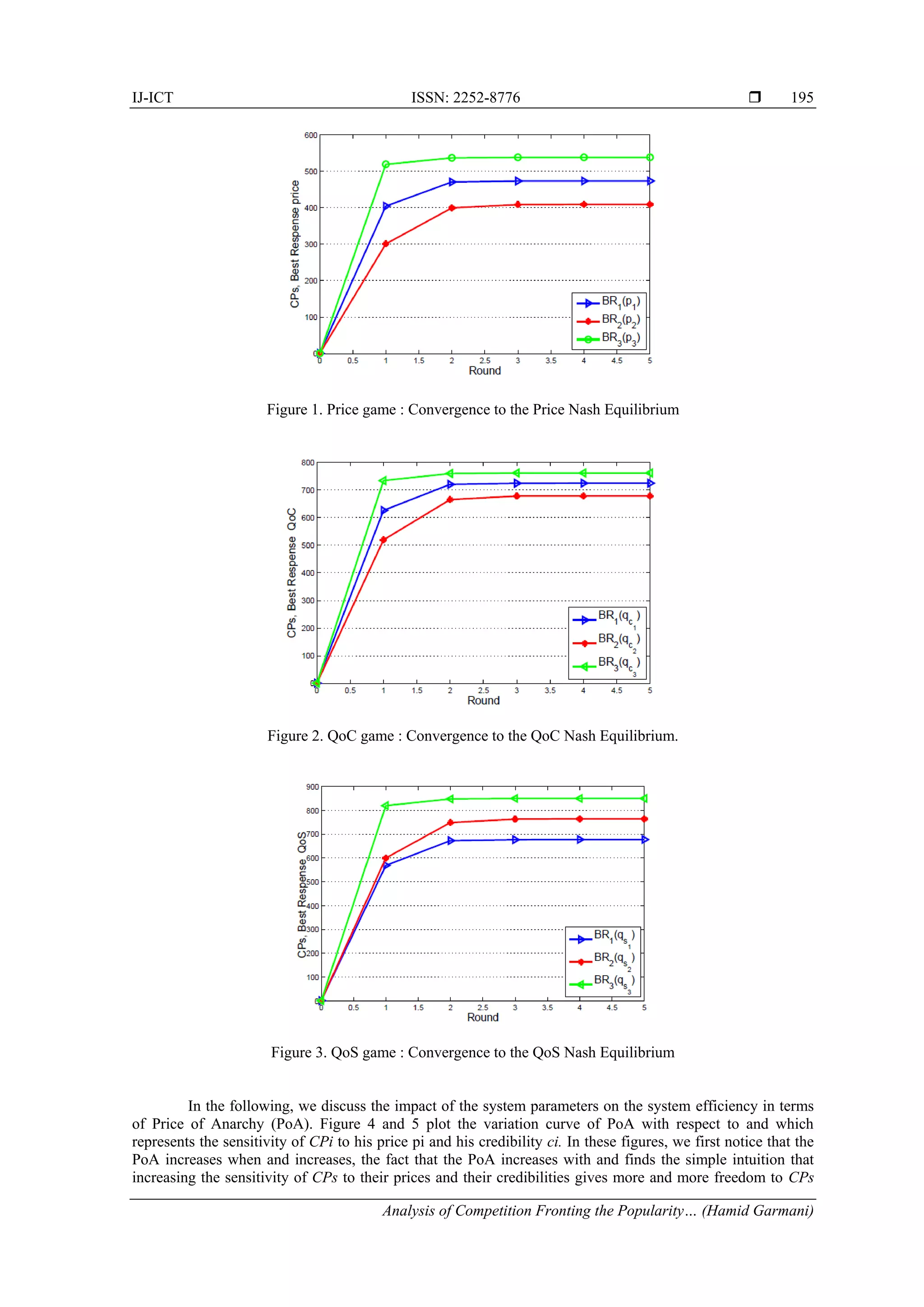
Figures 1, 2 and 3 present respectively curves of the convergence to Nash Equilibrium Price, to
Nash Equi-librium QoC and to Nash Equilibrium QoS. It is clear that the best response dynamics converges
to the unique Nash equilibrium price, QoC and QoS. We also remark that the speed of convergence is
relatively high (around 5 rounds are enough to converge to the joint price and QoS equilibrium).
IJ-ICT ISSN: 2252-8776 
Analysis of Competition Fronting the Popularity… (Hamid Garmani)
195
Figure 1. Price game : Convergence to the Price Nash Equilibrium
Figure 2. QoC game : Convergence to the QoC Nash Equilibrium.
Figure 3. QoS game : Convergence to the QoS Nash Equilibrium
In the following, we discuss the impact of the system parameters on the system efficiency in terms
of Price of Anarchy (PoA). Figure 4 and 5 plot the variation curve of PoA with respect to and which
represents the sensitivity of CPi to his price pi and his credibility ci. In these figures, we first notice that the
PoA increases when and increases, the fact that the PoA increases with and finds the simple intuition that
increasing the sensitivity of CPs to their prices and their credibilities gives more and more freedom to CPs
 ISSN: 2252-8776
IJECE Vol. 6, No. 3, December 2017 : 189 – 198
196
for optimizing the Nash equilibrium. When = 11 = 22 = 33 = 1 and = 11 = 22 = 33 = 1, in the other word,
when the sensitivity of an CP to the prices of its competitors is zero, PoA converges to 1 and the equilibrium
is approximately socially optimal.
IJ-ICT ISSN: 2252-8776 
Analysis of Competition Fronting the Popularity… (Hamid Garmani)
197
5. CONCLUSION AND PERSPECTIVES
In this work, we presented and analyzed a framework to model the complex interactions among
content providers as players through a class of two parameter Nash equilibrium model. The model is based
on a simple linear demand functions which describe the behaviour of customers. These functions take into
account not only the characteristics of a current but also of all other CPs in presence of two parameters
describing each CP service price and credibility of content. We established uniqueness of a Nash equilibrium
point and showed it with relevant numerical results. To quantify how efficient is the NE point we used PoA
measurement and showed its variation according to the parameters of the model. Our proposed algorithm
finds very fast the equilibrium price and the content credibility to be chosen by each CP.
This work can be developed to achieve the following purposes :
a. Modeling the users choice with a nonlinear function which is based on the Logit model.
b. Introducing advertising revenues in the utility of CPs to achieve maximum revenue. In
2010, advertising rev-enues of Google are more than 20 billions.
c. Taking into consideration the purchasing power of a target market for CPs.
 ISSN: 2252-8776
IJECE Vol. 6, No. 3, December 2017 : 189 – 198
198
REFERENCES
[1] T. Wolf; J. Griffioen; K. L. Calvert; R. Dutta; G. N. Rouskas; I. Baldine; A. Nagurney; , “Choice as a principle in
network architecture,” ACM SIGCOMM Computer Communication Review, vol. 42, no. 4, pp. 105–106, 2012.
[2] J.-J. Laffont; S. Marcus; P. Rey; J. Tirole; , “Internet interconnection and the off-net-cost pricing principle,” RAND
Journal of Economics, pp. 370–390, 2003.
[3] Z.-L. Zhang; P. Nabipay; A. Odlyzko; R. Guerin; , “Interactions, competition and innovation in a service-oriented
internet: an economic model,” in INFOCOM, 2010 Proceedings IEEE. IEEE, pp. 1–5, 2010.
[4] E. Altman; S. Caron; G. Kesidis; , “Application neutrality and a paradox of side payments,” arXiv preprint
arXiv:1008.2267, 2010.
[5] Y. Hu; Q. Qiang; , “An equilibrium model of online shopping supply chain networks with service capacity
investment,” Service Science, vol. 5, no. 3, pp. 238–248, 2013.
[6] A. Nagurney; D. Li; , “A dynamic network oligopoly model with transportation costs, product differentiation, and
quality competition,” Computational Economics, vol. 44, no. 2, pp. 201–229, 2014.
[7] A. Nagurney; D. Li; L. S. Nagurney; , “Pharmaceutical supply chain networks with outsourcing under price and
quality competition,” International Transactions in Operational Research, vol. 20, no. 6, pp. 859–888, 2013.
[8] A. Nagurney; D. Li; T. Wolf; S. Saberi, “A network economic game theory model of a service-oriented internet
with choices and quality competition,” NETNOMICS: Economic Research and Electronic Networking, vol. 14, no.
1-2, pp. 1–25, 2013.
[9] A. Nagurney; T. Wolf; , “A cournot–nash–bertrand game theory model of a service-oriented internet with price and
quality competition among network transport providers,” Computational Management Science, vol. 11, no. 4, pp.
475–502, 2014.
[10] E. Altman; , “In which content to specialize a game theoretic analysis,” in International Conference on Research in
Networking. Springer, pp. 121–125, 2012.
[11] T. Jimenez; Y. Hayel; E. Altman; , “Competition in access to content,” in International Conference on Re-search in
Networking. Springer, pp. 211–222, 2012.
[12] E. Altman; A. Legout; Y. Xu; , “Network non-neutrality debate: An economic analysis,” in International
Conference on Research in Networking. Springer, pp. 68–81, 2011.
[13] R. El Azouzi; E. Altman; L. Wynter; , “Telecommunications network equilibrium with price and quality-of-service
characteristics,” Teletraffic Science and Engineering, vol. 5, pp. 369–378, 2003.
[14] J. B. Rosen, “Existence and uniqueness of equilibrium points for concave n-person games,” Econometrica: Jour-
nal of the Econometric Society, pp. 520–534, 1965.
[15] H. Moulin, On the uniqueness and stability of Nash equilibrium in non-cooperative games. North-Holland
Publishing Company, 1980, no. 130.
[16] P. Maille´ and B. Tuffin, “Analysis of price competition in a slotted resource allocation game,” in INFOCOM
2008. The 27th Conference on Computer Communications. IEEE. IEEE, 2008.
[17] E. Koutsoupias and C. Papadimitriou, “Worst-case equilibria,” Computer science review, vol. 3, no. 2, pp. 65–69,
2009.
[18] L. Guijarro, V. Pla, J. R. Vidal, J. Martinez-Bauset, “Analysis of price competition under peering and transit
agreements in internet service provision to peer-to-peer users,” in 2011 IEEE Consumer Communications and
Networking Conference (CCNC). IEEE, 2011, pp. 1145–1149.

6. 10082 12462-1-pb

  • 1.
    International Journal ofInformatics and Communication Technology (IJ-ICT) Vol.6, No.3, December 2017, pp. 189~198 ISSN: 2252-8776, DOI: 10.11591/ijict.v6i3.pp189-198  189 Journal homepage: http://iaesjournal.com/online/index.php/IJICT Analysis of Competition Between Content Providers in the Internet Market M’hamed Outanoute*1 , Hamid Garmani2 , Mohamed Baslam3 , Rachid El Ayachi4 , Belaid Bouikhalene5 1,2,3,4 Faculty of Sciences and Techniques , Sultan Moulay Slimane University, Beni Mellal, Morocco 5 Polydisciplinary Faculty , Sultan Moulay Slimane University, Beni Mellal, Morocco Article Info ABSTRACT Article history: Received Aug 10th , 2017 Revised Oct 25th , 2017 Accepted Aug 8th , 2017 In the Internet market, content providers (CPs) continue to play a primordial role in the pro-cess of accessing different types of data: Images, Texts, Videos ..etc. Competition in this area is fierce, customers are looking for providers that offer them good content ( credibility of content and quality of service) with a reasonable price. In this work, we analyze this competition between CPs and the economic influence of their strategies on the market. We formulate our problem as a non-cooperative game among multiple CPs for the same market. Through a detailed analysis, we prove uniqueness of pure Nash Equilibrium (NE). Further-more, a fully distributed algorithm to converge to the NE point is presented. In order to quantify how efficient is the NE point, a detailed analysis of the Price of Anarchy (PoA) is adopted to ensure the performance of the system at equilibrium. Finally, we provide an extensive numerical study to describe the interactions between CPs and to point out the importance of quality of service (QoS) and credibility of content in the market. Keyword: Content Providers Game Theory Nash Equilibrium Price of Anarchy Pricing-QoS Copyright © 2017 Institute of Advanced Engineering and Science. All rights reserved. Corresponding Author: M’hamed Outanoute Faculty of Sciences and Techniques, Sultan Moulay Sliman University Beni Melal, Morocco (00212)676218940 Email: mhamed.outanoute@gmail.com 1. INTRODUCTION The current internet has enabled numerous distributed applications and services. However, providers gener-ally face many challenges in determining technical and economic solutions to providing services[1]. Key challenges are how to price and bill these services and how to establish economic relationships with other providers that are necessary to provide end-to-end services. Equilibrium models for the internet generally assume basic economic rela-tionships and consider price as the only factor that affects users demand (see [2][3][4]). However, in new paradigms for the internet and even in the case of supply chain networks, price is not the only factor and Quality of Service (QoS), i.e., the ability to provide different priorities to applications, users, or data flows, comes into play (see [5] [6] [7] [8] [9] ). Our contribution in this work is to expand the study on the internet domain by adding a utility model on income from content providers (CPs). CPs can be social networks, internet search engines, or any other websites. In this framework, we propose a modeling competition between CPs based on the parameters of price and credibility of content that is used to measure the effectiveness of content provided by the CP. Credibility is a function that depends on the QoS and quality of content (QoC). Customer behavior is modeled by the function demand that depends on providers policies. We use game theory to study the behavior of CPs in the internet. Then we study the impact of their decisions on customers and other CPs. We focus our studies on the non-cooperative games in terms of stable solutions, which are the pure strategy Nash Equilibria (NE) of the game. We do not consider mixed strategy equilibria, because our environment requires a concrete strategy rather than a randomized strategy, which would be the
  • 2.
     ISSN: 2252-8776 IJECEVol. 6, No. 3, December 2017 : 189 – 198 190 result of a mixed strategy. Hence, when using the term Nash equilibrium we mean pure strategy exact NE unless mentioned otherwise. CPs may be faced with the question of ”how to choose in what content to specialize” [10]. E. Altman considers several CPs that are faced with a similar problem and study the impact of their decisions on each other using a game theoretic approach. The author shows that the problem of selecting the content type is equivalent to a congestion game. In [11], the authors have studied game problems involving two types of CPs : one that corresponds to independent CPs, and one that correspond to CPs that have exclusive agreements with Internet Service Providers (ISPs). The cost for the internet users who are subscribers of some ISP of fetching content from an independent CP or from a CP that has an exclusive agreement with another ISP, was assumed to be larger than for fetching it from the CP that has an exclusive agreement with their own ISP. Weijie Wu et al. consider a Stackelberg game, where the CP decides reward first, and after that, the peers decide amount of capacity [5]. The CP rewards the peers based on the amount of upload capacity they contribute. From CP point of view, it aims at minimizing its total cost, i.e., the cost of uploading and the cost of rewarding the peers. The utility of a peer is the reward it receives, minus its cost of upload contribution. The rest of the paper is organized as follows : in section 2., we describe the problem model. In section 3., we formulate our model as a non-cooperative game. We present numerical results in section 4. and conclude our work in section 5. 2. PROBLEM MODELING In this section, we formulate the interaction among content providers (CPs) as a non-cooperative game. Each CP chooses credibility of content and the corresponding price. We consider a system with N content providers. Let pi and ci, be, respectively, the tariff and the credibility of content guaranteed by CPi. Now, each customer seeks to the content provider which allows him to meet a credibility of content sufficient to satisfy his/her needs, at suitable price. We consider that behaviors of customer’s has been handled by a simple function so called demand functions, see equation (1). This later depends on the price and credibility of content strategies of all. CPs are supposed to know the effect of their policy on the customer’s. 2.1. Model of Content Credibility Function We assume that the function of the credibility of content ci of CPi is a function of the quality of service qsi and quality content qci above which is written as follows : The quality of content provided can be specified for a specific domain of content, e.g., video streaming. 2.2. Demand Model
  • 3.
    IJ-ICT ISSN: 2252-8776 Analysis of Competition Fronting the Popularity… (Hamid Garmani) 191 Assumption 1 and 2 will be needed to ensure the uniqueness of the resulting equilibrium. It is furthermore a reasonable condition, in that Assumption 1 (resp. Assumption 2 ) implies that the influence of a CP price (resp. credibility of content) is significantly greater on its observed demand than the prices (resp. credibilities of content) of its competi-tors. This condition could then take into account the presence of customer loyalties and/or imperfect knowledge of competitors prices [13]. 2.3. Utility model for CP 3. NON-COOPERATIVE GAME FORMULATION
  • 4.
     ISSN: 2252-8776 IJECEVol. 6, No. 3, December 2017 : 189 – 198 192 3.1. QoS Game 3.2. Price Game
  • 5.
    IJ-ICT ISSN: 2252-8776 Analysis of Competition Fronting the Popularity… (Hamid Garmani) 193 3.3. QoC Game 3.4. Joint Price, QoC and QoS Game In the subsections cited above, we have shown the existence and the uniqueness of NE, by fixing each time one of the parameters. The next task is to determine the price, QoS and QoC at equilibrium. This calculation will be based on the best response algorithm:
  • 6.
     ISSN: 2252-8776 IJECEVol. 6, No. 3, December 2017 : 189 – 198 194 3.5. Price of Anarchy The concept of social welfare [16], is defined as the sum of the utilities of all agents in the systems (i.e. Providers). It is well known in game theory that agent selfishness, such as in a Nash equilibrium, does not lead in general to a socially efficient situation. As a measure of the loss of efficiency due to the divergence of user interests, we use the Price of Anarchy (PoA) [17], this latter is a measure of the loss of efficiency due to actors’ selfishness. This loss has been defined in [17] as the worst-case ratio comparing the global efficiency measure (that has to be chosen) at an outcome of the noncooperative game played among actors, to the optimal value of that efficiency measure. A PoA close to 1 indicates that the equilibrium is approximately socially optimal, and thus the consequences of selfish behavior are relatively benign. The term Price of Anarchy was first used by Koutsoupias and Papadimitriou [17] but the idea of measuring inefficiency of equilibrium is older. The concept in its current form was designed to be the analogue of the ”approximation ratio” in Approximation Algorithms or the ”competitive ratio” in Online Algorithms. As in [18], we measure the loss of efficiency due to actors selfishness as the quotient between the social welfare obtained at the Nash equilibrium and the maximum value of the social welfare: 4. NUMERICAL INVESTIGATIONS To clarify and show how to take advantage from our theoretical study, we suggest to study numerically the market share game while considering the best response dynamics and expressions of demand as well as utility functions of CPs. Hence, we consider a system with tree CPs seeking to maximize their respective revenues. Table 1 represents the system parameter values considered in this numerical study. Table 1. System parameters used for numerical examples Figures 1, 2 and 3 present respectively curves of the convergence to Nash Equilibrium Price, to Nash Equi-librium QoC and to Nash Equilibrium QoS. It is clear that the best response dynamics converges to the unique Nash equilibrium price, QoC and QoS. We also remark that the speed of convergence is relatively high (around 5 rounds are enough to converge to the joint price and QoS equilibrium).
  • 7.
    IJ-ICT ISSN: 2252-8776 Analysis of Competition Fronting the Popularity… (Hamid Garmani) 195 Figure 1. Price game : Convergence to the Price Nash Equilibrium Figure 2. QoC game : Convergence to the QoC Nash Equilibrium. Figure 3. QoS game : Convergence to the QoS Nash Equilibrium In the following, we discuss the impact of the system parameters on the system efficiency in terms of Price of Anarchy (PoA). Figure 4 and 5 plot the variation curve of PoA with respect to and which represents the sensitivity of CPi to his price pi and his credibility ci. In these figures, we first notice that the PoA increases when and increases, the fact that the PoA increases with and finds the simple intuition that increasing the sensitivity of CPs to their prices and their credibilities gives more and more freedom to CPs
  • 8.
     ISSN: 2252-8776 IJECEVol. 6, No. 3, December 2017 : 189 – 198 196 for optimizing the Nash equilibrium. When = 11 = 22 = 33 = 1 and = 11 = 22 = 33 = 1, in the other word, when the sensitivity of an CP to the prices of its competitors is zero, PoA converges to 1 and the equilibrium is approximately socially optimal.
  • 9.
    IJ-ICT ISSN: 2252-8776 Analysis of Competition Fronting the Popularity… (Hamid Garmani) 197 5. CONCLUSION AND PERSPECTIVES In this work, we presented and analyzed a framework to model the complex interactions among content providers as players through a class of two parameter Nash equilibrium model. The model is based on a simple linear demand functions which describe the behaviour of customers. These functions take into account not only the characteristics of a current but also of all other CPs in presence of two parameters describing each CP service price and credibility of content. We established uniqueness of a Nash equilibrium point and showed it with relevant numerical results. To quantify how efficient is the NE point we used PoA measurement and showed its variation according to the parameters of the model. Our proposed algorithm finds very fast the equilibrium price and the content credibility to be chosen by each CP. This work can be developed to achieve the following purposes : a. Modeling the users choice with a nonlinear function which is based on the Logit model. b. Introducing advertising revenues in the utility of CPs to achieve maximum revenue. In 2010, advertising rev-enues of Google are more than 20 billions. c. Taking into consideration the purchasing power of a target market for CPs.
  • 10.
     ISSN: 2252-8776 IJECEVol. 6, No. 3, December 2017 : 189 – 198 198 REFERENCES [1] T. Wolf; J. Griffioen; K. L. Calvert; R. Dutta; G. N. Rouskas; I. Baldine; A. Nagurney; , “Choice as a principle in network architecture,” ACM SIGCOMM Computer Communication Review, vol. 42, no. 4, pp. 105–106, 2012. [2] J.-J. Laffont; S. Marcus; P. Rey; J. Tirole; , “Internet interconnection and the off-net-cost pricing principle,” RAND Journal of Economics, pp. 370–390, 2003. [3] Z.-L. Zhang; P. Nabipay; A. Odlyzko; R. Guerin; , “Interactions, competition and innovation in a service-oriented internet: an economic model,” in INFOCOM, 2010 Proceedings IEEE. IEEE, pp. 1–5, 2010. [4] E. Altman; S. Caron; G. Kesidis; , “Application neutrality and a paradox of side payments,” arXiv preprint arXiv:1008.2267, 2010. [5] Y. Hu; Q. Qiang; , “An equilibrium model of online shopping supply chain networks with service capacity investment,” Service Science, vol. 5, no. 3, pp. 238–248, 2013. [6] A. Nagurney; D. Li; , “A dynamic network oligopoly model with transportation costs, product differentiation, and quality competition,” Computational Economics, vol. 44, no. 2, pp. 201–229, 2014. [7] A. Nagurney; D. Li; L. S. Nagurney; , “Pharmaceutical supply chain networks with outsourcing under price and quality competition,” International Transactions in Operational Research, vol. 20, no. 6, pp. 859–888, 2013. [8] A. Nagurney; D. Li; T. Wolf; S. Saberi, “A network economic game theory model of a service-oriented internet with choices and quality competition,” NETNOMICS: Economic Research and Electronic Networking, vol. 14, no. 1-2, pp. 1–25, 2013. [9] A. Nagurney; T. Wolf; , “A cournot–nash–bertrand game theory model of a service-oriented internet with price and quality competition among network transport providers,” Computational Management Science, vol. 11, no. 4, pp. 475–502, 2014. [10] E. Altman; , “In which content to specialize a game theoretic analysis,” in International Conference on Research in Networking. Springer, pp. 121–125, 2012. [11] T. Jimenez; Y. Hayel; E. Altman; , “Competition in access to content,” in International Conference on Re-search in Networking. Springer, pp. 211–222, 2012. [12] E. Altman; A. Legout; Y. Xu; , “Network non-neutrality debate: An economic analysis,” in International Conference on Research in Networking. Springer, pp. 68–81, 2011. [13] R. El Azouzi; E. Altman; L. Wynter; , “Telecommunications network equilibrium with price and quality-of-service characteristics,” Teletraffic Science and Engineering, vol. 5, pp. 369–378, 2003. [14] J. B. Rosen, “Existence and uniqueness of equilibrium points for concave n-person games,” Econometrica: Jour- nal of the Econometric Society, pp. 520–534, 1965. [15] H. Moulin, On the uniqueness and stability of Nash equilibrium in non-cooperative games. North-Holland Publishing Company, 1980, no. 130. [16] P. Maille´ and B. Tuffin, “Analysis of price competition in a slotted resource allocation game,” in INFOCOM 2008. The 27th Conference on Computer Communications. IEEE. IEEE, 2008. [17] E. Koutsoupias and C. Papadimitriou, “Worst-case equilibria,” Computer science review, vol. 3, no. 2, pp. 65–69, 2009. [18] L. Guijarro, V. Pla, J. R. Vidal, J. Martinez-Bauset, “Analysis of price competition under peering and transit agreements in internet service provision to peer-to-peer users,” in 2011 IEEE Consumer Communications and Networking Conference (CCNC). IEEE, 2011, pp. 1145–1149.