

Reconfigurable
Antennas
Mr. Pradeep Kumar K
IAT, Bangalore
Contents
 Abstract
 Brief Introduction
 Summary of Literature Review
 Research Gaps
 Objectives
 Problem Formulation
 Methodologies
 PERT Chart/ Milestones
2
Abstract
 Antennas are an important core element of any communication system for
Transceiving signals in the form of electromagnetic radiation.
 Modern electronic and WC technologies necessitate compact and multifunctional
antennas that are suitable for adapting in changing operating scenarios.
 RA is an antenna capable of modifying its frequency and radiation properties
dynamically, in a controlled and reversible manner.
3
Brief Introduction
Software Defined Antennas
 SDA design reflects a coherent integration between switching reconfigurable-
circuits and the plain antenna designs to provide frequency band reconfiguration.
 Common reconfigurable antenna design techniques use RF-switches, as the main
elements to design antennas with tuneable parameters, in order to achieve good
matching and avoid signals interference.
4
Classified according to the
Antenna parameter 5
1.Frequency reconfiguration: can adjust dynamically their frequency of operation.
2.Radiation pattern reconfiguration: based on the intentional modification of the
spherical distribution of radiation pattern.
3.Polarization reconfiguration: are capable of switching between different polarization
modes
4.Compound reconfiguration: capability of simultaneously tuning several antenna
parameters, for instance frequency and radiation pattern.
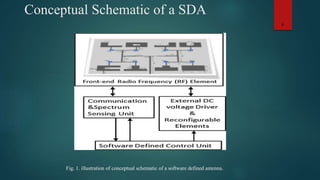
Conceptual Schematic of a SDA
6
Fig. 1. illustration of conceptual schematic of a software defined antenna.
Figure 3:Fabricated prototype ,frequency response for different
voltage values. Reproduced with permission from [20],
Copyright IEEE, 2014
Fig. 2. Examples of Ultra Wide Band
antennas used with SDRs
7
RAArchitecture
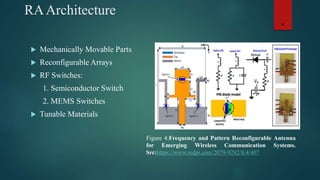
 Mechanically Movable Parts
 Reconfigurable Arrays
 RF Switches:
1. Semiconductor Switch
2. MEMS Switches
 Tunable Materials
8
Figure 4:Frequency and Pattern Reconfigurable Antenna
for Emerging Wireless Communication Systems.
Src:https://www.mdpi.com/2079-9292/8/4/407
Summary of Proposed Project
 RA plays important roles in smart and adaptive systems and are the subject of many research
studies.
 Advantages of SDA are multifunctional capabilities, minimized volume requirements, low front-
end processing efforts with no need for a filtering element, good isolation, and sufficient out-of-
band rejection;
 Major advantage is in Wireless Applications such as 4G and 5G mobile terminals.
 Active devices like MEMS, RF- Switches, varactor diodes, p-i-n diodes as its building blocks
 Antenna has to be reconfigurable into many different states, then it needs to have an adequate
number of active elements.
9
Objectives
 To investigate the feasibility of a single re-configurable structure
comprising multiple radiating sections.
 To operate for various frequency of operation.
 Various polarisations which suits for different radio systems.
 Various radiation patterns which suits for different radio systems
10
Problem Formulation
 The current research on reconfigurable antennas has revealed numerous
drawbacks in existing RA designs
1) Identifying the methods and technologies of reconfigurability, scope and
limitations of current approaches to generate new concepts and realise better
reconfigurable antenna designs.
2) Basing designs on structural simplicity and ease of control.
3) Designing of wideband reconfigurable antenna.
4) Developing a low-profile 360˚ beam-scanning antenna
5) Integrating multiple reconfigurability functions
6) Realising narrow-beam scanning frequency tunable antenna
11
Methodologies
The implementation process of reconfigurable antennas includes
antenna design, simulation, fabrication and measurements.
 several factors are considered: system performance requirements
(operating frequency, bandwidth, directivity, efficiency, power
consumption, etc.).
 Other limitations such as the antenna size, cost, fabrication
capabilities, etc. For static single antenna designs, these factors are
needed to be considered once.
 A suitable simulation environment, should be carefully chosen.
 3D models simulation environment.
12
 Compute the relevant antenna performance parameters, such as
resonant frequency, bandwidth, S-parameters, gain, input
impedance, directivity, among others.
 Fabrication of the patch antenna using standard silk screen printing
PCB manufacturing technique.
 In the prototypes, the switches are realized by the presence or
absence of a conductive path.
 The measurements are performed on standard measuring set up and
equipment.
13
References
1. L. Leszkowska and D. Duraj et al., Department of Microwave and Antenna Engineering, Faculty of
Electronics, Telecommunications and Informatics, Gdansk University of Technology 80-233 Gdansk,
Poland, “2019 13th European conference on antennas and propagation (EuCAP 2019)” .
2. Peng Yang and Kuixi Yan et al., Institute of Electronic and Information Engineering of UESTC in
Guangdong, China, 978-1-5386-7102-3/18/$31.00 ©2018 IEEE.
3. B. Belkadi and Z. Mahdjoub et al., Réseaux de Communication, Architectures et Multimedia (RCAM)
University of Sidi Bel Abbes, Algiers., 978-1-5386-7102-3/18/$31.00 ©2018 IEEE.
4. Dimitris E. Anagnostou and George Goussetiset et al., Institute of Sensors, Signals and Systems
Heriot-Watt University Edinburgh, UK, 2017 International workshop on antenna technology: small
antennas, innovative structures and Applications (iWAT) 978-1-5090-5177-9/17/$31.00 ©2017 IEEE.
5. Felipe F. Araújo, and Adaildo G.et al., Department of Communication Engineering Federal University
of Rio Grande do Norte Natal, Brazil,
6. Hattan F. Abutarboush, and A. Shamim, College of Engineering, Electrical Engineering Department,
Taibah University, Madinah, Saudi Arabia. 1536-1225 (c) 2018 IEEE.
14
7. F. A. Asadallah and J. Costantine et al., Electrical and Computer Engineering Department, American
University of Beirut, Beirut, Lebanon, 978-1-5386- 3284-0/17/$31.00 ©2017 IEEE.
8. Yuan-Ming Cai, Yinzeng Yin, School of Electronic Engineering, Xidian University Xi’an, China, 978-
1-5386-3284-0/17/$31.00 ©2017 IEEE.
9. Yuan-Ming Cai and Ke Li, et al., National Key Laboratory of Antennas and Microwave Technology,
Xidian University, Xi’an, Shaanxi, 710071, China, 2017 2169-3536 (c) 2018 IEEE.
10. Sulakshana Chilukuri, Y. Pandu Rangaiah, Department of ECE Vardhaman College of
Engineering, JNT University Hyderabad, India, 2018 9th International Conference on Mechanical
and Aerospace Engineering, 978- 1-5386-7229-7/18/$31.00 ©2018 IEEE
11. Kazim Demir and Asaf Behzat Sahin, et al., Department of Electrical and Electronics Engineering
Ankara Yildirim Beyazit University Ankara, Turkey, 978-1-5386-3284-0/17/$31.00 ©2017 IEEE.
12. Aishvaryaa Devi G and Aarthi J, et al., Electronics and Communication Engineering National Institute
of Technology Tiruchirappalli, India. 978-1-5386-0646-9/17/$31.00 ©2017 IEEE.
15
13. Asmae Hachi and Hassan. Lebbar, et al., Laboratoire d’Electronique, Energie,
Automatique et Traitement de l’Information, Faculte des sciences et techniques
Mohammedia, Université Hassan II de Casablanca– B.P. 146 - 20650 Mohammedia.
Maroc, “2017 13th European conference on antennas and propogation (EuCAP
2017)”.
14. Zhang-Cheng Hao and Jun Huet et al., State Key Lab. of Millimeter-waves, School of
information science and engineering, Southeast University, 210096, Nanjing, China,
2017 International workshop on antenna technology: small antennas, innovative
structures and Applications (iWAT), 978-1-5090-5177-9/17/$31.00 ©2017 IEEE.
15. Peng Fei Hu, and Yong Mei Pan et al., Senior Member, IEEE , 0018-926X (c) 2018
IEEE.
16. Adnan Kantemur and Ahmed H. Abdelrahman et al., Electrical and Computer
Engineering Department University of Arizona Tucson, AZ, 85721, USA, 978-1-5386-
3284-0/17/$31.00 ©2017 IEEE.
16
17
Pradeep Kumar K
IAT, Bangalore
pradeeptalksense@gmail.com
7661pradeep@gmail.com

Reconfigurable antenna for research work

  • 1.
  • 2.
    Contents  Abstract  BriefIntroduction  Summary of Literature Review  Research Gaps  Objectives  Problem Formulation  Methodologies  PERT Chart/ Milestones 2
  • 3.
    Abstract  Antennas arean important core element of any communication system for Transceiving signals in the form of electromagnetic radiation.  Modern electronic and WC technologies necessitate compact and multifunctional antennas that are suitable for adapting in changing operating scenarios.  RA is an antenna capable of modifying its frequency and radiation properties dynamically, in a controlled and reversible manner. 3
  • 4.
    Brief Introduction Software DefinedAntennas  SDA design reflects a coherent integration between switching reconfigurable- circuits and the plain antenna designs to provide frequency band reconfiguration.  Common reconfigurable antenna design techniques use RF-switches, as the main elements to design antennas with tuneable parameters, in order to achieve good matching and avoid signals interference. 4
  • 5.
    Classified according tothe Antenna parameter 5 1.Frequency reconfiguration: can adjust dynamically their frequency of operation. 2.Radiation pattern reconfiguration: based on the intentional modification of the spherical distribution of radiation pattern. 3.Polarization reconfiguration: are capable of switching between different polarization modes 4.Compound reconfiguration: capability of simultaneously tuning several antenna parameters, for instance frequency and radiation pattern.
  • 6.
    Conceptual Schematic ofa SDA 6 Fig. 1. illustration of conceptual schematic of a software defined antenna.
  • 7.
    Figure 3:Fabricated prototype,frequency response for different voltage values. Reproduced with permission from [20], Copyright IEEE, 2014 Fig. 2. Examples of Ultra Wide Band antennas used with SDRs 7
  • 8.
    RAArchitecture  Mechanically MovableParts  Reconfigurable Arrays  RF Switches: 1. Semiconductor Switch 2. MEMS Switches  Tunable Materials 8 Figure 4:Frequency and Pattern Reconfigurable Antenna for Emerging Wireless Communication Systems. Src:https://www.mdpi.com/2079-9292/8/4/407
  • 9.
    Summary of ProposedProject  RA plays important roles in smart and adaptive systems and are the subject of many research studies.  Advantages of SDA are multifunctional capabilities, minimized volume requirements, low front- end processing efforts with no need for a filtering element, good isolation, and sufficient out-of- band rejection;  Major advantage is in Wireless Applications such as 4G and 5G mobile terminals.  Active devices like MEMS, RF- Switches, varactor diodes, p-i-n diodes as its building blocks  Antenna has to be reconfigurable into many different states, then it needs to have an adequate number of active elements. 9
  • 10.
    Objectives  To investigatethe feasibility of a single re-configurable structure comprising multiple radiating sections.  To operate for various frequency of operation.  Various polarisations which suits for different radio systems.  Various radiation patterns which suits for different radio systems 10
  • 11.
    Problem Formulation  Thecurrent research on reconfigurable antennas has revealed numerous drawbacks in existing RA designs 1) Identifying the methods and technologies of reconfigurability, scope and limitations of current approaches to generate new concepts and realise better reconfigurable antenna designs. 2) Basing designs on structural simplicity and ease of control. 3) Designing of wideband reconfigurable antenna. 4) Developing a low-profile 360˚ beam-scanning antenna 5) Integrating multiple reconfigurability functions 6) Realising narrow-beam scanning frequency tunable antenna 11
  • 12.
    Methodologies The implementation processof reconfigurable antennas includes antenna design, simulation, fabrication and measurements.  several factors are considered: system performance requirements (operating frequency, bandwidth, directivity, efficiency, power consumption, etc.).  Other limitations such as the antenna size, cost, fabrication capabilities, etc. For static single antenna designs, these factors are needed to be considered once.  A suitable simulation environment, should be carefully chosen.  3D models simulation environment. 12
  • 13.
     Compute therelevant antenna performance parameters, such as resonant frequency, bandwidth, S-parameters, gain, input impedance, directivity, among others.  Fabrication of the patch antenna using standard silk screen printing PCB manufacturing technique.  In the prototypes, the switches are realized by the presence or absence of a conductive path.  The measurements are performed on standard measuring set up and equipment. 13
  • 14.
    References 1. L. Leszkowskaand D. Duraj et al., Department of Microwave and Antenna Engineering, Faculty of Electronics, Telecommunications and Informatics, Gdansk University of Technology 80-233 Gdansk, Poland, “2019 13th European conference on antennas and propagation (EuCAP 2019)” . 2. Peng Yang and Kuixi Yan et al., Institute of Electronic and Information Engineering of UESTC in Guangdong, China, 978-1-5386-7102-3/18/$31.00 ©2018 IEEE. 3. B. Belkadi and Z. Mahdjoub et al., Réseaux de Communication, Architectures et Multimedia (RCAM) University of Sidi Bel Abbes, Algiers., 978-1-5386-7102-3/18/$31.00 ©2018 IEEE. 4. Dimitris E. Anagnostou and George Goussetiset et al., Institute of Sensors, Signals and Systems Heriot-Watt University Edinburgh, UK, 2017 International workshop on antenna technology: small antennas, innovative structures and Applications (iWAT) 978-1-5090-5177-9/17/$31.00 ©2017 IEEE. 5. Felipe F. Araújo, and Adaildo G.et al., Department of Communication Engineering Federal University of Rio Grande do Norte Natal, Brazil, 6. Hattan F. Abutarboush, and A. Shamim, College of Engineering, Electrical Engineering Department, Taibah University, Madinah, Saudi Arabia. 1536-1225 (c) 2018 IEEE. 14
  • 15.
    7. F. A.Asadallah and J. Costantine et al., Electrical and Computer Engineering Department, American University of Beirut, Beirut, Lebanon, 978-1-5386- 3284-0/17/$31.00 ©2017 IEEE. 8. Yuan-Ming Cai, Yinzeng Yin, School of Electronic Engineering, Xidian University Xi’an, China, 978- 1-5386-3284-0/17/$31.00 ©2017 IEEE. 9. Yuan-Ming Cai and Ke Li, et al., National Key Laboratory of Antennas and Microwave Technology, Xidian University, Xi’an, Shaanxi, 710071, China, 2017 2169-3536 (c) 2018 IEEE. 10. Sulakshana Chilukuri, Y. Pandu Rangaiah, Department of ECE Vardhaman College of Engineering, JNT University Hyderabad, India, 2018 9th International Conference on Mechanical and Aerospace Engineering, 978- 1-5386-7229-7/18/$31.00 ©2018 IEEE 11. Kazim Demir and Asaf Behzat Sahin, et al., Department of Electrical and Electronics Engineering Ankara Yildirim Beyazit University Ankara, Turkey, 978-1-5386-3284-0/17/$31.00 ©2017 IEEE. 12. Aishvaryaa Devi G and Aarthi J, et al., Electronics and Communication Engineering National Institute of Technology Tiruchirappalli, India. 978-1-5386-0646-9/17/$31.00 ©2017 IEEE. 15
  • 16.
    13. Asmae Hachiand Hassan. Lebbar, et al., Laboratoire d’Electronique, Energie, Automatique et Traitement de l’Information, Faculte des sciences et techniques Mohammedia, Université Hassan II de Casablanca– B.P. 146 - 20650 Mohammedia. Maroc, “2017 13th European conference on antennas and propogation (EuCAP 2017)”. 14. Zhang-Cheng Hao and Jun Huet et al., State Key Lab. of Millimeter-waves, School of information science and engineering, Southeast University, 210096, Nanjing, China, 2017 International workshop on antenna technology: small antennas, innovative structures and Applications (iWAT), 978-1-5090-5177-9/17/$31.00 ©2017 IEEE. 15. Peng Fei Hu, and Yong Mei Pan et al., Senior Member, IEEE , 0018-926X (c) 2018 IEEE. 16. Adnan Kantemur and Ahmed H. Abdelrahman et al., Electrical and Computer Engineering Department University of Arizona Tucson, AZ, 85721, USA, 978-1-5386- 3284-0/17/$31.00 ©2017 IEEE. 16
  • 17.
    17 Pradeep Kumar K IAT,Bangalore pradeeptalksense@gmail.com 7661pradeep@gmail.com