
BNAVHS- SENIOR HIGH
Capstone Project
By: Group 3
BNAVHS- SENIOR HIGH
I. Introduction
Our lifetime preferences when pursuing something is starting to type of
school that enabling type of education that will mold student’s behavior
and their career preferences. Filipinos are truly meticulous when choosing
their own higher education that will grant them through superiority and
enlightenment. Even their social class is utterly low or can’t afford any
higher education. In our life, responsibilities to choose any career
preferences need a greater amount of thinking and exploring such a
tremendous of opportunity and desires of life. These amount of thinking
and exploring are truly crucial, whenever who you are or what kind of
dreams you want to conquer. All of these preparation of continuing
career preferences is totally coherent of new beginning that will bring
challenges and problems. In other words, this is the introduction that will
brings the true meaning of life and sacrifices.
Career Preferences are free opportunity to select a desired career. It is
time when secondary senior level is confused whether their career path is
right or wrong. When one is confused in choosing a career, he relies on his
friends and relatives. She/he is confused in the sense that they cannot
make their own decisions. However, career choice is difficult to find out
because there is much hard education, especially own decisions.
BNAVHS- SENIOR HIGH
Choosing of right career is very essential for, peaceful living and quality of
life. But, today most of the students in higher education are facing career
related problems in the form of either career indecision or wrong decision.
In such a situation, understanding students’ career plans and
preferences that subsequently determine future prestige, wealth, and
Status is vital to higher education professionals who facilitate students in
their career selection. It is, therefore, great. Concern to find out the areas
of the most preferred career of our young generation. Career is an
occupation undertaken for an extensive duration of a person's life and
with possibilities for progress. In these days’ career started as soon as Stem
students’ graduates finished his/her career and started to work. Career
preferences of stem student’s means which career paths they find
pleasing regardless of job conditions. In consequence, respondents are
requested to pass by job availability and feel attractive they locate the
career associated to STEM strand. Nowadays basic qualifications and
schooling are not ample for getting a job however exemplary and
successful fulfillment in academics Stem is particularly preferred.
Successful fulfillment in academics of stem or academic achievement is
defined by the Oxford Bibliographies as a performance outcome that
indicate the extent to which a person has to accomplished specific goals
BNAVHS- SENIOR HIGH
that were the focus of activities in instructional environments, specifically
in school, college, and university. The choice of a course and which
school to enter in college is one of the major decisions faced by
graduating students which is an important element of their learning
process. The course and school selection decision will most likely define
their future success. The paper was aimed at assessing the students?
Course and school preference using a descriptive research design. The
increasing information and the subsequent technological advancements
today, require some properties for the individuals to follow the
developments and to keep up with the contemporary. These properties
that the individuals should carry are called the 21st century skills.
Creativity, problem solving, critical thinking, communication, innovation,
career, scientific literacy and similar skills reside within the 21st century
skills. When the 21st century skills and the occupations of the future are
considered, it is seen that in fact our age requires science, technology,
engineering and mathematics (STEM) professionals. Because so-called
occupations of future contain interdisciplinary collaboration covering
science, technology, engineering and mathematics. This shows also that
most of the occupations of future shall be assessed under STEM careers.
BNAVHS- SENIOR HIGH
This study searches the differences in perception between learner’s stem
graduates’ students who made coinciding, contrary, and undecided
career choices. Career is determined as a continuous motion among
jobs, challenges, position, and one of a kind responsibility levels. Stem
Graduates plans, goals and needs have to be in relation with
organizational core plans and preference in order to succeed in advent
of personal career. The trouble of this study is parents’ preference of what
path their minor children to study, this influences the child’s interest to their
career preference decision-making is a non-stop process in which
individual of stem graduates will alternate their career action.
II. LITERATURE REVIEW
This chapter shows the relevant information that contributes to the
totality of this undertaking. It includes areas that may greatly facilitate in
understanding the study.
Conceptual Literature
After reading through literature on the study under discussion, the
material has been narrowed down to the topics as being significant to the
present study. These include the following main topics namely: Career
BNAVHS- SENIOR HIGH
preferences, Complexity of career resolution-making, Environment,
Influences, Socio economic factor, Opportunities, Career outlook.
Career preferences
Is a significant impact for human psychological capacity and the
physical characteristics? It is reported as associated with positive and
negative psychological, physical and socio-economic inequalities that
persist well beyond the youthful age into a person's adult life (Robertson,
2014; Bubić and Ivanišević, 2016).
The term “youth” is described by the United Nations Educational
Scientific and Cultural Organization (UNESCO) as a more fluid category
than a hard and fast age bracket. Many theoretical replicas have been
declared to examine the process of career improvement and decision-
making, one of which is the Social Cognitive Career Theory (SCCT) by Lent
et al. (1994). In proportion to SCCT, the profession development is
pretentious by 3 social cognitive processes self-efficacy beliefs, outcome
expectations and career goals. Which the intention is to improve the
quality of life (Lent et al., 2000; Blanco, 2011). It emphasizes the crucial
relationship between the self-desire in career preferences and decision
making and the social influences that act upon them. Carpenter and
BNAVHS- SENIOR HIGH
Foster (1977) suggest that earlier influences and experiences exposed to
form a foundation that conceive their own career preferences (carpenter
and foster, 1977). These authors lend to support the tenets of SCCT and
developed a 3-dimensional framework to determine the parts that impact
career preferences. Foster and Carpenter says that intrinsic, extrinsic, or
interpersonal dimensions can affect the career. Intrinsic dimension is a
station of career and roles in community. Extrinsic refers to security and
social identification. And the interpersonal dimension is the authority that
connected to friends, family, and others that can affect (Carpenter and
Foster, 1977).
Further deeply inspection by the other analysts that if the youth or
adult engage and motivated by intrinsic factors are can be freely interest
in employments and career that truly gratifying (Gokuladas, 2010; Kunnen,
2013). Hence, intrinsic factors are proceeding to decision from self, actions
that proceed to interest, happiness, bizarre or peculiar and self-
characteristics, job enjoyment, breakthrough to progression, and
experiences (Ryan and Deci, 2000; Kunnen, 2013; Nyamwange, 2016).
Extrinsic dimension is considered as external regulations and the
satisfaction that associated with career (Shoffner et al., 2015). The other
things that impacted the career decisions are distinguished profession,
BNAVHS- SENIOR HIGH
numbers of occupation, and large paying employments (Ryan and Deci,
2000). Hence, extrinsically influenced youth may prefer their own career
preferences on the borderline benefits that affects the particular career
such as financial salary, occupation security, occupation accessibility,
and compensation (Ryan and Deci, 2000; Edwards and Quinter, 2011;
Bakar et al., 2014). Interpersonal factors circumscribe the personal
activities of individualization in one’s life and this cover the influence
offamily, instructors/educators, peers, and community managements
(Gokuladas, 2010; Bossman, 2014; Wu et al., 2015). Beynon et al. says that
Chinese-Canadians educators are focus to select career to bring integrity
to their own family (Beynon et al., 1998). Educators who are potentially
influenced by interpersonal factors have a great value to opinions of
family and other people; they are dependable to other people and
willing to compromise their own interest (Guan et al., 2015).
Complexity of career resolution-making is utterly increase when the
human being is getting older (Gati and Saka, 2001). Children are likely to
state their own career preferences which can represent the future or
vision when they grow up or in adult stage (Howard and Walsh, 2011). As
the children getting more matured, they perspective to their own career
preferences as the energetic interplay of their own mental development
BNAVHS- SENIOR HIGH
stages and the overcoming community circumstances (Howard and
Walsh, 2011). Youth career decision-making is important to manage the
process of understanding by exploring what they want to do and journey
a tremendous of career choices with the assistance of guidance
andplanning. (Porfeli and Lee, 2012). The right handling of the procedure
declares individual specification and promotes wellbeing, work pleasure,
and steadiness (Kunnen, 2013) Osipow, Carney, and Barak (1976) prove a
divergent understanding the profession procedure when, they straight
their focus to career decision making (CDM), scrutinizing at the barricade
preventing people from creating decisions. Their 19-item Career Decision
Scale look into the particular of indecision, and while this scale is granted
and widely used in a tremendous of years, there have a staying criticism
about uncertainty of factor structure and the hard nature of its unit. A new
version was state these shortcomings and created the Career Decision-
making Difficulties Questionnaire (CDDQ; Gati, Osipoe, & Krausz, 1996)
another scales, act for a diverse of different theoretical viewpoints, have
been improve and utilize to calculate CDM. One of scales is the Career
Beliefs Inventory (Krumboltz, 1991), that is based on the proposition that
people’s profession alternatives depends on the expectations and
globalism they create about themselves and the world of occupation.
BNAVHS- SENIOR HIGH
Sampson, Peterson, Lenz, Reardon, & Saunders (1996) created other
analytical based measured called the Career Thoughts Inventory, while
Hartung (1995) utilize a Gestalt model as the bedrock for the Decisional
Process Inventory.
Profession-related decision-making, career enlargement and
progression are, hence, regarded as advisable consequences from a
grand range of involvements vital to hold up independent in making
prosperous career change throughout their own lifetimes. Still, attaining
clarity about the accurate nature of the involvements vital to attain these
outcomes, and the conditions necessary to support their successful
implementation is not straightforward. Like at a simple level, the essence
of career decision-making and education is, itself, contested. The HECSU
Protocol for Researchers (2005) pinnacle the reality of competing
theoretical outlook on career decision-making. For example, while some
view it basically as an actually judicious and direct cycle, others contend
that it is the aftereffect of fuller of feeling measures, but others that it is
obliged generally by outside variables. Also, here are shifted originations
of profession learning and how this identifies with vocation dynamic. There
exists, subsequently, a wide and liquid system inside which what 'matters'
for this writing survey must be resolved.
BNAVHS- SENIOR HIGH
Environment assumes a huge part in the vocation position the
understudy accomplishes from various perspectives. The climate that is
spoken about here is a factor that is utilized to sustain choices in vocation
decision. Sex, for instance has assumed a huge part in this climate. In a
proclamation delivered to the push on the 30th commemoration of the
Title IX notwithstanding of the sex separation, Marcia Greenberger (2002)
of the National Women's Law Center expressed that young men are as
yet being guided toward the conventional 'male' positions, which are
more lucrative. Young ladies are as yet expected to group into the
customary fields of cosmetology, childcare, and other comparative
positions. In Florida for instance, "99% of the understudies in cosmetology
are female, while 100% of the understudies taking pipes are male"
(Greenberger, 2002, p. 2). While it ought to be noticed that claims were
documented in these cases, not all states were liable of gross
disappointment with respect to specialized school to integrate the
positions to both of the sexes. Schools in certain states have had the
option to make a superior showing in establishing a superior climate for
understudies who need to cross sex lines while picking a vocation. Abilities
present in guys and females the same have been demonstrative of their
professional advantages. Grace Laleger, in her Ph.D. thesis, set out to
BNAVHS- SENIOR HIGH
learn the ability levels of young ladies as they applied to interests that the
young ladies had. The end indicated that there was a disappointingly low
connection of abilities to intrigue (Laleger, 1942). These kinds of studies
have indicated that it is so hard to break the code of inspiration that
understudies may have. The way thatLaleger's investigation was done in
1942 shows that sexual orientation predisposition, and its investigation, is
the same old thing, and may keep on being a consistently present piece
of the profession decision measure. One method for inciting understudies
to take an interest in the profession decision arranging is a command to
require Southern California's San Fernando Valley, District C's understudies
to present a portrayal of their arrangements for some postsecondary
instruction or preparing to class authorities; or if nothing else clarify their
future vocation ways in detail. Under this first-year preliminary strategy, the
alumni need to explain those objectives, which could incorporate school,
exchange school, the military, or different choices, regardless of whether
they have not met the necessity to graduate (Cavanagh, 2002).The
purpose of the profession clarification was to have understudies with low
assumptions talk with guides about choices for propelling their vocations
later on. Nonetheless, it has been demonstrated that advocates can't 'do
everything.' In a section named "Career counseling realities" (Weiler, 1977,
BNAVHS- SENIOR HIGH
p. 50), Weiler examined what advocates can and can't do. Advocates
can attract profession inclinations to the bleeding edge, in reflecting of
understudy inclinations, explaining vocation inclinations, summing up, and
empowering understudy profession inclinations. Guides ought not to be
locked in with the assessment for instance, mentioning to the understudy
what they are or are not fit for doing. Advocates ought not admonish or
mention to the understudy what they ought to what their thought
processes to be, or convince the understudy to receive an alternate
perspective. Vocation advisors are ineffectual in the event that they
attempt to direct, judge, or choose the understudy's qualities. Lastly,
instructors ought not to make forecasts that go past the capacity of their
preparation (Weiler, 1977). For understudies to furnish themselves with
answers to profession decision questions, dynamic has become a device
to frame vocation decisions. (Kroll et al., 1970) cited Super’s own research,
which shows that the dynamic cycle concerning one's vocation isn't such
a lot of an element of the data amassed to the individual, yet more the
cycle of development arranging. Kroll refers to Clarke, Gelatt, and Levine
in which they focused on that great dynamic depended upon
satisfactory data and viable procedures for settling on decision.
Understudies can help themselves in to choose legend from the real
BNAVHS- SENIOR HIGH
world, correspondence, and figuring out how to work self-sufficiently, are
central structure blocks utilized in viable vocation arranging. To prevail
with regards to getting their objectives, understudies should know what
they need. "Such a large number of us have been instructed to stifle what
we need and all things being equal focus on gathering others'
assumptions. In doing this we wind up spending the vast majority within
recent memory walking to others' drums" (Weiler, 1977, p. 57). Kroll has
given models of the dynamic cycle. John Dewey's model (Kroll et al.,
1970) depicts five recognizable advances portrayed: the reflective state,
proposals, intellectualization, theory, and afterward thinking. Similarly, as
Dewey's depiction is another from Poyla. Poyla (referred to in Kroll et al.,
1970) described four basic areas in the decision-making process 1)
understanding the issue, 2) seeing how different things of the issue are
connected to detail an arrangement, 3) doing the arrangement, and 4)
surveying and examining the finished arrangement. Overflow, Glass, Lavin,
and Goodman work from various perspectives using an essential logical
technique investigating how individuals decide. Their dynamic model
incorporates issue recognizable proof, data securing, arrangement
creation, arrangement assessment, methodology determination, and
genuine execution with resulting learning and correction (referred to in
BNAVHS- SENIOR HIGH
Kroll et. al., 1970). Tiedman and O'Hara have expressed their cycle in
stages (referred to in Kroll et. al. 1970). The stages have managed
expectation, crystallization, choice, explanation, execution or change.
Dynamic in vocation decisions expressed Kroll (et al., 1970) "is a consistent,
proceeding with measure despite the fact that a few choices are
required at this point that can be changed later just at extraordinary
enthusiastic, time, or monetary expenses to the decider" (p. 137).
Influences typically means to affect or change someone or
something in an indirect but usually important way. Influences is the most
valuable concepts in our life, sometimes it depicts on the situation that
relate in our study. Influence undergo to our study, to knowing the
concepts of the student chasing their career choice in the possibility
situation. Parental Influence defined the attitude, opinion and motivation
especially aspiration to the children that will have a big dream. The most
educated persons, the higher learner and the mostly important is to be a
respectful person that acknowledge to their parent. Children well be
motivated when under the pressure from parents. Dietrich and
Kracke(2009) reported of adolescent perceive their parents as putting
through their own wishes for the child’s future career rather than
BNAVHS- SENIOR HIGH
collaborating with the child in preparing for a career this may be
interpreted as disinterest in the child’s plans. Those who are positively
influenced by their parents are more likely to choose the same career
field of their parents that motivate me to pursue and to command my
commitment for my family and also to God. It is interesting to explore the
positively that an educator is mostly be higher and acclaimed their
achievement, given the proper guidance and encouragement.
Sshellenbarger (2006) supported relieving the pressures on kids to follow
suit in parents’ footsteps when he commended how “…the best lesson we
can tell our kids is that it’s fine to switch career” (p.2). Jane Dee Hull, the
first female governor of Arizona, once said, ‘Atthe end of the day, the
most overwhelming key to a child’s success is the positive involvement of
parents. That’s depicts the responsibility of choosing path of the students.
Parents serve as a major influence in their children’s career development
and career decision-making. Parents want their children to find joyfulness,
their freedom that they feel like comfortable and mostly important to find
their success on the career they chosen. Research also indicates that
when the students feel supported, feel protected and is always care, and
especially the loved bytheir parents, they have own ability to research
careers and to choose a career that would be exciting and interesting.
BNAVHS- SENIOR HIGH
This is important because studies show the different ability,
knowledge and show that adolescent who feel competent about career
decision-making, tend to make more enjoyable career choices in a life
short. (kenler 2004). Parent influence the level of educator that their
children achieved; the knowledge they want to work hard in different
aspect of their lives; the beliefs and attitudes that given a valuable person
cause motivational experiences to get succeed. Most of this learned are
getting to move up, getting to absorb the knowledge and giving them
aspirations to their parents that really proud because of their expectations
that is continuous to grow up.
Socioeconomic factors, therefore, also are important in motivating
the scholars to form career decisions (Sukovieff, 1989). A comprehensive
study by Ngesi (2003) reports that students from poor socioeconomic
backgrounds made wrong career decisions, and chose professions which
required a fast duration of coaching, primarily thanks to financial
constraints. because the old adage goes, nothing succeeds like success,
similarly, a student who fare well academically have better career
prospects and choices as compared to the struggling ones. Hoover –
Dempsey &Sadler (2000) assert that a well-read person has more
BNAVHS- SENIOR HIGH
Information associated with career choice, and reads more to form the
crucial decision. Thus, their decisions are likely to be correct and wise. The
role of fogeys within the lives of children is undeniable. Olayinka (2005)
asserts that it so happens that oldsters have pre-determined the careers
for his or her wards, and only serve to steer them therein direction. In other
research, it's elaborated that the attitude of fogeys and also the influence
of the house environment influences a child's career path. Similarly,
parents’ education has been proven as a component influencing career
choice (Grissmer, 2003; Ogunlade, 1973). Research supports the position
that parents’ education is linked with the students’ career choice.
Literature reports that parents’ educational level is that the most vital
consider students’ career decision (Grissmer, 2003; Ogunlade, 1973). The
results uphold that oldsters are a child’s first teacher, and thus they need
the role of a guide, advisor and counsellor in their lives. Bladeless cited in
Nyarko-Sampson (2013) explains that folks exert emotional pressure on
their wards regarding the selection of careers. They create independent
consultations regarding the career they think is most fitted for his or her
children. The child’s preferences are never a matter of concern for them.
A study by Mickelson and Velasco (1998) shows that mothers have a
robust influence on their children as compared to their fathers. Another
BNAVHS- SENIOR HIGH
fact proven by research is that children opt to discuss their plans and
choices with their mother more as compared to the fathers (Muthukrishna
& Sokoya, 2008). In keeping with Edwen (2000), different values are
attached to different career options. These values in line with him stem
from life experiences, educational background, and also the
environment. Values are attached to the soundness which is attached to
a specific career. A very important consider determining students’ career
choice is that the varsity to which they belong. Different curriculum
options, hidden curriculum, and college culture are all determinant of a
student’s career choice. Schools role is to supply accurate guidance, and
also encourage students to continue with education and not drop out
(Oladele, as cited in Nyarko-Sampson 2013). He further elaborates that
some parents are receptive to suggestions. However, these kinds of
parents usually set high standards from the very outset, then pave the way
for his or her children to follow that path. Studies report that children who
are initially passionate about parents regarding career decisions tend to
become more independent as they enter highschool and adolescence
(Kinnier Brigman & Nobel, 1990).
Opportunities. An opportunity is a situation in which it is possible for
you to do something that you want to do. When you chosing a career in
BNAVHS- SENIOR HIGH
near future there are some opportunities which you can pick up in case
your first choice is not possible. Science, technology, engineering, and
mathematics (STEM) programs are open in many different careers,
including opportunities in engineering, science, and research. Some STEM
students’ graduates may also apply their technical knowledge in law,
politics, education and etc. Each specialization offers unique challenges
and areas of expertise, which can help students determine their career
path. Students interested in theoretical physics, for example, may be
better served focusing on mathematics rather than engineering.
Career outlook. When choosing your desired career, you need to
keep in mind whether it will be good for you or bad for your future. The
outlook for careers with a STEM degree differs depending on each
worker's education and location. Students should always research specific
careers to learn more about their job outlook and potential salary. For
example, physical, and social sciences professionals can expect to earn
median annual salaries that range from $41,230 for agricultural and food
science technicians to $122,220 for physicists and astronomers.
Additionally, when you are choosing engineering there are some
potential salary for architecture and engineering professionals range from
BNAVHS- SENIOR HIGH
$45,010 for surveying and mapping technicians to $137,720 for petroleum
engineers.
III. Methods
Subjects/Participants
The respondents were taken to their respective location. The stem
graduates in Bauan National Integrated and Vocational High School was
selected on the length of their operation and other commonalities such
as geographical location and availability of the participants which is
located at Bauan, Batangas city. The study focuses on Career
Preferences of Stem Graduate’s in Bauan National Integrated and
Vocational High School. The main purpose of the study is to identify the
career preferences of stem graduate’s in Bauan National Integrated and
Vocational High School, academic year 2020-2021.
Due to the wide spread of coronavirus pandemic, the participants
were interview through online communications and pick the participants
who high in availability to use a modern technology that prelude our
researcher and gain to claim the answer that the researcher needs. The
study was conducted in Bauan National Integrated and Vocational High
BNAVHS- SENIOR HIGH
School within the school year 2020-2021. The study was limited to students
of BNIVHS while the study was delimited to specific stem graduates, only
the stem graduates can be considered as the participants.
Data Collection and Techniques
It may use the Survey Research to use as research design which
includes the assortment of data from an example of people through their
reactions to questions. It is an effective strategy for methodically
gathering information from an expansive range of people and instructive
settings (Glasow, 2005:1). Mathers et al. (2007:6) expressed that a review
which depends on an irregular testing strategy produces an example
which is illustrative of the specific populace under examination and
produces discoveries which might be summed up to the more extensive
populace accordingly improving outer what's more, inside legitimacy
which were fundamental in this examination.
In conclusion, the Survey Research is best fitted in collecting data
from predefined group.
BNAVHS- SENIOR HIGH
Ethical Issues about Collection upon the Subjects/ Participants
The main issue that holds this research, is the coronavirus pandemic.
Most of the researchers are have difficulties achieving the completion of
this research and it hardly produces findings that relevant to this research.
The participants are busy and mostly least to contact because of the
pandemic. But, the researcher made a tremendous possibility to hold this
research coherent and value the rights of all participants that the
researcher chooses carefully.
Materials and Procedures
The materials that the researchers used is through online capabilities
such as cellphones and laptop that collect the data of participants.
Through the use of the sophisticated gadget, the researcher reaches the
threshold of data because of using survey research. These materials are
probably the most ideal require to counterpart the problems and issues. It
gives more autonomy to reach the people that the researcher picks and
chooses. When creating accurate data the researcher has to use the
procedure that is needed.
BNAVHS- SENIOR HIGH
The procedure is to distribute the questionnaire, then as of now, the
researcher filled out the questionnaire. Using statistical analysis. It was
tailed, scored, and tabulated.
Data Analysis Approaches and/or Software
The following statistical tools were applied in interpreting the data
obtained from the instrument used in the survey.
ANOVA. This was applied to determine if there is a significant difference
between the responses of the participants based on their career
preferences.
T-test. This was utilized to determine if there is a significant difference
between the responses of the participants based on their chosen career.
Weighted Mean. This was used to determine the number that would
represent the average of the responses taken from the participants.
BNAVHS- SENIOR HIGH
These 3 are the methods of analyzing the data and how these will
be calculated and going to analyze the data-coding method, analysis of
interviews/ recordings, mathematics, and stats analysis. That brings
accurate and convincible data.
IV. Results, Findings, Interpretation, and Discussion
Results and Findings
Career Preferences are free opportunity to select a desired career.
It is also a decision making in a confusing situation which occurs during
the senior year of secondary school level. ... Career Preferences means
which career paths they find attractive regardless of job market
conditions.
To easily find the results of the research, here are some instruments
or equipment’s to find easily the data of a research.
Subject of the study this study entitled “Career Preference of STEM
graduates in Bauan National and Vocational Integrated High-School” will
consider STEM graduates in Bauan National and Vocational Integrated
High School. The researchers considered quota sampling in the
BNAVHS- SENIOR HIGH
determination of the sample size. The researchers will ask permission
through a letter addressed to the school principal for the conduct of the
study.
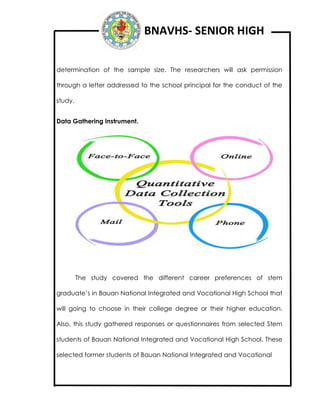
Data Gathering Instrument.
The study covered the different career preferences of stem
graduate’s in Bauan National Integrated and Vocational High School that
will going to choose in their college degree or their higher education.
Also, this study gathered responses or questionnaires from selected Stem
students of Bauan National Integrated and Vocational High School. These
selected former students of Bauan National Integrated and Vocational
BNAVHS- SENIOR HIGH
High School were acquired responses to identify what is their career
preferences choose.
The study was conducted in Bauan National Integrated and
Vocational High School within the school year 2020-2021. The study was
limited to students of BNIVHS while the study was delimited to specific
stem graduates, only the stem graduates can be considered as the
participants.
Interpretation
The researchers viewed the survey results of the middle school
students who participated in the citizen science intervention program
through the lens of SCCT (Lent et al., 1994). The SCCT framework provides
a model of STEM career choice variables, like science self-efficacy, task
interest, and outcome expectations, which might guide career goals and
actions for career development for underrepresented populations of
students (see Lent et al., 1994; Lent et al., 2018). It is important to avoid the
generalization of this model to explain all STEM career decisions in these
subpopulations of students, but it has been found to be a useful starting
point for defining potential decision-making variables for females and
BNAVHS- SENIOR HIGH
ethnic/racial minorities (Fouad & Santana, 2017; Turner et al., 2017). Some
of the findings from the current study extend the findings from the
literature while others disconfirm current literature. In the following
sections, I interpret these results in relation to the SCCT career choice
variables of science self-efficacy, task interest, and outcome
expectations. I have organized my interpretation of the findings by
research question.
Discussion
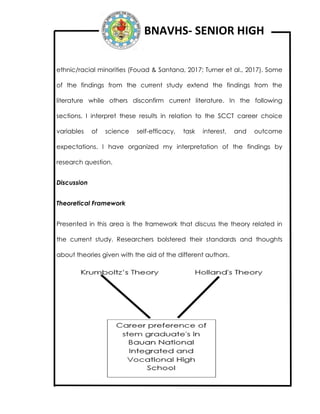
Theoretical Framework
Presented in this area is the framework that discuss the theory related in
the current study. Researchers bolstered their standards and thoughts
about theories given with the aid of the different authors.
BNAVHS- SENIOR HIGH
Holland’s Theory
According to John Holland, Careers are determined by an
interaction between our personality and the environment. John Holland’s
Theory of Career Choice (RIASEC) maintains that in choosing a career,
people prefer jobs where they can be round others who are like them?
They search for environments that will let them use them skills and abilities,
and express their attitudes and values, while taking on enjoyable
problems and roles. Behavior is determined by an interaction between
personality and environment.
Holland’s theory is centered on the notion that most people fit into
one of six personality types:
•Realistic
•Investigate
• Artistic
•Social
•Enterprising
•Conventional (Careers.govt.nz, 2019)
BNAVHS- SENIOR HIGH
This principle is relating to the present Study due to the fact it talks
about deciding on a career of STEM graduates. Therefore, this idea
defined that the career preference is relation between our persona and
environment, it decided behavior.
Krumboltz’s Theory
According to John Krumboltz’s planned happenstance theory
makes it ok to not always plan, because unplanned events could lead to
good careers.
This emerging theory specifically addresses the need for people to
deal with change within the rapidly changing labor market. Managing life
transitions is seen as an essential career management skill. Krumboltz’s
theory offers insight on how to deal with the limited degree of control we
have over some career experiences. (Careers.govt.nz, 2016)
This theory is connected to current study because it talks about to
unplanned occasions and career management skill of STEM graduates.
Therefore, this theory explains that when unplanned events it leads to
desirable careers. And to deal with the confined diploma of control we
BNAVHS- SENIOR HIGH
have over some career experiences. The choice of a course and which
school to enter in college is one of the major decisions faced by
graduating students which is an important element of their learning
process. The course and school selection decision will most likely define
their future success. The paper was aimed at assessing the students?
Course and school preference using a descriptive research design.
V. Recommendations, Application, and Conclusion
Profession-related decision-making, career enlargement and
progression are, hence, regarded as advisable consequences from a
grand range of involvements vital to hold up independent in making
prosperous career change throughout their own lifetimes. Still, attaining
clarity about the accurate nature of the involvements vital to attain these
outcomes, and the conditions necessary to support their successful
Implementation is not straightforward. Like at a simple level, the essence
of career decision-making and education is, itself, contested.
Further deeply inspection by the other analysts that if the youth or
adult engage and motivated by intrinsic factors are can be freely interest
BNAVHS- SENIOR HIGH
in employments and career that truly gratifying (Gokuladas, 2010; Kunnen,
2013). Hence, intrinsic factors are proceeding to decision from self, actions
that proceed to interest, happiness, bizarre or peculiar and
selfcharacteristics, job enjoyment, breakthrough to progression, and
experiences (Ryan and Deci, 2000; Kunnen, 2013; Nyamwange, 2016).
The purpose of the profession clarification was to have understudies
with low assumptions talk with guides about choices for propelling their
vocations later on. Nonetheless, it has been demonstrated that
Advocates can’t ‘do everything.’ In a section named “Career counseling
realities” (Weiler, 1977, p. 50), Weiler examined what advocates can and
can’t do. Advocates can attract profession inclinations to the bleeding
edge, in reflecting of understudy inclinations, explaining vocation
inclinations, summing up, and empowering understudy profession
inclinations. Guides ought not to be locked in with the assessment for
instance, mentioning to the understudy what they are or are not fit for
doing. Advocates ought not admonish or mention to the understudy what
they ought to ought what their thought processes to be, or convince the
understudy to receive an alternate perspective.
BNAVHS- SENIOR HIGH
Parents want their children to find joyfulness, their freedom that they
feel like comfortable and mostly important to find their success on the
career they chosen. Research also indicates that when the students feel
supported, feel protected and is always care, and especially the loved by
their parents, they have own ability to research careers and to choose a
career that would be exciting and interesting. This is important because
studies show the different ability, knowledge and show that adolescent
who feel competent about career decision-making, tend to make more
enjoyable career choices in a life short. (kenler 2004). Parent influence the
level of educator that their children achieved; the knowledge they want
to work hard in different aspect of their lives; the beliefs and attitudes that
given a valuable person cause motivational experiences to get succeed.
Most of this learned are getting to move up, getting to absorb the
knowledge and giving them aspirations to their parents that really proud
because of their expectations that is continuous to grow up.
Career pathways of the high school student are the improvements of
their knowledge and take some occupation the lead us to the successful.
The theory of Occupational describes how people become attracted to
certain occupations. Based on their self-determination, depicts the
BNAVHS- SENIOR HIGH
aspirations and personality that concerns to the people and especially to
the students. It concerned with motivation behind choices student
focuses on the degree of their dignity and behavior to self being
motivated and has determination.
The participation of minority students in Science, Technology,
engineering, and Mathematics (STEM) has received national attention for
more than a decade. As the population of the country becomes
increasingly diverse, there is concern that if groups that have historically
been underrepresented in these fields do not become part of the
technology enterprise the country will lose its preeminence in invention
and innovation. Science, Technology, Engineering, and Mathematics
(STEM) educators and stakeholders in South Africa are interested in the
ways STEM students make their career decisions because of the shortages
in these critical skills.
Career choice defined the most unforgettable way to get what
your commitment in your life. Mostly, when the student going through to
their path there are many challenges and problems that he/she
BNAVHS- SENIOR HIGH
encountered. But for me, being failure determines the successful, when
your failure to the career you will choice, don’t give up. Fail is not a failure,
I have a brain and you have too, it simply means no one can be rich
without mistake and failure. When you choose the profession, you want in
life you should always think about whether it suits your skills and abilities.
The results of this study show that students in middle school have a limited
STEM career knowledge with respect to subject requirements and with
respect to what sort of activities these careers involve.
VI. Reference
• E. Saskia Kunnen (2013). The Effects of Career Choice Guidance on
Identity Development
• Fouad, N. A., & Santana, M. C. (2017). SCCT and underrepresented
populations in STEM fields: Moving the needle. Journal of Career
Assessment, 25(1), 24–39. https://doi.org/10.1177/1069072716658324
• Frontiers in Education (2018). A Systematic Review of Factors That
Influence Youths Career Choices—the Role of Culture
•
BNAVHS- SENIOR HIGH
• Glasow, P.A. (2005). Fundamentals of survey research methodology. Fort
Huachuca, AZ: MITRE Washington C3 Centre.
• Jones, L, December 2008.The Career Key. (Careers.govt.nz, 2019).
• (Kothari and Crag, 2014:29; Creswell, 2013:23). Image
(https://www.google.com/search?q=quantitative+data+collection+tools
&oq=qu&aqs=chrome)
• Lent, R. W., Brown, S. D., & Hackett, G. (1994). Towards a unifying
social cognitive theory of career and academic interest, choice, and
performance. Journal of Vocational Behavior, 45, 79–122.
https://doi.org/10.1006/jvbe.1994.1027
• Lent, R. W., Sheu, H.-B., Miller, M., Cusick, M. E., Penn, L. T., & Truong,
N. N. (2018). Predictors of science, technology, engineering, and
mathematics choice options: A meta-analytic path analysis of the social-
cognitive choice model by gender and race/ethnicity. Journal of
Counseling Psychology, 65(1), 17–35. https://doi.org/10.1037/cou0000243
• Mathers, N., Fox, N. & Hunn, A. (2007). Surveys and questionnaires:
The NIHR RDS for the East Midlands, Yorkshire & the Humber. Nottingham:
National Institute for Health Research.
BNAVHS- SENIOR HIGH
• M. Borchert (2002) CAREER CHOICE FACTORS
• The Calgary Board of Education,Krumboltz’s Theory
(2008),(Careers.govt.nz,2019).
• Turner, S. L., Joeng, J. R., Sims, M. D., Dade, S. N., & Reid, M. F. (2017).
SES, gender, and STEM career interests, goals, and actions: A test of SCCT.
Journal of Career Assessment, 1–17.
https://doi.org/10.1177/1069072717748665

Thesis about Career preferences (Capstone)

  • 1.
    BNAVHS- SENIOR HIGH CapstoneProject By: Group 3
  • 2.
    BNAVHS- SENIOR HIGH I.Introduction Our lifetime preferences when pursuing something is starting to type of school that enabling type of education that will mold student’s behavior and their career preferences. Filipinos are truly meticulous when choosing their own higher education that will grant them through superiority and enlightenment. Even their social class is utterly low or can’t afford any higher education. In our life, responsibilities to choose any career preferences need a greater amount of thinking and exploring such a tremendous of opportunity and desires of life. These amount of thinking and exploring are truly crucial, whenever who you are or what kind of dreams you want to conquer. All of these preparation of continuing career preferences is totally coherent of new beginning that will bring challenges and problems. In other words, this is the introduction that will brings the true meaning of life and sacrifices. Career Preferences are free opportunity to select a desired career. It is time when secondary senior level is confused whether their career path is right or wrong. When one is confused in choosing a career, he relies on his friends and relatives. She/he is confused in the sense that they cannot make their own decisions. However, career choice is difficult to find out because there is much hard education, especially own decisions.
  • 3.
    BNAVHS- SENIOR HIGH Choosingof right career is very essential for, peaceful living and quality of life. But, today most of the students in higher education are facing career related problems in the form of either career indecision or wrong decision. In such a situation, understanding students’ career plans and preferences that subsequently determine future prestige, wealth, and Status is vital to higher education professionals who facilitate students in their career selection. It is, therefore, great. Concern to find out the areas of the most preferred career of our young generation. Career is an occupation undertaken for an extensive duration of a person's life and with possibilities for progress. In these days’ career started as soon as Stem students’ graduates finished his/her career and started to work. Career preferences of stem student’s means which career paths they find pleasing regardless of job conditions. In consequence, respondents are requested to pass by job availability and feel attractive they locate the career associated to STEM strand. Nowadays basic qualifications and schooling are not ample for getting a job however exemplary and successful fulfillment in academics Stem is particularly preferred. Successful fulfillment in academics of stem or academic achievement is defined by the Oxford Bibliographies as a performance outcome that indicate the extent to which a person has to accomplished specific goals
  • 4.
    BNAVHS- SENIOR HIGH thatwere the focus of activities in instructional environments, specifically in school, college, and university. The choice of a course and which school to enter in college is one of the major decisions faced by graduating students which is an important element of their learning process. The course and school selection decision will most likely define their future success. The paper was aimed at assessing the students? Course and school preference using a descriptive research design. The increasing information and the subsequent technological advancements today, require some properties for the individuals to follow the developments and to keep up with the contemporary. These properties that the individuals should carry are called the 21st century skills. Creativity, problem solving, critical thinking, communication, innovation, career, scientific literacy and similar skills reside within the 21st century skills. When the 21st century skills and the occupations of the future are considered, it is seen that in fact our age requires science, technology, engineering and mathematics (STEM) professionals. Because so-called occupations of future contain interdisciplinary collaboration covering science, technology, engineering and mathematics. This shows also that most of the occupations of future shall be assessed under STEM careers.
  • 5.
    BNAVHS- SENIOR HIGH Thisstudy searches the differences in perception between learner’s stem graduates’ students who made coinciding, contrary, and undecided career choices. Career is determined as a continuous motion among jobs, challenges, position, and one of a kind responsibility levels. Stem Graduates plans, goals and needs have to be in relation with organizational core plans and preference in order to succeed in advent of personal career. The trouble of this study is parents’ preference of what path their minor children to study, this influences the child’s interest to their career preference decision-making is a non-stop process in which individual of stem graduates will alternate their career action. II. LITERATURE REVIEW This chapter shows the relevant information that contributes to the totality of this undertaking. It includes areas that may greatly facilitate in understanding the study. Conceptual Literature After reading through literature on the study under discussion, the material has been narrowed down to the topics as being significant to the present study. These include the following main topics namely: Career
  • 6.
    BNAVHS- SENIOR HIGH preferences,Complexity of career resolution-making, Environment, Influences, Socio economic factor, Opportunities, Career outlook. Career preferences Is a significant impact for human psychological capacity and the physical characteristics? It is reported as associated with positive and negative psychological, physical and socio-economic inequalities that persist well beyond the youthful age into a person's adult life (Robertson, 2014; Bubić and Ivanišević, 2016). The term “youth” is described by the United Nations Educational Scientific and Cultural Organization (UNESCO) as a more fluid category than a hard and fast age bracket. Many theoretical replicas have been declared to examine the process of career improvement and decision- making, one of which is the Social Cognitive Career Theory (SCCT) by Lent et al. (1994). In proportion to SCCT, the profession development is pretentious by 3 social cognitive processes self-efficacy beliefs, outcome expectations and career goals. Which the intention is to improve the quality of life (Lent et al., 2000; Blanco, 2011). It emphasizes the crucial relationship between the self-desire in career preferences and decision making and the social influences that act upon them. Carpenter and
  • 7.
    BNAVHS- SENIOR HIGH Foster(1977) suggest that earlier influences and experiences exposed to form a foundation that conceive their own career preferences (carpenter and foster, 1977). These authors lend to support the tenets of SCCT and developed a 3-dimensional framework to determine the parts that impact career preferences. Foster and Carpenter says that intrinsic, extrinsic, or interpersonal dimensions can affect the career. Intrinsic dimension is a station of career and roles in community. Extrinsic refers to security and social identification. And the interpersonal dimension is the authority that connected to friends, family, and others that can affect (Carpenter and Foster, 1977). Further deeply inspection by the other analysts that if the youth or adult engage and motivated by intrinsic factors are can be freely interest in employments and career that truly gratifying (Gokuladas, 2010; Kunnen, 2013). Hence, intrinsic factors are proceeding to decision from self, actions that proceed to interest, happiness, bizarre or peculiar and self- characteristics, job enjoyment, breakthrough to progression, and experiences (Ryan and Deci, 2000; Kunnen, 2013; Nyamwange, 2016). Extrinsic dimension is considered as external regulations and the satisfaction that associated with career (Shoffner et al., 2015). The other things that impacted the career decisions are distinguished profession,
  • 8.
    BNAVHS- SENIOR HIGH numbersof occupation, and large paying employments (Ryan and Deci, 2000). Hence, extrinsically influenced youth may prefer their own career preferences on the borderline benefits that affects the particular career such as financial salary, occupation security, occupation accessibility, and compensation (Ryan and Deci, 2000; Edwards and Quinter, 2011; Bakar et al., 2014). Interpersonal factors circumscribe the personal activities of individualization in one’s life and this cover the influence offamily, instructors/educators, peers, and community managements (Gokuladas, 2010; Bossman, 2014; Wu et al., 2015). Beynon et al. says that Chinese-Canadians educators are focus to select career to bring integrity to their own family (Beynon et al., 1998). Educators who are potentially influenced by interpersonal factors have a great value to opinions of family and other people; they are dependable to other people and willing to compromise their own interest (Guan et al., 2015). Complexity of career resolution-making is utterly increase when the human being is getting older (Gati and Saka, 2001). Children are likely to state their own career preferences which can represent the future or vision when they grow up or in adult stage (Howard and Walsh, 2011). As the children getting more matured, they perspective to their own career preferences as the energetic interplay of their own mental development
  • 9.
    BNAVHS- SENIOR HIGH stagesand the overcoming community circumstances (Howard and Walsh, 2011). Youth career decision-making is important to manage the process of understanding by exploring what they want to do and journey a tremendous of career choices with the assistance of guidance andplanning. (Porfeli and Lee, 2012). The right handling of the procedure declares individual specification and promotes wellbeing, work pleasure, and steadiness (Kunnen, 2013) Osipow, Carney, and Barak (1976) prove a divergent understanding the profession procedure when, they straight their focus to career decision making (CDM), scrutinizing at the barricade preventing people from creating decisions. Their 19-item Career Decision Scale look into the particular of indecision, and while this scale is granted and widely used in a tremendous of years, there have a staying criticism about uncertainty of factor structure and the hard nature of its unit. A new version was state these shortcomings and created the Career Decision- making Difficulties Questionnaire (CDDQ; Gati, Osipoe, & Krausz, 1996) another scales, act for a diverse of different theoretical viewpoints, have been improve and utilize to calculate CDM. One of scales is the Career Beliefs Inventory (Krumboltz, 1991), that is based on the proposition that people’s profession alternatives depends on the expectations and globalism they create about themselves and the world of occupation.
  • 10.
    BNAVHS- SENIOR HIGH Sampson,Peterson, Lenz, Reardon, & Saunders (1996) created other analytical based measured called the Career Thoughts Inventory, while Hartung (1995) utilize a Gestalt model as the bedrock for the Decisional Process Inventory. Profession-related decision-making, career enlargement and progression are, hence, regarded as advisable consequences from a grand range of involvements vital to hold up independent in making prosperous career change throughout their own lifetimes. Still, attaining clarity about the accurate nature of the involvements vital to attain these outcomes, and the conditions necessary to support their successful implementation is not straightforward. Like at a simple level, the essence of career decision-making and education is, itself, contested. The HECSU Protocol for Researchers (2005) pinnacle the reality of competing theoretical outlook on career decision-making. For example, while some view it basically as an actually judicious and direct cycle, others contend that it is the aftereffect of fuller of feeling measures, but others that it is obliged generally by outside variables. Also, here are shifted originations of profession learning and how this identifies with vocation dynamic. There exists, subsequently, a wide and liquid system inside which what 'matters' for this writing survey must be resolved.
  • 11.
    BNAVHS- SENIOR HIGH Environmentassumes a huge part in the vocation position the understudy accomplishes from various perspectives. The climate that is spoken about here is a factor that is utilized to sustain choices in vocation decision. Sex, for instance has assumed a huge part in this climate. In a proclamation delivered to the push on the 30th commemoration of the Title IX notwithstanding of the sex separation, Marcia Greenberger (2002) of the National Women's Law Center expressed that young men are as yet being guided toward the conventional 'male' positions, which are more lucrative. Young ladies are as yet expected to group into the customary fields of cosmetology, childcare, and other comparative positions. In Florida for instance, "99% of the understudies in cosmetology are female, while 100% of the understudies taking pipes are male" (Greenberger, 2002, p. 2). While it ought to be noticed that claims were documented in these cases, not all states were liable of gross disappointment with respect to specialized school to integrate the positions to both of the sexes. Schools in certain states have had the option to make a superior showing in establishing a superior climate for understudies who need to cross sex lines while picking a vocation. Abilities present in guys and females the same have been demonstrative of their professional advantages. Grace Laleger, in her Ph.D. thesis, set out to
  • 12.
    BNAVHS- SENIOR HIGH learnthe ability levels of young ladies as they applied to interests that the young ladies had. The end indicated that there was a disappointingly low connection of abilities to intrigue (Laleger, 1942). These kinds of studies have indicated that it is so hard to break the code of inspiration that understudies may have. The way thatLaleger's investigation was done in 1942 shows that sexual orientation predisposition, and its investigation, is the same old thing, and may keep on being a consistently present piece of the profession decision measure. One method for inciting understudies to take an interest in the profession decision arranging is a command to require Southern California's San Fernando Valley, District C's understudies to present a portrayal of their arrangements for some postsecondary instruction or preparing to class authorities; or if nothing else clarify their future vocation ways in detail. Under this first-year preliminary strategy, the alumni need to explain those objectives, which could incorporate school, exchange school, the military, or different choices, regardless of whether they have not met the necessity to graduate (Cavanagh, 2002).The purpose of the profession clarification was to have understudies with low assumptions talk with guides about choices for propelling their vocations later on. Nonetheless, it has been demonstrated that advocates can't 'do everything.' In a section named "Career counseling realities" (Weiler, 1977,
  • 13.
    BNAVHS- SENIOR HIGH p.50), Weiler examined what advocates can and can't do. Advocates can attract profession inclinations to the bleeding edge, in reflecting of understudy inclinations, explaining vocation inclinations, summing up, and empowering understudy profession inclinations. Guides ought not to be locked in with the assessment for instance, mentioning to the understudy what they are or are not fit for doing. Advocates ought not admonish or mention to the understudy what they ought to what their thought processes to be, or convince the understudy to receive an alternate perspective. Vocation advisors are ineffectual in the event that they attempt to direct, judge, or choose the understudy's qualities. Lastly, instructors ought not to make forecasts that go past the capacity of their preparation (Weiler, 1977). For understudies to furnish themselves with answers to profession decision questions, dynamic has become a device to frame vocation decisions. (Kroll et al., 1970) cited Super’s own research, which shows that the dynamic cycle concerning one's vocation isn't such a lot of an element of the data amassed to the individual, yet more the cycle of development arranging. Kroll refers to Clarke, Gelatt, and Levine in which they focused on that great dynamic depended upon satisfactory data and viable procedures for settling on decision. Understudies can help themselves in to choose legend from the real
  • 14.
    BNAVHS- SENIOR HIGH world,correspondence, and figuring out how to work self-sufficiently, are central structure blocks utilized in viable vocation arranging. To prevail with regards to getting their objectives, understudies should know what they need. "Such a large number of us have been instructed to stifle what we need and all things being equal focus on gathering others' assumptions. In doing this we wind up spending the vast majority within recent memory walking to others' drums" (Weiler, 1977, p. 57). Kroll has given models of the dynamic cycle. John Dewey's model (Kroll et al., 1970) depicts five recognizable advances portrayed: the reflective state, proposals, intellectualization, theory, and afterward thinking. Similarly, as Dewey's depiction is another from Poyla. Poyla (referred to in Kroll et al., 1970) described four basic areas in the decision-making process 1) understanding the issue, 2) seeing how different things of the issue are connected to detail an arrangement, 3) doing the arrangement, and 4) surveying and examining the finished arrangement. Overflow, Glass, Lavin, and Goodman work from various perspectives using an essential logical technique investigating how individuals decide. Their dynamic model incorporates issue recognizable proof, data securing, arrangement creation, arrangement assessment, methodology determination, and genuine execution with resulting learning and correction (referred to in
  • 15.
    BNAVHS- SENIOR HIGH Krollet. al., 1970). Tiedman and O'Hara have expressed their cycle in stages (referred to in Kroll et. al. 1970). The stages have managed expectation, crystallization, choice, explanation, execution or change. Dynamic in vocation decisions expressed Kroll (et al., 1970) "is a consistent, proceeding with measure despite the fact that a few choices are required at this point that can be changed later just at extraordinary enthusiastic, time, or monetary expenses to the decider" (p. 137). Influences typically means to affect or change someone or something in an indirect but usually important way. Influences is the most valuable concepts in our life, sometimes it depicts on the situation that relate in our study. Influence undergo to our study, to knowing the concepts of the student chasing their career choice in the possibility situation. Parental Influence defined the attitude, opinion and motivation especially aspiration to the children that will have a big dream. The most educated persons, the higher learner and the mostly important is to be a respectful person that acknowledge to their parent. Children well be motivated when under the pressure from parents. Dietrich and Kracke(2009) reported of adolescent perceive their parents as putting through their own wishes for the child’s future career rather than
  • 16.
    BNAVHS- SENIOR HIGH collaboratingwith the child in preparing for a career this may be interpreted as disinterest in the child’s plans. Those who are positively influenced by their parents are more likely to choose the same career field of their parents that motivate me to pursue and to command my commitment for my family and also to God. It is interesting to explore the positively that an educator is mostly be higher and acclaimed their achievement, given the proper guidance and encouragement. Sshellenbarger (2006) supported relieving the pressures on kids to follow suit in parents’ footsteps when he commended how “…the best lesson we can tell our kids is that it’s fine to switch career” (p.2). Jane Dee Hull, the first female governor of Arizona, once said, ‘Atthe end of the day, the most overwhelming key to a child’s success is the positive involvement of parents. That’s depicts the responsibility of choosing path of the students. Parents serve as a major influence in their children’s career development and career decision-making. Parents want their children to find joyfulness, their freedom that they feel like comfortable and mostly important to find their success on the career they chosen. Research also indicates that when the students feel supported, feel protected and is always care, and especially the loved bytheir parents, they have own ability to research careers and to choose a career that would be exciting and interesting.
  • 17.
    BNAVHS- SENIOR HIGH Thisis important because studies show the different ability, knowledge and show that adolescent who feel competent about career decision-making, tend to make more enjoyable career choices in a life short. (kenler 2004). Parent influence the level of educator that their children achieved; the knowledge they want to work hard in different aspect of their lives; the beliefs and attitudes that given a valuable person cause motivational experiences to get succeed. Most of this learned are getting to move up, getting to absorb the knowledge and giving them aspirations to their parents that really proud because of their expectations that is continuous to grow up. Socioeconomic factors, therefore, also are important in motivating the scholars to form career decisions (Sukovieff, 1989). A comprehensive study by Ngesi (2003) reports that students from poor socioeconomic backgrounds made wrong career decisions, and chose professions which required a fast duration of coaching, primarily thanks to financial constraints. because the old adage goes, nothing succeeds like success, similarly, a student who fare well academically have better career prospects and choices as compared to the struggling ones. Hoover – Dempsey &Sadler (2000) assert that a well-read person has more
  • 18.
    BNAVHS- SENIOR HIGH Informationassociated with career choice, and reads more to form the crucial decision. Thus, their decisions are likely to be correct and wise. The role of fogeys within the lives of children is undeniable. Olayinka (2005) asserts that it so happens that oldsters have pre-determined the careers for his or her wards, and only serve to steer them therein direction. In other research, it's elaborated that the attitude of fogeys and also the influence of the house environment influences a child's career path. Similarly, parents’ education has been proven as a component influencing career choice (Grissmer, 2003; Ogunlade, 1973). Research supports the position that parents’ education is linked with the students’ career choice. Literature reports that parents’ educational level is that the most vital consider students’ career decision (Grissmer, 2003; Ogunlade, 1973). The results uphold that oldsters are a child’s first teacher, and thus they need the role of a guide, advisor and counsellor in their lives. Bladeless cited in Nyarko-Sampson (2013) explains that folks exert emotional pressure on their wards regarding the selection of careers. They create independent consultations regarding the career they think is most fitted for his or her children. The child’s preferences are never a matter of concern for them. A study by Mickelson and Velasco (1998) shows that mothers have a robust influence on their children as compared to their fathers. Another
  • 19.
    BNAVHS- SENIOR HIGH factproven by research is that children opt to discuss their plans and choices with their mother more as compared to the fathers (Muthukrishna & Sokoya, 2008). In keeping with Edwen (2000), different values are attached to different career options. These values in line with him stem from life experiences, educational background, and also the environment. Values are attached to the soundness which is attached to a specific career. A very important consider determining students’ career choice is that the varsity to which they belong. Different curriculum options, hidden curriculum, and college culture are all determinant of a student’s career choice. Schools role is to supply accurate guidance, and also encourage students to continue with education and not drop out (Oladele, as cited in Nyarko-Sampson 2013). He further elaborates that some parents are receptive to suggestions. However, these kinds of parents usually set high standards from the very outset, then pave the way for his or her children to follow that path. Studies report that children who are initially passionate about parents regarding career decisions tend to become more independent as they enter highschool and adolescence (Kinnier Brigman & Nobel, 1990). Opportunities. An opportunity is a situation in which it is possible for you to do something that you want to do. When you chosing a career in
  • 20.
    BNAVHS- SENIOR HIGH nearfuture there are some opportunities which you can pick up in case your first choice is not possible. Science, technology, engineering, and mathematics (STEM) programs are open in many different careers, including opportunities in engineering, science, and research. Some STEM students’ graduates may also apply their technical knowledge in law, politics, education and etc. Each specialization offers unique challenges and areas of expertise, which can help students determine their career path. Students interested in theoretical physics, for example, may be better served focusing on mathematics rather than engineering. Career outlook. When choosing your desired career, you need to keep in mind whether it will be good for you or bad for your future. The outlook for careers with a STEM degree differs depending on each worker's education and location. Students should always research specific careers to learn more about their job outlook and potential salary. For example, physical, and social sciences professionals can expect to earn median annual salaries that range from $41,230 for agricultural and food science technicians to $122,220 for physicists and astronomers. Additionally, when you are choosing engineering there are some potential salary for architecture and engineering professionals range from
  • 21.
    BNAVHS- SENIOR HIGH $45,010for surveying and mapping technicians to $137,720 for petroleum engineers. III. Methods Subjects/Participants The respondents were taken to their respective location. The stem graduates in Bauan National Integrated and Vocational High School was selected on the length of their operation and other commonalities such as geographical location and availability of the participants which is located at Bauan, Batangas city. The study focuses on Career Preferences of Stem Graduate’s in Bauan National Integrated and Vocational High School. The main purpose of the study is to identify the career preferences of stem graduate’s in Bauan National Integrated and Vocational High School, academic year 2020-2021. Due to the wide spread of coronavirus pandemic, the participants were interview through online communications and pick the participants who high in availability to use a modern technology that prelude our researcher and gain to claim the answer that the researcher needs. The study was conducted in Bauan National Integrated and Vocational High
  • 22.
    BNAVHS- SENIOR HIGH Schoolwithin the school year 2020-2021. The study was limited to students of BNIVHS while the study was delimited to specific stem graduates, only the stem graduates can be considered as the participants. Data Collection and Techniques It may use the Survey Research to use as research design which includes the assortment of data from an example of people through their reactions to questions. It is an effective strategy for methodically gathering information from an expansive range of people and instructive settings (Glasow, 2005:1). Mathers et al. (2007:6) expressed that a review which depends on an irregular testing strategy produces an example which is illustrative of the specific populace under examination and produces discoveries which might be summed up to the more extensive populace accordingly improving outer what's more, inside legitimacy which were fundamental in this examination. In conclusion, the Survey Research is best fitted in collecting data from predefined group.
  • 23.
    BNAVHS- SENIOR HIGH EthicalIssues about Collection upon the Subjects/ Participants The main issue that holds this research, is the coronavirus pandemic. Most of the researchers are have difficulties achieving the completion of this research and it hardly produces findings that relevant to this research. The participants are busy and mostly least to contact because of the pandemic. But, the researcher made a tremendous possibility to hold this research coherent and value the rights of all participants that the researcher chooses carefully. Materials and Procedures The materials that the researchers used is through online capabilities such as cellphones and laptop that collect the data of participants. Through the use of the sophisticated gadget, the researcher reaches the threshold of data because of using survey research. These materials are probably the most ideal require to counterpart the problems and issues. It gives more autonomy to reach the people that the researcher picks and chooses. When creating accurate data the researcher has to use the procedure that is needed.
  • 24.
    BNAVHS- SENIOR HIGH Theprocedure is to distribute the questionnaire, then as of now, the researcher filled out the questionnaire. Using statistical analysis. It was tailed, scored, and tabulated. Data Analysis Approaches and/or Software The following statistical tools were applied in interpreting the data obtained from the instrument used in the survey. ANOVA. This was applied to determine if there is a significant difference between the responses of the participants based on their career preferences. T-test. This was utilized to determine if there is a significant difference between the responses of the participants based on their chosen career. Weighted Mean. This was used to determine the number that would represent the average of the responses taken from the participants.
  • 25.
    BNAVHS- SENIOR HIGH These3 are the methods of analyzing the data and how these will be calculated and going to analyze the data-coding method, analysis of interviews/ recordings, mathematics, and stats analysis. That brings accurate and convincible data. IV. Results, Findings, Interpretation, and Discussion Results and Findings Career Preferences are free opportunity to select a desired career. It is also a decision making in a confusing situation which occurs during the senior year of secondary school level. ... Career Preferences means which career paths they find attractive regardless of job market conditions. To easily find the results of the research, here are some instruments or equipment’s to find easily the data of a research. Subject of the study this study entitled “Career Preference of STEM graduates in Bauan National and Vocational Integrated High-School” will consider STEM graduates in Bauan National and Vocational Integrated High School. The researchers considered quota sampling in the
  • 26.
    BNAVHS- SENIOR HIGH determinationof the sample size. The researchers will ask permission through a letter addressed to the school principal for the conduct of the study. Data Gathering Instrument. The study covered the different career preferences of stem graduate’s in Bauan National Integrated and Vocational High School that will going to choose in their college degree or their higher education. Also, this study gathered responses or questionnaires from selected Stem students of Bauan National Integrated and Vocational High School. These selected former students of Bauan National Integrated and Vocational
  • 27.
    BNAVHS- SENIOR HIGH HighSchool were acquired responses to identify what is their career preferences choose. The study was conducted in Bauan National Integrated and Vocational High School within the school year 2020-2021. The study was limited to students of BNIVHS while the study was delimited to specific stem graduates, only the stem graduates can be considered as the participants. Interpretation The researchers viewed the survey results of the middle school students who participated in the citizen science intervention program through the lens of SCCT (Lent et al., 1994). The SCCT framework provides a model of STEM career choice variables, like science self-efficacy, task interest, and outcome expectations, which might guide career goals and actions for career development for underrepresented populations of students (see Lent et al., 1994; Lent et al., 2018). It is important to avoid the generalization of this model to explain all STEM career decisions in these subpopulations of students, but it has been found to be a useful starting point for defining potential decision-making variables for females and
  • 28.
    BNAVHS- SENIOR HIGH ethnic/racialminorities (Fouad & Santana, 2017; Turner et al., 2017). Some of the findings from the current study extend the findings from the literature while others disconfirm current literature. In the following sections, I interpret these results in relation to the SCCT career choice variables of science self-efficacy, task interest, and outcome expectations. I have organized my interpretation of the findings by research question. Discussion Theoretical Framework Presented in this area is the framework that discuss the theory related in the current study. Researchers bolstered their standards and thoughts about theories given with the aid of the different authors.
  • 29.
    BNAVHS- SENIOR HIGH Holland’sTheory According to John Holland, Careers are determined by an interaction between our personality and the environment. John Holland’s Theory of Career Choice (RIASEC) maintains that in choosing a career, people prefer jobs where they can be round others who are like them? They search for environments that will let them use them skills and abilities, and express their attitudes and values, while taking on enjoyable problems and roles. Behavior is determined by an interaction between personality and environment. Holland’s theory is centered on the notion that most people fit into one of six personality types: •Realistic •Investigate • Artistic •Social •Enterprising •Conventional (Careers.govt.nz, 2019)
  • 30.
    BNAVHS- SENIOR HIGH Thisprinciple is relating to the present Study due to the fact it talks about deciding on a career of STEM graduates. Therefore, this idea defined that the career preference is relation between our persona and environment, it decided behavior. Krumboltz’s Theory According to John Krumboltz’s planned happenstance theory makes it ok to not always plan, because unplanned events could lead to good careers. This emerging theory specifically addresses the need for people to deal with change within the rapidly changing labor market. Managing life transitions is seen as an essential career management skill. Krumboltz’s theory offers insight on how to deal with the limited degree of control we have over some career experiences. (Careers.govt.nz, 2016) This theory is connected to current study because it talks about to unplanned occasions and career management skill of STEM graduates. Therefore, this theory explains that when unplanned events it leads to desirable careers. And to deal with the confined diploma of control we
  • 31.
    BNAVHS- SENIOR HIGH haveover some career experiences. The choice of a course and which school to enter in college is one of the major decisions faced by graduating students which is an important element of their learning process. The course and school selection decision will most likely define their future success. The paper was aimed at assessing the students? Course and school preference using a descriptive research design. V. Recommendations, Application, and Conclusion Profession-related decision-making, career enlargement and progression are, hence, regarded as advisable consequences from a grand range of involvements vital to hold up independent in making prosperous career change throughout their own lifetimes. Still, attaining clarity about the accurate nature of the involvements vital to attain these outcomes, and the conditions necessary to support their successful Implementation is not straightforward. Like at a simple level, the essence of career decision-making and education is, itself, contested. Further deeply inspection by the other analysts that if the youth or adult engage and motivated by intrinsic factors are can be freely interest
  • 32.
    BNAVHS- SENIOR HIGH inemployments and career that truly gratifying (Gokuladas, 2010; Kunnen, 2013). Hence, intrinsic factors are proceeding to decision from self, actions that proceed to interest, happiness, bizarre or peculiar and selfcharacteristics, job enjoyment, breakthrough to progression, and experiences (Ryan and Deci, 2000; Kunnen, 2013; Nyamwange, 2016). The purpose of the profession clarification was to have understudies with low assumptions talk with guides about choices for propelling their vocations later on. Nonetheless, it has been demonstrated that Advocates can’t ‘do everything.’ In a section named “Career counseling realities” (Weiler, 1977, p. 50), Weiler examined what advocates can and can’t do. Advocates can attract profession inclinations to the bleeding edge, in reflecting of understudy inclinations, explaining vocation inclinations, summing up, and empowering understudy profession inclinations. Guides ought not to be locked in with the assessment for instance, mentioning to the understudy what they are or are not fit for doing. Advocates ought not admonish or mention to the understudy what they ought to ought what their thought processes to be, or convince the understudy to receive an alternate perspective.
  • 33.
    BNAVHS- SENIOR HIGH Parentswant their children to find joyfulness, their freedom that they feel like comfortable and mostly important to find their success on the career they chosen. Research also indicates that when the students feel supported, feel protected and is always care, and especially the loved by their parents, they have own ability to research careers and to choose a career that would be exciting and interesting. This is important because studies show the different ability, knowledge and show that adolescent who feel competent about career decision-making, tend to make more enjoyable career choices in a life short. (kenler 2004). Parent influence the level of educator that their children achieved; the knowledge they want to work hard in different aspect of their lives; the beliefs and attitudes that given a valuable person cause motivational experiences to get succeed. Most of this learned are getting to move up, getting to absorb the knowledge and giving them aspirations to their parents that really proud because of their expectations that is continuous to grow up. Career pathways of the high school student are the improvements of their knowledge and take some occupation the lead us to the successful. The theory of Occupational describes how people become attracted to certain occupations. Based on their self-determination, depicts the
  • 34.
    BNAVHS- SENIOR HIGH aspirationsand personality that concerns to the people and especially to the students. It concerned with motivation behind choices student focuses on the degree of their dignity and behavior to self being motivated and has determination. The participation of minority students in Science, Technology, engineering, and Mathematics (STEM) has received national attention for more than a decade. As the population of the country becomes increasingly diverse, there is concern that if groups that have historically been underrepresented in these fields do not become part of the technology enterprise the country will lose its preeminence in invention and innovation. Science, Technology, Engineering, and Mathematics (STEM) educators and stakeholders in South Africa are interested in the ways STEM students make their career decisions because of the shortages in these critical skills. Career choice defined the most unforgettable way to get what your commitment in your life. Mostly, when the student going through to their path there are many challenges and problems that he/she
  • 35.
    BNAVHS- SENIOR HIGH encountered.But for me, being failure determines the successful, when your failure to the career you will choice, don’t give up. Fail is not a failure, I have a brain and you have too, it simply means no one can be rich without mistake and failure. When you choose the profession, you want in life you should always think about whether it suits your skills and abilities. The results of this study show that students in middle school have a limited STEM career knowledge with respect to subject requirements and with respect to what sort of activities these careers involve. VI. Reference • E. Saskia Kunnen (2013). The Effects of Career Choice Guidance on Identity Development • Fouad, N. A., & Santana, M. C. (2017). SCCT and underrepresented populations in STEM fields: Moving the needle. Journal of Career Assessment, 25(1), 24–39. https://doi.org/10.1177/1069072716658324 • Frontiers in Education (2018). A Systematic Review of Factors That Influence Youths Career Choices—the Role of Culture •
  • 36.
    BNAVHS- SENIOR HIGH •Glasow, P.A. (2005). Fundamentals of survey research methodology. Fort Huachuca, AZ: MITRE Washington C3 Centre. • Jones, L, December 2008.The Career Key. (Careers.govt.nz, 2019). • (Kothari and Crag, 2014:29; Creswell, 2013:23). Image (https://www.google.com/search?q=quantitative+data+collection+tools &oq=qu&aqs=chrome) • Lent, R. W., Brown, S. D., & Hackett, G. (1994). Towards a unifying social cognitive theory of career and academic interest, choice, and performance. Journal of Vocational Behavior, 45, 79–122. https://doi.org/10.1006/jvbe.1994.1027 • Lent, R. W., Sheu, H.-B., Miller, M., Cusick, M. E., Penn, L. T., & Truong, N. N. (2018). Predictors of science, technology, engineering, and mathematics choice options: A meta-analytic path analysis of the social- cognitive choice model by gender and race/ethnicity. Journal of Counseling Psychology, 65(1), 17–35. https://doi.org/10.1037/cou0000243 • Mathers, N., Fox, N. & Hunn, A. (2007). Surveys and questionnaires: The NIHR RDS for the East Midlands, Yorkshire & the Humber. Nottingham: National Institute for Health Research.
  • 37.
    BNAVHS- SENIOR HIGH •M. Borchert (2002) CAREER CHOICE FACTORS • The Calgary Board of Education,Krumboltz’s Theory (2008),(Careers.govt.nz,2019). • Turner, S. L., Joeng, J. R., Sims, M. D., Dade, S. N., & Reid, M. F. (2017). SES, gender, and STEM career interests, goals, and actions: A test of SCCT. Journal of Career Assessment, 1–17. https://doi.org/10.1177/1069072717748665