Dumpeti Sravan Kumar (B17EE092)
B.Tech IV Sem, EEE
Kakatiya InstitueOf Technology & Science, Warangal
KAKATIYA INSTITUTE OF TECHNOLOGY AND SCIENCE
WARANGAL
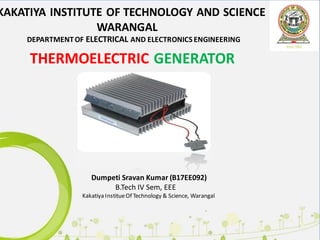
THERMOELECTRIC GENERATOR
DEPARTMENTOF ELECTRICAL AND ELECTRONICS ENGINEERING
CONTENTS:
• INTRODUCTION
• CONSTRUCTION OF TEG
• WORKING OF TEG
• APPLICATIONS
• ADVANTAGES
• LIMITATIONS
• CONCLUSION
• REFERENCES
aINTRODUCTION :
● Energy crisis-main problem.
• Increased pollution and population.
• Tremendous energy wasted in the form of heat
• Increased interest in renewable energy.
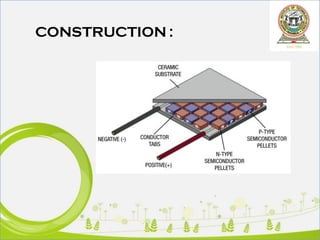
CONSTRUCTION :
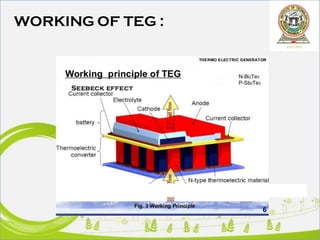
WORKING OF TEG :
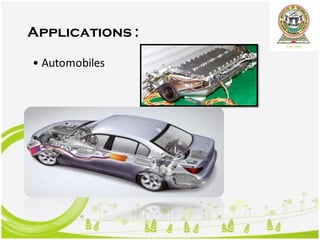
Applications :
• Automobiles
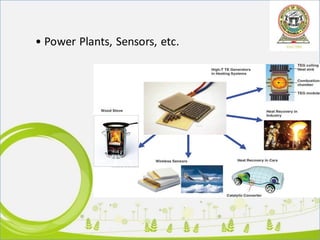
• Power Plants, Sensors, etc.
ADVANTAGES :
• Increase operation life under all environment.
• No noise and less maintainence.
• Available 24 hours a day.
• No moving parts.
• Size of TEG is 1/20 times
the solar.
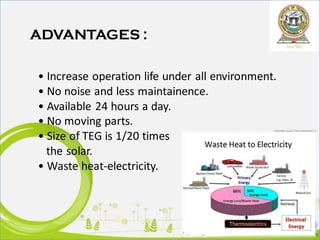
• Waste heat-electricity.
LIMITATIONS :
• Lack of customer/industry education about
thermoelectric generators.
• limited applications
• Less efficiency
Conclusion :
• Variety of application field.
• Numerous advantages over disadvantages.
• Waste heat conversion to useful energy beneficial
to present energy crisis.
• Increases scope of nano technology.
• Development in future lead to intresting
applications.
• TEG is expected to reach $720 million market in
2021 with a growth rate of 14.5%.
REFERENCES :
1. Seebeck, T. J. (1825). “Magnetische Polarisation der Metalle und Erze
durch Temperatur-Differenz (Magneticpolarization of metals and minerals
by temperaturedifferences)”. Abhandlungen der Königlichen Akademie
derWissenschaften zu Berlin(Treatises of the Royal Academy of
Sciences in Berlin) .
2. Seebeck, T. J. (1826). ”Ueber die Magnetische Polarisation der Metalle
und Erze durch Temperatur-Differenz” (On the magnetic polarization of
metals and minerals by temperature differences)”. Annalen der Physik und
Chemie.
3. Peltier (1834). “Nouvelles expériences sur la caloricité descourants
électrique (New experiments on the heat effects of electric
currents)”. Annales de Chimie et de Physique.
5. “Harvesting Wasted Heat in a Microprocessor Using Thermoelectric
Generators: Modeling, Analysis and
Measuremen”. 2008 Design, Automation and Test in Europe.
6. Chatterji, Tapan. “Increasing the Thermoelectric Figure of Merit” .
ANY QUERIES ?
THANK YOU

Thermoelectric generator

  • 1.
    Dumpeti Sravan Kumar(B17EE092) B.Tech IV Sem, EEE Kakatiya InstitueOf Technology & Science, Warangal KAKATIYA INSTITUTE OF TECHNOLOGY AND SCIENCE WARANGAL THERMOELECTRIC GENERATOR DEPARTMENTOF ELECTRICAL AND ELECTRONICS ENGINEERING
  • 2.
    CONTENTS: • INTRODUCTION • CONSTRUCTIONOF TEG • WORKING OF TEG • APPLICATIONS • ADVANTAGES • LIMITATIONS • CONCLUSION • REFERENCES
  • 3.
    aINTRODUCTION : ● Energycrisis-main problem. • Increased pollution and population. • Tremendous energy wasted in the form of heat • Increased interest in renewable energy.
  • 4.
  • 5.
  • 6.
  • 7.
    • Power Plants,Sensors, etc.
  • 8.
    ADVANTAGES : • Increaseoperation life under all environment. • No noise and less maintainence. • Available 24 hours a day. • No moving parts. • Size of TEG is 1/20 times the solar. • Waste heat-electricity.
  • 9.
    LIMITATIONS : • Lackof customer/industry education about thermoelectric generators. • limited applications • Less efficiency
  • 10.
    Conclusion : • Varietyof application field. • Numerous advantages over disadvantages. • Waste heat conversion to useful energy beneficial to present energy crisis. • Increases scope of nano technology. • Development in future lead to intresting applications. • TEG is expected to reach $720 million market in 2021 with a growth rate of 14.5%.
  • 11.
    REFERENCES : 1. Seebeck,T. J. (1825). “Magnetische Polarisation der Metalle und Erze durch Temperatur-Differenz (Magneticpolarization of metals and minerals by temperaturedifferences)”. Abhandlungen der Königlichen Akademie derWissenschaften zu Berlin(Treatises of the Royal Academy of Sciences in Berlin) . 2. Seebeck, T. J. (1826). ”Ueber die Magnetische Polarisation der Metalle und Erze durch Temperatur-Differenz” (On the magnetic polarization of metals and minerals by temperature differences)”. Annalen der Physik und Chemie. 3. Peltier (1834). “Nouvelles expériences sur la caloricité descourants électrique (New experiments on the heat effects of electric currents)”. Annales de Chimie et de Physique. 5. “Harvesting Wasted Heat in a Microprocessor Using Thermoelectric Generators: Modeling, Analysis and Measuremen”. 2008 Design, Automation and Test in Europe. 6. Chatterji, Tapan. “Increasing the Thermoelectric Figure of Merit” .
  • 12.
  • 13.