Chemical and Mechanical Engineering 2300 / Thermodynamics I 
Solution to Homework Assignment 5 (Lectures 1 - 11) 
Prof. Geoff Silcox 
Chemical Engineering 
University of Utah 
Due Monday, 2014 October 6, by 17:00 
To ensure that you receive full credit for your solutions, write out all equations in 
symbolic form, give numerical values for all variables and constants in the equations, and 
write answers to definitions or conceptual problems in complete sentences. Approximate 
answers are rounded to one significant figure. Your answers need to be reported with 
three. 
Problem 1 
Carbon steel ball bearings ( = 7833 kg/m3, Cp = 0.465 kJ/(kg K)), 8.00 mm in diameter 
are annealed by heating them to 900C in a furnace. They are then slowly cooled to 
100C in air at 35C. If 2500 balls are annealed per hour, determine the total rate of heat 
transfer from the balls to the ambient air. Approximate answer: 500 W. 
Solution 
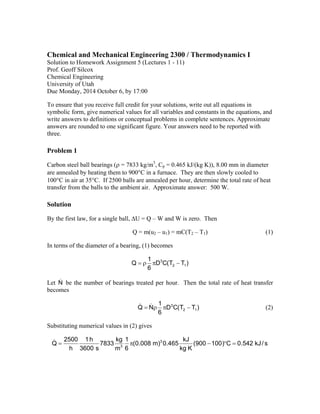
By the first law, for a single ball, U = Q – W and W is zero. Then 
Q = m(u2 – u1) = mC(T2 – T1) (1) 
In terms of the diameter of a bearing, (1) becomes 
Q   1  3  
2 1 
D C(T T ) 
6 
Let N 
be the number of bearings treated per hour. Then the total rate of heat transfer 
becomes 
Q N 1 2 1 
     3  (2) 
D C(T T ) 
6 
Substituting numerical values in (2) gives 
3       
(900 100) C 0.542 kJ / s 
Q 2500 3 
(0.008 m) 0.465 kJ 
6 
kg K 
1 
7833 kg 
m 
1h 
3600 s 
h
Problem 2 
1. Is the relation U = mcv,avgT restricted to constant-volume processes only, or can it 
be used for any kind of process involving an ideal gas? 
2. In the relation U = mcv,avgT, what is the correct unit of cv – kJ/kgC or kJ/kgK? 
3. A fixed mass of an ideal gas is heated from 50 to 80C (a) at constant volume and (b) 
at constant pressure. For which case do you think the energy required will be greater? 
Why? 
Solution 
1) The mass, specific heat, and temperature are all properties and are independent of path 
and history. We conclude that the relation U = mcv,avgT is applicable to all processes 
involving ideal gases. 
2) Both sets of units are correct since a change of 1C is identical to a change of 1 K. 
3) The energy required for the constant pressure case (b) will be greater because the gas 
will do work on the surroundings as it expands. The change in internal energy of the gas 
is the same for both cases. We can reach the same conclusion by looking at the heat 
capacities. For air at 300 K, Cp = 1.005 kJ/(kg K) and Cv = 0.718 kJ/(kg K). Because Cp > 
Cv, the energy needed to heat the gas from 50 to 80ºC is greater for the constant pressure 
case. 
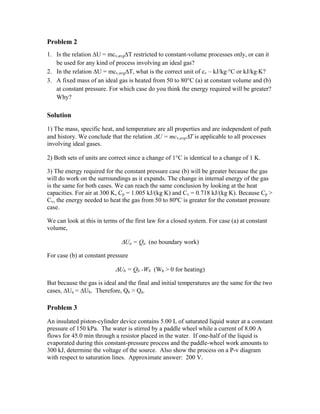
We can look at this in terms of the first law for a closed system. For case (a) at constant 
volume, 
Ua = Qa (no boundary work) 
For case (b) at constant pressure 
Ub = Qb -Wb (Wb > 0 for heating) 
But because the gas is ideal and the final and initial temperatures are the same for the two 
cases, Ua = Ub. Therefore, Qb > Qa. 
Problem 3 
An insulated piston-cylinder device contains 5.00 L of saturated liquid water at a constant 
pressure of 150 kPa. The water is stirred by a paddle wheel while a current of 8.00 A 
flows for 45.0 min through a resistor placed in the water. If one-half of the liquid is 
evaporated during this constant-pressure process and the paddle-wheel work amounts to 
300 kJ, determine the voltage of the source. Also show the process on a P-v diagram 
with respect to saturation lines. Approximate answer: 200 V.
Solution 
The device is sketched below. 
Assume this is a reversible process and that changes in KE and PE are negligible. 
Because only one-half of the liquid is evaporated, we know that the final state is a 
saturated mixture and that x1 = 0.00, x2 = 0.500. 
The relationship between the electrical work, We, current, I, voltage, V, and time, t, is 
We = VIt 
An essential conversion factor is1 kJ/s = 1000 VA. We are given that I = 8.00 A and t = 
2700 s. The P-v diagram is shown below. 
P 
The data for states 1 and 2 follow. 
State 1. From Table A-5. 
v1 = vf = 0.001053 m3/kg 
P1 =150 kPa h1 = hf = 467.11 kJ/kg 
The mass of water is calculated from the initial total volume and the specific volume: 
4.748 kg 
m V 0.005 m 
3 
1    
0.001053 m / kg 
v 
3 
1 
1 
H2O 
150 kPa 
Q = 0 
We 
Wpw=300 kJ 
150 kPa - 
v 
1 2
State 2. From Table A-5. 
P2 =150 kPa 
h2 = hf + x hfg = 467.11 + 0.5(2226.5) kJ/kg = 1580.36 kJ/kg 
The first law for this process is 
U W W P V e pw      (1) 
In terms of h, V, I, and t, (1) becomes 
2 1 pw H  m(h  h )  VIt  W (2) 
We solve (2) for the voltage to give 
m(h h ) W 
V 2 1 pw   
 (3) 
It 1kJ/ s 
1000 VA 
Inserting numerical values in (3) yields 
231 V 
4.748 kg (1580.36  V 467.11) kJ/ kg  
300 kJ  
8 A (2700 s) 1kJ/ s 
1000 VA 
 
Problem 4 
A house is maintained at 1 atm and 24C. Warm inside air is forced to leave the house at 
a rate of 150 m3/h as a result of outdoor air at 5C infiltrating through vents, cracks, 
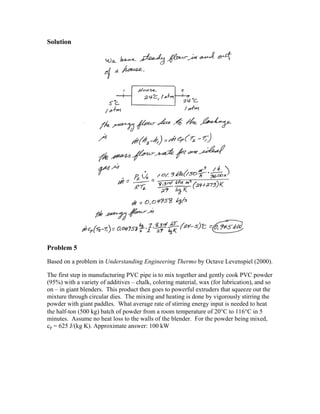
windows, and doors. Determine the rate of net energy loss due to mass transfer. 
Approximate answer: 0.9 kW
Solution 
Problem 5 
Based on a problem in Understanding Engineering Thermo by Octave Levenspiel (2000). 
The first step in manufacturing PVC pipe is to mix together and gently cook PVC powder 
(95%) with a variety of additives – chalk, coloring material, wax (for lubrication), and so 
on – in giant blenders. This product then goes to powerful extruders that squeeze out the 
mixture through circular dies. The mixing and heating is done by vigorously stirring the 
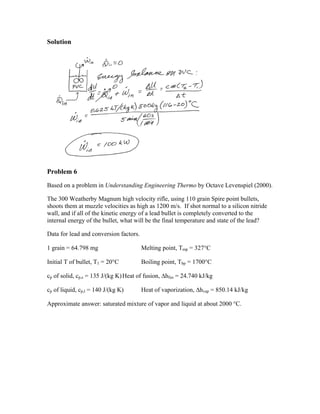
powder with giant paddles. What average rate of stirring energy input is needed to heat 
the half-ton (500 kg) batch of powder from a room temperature of 20C to 116C in 5 
minutes. Assume no heat loss to the walls of the blender. For the powder being mixed, 
cp = 625 J/(kg K). Approximate answer: 100 kW
Solution 
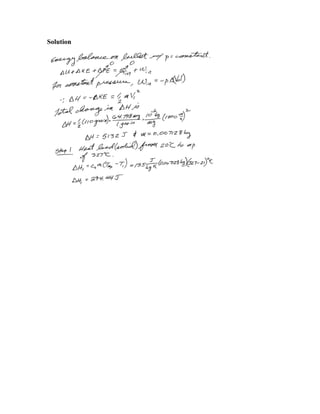
Problem 6 
Based on a problem in Understanding Engineering Thermo by Octave Levenspiel (2000). 
The 300 Weatherby Magnum high velocity rifle, using 110 grain Spire point bullets, 
shoots them at muzzle velocities as high as 1200 m/s. If shot normal to a silicon nitride 
wall, and if all of the kinetic energy of a lead bullet is completely converted to the 
internal energy of the bullet, what will be the final temperature and state of the lead? 
Data for lead and conversion factors. 
1 grain = 64.798 mg Melting point, Tmp = 327C 
Initial T of bullet, T1 = 20C Boiling point, Tbp = 1700C 
cp of solid, cp,s = 135 J/(kg K) Heat of fusion, hfus = 24.740 kJ/kg 
cp of liquid, cp,l = 140 J/(kg K) Heat of vaporization, hvap = 850.14 kJ/kg 
Approximate answer: saturated mixture of vapor and liquid at about 2000 C.
Solution
Thermodynamics Hw#5

Thermodynamics Hw#5

  • 1.
    Chemical and MechanicalEngineering 2300 / Thermodynamics I Solution to Homework Assignment 5 (Lectures 1 - 11) Prof. Geoff Silcox Chemical Engineering University of Utah Due Monday, 2014 October 6, by 17:00 To ensure that you receive full credit for your solutions, write out all equations in symbolic form, give numerical values for all variables and constants in the equations, and write answers to definitions or conceptual problems in complete sentences. Approximate answers are rounded to one significant figure. Your answers need to be reported with three. Problem 1 Carbon steel ball bearings ( = 7833 kg/m3, Cp = 0.465 kJ/(kg K)), 8.00 mm in diameter are annealed by heating them to 900C in a furnace. They are then slowly cooled to 100C in air at 35C. If 2500 balls are annealed per hour, determine the total rate of heat transfer from the balls to the ambient air. Approximate answer: 500 W. Solution By the first law, for a single ball, U = Q – W and W is zero. Then Q = m(u2 – u1) = mC(T2 – T1) (1) In terms of the diameter of a bearing, (1) becomes Q   1  3  2 1 D C(T T ) 6 Let N be the number of bearings treated per hour. Then the total rate of heat transfer becomes Q N 1 2 1      3  (2) D C(T T ) 6 Substituting numerical values in (2) gives 3       (900 100) C 0.542 kJ / s Q 2500 3 (0.008 m) 0.465 kJ 6 kg K 1 7833 kg m 1h 3600 s h
  • 2.
    Problem 2 1.Is the relation U = mcv,avgT restricted to constant-volume processes only, or can it be used for any kind of process involving an ideal gas? 2. In the relation U = mcv,avgT, what is the correct unit of cv – kJ/kgC or kJ/kgK? 3. A fixed mass of an ideal gas is heated from 50 to 80C (a) at constant volume and (b) at constant pressure. For which case do you think the energy required will be greater? Why? Solution 1) The mass, specific heat, and temperature are all properties and are independent of path and history. We conclude that the relation U = mcv,avgT is applicable to all processes involving ideal gases. 2) Both sets of units are correct since a change of 1C is identical to a change of 1 K. 3) The energy required for the constant pressure case (b) will be greater because the gas will do work on the surroundings as it expands. The change in internal energy of the gas is the same for both cases. We can reach the same conclusion by looking at the heat capacities. For air at 300 K, Cp = 1.005 kJ/(kg K) and Cv = 0.718 kJ/(kg K). Because Cp > Cv, the energy needed to heat the gas from 50 to 80ºC is greater for the constant pressure case. We can look at this in terms of the first law for a closed system. For case (a) at constant volume, Ua = Qa (no boundary work) For case (b) at constant pressure Ub = Qb -Wb (Wb > 0 for heating) But because the gas is ideal and the final and initial temperatures are the same for the two cases, Ua = Ub. Therefore, Qb > Qa. Problem 3 An insulated piston-cylinder device contains 5.00 L of saturated liquid water at a constant pressure of 150 kPa. The water is stirred by a paddle wheel while a current of 8.00 A flows for 45.0 min through a resistor placed in the water. If one-half of the liquid is evaporated during this constant-pressure process and the paddle-wheel work amounts to 300 kJ, determine the voltage of the source. Also show the process on a P-v diagram with respect to saturation lines. Approximate answer: 200 V.
  • 3.
    Solution The deviceis sketched below. Assume this is a reversible process and that changes in KE and PE are negligible. Because only one-half of the liquid is evaporated, we know that the final state is a saturated mixture and that x1 = 0.00, x2 = 0.500. The relationship between the electrical work, We, current, I, voltage, V, and time, t, is We = VIt An essential conversion factor is1 kJ/s = 1000 VA. We are given that I = 8.00 A and t = 2700 s. The P-v diagram is shown below. P The data for states 1 and 2 follow. State 1. From Table A-5. v1 = vf = 0.001053 m3/kg P1 =150 kPa h1 = hf = 467.11 kJ/kg The mass of water is calculated from the initial total volume and the specific volume: 4.748 kg m V 0.005 m 3 1    0.001053 m / kg v 3 1 1 H2O 150 kPa Q = 0 We Wpw=300 kJ 150 kPa - v 1 2
  • 4.
    State 2. FromTable A-5. P2 =150 kPa h2 = hf + x hfg = 467.11 + 0.5(2226.5) kJ/kg = 1580.36 kJ/kg The first law for this process is U W W P V e pw      (1) In terms of h, V, I, and t, (1) becomes 2 1 pw H  m(h  h )  VIt  W (2) We solve (2) for the voltage to give m(h h ) W V 2 1 pw    (3) It 1kJ/ s 1000 VA Inserting numerical values in (3) yields 231 V 4.748 kg (1580.36  V 467.11) kJ/ kg  300 kJ  8 A (2700 s) 1kJ/ s 1000 VA  Problem 4 A house is maintained at 1 atm and 24C. Warm inside air is forced to leave the house at a rate of 150 m3/h as a result of outdoor air at 5C infiltrating through vents, cracks, windows, and doors. Determine the rate of net energy loss due to mass transfer. Approximate answer: 0.9 kW
  • 5.
    Solution Problem 5 Based on a problem in Understanding Engineering Thermo by Octave Levenspiel (2000). The first step in manufacturing PVC pipe is to mix together and gently cook PVC powder (95%) with a variety of additives – chalk, coloring material, wax (for lubrication), and so on – in giant blenders. This product then goes to powerful extruders that squeeze out the mixture through circular dies. The mixing and heating is done by vigorously stirring the powder with giant paddles. What average rate of stirring energy input is needed to heat the half-ton (500 kg) batch of powder from a room temperature of 20C to 116C in 5 minutes. Assume no heat loss to the walls of the blender. For the powder being mixed, cp = 625 J/(kg K). Approximate answer: 100 kW
  • 6.
    Solution Problem 6 Based on a problem in Understanding Engineering Thermo by Octave Levenspiel (2000). The 300 Weatherby Magnum high velocity rifle, using 110 grain Spire point bullets, shoots them at muzzle velocities as high as 1200 m/s. If shot normal to a silicon nitride wall, and if all of the kinetic energy of a lead bullet is completely converted to the internal energy of the bullet, what will be the final temperature and state of the lead? Data for lead and conversion factors. 1 grain = 64.798 mg Melting point, Tmp = 327C Initial T of bullet, T1 = 20C Boiling point, Tbp = 1700C cp of solid, cp,s = 135 J/(kg K) Heat of fusion, hfus = 24.740 kJ/kg cp of liquid, cp,l = 140 J/(kg K) Heat of vaporization, hvap = 850.14 kJ/kg Approximate answer: saturated mixture of vapor and liquid at about 2000 C.
  • 7.