Problems in Trigonometry
                                     (Prepared by : EMManzano)

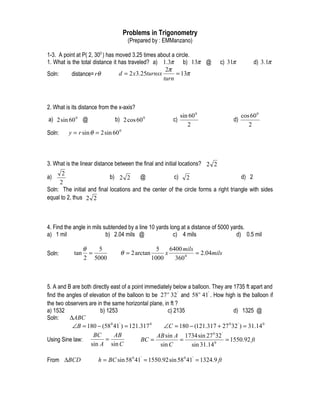
1-3. A point at P( 2, 300 ) has moved 3.25 times about a circle.
1. What is the total distance it has traveled? a) 1.3π b) 13π @              c) 31π         d) 3.1π
                                                    2π
Soln:      distance= rθ          d = 2 x3.25turnsx       = 13π
                                                   turn


2. What is its distance from the x-axis?
                                                           sin 60 0                   cos 60 0
a) 2 sin 60   0
                  @           b) 2 cos 60   0
                                                        c)                         d)
                                                              2                          2
Soln:    y = r sin θ = 2 sin 60 0


3. What is the linear distance between the final and initial locations? 2 2
      2
a)                           b) 2 2      @                 c) 2                       d) 2
     2
Soln: The initial and final locations and the center of the circle forms a right triangle with sides
equal to 2, thus 2 2


4. Find the angle in mils subtended by a line 10 yards long at a distance of 5000 yards.
a) 1 mil                   b) 2.04 mils @                c) 4 mils                  d) 0.5 mil

                  θ   5                           5    6400 mils
Soln:       tan     =            θ = 2 arctan        x           = 2.04mils
                  2 5000                        1000     360 0


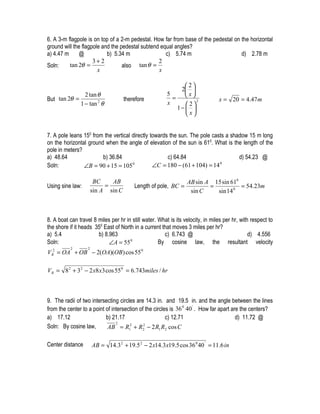
5. A and B are both directly east of a point immediately below a balloon. They are 1735 ft apart and
find the angles of elevation of the balloon to be 27 o 32 ' and 58 o 41' . How high is the balloon if
the two observers are in the same horizontal plane, in ft ?
a) 1532                 b) 1253                       c) 2135                      d) 1325 @
Soln:     ∆ABC
           ∠B = 180 − (58 0 41' ) = 121.317 0       ∠C = 180 − (121.317 + 27 0 32 ' ) = 31.14 0
                     BC       AB                 AB sin A 1734 sin 27 0 32 '
Using Sine law:            =               BC =             =                  = 1550.92 ft
                   sin A sin C                     sin C         sin 31.14 0

From ∆BCD              h = BC sin 58 0 41' = 1550.92 sin 58 0 41' = 1324.9 ft
6. A 3-m flagpole is on top of a 2-m pedestal. How far from base of the pedestal on the horizontal
ground will the flagpole and the pedestal subtend equal angles?
a) 4.47 m     @            b) 5.34 m                c) 5.74 m                       d) 2.78 m
                     3+ 2                        2
Soln:     tan 2θ =                also tan θ =
                       x                         x

                                                             2
                                                            2 
                 2 tan θ                                5
                                                          =  2
                                                               x
But tan 2θ =                         therefore                                  x = 20 = 4.47 m
               1 − tan 2 θ                              x     2
                                                           1−  
                                                              x


7. A pole leans 150 from the vertical directly towards the sun. The pole casts a shadow 15 m long
on the horizontal ground when the angle of elevation of the sun is 610. What is the length of the
pole in meters?
a) 48.64                b) 36.84                      c) 64.84                      d) 54.23 @
Soln:           ∠B = 90 + 15 = 105    0
                                                ∠C = 180 − (61 + 104) = 14 0

                        BC    AB                                 AB sin A 15 sin 610
Using sine law:             =            Length of pole, BC =            =           = 54.23m
                       sin A sin C                                sin C    sin 14 0


8. A boat can travel 8 miles per hr in still water. What is its velocity, in miles per hr, with respect to
the shore if it heads 350 East of North in a current that moves 3 miles per hr?
a) 5.4                 b) 8.963                       c) 6.743 @                               d) 4.556
Soln:                       ∠A = 55   0
                                                    By cosine law, the resultant velocity
          2        2
V R2 = OA + OB − 2(OA)(OB ) cos 55 0

V R = 8 2 + 3 2 − 2 x8 x3 cos 55 0 = 6.743miles / hr


9. The radii of two intersecting circles are 14.3 in. and 19.5 in. and the angle between the lines
from the center to a point of intersection of the circles is 36 0 40 ' . How far apart are the centers?
a) 17.12                   b) 21.17                     c) 12.71                         d) 11.72 @
                                2
Soln: By cosine law,        AB = R1 + R2 − 2 R1 R2 cos C
                                      2      2


Center distance        AB = 14.3 2 + 19.5 2 − 2 x14.3 x19.5 cos 36 0 40 ' = 11.6 in
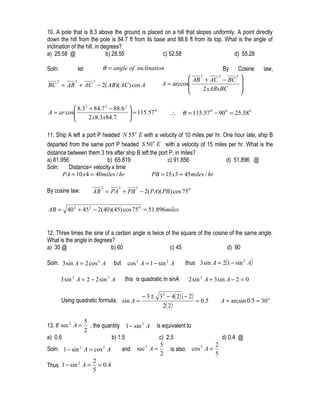
10. A pole that is 8.3 above the ground is placed on a hill that slopes uniformly. A point directly
down the hill from the pole is 84.7 ft from its base and 88.6 ft from its top. What is the angle of
inclination of the hill, in degrees?
a) 25.58 @                    b) 28.55             c) 52.58                       d) 55.28

Soln:             let          θ = angle of inclination                                 Cosine   By             law,
                                                                          AB + AC − BC 
                                                                                  2          2        2

                                                               A = arccos               
    2         2            2
BC = AB + AC − 2( AB )( AC ) cos A                                                      
                                                                              2 xABxBC
                                                                                        

           8.3 2 + 84.7 2 − 88.6 2 
A = ar cos
                                    = 115.57 0
                                                                  ∴     θ = 115.57 0 − 90 0 = 25.58 0
                 2 x8.3 x84.7      

11. Ship A left a port P headed N 55 o E with a velocity of 10 miles per hr. One hour late, ship B
departed from the same port P headed S 50 0 E with a velocity of 15 miles per hr. What is the
distance between them 3 hrs after ship B left the port P, in miles?
a) 81.956                  b) 65.819                  c) 91.856               d) 51.896 @
Soln:     Distance= velocity x time
       PA = 10 x 4 = 40miles / hr              PB = 15 x3 = 45miles / hr

                               2        2         2
By cosine law:             AB = PA + PB − 2( PA)( PB) cos 75 0

AB = 40 2 + 45 2 − 2( 40)(45) cos 75 0 = 51.896miles


12. Three times the sine of a certain angle is twice of the square of the cosine of the same angle.
What is the angle in degrees?
a) 30 @                     b) 60                      c) 45                    d) 90

Soln: 3 sin A = 2 cos 2 A             but     cos 2 A = 1 − sin 2 A        thus 3 sin A = 2(1 − sin 2 A)

        3 sin 2 A = 2 − 2 sin 2 A            this is quadratic in sinA      2 sin 2 A + 3 sin A − 2 = 0

                                                      − 3 ± 3 2 − 4( 2) ( − 2 )
        Using quadratic formula, sin A =                                        = 0.5         A = arcsin 0.5 = 30 o
                                                              2( 2 )

                        5
13. If sec A =
          2
                          , the quantity 1 − sin 2 A        is equivalent to
                        2
a) 0.6                              b) 1.5                  c) 2.5                               d) 0.4 @
                                                            5                            2
Soln: 1 − sin 2 A = cos 2 A                 and   sec 2 A =      is also       cos 2 A =
                                                            2                            5
                           2
Thus 1 − sin A =             = 0 .4
            2

                           5
14. If sin A = 2.511x , cos A = 3.06 x and                 sin 2 A = 3.939 x , find the value of x .
a) 0.704                 b) 0.804                           c) 0.256 @                 d) 0.40

Soln:   sin 2 A = 2 sin A cos A            thus       2( 2.511x )( 3.06 x ) = 3.939 x

           3.939
x=                     = 0.256
      2( 2.511)( 3.06)


15. sin 2 B is equal to
   1 − cos 2 B                cos 2 B − 1            2                                                     2
a)                 @       b)               c)                                                  d)
        2                         2             1 − cos 2 B                                            cos 2 B − 1
Soln: cos 2 B = cos B − sin B and cos B = 1 − sin 2 B thus
                   2        2             2


 cos 2 B = (1 − sin 2 B ) − sin 2 B ∴ 2 sin 2 B = 1 − cos 2 B and
                                                                                                    1 − cos 2 B
                                                                                        sin 2 B =
                                                                                                         2


16. cos 4 θ − sin 4 θ    is equal to
a) sin 4θ                     b) cos 2θ           @                c) sin 2θ                        d) cos 4θ

Soln:    rewrite,   ( cos θ ) − (sin θ )
                         2     2       2     2


 this is the form of the sum and difference of two squares ( x 2 − y 2 ) = ( x − y )( x + y )
x = cos 2 θ               and             y = sin 2 θ             thus the given equation is
( cos θ − sin θ )( cos θ + sin θ )
      2         2        2       2
                                                        but                 cos 2 θ + sin 2 θ = 1 and
cos 2 θ − sin 2 θ = cos 2θ


            1                1
17.                  −                     is equal to
        1 − sin x        1 + sin x

a) 2 cos x cot x             b) 2 sec x cot x              c) 2 cos x cot x             d) 2 sec x tan x      @

Soln: taking the least common denominator

1 + sin x − (1 − sin x )    2 sin x   2 sin x   2 sin x
                         =          =         =         = 2 tan x sec x
 (1 − sin x )(1 + sin x ) 1 − sin x cos x cos x cos x
                                  2       2
3                1
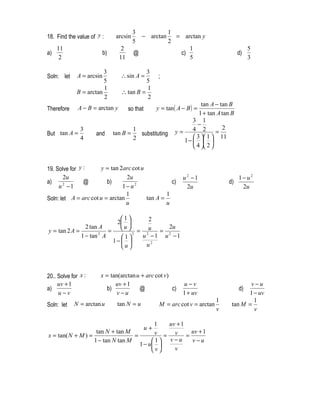
18. Find the value of y :       arcsin       − arctan       = arctan y
                                         5                2
     11                           2                             1                             5
a)                        b)             @                   c)                          d)
      2                          11                             5                             3

                        3                   3
Soln: let    A = arcsin           ∴ sin A =          ;
                        5                   5
                        1                   1
             B = arctan           ∴ tan B =
                        2                   2
                                                                        tan A − tan B
Therefore     A − B = arctan y        so that        y = tan ( A − B ) =
                                                                       1 + tan A tan B
                                                                    3 1
                                                                      −
               3                         1                          4 2          2
But tan A =          and       tan B =     substituting      y=                =
               4                         2                           3  1  11
                                                                1 −   
                                                                     4  2 


19. Solve for y :     y = tan 2arc cot u
       2u                        2u                              u2 −1                   1− u2
a)              @        b)                        c)                              d)
     u −1
      2
                               1− u2                              2u                      2u
                                 1               1
Soln: let A = arc cot u = arctan         tan A =
                                 u               u

                           1     2
                          2 
                2 tan A      u         2u
y = tan 2 A =           =   2 = 2u = 2
              1 − tan A
                      2
                            1  u −1 u −1
                         1−  
                            u   u2


20.. Solve for x :     x = tan(arctan u + arc cot v)
     uv + 1                  uv + 1                              u−v                        v−u
a)                       b)            @             c)                                  d)
     u−v                      v−u                                1 + uv                    1 − uv
                                                                               1             1
Soln: let   N = arctan u        tan N = u             M = arc cot v = arctan         tan M =
                                                                               v             v

                                           1  uv + 1
                                                u+
                    tan N + tan M          v = v = uv + 1
x = tan( N + M ) =                 =
                   1 − tan N tan M        1 v −u   v−u
                                     1 − u 
                                          v   v
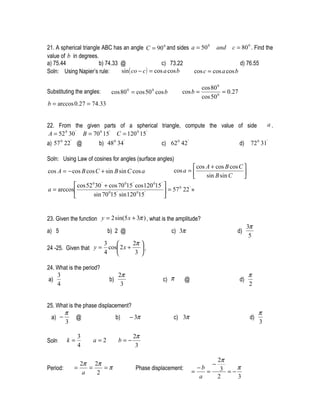
21. A spherical triangle ABC has an angle C = 90 0 and sides a = 50 0 and c = 80 0 . Find the
value of b in degrees.
a) 75.44                b) 74.33 @                   c) 73.22                     d) 76.55
Soln: Using Napier’s rule:       sin ( co − c ) = cos a cos b cos c = cos a cos b

                                                                       cos 80 0
Substituting the angles:      cos 80 0 = cos 50 0 cos b      cos b =            = 0.27
                                                                       cos 50 0
b = arccos 0.27 = 74.33


22. From the given parts of a spherical triangle, compute the value of side    a.
A = 52 30 B = 70 15 C = 120 15
        0    '    0   '        0 '


a) 57 0 22 ' @    b) 48 0 34 '          c) 62 0 42 '                d) 72 0 31'

Soln: Using Law of cosines for angles (surface angles)
                                                                   cos A + cos B cos C 
cos A = − cos B cos C + sin B sin C cos a                 cos a =                      
                                                                       sin B sin C     
           cos 52 0 30 ' + cos 70 015 ' cos120 015 ' 
a = arccos                                            = 57 22 =
                                                            0  '

                   sin 70 015 ' sin 120 015 '        


23. Given the function y = 2 sin(5 x + 3π ) , what is the amplitude?
                                                                                              3π
a) 5                        b) 2 @                        c) 3π                      d)
                                                                                               5
                           3           2π 
24 -25. Given that y =       cos 2 x +    ,
                           4            3 

24. What is the period?
    3                             2π                                                          π
 a)                          b)                     c) π      @                          d)
    4                              3                                                          2


25. What is the phase displacement?
      π                                                                                             π
 a) −        @               b)   − 3π                    c) 3π                                d)
       3                                                                                            3

               3                        2π
Soln      k=        a=2           b=−
               4                         3

                                                                               2π
                2π 2π                                                      −
Period:     =      =   =π               Phase displacement:
                                                                  =
                                                                    −b
                                                                       =        3 = −π
                 a   2
                                                                    a          2     3

Trigonometry [QEE-R 2012]

  • 1.
    Problems in Trigonometry (Prepared by : EMManzano) 1-3. A point at P( 2, 300 ) has moved 3.25 times about a circle. 1. What is the total distance it has traveled? a) 1.3π b) 13π @ c) 31π d) 3.1π 2π Soln: distance= rθ d = 2 x3.25turnsx = 13π turn 2. What is its distance from the x-axis? sin 60 0 cos 60 0 a) 2 sin 60 0 @ b) 2 cos 60 0 c) d) 2 2 Soln: y = r sin θ = 2 sin 60 0 3. What is the linear distance between the final and initial locations? 2 2 2 a) b) 2 2 @ c) 2 d) 2 2 Soln: The initial and final locations and the center of the circle forms a right triangle with sides equal to 2, thus 2 2 4. Find the angle in mils subtended by a line 10 yards long at a distance of 5000 yards. a) 1 mil b) 2.04 mils @ c) 4 mils d) 0.5 mil θ 5 5 6400 mils Soln: tan = θ = 2 arctan x = 2.04mils 2 5000 1000 360 0 5. A and B are both directly east of a point immediately below a balloon. They are 1735 ft apart and find the angles of elevation of the balloon to be 27 o 32 ' and 58 o 41' . How high is the balloon if the two observers are in the same horizontal plane, in ft ? a) 1532 b) 1253 c) 2135 d) 1325 @ Soln: ∆ABC ∠B = 180 − (58 0 41' ) = 121.317 0 ∠C = 180 − (121.317 + 27 0 32 ' ) = 31.14 0 BC AB AB sin A 1734 sin 27 0 32 ' Using Sine law: = BC = = = 1550.92 ft sin A sin C sin C sin 31.14 0 From ∆BCD h = BC sin 58 0 41' = 1550.92 sin 58 0 41' = 1324.9 ft
  • 2.
    6. A 3-mflagpole is on top of a 2-m pedestal. How far from base of the pedestal on the horizontal ground will the flagpole and the pedestal subtend equal angles? a) 4.47 m @ b) 5.34 m c) 5.74 m d) 2.78 m 3+ 2 2 Soln: tan 2θ = also tan θ = x x 2 2  2 tan θ 5 =  2 x But tan 2θ = therefore x = 20 = 4.47 m 1 − tan 2 θ x 2 1−   x 7. A pole leans 150 from the vertical directly towards the sun. The pole casts a shadow 15 m long on the horizontal ground when the angle of elevation of the sun is 610. What is the length of the pole in meters? a) 48.64 b) 36.84 c) 64.84 d) 54.23 @ Soln: ∠B = 90 + 15 = 105 0 ∠C = 180 − (61 + 104) = 14 0 BC AB AB sin A 15 sin 610 Using sine law: = Length of pole, BC = = = 54.23m sin A sin C sin C sin 14 0 8. A boat can travel 8 miles per hr in still water. What is its velocity, in miles per hr, with respect to the shore if it heads 350 East of North in a current that moves 3 miles per hr? a) 5.4 b) 8.963 c) 6.743 @ d) 4.556 Soln: ∠A = 55 0 By cosine law, the resultant velocity 2 2 V R2 = OA + OB − 2(OA)(OB ) cos 55 0 V R = 8 2 + 3 2 − 2 x8 x3 cos 55 0 = 6.743miles / hr 9. The radii of two intersecting circles are 14.3 in. and 19.5 in. and the angle between the lines from the center to a point of intersection of the circles is 36 0 40 ' . How far apart are the centers? a) 17.12 b) 21.17 c) 12.71 d) 11.72 @ 2 Soln: By cosine law, AB = R1 + R2 − 2 R1 R2 cos C 2 2 Center distance AB = 14.3 2 + 19.5 2 − 2 x14.3 x19.5 cos 36 0 40 ' = 11.6 in
  • 3.
    10. A polethat is 8.3 above the ground is placed on a hill that slopes uniformly. A point directly down the hill from the pole is 84.7 ft from its base and 88.6 ft from its top. What is the angle of inclination of the hill, in degrees? a) 25.58 @ b) 28.55 c) 52.58 d) 55.28 Soln: let θ = angle of inclination Cosine By law,  AB + AC − BC  2 2 2 A = arccos  2 2 2 BC = AB + AC − 2( AB )( AC ) cos A   2 xABxBC    8.3 2 + 84.7 2 − 88.6 2  A = ar cos   = 115.57 0  ∴ θ = 115.57 0 − 90 0 = 25.58 0  2 x8.3 x84.7  11. Ship A left a port P headed N 55 o E with a velocity of 10 miles per hr. One hour late, ship B departed from the same port P headed S 50 0 E with a velocity of 15 miles per hr. What is the distance between them 3 hrs after ship B left the port P, in miles? a) 81.956 b) 65.819 c) 91.856 d) 51.896 @ Soln: Distance= velocity x time PA = 10 x 4 = 40miles / hr PB = 15 x3 = 45miles / hr 2 2 2 By cosine law: AB = PA + PB − 2( PA)( PB) cos 75 0 AB = 40 2 + 45 2 − 2( 40)(45) cos 75 0 = 51.896miles 12. Three times the sine of a certain angle is twice of the square of the cosine of the same angle. What is the angle in degrees? a) 30 @ b) 60 c) 45 d) 90 Soln: 3 sin A = 2 cos 2 A but cos 2 A = 1 − sin 2 A thus 3 sin A = 2(1 − sin 2 A) 3 sin 2 A = 2 − 2 sin 2 A this is quadratic in sinA 2 sin 2 A + 3 sin A − 2 = 0 − 3 ± 3 2 − 4( 2) ( − 2 ) Using quadratic formula, sin A = = 0.5 A = arcsin 0.5 = 30 o 2( 2 ) 5 13. If sec A = 2 , the quantity 1 − sin 2 A is equivalent to 2 a) 0.6 b) 1.5 c) 2.5 d) 0.4 @ 5 2 Soln: 1 − sin 2 A = cos 2 A and sec 2 A = is also cos 2 A = 2 5 2 Thus 1 − sin A = = 0 .4 2 5
  • 4.
    14. If sinA = 2.511x , cos A = 3.06 x and sin 2 A = 3.939 x , find the value of x . a) 0.704 b) 0.804 c) 0.256 @ d) 0.40 Soln: sin 2 A = 2 sin A cos A thus 2( 2.511x )( 3.06 x ) = 3.939 x 3.939 x= = 0.256 2( 2.511)( 3.06) 15. sin 2 B is equal to 1 − cos 2 B cos 2 B − 1 2 2 a) @ b) c) d) 2 2 1 − cos 2 B cos 2 B − 1 Soln: cos 2 B = cos B − sin B and cos B = 1 − sin 2 B thus 2 2 2 cos 2 B = (1 − sin 2 B ) − sin 2 B ∴ 2 sin 2 B = 1 − cos 2 B and 1 − cos 2 B sin 2 B = 2 16. cos 4 θ − sin 4 θ is equal to a) sin 4θ b) cos 2θ @ c) sin 2θ d) cos 4θ Soln: rewrite, ( cos θ ) − (sin θ ) 2 2 2 2 this is the form of the sum and difference of two squares ( x 2 − y 2 ) = ( x − y )( x + y ) x = cos 2 θ and y = sin 2 θ thus the given equation is ( cos θ − sin θ )( cos θ + sin θ ) 2 2 2 2 but cos 2 θ + sin 2 θ = 1 and cos 2 θ − sin 2 θ = cos 2θ 1 1 17. − is equal to 1 − sin x 1 + sin x a) 2 cos x cot x b) 2 sec x cot x c) 2 cos x cot x d) 2 sec x tan x @ Soln: taking the least common denominator 1 + sin x − (1 − sin x ) 2 sin x 2 sin x 2 sin x = = = = 2 tan x sec x (1 − sin x )(1 + sin x ) 1 − sin x cos x cos x cos x 2 2
  • 5.
    3 1 18. Find the value of y : arcsin − arctan = arctan y 5 2 11 2 1 5 a) b) @ c) d) 2 11 5 3 3 3 Soln: let A = arcsin ∴ sin A = ; 5 5 1 1 B = arctan ∴ tan B = 2 2 tan A − tan B Therefore A − B = arctan y so that y = tan ( A − B ) = 1 + tan A tan B 3 1 − 3 1 4 2 2 But tan A = and tan B = substituting y= = 4 2  3  1  11 1 −     4  2  19. Solve for y : y = tan 2arc cot u 2u 2u u2 −1 1− u2 a) @ b) c) d) u −1 2 1− u2 2u 2u 1 1 Soln: let A = arc cot u = arctan tan A = u u 1 2 2  2 tan A u 2u y = tan 2 A = =   2 = 2u = 2 1 − tan A 2 1 u −1 u −1 1−   u u2 20.. Solve for x : x = tan(arctan u + arc cot v) uv + 1 uv + 1 u−v v−u a) b) @ c) d) u−v v−u 1 + uv 1 − uv 1 1 Soln: let N = arctan u tan N = u M = arc cot v = arctan tan M = v v 1 uv + 1 u+ tan N + tan M v = v = uv + 1 x = tan( N + M ) = = 1 − tan N tan M 1 v −u v−u 1 − u  v v
  • 6.
    21. A sphericaltriangle ABC has an angle C = 90 0 and sides a = 50 0 and c = 80 0 . Find the value of b in degrees. a) 75.44 b) 74.33 @ c) 73.22 d) 76.55 Soln: Using Napier’s rule: sin ( co − c ) = cos a cos b cos c = cos a cos b cos 80 0 Substituting the angles: cos 80 0 = cos 50 0 cos b cos b = = 0.27 cos 50 0 b = arccos 0.27 = 74.33 22. From the given parts of a spherical triangle, compute the value of side a. A = 52 30 B = 70 15 C = 120 15 0 ' 0 ' 0 ' a) 57 0 22 ' @ b) 48 0 34 ' c) 62 0 42 ' d) 72 0 31' Soln: Using Law of cosines for angles (surface angles)  cos A + cos B cos C  cos A = − cos B cos C + sin B sin C cos a cos a =    sin B sin C   cos 52 0 30 ' + cos 70 015 ' cos120 015 '  a = arccos  = 57 22 = 0 '  sin 70 015 ' sin 120 015 '  23. Given the function y = 2 sin(5 x + 3π ) , what is the amplitude? 3π a) 5 b) 2 @ c) 3π d) 5 3  2π  24 -25. Given that y = cos 2 x + , 4  3  24. What is the period? 3 2π π a) b) c) π @ d) 4 3 2 25. What is the phase displacement? π π a) − @ b) − 3π c) 3π d) 3 3 3 2π Soln k= a=2 b=− 4 3 2π 2π 2π − Period: = = =π Phase displacement: = −b = 3 = −π a 2 a 2 3