BITS Pilani
                                 Pilani Campus


Lecture 10 – First Law for Control Mass
Problem 1

A piston/cylinder contains 50 kg
of water at 200 kPa with a
volume of 0.1 m3. Stops in the
cylinder restricts the enclosed
  y
volume to 0.5 m3, as shown in
fig. The water is now heated to
200oC Find the final pressure
     C.                pressure,
volume and the work done by
the water.


                                   BITS Pilani, Pilani Campus
Example 2
A piston-cylinder arrangement has a linear
spring and the outside atmosphere acting
      g                                     g
on the piston. It contains water at 3 MPa
and 400oC with a volume of 0.1 m3. If the
piston is at the bottom the spring exerts a
                 bottom,
force such that a pressure of 200 kPa
inside is required to balance the forces. The
system now cools until th
    t                l     til the pressure
reaches 1 MPa. Find the heat transfer for
the process.


                                                BITSPilani, Pilani Campus
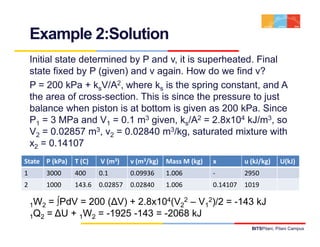
Example 2:Solution
    Initial state determined by P and v, it is superheated. Final
    state fixed by P (given) and v again. How do we find v?
    P = 200 kPa + ksV/A2, where ks is the spring constant, and A
    the area of cross-section. This is since the pressure to just
    balance when piston is at bottom is given as 200 kPa Since
                                                        kPa.
    P1 = 3 MPa and V1 = 0.1 m3 given, ks/A2 = 2.8x10⁴ kJ/m3, so
    V2 = 0.02857 m3, v2 = 0.02840 m3/kg, saturated mixture with
    x2 = 0.14107
State P (kPa)    T (C)   V (m3)    v (m3/kg)   Mass M (kg)   x         u (kJ/kg)      U(kJ)
1         3000   400     0.1       0.09936     1.006         ‐         2950
2         1000   143.6   0.02857   0.02840     1.006         0.14107   1019

    1W2 = ∫PdV = 200 (∆V) + 2 8x10⁴(V22 – V12)/2 = -143 kJ
                            2.8x10                  143
    1Q2 = ∆U + 1W2 = -1925 -143 = -2068 kJ
                                                                         BITSPilani, Pilani Campus
Problem 3
An insulated piston cylinder device
contains 5 L of saturated liquid
water at a constant pressure of
175kPa. Water is stirred by a peddle
wheel while current of 8 A flows for
45 min through a resistor place in
the water. If 50% of liquid (by mass)
                       q    ( y     )
is evaporated during this constant
pressure process and the peddle
work amounts to 300kJ determine
                    300kJ,
the voltage of the source. Also show
the on P-v diagram.


                                        BITS Pilani, Pilani Campus
Fig 4 2 Example of work crossing th b
Fi 4.2 E      l f       k       i the boundary of a system
                                            d     f    t
because of electric current flow across the system boundary
                                                 BITS Pilani, Pilani Campus
An insulated piston cylinder device contains 5 L of saturated liquid water at a constant
pressure of 175kPa. Water is stirred by a peddle wheel while current of 8 A flows for 45 min
through a resistor place in the water. If 50% of liquid (by mass) is evaporated during this
constant pressure process and the peddle work amounts to 300kJ, determine the voltage of
the source. Also show the on P-v diagram.


Solution:Assumptions
1 The cylinder is stationary and thus the kinetic and potential
  energy changes are zero.
2 The cylinder is well-insulated and thus heat transfer is
                    well insulated
  negligible.
3 The compression or expansion process is quasi-equilibrium.


                                                                                      BITS Pilani, Pilani Campus
An insulated piston cylinder device contains 5 L of saturated liquid water at a constant
pressure of 175kPa. Water is stirred by a peddle wheel while current of 8 A flows for 45 min
through a resistor place in the water. If 50% of liquid (by mass) is evaporated during this
constant pressure process and the peddle work amounts to 300kJ, determine the voltage of
the source. Also show the on P-v diagram.

• We take the contents of the cylinder as the system.
• This is a closed system since no mass enters or leaves
                                                   leaves.
• The energy balance for this stationary closed system can be
  expressed as


                              m(V2 − V1 )
                                                    2       2

      1 Q2 −1W2 = U 2 − U 1 +             + mg ( Z 2 − Z1 )
                                  2


                                     − 1W2 = U 2 − U1


                                                                                      BITS Pilani, Pilani Campus
An insulated piston cylinder device contains 5 L of saturated liquid water at a constant
pressure of 175kPa. Water is stirred by a peddle wheel while current of 8 A flows for 45 min
through a resistor place in the water. If 50% of liquid (by mass) is evaporated during this
constant pressure process and the peddle work amounts to 300kJ, determine the voltage of
the source. Also show the on P-v diagram.


                    We,,in + Wpw,,in − Wb,,out = ∆U  
                              p

                                 We,in + Wpw,in = m( h2 − h1 )
                              ( VI∆t ) + Wp iin = m( h2 − h1 )
                                          pw,


     P1 = 175 kPa ⎫ h1 = h f @175 kPa = 486.97 kJ/kg
                  ⎬v = v            = 0.001057 m 3 /
                                                   /kg
     sat.liquid ⎭ 1      f @175 kPa

     P2 = 175 kPa, x2 = 0.5
     h2 = h f + x2h fg = 486.97 + (0.5 × 2213.57) = 1593.755 kJ/kg
       V1     0.005 m 3
     m= =             3
                          = 4 7304 k
                            4.7304 kg
       v 1 0.001057 m /kg
                                                                                      BITS Pilani, Pilani Campus
An insulated piston cylinder device contains 5 L of saturated liquid water at a constant
pressure of 175kPa. Water is stirred by a peddle wheel while current of 8 A flows for 45 min
through a resistor place in the water. If 50% of liquid (by mass) is evaporated during this
constant pressure process and the peddle work amounts to 300kJ, determine the voltage of
the source. Also show the on P-v diagram.


   SUBSTITUTING

               VI∆t + (300kJ) = (4.7304 kg)(1593.755 − 486.97)kJ/kg
                             VI∆t = 4935.536 kJ
  P                                    4935.536 kJ ⎛ 1000 VA ⎞
                                  V=                  ⎜        ⎟
                                                      ⎜ 1 kJ/s ⎟ = 228.497 V
                                     (8 A)(45 × 60 s) ⎝        ⎠

           1           2


                                                     v

                                                                                      BITS Pilani, Pilani Campus
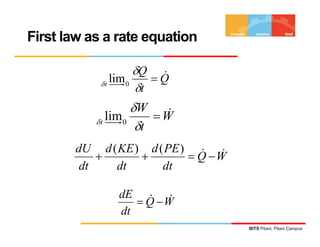
First law as a rate equation

       ∆U + ∆KE + ∆PE = δQ − δW
       ∆U ∆KE ∆PE δQ δW
          +    +    =   −
       δt   δt   δt   δt δt
                           ∆U   dU
              δt
                   lim 0      =
                           δt    dt

                       ∆ ( KE ) d ( KE )
              δt
                 lim 0         =
                          δt       dt
                       ∆ ( PE ) d ( PE )
        δt
             lim               =
                   0
                          δt       dt
                                           BITS Pilani, Pilani Campus
First law as a rate equation

                     δQ &
            δt
               lim 0    =Q
                     δt
                    δW    &
           δt
              lim 0     =W
                     δt
       dU d ( KE ) d ( PE ) & &
           +      +        = Q −W
        dt   dt       dt

               dE & &
                  = Q −W
               dt
                                    BITS Pilani, Pilani Campus
BITS Pilani
                           Pilani Campus


FIRST-LAW
FIRST LAW ANALYSIS FOR A
CONTROL VOLUME
FIRST-LAW ANALYSIS FOR A
CONTROL VOLUME


                           BITS Pilani, Pilani Campus
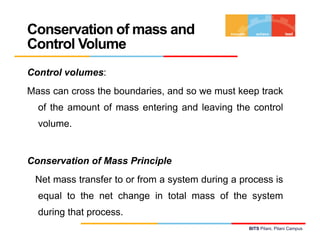
Conservation of mass and
Control Volume
Control volumes:
Mass can cross the boundaries, and so we must keep track
  of the amount of mass entering and leaving the control
  volume.


Conservation of Mass Principle
 Net mass transfer to or from a system during a process is
  equal to the net change in total mass of the system
  during that process.
                                                  BITS Pilani, Pilani Campus
Conservation of mass and
Control Volume
               dmC .V .
                        = ∑ mi − ∑ me
                            &      &
                dt

Total mass inside the control volume


mC .V . = ∫ ρ dV = ∫ (1 / v) dV = m A + mB + mC + .......


                                               BITS Pilani, Pilani Campus
Conservation of mass and
Control Volume


The l
Th volume fl
          flow rate is
                 t i
               V = ∨ A = ∫ ∨ local dA
                &

The mass flow rate becomes
                V&     ∨ local       ∨A
    m = ρ avgV = = ∫ (
    &         &                )dA =
                v         v           v
                                        BITS Pilani, Pilani Campus
FIRST-LAW ANALYSIS FOR A
CONTROL VOLUME

For a Fixed mass

     E2 − E1          =   1   Q2   −   W2
                                       1


The instantaneous rate equation is


                      = Q − W
                        &
         dE C . M .
           dt
                             &

                                            BITS Pilani, Pilani Campus

Thermodynamics lecture 10

  • 1.
    BITS Pilani Pilani Campus Lecture 10 – First Law for Control Mass
  • 2.
    Problem 1 A piston/cylindercontains 50 kg of water at 200 kPa with a volume of 0.1 m3. Stops in the cylinder restricts the enclosed y volume to 0.5 m3, as shown in fig. The water is now heated to 200oC Find the final pressure C. pressure, volume and the work done by the water. BITS Pilani, Pilani Campus
  • 3.
    Example 2 A piston-cylinderarrangement has a linear spring and the outside atmosphere acting g g on the piston. It contains water at 3 MPa and 400oC with a volume of 0.1 m3. If the piston is at the bottom the spring exerts a bottom, force such that a pressure of 200 kPa inside is required to balance the forces. The system now cools until th t l til the pressure reaches 1 MPa. Find the heat transfer for the process. BITSPilani, Pilani Campus
  • 4.
    Example 2:Solution Initial state determined by P and v, it is superheated. Final state fixed by P (given) and v again. How do we find v? P = 200 kPa + ksV/A2, where ks is the spring constant, and A the area of cross-section. This is since the pressure to just balance when piston is at bottom is given as 200 kPa Since kPa. P1 = 3 MPa and V1 = 0.1 m3 given, ks/A2 = 2.8x10⁴ kJ/m3, so V2 = 0.02857 m3, v2 = 0.02840 m3/kg, saturated mixture with x2 = 0.14107 State P (kPa) T (C) V (m3) v (m3/kg) Mass M (kg) x u (kJ/kg) U(kJ) 1 3000 400 0.1 0.09936 1.006 ‐ 2950 2 1000 143.6 0.02857 0.02840 1.006 0.14107 1019 1W2 = ∫PdV = 200 (∆V) + 2 8x10⁴(V22 – V12)/2 = -143 kJ 2.8x10 143 1Q2 = ∆U + 1W2 = -1925 -143 = -2068 kJ BITSPilani, Pilani Campus
  • 5.
    Problem 3 An insulatedpiston cylinder device contains 5 L of saturated liquid water at a constant pressure of 175kPa. Water is stirred by a peddle wheel while current of 8 A flows for 45 min through a resistor place in the water. If 50% of liquid (by mass) q ( y ) is evaporated during this constant pressure process and the peddle work amounts to 300kJ determine 300kJ, the voltage of the source. Also show the on P-v diagram. BITS Pilani, Pilani Campus
  • 6.
    Fig 4 2Example of work crossing th b Fi 4.2 E l f k i the boundary of a system d f t because of electric current flow across the system boundary BITS Pilani, Pilani Campus
  • 7.
    An insulated pistoncylinder device contains 5 L of saturated liquid water at a constant pressure of 175kPa. Water is stirred by a peddle wheel while current of 8 A flows for 45 min through a resistor place in the water. If 50% of liquid (by mass) is evaporated during this constant pressure process and the peddle work amounts to 300kJ, determine the voltage of the source. Also show the on P-v diagram. Solution:Assumptions 1 The cylinder is stationary and thus the kinetic and potential energy changes are zero. 2 The cylinder is well-insulated and thus heat transfer is well insulated negligible. 3 The compression or expansion process is quasi-equilibrium. BITS Pilani, Pilani Campus
  • 8.
    An insulated pistoncylinder device contains 5 L of saturated liquid water at a constant pressure of 175kPa. Water is stirred by a peddle wheel while current of 8 A flows for 45 min through a resistor place in the water. If 50% of liquid (by mass) is evaporated during this constant pressure process and the peddle work amounts to 300kJ, determine the voltage of the source. Also show the on P-v diagram. • We take the contents of the cylinder as the system. • This is a closed system since no mass enters or leaves leaves. • The energy balance for this stationary closed system can be expressed as m(V2 − V1 ) 2 2 1 Q2 −1W2 = U 2 − U 1 + + mg ( Z 2 − Z1 ) 2 − 1W2 = U 2 − U1 BITS Pilani, Pilani Campus
  • 9.
    An insulated pistoncylinder device contains 5 L of saturated liquid water at a constant pressure of 175kPa. Water is stirred by a peddle wheel while current of 8 A flows for 45 min through a resistor place in the water. If 50% of liquid (by mass) is evaporated during this constant pressure process and the peddle work amounts to 300kJ, determine the voltage of the source. Also show the on P-v diagram. We,,in + Wpw,,in − Wb,,out = ∆U   p We,in + Wpw,in = m( h2 − h1 ) ( VI∆t ) + Wp iin = m( h2 − h1 ) pw, P1 = 175 kPa ⎫ h1 = h f @175 kPa = 486.97 kJ/kg ⎬v = v = 0.001057 m 3 / /kg sat.liquid ⎭ 1 f @175 kPa P2 = 175 kPa, x2 = 0.5 h2 = h f + x2h fg = 486.97 + (0.5 × 2213.57) = 1593.755 kJ/kg V1 0.005 m 3 m= = 3 = 4 7304 k 4.7304 kg v 1 0.001057 m /kg BITS Pilani, Pilani Campus
  • 10.
    An insulated pistoncylinder device contains 5 L of saturated liquid water at a constant pressure of 175kPa. Water is stirred by a peddle wheel while current of 8 A flows for 45 min through a resistor place in the water. If 50% of liquid (by mass) is evaporated during this constant pressure process and the peddle work amounts to 300kJ, determine the voltage of the source. Also show the on P-v diagram. SUBSTITUTING VI∆t + (300kJ) = (4.7304 kg)(1593.755 − 486.97)kJ/kg VI∆t = 4935.536 kJ P 4935.536 kJ ⎛ 1000 VA ⎞ V= ⎜ ⎟ ⎜ 1 kJ/s ⎟ = 228.497 V (8 A)(45 × 60 s) ⎝ ⎠ 1 2 v BITS Pilani, Pilani Campus
  • 11.
    First law asa rate equation ∆U + ∆KE + ∆PE = δQ − δW ∆U ∆KE ∆PE δQ δW + + = − δt δt δt δt δt ∆U dU δt lim 0 = δt dt ∆ ( KE ) d ( KE ) δt lim 0 = δt dt ∆ ( PE ) d ( PE ) δt lim = 0 δt dt BITS Pilani, Pilani Campus
  • 12.
    First law asa rate equation δQ & δt lim 0 =Q δt δW & δt lim 0 =W δt dU d ( KE ) d ( PE ) & & + + = Q −W dt dt dt dE & & = Q −W dt BITS Pilani, Pilani Campus
  • 13.
    BITS Pilani Pilani Campus FIRST-LAW FIRST LAW ANALYSIS FOR A CONTROL VOLUME
  • 14.
    FIRST-LAW ANALYSIS FORA CONTROL VOLUME BITS Pilani, Pilani Campus
  • 15.
    Conservation of massand Control Volume Control volumes: Mass can cross the boundaries, and so we must keep track of the amount of mass entering and leaving the control volume. Conservation of Mass Principle Net mass transfer to or from a system during a process is equal to the net change in total mass of the system during that process. BITS Pilani, Pilani Campus
  • 16.
    Conservation of massand Control Volume dmC .V . = ∑ mi − ∑ me & & dt Total mass inside the control volume mC .V . = ∫ ρ dV = ∫ (1 / v) dV = m A + mB + mC + ....... BITS Pilani, Pilani Campus
  • 17.
    Conservation of massand Control Volume The l Th volume fl flow rate is t i V = ∨ A = ∫ ∨ local dA & The mass flow rate becomes V& ∨ local ∨A m = ρ avgV = = ∫ ( & & )dA = v v v BITS Pilani, Pilani Campus
  • 18.
    FIRST-LAW ANALYSIS FORA CONTROL VOLUME For a Fixed mass E2 − E1 = 1 Q2 − W2 1 The instantaneous rate equation is = Q − W & dE C . M . dt & BITS Pilani, Pilani Campus