1
Interfacing Temperature Sensors
P-N Junction Thermometers
IC Temperature Sensors
Thermocouples
Calibration of Thermometers
Resistive Temperature Sensors
Other Temperature Measurement Techniques
Chap 0 2
Applications of temperature sensing
 Food industry
 Monitor temperature-time cycles to ensure high food
quality
 Automotive industry
 Combustion and exhaust temperature
 Solar Energy conversion
 Accurate temperature measurement to achieve optimal
heat flow
 Energy efficiency in the home and industry
 Measurement of temperature
 Hospital infant incubator
 Temperature must be kept in the proper range
Chap 0 3
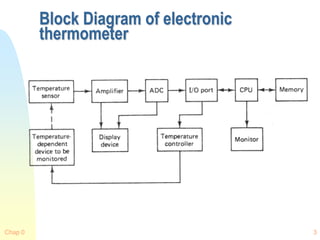
Block Diagram of electronic
thermometer
Chap 0 4
P-N Junction Thermometers
 Principle of Diode
Thermometer
 Forward Biased Current
 Voltage
 Where T is in K
 Voltage vs. Temperature
 Useful range
 40 ~ 400K
[exp( ) 1]
2
s
qV
I I
kT
 
4.6
(ln ln )
g
E kT
V M I
q q
  
Chap 0 5
Diode thermometer with known
characteristics
 Motorola MTS 105
 Calibrate Diode to obtain
accurate output
 Constant Current source
must be very stable
 1C accuracy
 0.002K with precision
GaAs Diode
 Calibration Procedures
 Determine VBE at
extremes (-40C and
150C)
 Plot line using VBE(-40C) and
VBE(150C)

 Given VBE(Tx), Tx can be found
using curve from step 2 or
equation
 Diode are more sensitive and
linear than others
 Wide range
 Less repeatable
 Affected by Magnetic (>
2.25 0.003( 600) /
c BE
T V mV C
   
[ ( ) (25 )]/ 25
x BE x BE c
T V T V C T
  
Chap 0 6
Diode thermometer with Unknown
characteristics
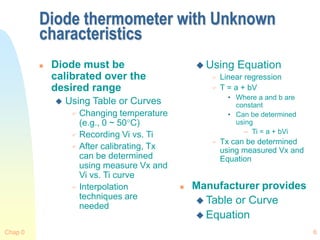
 Diode must be
calibrated over the
desired range
 Using Table or Curves
 Changing temperature
(e.g., 0 ~ 50C)
 Recording Vi vs. Ti
 After calibrating, Tx
can be determined
using measure Vx and
Vi vs. Ti curve
 Interpolation
techniques are
needed
 Using Equation
 Linear regression
 T = a + bV
• Where a and b are
constant
• Can be determined
using
– Ti = a + bVi
 Tx can be determined
using measured Vx and
Equation
 Manufacturer provides
 Table or Curve
 Equation
Chap 0 7
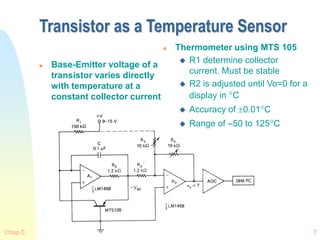
Transistor as a Temperature Sensor
 Base-Emitter voltage of a
transistor varies directly
with temperature at a
constant collector current
 Thermometer using MTS 105
 R1 determine collector
current. Must be stable
 R2 is adjusted until Vo=0 for a
display in C
 Accuracy of 0.01C
 Range of –50 to 125C
Chap 0 8
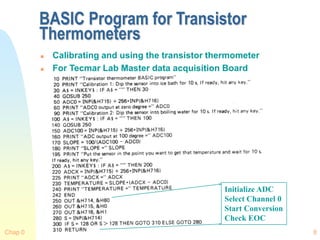
BASIC Program for Transistor
Thermometers
 Calibrating and using the transistor thermometer
 For Tecmar Lab Master data acquisition Board
Initialize ADC
Select Channel 0
Start Conversion
Check EOC
Chap 0 9
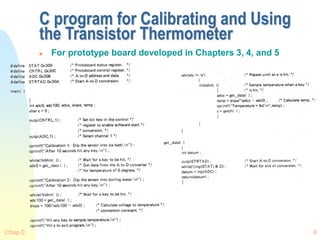
C program for Calibrating and Using
the Transistor Thermometer
 For prototype board developed in Chapters 3, 4, and 5
Chap 0 10
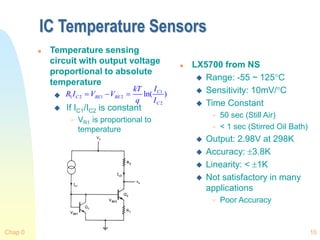
IC Temperature Sensors
 Temperature sensing
circuit with output voltage
proportional to absolute
temperature

 If IC1/IC2 is constant
 VR1 is proportional to
temperature
 LX5700 from NS
 Range: -55 ~ 125C
 Sensitivity: 10mV/C
 Time Constant
 50 sec (Still Air)
 < 1 sec (Stirred Oil Bath)
 Output: 2.98V at 298K
 Accuracy: 3.8K
 Linearity: < 1K
 Not satisfactory in many
applications
 Poor Accuracy
1
1 2 1 2
2
ln( )
C
C BE BE
C
I
kT
R I V V
q I
  
Chap 0 11
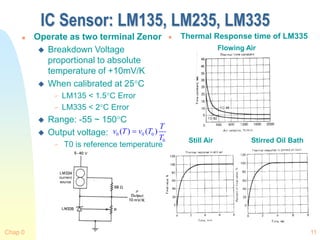
IC Sensor: LM135, LM235, LM335
 Operate as two terminal Zenor
 Breakdown Voltage
proportional to absolute
temperature of +10mV/K
 When calibrated at 25C
 LM135 < 1.5C Error
 LM335 < 2C Error
 Range: -55 ~ 150C
 Output voltage:
 T0 is reference temperature
 Thermal Response time of LM335
Flowing Air
Still Air Stirred Oil Bath
0 0 0
0
( ) ( )
T
v T v T
T

Chap 0 12
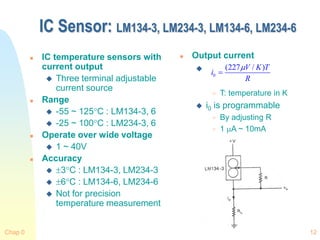
IC Sensor: LM134-3, LM234-3, LM134-6, LM234-6
 IC temperature sensors with
current output
 Three terminal adjustable
current source
 Range
 -55 ~ 125C : LM134-3, 6
 -25 ~ 100C : LM234-3, 6
 Operate over wide voltage
 1 ~ 40V
 Accuracy
 3C : LM134-3, LM234-3
 6C : LM134-6, LM234-6
 Not for precision
temperature measurement
 Output current

 T: temperature in K
 i0 is programmable
 By adjusting R
 1 A ~ 10mA
0
(227 / )
V K T
i
R


Chap 0 13
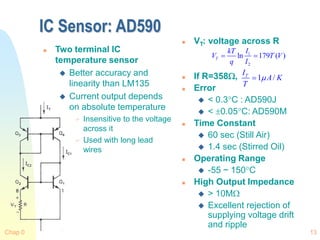
IC Sensor: AD590
 Two terminal IC
temperature sensor
 Better accuracy and
linearity than LM135
 Current output depends
on absolute temperature
 Insensitive to the voltage
across it
 Used with long lead
wires
 VT: voltage across R
 If R=358,
 Error
 < 0.3C : AD590J
 < 0.05C: AD590M
 Time Constant
 60 sec (Still Air)
 1.4 sec (Stirred Oil)
 Operating Range
 -55 ~ 150C
 High Output Impedance
 > 10M
 Excellent rejection of
supplying voltage drift
and ripple
1
2
ln 179 ( )
T
I
kT
V T V
q I
 
1 /
T
I
A K
T


Chap 0 14
Thermocouples
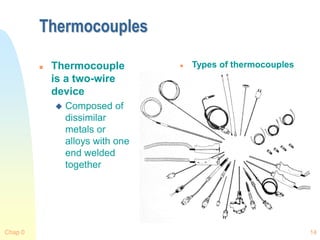
 Thermocouple
is a two-wire
device
 Composed of
dissimilar
metals or
alloys with one
end welded
together
 Types of thermocouples
Chap 0 15
Type of thermocouple junctions
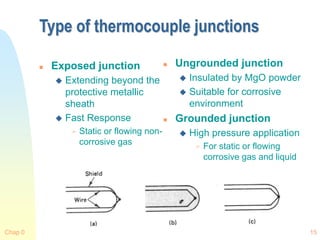
 Exposed junction
 Extending beyond the
protective metallic
sheath
 Fast Response
 Static or flowing non-
corrosive gas
 Ungrounded junction
 Insulated by MgO powder
 Suitable for corrosive
environment
 Grounded junction
 High pressure application
 For static or flowing
corrosive gas and liquid
Chap 0 16
Seebeck Effect: Principles of Thermocouples
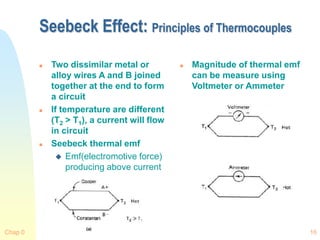
 Two dissimilar metal or
alloy wires A and B joined
together at the end to form
a circuit
 If temperature are different
(T2 > T1), a current will flow
in circuit
 Seebeck thermal emf
 Emf(electromotive force)
producing above current
 Magnitude of thermal emf
can be measure using
Voltmeter or Ammeter
Chap 0 17
Principles of Thermocouples
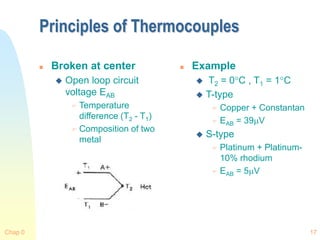
 Broken at center
 Open loop circuit
voltage EAB
 Temperature
difference (T2 - T1)
 Composition of two
metal
 Example
 T2 = 0C , T1 = 1C
 T-type
 Copper + Constantan
 EAB = 39V
 S-type
 Platinum + Platinum-
10% rhodium
 EAB = 5V
Chap 0 18
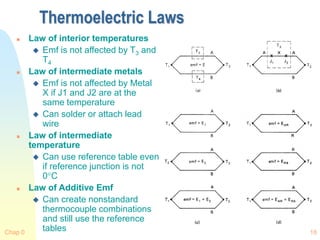
Thermoelectric Laws
 Law of interior temperatures
 Emf is not affected by T3 and
T4
 Law of intermediate metals
 Emf is not affected by Metal
X if J1 and J2 are at the
same temperature
 Can solder or attach lead
wire
 Law of intermediate
temperature
 Can use reference table even
if reference junction is not
0C
 Law of Additive Emf
 Can create nonstandard
thermocouple combinations
and still use the reference
tables
Chap 0 19
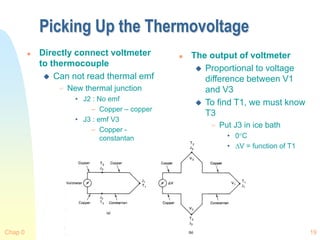
Picking Up the Thermovoltage
 Directly connect voltmeter
to thermocouple
 Can not read thermal emf
 New thermal junction
• J2 : No emf
– Copper – copper
• J3 : emf V3
– Copper -
constantan
 The output of voltmeter
 Proportional to voltage
difference between V1
and V3
 To find T1, we must know
T3
 Put J3 in ice bath
• 0C
• V = function of T1
Chap 0 20
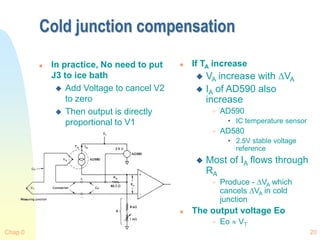
Cold junction compensation
 In practice, No need to put
J3 to ice bath
 Add Voltage to cancel V2
to zero
 Then output is directly
proportional to V1
 If TA increase
 VA increase with VA
 IA of AD590 also
increase
 AD590
• IC temperature sensor
 AD580
• 2.5V stable voltage
reference
 Most of IA flows through
RA
 Produce - VA which
cancels VA in cold
junction
 The output voltage Eo
 Eo  VT
Chap 0 21
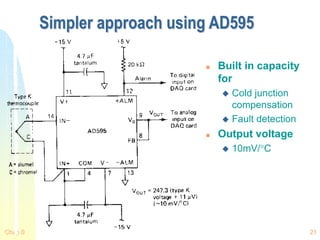
Simpler approach using AD595
 Built in capacity
for
 Cold junction
compensation
 Fault detection
 Output voltage
 10mV/C
Chap 0 22
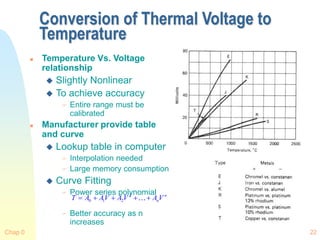
Conversion of Thermal Voltage to
Temperature
 Temperature Vs. Voltage
relationship
 Slightly Nonlinear
 To achieve accuracy
 Entire range must be
calibrated
 Manufacturer provide table
and curve
 Lookup table in computer
 Interpolation needed
 Large memory consumption
 Curve Fitting
 Power series polynomial
 Better accuracy as n
increases
2
0 1 2
n
n
T A AV A V A V
    
Chap 0 23
Calibration of Thermometers
 To ensure temperature
accuracy
 Noise Reduction of
thermocouples
 Output voltage is order
of V
 Sensitive to interface
 Analog active filter
and Guarding
techniques are
needed
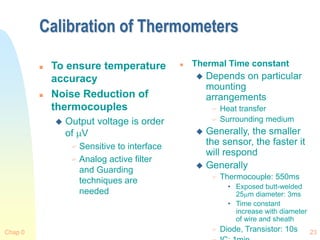
 Thermal Time constant
 Depends on particular
mounting
arrangements
 Heat transfer
 Surrounding medium
 Generally, the smaller
the sensor, the faster it
will respond
 Generally
 Thermocouple: 550ms
• Exposed butt-welded
25m diameter: 3ms
• Time constant
increase with diameter
of wire and sheath
 Diode, Transistor: 10s
Chap 0 24
Resistive Temperature Sensors
 Resistance of materials are changed with
temperature
 Conductive materials
 Metals
 R increases as T increases
 Called RTD
• Resistance Temperature Detector
 Semiconductors
 R decreases as T increases
 Called Thermistors
Chap 0 25
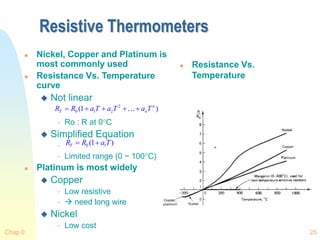
Resistive Thermometers
 Nickel, Copper and Platinum is
most commonly used
 Resistance Vs. Temperature
curve
 Not linear
 Ro : R at 0C
 Simplified Equation

 Limited range (0 ~ 100C)
 Platinum is most widely
 Copper
 Low resistive
  need long wire
 Nickel
 Low cost
 Resistance Vs.
Temperature
2
0 1 2
(1 )
n
T n
R R a T a T a T
    
0 1
(1 )
T
R R a T
 
Chap 0 26
Platinum Thermometers
 SPRT
 Standard Platinum
Resistance
Thermometer
 Range
 13.81K ~ 903.89K
 Some are designed to
1050C
 Callendar-Van Dusen
Equation
 -183 ~ 630C Range
 Typically
0
3
[ (0.01 1)(0.01 )
(0.01 1)(0.01 ) ]
T
R R T T T
T T
 

  
 
1
0
0.00392
1.49
0( 0),0.11( 0)
100
C
T T
R






  
 
Chap 0 27
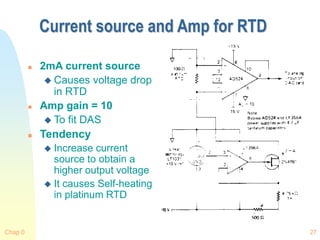
Current source and Amp for RTD
 2mA current source
 Causes voltage drop
in RTD
 Amp gain = 10
 To fit DAS
 Tendency
 Increase current
source to obtain a
higher output voltage
 It causes Self-heating
in platinum RTD
Chap 0 28
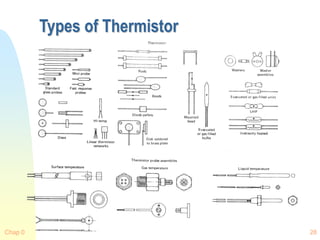
Types of Thermistor
Chap 0 29
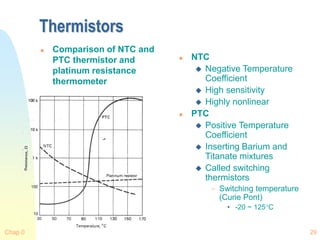
Thermistors
 Comparison of NTC and
PTC thermistor and
platinum resistance
thermometer
 NTC
 Negative Temperature
Coefficient
 High sensitivity
 Highly nonlinear
 PTC
 Positive Temperature
Coefficient
 Inserting Barium and
Titanate mixtures
 Called switching
thermistors
 Switching temperature
(Curie Pont)
• -20 ~ 125C
Chap 0 30
Empirical Correction
 Basic Characteristics
 Where
 Ro : R at known To
• Usually 298.15K
  : Material constant for
thermistor in K
• Determined from R
obtained at 0 and 50C
• 1500 ~ 6000K range
– Typically, 4000K
 Few  ~ 10M range
 Steinhart-Hart Equation
 Where
 A, B, C are found by
solving three equations
with known R and T
 Accuracy < 0.01C
 More narrow range
 -40C < T1, T2, T3 <150C,
|T2-T1|<50C, |T3-T2|<50C
0
0
1 1
exp[ ( )]
T
R R
T T

  3
1
ln (ln )
A B R C R
T
  
1
ln
B
C
T R A
 

Chap 0 31
Terminology
 Temperature Coefficient of
Resistance
 Typically, -4.4%/C at 27C
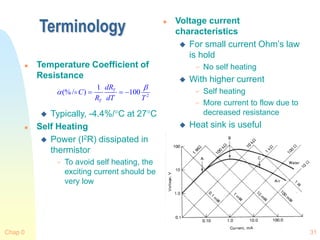
 Self Heating
 Power (I2R) dissipated in
thermistor
 To avoid self heating, the
exciting current should be
very low
 Voltage current
characteristics
 For small current Ohm’s law
is hold
 No self heating
 With higher current
 Self heating
 More current to flow due to
decreased resistance
 Heat sink is useful
2
1
(%/ ) 100
T
T
dR
C
R dT T

   
Chap 0 32
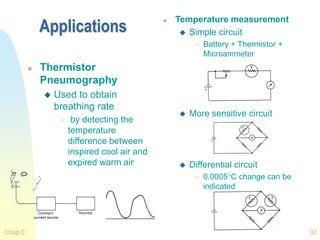
Applications
 Thermistor
Pneumography
 Used to obtain
breathing rate
 by detecting the
temperature
difference between
inspired cool air and
expired warm air
 Temperature measurement
 Simple circuit
 Battery + Thermistor +
Microammeter
 More sensitive circuit
 Differential circuit
 0.0005C change can be
indicated
Chap 0 33
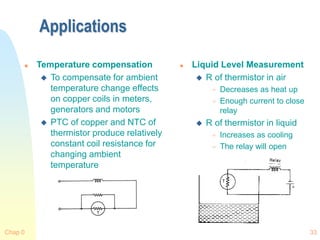
Applications
 Temperature compensation
 To compensate for ambient
temperature change effects
on copper coils in meters,
generators and motors
 PTC of copper and NTC of
thermistor produce relatively
constant coil resistance for
changing ambient
temperature
 Liquid Level Measurement
 R of thermistor in air
 Decreases as heat up
 Enough current to close
relay
 R of thermistor in liquid
 Increases as cooling
 The relay will open
Chap 0 34
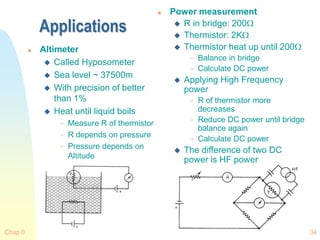
Applications
 Altimeter
 Called Hyposometer
 Sea level ~ 37500m
 With precision of better
than 1%
 Heat until liquid boils
 Measure R of thermistor
 R depends on pressure
 Pressure depends on
Altitude
 Power measurement
 R in bridge: 200
 Thermistor: 2K
 Thermistor heat up until 200
 Balance in bridge
 Calculate DC power
 Applying High Frequency
power
 R of thermistor more
decreases
 Reduce DC power until bridge
balance again
 Calculate DC power
 The difference of two DC
power is HF power
Chap 0 35
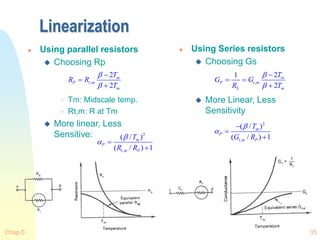
Linearization
 Using parallel resistors
 Choosing Rp
 Tm: Midscale temp.
 Rt,m: R at Tm
 More linear, Less
Sensitive:
 Using Series resistors
 Choosing Gs
 More Linear, Less
Sensitivity
,
2
2
m
P t m
m
T
R R
T





2
,
( / )
( / ) 1
m
P
t m P
T
R R

 

,
2
1
2
m
P t m
S m
T
G G
R T



 

2
,
( / )
( / ) 1
m
P
t m P
T
G R





Chap 0 36
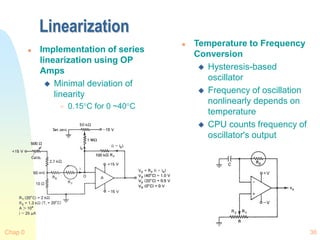
Linearization
 Implementation of series
linearization using OP
Amps
 Minimal deviation of
linearity
 0.15C for 0 ~40C
 Temperature to Frequency
Conversion
 Hysteresis-based
oscillator
 Frequency of oscillation
nonlinearly depends on
temperature
 CPU counts frequency of
oscillator's output
Chap 0 37
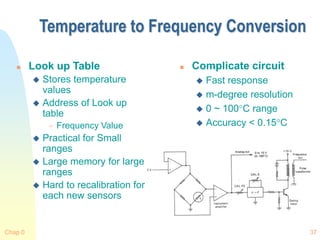
Temperature to Frequency Conversion
 Look up Table
 Stores temperature
values
 Address of Look up
table
 Frequency Value
 Practical for Small
ranges
 Large memory for large
ranges
 Hard to recalibration for
each new sensors
 Complicate circuit
 Fast response
 m-degree resolution
 0 ~ 100C range
 Accuracy < 0.15C
Chap 0 38
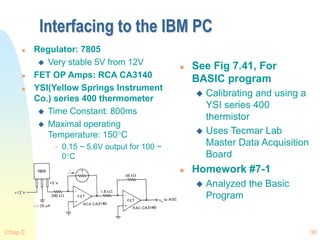
Interfacing to the IBM PC
 Regulator: 7805
 Very stable 5V from 12V
 FET OP Amps: RCA CA3140
 YSI(Yellow Springs Instrument
Co.) series 400 thermometer
 Time Constant: 800ms
 Maximal operating
Temperature: 150C
 0.15 ~ 5.6V output for 100 ~
0C
 See Fig 7.41, For
BASIC program
 Calibrating and using a
YSI series 400
thermistor
 Uses Tecmar Lab
Master Data Acquisition
Board
 Homework #7-1
 Analyzed the Basic
Program
Chap 0 39
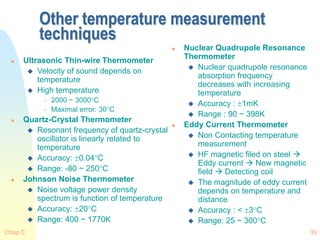
Other temperature measurement
techniques
 Ultrasonic Thin-wire Thermometer
 Velocity of sound depends on
temperature
 High temperature
 2000 ~ 3000C
 Maximal error: 30C
 Quartz-Crystal Thermometer
 Resonant frequency of quartz-crystal
oscillator is linearly related to
temperature
 Accuracy: 0.04C
 Range: -80 ~ 250C
 Johnson Noise Thermometer
 Noise voltage power density
spectrum is function of temperature
 Accuracy: 20C
 Range: 400 ~ 1770K
 Nuclear Quadrupole Resonance
Thermometer
 Nuclear quadrupole resonance
absorption frequency
decreases with increasing
temperature
 Accuracy : 1mK
 Range : 90 ~ 398K
 Eddy Current Thermometer
 Non Contacting temperature
measurement
 HF magnetic filed on steel 
Eddy current  New magnetic
field  Detecting coil
 The magnitude of eddy current
depends on temperature and
distance
 Accuracy : < 3C
 Range: 25 ~ 300C

7_Temperature_Sensor.ppt_ajinkya_xxxxxxxx

  • 1.
    1 Interfacing Temperature Sensors P-NJunction Thermometers IC Temperature Sensors Thermocouples Calibration of Thermometers Resistive Temperature Sensors Other Temperature Measurement Techniques
  • 2.
    Chap 0 2 Applicationsof temperature sensing  Food industry  Monitor temperature-time cycles to ensure high food quality  Automotive industry  Combustion and exhaust temperature  Solar Energy conversion  Accurate temperature measurement to achieve optimal heat flow  Energy efficiency in the home and industry  Measurement of temperature  Hospital infant incubator  Temperature must be kept in the proper range
  • 3.
    Chap 0 3 BlockDiagram of electronic thermometer
  • 4.
    Chap 0 4 P-NJunction Thermometers  Principle of Diode Thermometer  Forward Biased Current  Voltage  Where T is in K  Voltage vs. Temperature  Useful range  40 ~ 400K [exp( ) 1] 2 s qV I I kT   4.6 (ln ln ) g E kT V M I q q   
  • 5.
    Chap 0 5 Diodethermometer with known characteristics  Motorola MTS 105  Calibrate Diode to obtain accurate output  Constant Current source must be very stable  1C accuracy  0.002K with precision GaAs Diode  Calibration Procedures  Determine VBE at extremes (-40C and 150C)  Plot line using VBE(-40C) and VBE(150C)   Given VBE(Tx), Tx can be found using curve from step 2 or equation  Diode are more sensitive and linear than others  Wide range  Less repeatable  Affected by Magnetic (> 2.25 0.003( 600) / c BE T V mV C     [ ( ) (25 )]/ 25 x BE x BE c T V T V C T   
  • 6.
    Chap 0 6 Diodethermometer with Unknown characteristics  Diode must be calibrated over the desired range  Using Table or Curves  Changing temperature (e.g., 0 ~ 50C)  Recording Vi vs. Ti  After calibrating, Tx can be determined using measure Vx and Vi vs. Ti curve  Interpolation techniques are needed  Using Equation  Linear regression  T = a + bV • Where a and b are constant • Can be determined using – Ti = a + bVi  Tx can be determined using measured Vx and Equation  Manufacturer provides  Table or Curve  Equation
  • 7.
    Chap 0 7 Transistoras a Temperature Sensor  Base-Emitter voltage of a transistor varies directly with temperature at a constant collector current  Thermometer using MTS 105  R1 determine collector current. Must be stable  R2 is adjusted until Vo=0 for a display in C  Accuracy of 0.01C  Range of –50 to 125C
  • 8.
    Chap 0 8 BASICProgram for Transistor Thermometers  Calibrating and using the transistor thermometer  For Tecmar Lab Master data acquisition Board Initialize ADC Select Channel 0 Start Conversion Check EOC
  • 9.
    Chap 0 9 Cprogram for Calibrating and Using the Transistor Thermometer  For prototype board developed in Chapters 3, 4, and 5
  • 10.
    Chap 0 10 ICTemperature Sensors  Temperature sensing circuit with output voltage proportional to absolute temperature   If IC1/IC2 is constant  VR1 is proportional to temperature  LX5700 from NS  Range: -55 ~ 125C  Sensitivity: 10mV/C  Time Constant  50 sec (Still Air)  < 1 sec (Stirred Oil Bath)  Output: 2.98V at 298K  Accuracy: 3.8K  Linearity: < 1K  Not satisfactory in many applications  Poor Accuracy 1 1 2 1 2 2 ln( ) C C BE BE C I kT R I V V q I   
  • 11.
    Chap 0 11 ICSensor: LM135, LM235, LM335  Operate as two terminal Zenor  Breakdown Voltage proportional to absolute temperature of +10mV/K  When calibrated at 25C  LM135 < 1.5C Error  LM335 < 2C Error  Range: -55 ~ 150C  Output voltage:  T0 is reference temperature  Thermal Response time of LM335 Flowing Air Still Air Stirred Oil Bath 0 0 0 0 ( ) ( ) T v T v T T 
  • 12.
    Chap 0 12 ICSensor: LM134-3, LM234-3, LM134-6, LM234-6  IC temperature sensors with current output  Three terminal adjustable current source  Range  -55 ~ 125C : LM134-3, 6  -25 ~ 100C : LM234-3, 6  Operate over wide voltage  1 ~ 40V  Accuracy  3C : LM134-3, LM234-3  6C : LM134-6, LM234-6  Not for precision temperature measurement  Output current   T: temperature in K  i0 is programmable  By adjusting R  1 A ~ 10mA 0 (227 / ) V K T i R  
  • 13.
    Chap 0 13 ICSensor: AD590  Two terminal IC temperature sensor  Better accuracy and linearity than LM135  Current output depends on absolute temperature  Insensitive to the voltage across it  Used with long lead wires  VT: voltage across R  If R=358,  Error  < 0.3C : AD590J  < 0.05C: AD590M  Time Constant  60 sec (Still Air)  1.4 sec (Stirred Oil)  Operating Range  -55 ~ 150C  High Output Impedance  > 10M  Excellent rejection of supplying voltage drift and ripple 1 2 ln 179 ( ) T I kT V T V q I   1 / T I A K T  
  • 14.
    Chap 0 14 Thermocouples Thermocouple is a two-wire device  Composed of dissimilar metals or alloys with one end welded together  Types of thermocouples
  • 15.
    Chap 0 15 Typeof thermocouple junctions  Exposed junction  Extending beyond the protective metallic sheath  Fast Response  Static or flowing non- corrosive gas  Ungrounded junction  Insulated by MgO powder  Suitable for corrosive environment  Grounded junction  High pressure application  For static or flowing corrosive gas and liquid
  • 16.
    Chap 0 16 SeebeckEffect: Principles of Thermocouples  Two dissimilar metal or alloy wires A and B joined together at the end to form a circuit  If temperature are different (T2 > T1), a current will flow in circuit  Seebeck thermal emf  Emf(electromotive force) producing above current  Magnitude of thermal emf can be measure using Voltmeter or Ammeter
  • 17.
    Chap 0 17 Principlesof Thermocouples  Broken at center  Open loop circuit voltage EAB  Temperature difference (T2 - T1)  Composition of two metal  Example  T2 = 0C , T1 = 1C  T-type  Copper + Constantan  EAB = 39V  S-type  Platinum + Platinum- 10% rhodium  EAB = 5V
  • 18.
    Chap 0 18 ThermoelectricLaws  Law of interior temperatures  Emf is not affected by T3 and T4  Law of intermediate metals  Emf is not affected by Metal X if J1 and J2 are at the same temperature  Can solder or attach lead wire  Law of intermediate temperature  Can use reference table even if reference junction is not 0C  Law of Additive Emf  Can create nonstandard thermocouple combinations and still use the reference tables
  • 19.
    Chap 0 19 PickingUp the Thermovoltage  Directly connect voltmeter to thermocouple  Can not read thermal emf  New thermal junction • J2 : No emf – Copper – copper • J3 : emf V3 – Copper - constantan  The output of voltmeter  Proportional to voltage difference between V1 and V3  To find T1, we must know T3  Put J3 in ice bath • 0C • V = function of T1
  • 20.
    Chap 0 20 Coldjunction compensation  In practice, No need to put J3 to ice bath  Add Voltage to cancel V2 to zero  Then output is directly proportional to V1  If TA increase  VA increase with VA  IA of AD590 also increase  AD590 • IC temperature sensor  AD580 • 2.5V stable voltage reference  Most of IA flows through RA  Produce - VA which cancels VA in cold junction  The output voltage Eo  Eo  VT
  • 21.
    Chap 0 21 Simplerapproach using AD595  Built in capacity for  Cold junction compensation  Fault detection  Output voltage  10mV/C
  • 22.
    Chap 0 22 Conversionof Thermal Voltage to Temperature  Temperature Vs. Voltage relationship  Slightly Nonlinear  To achieve accuracy  Entire range must be calibrated  Manufacturer provide table and curve  Lookup table in computer  Interpolation needed  Large memory consumption  Curve Fitting  Power series polynomial  Better accuracy as n increases 2 0 1 2 n n T A AV A V A V     
  • 23.
    Chap 0 23 Calibrationof Thermometers  To ensure temperature accuracy  Noise Reduction of thermocouples  Output voltage is order of V  Sensitive to interface  Analog active filter and Guarding techniques are needed  Thermal Time constant  Depends on particular mounting arrangements  Heat transfer  Surrounding medium  Generally, the smaller the sensor, the faster it will respond  Generally  Thermocouple: 550ms • Exposed butt-welded 25m diameter: 3ms • Time constant increase with diameter of wire and sheath  Diode, Transistor: 10s
  • 24.
    Chap 0 24 ResistiveTemperature Sensors  Resistance of materials are changed with temperature  Conductive materials  Metals  R increases as T increases  Called RTD • Resistance Temperature Detector  Semiconductors  R decreases as T increases  Called Thermistors
  • 25.
    Chap 0 25 ResistiveThermometers  Nickel, Copper and Platinum is most commonly used  Resistance Vs. Temperature curve  Not linear  Ro : R at 0C  Simplified Equation   Limited range (0 ~ 100C)  Platinum is most widely  Copper  Low resistive   need long wire  Nickel  Low cost  Resistance Vs. Temperature 2 0 1 2 (1 ) n T n R R a T a T a T      0 1 (1 ) T R R a T  
  • 26.
    Chap 0 26 PlatinumThermometers  SPRT  Standard Platinum Resistance Thermometer  Range  13.81K ~ 903.89K  Some are designed to 1050C  Callendar-Van Dusen Equation  -183 ~ 630C Range  Typically 0 3 [ (0.01 1)(0.01 ) (0.01 1)(0.01 ) ] T R R T T T T T         1 0 0.00392 1.49 0( 0),0.11( 0) 100 C T T R           
  • 27.
    Chap 0 27 Currentsource and Amp for RTD  2mA current source  Causes voltage drop in RTD  Amp gain = 10  To fit DAS  Tendency  Increase current source to obtain a higher output voltage  It causes Self-heating in platinum RTD
  • 28.
    Chap 0 28 Typesof Thermistor
  • 29.
    Chap 0 29 Thermistors Comparison of NTC and PTC thermistor and platinum resistance thermometer  NTC  Negative Temperature Coefficient  High sensitivity  Highly nonlinear  PTC  Positive Temperature Coefficient  Inserting Barium and Titanate mixtures  Called switching thermistors  Switching temperature (Curie Pont) • -20 ~ 125C
  • 30.
    Chap 0 30 EmpiricalCorrection  Basic Characteristics  Where  Ro : R at known To • Usually 298.15K   : Material constant for thermistor in K • Determined from R obtained at 0 and 50C • 1500 ~ 6000K range – Typically, 4000K  Few  ~ 10M range  Steinhart-Hart Equation  Where  A, B, C are found by solving three equations with known R and T  Accuracy < 0.01C  More narrow range  -40C < T1, T2, T3 <150C, |T2-T1|<50C, |T3-T2|<50C 0 0 1 1 exp[ ( )] T R R T T    3 1 ln (ln ) A B R C R T    1 ln B C T R A   
  • 31.
    Chap 0 31 Terminology Temperature Coefficient of Resistance  Typically, -4.4%/C at 27C  Self Heating  Power (I2R) dissipated in thermistor  To avoid self heating, the exciting current should be very low  Voltage current characteristics  For small current Ohm’s law is hold  No self heating  With higher current  Self heating  More current to flow due to decreased resistance  Heat sink is useful 2 1 (%/ ) 100 T T dR C R dT T     
  • 32.
    Chap 0 32 Applications Thermistor Pneumography  Used to obtain breathing rate  by detecting the temperature difference between inspired cool air and expired warm air  Temperature measurement  Simple circuit  Battery + Thermistor + Microammeter  More sensitive circuit  Differential circuit  0.0005C change can be indicated
  • 33.
    Chap 0 33 Applications Temperature compensation  To compensate for ambient temperature change effects on copper coils in meters, generators and motors  PTC of copper and NTC of thermistor produce relatively constant coil resistance for changing ambient temperature  Liquid Level Measurement  R of thermistor in air  Decreases as heat up  Enough current to close relay  R of thermistor in liquid  Increases as cooling  The relay will open
  • 34.
    Chap 0 34 Applications Altimeter  Called Hyposometer  Sea level ~ 37500m  With precision of better than 1%  Heat until liquid boils  Measure R of thermistor  R depends on pressure  Pressure depends on Altitude  Power measurement  R in bridge: 200  Thermistor: 2K  Thermistor heat up until 200  Balance in bridge  Calculate DC power  Applying High Frequency power  R of thermistor more decreases  Reduce DC power until bridge balance again  Calculate DC power  The difference of two DC power is HF power
  • 35.
    Chap 0 35 Linearization Using parallel resistors  Choosing Rp  Tm: Midscale temp.  Rt,m: R at Tm  More linear, Less Sensitive:  Using Series resistors  Choosing Gs  More Linear, Less Sensitivity , 2 2 m P t m m T R R T      2 , ( / ) ( / ) 1 m P t m P T R R     , 2 1 2 m P t m S m T G G R T       2 , ( / ) ( / ) 1 m P t m P T G R     
  • 36.
    Chap 0 36 Linearization Implementation of series linearization using OP Amps  Minimal deviation of linearity  0.15C for 0 ~40C  Temperature to Frequency Conversion  Hysteresis-based oscillator  Frequency of oscillation nonlinearly depends on temperature  CPU counts frequency of oscillator's output
  • 37.
    Chap 0 37 Temperatureto Frequency Conversion  Look up Table  Stores temperature values  Address of Look up table  Frequency Value  Practical for Small ranges  Large memory for large ranges  Hard to recalibration for each new sensors  Complicate circuit  Fast response  m-degree resolution  0 ~ 100C range  Accuracy < 0.15C
  • 38.
    Chap 0 38 Interfacingto the IBM PC  Regulator: 7805  Very stable 5V from 12V  FET OP Amps: RCA CA3140  YSI(Yellow Springs Instrument Co.) series 400 thermometer  Time Constant: 800ms  Maximal operating Temperature: 150C  0.15 ~ 5.6V output for 100 ~ 0C  See Fig 7.41, For BASIC program  Calibrating and using a YSI series 400 thermistor  Uses Tecmar Lab Master Data Acquisition Board  Homework #7-1  Analyzed the Basic Program
  • 39.
    Chap 0 39 Othertemperature measurement techniques  Ultrasonic Thin-wire Thermometer  Velocity of sound depends on temperature  High temperature  2000 ~ 3000C  Maximal error: 30C  Quartz-Crystal Thermometer  Resonant frequency of quartz-crystal oscillator is linearly related to temperature  Accuracy: 0.04C  Range: -80 ~ 250C  Johnson Noise Thermometer  Noise voltage power density spectrum is function of temperature  Accuracy: 20C  Range: 400 ~ 1770K  Nuclear Quadrupole Resonance Thermometer  Nuclear quadrupole resonance absorption frequency decreases with increasing temperature  Accuracy : 1mK  Range : 90 ~ 398K  Eddy Current Thermometer  Non Contacting temperature measurement  HF magnetic filed on steel  Eddy current  New magnetic field  Detecting coil  The magnitude of eddy current depends on temperature and distance  Accuracy : < 3C  Range: 25 ~ 300C