INSTRUMENTATION DEPARTMENT
GOVERNMENT POLYTECHNIC
VIDYANAGAR KARAD 415124
INSTRUMENTATION DEPT.
GOVT. POLYTECHNIC KARAD
WELCOME
TO
DEAR STUDENTS
INSTRUMENTATION DEPT.
GOVT. POLYTECHNIC KARAD
TEMPERATURE MEASUREMENT
Dr. Prashant D. Sarawade
Lecturer in Instrumentation
GOVERNMENT POLYTECHNIC KARAD
415124
INSTRUMENTATION DEPT.
GOVT. POLYTECHNIC KARAD
• Temperature, its units. Temperature scales and conversions
• Classifications of temperature measuring transducers
• Filled system thermometers (a)Vapour pressure
• Expansion thermometers (a) Bimetallic thermometer
• Electrical methods
1. Thermistor 2. RTD 3. Thermocouple
• Pyrometer : Optical method and Radiation method
• Typical specifications of thermistors, thermocouple and RTD
• Calibration of temperature measuring transducers
Outline of Curriculum
INSTRUMENTATION DEPT.
GOVT. POLYTECHNIC KARAD
Temperature, its units
• Temperature :
The thermal state of body or degree of hotness of substance is
measured in terms of temperature.
( High – Upper fixed point (Steam) /Low –Lower ( ice point ))
• Units.
1. Celsius (0
C)
2. Fahrenheit (0
F )
3. Kelvin (0
K )
4. Rankine (0
R)
5. Reaumur (0
R’
)
6. International Practical Temperature Scale (IPTS)
INSTRUMENTATION DEPT.
GOVT. POLYTECHNIC KARAD
Temperature scales and conversions
1. Fahrenheit and Centigrade scales and conversions
=
2. Kelvin and Rankine temperature scale
0
K =0
C + 273.15
0
R =0
F + 459.69
INSTRUMENTATION DEPT.
GOVT. POLYTECHNIC KARAD
Classifications of temperature measuring transducers
(1) Expansion thermometers
(2) Filled system thermometers
(3) Electrical temperature instruments
(4) Pyrometers
(1) Expansion thermometers
(a) Expansion of solids - Bimetallic thermometer
(ii) Expansion of liquids
Liquid in glass thermometer / Liquid in glass thermometer
(iii) Expansion of gases
Gas thermometer
INSTRUMENTATION DEPT.
GOVT. POLYTECHNIC KARAD
Bimetallic thermometers
INSTRUMENTATION DEPT.
GOVT. POLYTECHNIC KARAD
It consists of two strips of metals such as invar (metal 1) and
brass (metal 2) welded together.
Each strip is made up of metal having a different coefficient of
thermal expansion.
When the welded strip is heated two metals change length in
accordance with individual rates of thermal expansion.
Two metals expands to different lengths as the temperature
rises. This forces a bimetallic strip to bend towards side with
low coefficient of thermal expansion. If one of the bimetallic
strip is fixed so that it cannot move , the distance of other end
bends is directly proportional to the square of the length of
metal strip.
INSTRUMENTATION DEPT.
GOVT. POLYTECHNIC KARAD
INSTRUMENTATION DEPT.
GOVT. POLYTECHNIC KARAD
Advantages:
(i) Their cost is low
(ii) They are tough and cannot easily broken
(iii) They are easily installed and maintained.
(iv) They have good accuracy relative to cost.
(v) They have fairly wide temperature range.(-75 deg.cel to
540 deg.cel)
Disadvantages:
(vi) They are limited to local mounting
(vii) Only indicating type is available
(viii) There is always a possibility of calibration change due to
rough handing
(ix) Their accuracy is not as high as glass stem thermometers.
INSTRUMENTATION DEPT.
GOVT. POLYTECHNIC KARAD
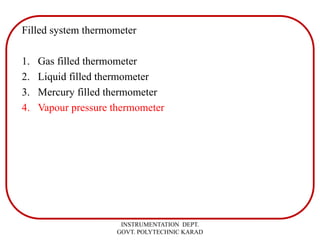
Filled system thermometer
1. Gas filled thermometer
2. Liquid filled thermometer
3. Mercury filled thermometer
4. Vapour pressure thermometer
INSTRUMENTATION DEPT.
GOVT. POLYTECHNIC KARAD
Vapour-pressure thermometer
INSTRUMENTATION DEPT.
GOVT. POLYTECHNIC KARAD
Vapour-pressure thermometer is also called filled system
thermometer.
In this bulb is partially filled with liquid, while capillary and
bourdon tubes are filled with vapour.
In this some of the liquid vaporizes during operation.
The liquid in vapour pressure system boils and vaporizes
during operation which creates a gas or vapour inside the
capillary and bourdon tube.
The liquid inside the bulb continues to boil until the pressure in
the system equals to vapour pressure of the boiling liquid.
At this point the liquid stops boiling unless its temperature
increases.
.
INSTRUMENTATION DEPT.
GOVT. POLYTECHNIC KARAD
When temperature of the substance surrounding the bulb drops,
the liquid and vapour inside the bulb also cool. This causes
some of the vapour to condense.
As the vapour condenses, the pressure inside the system
decreases.
This action continues until the pressure drops to the vapour
pressure of boiling liquid.
Due to change in pressure, the bourdon tube uncoils as pressure
increases and coil tightly as it decreases.
This movement of bourdon tube may be connected to a pointer
or to a pen on strip chart recorder or to a transmitter to indicate
temperature.
INSTRUMENTATION DEPT.
GOVT. POLYTECHNIC KARAD
Advantages:
1. Long capillary tube length is available.
2. Fast speed of response.
3. Ambient temperature compensation isnot required.
Disadvantages:
1. Nonlinear scale
2. No over range capacity
INSTRUMENTATION DEPT.
GOVT. POLYTECHNIC KARAD
• Resistance Temperature Detector (RTD) (T α R) PTC
• Thermistor (T α (1/R)) NTC
• Thermocouple
CONTACT TEMERATURE SENSOR
RESISTANCE THERMOMETERS
• RTDs and thermistors operate on the principle that the electrical
resistance of various materials changes in a reproducible way
with temperature variations.
• RTD is a precision temperature sensing device that utilizes
metal conductors and has a positive temperature coefficient
(PTC).
• Thermistors are made from semiconductor materials which have
a large negative coefficient of resistance. i.e. as temperature
increases the resistance of the thermistor decreases.
INSTRUMENTATION DEPT.
GOVT. POLYTECHNIC KARAD
THERMISTOR (Thermally sensitive resistor)
INSTRUMENTATION DEPT.
GOVT. POLYTECHNIC KARAD
• Small physical size
• High resistance varies from 1 kΩ to 100 kΩ
• Mostly NTC (metal oxides) but PTC (barium and strontium
titanate mixtures) models available
• Fast response time
• Not sensitive to shock and vibration.
• Lower cost than RTD
• Very high sensitivity and resolution up to 1000 times more
sensitive than RTD.
• Highly non-linear resistance-to-temperature relationship.
INSTRUMENTATION DEPT.
GOVT. POLYTECHNIC KARAD
NTC Thermistor
Sr.No Temperature Resistance
01 30 deg.cel 4000 Ω
02 35 deg.cel 3800 Ω
03 40 deg.cel 3200 Ω
04 50 deg.cel 3000 Ω
INSTRUMENTATION DEPT.
GOVT. POLYTECHNIC KARAD
)]
where,
= 4000 Thermistor resistance at input temperature (30)
= Resistance at reference temperature ( 25)
= Input temperature (K).
= Reference temperature (K). 25 deg. Cel.
=Thermistor material constant (K). 2000 to 4000
Thermistor 5K it means its resistance value is 5000 ohm at 25
deg.cel. 100 K = 100000 ohm at 25 deg. Cel.
The standard NTC thermistor characteristic equation which
relates temperature and resistance is given below
INSTRUMENTATION DEPT.
GOVT. POLYTECHNIC KARAD
• Narrow operating range for a single unit
• operating range is between -200 °c and 100°c
• More susceptible to internal/self heating issues than RTD
• Less stable than RTD
• Highly nonlinear sensor
DISADVANTAGES / ISSUES
Resistance Temperature Detector (RTD)
• Metals have linear relationship with temperature.
• platinum (high cost, highly linear, most common)
• tungsten (highly linear)
• copper (lower temperature ranges)
• nickel (lower temperature, low cost, nonlinear)
• nickel alloys (lower temperature, low cost)
• Each metal has a specific resistivity, ρ, which varies with
temperature and is determined experimentally.
R=
where =metal wire length, = cross-sectional area
7
• platinum : -250 0
C to 900 0
C
• copper : -200 0
C to 250 0
C
• nickel : -200 0
C to 400 0
C
8
Original resistance Ro = Resistance Measured at To (0 °C)
Rt = Resistance Measured at Tt (30 °C)
( Rt - Ro) α (Tt − To) (1)
(Rt - Ro) α Ro (2)
Combine (1) and (2)
(Rt - Ro) α (proportional) Ro (Tt − To )
(Rt - Ro) = α Ro (Tt − To );
[Define α = (Rt - Ro)/ Ro (Tt − To )]
Where, α is temperature coefficient of resistance.
α = (change in R)/original R (change in T) = 1/°C
Rt = Ro + α Ro (Tt − To ) ;
Rt = Ro [1+ α (Tt − To ) ]
9
• Low resistance 100 Ω (most common) to 1000 Ω
• Wide operating range (-200 °c to 850 °c)
• High sensitivity (compared to thermocouples)
• High accuracy (±0.0006 °c to 0.1°c)
• High repeatability and stability
• low drift (0.0025 °c/year)
• industrial models drift < 0.1 °c/year
RTD CHARACTERISTIC
10
INSTRUMENTATION DEPT.
GOVT. POLYTECHNIC KARAD
RTD ADVANTAGES
• Very high accuracy
• Good reproducibility
• Remain stable and accurate for many years
• Temperature compensation is not required
• Fast response
• Size is generally smaller than thermocouples
• Pt 100 / Pt 1000 – RTD
• 2-wire is well suited for
applications where there are no lead
wires.
• 3-wire provides sufficient accuracy
in accounting for the lead wire
resistance however, best accuracy
is obtained with 4-wire RTD.
• 4-wire RTD has a set of dummy
leads used to reduce the lead-
resistance error.
• slower response time
• sensitive to shock and vibration
• Self-heating effect
RTD DISADVANTAGES / ISSUES
INSTRUMENTATION DEPT.
GOVT. POLYTECHNIC KARAD
THERMOCOUPLE
INSTRUMENTATION DEPT.
GOVT. POLYTECHNIC KARAD
INSTRUMENTATION DEPT.
GOVT. POLYTECHNIC KARAD
• Thermocouples operate under the principle that the junction of
two dissimilar metals produces a measurable voltage (emf-
electromotive force) when the two ends of the thermocouple are
at different temperatures.
• They are inexpensive, small in size, rugged, and reasonably
accurate.
INSTRUMENTATION DEPT.
GOVT. POLYTECHNIC KARAD
PRINCIPLE OF OPERATION
• In 1821 T.J. Seebeck observed the existence of electromotive
force (emf) at the junction formed between two dissimilar
metals (seebeck effect).
• Seebeck effect is actually the combined result of two other
phenomenon, thomson and peltier effects.
• Peltier observed that when a current flows through a junction of
two different conductors heat is either dissipated or absorbed
• Thomson discovered that any current carrying conductor with a
temperature difference between two points will either absorb or
emit heat depending on the material
• Thomson effect is normally much smaller in magnitude than the
peltier effect and can be minimized and disregarded with proper
thermocouple design.
15
WHAT THERMOCOUPLE MATERIALS SHOULD BE USED?
Depends on requirements:
• Temperature range
• Required accuracy
• Environmental issues
• Abrasion or vibration resistance
• Installation requirements (size of wire)
16
THERMOCOUPLE TYPES
17
EMF versus TEMPERATURE
18
THERMOCOUPLE LAWS OR RULES
1) A thermocouple must contain two dissimilar materials and at
least two junctions at different temperatures to have an emf
voltage output.
2) Law of Intermediate metals
Insertion of an intermediate metal into a thermocouple circuit
will not affect the voltage output as long as the two
junctions are at the same temperature.
• Permits soldered and welded joints
3) Law of Intermediate temperatures
If a thermocouple circuit develops a net emf 1-2 for measuring
junction temperatures and , and a net emf 2-3 for temperatures
and , then it will develop a net voltage of emf 1-3 = emf 1-2 +
emf 2-3
when the junctions are at temperatures and .
19
INSTRUMENTATION DEPT.
GOVT. POLYTECHNIC KARAD
A
B
C
C/B
B/C
T3
T2
V(1-2)α (T1-T2)
V(3-2)α (T3-T2)
V(1-3) = V(1-2) + V(2-3)
4) If a thermocouple circuit of materials a and c generates a net
emf a-c when exposed to temperatures and , and a
thermocouple of materials c and b generates a net emf c-b for
the same two temperatures and , then a thermocouple made
from materials a and b will develop a net voltage of between
temperatures and .
emf a-b = emf a-c + emf c-b
sometimes useful in the calibration of different thermocouple
5) Temperature changes in the wiring between the input and
output ends do not affect the output voltage, provided the
wiring is of a thermocouple alloy.
20
THERMOCOUPLE TABLES (NIST)
21
REFERENCE TEMPERATURE SYSTEMS
• Ice baths
Accurate and inexpensive
• Electronically controlled references
Require periodic calibration and are generally not as stable as
ice bath but are more convenient.
• Compensated reference temperature systems
A dedicated temperature sensor inside the chassis automatically
accounts for the reference temperature before calculating
temperature.
• Utr boxes
A zone of uniform temperature that ensures all connections
made within the zone are at the same temperature.
22
23
T = + x V + x + x + x + x + x + x + x + x .
The coefficients for Temperature range -200 0
C to 0 0
C
Voltage range -5.891 mV to 0 mV
Error Range 0.04 0
C to – 0.02 0
C are:
= 0, = 2.5173462 x , = -1.1662878
= -1.0833638 , = -8.9773540 x , = -3.7342377 x
= -8.6632643 x , = -1.0450598 x
= -5.1920577 x , = 0
mV to TEMPERATURE CONVERSION for K Type
24
The coefficients for Temperature range 0 0
C to 500 0
C
Voltage range 0 mV to 20.644 mV
Error range 0.04 0
C to -0.05 0
C are:
= 0 , = 2.508355 *
= 7.860106 x , = -2.503131 x
= 8.315270 x , = -1.228034 x
= 9.804036 x , = -4.413030 x
= 1.057734 x , = -1.052755 x
25
INSTRUMENTATION DEPT.
GOVT. POLYTECHNIC KARAD
Pyrometers
Pyrometry is a technique used to measure temperature without
physical contact.
There are two types of pyrometers
1) Radiation pyrometers
2) Optical pyrometers
INSTRUMENTATION DEPT.
GOVT. POLYTECHNIC KARAD
Radiation pyrometers
INSTRUMENTATION DEPT.
GOVT. POLYTECHNIC KARAD
The operation is based on the measurement of radiant energy
emitted by the hot body.
It consists of lens to focus radiated energy from the body, whose
temperature is required on to detector or receiving element.
The receiving elements may be resistance thermometer,
thermocouple or thermopile.
A thermopile consists of several thermocouples connected in
series.
A temperature indicator, recorder, controller is attached with the
receiving element to indicate the temperature.
INSTRUMENTATION DEPT.
GOVT. POLYTECHNIC KARAD
When total energy radiated by a hot body whose temperature is
to be measured enters the pyrometer, it is focussed by lens on to
the detector.
The detector is a thermopile whose measuring junctions are
attached to a blackened disk.
The disk absorbs energy when pyrometer is focussed on a hot
body, and its temperature rises.
The reference junction of thermopile is attached to the
pyrometer case.
INSTRUMENTATION DEPT.
GOVT. POLYTECHNIC KARAD
The difference in temperature between the measuring junction
attached to the disk and reference junction attached to the
pyrometer case generates voltage is proportional to the
temperature of blackened disk, which is indicated by recording
instrument.
INSTRUMENTATION DEPT.
GOVT. POLYTECHNIC KARAD
Advantages:
1. Non contact method
2. Measure higher range of temperature.
3. Fast response speed
4. Moderate cost and high output.
Dis advantages:
5. Nonlinear scale
6. Measurement of temperature affected due to emissivity rates.
7. Error introduced due to intervening gases.
INSTRUMENTATION DEPT.
GOVT. POLYTECHNIC KARAD
Optical pyrometers
INSTRUMENTATION DEPT.
GOVT. POLYTECHNIC KARAD
INSTRUMENTATION DEPT.
GOVT. POLYTECHNIC KARAD
It provides an accurate method of measuring temperatures
between 600 0
C to 3000 0
C.
The method of measurement is based on comparison of the
intensity (brightness) of the visual radiation emitted by hot body
with the radiation emitted by source of known intensity.
The brightness of radiation emitted by hot body whose
temperature is to be measured is matched with the brightness of
a calibrated reference (lamp) whose temperature is known.
An optical pyrometer consists of an incandescent lamp filament
which is used as the reference source of radiation.
This is arranged in the field of vision of a telescope through
which both it (the filament) and hot body are viewed
simultaneously. The filament is heated by a 2volt battery in series
with rheostat by which a temperature of the filament is adjusted.
INSTRUMENTATION DEPT.
GOVT. POLYTECHNIC KARAD
The filament is connected in one arm of whetstone bridge circuit
across which is connected a moving coil galvanometer.
The electrical resistance of the lamp filament varies in accordance
with its temperature and the resistance in other arm of bridge are of
a material, the ohmic value of which does not altered with change
in temperature.
As the temperature of the filament is increased the bridge is
progressively thrown out of balance. The degree of unbalance is
shown by the magnitude of the galvanometer deflection which is
calibrated in terms of temperature.
In the operation, the hot object is viewed through the telescope
when the filament first appear as dark line against the glowing
background as shown at ‘A’.
On rotating the rheostat the temperature of filament is
progressively increased until the visible radiation matches that of
hot body.
INSTRUMENTATION DEPT.
GOVT. POLYTECHNIC KARAD
When tip of the filament becomes invisible against background, as
shown at ‘B’ and
when this stage is reached, the temperature may be read off from
the galvanometer provided that the rheostat isnot moved after the
temperature match is obtained.
An absorption screen is used between the object reading the
filament that reduces the intensity of radiation from the object
reading the filament so that the filament may be matched to hot
mass which is at a considerably higher temperature than the
filament its self.
A monochromatic red screen is fitted to the eye piece so that it may
be bought into field of vision at will. Its function is to eliminate
colour differences between the filament and the hot body to
facilitate matching and also to prevent dazzle at the higher filament
temperatures.
INSTRUMENTATION DEPT.
GOVT. POLYTECHNIC KARAD
Advantages:
1. Used to monitor temp. of moving or distant objects.
2. Good accuracy and wider range
3. Non contact type
4. It is lighter, convenient to use and portable.
Dis advantages:
5. Relatively expensive
6. Measurement of temperature affected due to emissivity rates.
7. Difficult to measure temp. of burning gases
8. Skilled operator is required for measurement.
INSTRUMENTATION DEPT.
GOVT. POLYTECHNIC KARAD
Calibration of temperature measuring transducers
Thermocouple : At start TC was accurate.
I have used for six months regularly. So, undesirable
characteristics as like drift, nonlinearity of TC deteriorates.
After 6 months ?
Good /Bad Throw it = Not suitable for measurement
Send this to calibration Labs (NIBL)
Calibration :Standard (Optical Pyrometer) - High accuracy (5 lacs)
= 30 deg.cel. (1 deg.cel)
TC (Our instrument) – 2000 Rs = 35 deg. cel
INSTRUMENTATION DEPT.
GOVT. POLYTECHNIC KARAD
1. Calibration of Bimetallic thermometer:
Own bimetallic thermometer : Standard thermometer
2. Calibration of thermocouple:
Own thermocouple : Standard thermometer (Thermocouple, RTD,
Liquid in glass thermometer)
3. Filled system thermometer:
Calibration is done by comparison method.
Own Filled system thermometer : standard thermocouple, liquid in
glass type thermometers)
INSTRUMENTATION DEPT.
GOVT. POLYTECHNIC KARAD
4. Resistance thermometers:
Own RTD : standard thermometer as reference, thermocouple,
liquid in glass thermometer or other thermometers
5. Calibration of Pyrometer
1. Radiation Pyrometers
Comparison method using standard optical pyrometer
2. Optical Pyrometers
INSTRUMENTATION DEPT.
GOVT. POLYTECHNIC KARAD
K Type TC
Thermometer
Room temp =25 voltage = 0.023 mv
Measuring
Junction (Hot)
Reference
Junction (Cold)
Temp. TC measured
voltage
NIST stand
Voltage (da
40 5.045 3.055
Multimeter
(mV)

Temperature and sensor and transducer notes

  • 1.
    INSTRUMENTATION DEPARTMENT GOVERNMENT POLYTECHNIC VIDYANAGARKARAD 415124 INSTRUMENTATION DEPT. GOVT. POLYTECHNIC KARAD WELCOME TO DEAR STUDENTS
  • 2.
    INSTRUMENTATION DEPT. GOVT. POLYTECHNICKARAD TEMPERATURE MEASUREMENT Dr. Prashant D. Sarawade Lecturer in Instrumentation GOVERNMENT POLYTECHNIC KARAD 415124
  • 3.
    INSTRUMENTATION DEPT. GOVT. POLYTECHNICKARAD • Temperature, its units. Temperature scales and conversions • Classifications of temperature measuring transducers • Filled system thermometers (a)Vapour pressure • Expansion thermometers (a) Bimetallic thermometer • Electrical methods 1. Thermistor 2. RTD 3. Thermocouple • Pyrometer : Optical method and Radiation method • Typical specifications of thermistors, thermocouple and RTD • Calibration of temperature measuring transducers Outline of Curriculum
  • 4.
    INSTRUMENTATION DEPT. GOVT. POLYTECHNICKARAD Temperature, its units • Temperature : The thermal state of body or degree of hotness of substance is measured in terms of temperature. ( High – Upper fixed point (Steam) /Low –Lower ( ice point )) • Units. 1. Celsius (0 C) 2. Fahrenheit (0 F ) 3. Kelvin (0 K ) 4. Rankine (0 R) 5. Reaumur (0 R’ ) 6. International Practical Temperature Scale (IPTS)
  • 5.
    INSTRUMENTATION DEPT. GOVT. POLYTECHNICKARAD Temperature scales and conversions 1. Fahrenheit and Centigrade scales and conversions = 2. Kelvin and Rankine temperature scale 0 K =0 C + 273.15 0 R =0 F + 459.69
  • 6.
    INSTRUMENTATION DEPT. GOVT. POLYTECHNICKARAD Classifications of temperature measuring transducers (1) Expansion thermometers (2) Filled system thermometers (3) Electrical temperature instruments (4) Pyrometers (1) Expansion thermometers (a) Expansion of solids - Bimetallic thermometer (ii) Expansion of liquids Liquid in glass thermometer / Liquid in glass thermometer (iii) Expansion of gases Gas thermometer
  • 7.
    INSTRUMENTATION DEPT. GOVT. POLYTECHNICKARAD Bimetallic thermometers
  • 8.
    INSTRUMENTATION DEPT. GOVT. POLYTECHNICKARAD It consists of two strips of metals such as invar (metal 1) and brass (metal 2) welded together. Each strip is made up of metal having a different coefficient of thermal expansion. When the welded strip is heated two metals change length in accordance with individual rates of thermal expansion. Two metals expands to different lengths as the temperature rises. This forces a bimetallic strip to bend towards side with low coefficient of thermal expansion. If one of the bimetallic strip is fixed so that it cannot move , the distance of other end bends is directly proportional to the square of the length of metal strip.
  • 9.
  • 10.
    INSTRUMENTATION DEPT. GOVT. POLYTECHNICKARAD Advantages: (i) Their cost is low (ii) They are tough and cannot easily broken (iii) They are easily installed and maintained. (iv) They have good accuracy relative to cost. (v) They have fairly wide temperature range.(-75 deg.cel to 540 deg.cel) Disadvantages: (vi) They are limited to local mounting (vii) Only indicating type is available (viii) There is always a possibility of calibration change due to rough handing (ix) Their accuracy is not as high as glass stem thermometers.
  • 11.
    INSTRUMENTATION DEPT. GOVT. POLYTECHNICKARAD Filled system thermometer 1. Gas filled thermometer 2. Liquid filled thermometer 3. Mercury filled thermometer 4. Vapour pressure thermometer
  • 12.
    INSTRUMENTATION DEPT. GOVT. POLYTECHNICKARAD Vapour-pressure thermometer
  • 13.
    INSTRUMENTATION DEPT. GOVT. POLYTECHNICKARAD Vapour-pressure thermometer is also called filled system thermometer. In this bulb is partially filled with liquid, while capillary and bourdon tubes are filled with vapour. In this some of the liquid vaporizes during operation. The liquid in vapour pressure system boils and vaporizes during operation which creates a gas or vapour inside the capillary and bourdon tube. The liquid inside the bulb continues to boil until the pressure in the system equals to vapour pressure of the boiling liquid. At this point the liquid stops boiling unless its temperature increases. .
  • 14.
    INSTRUMENTATION DEPT. GOVT. POLYTECHNICKARAD When temperature of the substance surrounding the bulb drops, the liquid and vapour inside the bulb also cool. This causes some of the vapour to condense. As the vapour condenses, the pressure inside the system decreases. This action continues until the pressure drops to the vapour pressure of boiling liquid. Due to change in pressure, the bourdon tube uncoils as pressure increases and coil tightly as it decreases. This movement of bourdon tube may be connected to a pointer or to a pen on strip chart recorder or to a transmitter to indicate temperature.
  • 15.
    INSTRUMENTATION DEPT. GOVT. POLYTECHNICKARAD Advantages: 1. Long capillary tube length is available. 2. Fast speed of response. 3. Ambient temperature compensation isnot required. Disadvantages: 1. Nonlinear scale 2. No over range capacity
  • 16.
    INSTRUMENTATION DEPT. GOVT. POLYTECHNICKARAD • Resistance Temperature Detector (RTD) (T α R) PTC • Thermistor (T α (1/R)) NTC • Thermocouple CONTACT TEMERATURE SENSOR RESISTANCE THERMOMETERS • RTDs and thermistors operate on the principle that the electrical resistance of various materials changes in a reproducible way with temperature variations. • RTD is a precision temperature sensing device that utilizes metal conductors and has a positive temperature coefficient (PTC). • Thermistors are made from semiconductor materials which have a large negative coefficient of resistance. i.e. as temperature increases the resistance of the thermistor decreases.
  • 17.
    INSTRUMENTATION DEPT. GOVT. POLYTECHNICKARAD THERMISTOR (Thermally sensitive resistor)
  • 18.
    INSTRUMENTATION DEPT. GOVT. POLYTECHNICKARAD • Small physical size • High resistance varies from 1 kΩ to 100 kΩ • Mostly NTC (metal oxides) but PTC (barium and strontium titanate mixtures) models available • Fast response time • Not sensitive to shock and vibration. • Lower cost than RTD • Very high sensitivity and resolution up to 1000 times more sensitive than RTD. • Highly non-linear resistance-to-temperature relationship.
  • 19.
    INSTRUMENTATION DEPT. GOVT. POLYTECHNICKARAD NTC Thermistor Sr.No Temperature Resistance 01 30 deg.cel 4000 Ω 02 35 deg.cel 3800 Ω 03 40 deg.cel 3200 Ω 04 50 deg.cel 3000 Ω
  • 20.
    INSTRUMENTATION DEPT. GOVT. POLYTECHNICKARAD )] where, = 4000 Thermistor resistance at input temperature (30) = Resistance at reference temperature ( 25) = Input temperature (K). = Reference temperature (K). 25 deg. Cel. =Thermistor material constant (K). 2000 to 4000 Thermistor 5K it means its resistance value is 5000 ohm at 25 deg.cel. 100 K = 100000 ohm at 25 deg. Cel. The standard NTC thermistor characteristic equation which relates temperature and resistance is given below
  • 21.
    INSTRUMENTATION DEPT. GOVT. POLYTECHNICKARAD • Narrow operating range for a single unit • operating range is between -200 °c and 100°c • More susceptible to internal/self heating issues than RTD • Less stable than RTD • Highly nonlinear sensor DISADVANTAGES / ISSUES
  • 22.
    Resistance Temperature Detector(RTD) • Metals have linear relationship with temperature. • platinum (high cost, highly linear, most common) • tungsten (highly linear) • copper (lower temperature ranges) • nickel (lower temperature, low cost, nonlinear) • nickel alloys (lower temperature, low cost) • Each metal has a specific resistivity, ρ, which varies with temperature and is determined experimentally. R= where =metal wire length, = cross-sectional area 7
  • 23.
    • platinum :-250 0 C to 900 0 C • copper : -200 0 C to 250 0 C • nickel : -200 0 C to 400 0 C 8
  • 24.
    Original resistance Ro= Resistance Measured at To (0 °C) Rt = Resistance Measured at Tt (30 °C) ( Rt - Ro) α (Tt − To) (1) (Rt - Ro) α Ro (2) Combine (1) and (2) (Rt - Ro) α (proportional) Ro (Tt − To ) (Rt - Ro) = α Ro (Tt − To ); [Define α = (Rt - Ro)/ Ro (Tt − To )] Where, α is temperature coefficient of resistance. α = (change in R)/original R (change in T) = 1/°C Rt = Ro + α Ro (Tt − To ) ; Rt = Ro [1+ α (Tt − To ) ] 9
  • 25.
    • Low resistance100 Ω (most common) to 1000 Ω • Wide operating range (-200 °c to 850 °c) • High sensitivity (compared to thermocouples) • High accuracy (±0.0006 °c to 0.1°c) • High repeatability and stability • low drift (0.0025 °c/year) • industrial models drift < 0.1 °c/year RTD CHARACTERISTIC 10
  • 26.
    INSTRUMENTATION DEPT. GOVT. POLYTECHNICKARAD RTD ADVANTAGES • Very high accuracy • Good reproducibility • Remain stable and accurate for many years • Temperature compensation is not required • Fast response • Size is generally smaller than thermocouples • Pt 100 / Pt 1000 – RTD
  • 27.
    • 2-wire iswell suited for applications where there are no lead wires. • 3-wire provides sufficient accuracy in accounting for the lead wire resistance however, best accuracy is obtained with 4-wire RTD. • 4-wire RTD has a set of dummy leads used to reduce the lead- resistance error. • slower response time • sensitive to shock and vibration • Self-heating effect RTD DISADVANTAGES / ISSUES
  • 28.
  • 29.
  • 30.
    INSTRUMENTATION DEPT. GOVT. POLYTECHNICKARAD • Thermocouples operate under the principle that the junction of two dissimilar metals produces a measurable voltage (emf- electromotive force) when the two ends of the thermocouple are at different temperatures. • They are inexpensive, small in size, rugged, and reasonably accurate.
  • 31.
    INSTRUMENTATION DEPT. GOVT. POLYTECHNICKARAD PRINCIPLE OF OPERATION • In 1821 T.J. Seebeck observed the existence of electromotive force (emf) at the junction formed between two dissimilar metals (seebeck effect). • Seebeck effect is actually the combined result of two other phenomenon, thomson and peltier effects. • Peltier observed that when a current flows through a junction of two different conductors heat is either dissipated or absorbed
  • 32.
    • Thomson discoveredthat any current carrying conductor with a temperature difference between two points will either absorb or emit heat depending on the material • Thomson effect is normally much smaller in magnitude than the peltier effect and can be minimized and disregarded with proper thermocouple design. 15
  • 33.
    WHAT THERMOCOUPLE MATERIALSSHOULD BE USED? Depends on requirements: • Temperature range • Required accuracy • Environmental issues • Abrasion or vibration resistance • Installation requirements (size of wire) 16
  • 34.
  • 35.
  • 36.
    THERMOCOUPLE LAWS ORRULES 1) A thermocouple must contain two dissimilar materials and at least two junctions at different temperatures to have an emf voltage output. 2) Law of Intermediate metals Insertion of an intermediate metal into a thermocouple circuit will not affect the voltage output as long as the two junctions are at the same temperature. • Permits soldered and welded joints 3) Law of Intermediate temperatures If a thermocouple circuit develops a net emf 1-2 for measuring junction temperatures and , and a net emf 2-3 for temperatures and , then it will develop a net voltage of emf 1-3 = emf 1-2 + emf 2-3 when the junctions are at temperatures and . 19
  • 37.
    INSTRUMENTATION DEPT. GOVT. POLYTECHNICKARAD A B C C/B B/C T3 T2 V(1-2)α (T1-T2) V(3-2)α (T3-T2) V(1-3) = V(1-2) + V(2-3)
  • 38.
    4) If athermocouple circuit of materials a and c generates a net emf a-c when exposed to temperatures and , and a thermocouple of materials c and b generates a net emf c-b for the same two temperatures and , then a thermocouple made from materials a and b will develop a net voltage of between temperatures and . emf a-b = emf a-c + emf c-b sometimes useful in the calibration of different thermocouple 5) Temperature changes in the wiring between the input and output ends do not affect the output voltage, provided the wiring is of a thermocouple alloy. 20
  • 39.
  • 40.
    REFERENCE TEMPERATURE SYSTEMS •Ice baths Accurate and inexpensive • Electronically controlled references Require periodic calibration and are generally not as stable as ice bath but are more convenient. • Compensated reference temperature systems A dedicated temperature sensor inside the chassis automatically accounts for the reference temperature before calculating temperature. • Utr boxes A zone of uniform temperature that ensures all connections made within the zone are at the same temperature. 22
  • 41.
  • 42.
    T = +x V + x + x + x + x + x + x + x + x . The coefficients for Temperature range -200 0 C to 0 0 C Voltage range -5.891 mV to 0 mV Error Range 0.04 0 C to – 0.02 0 C are: = 0, = 2.5173462 x , = -1.1662878 = -1.0833638 , = -8.9773540 x , = -3.7342377 x = -8.6632643 x , = -1.0450598 x = -5.1920577 x , = 0 mV to TEMPERATURE CONVERSION for K Type 24
  • 43.
    The coefficients forTemperature range 0 0 C to 500 0 C Voltage range 0 mV to 20.644 mV Error range 0.04 0 C to -0.05 0 C are: = 0 , = 2.508355 * = 7.860106 x , = -2.503131 x = 8.315270 x , = -1.228034 x = 9.804036 x , = -4.413030 x = 1.057734 x , = -1.052755 x 25
  • 44.
    INSTRUMENTATION DEPT. GOVT. POLYTECHNICKARAD Pyrometers Pyrometry is a technique used to measure temperature without physical contact. There are two types of pyrometers 1) Radiation pyrometers 2) Optical pyrometers
  • 45.
    INSTRUMENTATION DEPT. GOVT. POLYTECHNICKARAD Radiation pyrometers
  • 46.
    INSTRUMENTATION DEPT. GOVT. POLYTECHNICKARAD The operation is based on the measurement of radiant energy emitted by the hot body. It consists of lens to focus radiated energy from the body, whose temperature is required on to detector or receiving element. The receiving elements may be resistance thermometer, thermocouple or thermopile. A thermopile consists of several thermocouples connected in series. A temperature indicator, recorder, controller is attached with the receiving element to indicate the temperature.
  • 47.
    INSTRUMENTATION DEPT. GOVT. POLYTECHNICKARAD When total energy radiated by a hot body whose temperature is to be measured enters the pyrometer, it is focussed by lens on to the detector. The detector is a thermopile whose measuring junctions are attached to a blackened disk. The disk absorbs energy when pyrometer is focussed on a hot body, and its temperature rises. The reference junction of thermopile is attached to the pyrometer case.
  • 48.
    INSTRUMENTATION DEPT. GOVT. POLYTECHNICKARAD The difference in temperature between the measuring junction attached to the disk and reference junction attached to the pyrometer case generates voltage is proportional to the temperature of blackened disk, which is indicated by recording instrument.
  • 49.
    INSTRUMENTATION DEPT. GOVT. POLYTECHNICKARAD Advantages: 1. Non contact method 2. Measure higher range of temperature. 3. Fast response speed 4. Moderate cost and high output. Dis advantages: 5. Nonlinear scale 6. Measurement of temperature affected due to emissivity rates. 7. Error introduced due to intervening gases.
  • 50.
  • 51.
  • 52.
    INSTRUMENTATION DEPT. GOVT. POLYTECHNICKARAD It provides an accurate method of measuring temperatures between 600 0 C to 3000 0 C. The method of measurement is based on comparison of the intensity (brightness) of the visual radiation emitted by hot body with the radiation emitted by source of known intensity. The brightness of radiation emitted by hot body whose temperature is to be measured is matched with the brightness of a calibrated reference (lamp) whose temperature is known. An optical pyrometer consists of an incandescent lamp filament which is used as the reference source of radiation. This is arranged in the field of vision of a telescope through which both it (the filament) and hot body are viewed simultaneously. The filament is heated by a 2volt battery in series with rheostat by which a temperature of the filament is adjusted.
  • 53.
    INSTRUMENTATION DEPT. GOVT. POLYTECHNICKARAD The filament is connected in one arm of whetstone bridge circuit across which is connected a moving coil galvanometer. The electrical resistance of the lamp filament varies in accordance with its temperature and the resistance in other arm of bridge are of a material, the ohmic value of which does not altered with change in temperature. As the temperature of the filament is increased the bridge is progressively thrown out of balance. The degree of unbalance is shown by the magnitude of the galvanometer deflection which is calibrated in terms of temperature. In the operation, the hot object is viewed through the telescope when the filament first appear as dark line against the glowing background as shown at ‘A’. On rotating the rheostat the temperature of filament is progressively increased until the visible radiation matches that of hot body.
  • 54.
    INSTRUMENTATION DEPT. GOVT. POLYTECHNICKARAD When tip of the filament becomes invisible against background, as shown at ‘B’ and when this stage is reached, the temperature may be read off from the galvanometer provided that the rheostat isnot moved after the temperature match is obtained. An absorption screen is used between the object reading the filament that reduces the intensity of radiation from the object reading the filament so that the filament may be matched to hot mass which is at a considerably higher temperature than the filament its self. A monochromatic red screen is fitted to the eye piece so that it may be bought into field of vision at will. Its function is to eliminate colour differences between the filament and the hot body to facilitate matching and also to prevent dazzle at the higher filament temperatures.
  • 55.
    INSTRUMENTATION DEPT. GOVT. POLYTECHNICKARAD Advantages: 1. Used to monitor temp. of moving or distant objects. 2. Good accuracy and wider range 3. Non contact type 4. It is lighter, convenient to use and portable. Dis advantages: 5. Relatively expensive 6. Measurement of temperature affected due to emissivity rates. 7. Difficult to measure temp. of burning gases 8. Skilled operator is required for measurement.
  • 56.
    INSTRUMENTATION DEPT. GOVT. POLYTECHNICKARAD Calibration of temperature measuring transducers Thermocouple : At start TC was accurate. I have used for six months regularly. So, undesirable characteristics as like drift, nonlinearity of TC deteriorates. After 6 months ? Good /Bad Throw it = Not suitable for measurement Send this to calibration Labs (NIBL) Calibration :Standard (Optical Pyrometer) - High accuracy (5 lacs) = 30 deg.cel. (1 deg.cel) TC (Our instrument) – 2000 Rs = 35 deg. cel
  • 57.
    INSTRUMENTATION DEPT. GOVT. POLYTECHNICKARAD 1. Calibration of Bimetallic thermometer: Own bimetallic thermometer : Standard thermometer 2. Calibration of thermocouple: Own thermocouple : Standard thermometer (Thermocouple, RTD, Liquid in glass thermometer) 3. Filled system thermometer: Calibration is done by comparison method. Own Filled system thermometer : standard thermocouple, liquid in glass type thermometers)
  • 58.
    INSTRUMENTATION DEPT. GOVT. POLYTECHNICKARAD 4. Resistance thermometers: Own RTD : standard thermometer as reference, thermocouple, liquid in glass thermometer or other thermometers 5. Calibration of Pyrometer 1. Radiation Pyrometers Comparison method using standard optical pyrometer 2. Optical Pyrometers
  • 59.
    INSTRUMENTATION DEPT. GOVT. POLYTECHNICKARAD K Type TC Thermometer Room temp =25 voltage = 0.023 mv Measuring Junction (Hot) Reference Junction (Cold) Temp. TC measured voltage NIST stand Voltage (da 40 5.045 3.055 Multimeter (mV)