INTRODUCTION
INTRODUCTION
Thermistor is a type of resistor whose
resistance changes with temperature. It is
commonly used in temperature sensing
applications. Thermistors can be classified into
two types: Positive Temperature Coefficient (PTC)
and Negative Temperature Coefficient (NTC).
Thermistor is a type of resistor whose
resistance changes with temperature. It is
commonly used in temperature sensing
applications. Thermistors can be classified into
two types: Positive Temperature Coefficient (PTC)
and Negative Temperature Coefficient (NTC).
PTC thermistors are thermistors whose
resistance increases with increasing
temperature. They are commonly used as
overcurrent protectors and self-regulating
heating elements. PTC thermistors have a
non-linear resistance-temperature
characteristic.
PTC thermistors are thermistors whose
resistance increases with increasing
temperature. They are commonly used as
overcurrent protectors and self-regulating
heating elements. PTC thermistors have a
non-linear resistance-temperature
characteristic.
PTC THERMISTORS
PTC THERMISTORS
NTC thermistors are thermistors whose
resistance decreases with increasing
temperature. They are commonly used in
temperature sensing applications. NTC
thermistors have a negative temperature
coefficient of resistance and a non-linear
resistance-temperature characteristic.
NTC thermistors are thermistors whose
resistance decreases with increasing
temperature. They are commonly used in
temperature sensing applications. NTC
thermistors have a negative temperature
coefficient of resistance and a non-linear
resistance-temperature characteristic.
NTC THERMISTORS
NTC THERMISTORS
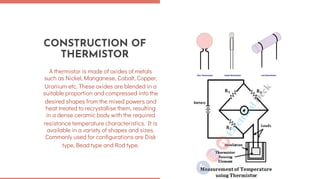
A thermistor is made of oxides of metals
such as Nickel, Manganese, Cobalt, Copper,
Uranium etc. These oxides are blended in a
suitable proportion and compressed into the
desired shapes from the mixed powers and
heat treated to recrystallise them, resulting
in a dense ceramic body with the required
resistance temperature characteristics. It is
available in a variety of shapes and sizes.
Commonly used for configurations are Disk
type, Bead type and Rod type.
A thermistor is made of oxides of metals
such as Nickel, Manganese, Cobalt, Copper,
Uranium etc. These oxides are blended in a
suitable proportion and compressed into the
desired shapes from the mixed powers and
heat treated to recrystallise them, resulting
in a dense ceramic body with the required
resistance temperature characteristics. It is
available in a variety of shapes and sizes.
Commonly used for configurations are Disk
type, Bead type and Rod type.
CONSTRUCTION OF
THERMISTOR
CONSTRUCTION OF
THERMISTOR
HOW THERMISTORS WORK
Thermistors work by utilizing the
temperature dependence of the
semiconductor material from which they are
made. As the temperature changes, the
number of charge carriers in the material
changes, which in turn changes the
resistance of the thermistor. The relationship
between resistance and temperature is non-
linear.
Thermistors work by utilizing the
temperature dependence of the
semiconductor material from which they are
made. As the temperature changes, the
number of charge carriers in the material
changes, which in turn changes the
resistance of the thermistor. The relationship
between resistance and temperature is non-
linear.
Relation between the temperature
and the resistance
Relation between the temperature
and the resistance
• The relation between the temperature and the resistance of
the thermistor is mathematically expressed by the equation
:RT₁ = RT₂ exp[β((1/T₁)-(1/T₂) ]
Where,
RT₁ - Resistance of the thermistor at temperature T₁ in Kelvin.
RT₂ - Resistance of the thermistor at temperature T₂ in Kelvin.
β-temperature depending on the material of thermistor.
• The relation between the temperature and the resistance of
the thermistor is mathematically expressed by the equation
:RT₁ = RT₂ exp[β((1/T₁)-(1/T₂) ]
Where,
RT₁ - Resistance of the thermistor at temperature T₁ in Kelvin.
RT₂ - Resistance of the thermistor at temperature T₂ in Kelvin.
β-temperature depending on the material of thermistor.
Applications of Thermistor
The main function of a thermistor is to be used as a temperature sensor.
They are used in digital thermometers.
Thermistors are used to control and maintain the temperature of a room for
domestic and office use.
They are used in automobiles to monitor the temperature.
They are used for protection against overcurrent in electrical circuits and also
act as a fuse.
The Inrush thermistors are used for the safe starting of electrical motor.
They also provide time delays in an electrical circuits.
The main function of a thermistor is to be used as a temperature sensor.
They are used in digital thermometers.
Thermistors are used to control and maintain the temperature of a room for
domestic and office use.
They are used in automobiles to monitor the temperature.
They are used for protection against overcurrent in electrical circuits and also
act as a fuse.
The Inrush thermistors are used for the safe starting of electrical motor.
They also provide time delays in an electrical circuits.
CONCLUSION
CONCLUSION
Thermistors are versatile and useful components in electronic circuits.
They can be used for temperature sensing, overcurrent protection, self-
regulating heating elements, and temperature compensation. PTC and
NTC thermistors have different characteristics and are used for different
applications.
Thermistors are versatile and useful components in electronic circuits.
They can be used for temperature sensing, overcurrent protection, self-
regulating heating elements, and temperature compensation. PTC and
NTC thermistors have different characteristics and are used for different
applications.
THANK YOU
THANK YOU
Do you have any questions?

ppt pawan_merged.pdf

  • 2.
    INTRODUCTION INTRODUCTION Thermistor is atype of resistor whose resistance changes with temperature. It is commonly used in temperature sensing applications. Thermistors can be classified into two types: Positive Temperature Coefficient (PTC) and Negative Temperature Coefficient (NTC). Thermistor is a type of resistor whose resistance changes with temperature. It is commonly used in temperature sensing applications. Thermistors can be classified into two types: Positive Temperature Coefficient (PTC) and Negative Temperature Coefficient (NTC).
  • 3.
    PTC thermistors arethermistors whose resistance increases with increasing temperature. They are commonly used as overcurrent protectors and self-regulating heating elements. PTC thermistors have a non-linear resistance-temperature characteristic. PTC thermistors are thermistors whose resistance increases with increasing temperature. They are commonly used as overcurrent protectors and self-regulating heating elements. PTC thermistors have a non-linear resistance-temperature characteristic. PTC THERMISTORS PTC THERMISTORS
  • 4.
    NTC thermistors arethermistors whose resistance decreases with increasing temperature. They are commonly used in temperature sensing applications. NTC thermistors have a negative temperature coefficient of resistance and a non-linear resistance-temperature characteristic. NTC thermistors are thermistors whose resistance decreases with increasing temperature. They are commonly used in temperature sensing applications. NTC thermistors have a negative temperature coefficient of resistance and a non-linear resistance-temperature characteristic. NTC THERMISTORS NTC THERMISTORS
  • 5.
    A thermistor ismade of oxides of metals such as Nickel, Manganese, Cobalt, Copper, Uranium etc. These oxides are blended in a suitable proportion and compressed into the desired shapes from the mixed powers and heat treated to recrystallise them, resulting in a dense ceramic body with the required resistance temperature characteristics. It is available in a variety of shapes and sizes. Commonly used for configurations are Disk type, Bead type and Rod type. A thermistor is made of oxides of metals such as Nickel, Manganese, Cobalt, Copper, Uranium etc. These oxides are blended in a suitable proportion and compressed into the desired shapes from the mixed powers and heat treated to recrystallise them, resulting in a dense ceramic body with the required resistance temperature characteristics. It is available in a variety of shapes and sizes. Commonly used for configurations are Disk type, Bead type and Rod type. CONSTRUCTION OF THERMISTOR CONSTRUCTION OF THERMISTOR
  • 6.
    HOW THERMISTORS WORK HOWTHERMISTORS WORK Thermistors work by utilizing the temperature dependence of the semiconductor material from which they are made. As the temperature changes, the number of charge carriers in the material changes, which in turn changes the resistance of the thermistor. The relationship between resistance and temperature is non- linear. Thermistors work by utilizing the temperature dependence of the semiconductor material from which they are made. As the temperature changes, the number of charge carriers in the material changes, which in turn changes the resistance of the thermistor. The relationship between resistance and temperature is non- linear.
  • 7.
    Relation between thetemperature and the resistance Relation between the temperature and the resistance • The relation between the temperature and the resistance of the thermistor is mathematically expressed by the equation :RT₁ = RT₂ exp[β((1/T₁)-(1/T₂) ] Where, RT₁ - Resistance of the thermistor at temperature T₁ in Kelvin. RT₂ - Resistance of the thermistor at temperature T₂ in Kelvin. β-temperature depending on the material of thermistor. • The relation between the temperature and the resistance of the thermistor is mathematically expressed by the equation :RT₁ = RT₂ exp[β((1/T₁)-(1/T₂) ] Where, RT₁ - Resistance of the thermistor at temperature T₁ in Kelvin. RT₂ - Resistance of the thermistor at temperature T₂ in Kelvin. β-temperature depending on the material of thermistor.
  • 8.
    Applications of Thermistor Applicationsof Thermistor The main function of a thermistor is to be used as a temperature sensor. They are used in digital thermometers. Thermistors are used to control and maintain the temperature of a room for domestic and office use. They are used in automobiles to monitor the temperature. They are used for protection against overcurrent in electrical circuits and also act as a fuse. The Inrush thermistors are used for the safe starting of electrical motor. They also provide time delays in an electrical circuits. The main function of a thermistor is to be used as a temperature sensor. They are used in digital thermometers. Thermistors are used to control and maintain the temperature of a room for domestic and office use. They are used in automobiles to monitor the temperature. They are used for protection against overcurrent in electrical circuits and also act as a fuse. The Inrush thermistors are used for the safe starting of electrical motor. They also provide time delays in an electrical circuits.
  • 9.
    CONCLUSION CONCLUSION Thermistors are versatileand useful components in electronic circuits. They can be used for temperature sensing, overcurrent protection, self- regulating heating elements, and temperature compensation. PTC and NTC thermistors have different characteristics and are used for different applications. Thermistors are versatile and useful components in electronic circuits. They can be used for temperature sensing, overcurrent protection, self- regulating heating elements, and temperature compensation. PTC and NTC thermistors have different characteristics and are used for different applications.
  • 10.
    THANK YOU THANK YOU Doyou have any questions? Do you have any questions?