Download as PDF, PPTX
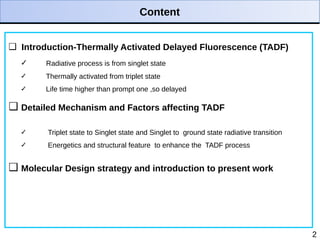


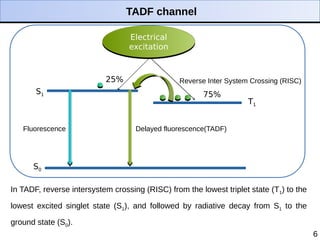
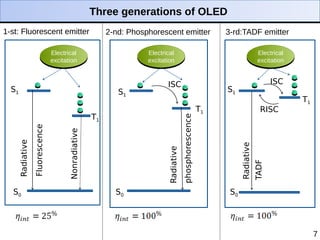
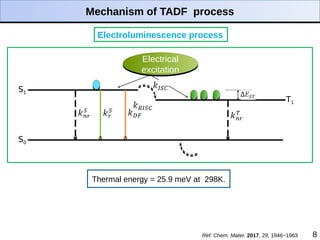

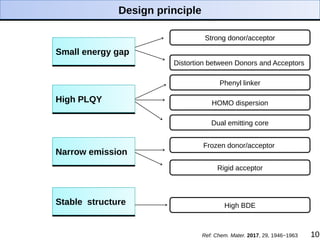
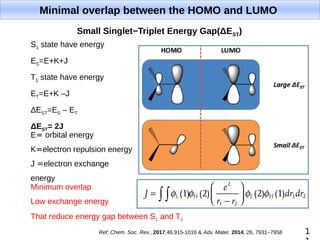


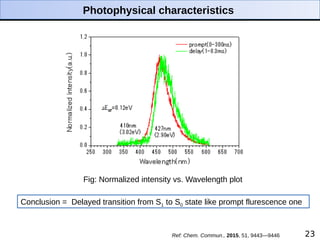


The document discusses thermally activated delayed fluorescence (TADF) for organic light emitting diodes. It begins with an introduction to TADF and the mechanisms allowing conversion of triplet excitons to light. Key parameters for efficient TADF emitters include a small singlet-triplet energy gap, high photoluminescence quantum yield, and high oscillator strength. Molecular design strategies aim to engineer these parameters, such as introducing strong donor-acceptor motifs or using spiro linkers to separate orbitals. The document concludes that TADF could harvest normally wasted triplet excitons, improving light emission efficiency.


