Anubhav Jain
The Materials Project and
computational materials discovery
DREAMS, May 2015
Lawrence Berkeley Lab
Berkeley, CA
  The Materials Design Challenge
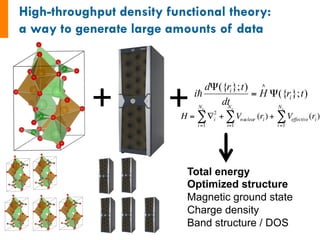
  High-Throughput density functional theory +
new battery materials
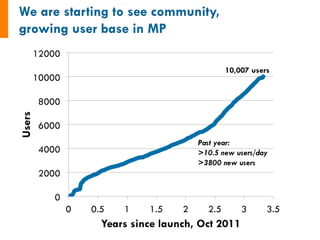
  The Materials Project
  Concluding thoughts
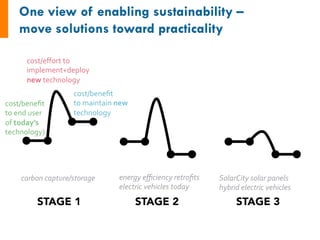
cost/effort	to	
implement+deploy	
new	technology	
cost/benefit	
to	maintain	new	
technology	
cost/benefit	
to	end	user	
of	today’s	
technology)	
STAGE 1 STAGE 2 STAGE 3
carbon	capture/storage	 energy	efficiency	retrofits	
electric	vehicles	today	
SolarCity	solar	panels	
hybrid	electric	vehicles
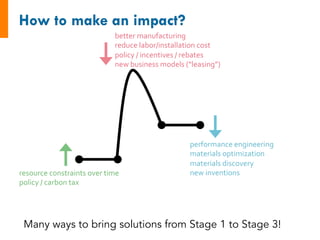
resource	constraints	over	time	
policy	/	carbon	tax	
better	manufacturing	
reduce	labor/installation	cost	
policy	/	incentives	/	rebates	
new	business	models	(“leasing”)	
performance	engineering	
materials	optimization	
materials	discovery	
new	inventions	
Many ways to bring solutions from Stage 1 to Stage 3!
¡  Alternative materials could make a big dent in
sustainability, scalability, and cost
¡  But it’s hard! In most of these applications, we’ve been
re-using the same fundamental materials for decades
§  solar power w/Si since 1950s
§  graphite/LCO (basis of today’s Li battery electrodes) since
1990
¡  Why is designing brand new materials such a
challenge?
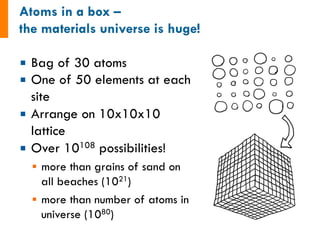
¡  Bag of 30 atoms
¡  One of 50 elements at each
site
¡  Arrange on 10x10x10
lattice
¡  Over 10108 possibilities!
§  more than grains of sand on
all beaches (1021)
§  more than number of atoms in
universe (1080)
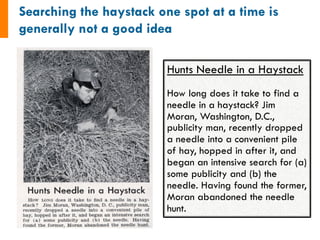
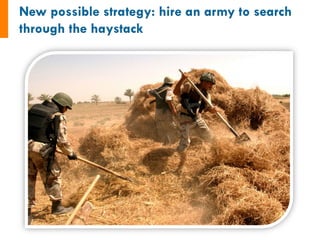
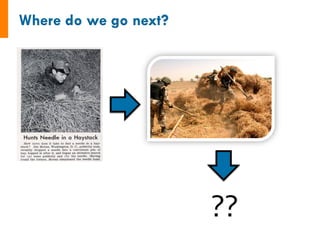
Hunts Needle in a Haystack
How long does it take to find a
needle in a haystack? Jim
Moran, Washington, D.C.,
publicity man, recently dropped
a needle into a convenient pile
of hay, hopped in after it, and
began an intensive search for (a)
some publicity and (b) the
needle. Having found the former,
Moran abandoned the needle
hunt.
We need new ideas for
accelerating materials discovery
  The Materials Design Challenge
  High-Throughput density functional theory +
new battery materials
  The Materials Project
  Concluding thoughts
+	 )};({
)};({
trH
dt
trd
i i
i
Ψ=
Ψ ∧
!
+	
Total energy
Optimized structure
Magnetic ground state
Charge density
Band structure / DOS
H = ∇i
2
i=1
Ne
∑ + Vnuclear (ri)
i=1
Ne
∑ + Veffective(ri)
i=1
Ne
∑
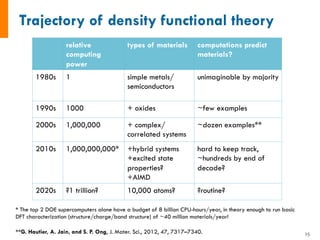
relative
computing
power
types of materials computations predict
materials?
1980s 1 simple metals/
semiconductors
unimaginable by majority
1990s 1000 + oxides ~few examples
2000s 1,000,000 + complex/
correlated systems
~dozen examples**
2010s 1,000,000,000* +hybrid systems
+excited state
properties?
+AIMD
hard to keep track,
~hundreds by end of
decade?
2020s ?1 trillion? 10,000 atoms? ?routine?
* The top 2 DOE supercomputers alone have a budget of 8 billion CPU-hours/year, in theory enough to run basic
DFT characterization (structure/charge/band structure) of ~40 million materials/year!
**G. Hautier, A. Jain, and S. P. Ong, J. Mater. Sci., 2012, 47, 7317–7340. 15
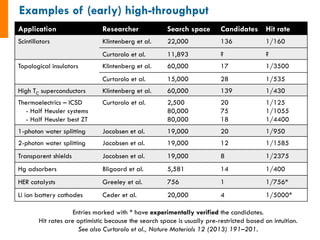
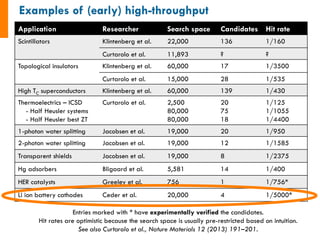
Application Researcher Search space Candidates Hit rate
Scintillators Klintenberg et al. 22,000 136 1/160
Curtarolo et al. 11,893 ? ?
Topological insulators Klintenberg et al. 60,000 17 1/3500
Curtarolo et al. 15,000 28 1/535
High TC superconductors Klintenberg et al. 60,000 139 1/430
Thermoelectrics – ICSD
- Half Heusler systems
- Half Heusler best ZT
Curtarolo et al. 2,500
80,000
80,000
20
75
18
1/125
1/1055
1/4400
1-photon water splitting Jacobsen et al. 19,000 20 1/950
2-photon water splitting Jacobsen et al. 19,000 12 1/1585
Transparent shields Jacobsen et al. 19,000 8 1/2375
Hg adsorbers Bligaard et al. 5,581 14 1/400
HER catalysts Greeley et al. 756 1 1/756*
Li ion battery cathodes Ceder et al. 20,000 4 1/5000*
Entries marked with * have experimentally verified the candidates.
Hit rates are optimistic because the search space is usually pre-restricted based on intuition.
See also Curtarolo et al., Nature Materials 12 (2013) 191–201.
Application Researcher Search space Candidates Hit rate
Scintillators Klintenberg et al. 22,000 136 1/160
Curtarolo et al. 11,893 ? ?
Topological insulators Klintenberg et al. 60,000 17 1/3500
Curtarolo et al. 15,000 28 1/535
High TC superconductors Klintenberg et al. 60,000 139 1/430
Thermoelectrics – ICSD
- Half Heusler systems
- Half Heusler best ZT
Curtarolo et al. 2,500
80,000
80,000
20
75
18
1/125
1/1055
1/4400
1-photon water splitting Jacobsen et al. 19,000 20 1/950
2-photon water splitting Jacobsen et al. 19,000 12 1/1585
Transparent shields Jacobsen et al. 19,000 8 1/2375
Hg adsorbers Bligaard et al. 5,581 14 1/400
HER catalysts Greeley et al. 756 1 1/756*
Li ion battery cathodes Ceder et al. 20,000 4 1/5000*
Entries marked with * have experimentally verified the candidates.
Hit rates are optimistic because the search space is usually pre-restricted based on intuition.
See also Curtarolo et al., Nature Materials 12 (2013) 191–201.
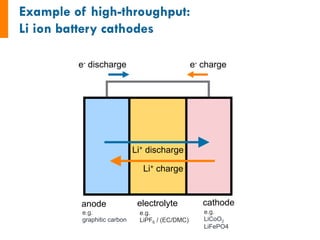
anode electrolyte cathode
Li+ discharge
e- discharge
e.g.
graphitic carbon
e.g.
LiPF6 / (EC/DMC)
e.g.
LiCoO2
LiFePO4
Li+ charge
e- charge
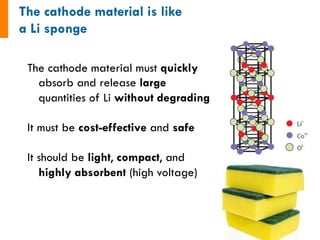
The cathode material must quickly
absorb and release large
quantities of Li without degrading
It must be cost-effective and safe
It should be light, compact, and
highly absorbent (high voltage)
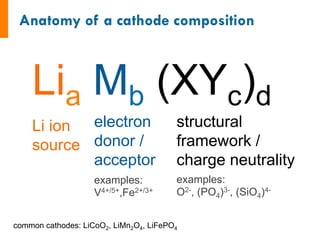
Lia Mb (XYc)d
Li ion
source
electron
donor /
acceptor
structural
framework /
charge neutrality
examples:
V4+/5+,Fe2+/3+
examples:
O2-, (PO4)3-, (SiO4)4-
common cathodes: LiCoO2, LiMn2O4, LiFePO4
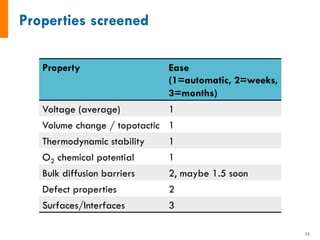
Property Ease
(1=automatic, 2=weeks,
3=months)
Voltage (average) 1
Volume change / topotactic 1
Thermodynamic stability 1
O2 chemical potential 1
Bulk diffusion barriers 2, maybe 1.5 soon
Defect properties 2
Surfaces/Interfaces 3
21
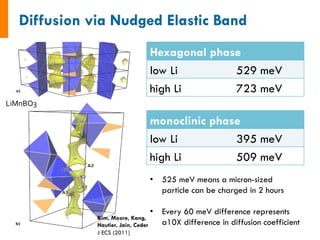
Hexagonal phase
low Li 529 meV
high Li 723 meV
monoclinic phase
low Li 395 meV
high Li 509 meV
•  525 meV means a micron-sized
particle can be charged in 2 hours
•  Every 60 meV difference represents
a10X difference in diffusion coefficient
Kim, Moore, Kang,
Hautier, Jain, Ceder
J ECS (2011)
LiMnBO3
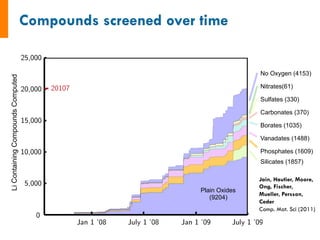
Plain Oxides
(9204)
Silicates (1857)
Phosphates (1609)
Borates (1035)
Carbonates (370)
Vanadates (1488)
Sulfates (330)
Nitrates(61)
No Oxygen (4153)
LiContainingCompoundsComputed
Jain, Hautier, Moore,
Ong, Fischer,
Mueller, Persson,
Ceder
Comp. Mat. Sci (2011)
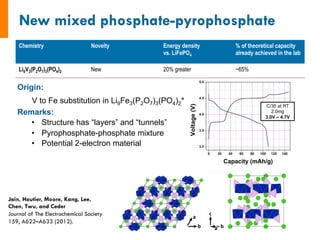
Chemistry Novelty Energy density
vs. LiFePO4
% of theoretical capacity
already achieved in the lab
Li9V3(P2O7)3(PO4)2 New 20% greater ~65%
Origin:
V to Fe substitution in Li9Fe3(P2O7)3(PO4)2*
Remarks:
•  Structure has “layers” and “tunnels”
•  Pyrophosphate-phosphate mixture
•  Potential 2-electron material
Jain, Hautier, Moore, Kang, Lee,
Chen, Twu, and Ceder
Journal of The Electrochemical Society
159, A622–A633 (2012).
C/35 at RT
2.0mg
3.0V – 4.7V
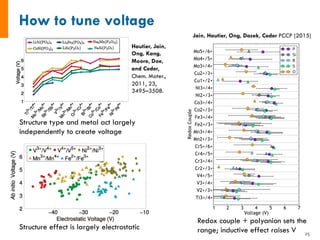
Structure type and metal act largely
independently to create voltage
Structure effect is largely electrostatic
Redox couple + polyanion sets the
range; inductive effect raises V
Hautier, Jain,
Ong, Kang,
Moore, Doe,
and Ceder,
Chem. Mater.,
2011, 23,
3495–3508.
Jain, Hautier, Ong, Dacek, Ceder PCCP (2015)
25
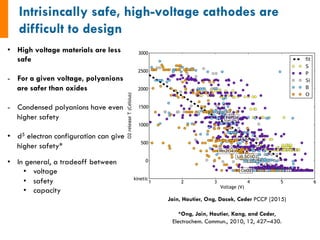
Jain, Hautier, Ong, Dacek, Ceder PCCP (2015)
*Ong, Jain, Hautier, Kang, and Ceder,
Electrochem. Commun., 2010, 12, 427–430.
•  High voltage materials are less
safe
-  For a given voltage, polyanions
are safer than oxides
-  Condensed polyanions have even
higher safety
•  d5 electron configuration can give
higher safety*
•  In general, a tradeoff between
•  voltage
•  safety
•  capacity
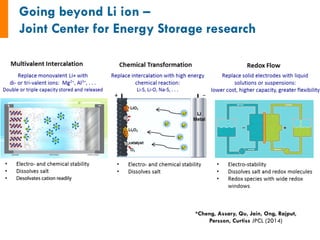
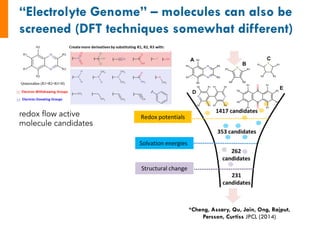
*Cheng, Assary, Qu, Jain, Ong, Rajput,
Persson, Curtiss JPCL (2014)
redox flow active
molecule candidates
*Cheng, Assary, Qu, Jain, Ong, Rajput,
Persson, Curtiss JPCL (2014)
Ongoing work:
thermoelectrics
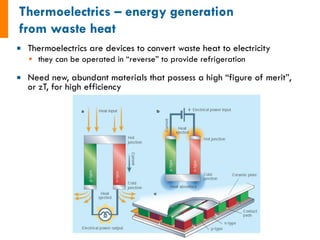
¡  Thermoelectrics are devices to convert waste heat to electricity
§  they can be operated in “reverse” to provide refrigeration
¡  Need new, abundant materials that possess a high “figure of merit”,
or zT, for high efficiency
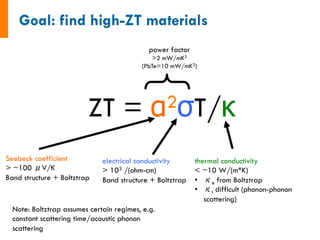
ZT = α2σT/κ
power factor
>2 mW/mK2
(PbTe=10 mW/mK2)
Seebeck coefficient
> ~100 μV/K
Band structure + Boltztrap
electrical conductivity
> 103 /(ohm-cm)
Band structure + Boltztrap
thermal conductivity
< ~10 W/(m*K)
•  κe from Boltztrap
•  κl difficult (phonon-phonon
scattering)
Note: Boltztrap assumes certain regimes, e.g.
constant scattering time/acoustic phonon
scattering
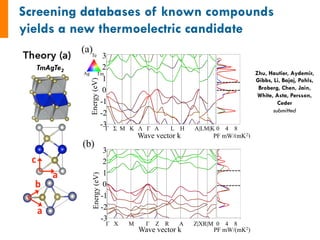
Zhu, Hautier, Aydemir,
Gibbs, Li, Bajaj, Pohls,
Broberg, Chen, Jain,
White, Asta, Persson,
Ceder
submitted
TmAgTe2
Energy(eV)
!
!
Wave vector k
(a)Te
Ag Tm
3
2
1
0
-1
-2
-3Γ Σ M K Λ Γ A L H A|LM|K 0 4 8
PF mW/(mK2)
!
!
!!!!!Wave!vector!k!
!!
(b)
Energy(eV)
Wave vector k
3
2
1
0
-1
-2
-3
Γ X M Γ Z R A Z|XR|M 0 4 8
PF mW/(mK2)
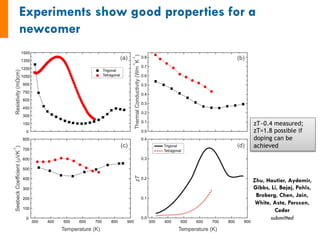
zT~0.4 measured;
zT=1.8 possible if
doping can be
achieved
Zhu, Hautier, Aydemir,
Gibbs, Li, Bajaj, Pohls,
Broberg, Chen, Jain,
White, Asta, Persson,
Ceder
submitted
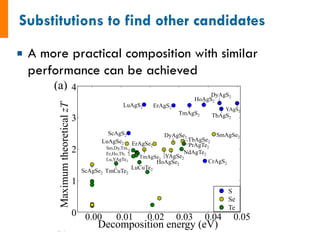
¡  A more practical composition with similar
performance can be achieved
TbAgS2
DyAgS2
TmAgS2
ErAgS2
HoAgS2
LuAgS2
ScAgS2 SmAgSe2
PrAgTe2
TbAgSe2
ErAgSe2
LuAgSe2
DyAgSe2
CrAgS2
LuCuTe2TmCuTe2ScAgSe2
NdAgTe2
YAgSe2
HoAgSe2
TmAgSe2
Sm,Dy,Tm,
Er,Ho,Tb,
Lu,YAgTe2
YAgS2
(a)
MaximumtheoreticalzT
4
3
2
1
0 0.00 0.01 0.02 0.03 0.04 0.05
Decomposition energy (eV)
S
Se
Te
(b)
ScAgSe2
L
Tm,Lu,Er
Y,Dy,TbA
TmC
MaximumtheoreticalzT
(a) 4
3
2
1
0
Deco
0.00 0
(b)
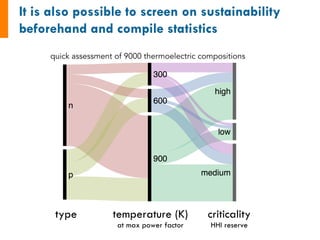
quick assessment of 9000 thermoelectric compositions
  The Materials Design Challenge
  High-Throughput density functional theory +
new battery materials
  The Materials Project
  Concluding thoughts
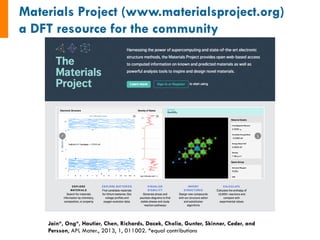
Jain*, Ong*, Hautier, Chen, Richards, Dacek, Cholia, Gunter, Skinner, Ceder, and
Persson, APL Mater., 2013, 1, 011002. *equal contributions
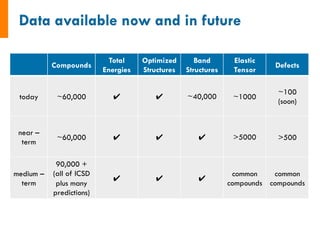
Compounds
Total
Energies
Optimized
Structures
Band
Structures
Elastic
Tensor
Defects
today ~60,000 ✔ ✔ ~40,000 ~1000
~100
(soon)
near –
term
~60,000 ✔ ✔ ✔ >5000 >500
medium –
term
90,000 +
(all of ICSD
plus many
predictions)
✔ ✔ ✔
common
compounds
common
compounds
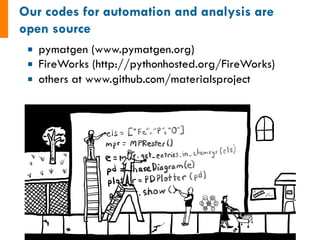
¡  pymatgen (www.pymatgen.org)
¡  FireWorks (http://pythonhosted.org/FireWorks)
¡  others at www.github.com/materialsproject
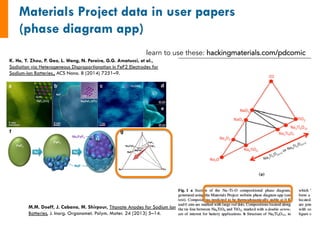
K. He, Y. Zhou, P. Gao, L. Wang, N. Pereira, G.G. Amatucci, et al.,
Sodiation via Heterogeneous Disproportionation in FeF2 Electrodes for
Sodium-Ion Batteries., ACS Nano. 8 (2014) 7251–9.
M.M. Doeff, J. Cabana, M. Shirpour, Titanate Anodes for Sodium Ion
Batteries, J. Inorg. Organomet. Polym. Mater. 24 (2013) 5–14.
learn to use these: hackingmaterials.com/pdcomic
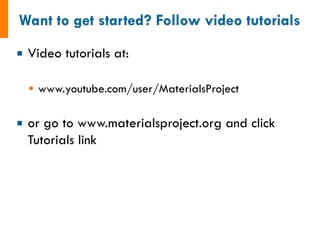
¡  Video tutorials at:
§  www.youtube.com/user/MaterialsProject
¡  or go to www.materialsproject.org and click
Tutorials link
Where is the
Materials Project
headed in the
future?
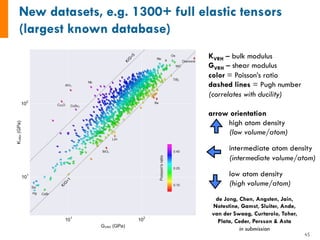
de Jong, Chen, Angsten, Jain,
Notestine, Gamst, Sluiter, Ande,
van der Swaag, Curtarolo, Toher,
Plata, Ceder, Persson & Asta
in submission
KVRH – bulk modulus
GVRH – shear modulus
color = Poisson’s ratio
dashed lines = Pugh number
(correlates with ducility)
arrow orientation
high atom density
(low volume/atom)
intermediate atom density
(intermediate volume/atom)
low atom density
(high volume/atom)
45
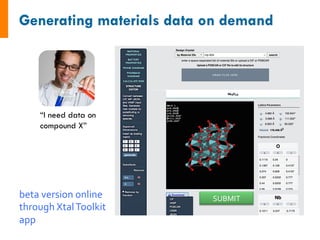
beta	version	online	
through	Xtal	Toolkit	
app	
	
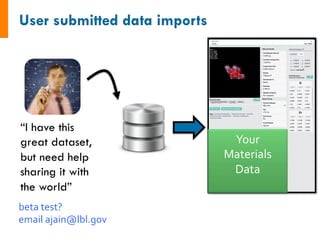
“I need data on
compound X”
SUBMIT
“I have this
great dataset,
but need help
sharing it with
the world”
Your	
Materials	
Data	
	
beta	test?	
email	ajain@lbl.gov
  The Materials Design Challenge
  High-Throughput density functional theory +
new battery materials
  The Materials Project
  Concluding thoughts
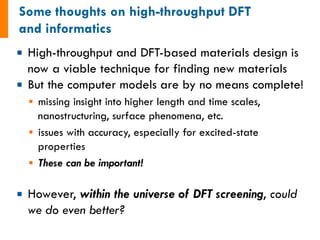
¡  High-throughput and DFT-based materials design is
now a viable technique for finding new materials
¡  But the computer models are by no means complete!
§  missing insight into higher length and time scales,
nanostructuring, surface phenomena, etc.
§  issues with accuracy, especially for excited-state
properties
§  These can be important!
¡  However, within the universe of DFT screening, could
we do even better?
??
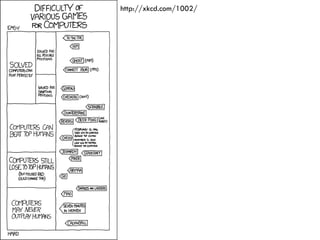
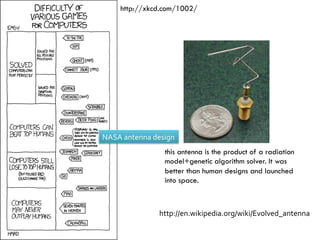
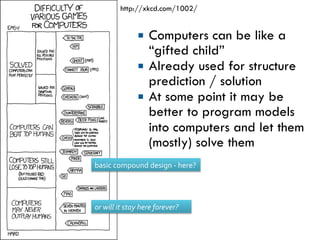
http://xkcd.com/1002/
NASA	antenna	design	
http://en.wikipedia.org/wiki/Evolved_antenna	
this antenna is the product of a radiation
model+genetic algorithm solver. It was
better than human designs and launched
into space.
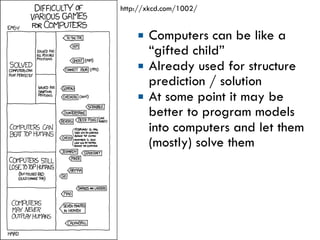
¡  Computers can be like a
“gifted child”
¡  Already used for structure
prediction / solution
¡  At some point it may be
better to program models
into computers and let them
(mostly) solve them
http://xkcd.com/1002/
¡  Computers can be like a
“gifted child”
¡  Already used for structure
prediction / solution
¡  At some point it may be
better to program models
into computers and let them
(mostly) solve them
http://xkcd.com/1002/
basic	compound	design	-	here?	
or	will	it	stay	here	forever?
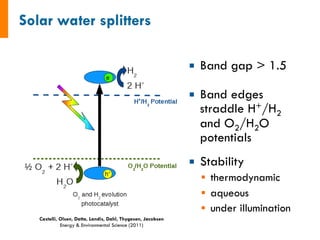
¡  Band gap > 1.5
¡  Band edges
straddle H+/H2
and O2/H2O
potentials
¡  Stability
§  thermodynamic
§  aqueous
§  under illumination
Castelli, Olsen, Datta, Landis, Dahl, Thygesen, Jacobsen
Energy & Environmental Science (2011)
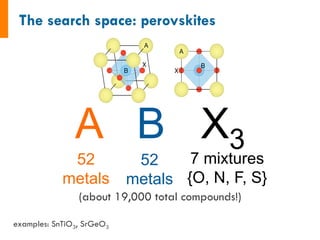
A B X3
52
metals
52
metals
7 mixtures
{O, N, F, S}
examples: SnTiO3, SrGeO3
(about 19,000 total compounds!)
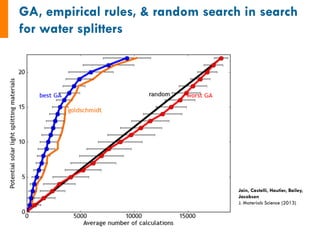
Jain, Castelli, Hautier, Bailey,
Jacobsen
J. Materials Science (2013)
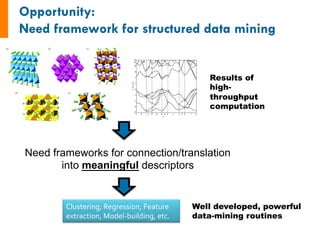
Results of
high-
throughput
computation
Clustering,	Regression,	Feature	
extraction,	Model-building,	etc.	
Well developed, powerful
data-mining routines
Need frameworks for connection/translation
into meaningful descriptors
¡  Dr. Kristin Persson and Prof. Gerbrand Ceder,
founders of Materials Project and their teams
¡  Prof. Shyue Ping Ong
¡  Prof. Geoffroy Hautier
¡  Prof. Jeffrey Snyder + team (thermoelectrics)
¡  Prof. Mary Anne White + team (thermoelectrics)
¡  Prof. Mark Asta and team (elastic tensor/TEs)
¡  Prof. Karsten Jacobsen + team (perovskite GA)
¡  NERSC computing center and staff
¡  Funding: DOE, LBL LDRD, Bosch, Umicore

The Materials Project and computational materials discovery

  • 1.
    Anubhav Jain The MaterialsProject and computational materials discovery DREAMS, May 2015 Lawrence Berkeley Lab Berkeley, CA
  • 2.
      The MaterialsDesign Challenge   High-Throughput density functional theory + new battery materials   The Materials Project   Concluding thoughts
  • 3.
    cost/effort to implement+deploy new technology cost/benefit to maintain new technology cost/benefit to end user of today’s technology) STAGE 1 STAGE2 STAGE 3 carbon capture/storage energy efficiency retrofits electric vehicles today SolarCity solar panels hybrid electric vehicles
  • 4.
  • 5.
    ¡  Alternative materialscould make a big dent in sustainability, scalability, and cost ¡  But it’s hard! In most of these applications, we’ve been re-using the same fundamental materials for decades §  solar power w/Si since 1950s §  graphite/LCO (basis of today’s Li battery electrodes) since 1990 ¡  Why is designing brand new materials such a challenge?
  • 8.
    ¡  Bag of30 atoms ¡  One of 50 elements at each site ¡  Arrange on 10x10x10 lattice ¡  Over 10108 possibilities! §  more than grains of sand on all beaches (1021) §  more than number of atoms in universe (1080)
  • 10.
    Hunts Needle ina Haystack How long does it take to find a needle in a haystack? Jim Moran, Washington, D.C., publicity man, recently dropped a needle into a convenient pile of hay, hopped in after it, and began an intensive search for (a) some publicity and (b) the needle. Having found the former, Moran abandoned the needle hunt.
  • 11.
    We need newideas for accelerating materials discovery
  • 12.
      The MaterialsDesign Challenge   High-Throughput density functional theory + new battery materials   The Materials Project   Concluding thoughts
  • 13.
    + )};({ )};({ trH dt trd i i i Ψ= Ψ∧ ! + Total energy Optimized structure Magnetic ground state Charge density Band structure / DOS H = ∇i 2 i=1 Ne ∑ + Vnuclear (ri) i=1 Ne ∑ + Veffective(ri) i=1 Ne ∑
  • 15.
    relative computing power types of materialscomputations predict materials? 1980s 1 simple metals/ semiconductors unimaginable by majority 1990s 1000 + oxides ~few examples 2000s 1,000,000 + complex/ correlated systems ~dozen examples** 2010s 1,000,000,000* +hybrid systems +excited state properties? +AIMD hard to keep track, ~hundreds by end of decade? 2020s ?1 trillion? 10,000 atoms? ?routine? * The top 2 DOE supercomputers alone have a budget of 8 billion CPU-hours/year, in theory enough to run basic DFT characterization (structure/charge/band structure) of ~40 million materials/year! **G. Hautier, A. Jain, and S. P. Ong, J. Mater. Sci., 2012, 47, 7317–7340. 15
  • 16.
    Application Researcher Searchspace Candidates Hit rate Scintillators Klintenberg et al. 22,000 136 1/160 Curtarolo et al. 11,893 ? ? Topological insulators Klintenberg et al. 60,000 17 1/3500 Curtarolo et al. 15,000 28 1/535 High TC superconductors Klintenberg et al. 60,000 139 1/430 Thermoelectrics – ICSD - Half Heusler systems - Half Heusler best ZT Curtarolo et al. 2,500 80,000 80,000 20 75 18 1/125 1/1055 1/4400 1-photon water splitting Jacobsen et al. 19,000 20 1/950 2-photon water splitting Jacobsen et al. 19,000 12 1/1585 Transparent shields Jacobsen et al. 19,000 8 1/2375 Hg adsorbers Bligaard et al. 5,581 14 1/400 HER catalysts Greeley et al. 756 1 1/756* Li ion battery cathodes Ceder et al. 20,000 4 1/5000* Entries marked with * have experimentally verified the candidates. Hit rates are optimistic because the search space is usually pre-restricted based on intuition. See also Curtarolo et al., Nature Materials 12 (2013) 191–201.
  • 17.
    Application Researcher Searchspace Candidates Hit rate Scintillators Klintenberg et al. 22,000 136 1/160 Curtarolo et al. 11,893 ? ? Topological insulators Klintenberg et al. 60,000 17 1/3500 Curtarolo et al. 15,000 28 1/535 High TC superconductors Klintenberg et al. 60,000 139 1/430 Thermoelectrics – ICSD - Half Heusler systems - Half Heusler best ZT Curtarolo et al. 2,500 80,000 80,000 20 75 18 1/125 1/1055 1/4400 1-photon water splitting Jacobsen et al. 19,000 20 1/950 2-photon water splitting Jacobsen et al. 19,000 12 1/1585 Transparent shields Jacobsen et al. 19,000 8 1/2375 Hg adsorbers Bligaard et al. 5,581 14 1/400 HER catalysts Greeley et al. 756 1 1/756* Li ion battery cathodes Ceder et al. 20,000 4 1/5000* Entries marked with * have experimentally verified the candidates. Hit rates are optimistic because the search space is usually pre-restricted based on intuition. See also Curtarolo et al., Nature Materials 12 (2013) 191–201.
  • 18.
    anode electrolyte cathode Li+discharge e- discharge e.g. graphitic carbon e.g. LiPF6 / (EC/DMC) e.g. LiCoO2 LiFePO4 Li+ charge e- charge
  • 19.
    The cathode materialmust quickly absorb and release large quantities of Li without degrading It must be cost-effective and safe It should be light, compact, and highly absorbent (high voltage)
  • 20.
    Lia Mb (XYc)d Liion source electron donor / acceptor structural framework / charge neutrality examples: V4+/5+,Fe2+/3+ examples: O2-, (PO4)3-, (SiO4)4- common cathodes: LiCoO2, LiMn2O4, LiFePO4
  • 21.
    Property Ease (1=automatic, 2=weeks, 3=months) Voltage(average) 1 Volume change / topotactic 1 Thermodynamic stability 1 O2 chemical potential 1 Bulk diffusion barriers 2, maybe 1.5 soon Defect properties 2 Surfaces/Interfaces 3 21
  • 22.
    Hexagonal phase low Li529 meV high Li 723 meV monoclinic phase low Li 395 meV high Li 509 meV •  525 meV means a micron-sized particle can be charged in 2 hours •  Every 60 meV difference represents a10X difference in diffusion coefficient Kim, Moore, Kang, Hautier, Jain, Ceder J ECS (2011) LiMnBO3
  • 23.
    Plain Oxides (9204) Silicates (1857) Phosphates(1609) Borates (1035) Carbonates (370) Vanadates (1488) Sulfates (330) Nitrates(61) No Oxygen (4153) LiContainingCompoundsComputed Jain, Hautier, Moore, Ong, Fischer, Mueller, Persson, Ceder Comp. Mat. Sci (2011)
  • 24.
    Chemistry Novelty Energydensity vs. LiFePO4 % of theoretical capacity already achieved in the lab Li9V3(P2O7)3(PO4)2 New 20% greater ~65% Origin: V to Fe substitution in Li9Fe3(P2O7)3(PO4)2* Remarks: •  Structure has “layers” and “tunnels” •  Pyrophosphate-phosphate mixture •  Potential 2-electron material Jain, Hautier, Moore, Kang, Lee, Chen, Twu, and Ceder Journal of The Electrochemical Society 159, A622–A633 (2012). C/35 at RT 2.0mg 3.0V – 4.7V
  • 25.
    Structure type andmetal act largely independently to create voltage Structure effect is largely electrostatic Redox couple + polyanion sets the range; inductive effect raises V Hautier, Jain, Ong, Kang, Moore, Doe, and Ceder, Chem. Mater., 2011, 23, 3495–3508. Jain, Hautier, Ong, Dacek, Ceder PCCP (2015) 25
  • 27.
    Jain, Hautier, Ong,Dacek, Ceder PCCP (2015) *Ong, Jain, Hautier, Kang, and Ceder, Electrochem. Commun., 2010, 12, 427–430. •  High voltage materials are less safe -  For a given voltage, polyanions are safer than oxides -  Condensed polyanions have even higher safety •  d5 electron configuration can give higher safety* •  In general, a tradeoff between •  voltage •  safety •  capacity
  • 28.
    *Cheng, Assary, Qu,Jain, Ong, Rajput, Persson, Curtiss JPCL (2014)
  • 29.
    redox flow active moleculecandidates *Cheng, Assary, Qu, Jain, Ong, Rajput, Persson, Curtiss JPCL (2014)
  • 30.
  • 31.
    ¡  Thermoelectrics aredevices to convert waste heat to electricity §  they can be operated in “reverse” to provide refrigeration ¡  Need new, abundant materials that possess a high “figure of merit”, or zT, for high efficiency
  • 32.
    ZT = α2σT/κ powerfactor >2 mW/mK2 (PbTe=10 mW/mK2) Seebeck coefficient > ~100 μV/K Band structure + Boltztrap electrical conductivity > 103 /(ohm-cm) Band structure + Boltztrap thermal conductivity < ~10 W/(m*K) •  κe from Boltztrap •  κl difficult (phonon-phonon scattering) Note: Boltztrap assumes certain regimes, e.g. constant scattering time/acoustic phonon scattering
  • 33.
    Zhu, Hautier, Aydemir, Gibbs,Li, Bajaj, Pohls, Broberg, Chen, Jain, White, Asta, Persson, Ceder submitted TmAgTe2 Energy(eV) ! ! Wave vector k (a)Te Ag Tm 3 2 1 0 -1 -2 -3Γ Σ M K Λ Γ A L H A|LM|K 0 4 8 PF mW/(mK2) ! ! !!!!!Wave!vector!k! !! (b) Energy(eV) Wave vector k 3 2 1 0 -1 -2 -3 Γ X M Γ Z R A Z|XR|M 0 4 8 PF mW/(mK2)
  • 34.
    zT~0.4 measured; zT=1.8 possibleif doping can be achieved Zhu, Hautier, Aydemir, Gibbs, Li, Bajaj, Pohls, Broberg, Chen, Jain, White, Asta, Persson, Ceder submitted
  • 35.
    ¡  A morepractical composition with similar performance can be achieved TbAgS2 DyAgS2 TmAgS2 ErAgS2 HoAgS2 LuAgS2 ScAgS2 SmAgSe2 PrAgTe2 TbAgSe2 ErAgSe2 LuAgSe2 DyAgSe2 CrAgS2 LuCuTe2TmCuTe2ScAgSe2 NdAgTe2 YAgSe2 HoAgSe2 TmAgSe2 Sm,Dy,Tm, Er,Ho,Tb, Lu,YAgTe2 YAgS2 (a) MaximumtheoreticalzT 4 3 2 1 0 0.00 0.01 0.02 0.03 0.04 0.05 Decomposition energy (eV) S Se Te (b) ScAgSe2 L Tm,Lu,Er Y,Dy,TbA TmC MaximumtheoreticalzT (a) 4 3 2 1 0 Deco 0.00 0 (b)
  • 36.
    quick assessment of9000 thermoelectric compositions
  • 37.
      The MaterialsDesign Challenge   High-Throughput density functional theory + new battery materials   The Materials Project   Concluding thoughts
  • 38.
    Jain*, Ong*, Hautier,Chen, Richards, Dacek, Cholia, Gunter, Skinner, Ceder, and Persson, APL Mater., 2013, 1, 011002. *equal contributions
  • 40.
    Compounds Total Energies Optimized Structures Band Structures Elastic Tensor Defects today ~60,000 ✔✔ ~40,000 ~1000 ~100 (soon) near – term ~60,000 ✔ ✔ ✔ >5000 >500 medium – term 90,000 + (all of ICSD plus many predictions) ✔ ✔ ✔ common compounds common compounds
  • 41.
    ¡  pymatgen (www.pymatgen.org) ¡ FireWorks (http://pythonhosted.org/FireWorks) ¡  others at www.github.com/materialsproject
  • 42.
    K. He, Y.Zhou, P. Gao, L. Wang, N. Pereira, G.G. Amatucci, et al., Sodiation via Heterogeneous Disproportionation in FeF2 Electrodes for Sodium-Ion Batteries., ACS Nano. 8 (2014) 7251–9. M.M. Doeff, J. Cabana, M. Shirpour, Titanate Anodes for Sodium Ion Batteries, J. Inorg. Organomet. Polym. Mater. 24 (2013) 5–14. learn to use these: hackingmaterials.com/pdcomic
  • 43.
    ¡  Video tutorialsat: §  www.youtube.com/user/MaterialsProject ¡  or go to www.materialsproject.org and click Tutorials link
  • 44.
    Where is the MaterialsProject headed in the future?
  • 45.
    de Jong, Chen,Angsten, Jain, Notestine, Gamst, Sluiter, Ande, van der Swaag, Curtarolo, Toher, Plata, Ceder, Persson & Asta in submission KVRH – bulk modulus GVRH – shear modulus color = Poisson’s ratio dashed lines = Pugh number (correlates with ducility) arrow orientation high atom density (low volume/atom) intermediate atom density (intermediate volume/atom) low atom density (high volume/atom) 45
  • 46.
  • 47.
    “I have this greatdataset, but need help sharing it with the world” Your Materials Data beta test? email ajain@lbl.gov
  • 48.
      The MaterialsDesign Challenge   High-Throughput density functional theory + new battery materials   The Materials Project   Concluding thoughts
  • 49.
    ¡  High-throughput andDFT-based materials design is now a viable technique for finding new materials ¡  But the computer models are by no means complete! §  missing insight into higher length and time scales, nanostructuring, surface phenomena, etc. §  issues with accuracy, especially for excited-state properties §  These can be important! ¡  However, within the universe of DFT screening, could we do even better?
  • 50.
  • 52.
  • 53.
    http://xkcd.com/1002/ NASA antenna design http://en.wikipedia.org/wiki/Evolved_antenna this antenna isthe product of a radiation model+genetic algorithm solver. It was better than human designs and launched into space.
  • 54.
    ¡  Computers canbe like a “gifted child” ¡  Already used for structure prediction / solution ¡  At some point it may be better to program models into computers and let them (mostly) solve them http://xkcd.com/1002/
  • 55.
    ¡  Computers canbe like a “gifted child” ¡  Already used for structure prediction / solution ¡  At some point it may be better to program models into computers and let them (mostly) solve them http://xkcd.com/1002/ basic compound design - here? or will it stay here forever?
  • 56.
    ¡  Band gap> 1.5 ¡  Band edges straddle H+/H2 and O2/H2O potentials ¡  Stability §  thermodynamic §  aqueous §  under illumination Castelli, Olsen, Datta, Landis, Dahl, Thygesen, Jacobsen Energy & Environmental Science (2011)
  • 57.
    A B X3 52 metals 52 metals 7mixtures {O, N, F, S} examples: SnTiO3, SrGeO3 (about 19,000 total compounds!)
  • 58.
    Jain, Castelli, Hautier,Bailey, Jacobsen J. Materials Science (2013)
  • 59.
    Results of high- throughput computation Clustering, Regression, Feature extraction, Model-building, etc. Well developed,powerful data-mining routines Need frameworks for connection/translation into meaningful descriptors
  • 60.
    ¡  Dr. KristinPersson and Prof. Gerbrand Ceder, founders of Materials Project and their teams ¡  Prof. Shyue Ping Ong ¡  Prof. Geoffroy Hautier ¡  Prof. Jeffrey Snyder + team (thermoelectrics) ¡  Prof. Mary Anne White + team (thermoelectrics) ¡  Prof. Mark Asta and team (elastic tensor/TEs) ¡  Prof. Karsten Jacobsen + team (perovskite GA) ¡  NERSC computing center and staff ¡  Funding: DOE, LBL LDRD, Bosch, Umicore