










Thermal Testing
Experts in process design and material
processing for over 65 years.
With Rotary Kilns
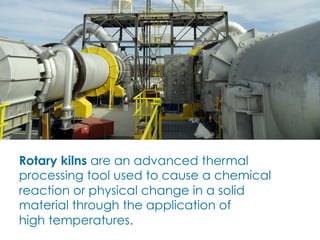
Rotary kilns are an advanced thermal
processing tool used to cause a chemical
reaction or physical change in a solid
material through the application of
high temperatures.
Rotary kilns are highly flexible and can be used
to process a wide variety of materials.
Rotary kilns are highly flexible and can be used
to process a wide variety of materials.
They are used for countless applications, with
new ones being developed all the time.
Testing plays an integral role in the
development of many industrial processes,
but is especially important when working with
rotary kilns, whether the process is new or
well-established.
Some of the most commonly tested
applications include:
Some of the most commonly tested
applications include:
•  Thermal Desorption of Organic/Hazardous
Wastes
Some of the most commonly tested
applications include:
•  Thermal Desorption of Organic/Hazardous
Wastes
•  Sintering
Some of the most commonly tested
applications include:
•  Thermal Desorption of Organic/Hazardous
Wastes
•  Sintering
•  Heat Setting
Some of the most commonly tested
applications include:
•  Thermal Desorption of Organic/Hazardous
Wastes
•  Sintering
•  Heat Setting
•  Organic Combustion
Some of the most commonly tested
applications include:
•  Thermal Desorption of Organic/Hazardous
Wastes
•  Sintering
•  Heat Setting
•  Organic Combustion
•  Metal Recovery
Some of the most commonly tested
applications include:
•  Thermal Desorption of Organic/Hazardous
Wastes
•  Sintering
•  Heat Setting
•  Organic Combustion
•  Metal Recovery
•  Calcination
Some of the most commonly tested
applications include:
•  Thermal Desorption of Organic/Hazardous
Wastes
•  Sintering
•  Heat Setting
•  Organic Combustion
•  Metal Recovery
•  Calcination
•  Mineral Processing
Some of the most commonly tested
applications include:
•  Thermal Desorption of Organic/Hazardous
Wastes
•  Sintering
•  Heat Setting
•  Organic Combustion
•  Metal Recovery
•  Calcination
•  Mineral Processing
•  Reduction Roasting
Some of the most commonly tested
applications include:
•  Thermal Desorption of Organic/Hazardous
Wastes
•  Sintering
•  Heat Setting
•  Organic Combustion
•  Metal Recovery
•  Calcination
•  Mineral Processing
•  Reduction Roasting
•  And More…
Why is
Testing Important?
There are many reasons why it is both
necessary and desirable to conduct testing…
To Size and Design A Commercial Size Kiln
One of the most common reasons for
conducting testing is to gather the
necessary data for sizing a commercial size
unit for an intended application.
In this setting, the desired set of product
parameters has typically been determined,
and the customer needs to know how the
kiln will need to be designed to produce
those specifications.
To Aid in Product Development
Testing is also useful in the product
development stage.
To Aid in Product Development
Testing is also useful in the product
development stage.
Here, testing can be carried out on small
batches of material, in order to determine
what specifications will be needed for the
job at hand.
This is commonly seen in the proppant
industry, where proppants must be
carefully designed to perform under the
specific characteristics of the deposit.
To Confirm Viability of an Intended Process
Testing is also a valuable tool in determining
whether or not an intended process holds
potential for a commercial scale operation.
To Confirm Viability of an Intended Process
Testing is also a valuable tool in determining
whether or not an intended process holds
potential for a commercial scale operation.
Here, testing at various scales can be used
to determine if a process is both technically
possible, and economically viable.
A common example of this can be seen
in the recovery of metals from wastes:
A common example of this can be seen
in the recovery of metals from wastes:
Often times waste materials may contain
valuable metals, but are landfilled
because the metals are not accessible in
their current form.
A common example of this can be seen
in the recovery of metals from wastes:
Often times waste materials may contain
valuable metals, but are landfilled
because the metals are not accessible in
their current form.
In cases like this, the waste material can
be tested to determine if the metal can
be recovered in an economically
viable way.
To Test Variable Process Conditions
Testing is also helpful when a company
would like to improve their existing thermal
process, without having to use their
own kiln.
To Test Variable Process Conditions
Testing is also helpful when a company
would like to improve their existing thermal
process, without having to use their
own kiln.
Testing allows them to try out various
process conditions in a test setting, without
disrupting production of their existing
system.
How Testing
Works
Testing is commonly conducted first at batch
scale, and then at pilot scale.
Batch Testing
Batch, or feasibility testing, involves testing
small sample sizes in order to gather initial
process data, such as time and
temperature profiles.
Batch Testing
Batch, or feasibility testing, involves testing
small sample sizes in order to gather initial
process data, such as time and
temperature profiles.
This is a cost-effective way to gather initial
process data and help define process
parameters needed for pilot scale testing.
Pilot Testing
Pilot testing is carried out at a much larger
scale, allowing for a continuous process to
be tested and commercial process
conditions to be simulated.
During both types of testing, solid samples can
be regularly removed from the kiln to analyze
the physical and chemical properties of the
material at defined intervals.
Various material characteristics can be
analyzed to ensure a product is meeting
desired specifications. This might include:
Various material characteristics can be
analyzed to ensure a product is meeting
desired specifications. This might include:
•  Flowability
Various material characteristics can be
analyzed to ensure a product is meeting
desired specifications. This might include:
•  Flowability
•  Compression Strength
Various material characteristics can be
analyzed to ensure a product is meeting
desired specifications. This might include:
•  Flowability
•  Compression Strength
•  Bulk Density
Various material characteristics can be
analyzed to ensure a product is meeting
desired specifications. This might include:
•  Flowability
•  Compression Strength
•  Bulk Density
•  Crush Strength
Various material characteristics can be
analyzed to ensure a product is meeting
desired specifications. This might include:
•  Flowability
•  Compression Strength
•  Bulk Density
•  Crush Strength
•  Chemical Analysis
Various material characteristics can be
analyzed to ensure a product is meeting
desired specifications. This might include:
•  Flowability
•  Compression Strength
•  Bulk Density
•  Crush Strength
•  Chemical Analysis
•  Gas Sampling & Monitoring
A number of data points can also be
collected during processing, including:
A number of data points can also be
collected during processing, including:
•  Residence Time
A number of data points can also be
collected during processing, including:
•  Residence Time
•  Kiln Slope
A number of data points can also be
collected during processing, including:
•  Residence Time
•  Kiln Slope
•  Temperature Requirements
A number of data points can also be
collected during processing, including:
•  Residence Time
•  Kiln Slope
•  Temperature Requirements
•  Kiln Speed
A number of data points can also be
collected during processing, including:
•  Residence Time
•  Kiln Slope
•  Temperature Requirements
•  Kiln Speed
•  Emissions
A number of data points can also be
collected during processing, including
•  Residence Time
•  Kiln Slope
•  Temperature Requirements
•  Kiln Speed
•  Emissions
•  Feed Rate
A number of data points can also be
collected during processing, including
•  Residence Time
•  Kiln Slope
•  Temperature Requirements
•  Kiln Speed
•  Emissions
•  Feed Rate
•  And more…
The FEECO Innovation Center offers
comprehensive testing options for thermal
applications. In addition to batch and pilot
scale direct and indirect kilns, FEECO offers a
range of optional testing equipment,
including:
The FEECO Innovation Center offers
comprehensive testing options for thermal
applications. In addition to batch and pilot
scale direct and indirect kilns, FEECO offers a
range of optional testing equipment,
including:
-  Combustion Chamber
The FEECO Innovation Center offers
comprehensive testing options for thermal
applications. In addition to batch and pilot
scale direct and indirect kilns, FEECO offers a
range of optional testing equipment,
including:
-  Combustion Chamber
-  Thermal Oxidizer
The FEECO Innovation Center offers
comprehensive testing options for thermal
applications. In addition to batch and pilot
scale direct and indirect kilns, FEECO offers a
range of optional testing equipment,
including:
-  Combustion Chamber
-  Thermal Oxidizer
-  Baghouse
The FEECO Innovation Center offers
comprehensive testing options for thermal
applications. In addition to batch and pilot
scale direct and indirect kilns, FEECO offers a
range of optional testing equipment,
including:
-  Combustion Chamber
-  Thermal Oxidizer
-  Baghouse
-  Wet Scrubber
The FEECO Innovation Center offers
comprehensive testing options for thermal
applications. In addition to batch and pilot
scale direct and indirect kilns, FEECO offers a
range of optional testing equipment,
including:
-  Combustion Chamber
-  Thermal Oxidizer
-  Baghouse
-  Wet Scrubber
-  Removable Flights, Dams, and Bed Disturbers
The FEECO Innovation Center offers
comprehensive testing options for thermal
applications. In addition to batch and pilot
scale direct and indirect kilns, FEECO offers a
range of optional testing equipment,
including:
-  Combustion Chamber
-  Thermal Oxidizer
-  Baghouse
-  Wet Scrubber
-  Removable Flights, Dams, and Bed Disturbers
-  And more…
Test kilns can also be configured to test
co-current and counter current processing
conditions.
In addition, we have partnered with
Rockwell Automation to bring our
customers the best in process automation,
both as a service in the Innovation Center,
and as part of a system purchase.
This allows us to track and adjust a variety
of data points in real-time, all from a single
interface. Data points include:
This allows us to track and adjust a variety
of data points in real-time, all from a single
interface. Data points include:
-  Current (Amps)
This allows us to track and adjust a variety
of data points in real-time, all from a single
interface. Data points include:
-  Current (Amps)
-  Feed Rate
This allows us to track and adjust a variety
of data points in real-time, all from a single
interface. Data points include:
-  Current (Amps)
-  Feed Rate
-  Flow Rates
This allows us to track and adjust a variety
of data points in real-time, all from a single
interface. Data points include:
-  Current (Amps)
-  Feed Rate
-  Flow Rates
-  Fuel Usage
This allows us to track and adjust a variety
of data points in real-time, all from a single
interface. Data points include:
-  Current (Amps)
-  Feed Rate
-  Flow Rates
-  Fuel Usage
-  Gas Sampling & Analysis
This allows us to track and adjust a variety
of data points in real-time, all from a single
interface. Data points include:
-  Current (Amps)
-  Feed Rate
-  Flow Rates
-  Fuel Usage
-  Gas Sampling & Analysis
-  Horsepower
This allows us to track and adjust a variety
of data points in real-time, all from a single
interface. Data points include:
-  Current (Amps)
-  Feed Rate
-  Flow Rates
-  Fuel Usage
-  Gas Sampling & Analysis
-  Horsepower
-  Speed
This allows us to track and adjust a variety
of data points in real-time, all from a single
interface. Data points include:
-  Current (Amps)
-  Feed Rate
-  Flow Rates
-  Fuel Usage
-  Gas Sampling & Analysis
-  Horsepower
-  Speed
-  System Pressure
This allows us to track and adjust a variety
of data points in real-time, all from a single
interface. Data points include:
-  Current (Amps)
-  Feed Rate
-  Flow Rates
-  Fuel Usage
-  Gas Sampling & Analysis
-  Horsepower
-  Speed
-  System Pressure
-  Temperature
This allows us to track and adjust a variety
of data points in real-time, all from a single
interface. Data points include:
-  Current (Amps)
-  Feed Rate
-  Flow Rates
-  Fuel Usage
-  Gas Sampling & Analysis
-  Horsepower
-  Speed
-  System Pressure
-  Temperature
-  Torque
These data points can then be selected,
trended, and reported on, giving
customers an unparalleled process design
and optimization experience.
Conclusion
Testing is a critical component in the
development of both new and existing rotary
kiln applications.
Conclusion
Testing is a critical component in the
development of both new and existing rotary
kiln applications.
The testing process not only determines if a
process is technically and economically viable,
but it also gathers the data necessary for scale-
up to a commercial size unit.
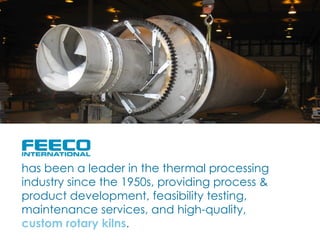
has been a leader in the thermal processing
industry since the 1950s, providing process &
product development, feasibility testing,
maintenance services, and high-quality,
custom rotary kilns.
Want to learn more?
Download our
Rotary Kiln Handbook
The Rotary Kiln Handbook
Rotary Kiln Sizing & Design
Processing Challenges
Service & Maintenance
And more…
Download Now

Thermal Testing With Rotary Kilns

  • 1.
    Thermal Testing Experts inprocess design and material processing for over 65 years. With Rotary Kilns
  • 2.
    Rotary kilns arean advanced thermal processing tool used to cause a chemical reaction or physical change in a solid material through the application of high temperatures.
  • 3.
    Rotary kilns arehighly flexible and can be used to process a wide variety of materials.
  • 4.
    Rotary kilns arehighly flexible and can be used to process a wide variety of materials. They are used for countless applications, with new ones being developed all the time.
  • 5.
    Testing plays anintegral role in the development of many industrial processes, but is especially important when working with rotary kilns, whether the process is new or well-established.
  • 6.
    Some of themost commonly tested applications include:
  • 7.
    Some of themost commonly tested applications include: •  Thermal Desorption of Organic/Hazardous Wastes
  • 8.
    Some of themost commonly tested applications include: •  Thermal Desorption of Organic/Hazardous Wastes •  Sintering
  • 9.
    Some of themost commonly tested applications include: •  Thermal Desorption of Organic/Hazardous Wastes •  Sintering •  Heat Setting
  • 10.
    Some of themost commonly tested applications include: •  Thermal Desorption of Organic/Hazardous Wastes •  Sintering •  Heat Setting •  Organic Combustion
  • 11.
    Some of themost commonly tested applications include: •  Thermal Desorption of Organic/Hazardous Wastes •  Sintering •  Heat Setting •  Organic Combustion •  Metal Recovery
  • 12.
    Some of themost commonly tested applications include: •  Thermal Desorption of Organic/Hazardous Wastes •  Sintering •  Heat Setting •  Organic Combustion •  Metal Recovery •  Calcination
  • 13.
    Some of themost commonly tested applications include: •  Thermal Desorption of Organic/Hazardous Wastes •  Sintering •  Heat Setting •  Organic Combustion •  Metal Recovery •  Calcination •  Mineral Processing
  • 14.
    Some of themost commonly tested applications include: •  Thermal Desorption of Organic/Hazardous Wastes •  Sintering •  Heat Setting •  Organic Combustion •  Metal Recovery •  Calcination •  Mineral Processing •  Reduction Roasting
  • 15.
    Some of themost commonly tested applications include: •  Thermal Desorption of Organic/Hazardous Wastes •  Sintering •  Heat Setting •  Organic Combustion •  Metal Recovery •  Calcination •  Mineral Processing •  Reduction Roasting •  And More…
  • 16.
  • 17.
    There are manyreasons why it is both necessary and desirable to conduct testing…
  • 18.
    To Size andDesign A Commercial Size Kiln One of the most common reasons for conducting testing is to gather the necessary data for sizing a commercial size unit for an intended application.
  • 19.
    In this setting,the desired set of product parameters has typically been determined, and the customer needs to know how the kiln will need to be designed to produce those specifications.
  • 20.
    To Aid inProduct Development Testing is also useful in the product development stage.
  • 21.
    To Aid inProduct Development Testing is also useful in the product development stage. Here, testing can be carried out on small batches of material, in order to determine what specifications will be needed for the job at hand.
  • 22.
    This is commonlyseen in the proppant industry, where proppants must be carefully designed to perform under the specific characteristics of the deposit.
  • 23.
    To Confirm Viabilityof an Intended Process Testing is also a valuable tool in determining whether or not an intended process holds potential for a commercial scale operation.
  • 24.
    To Confirm Viabilityof an Intended Process Testing is also a valuable tool in determining whether or not an intended process holds potential for a commercial scale operation. Here, testing at various scales can be used to determine if a process is both technically possible, and economically viable.
  • 25.
    A common exampleof this can be seen in the recovery of metals from wastes:
  • 26.
    A common exampleof this can be seen in the recovery of metals from wastes: Often times waste materials may contain valuable metals, but are landfilled because the metals are not accessible in their current form.
  • 27.
    A common exampleof this can be seen in the recovery of metals from wastes: Often times waste materials may contain valuable metals, but are landfilled because the metals are not accessible in their current form. In cases like this, the waste material can be tested to determine if the metal can be recovered in an economically viable way.
  • 28.
    To Test VariableProcess Conditions Testing is also helpful when a company would like to improve their existing thermal process, without having to use their own kiln.
  • 29.
    To Test VariableProcess Conditions Testing is also helpful when a company would like to improve their existing thermal process, without having to use their own kiln. Testing allows them to try out various process conditions in a test setting, without disrupting production of their existing system.
  • 30.
  • 31.
    Testing is commonlyconducted first at batch scale, and then at pilot scale.
  • 32.
    Batch Testing Batch, orfeasibility testing, involves testing small sample sizes in order to gather initial process data, such as time and temperature profiles.
  • 33.
    Batch Testing Batch, orfeasibility testing, involves testing small sample sizes in order to gather initial process data, such as time and temperature profiles. This is a cost-effective way to gather initial process data and help define process parameters needed for pilot scale testing.
  • 34.
    Pilot Testing Pilot testingis carried out at a much larger scale, allowing for a continuous process to be tested and commercial process conditions to be simulated.
  • 35.
    During both typesof testing, solid samples can be regularly removed from the kiln to analyze the physical and chemical properties of the material at defined intervals.
  • 36.
    Various material characteristicscan be analyzed to ensure a product is meeting desired specifications. This might include:
  • 37.
    Various material characteristicscan be analyzed to ensure a product is meeting desired specifications. This might include: •  Flowability
  • 38.
    Various material characteristicscan be analyzed to ensure a product is meeting desired specifications. This might include: •  Flowability •  Compression Strength
  • 39.
    Various material characteristicscan be analyzed to ensure a product is meeting desired specifications. This might include: •  Flowability •  Compression Strength •  Bulk Density
  • 40.
    Various material characteristicscan be analyzed to ensure a product is meeting desired specifications. This might include: •  Flowability •  Compression Strength •  Bulk Density •  Crush Strength
  • 41.
    Various material characteristicscan be analyzed to ensure a product is meeting desired specifications. This might include: •  Flowability •  Compression Strength •  Bulk Density •  Crush Strength •  Chemical Analysis
  • 42.
    Various material characteristicscan be analyzed to ensure a product is meeting desired specifications. This might include: •  Flowability •  Compression Strength •  Bulk Density •  Crush Strength •  Chemical Analysis •  Gas Sampling & Monitoring
  • 43.
    A number ofdata points can also be collected during processing, including:
  • 44.
    A number ofdata points can also be collected during processing, including: •  Residence Time
  • 45.
    A number ofdata points can also be collected during processing, including: •  Residence Time •  Kiln Slope
  • 46.
    A number ofdata points can also be collected during processing, including: •  Residence Time •  Kiln Slope •  Temperature Requirements
  • 47.
    A number ofdata points can also be collected during processing, including: •  Residence Time •  Kiln Slope •  Temperature Requirements •  Kiln Speed
  • 48.
    A number ofdata points can also be collected during processing, including: •  Residence Time •  Kiln Slope •  Temperature Requirements •  Kiln Speed •  Emissions
  • 49.
    A number ofdata points can also be collected during processing, including •  Residence Time •  Kiln Slope •  Temperature Requirements •  Kiln Speed •  Emissions •  Feed Rate
  • 50.
    A number ofdata points can also be collected during processing, including •  Residence Time •  Kiln Slope •  Temperature Requirements •  Kiln Speed •  Emissions •  Feed Rate •  And more…
  • 51.
    The FEECO InnovationCenter offers comprehensive testing options for thermal applications. In addition to batch and pilot scale direct and indirect kilns, FEECO offers a range of optional testing equipment, including:
  • 52.
    The FEECO InnovationCenter offers comprehensive testing options for thermal applications. In addition to batch and pilot scale direct and indirect kilns, FEECO offers a range of optional testing equipment, including: -  Combustion Chamber
  • 53.
    The FEECO InnovationCenter offers comprehensive testing options for thermal applications. In addition to batch and pilot scale direct and indirect kilns, FEECO offers a range of optional testing equipment, including: -  Combustion Chamber -  Thermal Oxidizer
  • 54.
    The FEECO InnovationCenter offers comprehensive testing options for thermal applications. In addition to batch and pilot scale direct and indirect kilns, FEECO offers a range of optional testing equipment, including: -  Combustion Chamber -  Thermal Oxidizer -  Baghouse
  • 55.
    The FEECO InnovationCenter offers comprehensive testing options for thermal applications. In addition to batch and pilot scale direct and indirect kilns, FEECO offers a range of optional testing equipment, including: -  Combustion Chamber -  Thermal Oxidizer -  Baghouse -  Wet Scrubber
  • 56.
    The FEECO InnovationCenter offers comprehensive testing options for thermal applications. In addition to batch and pilot scale direct and indirect kilns, FEECO offers a range of optional testing equipment, including: -  Combustion Chamber -  Thermal Oxidizer -  Baghouse -  Wet Scrubber -  Removable Flights, Dams, and Bed Disturbers
  • 57.
    The FEECO InnovationCenter offers comprehensive testing options for thermal applications. In addition to batch and pilot scale direct and indirect kilns, FEECO offers a range of optional testing equipment, including: -  Combustion Chamber -  Thermal Oxidizer -  Baghouse -  Wet Scrubber -  Removable Flights, Dams, and Bed Disturbers -  And more…
  • 58.
    Test kilns canalso be configured to test co-current and counter current processing conditions.
  • 59.
    In addition, wehave partnered with Rockwell Automation to bring our customers the best in process automation, both as a service in the Innovation Center, and as part of a system purchase.
  • 60.
    This allows usto track and adjust a variety of data points in real-time, all from a single interface. Data points include:
  • 61.
    This allows usto track and adjust a variety of data points in real-time, all from a single interface. Data points include: -  Current (Amps)
  • 62.
    This allows usto track and adjust a variety of data points in real-time, all from a single interface. Data points include: -  Current (Amps) -  Feed Rate
  • 63.
    This allows usto track and adjust a variety of data points in real-time, all from a single interface. Data points include: -  Current (Amps) -  Feed Rate -  Flow Rates
  • 64.
    This allows usto track and adjust a variety of data points in real-time, all from a single interface. Data points include: -  Current (Amps) -  Feed Rate -  Flow Rates -  Fuel Usage
  • 65.
    This allows usto track and adjust a variety of data points in real-time, all from a single interface. Data points include: -  Current (Amps) -  Feed Rate -  Flow Rates -  Fuel Usage -  Gas Sampling & Analysis
  • 66.
    This allows usto track and adjust a variety of data points in real-time, all from a single interface. Data points include: -  Current (Amps) -  Feed Rate -  Flow Rates -  Fuel Usage -  Gas Sampling & Analysis -  Horsepower
  • 67.
    This allows usto track and adjust a variety of data points in real-time, all from a single interface. Data points include: -  Current (Amps) -  Feed Rate -  Flow Rates -  Fuel Usage -  Gas Sampling & Analysis -  Horsepower -  Speed
  • 68.
    This allows usto track and adjust a variety of data points in real-time, all from a single interface. Data points include: -  Current (Amps) -  Feed Rate -  Flow Rates -  Fuel Usage -  Gas Sampling & Analysis -  Horsepower -  Speed -  System Pressure
  • 69.
    This allows usto track and adjust a variety of data points in real-time, all from a single interface. Data points include: -  Current (Amps) -  Feed Rate -  Flow Rates -  Fuel Usage -  Gas Sampling & Analysis -  Horsepower -  Speed -  System Pressure -  Temperature
  • 70.
    This allows usto track and adjust a variety of data points in real-time, all from a single interface. Data points include: -  Current (Amps) -  Feed Rate -  Flow Rates -  Fuel Usage -  Gas Sampling & Analysis -  Horsepower -  Speed -  System Pressure -  Temperature -  Torque
  • 71.
    These data pointscan then be selected, trended, and reported on, giving customers an unparalleled process design and optimization experience.
  • 72.
    Conclusion Testing is acritical component in the development of both new and existing rotary kiln applications.
  • 73.
    Conclusion Testing is acritical component in the development of both new and existing rotary kiln applications. The testing process not only determines if a process is technically and economically viable, but it also gathers the data necessary for scale- up to a commercial size unit.
  • 74.
    has been aleader in the thermal processing industry since the 1950s, providing process & product development, feasibility testing, maintenance services, and high-quality, custom rotary kilns.
  • 75.
    Want to learnmore? Download our Rotary Kiln Handbook The Rotary Kiln Handbook Rotary Kiln Sizing & Design Processing Challenges Service & Maintenance And more… Download Now