Biosolids Granulation
Experts in process design and material
processing for over 65 years.
How it Works:
Biosolids present significant challenges for
wastewater treatment plants. High
transportation costs and reduced land
available for application combined with a
growing population leaves municipalities with
few options.
However, a technology that transforms
biosolids into a granular product holds
opportunity to help solve these
problems…
Biosolids
Granulation
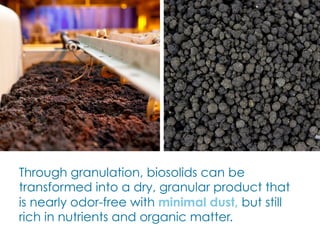
Through granulation, biosolids can be
transformed into a dry, granular product that
is nearly odor-free with minimal dust, but still
rich in nutrients and organic matter.
The granulation of biosolids offers the
opportunity to alleviate the aforementioned
issues, and can also offer many benefits.
Benefits include:
Benefits include:
•  Improved product handling & application
Benefits include:
•  Improved product handling & application
•  Reduced waste management costs
Benefits include:
•  Improved product handling & application
•  Reduced waste management costs
•  Reduced opportunity for runoff
Benefits include:
•  Improved product handling & application
•  Reduced waste management costs
•  Reduced opportunity for runoff
•  The creation of a custom, premium product
Benefits include:
•  Improved product handling & application
•  Reduced waste management costs
•  Reduced opportunity for runoff
•  The creation of a custom, premium product
•  Potential additional source of revenue
Benefits include:
•  Improved product handling & application
•  Reduced waste management costs
•  Reduced opportunity for runoff
•  The creation of a custom, premium product
•  Potential additional source of revenue
•  Enhanced nutrient management
The Process
BURNER
DRYER
RAW FEED
FUEL
RAW FEED BINDER
PADDLE
MIXER
FUEL
BURNER
DRYER
COOLER
BAGHOUSE
TO
ATMOSPHERE
PRODUCT
SCREEN
CRUSHING
EQUIPMENT
RECYCLE
BIN
TRUCK LOAD OUT
RAIL LOAD OUT
PACKAGING LINE
STOCK PILE
PRODUCT
BIN
TO
ATMOSPHERE
BAGHOUSE
OR SCRUBBER
SYSTEM
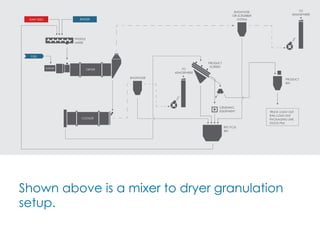
Shown above is a mixer to dryer granulation
setup.
First, raw feed and binder are fed into a
mixer, generally a pug mill (paddle mixer).
This is where the feedstock is thoroughly
mixed and the actual granulation occurs.
Next, the granules created in the mixer are
fed to a rotary dryer, where they are dried
into their final form. The tumbling action of
the dryer further “polishes” and rounds the
granules.
Granules exit the dryer and are fed to a rotary
cooler, where the product is cooled. Product
is then screened, where undersize material
and crushed oversize material are fed back
into the process as recycle, creating a
continuous process loop.
The resulting product goes beyond the
EPA’s qualifications for a Class A Biosolid
(according to the EPA’s 503 regulations).
The granulation process is highly customizable,
and yields a clean, odor-free, premium fertilizer
product.
The granulation process is highly customizable,
and yields a clean, odor-free, premium fertilizer
product.
The product can even be combined with
traditional chemical-based fertilizer ingredients
or minerals to create a custom blend or
boutique fertilizer.
Conclusion
While biosolids do present challenges to
municipalities in their current form, the
granulation of biosolids offers improved value,
as well as many economic and environmental
benefits.
has been a leader in the fertilizer industry since
the 1950s, providing process & product
development, feasibility testing, and custom
fertilizer production solutions, equipment, and
complete process systems.
Want to learn more?
Download our
Biosolids
Brochure
Download Now

How it Works: Biosolids Granulation

  • 1.
    Biosolids Granulation Experts inprocess design and material processing for over 65 years. How it Works:
  • 2.
    Biosolids present significantchallenges for wastewater treatment plants. High transportation costs and reduced land available for application combined with a growing population leaves municipalities with few options.
  • 3.
    However, a technologythat transforms biosolids into a granular product holds opportunity to help solve these problems…
  • 4.
  • 5.
    Through granulation, biosolidscan be transformed into a dry, granular product that is nearly odor-free with minimal dust, but still rich in nutrients and organic matter.
  • 6.
    The granulation ofbiosolids offers the opportunity to alleviate the aforementioned issues, and can also offer many benefits.
  • 7.
  • 8.
    Benefits include: •  Improvedproduct handling & application
  • 9.
    Benefits include: •  Improvedproduct handling & application •  Reduced waste management costs
  • 10.
    Benefits include: •  Improvedproduct handling & application •  Reduced waste management costs •  Reduced opportunity for runoff
  • 11.
    Benefits include: •  Improvedproduct handling & application •  Reduced waste management costs •  Reduced opportunity for runoff •  The creation of a custom, premium product
  • 12.
    Benefits include: •  Improvedproduct handling & application •  Reduced waste management costs •  Reduced opportunity for runoff •  The creation of a custom, premium product •  Potential additional source of revenue
  • 13.
    Benefits include: •  Improvedproduct handling & application •  Reduced waste management costs •  Reduced opportunity for runoff •  The creation of a custom, premium product •  Potential additional source of revenue •  Enhanced nutrient management
  • 14.
  • 15.
    BURNER DRYER RAW FEED FUEL RAW FEEDBINDER PADDLE MIXER FUEL BURNER DRYER COOLER BAGHOUSE TO ATMOSPHERE PRODUCT SCREEN CRUSHING EQUIPMENT RECYCLE BIN TRUCK LOAD OUT RAIL LOAD OUT PACKAGING LINE STOCK PILE PRODUCT BIN TO ATMOSPHERE BAGHOUSE OR SCRUBBER SYSTEM Shown above is a mixer to dryer granulation setup.
  • 16.
    First, raw feedand binder are fed into a mixer, generally a pug mill (paddle mixer). This is where the feedstock is thoroughly mixed and the actual granulation occurs.
  • 17.
    Next, the granulescreated in the mixer are fed to a rotary dryer, where they are dried into their final form. The tumbling action of the dryer further “polishes” and rounds the granules.
  • 18.
    Granules exit thedryer and are fed to a rotary cooler, where the product is cooled. Product is then screened, where undersize material and crushed oversize material are fed back into the process as recycle, creating a continuous process loop.
  • 19.
    The resulting productgoes beyond the EPA’s qualifications for a Class A Biosolid (according to the EPA’s 503 regulations).
  • 20.
    The granulation processis highly customizable, and yields a clean, odor-free, premium fertilizer product.
  • 21.
    The granulation processis highly customizable, and yields a clean, odor-free, premium fertilizer product. The product can even be combined with traditional chemical-based fertilizer ingredients or minerals to create a custom blend or boutique fertilizer.
  • 22.
    Conclusion While biosolids dopresent challenges to municipalities in their current form, the granulation of biosolids offers improved value, as well as many economic and environmental benefits.
  • 23.
    has been aleader in the fertilizer industry since the 1950s, providing process & product development, feasibility testing, and custom fertilizer production solutions, equipment, and complete process systems.
  • 24.
    Want to learnmore? Download our Biosolids Brochure Download Now