Pre-conditioning
Manure for Granulation
Experts in process design and material
processing for over 65 years.
Options in
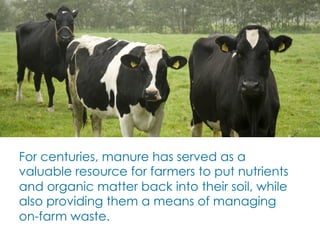
For centuries, manure has served as a
valuable resource for farmers to put nutrients
and organic matter back into their soil, while
also providing them a means of managing
on-farm waste.
As herd sizes continue to grow and farms
must learn to deal with larger amounts of
manure, the granulation of manure into a
fertilizer or soil amendment product is
becoming increasingly popular.
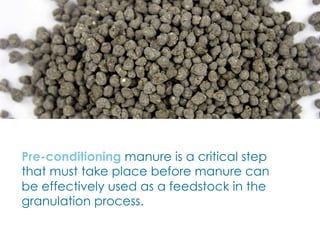
Pre-conditioning manure is a critical step
that must take place before manure can
be effectively used as a feedstock in the
granulation process.
Why Pre-Conditioning
is Necessary
There are many characteristics that
make raw manure an unsuitable
feedstock for granulation.
There are many characteristics that
make raw manure an unsuitable
feedstock for granulation.
Pre-conditioning serves to process
manure into a feedstock that will allow
for optimal granulation to occur.
Pre-conditioning focuses on:
There are many characteristics that
make raw manure an unsuitable
feedstock for granulation.
Pre-conditioning serves to process
manure into a feedstock that will allow
for optimal granulation to occur.
Pre-conditioning focuses on:
•  Particle size distribution
There are many characteristics that
make raw manure an unsuitable
feedstock for granulation.
Pre-conditioning serves to process
manure into a feedstock that will allow
for optimal granulation to occur.
Pre-conditioning focuses on:
•  Particle size distribution
•  Moisture content
There are many characteristics that
make raw manure an unsuitable
feedstock for granulation.
Pre-conditioning serves to process
manure into a feedstock that will allow
for optimal granulation to occur.
Pre-conditioning focuses on:
•  Particle size distribution
•  Moisture content
•  Material composition
Particle Size Distribution
For granulation to occur, large particles
will need to be removed or ground. A
particle size distribution (PSD) of around
60 mesh is ideal.
Moisture Content
The appropriate moisture content is
critical to the success of granulation.
Ideal moisture content for poultry manure
is under 20%, while for hog and dairy
manures, the moisture content should fall
between 60 – 80%, so the material is in a
cake form instead of a slurry.
Material Composition
Pre-conditioning also addresses the
composition of the manure.
Material Composition
Pre-conditioning also addresses the
composition of the manure.
The material should be examined to
determine if it contains coarse fibers or
bedding, which could inhibit granulation,
as well as dilute the nutrient content.
Material Composition
Pre-conditioning also addresses the
composition of the manure.
The material should be examined to
determine if it contains coarse fibers or
bedding, which could inhibit granulation,
as well as dilute the nutrient content.
The material is also analyzed to
determine if it contains any natural
binding agents.
Approaches to
Pre-Conditioning
The pre-conditioning process varies
considerably from one material to the next.
The pre-conditioning process varies
considerably from one material to the next.
Many options are available, with a
combination of methods often being desirable.
Pre-Conditioning Wet Feedstock
Common pre-conditioning methods for
wet feedstock such as dairy and hog
manure include:
Pre-Conditioning Wet Feedstock
Common pre-conditioning methods for
wet feedstock such as dairy and hog
manure include:
•  Sand Removal
Pre-Conditioning Wet Feedstock
Common pre-conditioning methods for
wet feedstock such as dairy and hog
manure include:
•  Sand Removal
•  Anaerobic Digestion
Pre-Conditioning Wet Feedstock
Common pre-conditioning methods for
wet feedstock such as dairy and hog
manure include:
•  Sand Removal
•  Anaerobic Digestion
•  Coarse Fiber Removal
Pre-Conditioning Wet Feedstock
Common pre-conditioning methods for
wet feedstock such as dairy and hog
manure include:
•  Sand Removal
•  Anaerobic Digestion
•  Coarse Fiber Removal
•  Solid/Liquid Separation
Sand Removal
In dairy applications where sand is used
as a bedding, sand removal is necessary;
not only is sand abrasive, which can
damage equipment over time, but it also
reduces the effectiveness of granulation
and would be undesirable in a fertilizer
product.
Sand Removal
In dairy applications where sand is used
as a bedding, sand removal is necessary;
not only is sand abrasive, which can
damage equipment over time, but it also
reduces the effectiveness of granulation
and would be undesirable in a fertilizer
product.
Sand can also fill up digesters if not
removed.
A sand separation system is used to
remove sand from manure. This is
typically a combination of steps that
work to wash the material and run it
through an inclined screw, hydrocyclone,
or sand lane to separate out the sand.
Anaerobic Digestion
Anaerobic digestion is a biological
process that breaks down material in the
absence of oxygen.
Anaerobic Digestion
Anaerobic digestion is a biological
process that breaks down material in the
absence of oxygen.
This process homogenizes and stabilizes
the manure in order to prepare it for
solid/liquid separation and nutrient
capture.
The slurry material resulting from
anaerobic digestion is reduced in odor
and pathogens.
The slurry material resulting from
anaerobic digestion is reduced in odor
and pathogens.
Anaerobic digestion also produces a
biogas which can be converted into a
usable fuel source to make electricity, be
used on-farm, or sold back to the
energy grid.
Coarse Fiber Removal
Coarse fibers must also be removed prior
to granulation. This step is necessary to
remove any bedding or straw particles
that would impede granulation or create
a weak pellet product.
Solid/Liquid Separation
When moisture can be freely pressed out,
solid/liquid separation (with nutrient
capture) is required.
Solid/Liquid Separation
When moisture can be freely pressed out,
solid/liquid separation (with nutrient
capture) is required.
Solid/liquid separation yields a
concentrated cake material ideal for use
in a fertilizer product because of its rich
nutrient content.
Solid/liquid separation can be carried out
using a variety of methods, with
techniques combining mechanical,
gravity, and chemical action.
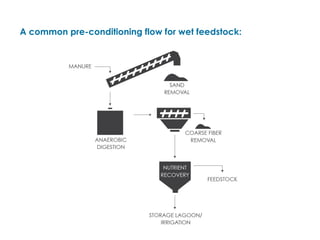
A common pre-conditioning flow for wet feedstock:
Pre-conditioning Dry Feedstock
Dry feedstock is generally a poultry
manure, poultry litter, compost, or other
type of similar material.
Pre-conditioning Dry Feedstock
Dry feedstock is generally a poultry
manure, poultry litter, compost, or other
type of similar material.
Here again, many methods are available
for pre-conditioning, with a combination
of methods often being desirable:
Pre-conditioning Dry Feedstock
Dry feedstock is generally a poultry
manure, poultry litter, compost, or other
type of similar material.
Here again, many methods are available
for pre-conditioning, with a combination
of methods often being desirable:
•  Drying
Pre-conditioning Dry Feedstock
Dry feedstock is generally a poultry
manure, poultry litter, compost, or other
type of similar material.
Here again, many methods are available
for pre-conditioning, with a combination
of methods often being desirable:
•  Drying
•  Grinding
Pre-conditioning Dry Feedstock
Dry feedstock is generally a poultry
manure, poultry litter, compost, or other
type of similar material.
Here again, many methods are available
for pre-conditioning, with a combination
of methods often being desirable:
•  Drying
•  Grinding
•  Composting
Drying
A pre-drying step is sometimes necessary
if the moisture content of the material is
too high. This is especially true when a
grinding step is required, because a
material that is too wet would clog the
equipment.
Drying
A pre-drying step is sometimes necessary
if the moisture content of the material is
too high. This is especially true when a
grinding step is required, because a
material that is too wet would clog the
equipment.
Drying can be carried out using a variety
of equipment, or through back mixing – a
process where dried product is mixed
with wet feedstock to reduce the
moisture content.
Grinding
Grinding is necessary when the material
contains large particles, as these would
inhibit effective granulation.
Grinding
Grinding is necessary when the material
contains large particles, as these would
inhibit effective granulation.
This is commonly carried out using a
hammer mill.
Composting
Anaerobic digestion is often not an
option for dry feedstock, because it
requires a pumpable slurry. For this
reason, composting is often used with dry
feedstock materials to homogenize the
material and break it down prior to
granulation.
While composting can be used for both
wet and dry feedstock, it is typically only
seen with dry, because wet feedstock
contains too much moisture to be
efficiently composted, and would likely
require a lot of bulking agents, which
would dilute the overall nutrient content.
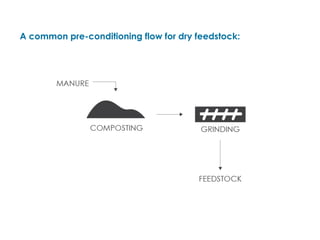
A common pre-conditioning flow for dry feedstock:
Conclusion
Pre-conditioning manure prior to granulation is
a critical component in the success of the
process and end product.
Depending on the feedstock characteristics, a
variety of options are available, with a
combination of methods often producing the
desired results.
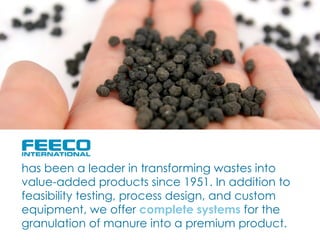
has been a leader in transforming wastes into
value-added products since 1951. In addition to
feasibility testing, process design, and custom
equipment, we offer complete systems for the
granulation of manure into a premium product.
Want to learn more?
Download our
Organics Granulation
Handbook
Download Now
The Organics Granulation Handbook
Granulation as a Solution
Systems and Equipment
Considerations
Outlook

Options in Pre-conditioning Manure for Granulation

  • 1.
    Pre-conditioning Manure for Granulation Expertsin process design and material processing for over 65 years. Options in
  • 2.
    For centuries, manurehas served as a valuable resource for farmers to put nutrients and organic matter back into their soil, while also providing them a means of managing on-farm waste.
  • 3.
    As herd sizescontinue to grow and farms must learn to deal with larger amounts of manure, the granulation of manure into a fertilizer or soil amendment product is becoming increasingly popular.
  • 4.
    Pre-conditioning manure isa critical step that must take place before manure can be effectively used as a feedstock in the granulation process.
  • 5.
  • 6.
    There are manycharacteristics that make raw manure an unsuitable feedstock for granulation.
  • 7.
    There are manycharacteristics that make raw manure an unsuitable feedstock for granulation. Pre-conditioning serves to process manure into a feedstock that will allow for optimal granulation to occur. Pre-conditioning focuses on:
  • 8.
    There are manycharacteristics that make raw manure an unsuitable feedstock for granulation. Pre-conditioning serves to process manure into a feedstock that will allow for optimal granulation to occur. Pre-conditioning focuses on: •  Particle size distribution
  • 9.
    There are manycharacteristics that make raw manure an unsuitable feedstock for granulation. Pre-conditioning serves to process manure into a feedstock that will allow for optimal granulation to occur. Pre-conditioning focuses on: •  Particle size distribution •  Moisture content
  • 10.
    There are manycharacteristics that make raw manure an unsuitable feedstock for granulation. Pre-conditioning serves to process manure into a feedstock that will allow for optimal granulation to occur. Pre-conditioning focuses on: •  Particle size distribution •  Moisture content •  Material composition
  • 11.
    Particle Size Distribution Forgranulation to occur, large particles will need to be removed or ground. A particle size distribution (PSD) of around 60 mesh is ideal.
  • 12.
    Moisture Content The appropriatemoisture content is critical to the success of granulation. Ideal moisture content for poultry manure is under 20%, while for hog and dairy manures, the moisture content should fall between 60 – 80%, so the material is in a cake form instead of a slurry.
  • 13.
    Material Composition Pre-conditioning alsoaddresses the composition of the manure.
  • 14.
    Material Composition Pre-conditioning alsoaddresses the composition of the manure. The material should be examined to determine if it contains coarse fibers or bedding, which could inhibit granulation, as well as dilute the nutrient content.
  • 15.
    Material Composition Pre-conditioning alsoaddresses the composition of the manure. The material should be examined to determine if it contains coarse fibers or bedding, which could inhibit granulation, as well as dilute the nutrient content. The material is also analyzed to determine if it contains any natural binding agents.
  • 16.
  • 17.
    The pre-conditioning processvaries considerably from one material to the next.
  • 18.
    The pre-conditioning processvaries considerably from one material to the next. Many options are available, with a combination of methods often being desirable.
  • 19.
    Pre-Conditioning Wet Feedstock Commonpre-conditioning methods for wet feedstock such as dairy and hog manure include:
  • 20.
    Pre-Conditioning Wet Feedstock Commonpre-conditioning methods for wet feedstock such as dairy and hog manure include: •  Sand Removal
  • 21.
    Pre-Conditioning Wet Feedstock Commonpre-conditioning methods for wet feedstock such as dairy and hog manure include: •  Sand Removal •  Anaerobic Digestion
  • 22.
    Pre-Conditioning Wet Feedstock Commonpre-conditioning methods for wet feedstock such as dairy and hog manure include: •  Sand Removal •  Anaerobic Digestion •  Coarse Fiber Removal
  • 23.
    Pre-Conditioning Wet Feedstock Commonpre-conditioning methods for wet feedstock such as dairy and hog manure include: •  Sand Removal •  Anaerobic Digestion •  Coarse Fiber Removal •  Solid/Liquid Separation
  • 24.
    Sand Removal In dairyapplications where sand is used as a bedding, sand removal is necessary; not only is sand abrasive, which can damage equipment over time, but it also reduces the effectiveness of granulation and would be undesirable in a fertilizer product.
  • 25.
    Sand Removal In dairyapplications where sand is used as a bedding, sand removal is necessary; not only is sand abrasive, which can damage equipment over time, but it also reduces the effectiveness of granulation and would be undesirable in a fertilizer product. Sand can also fill up digesters if not removed.
  • 26.
    A sand separationsystem is used to remove sand from manure. This is typically a combination of steps that work to wash the material and run it through an inclined screw, hydrocyclone, or sand lane to separate out the sand.
  • 27.
    Anaerobic Digestion Anaerobic digestionis a biological process that breaks down material in the absence of oxygen.
  • 28.
    Anaerobic Digestion Anaerobic digestionis a biological process that breaks down material in the absence of oxygen. This process homogenizes and stabilizes the manure in order to prepare it for solid/liquid separation and nutrient capture.
  • 29.
    The slurry materialresulting from anaerobic digestion is reduced in odor and pathogens.
  • 30.
    The slurry materialresulting from anaerobic digestion is reduced in odor and pathogens. Anaerobic digestion also produces a biogas which can be converted into a usable fuel source to make electricity, be used on-farm, or sold back to the energy grid.
  • 31.
    Coarse Fiber Removal Coarsefibers must also be removed prior to granulation. This step is necessary to remove any bedding or straw particles that would impede granulation or create a weak pellet product.
  • 32.
    Solid/Liquid Separation When moisturecan be freely pressed out, solid/liquid separation (with nutrient capture) is required.
  • 33.
    Solid/Liquid Separation When moisturecan be freely pressed out, solid/liquid separation (with nutrient capture) is required. Solid/liquid separation yields a concentrated cake material ideal for use in a fertilizer product because of its rich nutrient content.
  • 34.
    Solid/liquid separation canbe carried out using a variety of methods, with techniques combining mechanical, gravity, and chemical action.
  • 35.
    A common pre-conditioningflow for wet feedstock:
  • 36.
    Pre-conditioning Dry Feedstock Dryfeedstock is generally a poultry manure, poultry litter, compost, or other type of similar material.
  • 37.
    Pre-conditioning Dry Feedstock Dryfeedstock is generally a poultry manure, poultry litter, compost, or other type of similar material. Here again, many methods are available for pre-conditioning, with a combination of methods often being desirable:
  • 38.
    Pre-conditioning Dry Feedstock Dryfeedstock is generally a poultry manure, poultry litter, compost, or other type of similar material. Here again, many methods are available for pre-conditioning, with a combination of methods often being desirable: •  Drying
  • 39.
    Pre-conditioning Dry Feedstock Dryfeedstock is generally a poultry manure, poultry litter, compost, or other type of similar material. Here again, many methods are available for pre-conditioning, with a combination of methods often being desirable: •  Drying •  Grinding
  • 40.
    Pre-conditioning Dry Feedstock Dryfeedstock is generally a poultry manure, poultry litter, compost, or other type of similar material. Here again, many methods are available for pre-conditioning, with a combination of methods often being desirable: •  Drying •  Grinding •  Composting
  • 41.
    Drying A pre-drying stepis sometimes necessary if the moisture content of the material is too high. This is especially true when a grinding step is required, because a material that is too wet would clog the equipment.
  • 42.
    Drying A pre-drying stepis sometimes necessary if the moisture content of the material is too high. This is especially true when a grinding step is required, because a material that is too wet would clog the equipment. Drying can be carried out using a variety of equipment, or through back mixing – a process where dried product is mixed with wet feedstock to reduce the moisture content.
  • 43.
    Grinding Grinding is necessarywhen the material contains large particles, as these would inhibit effective granulation.
  • 44.
    Grinding Grinding is necessarywhen the material contains large particles, as these would inhibit effective granulation. This is commonly carried out using a hammer mill.
  • 45.
    Composting Anaerobic digestion isoften not an option for dry feedstock, because it requires a pumpable slurry. For this reason, composting is often used with dry feedstock materials to homogenize the material and break it down prior to granulation.
  • 46.
    While composting canbe used for both wet and dry feedstock, it is typically only seen with dry, because wet feedstock contains too much moisture to be efficiently composted, and would likely require a lot of bulking agents, which would dilute the overall nutrient content.
  • 47.
    A common pre-conditioningflow for dry feedstock:
  • 48.
    Conclusion Pre-conditioning manure priorto granulation is a critical component in the success of the process and end product. Depending on the feedstock characteristics, a variety of options are available, with a combination of methods often producing the desired results.
  • 49.
    has been aleader in transforming wastes into value-added products since 1951. In addition to feasibility testing, process design, and custom equipment, we offer complete systems for the granulation of manure into a premium product.
  • 50.
    Want to learnmore? Download our Organics Granulation Handbook Download Now The Organics Granulation Handbook Granulation as a Solution Systems and Equipment Considerations Outlook