1
Once food is harvested, it begins to deteriorate
immediately due to the following factors:
•micro-organisms (yeast, mould, bacteria);
•intrinsic enzymes;
•temperature;
•moisture; and
•insects and vermin.
2
Because of the risk of spoilage, much of food is
processed in some way to increase its
availability.
A food is considered preserved once it is
stabilized with respect to safety and quality.
3
No type of food processing can transform poor
quality raw materials into good ones.
It can only increase the product's shelf life.
4
To ensure that product meets high standards:
•use the highest quality raw ingredients;
•establish good processing techniques-and follow
them; and
•maintain an appropriate product environment after
processing.
5
Not all processing methods are applied to foods
to achieve preservation.
Some are also used to change or stabilize food
texturally.
6
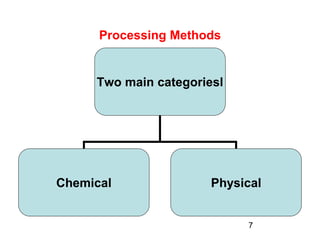
Processing Methods
7
Two main categoriesl
Chemical Physical
Chemical Processing Methods
 Intermediate Moisture Foods (IMF)
 Water Activity (aw)
 Addition of Chemicals
 PH Control
8
Intermediate Moisture Foods (IMF)
 Binding the water that's present preserves
intermediate moisture foods-for example,
cookies, cake and bread. This reduces the
availability of the water for deteriorative
reactions.
 Water is immobilized by adding permissible
humectant additives such as glycerol, glycols,
sorbitol, sugars and salts.
 Generally, IMFs possess water activities that
range from 0.6 to 0.85. This enables the food to
be stable at room temperature, because the
growth of most micro-organisms is inhibited at
these levels.
9
Water Activity (aw)
 It is the availabilityof water for microbial,
enzymatic, or chemical activity that
determines the shelf life of foods. This water
availability is measured as water activity (aw).
Water activity is measured on a scale of 0 to
1, where 0 indicates no water and 1 indicates
all water. Food spoilage micro-organisms, in
general, are inhibited in food where the water
activity is below 0.6. However, if the pH of the
food is less than 4.6, micro-organisms are
inhibited when the water activity is below 0.85.
10
ADDITION OF CHEMICALS
The addition of some chemicals inhibits
microbial growth in foods.
These chemicals include not only those
classified as preservatives. Salt, sugars,
wood smoke and some spices also
inhibit the growth of micro-organisms.
For more information on chemical
preservatives.
11
pH Control
Almost every food, with the exception
of egg whites and soda crackers, has a
pH value of less than 7.
Foods can be broadly categorized on
the basis of their pH as high acid, acid,
medium acid or low acid.
12
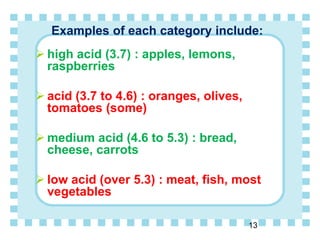
Examples of each category include:
 high acid (3.7) : apples, lemons,
raspberries
 acid (3.7 to 4.6) : oranges, olives,
tomatoes (some)
 medium acid (4.6 to 5.3) : bread,
cheese, carrots
 low acid (over 5.3) : meat, fish, most
vegetables
13
Most micro-organisms grow best in the
pH range of 6.5 to 7.5.
Yeasts and moulds are capable of
growing over a much broader pH range
than bacteria.
Few pathogens will grow below pH 4.0.
14
Physical Processing Methods
 Sterilization
 (Retorting)
 Pasteurization
 Blanching
 Microwaving
 Frying
 Refrigeration
 Freezing
 Irradiation
 Evaporation
 Dehydration
 Emulsions
 Homogenization
 Extrusion
15
Sterilization
16
 Sterilization destroys all pathogenic and
spoilage micro-organisms in foods and
inactivates enzymes by heating.
 All canned foods are sterilized in a retort (a
large pressure cooker).
 This process enables food to have a shelf
life of more than two years.
Foods that have a pH of more than 4.6,
such as meat and most vegetables, must
undergo severe heating conditions to
destroy all pathogens.
These foods are heated under pressure to
121°C for varying times.
17
Severe conditions are applied to ensure
that Clostridium botulinum spores are
destroyed during processing.
The spores are destroyed by heat or are
inhibited at pH values of less than 4.6.
Therefore, a food with a pH of less than
4.6 that is packaged anaerobically.
18
Pasteurization
19
 Pasteurization is the process of heating
a food-usually a liquid-to or below its
boiling point for a defined period of time.
 The purpose is to destroy all pathogens,
reduce the number of bacteria, inactivate
enzymes and extend the shelf life of a
food product.
Foods with a pH of less than 4.6, such as
milk and spaghetti sauce, can be
pasteurized.
Permanent stability-that is, shelf life of
about two years-is obtained with foods that
can withstand prolonged heating, such as
bottled juices.
20
There is a greater loss of flavour from foods
that are exposed to a longer time-
temperature relationship. Therefore,
temporary stability (that is, limited shelf life)
is only obtained with some foods where
prolonged heating would destroy its quality.
These foods, such as milk, usually require
subsequent refrigeration.
21
"High temperature short time" (HTST) and
"ultra high temperature" (UHT) processes
have been developed to retain a food's
texture and flavour quality parameters.
22
Blanching
23
 Blanching is a slight heat treatment,
using hot water or steam, that is applied
mostly to vegetables before canning or
freezing.
Blanching is used before freezing to
inactivate enzymes present that cause
deteriorative reactions to foods during
frozen storage.
 These reactions include colour and
texture changes, off-flavours and a
decrease in nutritional value.
Blanching is used before canning for
different reasons, because enzymes will
inevitably be destroyed during canning.
Blanching induces a vacuum in canned
goods, and it's also used to control the fill
into containers (for example, spinach).
24
Microwaving
25
 Microwave ovens are rarely used for processing
large quantities of food. They are mainly of interest
when the products such as frozen foods are used..
Microwave ovens use electromagnetic radiation to
excite water molecules in food. The actual waves
penetrate only about 10 inches from the source of
the radiation. Within the food, the waves only
penetrate 3�4 to 1 inch on all sides. As a result,
the actual ovens must be limited in size. Heat is
produced within the food by the friction of water
molecules, which spreads to the centre of the food
by conduction.
Small portions are cooked rapidly in
microwave ovens. As the quantity of food
increases, however, the efficiency is lost.
26
Frying
27
 Frying involves cooking in hot oil. Because of
the big difference between the temperature of
the oil and the food, as well as the small size of
the food pieces, cooking is completed in a
relatively short time-anywhere from 20 seconds
to six minutes.
Fried foods are known for their characteristic
crispy outer surface as well as their high fat
content.
The fat that is absorbed by the food
product varies from 10 percent to 40
percent, depending on the time the food is
immersed in the oil.
Continuous fryers are often used in the
food industry.
28
Refrigeration
29
 Refrigerators should be set to below 4°C
to control the growth of micro-organisms
in foods.
 This lowered temperature also reduces
the respiration rate of fruits and
vegetables, which retards reactions that
promote spoilage.
Refrigeration is generally used to:
 reduce spoilage during distribution of perishable
foods;
 increase the holding period between harvesting
and processing; and
 extend the storage life of commercially
processed foods.
Not all foods benefit from cold temperatures.
For example, bananas turn black and bread goes
stale when refrigerated
30
Freezing
 While many home freezers are held at -
10°C, commercial freezers are under -
18°C. At this temperature, the growth of
micro-organisms is almost stopped.
Deteriorative microbial reactions will still
occur, but over a much longer time.
 In addition, deteriorative enzymatic
reactions will still take place during frozen
storage. Uncooked fruits and vegetables
must be blanched before freezing to
prevent these reactions.
31
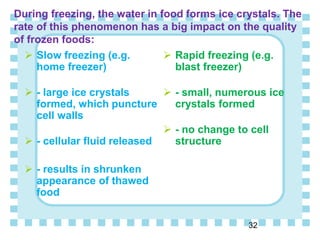
During freezing, the water in food forms ice crystals. The
rate of this phenomenon has a big impact on the quality
of frozen foods:
 Slow freezing (e.g.
home freezer)
 - large ice crystals
formed, which puncture
cell walls
 - cellular fluid released
 - results in shrunken
appearance of thawed
food
 Rapid freezing (e.g.
blast freezer)
 - small, numerous ice
crystals formed
 - no change to cell
structure
32
The shelf life of frozen foods is largely dependent
on storage conditions.
Under ideal conditions, frozen foods can have a
shelf life of one year.
33
However, if foods are continuously
exposed to warmer temperatures, such as
the opening and closing of freezer doors,
then heat shock occurs.
Heat shock is when ice melts and re-forms
into larger ice crystals. The best example
is ice cream, which has a gritty texture if
large ice crystals have developed.
Irradiation
35
 Irradiation is the controversial process
of applying low doses of gamma
radiation to food products.
Irradiation is generally used for:
 prevent sprouting in potatoes and
onions;
 control insect infestation of wheat flour
and
 reduce the microbial load of ground
spices.
36
If irradiation becomes more widespread
among various other food products, it is
expected to replace fumigation, ensure
hygienic quality and reduce the
dependence on refrigeration.
Batch vs. Continuous Processing
38
 Food is processed in either discrete
batches or a continuous system.
 Generally, batch systems are used to
produce small quantities of food,
whereas larger volumes are required for
continuous systems.
39
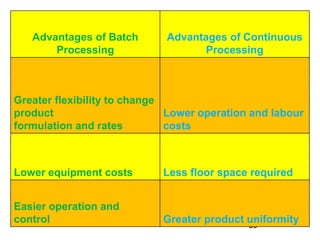
Advantages of Batch
Processing
Advantages of Continuous
Processing
Greater flexibility to change
product
formulation and rates
Lower operation and labour
costs
Lower equipment costs Less floor space required
Easier operation and
control Greater product uniformity
Evaporation
40
 Evaporation is the partial removal of water from
liquid foods by boiling. When the operation is
done under vacuum, boiling is avoided and the
food's flavour qualities are retained.

Some of the foods that have undergone
evaporation are evaporated milk, tomato paste
and juice concentrates.
This process is carried out for three main reasons:
 to reduce the weight and, therefore,
 reduce storage and transport costs;
 to preserve foods by decreasing the water
activity and increasing the solids content; and
 to provide consumers with convenient foods.
41
Dehydration
42
 Dehydration-or drying-is the nearly complete
removal of water from solid foods.
 One of the oldest methods of food preservation, it
was traditionally carried out by the sun.

This application is used for the same reasons that
liquid foods undergo evaporation-preservation,
convenience and cost savings.
 Dried soup mixes, dried fruit, powdered milk and
spices are just a few examples of dehydrated
foods.
Spray drying and freeze drying are two drying
methods used widely today.
Spray drying is when a liquid food is atomized into
a fine, dry powder.
Examples include natural and artificial flavours
and milk powders.
Freeze drying involves first freezing the food and
then driving off the ice, leaving a high quality,
porous dried food such as instant coffee.
43
Emulsions
44
 An emulsion is a system containing two liquid
phases that don't mix, where one phase
(disperse phase) is distributed throughout the
other phase
 (continuous phase) in the form of very small
droplets.
Generally there are two types
of emulsions:
oil in water (O/W)
water in oil (W/O)
An example of an O/W emulsion is
salad dressing,
and
an example of a W/O emulsion is
butter.
Homogenization
46
 Homogenization is used to stabilize an
emulsion. More specifically, it is the reduction in
size and the increase in number of droplets of
the dispersed phase by the application of
intense shearing forces.

Generally, homogenization is applied to change
the functional properties or improve the texture
of emulsions. For example, most fluid milk sold
at the retail level is homogenized to improve its
stability, and most caramel fillings are
homogenized to increase their smoothness
Extrusion
47
 Extrusion is the process in which a food is
compressed and worked to form a semi-solid
mass. This mass is then forced through a
restricted opening, or die, to create a desired
texture or shape.
 The purpose of this application is simply to
provide a greater variety of textured foods to
consumers.
Food may also be cooked while extruded.
 This is referrred to as extrustion cooking or hot
extrusion.
Some extruded food products are licorice,
puffed wheat and cornflakes.
Hurdle or Combination Processing
48
 Hurdle technology is a concept that was
developed to address the consumer demand for
more natural, fresh-like foods. It is a way for
food processors to employ only mild
preservation techniques to their food products.

The idea is to use deliberate low-level
combinations of existing and novel preservation
techniques ("hurdles") to eliminate the growth of
micro-organisms. Lower-intensity individual
methods can be used because of the collective
effect of the combined methods.
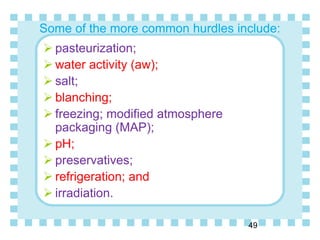
Some of the more common hurdles include:
 pasteurization;
 water activity (aw);
 salt;
 blanching;
 freezing; modified atmosphere
packaging (MAP);
 pH;
 preservatives;
 refrigeration; and
 irradiation.
49
Some micro-organisms present will be able to
survive the individual treatments applied.
However, no microorganism will be able to
overcome all of the combined hurdles.
Thus the food is stable and safe.
The only way to ensure that the correct
combination of hurdle technologies is used is to
make sure that a qualified resource conducts
quality and safety shelf-life studies.
50
Examples of hurdle processing can be found in
traditional and recently developed foods, such as
yogurt and prepackaged fresh salads.
The hurdles employed in yogurt manufacture
include low temperatures, high acid and
competitive microbial flora.
Those used to prepare prepackaged fresh salads
include low temperatures and modified
atmospheres.
51
different preservation principles involved in food processing.ppt

different preservation principles involved in food processing.ppt

  • 1.
  • 2.
    Once food isharvested, it begins to deteriorate immediately due to the following factors: •micro-organisms (yeast, mould, bacteria); •intrinsic enzymes; •temperature; •moisture; and •insects and vermin. 2
  • 3.
    Because of therisk of spoilage, much of food is processed in some way to increase its availability. A food is considered preserved once it is stabilized with respect to safety and quality. 3
  • 4.
    No type offood processing can transform poor quality raw materials into good ones. It can only increase the product's shelf life. 4
  • 5.
    To ensure thatproduct meets high standards: •use the highest quality raw ingredients; •establish good processing techniques-and follow them; and •maintain an appropriate product environment after processing. 5
  • 6.
    Not all processingmethods are applied to foods to achieve preservation. Some are also used to change or stabilize food texturally. 6
  • 7.
    Processing Methods 7 Two maincategoriesl Chemical Physical
  • 8.
    Chemical Processing Methods Intermediate Moisture Foods (IMF)  Water Activity (aw)  Addition of Chemicals  PH Control 8
  • 9.
    Intermediate Moisture Foods(IMF)  Binding the water that's present preserves intermediate moisture foods-for example, cookies, cake and bread. This reduces the availability of the water for deteriorative reactions.  Water is immobilized by adding permissible humectant additives such as glycerol, glycols, sorbitol, sugars and salts.  Generally, IMFs possess water activities that range from 0.6 to 0.85. This enables the food to be stable at room temperature, because the growth of most micro-organisms is inhibited at these levels. 9
  • 10.
    Water Activity (aw) It is the availabilityof water for microbial, enzymatic, or chemical activity that determines the shelf life of foods. This water availability is measured as water activity (aw). Water activity is measured on a scale of 0 to 1, where 0 indicates no water and 1 indicates all water. Food spoilage micro-organisms, in general, are inhibited in food where the water activity is below 0.6. However, if the pH of the food is less than 4.6, micro-organisms are inhibited when the water activity is below 0.85. 10
  • 11.
    ADDITION OF CHEMICALS Theaddition of some chemicals inhibits microbial growth in foods. These chemicals include not only those classified as preservatives. Salt, sugars, wood smoke and some spices also inhibit the growth of micro-organisms. For more information on chemical preservatives. 11
  • 12.
    pH Control Almost everyfood, with the exception of egg whites and soda crackers, has a pH value of less than 7. Foods can be broadly categorized on the basis of their pH as high acid, acid, medium acid or low acid. 12
  • 13.
    Examples of eachcategory include:  high acid (3.7) : apples, lemons, raspberries  acid (3.7 to 4.6) : oranges, olives, tomatoes (some)  medium acid (4.6 to 5.3) : bread, cheese, carrots  low acid (over 5.3) : meat, fish, most vegetables 13
  • 14.
    Most micro-organisms growbest in the pH range of 6.5 to 7.5. Yeasts and moulds are capable of growing over a much broader pH range than bacteria. Few pathogens will grow below pH 4.0. 14
  • 15.
    Physical Processing Methods Sterilization  (Retorting)  Pasteurization  Blanching  Microwaving  Frying  Refrigeration  Freezing  Irradiation  Evaporation  Dehydration  Emulsions  Homogenization  Extrusion 15
  • 16.
    Sterilization 16  Sterilization destroysall pathogenic and spoilage micro-organisms in foods and inactivates enzymes by heating.  All canned foods are sterilized in a retort (a large pressure cooker).  This process enables food to have a shelf life of more than two years.
  • 17.
    Foods that havea pH of more than 4.6, such as meat and most vegetables, must undergo severe heating conditions to destroy all pathogens. These foods are heated under pressure to 121°C for varying times. 17
  • 18.
    Severe conditions areapplied to ensure that Clostridium botulinum spores are destroyed during processing. The spores are destroyed by heat or are inhibited at pH values of less than 4.6. Therefore, a food with a pH of less than 4.6 that is packaged anaerobically. 18
  • 19.
    Pasteurization 19  Pasteurization isthe process of heating a food-usually a liquid-to or below its boiling point for a defined period of time.  The purpose is to destroy all pathogens, reduce the number of bacteria, inactivate enzymes and extend the shelf life of a food product.
  • 20.
    Foods with apH of less than 4.6, such as milk and spaghetti sauce, can be pasteurized. Permanent stability-that is, shelf life of about two years-is obtained with foods that can withstand prolonged heating, such as bottled juices. 20
  • 21.
    There is agreater loss of flavour from foods that are exposed to a longer time- temperature relationship. Therefore, temporary stability (that is, limited shelf life) is only obtained with some foods where prolonged heating would destroy its quality. These foods, such as milk, usually require subsequent refrigeration. 21
  • 22.
    "High temperature shorttime" (HTST) and "ultra high temperature" (UHT) processes have been developed to retain a food's texture and flavour quality parameters. 22
  • 23.
    Blanching 23  Blanching isa slight heat treatment, using hot water or steam, that is applied mostly to vegetables before canning or freezing. Blanching is used before freezing to inactivate enzymes present that cause deteriorative reactions to foods during frozen storage.  These reactions include colour and texture changes, off-flavours and a decrease in nutritional value.
  • 24.
    Blanching is usedbefore canning for different reasons, because enzymes will inevitably be destroyed during canning. Blanching induces a vacuum in canned goods, and it's also used to control the fill into containers (for example, spinach). 24
  • 25.
    Microwaving 25  Microwave ovensare rarely used for processing large quantities of food. They are mainly of interest when the products such as frozen foods are used.. Microwave ovens use electromagnetic radiation to excite water molecules in food. The actual waves penetrate only about 10 inches from the source of the radiation. Within the food, the waves only penetrate 3�4 to 1 inch on all sides. As a result, the actual ovens must be limited in size. Heat is produced within the food by the friction of water molecules, which spreads to the centre of the food by conduction.
  • 26.
    Small portions arecooked rapidly in microwave ovens. As the quantity of food increases, however, the efficiency is lost. 26
  • 27.
    Frying 27  Frying involvescooking in hot oil. Because of the big difference between the temperature of the oil and the food, as well as the small size of the food pieces, cooking is completed in a relatively short time-anywhere from 20 seconds to six minutes. Fried foods are known for their characteristic crispy outer surface as well as their high fat content.
  • 28.
    The fat thatis absorbed by the food product varies from 10 percent to 40 percent, depending on the time the food is immersed in the oil. Continuous fryers are often used in the food industry. 28
  • 29.
    Refrigeration 29  Refrigerators shouldbe set to below 4°C to control the growth of micro-organisms in foods.  This lowered temperature also reduces the respiration rate of fruits and vegetables, which retards reactions that promote spoilage.
  • 30.
    Refrigeration is generallyused to:  reduce spoilage during distribution of perishable foods;  increase the holding period between harvesting and processing; and  extend the storage life of commercially processed foods. Not all foods benefit from cold temperatures. For example, bananas turn black and bread goes stale when refrigerated 30
  • 31.
    Freezing  While manyhome freezers are held at - 10°C, commercial freezers are under - 18°C. At this temperature, the growth of micro-organisms is almost stopped. Deteriorative microbial reactions will still occur, but over a much longer time.  In addition, deteriorative enzymatic reactions will still take place during frozen storage. Uncooked fruits and vegetables must be blanched before freezing to prevent these reactions. 31
  • 32.
    During freezing, thewater in food forms ice crystals. The rate of this phenomenon has a big impact on the quality of frozen foods:  Slow freezing (e.g. home freezer)  - large ice crystals formed, which puncture cell walls  - cellular fluid released  - results in shrunken appearance of thawed food  Rapid freezing (e.g. blast freezer)  - small, numerous ice crystals formed  - no change to cell structure 32
  • 33.
    The shelf lifeof frozen foods is largely dependent on storage conditions. Under ideal conditions, frozen foods can have a shelf life of one year. 33
  • 34.
    However, if foodsare continuously exposed to warmer temperatures, such as the opening and closing of freezer doors, then heat shock occurs. Heat shock is when ice melts and re-forms into larger ice crystals. The best example is ice cream, which has a gritty texture if large ice crystals have developed.
  • 35.
    Irradiation 35  Irradiation isthe controversial process of applying low doses of gamma radiation to food products.
  • 36.
    Irradiation is generallyused for:  prevent sprouting in potatoes and onions;  control insect infestation of wheat flour and  reduce the microbial load of ground spices. 36
  • 37.
    If irradiation becomesmore widespread among various other food products, it is expected to replace fumigation, ensure hygienic quality and reduce the dependence on refrigeration.
  • 38.
    Batch vs. ContinuousProcessing 38  Food is processed in either discrete batches or a continuous system.  Generally, batch systems are used to produce small quantities of food, whereas larger volumes are required for continuous systems.
  • 39.
    39 Advantages of Batch Processing Advantagesof Continuous Processing Greater flexibility to change product formulation and rates Lower operation and labour costs Lower equipment costs Less floor space required Easier operation and control Greater product uniformity
  • 40.
    Evaporation 40  Evaporation isthe partial removal of water from liquid foods by boiling. When the operation is done under vacuum, boiling is avoided and the food's flavour qualities are retained.  Some of the foods that have undergone evaporation are evaporated milk, tomato paste and juice concentrates.
  • 41.
    This process iscarried out for three main reasons:  to reduce the weight and, therefore,  reduce storage and transport costs;  to preserve foods by decreasing the water activity and increasing the solids content; and  to provide consumers with convenient foods. 41
  • 42.
    Dehydration 42  Dehydration-or drying-isthe nearly complete removal of water from solid foods.  One of the oldest methods of food preservation, it was traditionally carried out by the sun.  This application is used for the same reasons that liquid foods undergo evaporation-preservation, convenience and cost savings.  Dried soup mixes, dried fruit, powdered milk and spices are just a few examples of dehydrated foods.
  • 43.
    Spray drying andfreeze drying are two drying methods used widely today. Spray drying is when a liquid food is atomized into a fine, dry powder. Examples include natural and artificial flavours and milk powders. Freeze drying involves first freezing the food and then driving off the ice, leaving a high quality, porous dried food such as instant coffee. 43
  • 44.
    Emulsions 44  An emulsionis a system containing two liquid phases that don't mix, where one phase (disperse phase) is distributed throughout the other phase  (continuous phase) in the form of very small droplets.
  • 45.
    Generally there aretwo types of emulsions: oil in water (O/W) water in oil (W/O) An example of an O/W emulsion is salad dressing, and an example of a W/O emulsion is butter.
  • 46.
    Homogenization 46  Homogenization isused to stabilize an emulsion. More specifically, it is the reduction in size and the increase in number of droplets of the dispersed phase by the application of intense shearing forces.  Generally, homogenization is applied to change the functional properties or improve the texture of emulsions. For example, most fluid milk sold at the retail level is homogenized to improve its stability, and most caramel fillings are homogenized to increase their smoothness
  • 47.
    Extrusion 47  Extrusion isthe process in which a food is compressed and worked to form a semi-solid mass. This mass is then forced through a restricted opening, or die, to create a desired texture or shape.  The purpose of this application is simply to provide a greater variety of textured foods to consumers. Food may also be cooked while extruded.  This is referrred to as extrustion cooking or hot extrusion. Some extruded food products are licorice, puffed wheat and cornflakes.
  • 48.
    Hurdle or CombinationProcessing 48  Hurdle technology is a concept that was developed to address the consumer demand for more natural, fresh-like foods. It is a way for food processors to employ only mild preservation techniques to their food products.  The idea is to use deliberate low-level combinations of existing and novel preservation techniques ("hurdles") to eliminate the growth of micro-organisms. Lower-intensity individual methods can be used because of the collective effect of the combined methods.
  • 49.
    Some of themore common hurdles include:  pasteurization;  water activity (aw);  salt;  blanching;  freezing; modified atmosphere packaging (MAP);  pH;  preservatives;  refrigeration; and  irradiation. 49
  • 50.
    Some micro-organisms presentwill be able to survive the individual treatments applied. However, no microorganism will be able to overcome all of the combined hurdles. Thus the food is stable and safe. The only way to ensure that the correct combination of hurdle technologies is used is to make sure that a qualified resource conducts quality and safety shelf-life studies. 50
  • 51.
    Examples of hurdleprocessing can be found in traditional and recently developed foods, such as yogurt and prepackaged fresh salads. The hurdles employed in yogurt manufacture include low temperatures, high acid and competitive microbial flora. Those used to prepare prepackaged fresh salads include low temperatures and modified atmospheres. 51