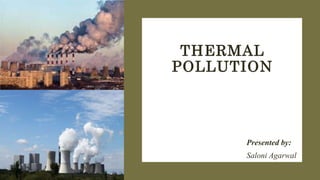

THERMAL
POLLUTION
Presented by:
Saloni Agarwal
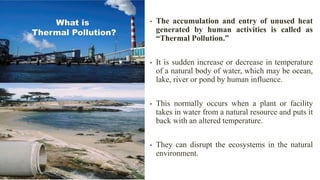
• The accumulation and entry of unused heat
generated by human activities is called as
“Thermal Pollution.”
• It is sudden increase or decrease in temperature
of a natural body of water, which may be ocean,
lake, river or pond by human influence.
• This normally occurs when a plant or facility
takes in water from a natural resource and puts it
back with an altered temperature.
• They can disrupt the ecosystems in the natural
environment.
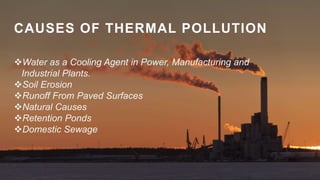
CAUSES OF THERMAL POLLUTION
Water as a Cooling Agent in Power, Manufacturing and
Industrial Plants.
Soil Erosion
Runoff From Paved Surfaces
Natural Causes
Retention Ponds
Domestic Sewage
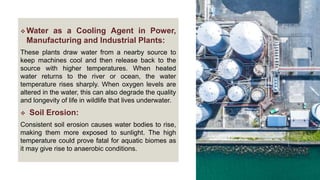
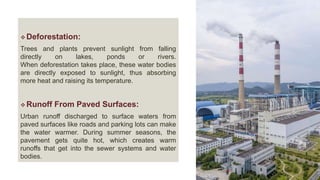
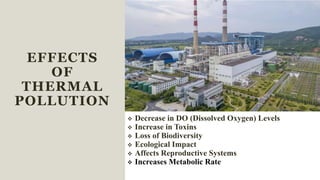
 Water as a Cooling Agent in Power,
Manufacturing and Industrial Plants:
These plants draw water from a nearby source to
keep machines cool and then release back to the
source with higher temperatures. When heated
water returns to the river or ocean, the water
temperature rises sharply. When oxygen levels are
altered in the water, this can also degrade the quality
and longevity of life in wildlife that lives underwater.
 Soil Erosion:
Consistent soil erosion causes water bodies to rise,
making them more exposed to sunlight. The high
temperature could prove fatal for aquatic biomes as
it may give rise to anaerobic conditions.
 Deforestation:
Trees and plants prevent sunlight from falling
directly on lakes, ponds or rivers.
When deforestation takes place, these water bodies
are directly exposed to sunlight, thus absorbing
more heat and raising its temperature.
 Runoff From Paved Surfaces:
Urban runoff discharged to surface waters from
paved surfaces like roads and parking lots can make
the water warmer. During summer seasons, the
pavement gets quite hot, which creates warm
runoffs that get into the sewer systems and water
bodies.
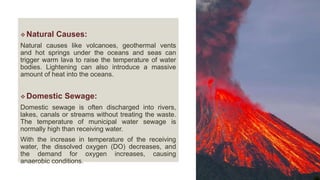
 Natural Causes:
Natural causes like volcanoes, geothermal vents
and hot springs under the oceans and seas can
trigger warm lava to raise the temperature of water
bodies. Lightening can also introduce a massive
amount of heat into the oceans.
 Domestic Sewage:
Domestic sewage is often discharged into rivers,
lakes, canals or streams without treating the waste.
The temperature of municipal water sewage is
normally high than receiving water.
With the increase in temperature of the receiving
water, the dissolved oxygen (DO) decreases, and
the demand for oxygen increases, causing
anaerobic conditions.
EFFECTS
OF
THERMAL
POLLUTION
 Decrease in DO (Dissolved Oxygen) Levels
 Increase in Toxins
 Loss of Biodiversity
 Ecological Impact
 Affects Reproductive Systems
 Increases Metabolic Rate
reases Metabolic Rate
 Decrease in DO (Dissolved Oxygen) Levels:
The warm temperature reduces the levels of DO (Dissolved Oxygen) in water.
The warm water holds relatively less oxygen than cold water. The decrease in
DO can create suffocation for plants and animals such as fish, amphibians
and copepods, which may give rise to anaerobic conditions.
Warmer water allows algae to flourish on the surface of the water, and over
the long term, growing algae can decrease oxygen levels in the water.
 Increase in Toxins:
With the constant flow of high-temperature discharge from industries, there is
a huge increase in toxins that are being regurgitated into the natural body of
water. These toxins may contain chemicals or radiation that may have a harsh
impact on the local ecology and make them susceptible to various diseases.
 Loss of Biodiversity:
A dent in the biological activity in the water may cause a significant loss of
biodiversity. Changes in the environment may cause certain species of
organisms to shift their base to some other place while there could be a
significant number of species that may shift in because of warmer waters.
 Ecological Impact:
• A sudden thermal shock can result in mass killings of fish, insects, plants
or amphibians. Hotter water may prove favorable for some species, while
it could be lethal for other species. Small water temperature increases the
level of activity, while higher temperature decreases the level of activity.
• Many aquatic species are sensitive to small temperature changes such as
one degree Celsius that can cause significant changes in organism
metabolism and other adverse cellular biology effects.
 Affects Reproductive Systems:
A significant halt in the reproduction of marine wildlife can happen due to
increasing temperatures as reproduction can happen within a certain range
of temperature. Excessive temperature can cause the release of immature
eggs or can prevent the normal development of certain eggs.
 Increases Metabolic Rate:
Thermal pollution increases the metabolic rate of organisms as increasing
enzyme activity occurs that causes organisms to consume more food than
what is normally required if their environment were not changed. It disrupts
the stability of the food chain and alters the balance of species composition.
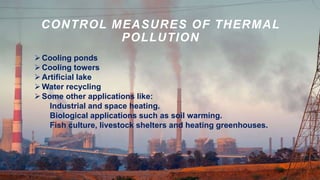
CONTROL MEASURES OF THERMAL
POLLUTION
Cooling ponds
Cooling towers
Artificial lake
Water recycling
Some other applications like:
Industrial and space heating.
Biological applications such as soil warming.
Fish culture, livestock shelters and heating greenhouses.
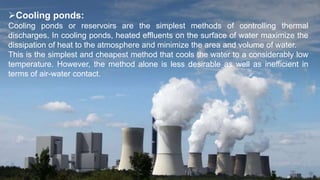
Cooling ponds:
Cooling ponds or reservoirs are the simplest methods of controlling thermal
discharges. In cooling ponds, heated effluents on the surface of water maximize the
dissipation of heat to the atmosphere and minimize the area and volume of water.
This is the simplest and cheapest method that cools the water to a considerably low
temperature. However, the method alone is less desirable as well as inefficient in
terms of air-water contact.
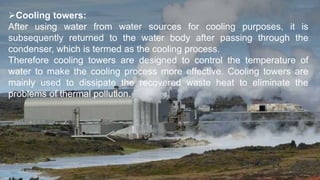
Cooling towers:
After using water from water sources for cooling purposes, it is
subsequently returned to the water body after passing through the
condenser, which is termed as the cooling process.
Therefore cooling towers are designed to control the temperature of
water to make the cooling process more effective. Cooling towers are
mainly used to dissipate the recovered waste heat to eliminate the
problems of thermal pollution.
Artificial lake:
Artificial lakes are man-made water bodies that offer a possible
alternative. The heated effluents may be discharged into the lake at
one end, and the water may be withdrawn from the other end for
cooling purposes. The heat is eventually dissipated through
evaporation. However, these lakes have to be rejuvenated continuously.
Water recycling:
Industrially treated water can be recycled for domestic use or industrial
heating that the problem of thermal pollution can be mitigated.
We learned how various industries and power
plants are discharging their waste heat and
effluents directly into the near water bodies
causing thermal pollution.
An increase in temperature can cause various
changes in the water bodies and affect the
aaquatic ecosystems.
There are many stricter rules in place but
industries are still following the conventional
methods.
Many people don't know what thermal
pollution is as they can not forsee any direct
effect on human beings.
In order to combat such issues, we need to be
aware of the cause and effect of thermal
pollution so that we are in a better position to
control it.
Thermal pollution

Thermal pollution

  • 1.
  • 2.
    • The accumulationand entry of unused heat generated by human activities is called as “Thermal Pollution.” • It is sudden increase or decrease in temperature of a natural body of water, which may be ocean, lake, river or pond by human influence. • This normally occurs when a plant or facility takes in water from a natural resource and puts it back with an altered temperature. • They can disrupt the ecosystems in the natural environment.
  • 3.
    CAUSES OF THERMALPOLLUTION Water as a Cooling Agent in Power, Manufacturing and Industrial Plants. Soil Erosion Runoff From Paved Surfaces Natural Causes Retention Ponds Domestic Sewage
  • 4.
     Water asa Cooling Agent in Power, Manufacturing and Industrial Plants: These plants draw water from a nearby source to keep machines cool and then release back to the source with higher temperatures. When heated water returns to the river or ocean, the water temperature rises sharply. When oxygen levels are altered in the water, this can also degrade the quality and longevity of life in wildlife that lives underwater.  Soil Erosion: Consistent soil erosion causes water bodies to rise, making them more exposed to sunlight. The high temperature could prove fatal for aquatic biomes as it may give rise to anaerobic conditions.
  • 5.
     Deforestation: Trees andplants prevent sunlight from falling directly on lakes, ponds or rivers. When deforestation takes place, these water bodies are directly exposed to sunlight, thus absorbing more heat and raising its temperature.  Runoff From Paved Surfaces: Urban runoff discharged to surface waters from paved surfaces like roads and parking lots can make the water warmer. During summer seasons, the pavement gets quite hot, which creates warm runoffs that get into the sewer systems and water bodies.
  • 6.
     Natural Causes: Naturalcauses like volcanoes, geothermal vents and hot springs under the oceans and seas can trigger warm lava to raise the temperature of water bodies. Lightening can also introduce a massive amount of heat into the oceans.  Domestic Sewage: Domestic sewage is often discharged into rivers, lakes, canals or streams without treating the waste. The temperature of municipal water sewage is normally high than receiving water. With the increase in temperature of the receiving water, the dissolved oxygen (DO) decreases, and the demand for oxygen increases, causing anaerobic conditions.
  • 7.
    EFFECTS OF THERMAL POLLUTION  Decrease inDO (Dissolved Oxygen) Levels  Increase in Toxins  Loss of Biodiversity  Ecological Impact  Affects Reproductive Systems  Increases Metabolic Rate reases Metabolic Rate
  • 8.
     Decrease inDO (Dissolved Oxygen) Levels: The warm temperature reduces the levels of DO (Dissolved Oxygen) in water. The warm water holds relatively less oxygen than cold water. The decrease in DO can create suffocation for plants and animals such as fish, amphibians and copepods, which may give rise to anaerobic conditions. Warmer water allows algae to flourish on the surface of the water, and over the long term, growing algae can decrease oxygen levels in the water.  Increase in Toxins: With the constant flow of high-temperature discharge from industries, there is a huge increase in toxins that are being regurgitated into the natural body of water. These toxins may contain chemicals or radiation that may have a harsh impact on the local ecology and make them susceptible to various diseases.
  • 9.
     Loss ofBiodiversity: A dent in the biological activity in the water may cause a significant loss of biodiversity. Changes in the environment may cause certain species of organisms to shift their base to some other place while there could be a significant number of species that may shift in because of warmer waters.  Ecological Impact: • A sudden thermal shock can result in mass killings of fish, insects, plants or amphibians. Hotter water may prove favorable for some species, while it could be lethal for other species. Small water temperature increases the level of activity, while higher temperature decreases the level of activity. • Many aquatic species are sensitive to small temperature changes such as one degree Celsius that can cause significant changes in organism metabolism and other adverse cellular biology effects.
  • 10.
     Affects ReproductiveSystems: A significant halt in the reproduction of marine wildlife can happen due to increasing temperatures as reproduction can happen within a certain range of temperature. Excessive temperature can cause the release of immature eggs or can prevent the normal development of certain eggs.  Increases Metabolic Rate: Thermal pollution increases the metabolic rate of organisms as increasing enzyme activity occurs that causes organisms to consume more food than what is normally required if their environment were not changed. It disrupts the stability of the food chain and alters the balance of species composition.
  • 11.
    CONTROL MEASURES OFTHERMAL POLLUTION Cooling ponds Cooling towers Artificial lake Water recycling Some other applications like: Industrial and space heating. Biological applications such as soil warming. Fish culture, livestock shelters and heating greenhouses.
  • 12.
    Cooling ponds: Cooling pondsor reservoirs are the simplest methods of controlling thermal discharges. In cooling ponds, heated effluents on the surface of water maximize the dissipation of heat to the atmosphere and minimize the area and volume of water. This is the simplest and cheapest method that cools the water to a considerably low temperature. However, the method alone is less desirable as well as inefficient in terms of air-water contact.
  • 13.
    Cooling towers: After usingwater from water sources for cooling purposes, it is subsequently returned to the water body after passing through the condenser, which is termed as the cooling process. Therefore cooling towers are designed to control the temperature of water to make the cooling process more effective. Cooling towers are mainly used to dissipate the recovered waste heat to eliminate the problems of thermal pollution.
  • 14.
    Artificial lake: Artificial lakesare man-made water bodies that offer a possible alternative. The heated effluents may be discharged into the lake at one end, and the water may be withdrawn from the other end for cooling purposes. The heat is eventually dissipated through evaporation. However, these lakes have to be rejuvenated continuously. Water recycling: Industrially treated water can be recycled for domestic use or industrial heating that the problem of thermal pollution can be mitigated.
  • 15.
    We learned howvarious industries and power plants are discharging their waste heat and effluents directly into the near water bodies causing thermal pollution. An increase in temperature can cause various changes in the water bodies and affect the aaquatic ecosystems. There are many stricter rules in place but industries are still following the conventional methods. Many people don't know what thermal pollution is as they can not forsee any direct effect on human beings. In order to combat such issues, we need to be aware of the cause and effect of thermal pollution so that we are in a better position to control it.